Canal Zone

02.13.08

T he story about boys throwing rocks at frogs—the boys throw in sport, but the frogs die in earnest—describes the difference between violence in a play and violence in a movie. The greater level of realism in a movie takes what might have been something fanciful and makes it brutal, even repulsive. As in David Mamet’s odd policiers and gangster films, In Bruges can never get the balance right between sport and earnestness.

The setting stands out in this off-putting, bloody-buddy pic. Director, writer and famed playwright Martin McDonagh celebrates the city of Bruges in Belgium. Though it’s supposed to be “undiscovered,” the joke has it that if it were anywhere else than a crap place like Belgium it would draw hoards. (Actually, it’s a tourist zoo already.)

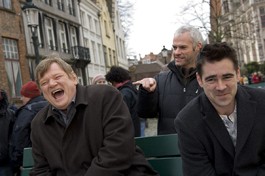
Two Irish Londoner gunmen (Brendan Gleeson, Colin Farrell) are on vacation from their last job, sent to Bruges until the heat’s off. Both of them are a bit uneasy. Their boss, presently a Charlie’s Angels &–like voice on the phone, isn’t the sort of man who does favors.

Being a hearty lout, Farrell’s Ray gazes upon Bruges, with its silver fogs and spires, and happily pronounces it “absolute rubbish.” Farrell knits his black kabuki eyebrows trying to figure out what anyone sees in it all, and then goes out to find several pints and a girl. The girl is Chloe (Clémence Poésy), a hanger-on drawn by a local film. As per the satire in Living in Oblivion , the scene being shot features a dwarf (Jordan Prentice) in a dream sequence. Killer, lady and dwarf spar wittily; Chloe turns out to have a secret or two of her own.

Brendan Gleeson’s Ken is the older, more experienced gangster. He sees what’s around him and is genuinely edified. He spends his rest periods flat on his back, reading a vintage paperback so old it has the price on it in shillings.

The two gunmen make a pretty good comedy team—a calm old silverback and a jittery baboon. As Ken is the tour guide of this operation, he hauls Ray to the Basilica of the Holy Blood. The two also observe the fat American tourists who’ll probably die on the way to the tower of the Belfort. On another journey, they stop at the Groeningemuseum, where both stop to look appalled at the seriously appalling 1498 Judgment of Cambyses by David. Ray thoughtfully describes this and the other paintings as “rubbish by spastics.” But he is stirred by Bosch’s Last Judgment , which gives his Catholic soul the willies. This is foreshadowing, as finally we see how very badly Ray’s job went wrong.

In a small part, Yuri (Eric Godon), the local illegal ordnance dealer, is a standout; we can take his darkness and danger seriously. McDonagh’s quips liven the film as much as the scenery does. But the handling of the violence seems like that line about jesting at scars if you never felt a wound. The clip used from Welles’ Touch of Evil says it all: a movie this eager to be an American actioner might have taken it easy on the Yank jokes. And a movie with aims this small ought not to make fun of a dwarf’s stature.

‘In Bruges’ plays at select North Bay theaters. See Movie Times, p36.


New and upcoming film releases.

Browse all movie reviews.

Wide open ‘Secret’

02.13.08

The Secret Eating Society, a group of design-savvy foodie hipsters, ended 2007 with a party at Sebastopol’s West County Grill and the publication of the “zero” issue of their magazine, The Secret Eating Society Quarterly Journal. The vibe was young and fun, with a let’s-roll-up-the-rug-and-throw-a-magazine purity that was irresistible.

Devoted to all things smart, yummy and sustainable, the SES hosts underground dinners in honor of such as our watersheds, the libido and even the lack of vision (one such meal found diners blindfolded throughout). They have indulged in the guaranteed-to-disappoint rite of foodie passage known as “roasting your own pig” (watching teeth drop vigorously from the animal’s skull is an extreme appetite supressant and apparently only islanders know how to cook the meat so that it matures under heat from a garish white). Nonplussed, SES members continue to offer such events as its Butchering for Amateurs class (they assure that they don’t lead a baby lamb in by a rope) and Speed M[eat]ing, which is like dating . . . but not.

They celebrate their journal’s first official release with a yowza party on Friday, Feb. 29, making a leap (year) forward from an organized collective of attractive and adventurous eaters to an organized collective of attractive and adventurous eaters with print power. Plan to be at Peter Lowell’s from 6pm to 8pm on Feb. 29. 7385 Healdsburg Ave., Sebastopol. $10. [ http://www.secreteatingsociety.com ]www.secreteatingsociety.com.

Quick dining snapshots by Bohemian staffers.

Winery news and reviews.

Food-related comings and goings, openings and closings, and other essays for those who love the kitchen and what it produces.

Recipes for food that you can actually make.

Godard’s Enigma

0

A new box set of four later Godard films shows that the French director still poses a riddle“The legendary ‘French New Wave’ director” helpfully says the cover of the new Jean-Luc Godard Box Set (three discs; $34.98; Lionsgate).

Oh, that Godard. Here are four beautiful films from 1982–93; each one as intractable as the Rock of Gibraltar. Hélas Pour Moi (Oh, Woe Is Me) is the title of the most recent effort (1993), but it could fit the entire collection. The disillusioned director, plagued by questions of the death of cinema and the death of God, arranges his figures for the best lighting and indulges his love for rhetoric and classical music.Passion (1982) is the glossiest film in the set. It counterpoints the oppressed workers in a small French town with the frustrations of a Polish film director (Jerzy Radziwilowicz)—himself just an ordered-around employee, distracted by news of the Solidarity movement in his native country. This director is immersed—or rather, enchained—in a breast-heavy but otherwise useless movie that seems to be one long tableau vivant. Godard knows well the swoon of the culture vulture when seeing masterworks by Goya and others restaged by girls who seem to have escaped the Folies Bergère. Outwitting that reaction is the essence of this movie’s wit.

The other Raoul Coutard–shot film in this collection is arguably the most rewarding: 1983’s Prénom: Carmen, a sexually explicit/postmodern/modern-dress restaging of the fatal coupling of a thieving harlot (a musky Maruschka Detmers) and a callow soldier, who are linked after a ridiculously aestheticized, comic yet cool bank robbery. Here are nods to different versions of the story, from Bizet to Otto Preminger; essential to the film is the idea of the word “perhaps” as the most sexually fraught word a woman can utter. Meanwhile, the cranky filmmaker Uncle Jean (Godard himself) malingers in a hospital, trying to keep his hands clean of the whole affair.Detective (1985) is something I should like to see a few more times before weighing in on it. At first view, it seemed unusually slack, unusually cryptic and mostly there to record Godard’s growing realization that home video might displace cinema. (Worse, the master cinematographer Raoul Coutard is missing in action.)Hélas Pour Moi is about God, who loves us and kills us. A vaguely Apollonian deity (Gerard Depardieu) descends on Earth to seduce a somewhat plain but faithful married woman. A demiurge? God himself? “Looking at the invisible is exhausting,” says a female commentator, and one can rely only on the visible here: the faces and shapes of women in doorways, windows and flare of light. Godard discovers new ways to display women (such as the contortionist serving a cup of coffee in Passion).

This collection—sometimes sublime, sometimes infuriating, sometimes enlightening, sometimes didactic—includes a 30-minute documentary, Jean-Luc Godard: A Riddle Wrapped in an Engima by Gidion Philips. The commentators do an agile job explaining the director’s methods, if not meaning. Who can? Richard von Busack

Pollution & Pupping

0

02.13.08

Two disparate but reliable harbingers of spring are the birth of new marine mammals on North Coast beaches and the slowly rising yellow haze of agricultural industry. Prompted by dry days and warming temperatures, unnecessary emissions are an issue even in the many rural enclaves of the North Bay. The Bay Area Air Quality Management District has one solution: throw money at it. Which is where the Carl Moyer Memorial Air Quality Standards Attainment Program comes in. With a $12 million endowment, the more familiarly known Carl Moyer Program gives money to those with diesel-driven trucks, marine vessels, construction vehicles, ag irrigation pumps and other outdoor engine owners to help them upgrade their equipment to cleaner 21st-century standards. Deadline to apply is April 4, and both public and private entities are encouraged to do so. For more details and to see if your filthy, diesel smog-machine fits the guidelines, go to the Air Resources Board website and search for Carl Moyer. [ http://www.arb.ca.gov ]www.arb.ca.gov.

Regarding those harbor seal pups —well, don’t. Unless you’re far enough away, that is, that you can’t make even eye contact with the animals and their moms. In the North Bay, harbor seal pupping is in progress primarily in the Bolinas Lagoon and Tomales Bay, and the National Oceanic Atmospheric Administration warns that if a seal reacts to your presence in any way, you’re already too close.

Many humans mistakenly assume that an unattended harbor seal pup is an abandoned harbor seal pup. Most often, the reality is that Mom is in the water getting her lunch. The presence of even the most concerned human hovering around the pup can prevent Mom from returning and nursing the baby, inadvertently causing pup deaths.

The best thing to do if you are concerned about a seemingly orphaned pup is to contact an onsite ranger or these authorities: the Marine Mammal Center (415.289.7325), Gulf of the Farallones National Marine Sanctuary (415.561.6622) or the Pt. Reyes National Seashore (415.464.5170).

Send your community alert, political notice, call for help or volunteer opportunity to us at bl***@******an.com.


Sailboat Mindset

02.13.08

According to designer and builder Ted Owens, author of Building with Awareness: The Construction of a Hybrid Home (New Society; $42), the number one design element for energy efficiency is the direction the house is facing and the placement of the windows. In a recent telephone interview, he tells me in minute detail exactly where each of the windows in his 800-square-foot straw-bale home are located, how big they are and how this affects the house’s ability to maintain an ideal temperature during all four of the year’s seasons. Once again, I am reminded how the truly green home seems to function as a living entity, soaking up sun, storing rainwater, maintaining ideal temperatures, filtering light at the appropriate times and in the appropriate amounts and storing heat in its walls.

Owens, who takes the reader step by step through his process in Building with Awareness, tells me that he sees the sailboat as being the ultimate example of small design. In the sailboat, every space is used, and the ultimate goal of the design is total self-sufficiency. Owens thinks of this as his “sailboat mindset,” and by the time I am done viewing a small portion of the five-hour-and-45-minute-long video that accompanies the text, I have jumped on board. The fact that the house is in New Mexico and I live in California does little to quell my desire to move in immediately. Of course, Owens is already living in the house, but this seems like an inconvenience that could surely be worked out. Couldn’t he just build himself another one and sell me his?

This is exactly the type of attitude that Owens seeks to dispel with his guidebook. His book is about self-empowerment, not dependency, though, to be honest, even after reading the book and watching the DVD, I probably wouldn’t be able to do much more than mix up some earth plaster, which seems to be the most doable task of the home’s construction. Then again, I don’t even own a hammer, and besides, building skills are not a prerequisite for enjoyment here. The goal of Owens’ video and book is to raise the bar on the how-to genre, and the end result is something both interesting and informative. Even though I have no money, property or skills to build my own straw bale, I now have an understanding of the process. I’ve learned about earth plasters, photovoltaic cells, passive solar heating and cooling, rubble trench foundations, rainwater cisterns, straw-bale walls and how to make my own adobe bricks—all while sitting on my couch.

Owens tells me that one of the goals of this project is to jump-start the learning curve by showing viewers and readers how the house was designed, why it was designed the way it is and to examine any problems that came up during the building process. Owens believes that the time for being a proactive green builder is now, not some time in the distant future. We have the materials and the knowledge to build responsibly, to think small, efficient and sustainable, and our plethora of excuses for why this is not possible must be shed immediately like a snake’s old constricting skin.

One of the most striking features of Owens’ house is its beauty. The design seems utterly perfect—the little lifted-up living area, the loft with the gorgeous window, the nooks carved into the walls, the irresistible texture of everything. This is part of the beauty of straw bale, Owens tells me, and of working with natural materials in general. They are more forgiving, and slight imperfections only add to the overall aesthetic. By building small, Owens says, by taking into consideration exactly how much space he needed and why, he was able to spend more of his money on the fine details. The end result is a house that cost less to build, costs less to maintain and to heat, and which, despite its compact size, one could easily imagine never wanting to leave.

Seventeen years ago, Owens was working in commercial film production, a field that did not satisfy his creative urge to help solve some of the world’s problems. He began to design the directions for building solar ovens out of boxes as a way to help people living in developing countries conserve their often sparse wood supplies. The box ovens would get up to 200 degrees, which demands a longer cooking time but saves on fuel. Building a hybrid home is not so different, I have concluded, than building an oven out of a box—both demand ingenuity, creativity and a willingness to utilize design in order to better ourselves and our surroundings.

For Owens, the straw-bale project has been both a continuation of his life’s work, as well as an experiment, a way of pushing himself to explore what it would actually take to build a hybrid home powered by the sun. Though I am closer to building an oven out of a box than I am to building a house, I feel confident that, should the opportunity arise, I will not go into it blindly. I will have an increased awareness for the importance of putting the longevity of the planet on equal footing with my desire for a place to call my own.

To order a copy of ‘Building with Awareness’ and for a wealth of information on green building, go to [ http://www.buildingwithawareness.com ]www.buildingwithawareness.com.


Haunted by Hills

0

02.13.08


I was born at sea level, and I am still just several feet above the sea. It’s not like I’ve never been anywhere, for my life has been full of ups and downs. Hills, I mean. I hunger for them, and the steeper the slope, the tastier. I helplessly crave hills. Living in San Francisco, my hunger is easily satisfied. I log about four vertical miles of climbing each week without going more than three miles from my front door.

As a connoisseur of all things that go up, I take a natural interest in other cyclists and their own relationship with hills. And though I haven’t met one yet, the idea of another rider stronger than I am troubles me deeply.

Thus, when it comes time again for all those Euro riders and that guy from Santa Rosa to come gaggling over from the prologue in Palo Alto, huffing and puffing and raising a fuss over their Tour of California, I just can’t help bristling my fur, especially when they get to talking about the climb over Trinity Road, that itty-bitty little hump north of Glen Ellen.

The newspapers will discuss, inevitably, how the cyclists destroyed the Santa Rosa-Sacramento stage, and how the pack of athletes started their ride to the capital by sailing over the “seemingly endless,” the “grueling,” the “vertical” Trinity Road.

Frankly, I can’t stand it.

So this year, amidst all the hoopla over the tour and that little grade that all the riders seem so afraid of, I decided to get out there, and even conduct a little science while I was at it. I wanted to see precisely how steep and formidable Trinity Road actually is and compare it to a few of the other Bay Area slopes I ride most days. My suspicion was that the feared hill is an easy one, highly overrated and not really very steep at all.

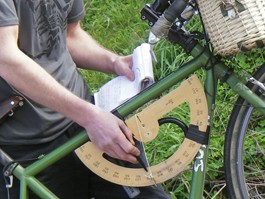
A responsible scientist, of course, never approaches an experiment bearing an agenda, prejudice or opinion—but I do. To verify my theory that Trinity Road is a sissy bump in the road, I mounted a large wooden protractor to the frame of my Surly Crosscheck and fixed a dangling plumb bob from the midpoint of the instrument. With this simple contraption, I would be able to take precise measurements of the slope beneath my wheels with hardly more than a glance.

Loading my wicker handlebar basket with basic bike tools, a notebook, aviator sunglasses, some organic dried figs and a North Coast Russian Imperial Stout, which I never ride without, I conducted my research expedition two Saturdays ago. I rideshared to Sonoma, then rode the seven miles north along Highway 12 to the intersection of Trinity Road, turned right and began my experiment.

The road impressed me. Indeed, it impressed with its gentle, easy grade, fit for any half-assed weekend rider wearing a pair of Spandex shorts.

“Why, 12th Avenue is steeper than this hill!” I exclaimed halfway up, referring to my own San Francisco street.

At two particularly steep slants, I hopped off the bike to take protractor readings. Neither exceeded 8.5 degrees—a mild 15 percent grade; in other words, 15 feet up for every 100 feet forward. I reached the top, the fire station at Cavedale Road, in about 21 minutes. The pros could have beaten that time by half, but they have several advantages: 14-pound bikes, no U-lock and no protractor or plumb bob. Their beer is in the support vehicle, as are their figs, notebook and bike tools.

Down the other side I went. It is steeper than the west slope, and I braked hard all the way down on the wet asphalt. I stopped in the forest on what was apparently the sharpest slope, and found it to be 10 degrees, a 17 percent grade. At the bottom, at the bridge over Dry Creek, I turned around and charged back up again. I feverishly wished for a team of semi-pros in Spandex, sucking on their corn-syrup, power-gel goop and staring down the world through their orange-tinted goggles to pass as they chugged weakly up the slope. After all, heaven hath no pleasure like sailing past a team of young urban professionals when your bike weighs 25 pounds and carries a wicker basket on the handlebars.

But the weather was poor, all the rich boys had stayed home and I was alone to entertain my fantasies. I reached the top in 16 minutes, and just like that my experiment was over, the great mountain conquered, the sky kissed. I’d been defrauded.

All my measurements were taken—they were unimpressive—there were no other cyclists to humiliate and I’d hardly broken a sweat. So I took my Surly on up Cavedale Road another few hundred vertical feet to drink my Imperial Stout on a log beneath a large oak. I savored the heavy oatmeal-and-toffee essence and absorbed the calories and the warmth of the alcohol. I descended to Highway 12 again and turned back and rode up to the fire station once more, wondering if perhaps last time I’d slept through the most slanted segment. But no: every foot of the way smelled of wimps, weekend riders, Subaru roof racks, blinding Genentech jerseys, energy bars and Gatorade.

Back in my apartment, I analyzed the data. West slope of Trinity Road: 3.2 miles with an estimated average grade of 5 degrees, or about 8 percent, equaling a climb of approximately 1,350 feet times two. The east slope: 2.5 miles from the beginning of the descent, with an estimated average grade of 7 degrees, or 12 percent, equaling a climb of approximately 1,000 feet. Cavedale to the summit: about two miles, nothing beyond 8 degrees by my protractor. Gain of 500 feet. For the day, 4,200 feet total gain over 10.9 miles of ascent. An average grade of 7.3 percent. Hmm.

The next day I scouted the Marin Headlands with my bike and instruments. I found several streets in residential Sausalito that reached over a 20 percent grade. The long ride up from Bridgeway to the peak of the Headlands overlook is 826 vertical feet, but in the course of 3.5 miles it boasts a mere 4.5 percent average slant. In San Francisco dwell the real monsters. There, I measured the steepest hills I could find. Seventeenth Street coming out of the Castro (not actually very steep, but a well-known yardstick): 17.5 percent; 14th Avenue between Quintara and Rivera: 21 percent; Dalewood Street on Mount Davidson: 25 percent; Duncan Street between Diamond and Douglass: 28.5 percent. And the most prohibitively steep slope I’ve ever gone up, the very southernmost block of Stanyan above Cole Valley? A staggering 33.5 percent.

Trinity Road was not half as steep. I could have ascended it drunk on one leg while sending a text message.

But what’s a hill even worth in the end? At the finish line of this meandering race that we call life, even the biggest mountain cancels out to zero, glory had and just as soon forgotten. At 29, I’m too old to be much of a cyclist anymore, though I often stay out riding and climbing until late in the day. Then, in the cool of the evening, after most of the other cyclists have returned home, I’m left alone with just the sound of the hilltop sirens calling me upward—and the hope that my chain won’t snap.

I know that somewhere out there is a regal 35 percent grade, and a road runs up it. Alongside are the footprints of the poor saps who had to push their bikes to the summit, and beside them are the treads of one Surly with a basket that bullies past them all. Though I will never get off to walk, I can still never reach the top.

I am haunted by hills.


First Bite

E ditor’s note: First Bite is a new concept in restaurant writing. This is not a go-three-times, try-everything-on-the-menu report; rather, this is a quick snapshot of a single experience.

This is really a two-bite review. I had to try it twice to fully appreciate the differences between the lunch and dinner experience. Let’s just say, with apologies to the cliché police, it’s like night and day. My lunch at Charizma was so wonderful, I hurried back to have dinner. I wish I could say it was as good.

The place sure looks lovely, with rich burgundy tones on the walls and the couches in the corner, a long curvaceous canoe suspended over the spacious dining room, lots of wood and stone accents, antiques, original artwork. It’s a wonderful combination of funky and elegant, a nice surprise on Guerneville’s Main Street. The choice of music is intriguing. The day we went, old jazz and Portuguese fados emerged from the speakers.

There are nine sandwiches ($6.50–$8.25) offered daily and include such enticing offerings as the Ab-Fab (tri-tip with melted pepper jack, mushrooms, sautéed onion and bell pepper, and peperoncini on a baguette) and the Swede (shrimp salad, hard-boiled egg, avocado and dill on rye). Charizma has salads ($6.00–$7.75), soups ($3.50–$5.50) and one hot plate per day ($8.50) For lunch, the ingredients were fresh and the service was quick and friendly. The owner Helena Giesea was very much in evidence, and we felt we were getting a good value for our money.

Then came night. Settling on couches by the window, we ordered glasses of wine ($6.50–$8 for large pours). During a long wait, which felt longer given the empty off-season, we were able to take in our surroundings: a great view of Guerneville’s nightlife through the storefront window and the big cursive “C” on the far wall. My daughter said the whole place seemed like it was written in cursive, and it does, if a little outside the lines.

We’d gone on a Tuesday, purportedly “game night.” How perfect, I thought: a way to engage the kiddies while sneaking in some adult conversation, snuggled under lap rugs. Our waitress, who was certainly sweet and personable, if inexperienced, produced the only game she could find: “Wineopoly.” Who knows, it might be totally fun for enophiles who know the percentage of Cabernet Franc in Bordeaux, but come on. Why have game night, if you have only one game?

The food also went a little awry. The New York steak with blue cheese, fried potatoes and roast tomato ($19) filled the dining room with its aroma while cooking, and was delectable—true to its promising smell. The mixed greens with brie, celery, grapes and toasted almonds served with a fig-honey vinaigrette ($15) was less so. The brie was ice cold from the fridge, the almonds untoasted, the dressing cloying and sweet. The hot chile wok chicken with garlic, vegetables and rice noodles ($16) was bland and one-dimensional. We did have a half-price dessert (actually, we had to remind our waitress of the special) a decent chewy mocha cake with vanilla ice cream ($7), which ended things on a sweeter note.

Charizma is a great lunch (and, I hear, breakfast) spot, but I so wanted to love the nighttime incarnation. Guerneville needs a nice, upscale yet affordable dinner choice. Charizma could become that, but it’s going to take some day classes to get their ascenders, descenders and loops just right.

Charizma Wine Lounge and Deli. Breakfast and lunch, daily; dinner, Thursday–Sunday. 16337 Main St., Guerneville. 707.869.0909.


View All

Quick-and-dirty dashes through North Bay restaurants. These aren’t your standard “bring five friends and order everything on the menu” dining reviews.

Power of the 113

0

02.13.08

A new research study completed at Sonoma State University shows how health and disability insurance companies are systematically cheating the American public.

Michael Moore’s top-grossing movie Sicko is but one example of the growing concern surrounding healthcare in the United States. The number of Americans without health insurance reached 47 million at last count, 16 percent of the population. The cost of health insurance is rising two to three times faster than inflation and is the number one cause of personal bankruptcy in the country. We pay more and get less medical care than the rest of the industrialized world. The total per capita healthcare cost in the United States exceeds the healthcare expense per person in all other full-care countries.

The Institute of Medicine estimates that as many as 18,000 Americans die prematurely each year because they do not have health insurance. This figure does not include those who die prematurely each year because their insurers delay, diminish or deny payment for promised benefits. Reports about people who die unnecessarily from services denied or delayed by insurance companies seldom receive broad coverage in the corporate media. Lack of media coverage has led to a nation of people uninformed about how national health and disability policies are controlled by the private insurance industry and how government regulators are powerless to do anything about it.

If industrialized countries around the world offer healthcare as a basic right, why is full healthcare not happening in the United States? Private insurance companies are motivated to make as much money as possible and do so by systematically delaying, diminishing and denying payment for promised services, and blaming individuals for their own misfortune.

On the boards of directors of the nine largest insurance companies are 113 people. These directors are some of the richest people in the world. They hold 150 past and/or present positions with major financial or investment institutions in the United States, including such major firms as JPMorgan, Citigroup, Lord Abbett, Bank of America and Merrill Lynch. Additionally, these board members have connections to some of the largest corporations in the world, including General Motors, IBM, Ford, Microsoft and Coca-Cola. The combined affiliations among these 113 health-insurance directors represented revenue of over $2.5 trillion in 2006.

As some of the richest, most powerful people in America, healthcare executives dominate health policy with their campaign donations and active lobbying efforts. They spend millions to keep themselves in the health-insurance delivery business despite overwhelming evidence that we would all be better off without them. They use these profits to propagandize the American public and influence voters through the scare tactic of invoking some Soviet-era form of “socialized medicine” and predicting long delays in service, supposedly a bane of single-payer systems.

The single-payer advocacy group, Physicians for a National Health Program, reports that private insurance corporations spend an enormous amount of money on business-oriented expenses rather than health-related investments. A 2003 study in the New England Journal of Medicine estimates that spending for administrative costs associated with healthcare amount to over $320 billion per year, or about 31 percent of healthcare costs in the United States overall. The administrative costs in the Canadian national healthcare system amount to 16.7 percent, or about half of the administrative overhead in the United States.

Countries with common pool or single payer healthcare systems provide similar levels of service to every person. In such countries, it is the responsibility of society as a whole to provide healthcare for each individual.

People in the United States have a choice. We can continue with a high-cost, profit-driven private-insurance healthcare system leaving millions to languish without care and millions more to face the frustrations of systematic delays, diminished care and denials of promised benefits. Alternatively, we can build a common pool healthcare system that provides necessary health care goods to everyone for less than what we are now paying.

Let’s find and support the politicians who will provide healthcare for all outside of corporate fat-cat control.

Peter Phillips is a professor of sociology at Sonoma State University and director of Project Censored. Bridget Thornton is a graduate student in the Interdisciplinary Studies. All statements above are fully documented in their new study “Practices in Health Care and Disability Insurance: Delay, Diminish Deny and Blame.” To learn more, go to www.projectcensored.org.

Open Mic is now a weekly feature in the Bohemian. We welcome your contribution. To have your topical essay of 700 words considered for publication, write op*****@******an.com.


Wine Tasting Room of the Week

0


W hile a gold medal is no guarantee that you’ll like the wine, a pavilion of 1,500 gold medal winners has got to have more appeal than a roomful of also-rans. At the San Francisco Chronicle Wine Competition tasting, all the top wines will be available for sampling at the public’s leisure at Ft. Mason on Saturday, Feb. 16. The nation’s largest wine competition held its judging last month in Cloverdale and benefits Santa Rosa Junior College’s culinary and viticulture programs. Expect many local notables, as well as winners of such exotic categories as “White Native American,” featuring the top Norton and Catawba wines from lands far east of the Sierras.

Meanwhile, if I can arbitrarily hand out tasting-room golds, this week goes to Dutton Estate. Not to be confused with Dutton-Goldfield down the road, Joe and Tracy Dutton run this winery with the help of winemaker Mat Gustafson. It’s fronted by a nicely refurbished 1930s stucco house just off Gravenstein Highway, and I must have passed it up on a hundred rainy days. One recent rainy day, I dropped in.

Lovely wines all around. The 2006 Kylie’s Cuvée Sauvignon Blanc ($17) has an aroma of jasmine and forward tropical flavors of mango and pineapple. Wow, I’m guessing that some proactive leaf management kept as much golden sun on these grapes as is possible in the cool Green Valley. The 2005 Dutton Palms Chardonnay ($42) has a noseful of Parmigiano-Reggiano, baked aromas of quiche and custard, and is mellow on the finish.

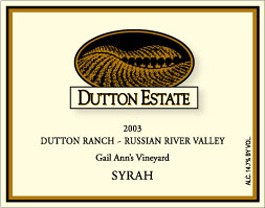
The strawberry-jammy 2006 Karmen Isabella Pinot Noir ($32) is not complex, but bright and tasty. Best of all are three Syrahs, their characteristics varying from red plum and grape steeped with tobacco leaf in the dry but smooth 2003 Three Blocks Syrah ($30), to cola nut and graham cracker with a silky mouth-feel in the 2003 Dutton Ranch Syrah ($30). Finally, the 2004 Gail Ann’s Syrah ($36) is all cherry and vanilla, opulent raspberry syrup and cherry notes. Dessert? The 2006 Sweet Sisters Late Harvest French Columbard ($18) starts out like fresh apple juice, matures to fermenting apples in the amber light of an autumn afternoon and then unforgettably suggests olive trees crying tears of honey.

Dutton Estate is a great spot for a visit, and for those who regularly hit the Gravenstein trail commute with a Jackson and change, it’s a can’t-go-wrong bet for a special dinner wine.

Dutton Estate and Sebastopol Vineyards, 8757 Green Valley Road at Highway 116, Sebastopol. Open 11am-5pm. Tasting fee $5. 707.829.9463. For details on the San Francisco Chronicle tasting, go to [ http://www.winejudging.com ]www.winejudging.com.


View All

Whirling Back-porch Punk

0

music & nightlife |

By Gabe Meline

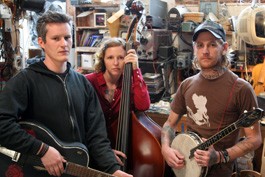
Success couldn’t be sweeter for the Devil Makes Three, a rough-edged bluegrass trio who specialize in selling the soul of country and ragtime music to the devils of punk rock and hard blues. A rare breed in a squeaky-clean, post–O Brother bluegrass world, the band nonetheless carries a hopeful, wide-angled wisdom that reflects the tumultuous world around them.

“I’ve never hopped a freight train, but I’ve definitely done a hell of a lot of traveling,” said 28-year-old frontman Pete Bernhard in a 2007 Bohemian interview. “I grew up in Vermont, and I drove across the country to California, then I moved to Nashville, then to Olympia . . .

You know, I just didn’t really know what the hell I was doing. I was driving around in circles, basically.”

Whatever he picked up along the way has certainly been propelling the band, which features the sturdy upright bass of Lucia Turino and the stunning banjo and guitar work of Cooper McBean, both also Vermont natives. And while the Devil Makes Three are fast becoming a well-known headliner at large clubs, the trio started out like any good band: playing cramped house parties, a tradition that came to an end when simply too many people began showing up. “It just sucked,” Bernhard said without too much regret in his voice. “A lot of people would come and break shit, and then the person who owned the house is pissed off at you, and you’re like, ‘I don’t know who these people are!'” The Devil Makes Three’s self-titled debut album, re-released on Milan Records last year, is a deft crosspollination of the austere and the animated. Bernhard’s always been into older music, from the time his brother bought him a Willie Dixon box set on Chess Records when he was 10 years old. “But a lot of the stuff that I write is political, and that definitely comes from punk,” he said. “Hopefully, the energy of our show emulates the feeling of a punk show—just high-energy and fun.”

The Devil Makes Three perform on Friday, Feb. 15, at the Phoenix Theater. 201 E. Washington St., Petaluma. 8pm. $15. 707.762.3565.


FIND A MUSIC REVIEW

Canal Zone

02.13.08T he story about boys throwing rocks at frogs—the boys throw in sport, but the frogs die in earnest—describes the difference between violence in a play and violence in a movie. The greater level of realism in a movie takes what might have been something fanciful and makes it brutal, even repulsive. As in David Mamet's odd policiers and...

Wide open ‘Secret’

02.13.08The Secret Eating Society, a group of design-savvy foodie hipsters, ended 2007 with a party at Sebastopol's West County Grill and the publication of the "zero" issue of their magazine, The Secret Eating Society Quarterly Journal. The vibe was young and fun, with a let's-roll-up-the-rug-and-throw-a-magazine purity that was irresistible.Devoted to all things smart, yummy and sustainable, the SES hosts...

Godard’s Enigma

A new box set of four later Godard films shows that the French director still poses a riddle"The legendary ‘French New Wave’ director" helpfully says the cover of the new Jean-Luc Godard Box Set (three discs; $34.98; Lionsgate).Oh, that Godard. Here are four beautiful films from 1982–93; each one as intractable as the Rock of Gibraltar. Hélas Pour Moi...

Pollution & Pupping

02.13.08Two disparate but reliable harbingers of spring are the birth of new marine mammals on North Coast beaches and the slowly rising yellow haze of agricultural industry. Prompted by dry days and warming temperatures, unnecessary emissions are an issue even in the many rural enclaves of the North Bay. The Bay Area Air Quality Management District has one solution:...

Sailboat Mindset

02.13.08 According to designer and builder Ted Owens, author of Building with Awareness: The Construction of a Hybrid Home (New Society; $42), the number one design element for energy efficiency is the direction the house is facing and the placement of the windows. In a recent telephone interview, he tells me in minute detail exactly where each of the...

Haunted by Hills

02.13.08I was born at sea level, and I am still just several feet above the sea. It's not like I've never been anywhere, for my life has been full of ups and downs. Hills, I mean. I hunger for them, and the steeper the slope, the tastier. I helplessly crave hills. Living in San Francisco, my hunger is easily...

First Bite

Power of the 113

02.13.08A new research study completed at Sonoma State University shows how health and disability insurance companies are systematically cheating the American public. Michael Moore's top-grossing movie Sicko is but one example of the growing concern surrounding healthcare in the United States. The number of Americans without health insurance reached 47 million at last count, 16 percent of...

Whirling Back-porch Punk

music & nightlife | By...
11,084FansLike
4,446FollowersFollow
6,928FollowersFollow