
Measure Q Verbiage
Leilani Clark was taken for a ride by whoever told her that a Sonoma County judge “threw out sections of the ballot argument against Measure Q, ruling that opposition statements contained false and misleading information” (“Riding that Train,” Oct. 8). I was in the courtroom, and that is not what happened. It is true that backers of Measure Q sued critics over one sentence in the No on Q argument, signed by Ernie Carpenter (Sebastopol), Dick Gaines (Windsor), Bill Bennett (Petaluma) and me. The sentence was retained (not “thrown out”), tweaked slightly with our consent, and appears in the Sonoma County Voters Information Pamphlet (“Rebuttal to Argument in Favor of Measure Q”) as follows: “NCRA freight trains and gravel mining, if facilitated by SMART, might damage the Eel River and its threatened salmon and steelhead.”
We have been called liars and worse for wanting to inform voters about Measure Q’s shortcomings—its outlandish expense, limited utility and detrimental consequences. Under the guise of reducing greenhouse gases and traffic congestion, Measure Q would actually fuel overdevelopment and environmental decline, while diverting huge sums of money from more workable transportation solutions. But don’t take my word for it. Please read the ballot arguments in your voter information pamphlet and make up your own mind about which side, blinded by wishful thinking, is taking you for a ride. Then vote no on Q.
Joan Vilms
Santa Rosa
Call it Art Country, Please
A big thanks to Gretchen Giles and the Bohemian for spotlighting ARTrails, the Arts Council and the new Artspace404 (“Hitting the ‘Trail,” Oct. 8). As a new Arts Council board member, I’m impressed by the number of programs and initiatives the council plans and executes year after year as the county’s champion and voice for the arts. Sonoma County’s wealth of creative talent, established and emerging, visual as well as performing, is still largely undiscovered, and your article not only helps raise the awareness of our art community, it helps us in our goal of making Sonoma County as well known for its arts as it is for food and wine.
Rob Akins
Forestville
Neanderthal slanderer!
Dear Tom Tomorrow: Well, you’ve done it again! Earlier in this presidential campaign, about 150 years ago, you published an edition of “This Modern World” that compared Republican presidential candidates to Neanderthals. The strip on Oct. 1 also repeats that same slander of Neanderthals, but this time you added insult to injury by comparing a certain Republican vice presidential candidate to, and I quote, “a deer caught in the headlights.” Now our doe-eyed friends are also caught in the cross-hairs of your invective.
A call to arms: Neanderthals and deer caught in headlights, unite against defamation!
Ken Ward
Guerneville
Contest: Jive Turkey
Our annual fall writing contest is here and once again, we’re playing a slight variation on Exquisite Corpse. We start a story (see below) and you finish it in 500 words or less. Each sentence is specially larded with details aimed at prompting smart, funny, poignant, scary, marvelous, wonderful, passionate, enthralling, ridiculous and clever tales from you. Deadline is Friday, Nov. 14, at 5pm. We’ll publish the five we love the most on Nov. 26. Submissions should be sent to ja******@******an.com; attachments are fine. Regular post is also welcomed: Jive Turkey, Bohemian, 847 Fifth St., Santa Rosa, CA 95404. No phone calls, OK?
Jive Turkey
The turkey hit the floor with a wet thud. Three year’s worth of dust settled ashily down around it. Unperturbed, Hector and Nanette continued to tango poorly, inhibited by the many packing cases around them. Breaking briefly, Nanette took a small sip of her pisco sour, leaving a lipstick ring that caught Hector’s attention. Guests were due in hours, but Hector was sanguine. After all, Nanette was sure to . . .
What was Nanette sure to do? What’s with all that dust? If you’re going to tango, shouldn’t you do it well? What the hell is this, a Somerset Maugham short story? Packing cases!? Is there some metaphor to be wrought from a pisco sour? Lipstick, friend or foe? These questions and more are yours to answer as you best see fit when you play Jive Turkey with us!
&–&–>
Whiskyfest

An air of high sophistication filled the ballroom of the San Francisco Marriott on Friday, Oct. 10, as my brother-in-law and I bumbled about among echelons of society we had only read about in books by F. Scott Fitzgerald. Women wore pearly necklaces and dresses that reached the floor. Men with scarves about their necks looked somber until a passing busboy dropped a plate of chèvre and incited a sincere laugh. But this was not an anthropological fieldtrip; this was the second annual San Francisco Whiskyfest.
We decided to sample the oldest whiskeys in the house, which seemed a gentlemanly approach. We began at Duncan Taylor, where the suited rep was serving industry standard quarter-ounce pours of four whiskeys between 16 and 37 years of age. The 21-year-old bore a portlike aroma and, at 127 proof, seared the mouth. Tears streamed from our eyes, we choked, coughed and reeled, we clutched at the curtains to keep our balance, and we knew, surely, that this was excellent stuff.
I elbowed for a space at the table of Highland Park and managed a sample of the 12-year-old, then the 30-year stuff. A rube such as I who is firmly adjusted to softer spirits expects an 18-year difference in the age of two beverages to be brilliant and jolting. Alas, the thirty-something was merely a degree richer and a shade darker, more like a 20-year-old.
Much to our rapture, beer was served in the ballroom’s southwest corner. There is a mantra I recall from college: “Liquor before beer, never fear,” though my brother-in-law swore it was “Beer after liquor, never sicker.” We took a gamble, and at the table of Quebec’s Unibroue downed glass after glass of cool, soothing brew.
Quick dining snapshots by Bohemian staffers.
Winery news and reviews.
Food-related comings and goings, openings and closings, and other essays for those who love the kitchen and what it produces.
Recipes for food that you can actually make.
For Love of Jazz
10.15.08
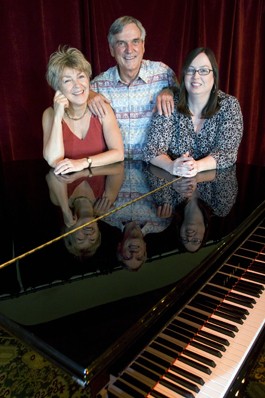
COLLABORATIVE EFFORTS: Susan Frye, Vic Conforti and Linda King are among the many who make it happen.
By Patricia Lynn Henley
A soft motion ripples across the audience as heads bob and feet tap in time with the sweet and sensuous music. It’s a warm September evening, the last in a summer series of free monthly jazz concerts in Sonoma Plaza’s outdoor amphitheater.
Late arrivals lug picnic baskets and search for a spot to roost. The wide wooden benches filling the amphitheater are full, as is the surrounding low concrete retaining wall. Volunteers pass donation baskets, gathering in the cash needed to keep the music going. It’s just one more successful evening for the Sonoma Valley Jazz Society (SVJS).
“We want to connect people with jazz,” explains society president Janice King. “I mean, I love blues and classical, but there’s something about jazz. It’s multilayered.”
King remembers when she first encountered the Sonoma Valley Jazz Society. A mother who also worked full time, she wasn’t able to get out of the small town of Sonoma often to hear good music. And she wanted to get involved in her local community, but wasn’t sure how to find the time. Then she stumbled across one of the summer concerts.
“It was a nice summer night. There was the farmers market, and the jazz was playing. I thought, this is heaven. It doesn’t get much better than this.”
The society was formed 19 years ago by a group of locals who didn’t want to have to drive out of town to hear really great jazz. One of the founders, Norm Anderson, passed away last year. Another, David Watson, moved to Hawaii. But in its own laid-back fashion, the jazz society continues to ensure that indigenous American music will be played locally.
“It’s so low-key that it just kind of grows organically,” says Michael J. Kelley, a local music promoter and sound engineer. “The right kind of people find out about it, and they bring people from all over the world—it’s truly world jazz.”
Past headliners include Omar Sosa and his Afreecanos band, as well as the Honolulu Jazz Quartet. In addition to the four free Summer Plaza concerts, there’s a Meet the Musicians series, where jazz pros both perform and talk about their musical careers. Plus, the society co-sponsors an annual jazz camp, with middle and high school students coached by experienced musicians.
The society also helps book jazz musicians on Friday and Saturday nights in the lounge at the Lodge at Sonoma. King handles that in conjunction with society board member-jazz vocalist Dana Land. Musicians love playing in the lounge, Land says. “It’s a listening venue,” Land explains.
SVJS first vice president Vic Conforti has loved jazz since he was 12. His brother’s a musician, and Conforti, whose holds a day job as an architect, plays chromatic harmonica and the drums. “I love jazz and I love to share it with people,” he says of his long-term commitment to the society.
The group’s annual operating budget of about $12,000 is raised by collection baskets at the free concerts, $40–$70 memberships and $200 annual sponsorships by local businesses and individuals. About a dozen core volunteers keep everything going.
Society cofounders Bev Prevost, Rocco Leucero and Wanda MacAleese stay involved to varying degrees. In addition to King, Land and Conforti, society board members include Susan Frye, Lina Perals, Sylvia Kelly, Diane Rawicz, Ann Hollister, David Aguilar, Ted Bell and Bonnie Thomas.
They call themselves “the little jazz society that could.” King likes making announcements at the summer concerts because it gives her a chance to look out over the diverse audience.
“It’s so great that we can bring this little bit of pleasure into their lives and just add to the whole community. I know people say it’s become a tradition with them, the jazz concerts in the park. They’ve been coming for years and years.”
He’s Already Gone
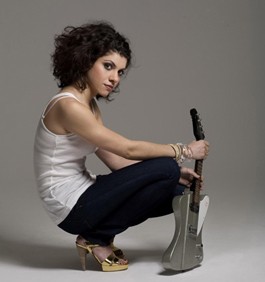
Since we last spoke in 2006, Carrie Rodriguez has pretty much been on tour. Other than a couple of months in the studio recording her latest album, She Ain’t Me, the road-tested Rodriguez and her band have crisscrossed the country several times. On the cusp of yet another tour that visits Healdsburg’s Raven Theater on Oct. 16, she enjoys a rare day off in her adopted hometown of Brooklyn, N.Y., fielding phone calls and explaining how she grew into the performer she is today.
“My mom was an opera buff,” she says. “My dad—he’s a musician—he turned me on to the Texas singer-songwriter folk scene.” But the Austin youngster kept to the beat of the maestro rather than the mandolin; even in the hotbed of Americana music, Rodriguez took up classical violin when her divorced mom enrolled her in the Suzuki Method music classes.
While attending the Oberlin Conservatory of Music, Rodriguez had a revelation, thanks to old family friend Lyle Lovett. “That was a real turning point for me,” she says. “Lyle knew my dad; they came from the same scene in Houston. Lyle later recorded one of my dad’s songs on his Step Inside This House album. He knew I was at school up there and invited me to his show in Cleveland. He actually told me to bring my violin to the sound check. I think he just wanted to check me out. I sucked so bad. I was still into classical and didn’t know how to accompany a song.”
This got Rodriguez to thinking that she wanted to learn, so she left Ohio and transferred to the Berklee College of Music. “Lyle came through Boston the next year,” she relates, “and did the same thing, told me to bring my fiddle to the show. I’m sure I was nervous—it was at the Orpheum Theatre in front of a few thousand people—but it was just such a sweet moment. Not only was I onstage with Lyle, but we were playing my dad’s song that he wrote for my mother when they got married. It was special.”
After returning to Austin, Rodriguez started playing with a local band when she was approached by legendary songwriter Chip Taylor at South by Southwest. “The whole thing made me a little uncomfortable,” she recalls. “He asked me if I sang harmony, and I had never done that. He was real easygoing about it, he put a microphone in front of me one night.” A duo was born.
She Ain’t Me is Rodriguez’s second release as a solo artist, but after the Taylor-heavy Seven Angels on a Bicycle, she considers it “my first solo record. It’s more autobiographical. I wrote most of it. I love songwriting; it’s an important outlet for me. It’s fresh and new. But I know that after working with Chip, I’m pretty green.”
“I guess it was fate that I met him,” Rodriguez says of her long association with Taylor. “It’s allowed me to do things I never thought of doing.”
Carrie Rodriguez performs Thursday, Oct. 16, at the Raven Theater, 115 North St., Healdsburg. 8pm. $20&–$30. 707.433.6335.
Dead Days
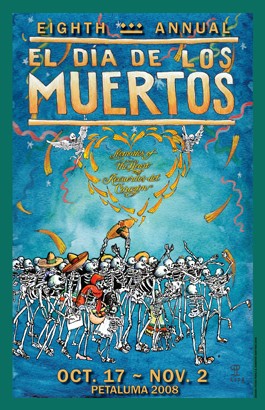
CULTURAL STRUCTURE:Peter Perez’s joyful skeletons enliven Petaluma’s annual celebration.
By Hallie O’Donnell
The skeletons move across the terrain in jubilation, their bones rigidly and delicately interlocked. Humerus, ulna and radius stretch toward the heavens. Sombreros sit atop their craniums. It is as if they feel the call back to the temporal realm, and are beckoned to return in spirit form.
This imagery lives inside the latest poster for Petaluma’s annual El Dia de los Muertos celebration, reminding us that the dead can still be given animation via the colorful celebration of their memories.
The skull, which is the most anatomically recognizable symbol in the Day of the Dead, acts as a harbinger of the inevitable and a concrete experiential reminder of our biological, intellectual and spiritual blueprint as a species, and why we need to fulfill the duty of paying homage to just being alive.
Marjorie Helm, who is a cofounder of Petaluma’s Dia de Los Muertos celebration, running Oct. 17–Nov.2, talks enthusiastically about it being an instrument to help build bridges between the Anglo and Latino communities. To mourn and to do it with a sense of celebratory gusto and a sense of humor not often present in the death rites of Western Europe and the United States is what makes this event unique. This year, there will be 70 altars at 64 venues around the city, and three community altars where anyone can bring a photograph of a loved one who has passed and make offerings. The community altar, Helm says, is a place where people share anecdotes, thus acting as a therapeutic outlet for the participants.
Peter Perez, now 69, is the man behind the posters created each year, and acts as the event’s founding artist. He is currently curating the ancillary Dia de los Muertos exhibit housed in Petaluma’s new Art Center, displaying altars created from artists around the Bay Area.
Perez has had an illustrious career as a graphic designer, when he started doing artwork in the early 1960s, landing him first in Manhattan and then in Boston. He remembers a time many years ago when a friend’s mother told him that with the gift he had he would “draw his way out of poverty.” He internalized this and promptly left his job doing computer work at a gas company so he could go to art school and run with his dreams.
Serendipity was also a factor when Helm and Perez met, becoming friendly at a dog park, of all places, in 2000. They decided to join collaborative forces, and along with other Day of the Dead cofounder Abraham Solar, brought the idea to the city of Petaluma, and a new event was born.
Every year for the past eight, the celebration has built momentum. The celebration seems to fully embrace the idea that in order to really live, death must be accepted and given its fair dose of comic relief, acknowledging that absurdity is part and parcel of our mortal precipice.
Death and life walk hand in hand for Perez. Alluding to the altars, he says, “It’s beautiful to see how people honor their departed. There are all the traditional elements, and each one is uniquely different and special. They have the mementos and the things that person enjoyed in life and would like to maybe come back and enjoy for an evening.
“The Latino culture,” he adds warmly, “has way more acceptance of death. We will all get a chance at it.”
Petaluma’s El Dia de los Muertos celebration runs Oct. 17–Nov. 2. Maps of altar locations are available at the Petaluma Art Center, the Petaluma Library, the Historical Museum and downtown stores. The opening event is slated for Sunday, Oct. 19, from 1pm to 4pm at the St. Vincent de Paul Church Square. The celebration ends Nov. 2 with a candlelit procession, mariachis and big puppets in downtown. There are events almost every day. Petaluma Art Center, 230 Lakeville St., Petaluma. For more details, go to www.petalumaartscouncil.org.
Museums and gallery notes.
Reviews of new book releases.
Reviews and previews of new plays, operas and symphony performances.
Reviews and previews of new dance performances and events.
1-4-2 Go!
10.15.08
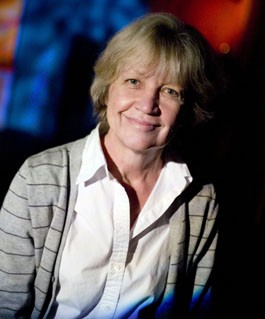
COMEDY TONIHGHT! 142’s Lucy Mercer is particularly proud of her venue’s opportunity for comics.
By David Templeton
The mission statement posted on the website for Mill Valley’s 142 Throckmorton Theatre pretty much says it all. “142 Thockmorton is founded on the philosophy that theatre, music, dance, film, poetry, visual and related arts are essential components of a rich and rewarding life, and an indispensable part of human inspiration and education.”
Couldn’t have said it better ourselves, and 142 Throckmorton has been awarded a 2008 Boho Award precisely because of its commitment to the belief that the arts can be a force of good and a unifying influence within a community. Gorgeously refurbished, the 90-year-old site was originally a live theater, but for decades functioned as the Mill Valley Oddfellows Hall. Crumbling from the ground up and in serious need of repair, the building seemed destined for eventual demolition. Now it’s a vibrant, eccentrically decorated hub of artistic activity, the reach of which extends far beyond Mill Valley.
“I’d never run a theater before in my life,” says Lucy Mercer, owner and artistic director, “but I’ve always loved old buildings, and when I realized I could buy and restore this beautiful old place, I decided that the best thing for the community was not another office building but a place where local people and artists can come together and do wonderful, important, surprising things.”
It can truly be said that there is no place in the North Bay quite like 142 Throckmorton, with daily happenings that run the gamut from theatrical productions, staged readings of new plays, rock band concerts, chamber music performances, lectures, forums and comedy nights. Comedy, in fact, is where 142 Throckmorton has made its biggest and loudest mark. Every Tuesday night is the Mark Pitta and Friends comedy showcase, a popular weekly event in which local comedians, hosted by comic Mark Pitta, take the stage to work on new material, be it standup routines, one-person shows or stage plays.
“There aren’t any places in Marin where comics have regular performance opportunities,” Mercer says. “I’m especially proud of the place we’ve created here for comedians. On Tuesdays, the green room is full of young up-and-coming comedians, hanging out and swapping stories with more experienced comics. It’s really wonderful.”
Under Mercer’s direction, the theater is also a major supporter of local nonprofits. Next week (Sunday, Oct. 26, at 6pm), a major fundraiser to fight breast cancer is featured. Called The Breast of Broadway, the musical revue will feature Broadway tunes from across the years, with local performers including Susan Zelinsky, Rana Kangas-Kent, Erika Alstrom, Erik Batz, Chaz Simonds and others.
Mercer’s support of artists and performers goes beyond what she programs onstage. Over the last several months, she’s given extra office space to a handful of painters and sculptors, converting the rooms to studios.
“My hope has always been that this building would be a focus of activity all the time,” Mercer says. In addition to the nightly performances, the institution, which is a certified nonprofit, also offers the thriving New Playwrights Lab, a resident orchestra called the Left Coast Chamber Ensemble and has recently launched the Marin Youth Performers with classes and regular performances of musicals and plays by young people. “A community needs its artists,” Mercer says, “as much as it needs policemen and firefighters.”
Time for Treatment?

10.15.08
LONELIEST NUMBER: It costs some $46,000 to keep a nonviolent drug offender in prison for a year.
Dubbed the Nonviolent Offender Rehabilitation Act (NORA), Proposition 5 asks voters whether they want to reduce California’s ever-increasing prison population by expanding existing drug and alcohol treatment programs.
It’s a decision about whether to continue with a “lock ’em all up” philosophy or follow the trend begun in 2000 when voters approved new treatment and rehabilitation efforts under Proposition 36.
Prop. 5 will take that approach a step further, expanding the types of offenders eligible for diversion into treatment programs and financing those services by taking $460 million a year off the top of the state’s general fund. It will also revamp the parole system, giving credit for participation in a treatment program; lighten the charge for possessing less than 28.5 grams of marijuana from a misdemeanor to an infraction (like a traffic ticket); fund additional treatment programs for teens considered at risk of committing future drug crimes; and provide inmates with rehabilitation programs at least 90 days before they’re released from prison.
Reactions to NORA fall along somewhat predictable lines. Law enforcement groups warn that it will give career criminals a “get out of jail free” card while creating chaos in the correctional system. A few of the folks opposing NORA include Mothers Against Drunk Driving, the California District Attorneys Association, the California State Sheriffs’ Association, the California State Association of Counties, the California Chamber of Commerce and actor Martin Sheen.
Defense attorneys and professionals in the rehab community say that NORA will safely reduce prison overcrowding by providing nonviolent offenders and parolees with much-needed treatment and rehab services under close supervision. Among those supporting the proposition are the California Association of Addiction Recovery Resources, the California Federation of Teachers, the League of Women Voters of California, the California Nurses Association and former San Quentin warden Jeanne Woodford.
Prop. 5 is poorly written and would be difficult if not impossible to adjust, charges Kevin Spillane, a spokesman for People Against the Proposition 5 Deception.
“The initiative enables criminals who have committed other crimes to avoid prosecution and go into a drug treatment program. The intent is to enable a wide array of criminals to escape prosecution,” Spillane asserts. “This is a back-door attempt to legalize drugs.”
That’s not true, counters Margaret Dooley-Sammuli of the NORA Campaign: Yes on 5. “It certainly isn’t a veiled attempt to legalize drugs,” she says with a laugh. “All of these attacks we’re hearing now in the Proposition 5 campaign we heard in 2000 when Proposition 36 was on the ballot.”
In seven years of implementation, she notes, Prop. 36 allowed 36,000 people a year to enter treatment, more than half of them for the first time.
“What we find is that intervention in the courtroom is extremely successful,” Dooley-Sammuli says.
While opponents argue that Prop. 5 limits judges’ ability to decide who gets diverted into treatment, Dooley-Sammuli contends it actually gives judges more discretion than they have under Prop. 36.
“It’s the judge’s decision if what’s motivating a nonviolent crime is addiction and it gives the judge the option that what’s needed to break that cycle of crime is treatment. It also gives the judge the option to jail them first. Proposition 5 is untying their hands to be more solution-oriented.”
California operates 33 state prisons and related facilities, with a total adult inmate population of 171,000. In the 2008–’09 budget, annual operating costs for the California Department of Corrections and Rehabilitation is approximately $10 million. The cost to keep an inmate in jail for one year averages $46,000.
The state legislative analyst estimates that Prop. 5 could cost more than $1 billion annually for expanded treatment program, that it could also save more than $1 billion annually through reduced prison and parole costs, and that there could be an unknown cost to county and local governments.
Prop. 5 takes $460 billion off the top of the state general fund without any guarantee that it’s going to be successful, says Sonoma County Assistant District Attorney Diana Gomez.
“The financial impacts are unknown,” she says. “The legislative analyst’s office has no real way to determine if it’s going to save billions or cost billions.”
But NORA supporters point out that although opponents object to earmarking $460 million of the general fund for rehab, many of those same law enforcement groups support Proposition 6, which would take $965 million out of the state general fund for law enforcement efforts and to build more prisons. Prop. 5 supporters say it’s time to change how the state spends its money.
“People don’t like Proposition 5, because it takes money off the top of the California general fund,” acknowledges Michael Spielman, executive director of the Drug Abuse Alternatives Center. “But that money right now is going into prisons, so why not put some of that money into treatment?”
Three categories of treatment are created under NORA. Offenders charged with nonviolent drug possession offenses who have no current or prior violent convictions would go in Track I, and judges would have the option of allowing offenders charged with non–drug related offenses to participate in this category. Track II would expand the programs now operating under Prop. 36, and Track III would be based on current Drug Court programs.
If someone fails in Track I, they can try again in Track II and yet again in Track III. Opponents of NORA criticize this as too lenient, but Spielman says it simply reflects the reality that most addicts don’t succeed the first time the go through rehab.
“If you believe that addiction is a chronic relapsing disease and you look at the success rates for treatment of addiction, they range from 40 to 60 percent. That’s the same rate you see in diabetes, hypertension and other chronic lapsing diseases.”
Prop. 5, Spielman says, is based on that reality and gives addicts additional chances to make treatment work for them.
He adds, “We’re talking about people who by and large are not violent. They’re in prison because of drug-related offenses.”
California’s initiative process can be frustrating, because unlike bills that go through the legislature, ballot measures have to be approved or rejected as they’re written. There’s no process for changes or amendments.
“Proposition 5 isn’t perfect, but it will go a long way” toward making things better, Spielman says. The opponents of Prop. 5 criticize it, but don’t offer an alternative.
“All the studies show that treatment works, so you’re giving people a chance at treatment instead of incarceration.”
The North Bay Bohemian recommends voting yes on Prop. 5.
Plenty of Tongue
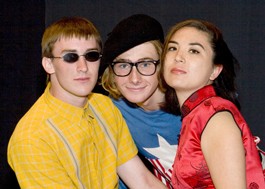
H ere’s a secret that few critics would dare utter in public: A play doesn’t have to be good to be great. Some of the most uneven productions in Sonoma County history have still yielded satisfying pleasures, and laugh for laugh, some of the best times had in a theater have been provided by shows rife with problems. In this spirit I report that the Raven Players’ recently opened production of Larry Shue’s 1984 farce The Foreigner is one of the most unevenly acted shows of 2008—and also very likely the funniest.
With performances ranging from uh-oh-not-so-great to wow-where-has-this-person-been-hiding, the play is a mish-mash of colliding skill sets and outrageously bad accents, but under the direction of Alan Kaplan, it all somehow works, and works well.
Set in a rustic hunting lodge in deep Georgia, the 1984 comedy begins with the arrival of two Englishmen, the boisterous military man Froggy LeSueur (Audie Foote, with an accent the runs the gamut from bad Australian to scandalous Scottish) and the unspeakably shy Charlie Baker (an outrageously spot-on Eric Thompson).
So fearful of strangers is Charlie that Froggy, in the area on some sort of military maneuvers and eager to leave his friend in the care of the lodge’s larger-than-life innkeeper Betty (Mo McElroy, channeling Vicky Lawrence from Mama’s Family ), explains that Charlie is a foreigner, and understands no English whatsoever. As a result, Charlie—who initially is glad not to have to interact with the lodge’s various visitors and residents—soon becomes the holder of some very big secrets, since everyone feels comfortable spilling their beans in front of him.
The biggest laughs in The Foreigner spring from Charlie’s attempts to convince everyone that he really does speak a different language, one that he has to improvise from scratch whenever anyone walks in on him having a conversation with Froggy. One of the funniest moments in the show comes when Charlie is encouraged to tell a story from his homeland. What Thompson does with this moment should win him some sort of award, and praise should go to director Kaplan for staging it so well.
The comedy is broad, the motivations are not subtle, and in this production, the underlying subtexts that could have rooted the story in some believable emotion are almost completely ignored, but what emerges is still a drop-dead, laugh-till-you-cry, hold-your-sides-to-keep-them-from-hurting triumph of goofiness over finesse. This Foreigner is a welcome visitor.
The Foreigner runs Friday&–Saturday through Oct. 26, with one Thursday-night performance on Oct. 24. The Raven Performing Arts Theatre, 115 North St., Healdsburg. $13&–$21. www. ravenplayers.org/tickets.
Museums and gallery notes.
Reviews of new book releases.
Reviews and previews of new plays, operas and symphony performances.
Reviews and previews of new dance performances and events.
Infinite Scenarios
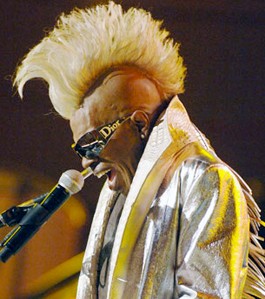
No matter what happens at Sly Stone’s concert at the Wells Fargo Center this Friday night, I can guarantee you one thing, backed by the full faith and credit of the longtime concertgoer: You’re gonna see something.
Sly Stone, the man with the most glaring ratio of pure talent to sheer undependability, the man responsible for an incredible library of outstanding albums who fell off a drug-addled career into veritable thin air all those years ago—that man has not performed a full concert on his Bay Area home turf for over 30 years. He crawls out from under his self-imposed rock to stage a grand return in Santa Rosa on Oct. 17.
Despite Stone’s unreliable reputation, tickets for the show have sold well, mostly to people who already know exactly what I’m about to tell you once again: You’re gonna see something. Go, go, go. He’s so completely bonkers-ass weird and unpredictable that there’s an infinite number of possible scenarios for this show. Here are just 10:
1. Sly Stone could come out 45 minutes late, vamp a 15-minute coda for “Thank You (Falettinme Be Mice Elf Agin),” climb off the stage to do some pushups in the aisles and then walk out of the theater to go swear at cars on the freeway.
2. Sly Stone could sit backstage, refusing to go on until he’s been paid twice his guarantee, then eat a $100 bill, preen his Mohawk, strip down to a G-string and recite the evening news while his band plays instrumental versions of “Family Affair” and “Fresh.”
3. Sly Stone could show up wearing an aluminum foil mask and cape and set up a giant trampoline in the lobby, forcing his band to play “Sing a Simple Song” while posing for his personal videographer, who’ll hang from the chandelier and refer to Stone exclusively as “Zeke Superfly Wahlberg Miyagi.”
4. Sly Stone could order everybody out of the theater five minutes before curtain, demand that the stage be filled with plates of London broil and vats of low-fat yogurt, climb onto a 10-foot throne, order everybody back inside and fling the food at their heads while singing “Everyday People.”
5. Sly Stone could drive around Santa Rosa beforehand, pick up a street hooker, pay a minister in the theater $10,000 to marry them onstage, claim that they’ll name their first daughter “Larkfield,” rip shreds from his newlywed’s dress and feed them to his pit bull, sing a few lines of “Everybody Is a Star” and drive up to Covelo to start a new life.
6. Sly Stone could clear out an entire aisle of seats, set up a steel-cage “globe of death” with Argentinean motorcyclists revving around it in drag, initiate a mass release of disabled pigeons from the ceiling, smoke a gigantic cigar upside down on a tricycle and mutter, “I Want to Take You Higher” while showing a documentary on the mating habits of Iranian frogs.
7. Sly Stone could stay backstage the entire night, addressing the crowd over the PA system about the real perpetrators behind 9-11, the hidden subliminal messages in Kung Fu Panda, the aliens from planet Zyroax that landed at his house last week, the Moonie colonization of inner Earth, the secret mind-controlling ingredients in Weetabix, the reasons Mel Gibson will be our next president and the duty we have as Americans to go to work naked covered in glossy nail polish every other Tuesday.
8. Sly Stone could bake himself into a cinnamon dough and roll out onto the stage with a saxophone sticking out of his nose that plays the first three notes of “Hot Fun in the Summertime” every time he sneezes because he’ll have an entire meadow of ragweed and anise planted around the stage with hired munchkins doing cartwheels in time to drunken macaws who knock their heads against each other while large machines shoot shredded ravioli up to the far reaches of the balcony.
9. Sly Stone could sit in a large, red upholstered couch, shove heaping spoonfuls of peanut butter in his mouth and recite garbled lines of “Dance to the Music,” while two teenage girls dressed up like tigers at his side drink that new God-awful Budweiser & Clamato crap out of a KFC bucket as Mylar ribbons poisoned with PCP fall from the ceiling onto the crowd, sending them away tripping so hard that they, too, actually buy some Budweiser & Clamato from the Quik Stop on the way home and drink it in one strong chug, believing it to be the sacred blood of Sly Stone, revelator and son of God.
10. Sly Stone could come out onstage, play a decent 90-minute set, say “Thank you,” and leave the stage.
Nah. Won’t happen.
Sly Stone performs Friday, Oct. 17, at the Wells Fargo Center, 50 Mark West Springs Road, Santa Rosa. 8pm. $18&–$83. 707.546.3600.
Race in the Race
Watching Barack Obama in a recent debate, so handsome and tall in a narrow-cut suit with a skinny tie, leaning artfully on a stool in the Town Hall setting, many of us may have entirely forgotten that he is black. In such a setting, calmly laying out the facts of his campaign and making reasonable sustained promises to the American people, his race doesn’t matter at all. Or does it? Many feminists angry over Hillary Clinton’s defeat have suggested that Americans are even more misogynist than they are racist. We can “forgive” Obama for being of color, but never forgive Clinton for being a woman.
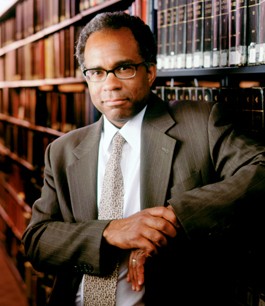
Writing last month in the Washington Post, Harvard law professor Randall Kennedy quietly prepares his fellow African Americans for the worst. Obama may not win. And if he doesn’t, what does that mean to the millions of black voters who have never before seen one of their own get so far in public office? Kennedy appears at SSU on Oct. 21.
As the first African American to be seriously considered a contender for the presidency—and as of this writing, the polls show him to be 10 points ahead—Obama has more riding on his shoulders than just a mandate to win. He has the hopes and aspirations of most African-American citizens riding there, too. And that’s why, Kennedy argues, many are already aiming low. “My mother will be sorry if Obama loses, but she won’t feel disillusioned, because she hasn’t allowed herself to get her hopes up,” he writes in the Post. “She has insisted throughout that ‘the white folks are going to refuse one way or another to permit Obama to become president.’ That she says this is remarkable, given the success of her three children, all of whom attended Princeton and became attorneys (one is a federal judge). Still, even though she has seen many racial barriers fall, she’s simply unwilling to make herself vulnerable to dejection by investing herself fully in the Obama phenomenon.”
Author of such controversial works as Nigger: The Strange Career of a Troublesome Word and 2004’s Sellout: The Politics of Racial Betrayal, Kennedy admits that he cried when Obama won the Democratic nomination on the 45th anniversary of Dr. King’s “I Have a Dream” speech. But that doesn’t mean that he’s not ready to concede that perhaps African Americans will have to be content with just getting so far, even if the winning is not achievable. An impossible dream? Only three weeks until we find out.
Hear Randall Kennedy discuss race in America, the n-word, the concept of the “sellout” in black culture and indeed, dear good Mr. Obama himself when Kennedy appears on Tuesday, Oct. 21, at the Cooperage. Sonoma State University, 1801 E. Cotati Ave., Rohnert Park. 7:30pm. $10 general; SSU, free. 707.664.2382.
Museums and gallery notes.
Reviews of new book releases.
Reviews and previews of new plays, operas and symphony performances.
Reviews and previews of new dance performances and events.
Letters to the Editor
Whiskyfest
For Love of Jazz
He’s Already Gone
1-4-2 Go!
Time for Treatment?
Plenty of Tongue
Infinite Scenarios
Race in the Race



FOLLOW US
Copyright © Weeklys All rights reserved.
Our Publications
