Food For All?

0

12.03.08

Sonoma County food pantries this year have been deluged withrequests from those in need, even while donations are down, reportsthe Redwood Empire Food Bank (REFB), making this year’s annual fooddrive more important than ever.

According to a recent report released by the Department ofAgriculture, 700,000 children went hungry in the United States atsome point in 2007, up more than 50 percent from 2006. Thosenumbers have hit close to home, with demand for food increasingexponentially at a local level over the past few months. “We’restretched,” says David Goodman, executive director of the REFB, thelargest food bank between San Francisco and Oregon. “We can’t servethe pantries that operate in every community of the county unlesseveryone pitches in.”

In Santa Rosa, the FISH pantry (Friends in Service Here) hasseen increases from 3,500 requests for help per month to over 5,200in the last two years, says FISH’s Ron Shirley. It’s not just theeconomic downturn, says Shirley; rising food costs play their partas well. “Pasta is up. Rice is up through the ceiling. Cereal isup,” he says. “A box of cereal that weighs a pound costs $4. That’sridiculous. People just can’t afford to buy what they used to.”

Steve Bousshard, a volunteer at Neighbors Organized AgainstHunger in Rohnert Park, notes that their demand has skyrocketed.”We were serving 160 to 180 families every week last year,” hesays. “Now we’re serving from 240 to 280 families—and theseare families with two, three, four and five members.”

At the Sebastopol Inter-Church pantry recently, demand was sohigh that volunteers had to stop answering the phone to fillorders. At St. Philip’s Church in Occidental, requests for helpamong single men nearly doubled between August and September. It’snot just Sonoma County that’s hurting, either; the REFB works withover a hundred similar agencies, providing food to pantries inLake, Humboldt, Mendocino and Del Norte counties.

Luckily, there are numerous ways for people to help. Donationsof nonperishable foods are accepted in REFB barrels locatedthroughout the county at schools, stores and businesses, mostnotably at supermarkets like G&G, Lucky, Whole Foods andSafeway, and other stores such as Friedman’s Home Improvement andLongs Drugs. Canned or packaged food only—no homemade food orglass containers.

Cash donations are always accepted, either online atwww.refb.org or by sending a check to REFB, 3320 Industrial Drive,Santa Rosa, CA, 95403. Those wanting to make a donation by phone,or to otherwise get involved by volunteering in the warehouse orstarting a food drive in their area, can call 707.523.7900.

to theeditor about this story.


Domaine Carneros

0

H onoring last New Year’s resolution, Swirl ‘n’ Spit has logged 11 months without making reference to the fascinating story of how a long-deracinated word was returned to its rightful homeland and replaced in California with “sparkling wine.” As for the reason why, at the same time, merchants from France’s Champagne region may insert replica châteaux into California appellations, sans ironie , well, that’s easy. Because everybody loves a great big château, that’s why.

Domaine Carneros was founded by Champagne house Taittinger in 1987, and its 350 rolling acres of vineyards were certified organic in 2007. Its architecture was lifted from Taittinger’s Château de la Marquetterie, and strategically plunked down on the Carneros Highway. It’s hard to imagine any wine country tourist driving by this and saying, “Honey, look at that lovely château. I’ll bet it’s stocked to the rafters with top-notch Champagne, but let’s just skip it this time, OK?”

Luckily for us, this grand house welcomes the unwashed to enjoy the quaff of kings, seven days a week. For a little privacy, the Balcony Package ($250) is billed as an “impressive way to pop the question, celebrate an anniversary,” or just hang out and burn some cash. We came strictly for the hanging out, which is more economically enjoyed on the ground floor.

Every last table was taken as we entered the tasting room, but I have a knack for that. Promptly, an attentive manager approached to put us on the waiting list; we had only begun killing time in the gift shop when he tracked us down. After politely shoving off another party that was already hungrily vulturing our table by the toasty fireplace (I was too busy suppressing any visible satisfaction with this arrangement to feel bad for them), he sent out a woman who poured our sparkling and answered our questions with chatty congeniality. If this is not some kind of fluke, and I don’t think it is, then the floor is exceptionally well-run at this busy destination winery.

Roasted almonds come with the territory. The menu includes artisan cheese plates to pair with sparkling or red wine, respectively, and there’s also smoked salmon and caviar. Our sparkling cheese plate ($14) was piled generously with wedges of Bellwether Carmody, French brie, goat cheese and dried fruit. The sparkling wine sampler ($15) included the 2005 Brut Vintage ($26); sharp apple-pear notes finished with appealing tangy-lemon custard flavor. I enjoyed the “luxury cuvée” Le Rêve Blanc de Blancs ($85) for its bouquet of hoary yeast, cashew butter and ripe linens that, in the best way, marks a fine sparkling for me. Tiny bubbles carried away the well-melded flavors of pear and crème brûlée, which then just slipped away like a dream.

Domaine Carneros, 1240 Duhig Road (at Highway 12/121), Napa. Wine flights $15; also available by the glass or bottle. Open 10am–5:45pm. 800.716.2788.


View All

Life’s  Not Fair

0

12.03.08

Kanye West is known more for his lack of impulse control than for his work. From award-show tantrums and impassioned telethon declarations (“George Bush doesn’t care about black people”) to paparazzi scuffles to his recent proclamation that he’s the voice of his generation, the audacious rapper-producer stands alone in terms of sheer gall. But his outbursts, described by one journalist as performance art, wouldn’t matter if not for his impressive catalogue, supplemented by his newest release 808s & Heartbreak, where West finally leaves his boastful, aggressive comfort zone.

It was only four years ago that West revitalized hip-hop with his landmark debut The College Dropout. Uncommonly armed with his real name, autobiographical stories and catchy sped-up soul samples, the Chicagoan extended “conscious” hip-hop to the “self” and crossed demographics like no other since The Miseducation of Lauryn Hill. Hip-hop fans wanting more than bling-bling or bang-bang relished a thoughtful new voice amid a sea of clones.

But 2007 ended the era where the quality of West’s work outshone his public childishness. Graduation, the culmination of his college-motif trilogy, showed West as a burned-out student, his familiar samples, elementary MC skills and personal contradictions more tedious than revelatory. His headlines took a sad turn with the breakup of his longtime girlfriend and the death of his mother, the subject of 2005’s touching tribute “Hey Mama.”

It’s no surprise, then, that 808s & Heartbreak intersects West’s work and personal life like never before. Throughout the aptly titled album, whose cover shows a deflated balloon heart, the rapper presents vulnerable diary entries full of grief and bitterness. Musically, the record described by West as “minimal but functional” draws on the entire history of electronic music, from new wave and trip-hop to industrial and his hometown’s own Chicago house.

“Say You Will” opens the album with a slow trip-hop beat, computer blips and a distant choir, evoking Depeche Mode or Massive Attack. West sounds downright obsessed. “Hey, hey, hey, hey,” he sings robotically through Auto-Tune (the “vocoder effect,” which he uses on every track), “don’t say you will, unless you will.” A startling two-minute-plus instrumental coda leads into “Welcome to Heartbreak,” which is full of regrets. “My friend showed me pictures of my kids,” West tells us, “and all I could show him was pictures of my cribs.”

But most songs decry his victimization by an unnamed woman, most notably in the new single “Heartless,” whose syncopated synth jabs make it the most immediately pleasing track on the album. This grows incredibly tiresome by the time you get to West’s surveillance complaint “RoboCop,” whose soaring chorus is more Killers than U2. Faring better is “Street Lights,” whose circular piano and guitar chimes help West finally achieve empathy though the audio veil. “I know my destination, but I’m just not there,” he croons on the record’s strongest melody. “Life’s just not fair,” he repeats to end the song, “life’s just not fair.”

What’s understandable is West’s near-avoidance of his mother, whose sole mention appears in brief finale “Coldest Winter.” “Goodbye my friend / Will I never love again,” he painfully sings to his mom, whose passing is barely a year old. Most poignant is his understated couplet, “It’s four a.m. and I can’t sleep / Her love is all that I can see.”

Though certainly a bold move, 808s is monotonous after the initial shock wears off. Most detrimental is West’s lackluster vocals, not so much in their meager range but in their relative stagnation within it. Coupled with weak melodies, Kid A&–like lyrical repetitions become droning instead of entrancing. Young Jeezy’s guest spot on “Amazing” is a welcome diversion, as is flinty-voiced Lil’ Wayne, whose own enthralling Auto-Tuned vocals save the eerie kiss-off of “See You in My Nightmares.”


While the constant vocoder effect is anything but innovative after T-Pain and recent tracks by Snoop Dogg and R. Kelly, West’s exorcising of demons with a method forever identified with funky party jams is inventive. And his decision, or compulsion, to so enshroud his most vulnerable words is the album’s most fascinating aspect. Artistically, it’s relieving to find his sense of exploration intact, even if this particular collection is hit-or-miss. On a personal level, here’s hoping Kanye West soon finds his peace.


I Got Mine

12.03.08

I happened across my old pal Pete Bingo whilewaiting to cash a check the other day. The line stretched aroundthe building and down the block. Could be this was because the bankhad been seized by the Feds earlier that very morning.

Finally, I was within spitting distance of the front door, andhere comes Pete. Sighting me, he waddles up like he owns the place.I’d been in line for the better part of an hour, but Peteimmediately used our conversation to buttinski just ahead ofme.

Pete Bingo calls himself both a “primordial-ooze free marketeer”and the world’s greatest salesman. But he pays the rent working forhis granddaughter as a hired gumshoe in the City.

I’ve never known Pete to say a bad word against the system,particularly when it comes to the system formerly known as freemarket capitalism, or its recently liquidated manifestation,deregulated finance capitalism. But boy-oh-boy does he rail againstsocialism, claiming its every form is pure distilled evil, thoughthe depth of his reference to it seems to be “all those goddamnedwelfare bums.”

Pete’s been financially challenged for as long as I’ve known himand is anything but a young bull, but being an eternal optimist, hestill expects to become enormously wealthy through hisentrepreneurial endeavors, and according to him, “the sooner, thebetter.”

So in light of recent massive financial disasters, missteps,bailouts, giveaways, criminal activities and secretive billions intaxpayer monies smuggled off to an unholy and undisclosed array of”free market” enterprises, I figured I’d have a little fun withhim. But first our handshake.

“How’s things, Pete?”

“Like always, makin’ history—no money. Still fightin’ thewar on poverty.”

“So, Pete,” and I dug right into him, “I hear Treasury justdropped untold billions on Citigroup. Last week we played SantaClaus to a bunch of unnamed banks. Before that it was Fannie,Freddy, Bear Stearns, AIG, Indy Mac and we don’t even know whoelse. How’re you feeling about socialism now that our money’s goingto bail out rich welfare bums, instead of feeding and shelteringthe poor ones?”

“Damned Democrats.”

“But Pete, Bush himself demanded the bailout money, and besides,legislation couldn’t have passed muster without Republicansupport.”

“Yeah, but my boys had a gun to their head.”

“Well, don’t think for a minute that progressives backed theplan. The fact that it passed just shows the reach of the corporateworld into the pants of both parties. Anyway, now that capitalism’sdead and the corporatocracy has us footing the bill for theirmistakes, how do you figure you’ll come out of this?”

“Smelling like a rose, that’s how I’m coming out of it . . . and. . . you, madam!”

Pete had turned from me, gearing himself into sales mode,tipping the rim of his pith helmet, smiling widely at awell-dressed elderly woman shambling our way. “That’s onefine-looking walker you have there, old girl. Perhaps I couldinterest you in an equally fashionable plastic-press magnetic sign.It’s the perfect complement, custom-made by talented machinists inexotic China. Just attach one to the front of your walker andyou’ll be surprised at . . .”

The woman glared back at Pete as though he were a uniquely vileform of vermin.

“Of course, if you already have sufficient signage, then you’llwant to protect your investment with a Dead Devil Alarm.” Sensingwhy the old woman was scowling so, Pete shifted tack, hoping toclose the deal. “Yeah, I don’t like any of that cheap crap made inChina, either. Now, this here Dead Devil Alarm, though, it’s madein the good ol’ American Marianas by workers my good friend’Truthful’ Tom DeLay says are as happy and well-paid as clams onthe half-shell. Now, allow me to present you with one of mybusiness cards. The name’s Pete Bingo. I’m the exclusive dealer . ..”

But the woman and her walker kept shuffling right on past us, soPete shrugged, sighed and shoved his business card back into hissafari jacket. He rubbed his medicine-ball belly, turning hisattention back my way, smacking his lips before saying, “I’mgetting a taste for a little something to eat. After we rob thebank, how ’bout you and me go out for a bite—on you?”

“I’m due back at work, but if you’re short on lunch money, whydon’t you grab some from your good buddy, Hank Paulson?”

“Yeah, well, I tried that.”

“Pete, pardon me for saying this, but here we are on the vergeof the next Great Depression, and you don’t seem to appreciate thatthis free market economic system you’ve worshipped your entirelifetime has collapsed before our very eyes.”

“Like I always say, GTM—’get the money.'”

“What the hell is that supposed to mean?”

“There’s never a shortage of money-making opportunities amidstdisaster.”

I admit it, Pete hit the nail on head. Our nation has suffered18 economic recessions since 1797, including the Great Depression.Historical statistics indicate we’ve muddled through economicdownturns more than one in every three years—and yet the J.P. Morgan–types seem to come out of each one fat, happy,wealthier and more powerful than ever. That said, people like Peteand me typically emerge from periods of financial malaise minusshirts, shoes, shorts or worse.

 I just had to ask Pete, “How’d you like to finally see alittle industry oversight now that we’re paying for all thesefat-cat mistakes?”

“I don’t want nobody telling me what I can sell for how much towhoever.”

“But isn’t capitalism at its heart and soul all about takingfull responsibility for one’s own actions? You know, making profitfor your successes and paying the price when things don’t go sowell?”

“Well, yessss. I would say yes. That is, I wouldsay yes—but I’m not that much of a liar.” Suddenly Petenoticed yet another acquaintance standing third from the head ofthe line. “You’ll excuse me,” he said, “I see a friendly pigeonneeds plucking.” And he was off to the races.

 Open Mic is now a weekly feature in the Bohemian. Wewelcome your contribution. To have your topical essay of 700 wordsconsidered for publication, write [ mailto:op*****@******an.com” data-original-string=”/x3IHQUITl/23hyk9Q3lUg==06a0p8XCwvaew/j/ZxVxlARneRDg9LgHvrJ85ARybWGJ8A14YCqlrwE2met9nKdu2xaXduyw+fyEWklZITWrZKt50/cu/d/8LY+eDDXEkzLuHzq8NXZDZtQ6faYJOconkHoJkMY0aFiDNIRLjThlvKduw==” title=”This contact has been encoded by Anti-Spam by CleanTalk. Click to decode. To finish the decoding make sure that JavaScript is enabled in your browser.]op*****@******an.com.


to theeditor about this story.


Home Truths

12.03.08

Biopics are notorious for bleaching a director’s style; they turn every moviemaker into Taylor Hackford. One of the many surprises of Milk is that it is thoroughly a Gus Van Sant film. The use of negative space, the concentration on quiet moments of people chafing in their own skin, could only be the director who had been working on so many experimental films—some of them exasperating, yes.

The boldness is seen early on. Not very long into the movie, Van Sant tells the fate of Harvey Milk through a real TV news clip of Dianne Feinstein on Nov. 27, 1978. Milk follows 10 key years in the history of the gay liberation movement, giving all the visuals needed to make you realize what an astounding journey it was.  

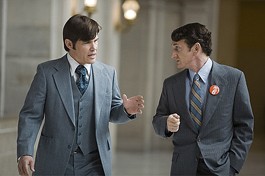
Milk‘s intelligence shows at the beginning of the end of the film, a bull and matador scene where Josh Brolin’s drunken Dan White confronts Sean Penn’s Harvey Milk at a party at City Hall. Both men are two small figures in the corner of a large chamber. White is almost violent, but he’s also almost ridiculous. He seems so lost that it might be possible to enlighten him, to tell him that gay liberation wasn’t going to be the end of the world. You can see why Harvey Milk risked it, trying to appeal to White’s tolerance.

In this telling, Harvey Milk began as just another furtive gay guy on the IRT, picking up one Scott (James Franco) on a staircase, leaning against him against the white tiles of an off-screen subway station. This is the evening Milk turns 40, and he’s a little too old for this pickup. But he has a good way with words and manages to convince Scott to come home with him.

The two run away to San Francisco in the early 1970s. There Milk starts a camera shop on Castro Street. Some of the locals hate the new arrivals. The police harass and beat the homosexuals whenever they get a chance. After organizing the neighborhood, Milk takes up local politics. Running for state assembly and then supervisor, Milk bypasses the Democratic machine at first. District elections give him a power base and finally a chance to become a national hero: the first openly gay city politician.

The backlash comes fast. The former beauty queen Anita Bryant leads a campaign against a gay rights ordinance in Miami. This Palin of her time flaunts the old fear, claiming children will be recruited to a deviant lifestyle. Thus Milk’s standard speech opening: “My name is Harvey Milk, and I’m here to recruit you.”

Milk’s regular opponent on the Board of Supervisors, Dan White, is probably the most hated figure San Francisco ever produced. Yet Van Sant is a big enough artist to see things from White’s side. Brolin has done some startlingly good acting over the last couple of years. He hasn’t surpassed this creation, though. Milk perplexes White to the extreme; the gay man tries to be friendly, but he can’t resist teasing this solitary, strange ex-cop, a beefy Irishman in a mortician’s black suit. Milk thinks White is a closet case. Fortunately, that’s too simple an explanation for Van Sant and Brolin. In this sensational bit of supporting acting, Brolin makes otherness, discomfort and mysterious shame seem fascinating.

A film this timely is rare. Usually, movies lag, coming a year and a half after whatever public mood came and went. We can accept Milk‘s message of hope because we’ve lived to see the uselessness of Dan White’s last-ditch attempt to stop history. Penn plays Milk as a cordial, suave and funny man, but with a habit of secrecy; this hero is a man who is fun to watch. That’s the last thing you expect from a martyr’s biopic.

And rather than a sense of hopeless loss, Milk leaves you with a sense that progress can win, beginning as it does with documentary footage of police raids on gay bars, and ending with a river of candlelight rolling down Market Street from the foot of Twin Peaks to City Hall.

  ‘Milk’ opens on Friday, Dec. 5, at the Rialto Cinemas Lakeside, 551 Summerfield Road, Santa Rosa. 707.525.4840


New and upcoming film releases.

Browse all movie reviews.

Broken Truths

12.03.08

By Bart Schneider

Terry Tempest Williams knows the earth and writes about it with native intimacy, no matter the setting or continent. It is her first love. For four generations, the men in her family have worked in the Tempest Company, a pipeline construction business in Utah and the Southwest. As her brothers learned to use shovels to dig intricate pathways for laying pipe, she says that her tool of choice became the pen, with which she learned to write about the earth.

One of our most important environmental writers, Williams makes two North Bay appearances this weekend, to read and discuss her new book Finding Beauty in a Broken World (Pantheon; $26). Williams’ landmark 1991 book, Refuge: an Unnatural History of Family and Place, tells the story of her mother’s battle with ovarian cancer and the demise of Utah’s Bear River Migratory Bird Refuge. The book’s epilogue considers the likelihood that living downwind from the above-ground nuclear testing conducted by the U.S. Atomic Energy Commission in the 1950s and early ’60s was responsible for the high incidence of cancer in her family.

“I belong to a clan of One-Breasted Women,” Williams writes. “My mother, my grandmothers and six aunts have all had mastectomies. Seven are dead. The two who survive have just completed rounds of chemotherapy and radiation.”

In Finding Beauty, Williams leads the reader to three distinct geographies: Ravenna, the Italian city near the Adriatic, famed for it mosaics, where the author learns the rudimentary skills of that ancient craft; Bryce Canyon, in her native Utah, where she works with scientists to observe the daily habits of the endangered prairie dog; and, finally, Rwanda, where she witnesses the aftermath of the 1994 genocide and helps build a memorial to the victims.

In Ravenna, Williams apprentices in a mosaic workshop. “You can learn this technique in 15 minutes,” her teacher tells her, “it will take you a lifetime to master it.” The mosaic provides the metaphor and suggests the shape for Williams’ book. “A mosaic,” she tells us, “is a conversation between what is broken.” And the narrative unfolds in hundreds of short, discrete sections that together form a cohesive whole.

In the middle section of her book, Williams defends the lowly and endangered prairie dog, the scourge of ranchers and golfers in the Southwest, in what may be the most impassioned writing about these creatures and their towns since Willa Cather wrote about them in My Ántonia.

But the emotional heart of this book is in Rwanda. Williams spends a dedicated and deeply draining month with a small team hoping to construct a memorial in this country devastated by genocide in 1994. She is above all else a brave witness to the aftermath of these atrocities.

Led by a Chinese visionary artist named Lily Yeh, the team travels through a number of villages, meets with numerous officials, provides art supplies and inspires groups of children and elders to paint village houses in patterns derived from drawings made by the children. “Beauty,” the author tells us, “is not a luxury but a strategy for survival.”

Williams sketches deft, appreciative portraits of her companions and the Rwandans she encounters, but presents herself in the most humble manner. What she witnesses makes her ill. She often feels helpless and frightened. But her chronicle of post-genocide Rwanda is one of the most important pieces of testimony we have. Williams celebrates her translator, Louis, without whom she’d be helpless.

“Words,” she writes, “are our tools for understanding and misunderstanding. Words can ignite and incite, kill and cull, and at the same time, words can create bridges between cruelty and compassion. A chain of words becomes a history: Neighbors. Hutu. Tutsi. Colonialism. Identity. Power. Resentment. Propaganda. A plan. A purpose. A genocide.”

Williams appears in a benefit reading from Finding Beauty in a Broken World on Sunday, Dec. 7, at Toby’s Feed Barn in Point Reyes Station. The event, hosted by Point Reyes Books, is a fundraiser for West Marin Review, the nonprofit literary and art journal, whose gorgeous keeper of a first issue was published last spring. 4pm. $15. 415.663.1542. Williams also reads from her new book on Saturday, Dec. 6, at Copperfield’s Books, 2316 Montgomery Drive, Santa Rosa. 7pm. Free. 707.578.1242.

 Novelist Bart Schneider was the founding editor of ‘Hungry Mind Review’ and ‘Speakeasy Magazine.’ His latest novel is ‘The Man in the Blizzard.’ Lit Life is a new biweekly feature. You can contact Bart at [ mailto:li*****@******an.com” data-original-string=”Fr9bCKALw5XksoG96MHALQ==06amZzjAjdJ//gD7CDYN1BBBLslk5T180HEVkuZVC8aOkUF6zeKnqXvpfdeuwQjx8tu/hJtGdNvwkPKyaL+Yk4QWHY6dtduImkmczh2ij0i3Xw=” title=”This contact has been encoded by Anti-Spam by CleanTalk. Click to decode. To finish the decoding make sure that JavaScript is enabled in your browser. ]li*****@******an.com.


Museums and gallery notes.

Reviews of new book releases.

Reviews and previews of new plays, operas and symphony performances.

Reviews and previews of new dance performances and events.

Flower Fresh

0

11.26.08

Beer is a processed food. It is made from preserved ingredients, often pulled out of dry storage a year or more after harvest for shipment to breweries around the world. Many factories that make beer approach the beverage as a mass-produced product, like Snickers or Coca-Cola, one that must taste predictably the same batch after batch. But craft brewers have recognized the connection between their beer and the earth, and to celebrate each autumn’s hop harvest, these beer makers brew up limited batches of the latest innovative trend in brewing: wet-hop beers.

The vast majority of beer is brewed using hops that have been dried. Drying significantly detracts from the aromatic properties of this flower, as its bitter acids and aromatic oils evaporate in the 140-degree baking kilns. Dried hops are compressed, packed and bundled like hay and can be used anytime, anywhere.

Fresh hops cannot. They signify a tangible time and place, and the beers they go into are a seasonal product of the harvest. Brewers who live in growing regions like the Pacific Northwest enjoy obvious advantages in brewing wet-hop beers, as they stir the fragrant unwilted blossoms into the beer just minutes or hours off the vine. Ninety percent of the production of American hops comes from Oregon and Washington, and there the wet-hop beer trend has found a strong foothold in the presence of 40,000 acres of plantings.

Still, California’s brewers are getting in on the wet-hop action, and each year many breweries pay top dollar to overnight fresh hops to their facilities. In fact, Chico’s Sierra Nevada Brewing Company made the first North American wet-hop beer in 1995 with fresh Cascade and Centennial hops flown in from Washington. But brewer Steve Dresler wanted to bring the freshness factor even closer to home, and five years ago he planted three acres of hops on the land adjacent to the brewery for sole use in the now annual Chico Estate Harvest Ale, released in its third vintage in September along with the 12th vintage of the original Washington state Wet Hop Ale. Each of the malty ales borders between an India pale and an amber, with a particularly fresh and herbal hop character.

Lagunitas Brewing Company has also been stirring fresh Washington hops into specialty batches the last two falls, and this fall owner Tony Magee grew and harvested over 300 pounds of hops from a third of an acre east of Tomales Bay.

“People told us they wouldn’t grow here, that it was too cold or too windy, but as near as I can tell these guys are rock stars,” says Magee. “You just put this rhizome, this little stick, in the ground, and up comes this prehistoric-looking vine.”

The small hop orchard has served as a successful experimental crop, he says, and this spring six more acres will be planted.

“Growing your own hops gives you a little more ownership in the whole process,” says Magee. “It gives you a deeper understanding of the mystique of brewing beer. It’s like the winemaker who also grows his own grapes.”

Moonlight Brewing is also growing local hops for its annual wet-hop beer, though owner Brian Hunt is skeptical of the reality of regional terroir noticeably affecting beer.

“That would be a stretch, but not impossible. In wine, the grapes are 100 percent of the wine. Hops contribute far less than 1 percent of the final beer’s weight. No doubt, someone skilled could taste and identify some crop differences by year, location or growing climate, but I can’t say I have that skill.”

Mark Vickery, brewmaster at Golden Valley Brewery and Pub, just south of Portland, has now made five consecutive vintages of a wet-hop ale sourced with hops grown 10 miles from the brewpub. Vickery, a wet-hop beer innovator who founded the now annual Fresh Hop Beer Tastival in Portland four years ago, wishes to instill in his beer a unique sense of locality, and though he and others easily market this angle to fascinated brewpub customers, Vickery feels that terroir remains elusive in a product as processed and contrived as beer.

“Terroir has a hard time translating to beer. With wine, everything—the grapes and the yeast—can be gotten from the same place. With beer, that’s not quite possible.”

Yet multiple breweries in the North Bay are cutting out the food miles and bringing hop production into their backyards for the simple sake of having an “estate” wet-hop beer. Moonlight, Dempsey’s, Moylan’s and Russian River, in addition to Lagunitas, all grow hops onsite or nearby for use in harvest-time wet-hop ales. The climate here may be far from perfect, as farmers in the Northwest claim that happy hop vines like a good freeze each winter, but for Peter Burrell, owner and brewer at Dempsey’s, growing results thus far have been satisfactory. On a two-acre farm west of Petaluma, he is growing a handful of vines, and an annual crop of 15 pounds has contributed to five vintages of wet-hop beers. The current release, the fresh-hop Red Rooster, is on tap at the riverside pub. With wet-hop beers, Burrell says, the control that the brewer exerts on the beer is limited; a limited supply of hops in turn limits the ability to fine-tune the beer, and what the season provides is what you get—much, he notes, like a vintage of wine.

Bear Republic’s brewmaster Richard Norgrove, who makes a wet-hop pale ale each year, has had less success than others in growing local hops. He attempted to do so on his grandmother’s property in Windsor, but poorly drained soil led to root rot and stifled the health of his vines for several years. Eventually Norgrove abandoned the project and now sources fresh hops from Washington’s Yakima Valley each fall.

At Moylan’s Restaurant and Brewery in Novato, several hop vines are growing along the back wall of the brewery in the parking lot. Brewer Denise Jones harvested a hop crop of approximately one pound in the fall of 2007 and used Yakima Valley Warrior hops for her wet-hop ale. This year’s estate crop was a bumper, harvested in the last week of October, and will be on tap this fall. Jones will also be releasing several other beers with fresh Northwest hops this month, including a double IPA, a triple IPA and a bottled barleywine.

At Sierra Nevada, as orchard managers boost the hop acreage from three to 10, all of which will swing into full bloom by next fall, brewer Dresler also has his eye on 35 acres nearby that he believes could look lovely dressed in golden shimmers of barley, making feasible the idea of a fully estate produced beer.

But Lakefront Brewery in Wisconsin may have beaten Sierra Nevada to the punch. Here, managers are arranging to pull together all the essential agriculture elements to make a “100-mile beer.” Lakefront has struck contracts with six local organic farmers to custom grow its hops—though whitetail deer ate the entire harvest this summer—and on another nearby property a farmer has dedicated 80 acres to beer barley.

However, on a full-production scale, estate beer is not a feasible idea for most breweries. Sierra Nevada alone would require hundreds of acres of hops and even more of barley, and the agricultural infrastructure of beer-making requires highly regional and established industries. There is no room in the Central Valley for both hops and barley, says brewer Dresler.

“The idea of cottage malting houses for each brewery just isn’t feasible,” Dresler says. “The industries behind beer-making are huge.”

This reality will likely persist for the foreseeable future, and wet-hop beers will likewise remain a limited portion of America’s beer flow—a celebratory event which brewers frequently liken to Beaujolais Nouveau. Anyway, Hunt at Moonlight says wet-hop beers are too susceptible to idiosyncrasies of season and harvest for a brewer ever to rely upon as a staple product.

“Financially, fresh hop beers are failures, but brewers don’t make them for the profit. We make them because they are the highest honor we can give to the hops. We love hops and know that there’s no other way to get these most ethereal fresh flavors into a drinkable form.”

The season only comes once per year, so taste the flowers while you can.

Quick dining snapshots by Bohemian staffers.

Winery news and reviews.

Food-related comings and goings, openings and closings, and other essays for those who love the kitchen and what it produces.

Recipes for food that you can actually make.

Blue Note Reissues LPs With CDs Inside

6

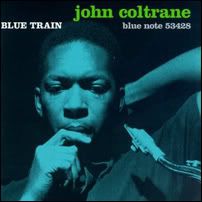
In an all-caps explanation about “YOUNGER, MORE ECLECTIC-MINDED POP CULTURE FANS” so crazy over Penguin shirts and Amy Winehouse that they’re “DELVING INTO ALL THINGS RETRO,” Blue Note records has announced the reissue of twelve best-selling titles on vinyl with a bonus CD inside.
Titles include: Cannonball Adderly, Somethin’ Else; Kenny Burrell, Midnight Blue; Dexter Gordon, Go!; Joe Henderson, Page One; Lee Morgan, The Sidewinder; Horace Silver, Song for my Father; Art Blakey, Moanin’; John Coltrane, Blue Train; Herbie Hancock, Maiden Voyage; Hank Mobley, Soul Station; Wayne Shorter, Speak No Evil; and McCoy Tyner, The Real McCoy.
(No Out to Lunch? Tsk.)
The titles run about $20. Truly an idea whose time has come. Oh wait—it already did. Get with it, Impulse!

Fightin’ Irish

0

11.26.08


As one of the strongest North Bay  theater years in recent memory comes to a close, Mill Valley’s Marin Theatre Company has unfurled its best play of 2008. Conor McPherson’s bruisingly un-Christmasy holiday fable The Seafarer is an Irish redemption story with an edge, a tale of alcoholic dreamers, unattractive lovers, poetry-spouting devils, foul-mouthed saints and accidental heroes. It’s a beautifully and entertainingly wrought study in perfectly balanced opposites. Premiering on Broadway last year and immediately nominated for a Tony Award for Best Play, the MTC production, directed by artistic director Jasson Minadakis, is the West Coast premiere of what could easily become an alterna-Christmas classic.

It’s Christmas Eve in the coastal Irish town of Baldoyle, Ireland, and Sharky (Andy Murray), a notorious drinker and professional screw-up, has come home after a months-long stint as a chauffeur in Dublin (a job he’s just lost), to take care of his equally hard-drinking brother Richard (Julian López-Morillas), who’s recently lost his sight after hitting his head (falling into a dumpster, we learn) and seems to have lost interest in bathing or changing his clothes.

The brothers’ tenuously married friend Ivan (the hilarious Andrew Hurteau) has spent the night in their bathroom after a long night of alcohol abuse and poker playing, and is now afraid to go home, having certainly re-alienated his wife and family while also misplacing his eyeglasses, which makes him almost as blind as Richard.

These early scenes set the mood for the entire play: there will be much Irish-accented cursing (hundreds of fecks and dozens of Jay-sus-es), numerous examples of rascalish low-lifery and bottle after bottle of wine, whiskey, beer and Irish moonshine. In spite of this trio’s conspicuously unsavory approach to life, there is depth, wit and charm to the characters, and it does not take long to see the good percolating right along with the bad.

As the brothers prepare for Christmas, they encounter the insecurely obnoxious Nicky (John Flanagan), who happens to be living with Sharky’s ex-wife, and who inconveniently drops by with a mysterious stranger in tow, the well-tailored Mr. Lockhart (Robert Sicular), who quickly reveals himself (to Sharky, anyway) to be the Devil, come to play cards for Sharky’s recently sober soul.

The chief pleasure of the proceedings is the way McPherson challenges us to get to know these people and form opinions about them, perceptions he then alters as he guides us on our way to genuinely caring about them, losers or not, drunk or not, smelly or not. A richer, sweeter, more entertaining band of layabouts you are not likely to meet onstage.

As Sharky, Murray carries himself with a sense of wounded, tentative dignity, having discovered a glimmer of hope and human connection in his life, only to face eternal isolation in hell when Mr. Lockhart arrives to collect Sharky’s soul—unless Sharky can beat him in one last all-night poker game. As Richard, López-Morillas is a glorious mess of a man, simultaneously grateful and resentful of his brother’s presence, constantly deriding Sharky for his decision to quit drinking while making it clear that he needs him desperately.

As Ivan, Hurteau achieves a perfect blend of cluelessness and smart-hearted self-awareness, while the overconfident Nicky, as played by Flanagan, is oblivious to everything, including the danger he has subjected his friends to by bringing Mr. Lockhart into their home.

And what an invention Mr. Lockhart is.

Played by Sicular with a sad, world-weary cruelty that is as heartbreaking as it is frightening, Lockhart is a decidedly Irish Devil, equally prone to drinking, though not as experienced at it as his would-be victims, and just as fond of telling long stories. After one such story, Richard is moved to remark, “Well, that is one maudlin fucker.”


But there is nothing maudlin about The Seafarer (named after an ancient Celtic poem about a haunted mariner alone in a freezing storm). John Wilson’s gorgeous set anchors the action in the delightfully detailed squalor of the brother’s two-story home, but then establishes the fantastic side of the story as the set rises up into the rafters with a cavelike structure resembling the ancient Irish tomb of Newgrange. MTC’s edgy and wonderful holiday offering is a magnificent Christmas concoction of ribaldry, humanity, redemption, loss, love and good, twisty fun.

  ‘The Seafarer’ runs Tuesday&–Sunday through Dec. 7 at the Marin Theatre Company. Tuesday and Thursday&–Saturday at 8pm; Wednesday at 7:30pm; Sunday at 7pm; also, Thursday at 1pm and Saturday&–Sunday at 2pm. 397 Miller Ave., Mill Valley. $31&–$51. 415.388.5208.


Museums and gallery notes.

Reviews of new book releases.

Reviews and previews of new plays, operas and symphony performances.

Reviews and previews of new dance performances and events.

High Notes

0

Food For All?

12.03.08Sonoma County food pantries this year have been deluged withrequests from those in need, even while donations are down, reportsthe Redwood Empire Food Bank (REFB), making this year's annual fooddrive more important than ever.According to a recent report released by the Department ofAgriculture, 700,000 children went hungry in the United States atsome point in 2007, up more than 50...

Life’s  Not Fair

12.03.08Kanye West is known more for his lack of impulse control than for his work. From award-show tantrums and impassioned telethon declarations ("George Bush doesn't care about black people") to paparazzi scuffles to his recent proclamation that he's the voice of his generation, the audacious rapper-producer stands alone in terms of sheer gall. But his outbursts, described by one...

I Got Mine

12.03.08I happened across my old pal Pete Bingo whilewaiting to cash a check the other day. The line stretched aroundthe building and down the block. Could be this was because the bankhad been seized by the Feds earlier that very morning.Finally, I was within spitting distance of the front door, andhere comes Pete. Sighting me, he waddles up like he...

Home Truths

12.03.08Biopics are notorious for bleaching a director's style; they turn every moviemaker into Taylor Hackford. One of the many surprises of Milk is that it is thoroughly a Gus Van Sant film. The use of negative space, the concentration on quiet moments of people chafing in their own skin, could only be the director who had been working on...

Broken Truths

12.03.08 By Bart SchneiderTerry Tempest Williams knows the earth and writes about it with native intimacy, no matter the setting or continent. It is her first love. For four generations, the men in her family have worked in the Tempest Company, a pipeline construction business in Utah and the Southwest. As her brothers learned to use shovels...

Flower Fresh

11.26.08Beer is a processed food. It is made from preserved ingredients, often pulled out of dry storage a year or more after harvest for shipment to breweries around the world. Many factories that make beer approach the beverage as a mass-produced product, like Snickers or Coca-Cola, one that must taste predictably the same batch after batch. But craft brewers...

Blue Note Reissues LPs With CDs Inside

In an all-caps explanation about "YOUNGER, MORE ECLECTIC-MINDED POP CULTURE FANS" so crazy over Penguin shirts and Amy Winehouse that they're "DELVING INTO ALL THINGS RETRO," Blue Note records has announced the reissue of twelve best-selling titles on vinyl with a bonus CD inside. Titles include: Cannonball Adderly, Somethin' Else; Kenny Burrell, Midnight Blue; Dexter Gordon, Go!; Joe Henderson, Page...

Fightin’ Irish

11.26.08As one of the strongest North Bay  theater years in recent memory comes to a close, Mill Valley's Marin Theatre Company has unfurled its best play of 2008. Conor McPherson's bruisingly un-Christmasy holiday fable The Seafarer is an Irish redemption story with an edge, a tale of alcoholic dreamers, unattractive lovers, poetry-spouting devils, foul-mouthed saints and accidental heroes. It's...

High Notes

11,084FansLike
4,446FollowersFollow
6,928FollowersFollow