Slouching Toward Extinction?

0

01.21.09

Readers of the Santa Rosa Press Democrat picked unusually slim papers up from their driveways on Monday, Jan. 19. Mondays are always light news days in print, but as executive editor Catherine Barnett explained in a “To Our Readers” note on the front page, such trim is the new norm for the PD, on Mondays at least. Announcing that, due to spiraling print and paper costs (don’t we know it!), the Monday paper will be just two sections from now on instead of four, she writes quite plainly, “Some editors try to promote the two larger sections as being preferable to four smaller sections. I won’t do that. Both the publisher and I have spent the better part of our careers trying to grow the reach, credibility and quality of the Press Democrat’s news report, and we both find it dispiriting to cut the newspaper.”

A quick count of the Jan. 19 edition finds just seven of the PD‘s 40 editorial staffers with a byline; the rest of the content is all from syndicated national sources, an unfortunate coincidence being that even the editorial hole was filled that day by a national source—President Obama. We hate to see this happen to a good local pub.


Meanwhile, the San Francisco Chronicle announced on Friday, Jan. 16, that it too was drastically rearranging its paper. The reliable Wednesday food section, a bastion for area restaurant-goers and home cooks, will be revamped and appear in the Sunday Styles section beginning on Feb. 1. The Friday wine section also gets crammed into the Sunday edition, and Thursdays, a dreary edition reserved mostly to deliver the accidentally fine-arts-heavy, calendar-driven bid for those crazy young folks known as “96 Hours,” will find a restaurant review and restaurant update review plus the popular “Inside Scoop” column tracking resto comings and goings in the Datebook section.

The Home & Garden section is promised to appear on Wednesdays, moving from its Saturday slot on Feb. 4. By cannibalizing their print product, perhaps the Chron means to drive subscribers to a Sunday-only print read with free content just given away daily on their website?

Or perhaps not.


Start Counting

0

01.21.09

I‘ve only seen the Bunker twice, but so far, with captivating songs constructed from the same three or four chords that pop songwriters have been using since the dawn of time, they’re the most promising new band in town. They’re nothing fancy—just two guys, Spike Clem and drummer Sam Maurer—and that’s exactly why they’ve been stuck in my head for the last couple weeks. Youth is complex; the Bunker aren’t.

Clem is a rakishly thin 18-year-old and has already written the kinds of songs that make stars out of kids who don’t know just how weird being a star can be. At a show last week, the Bunker hadn’t yet played one note when a group of fans started crowding in tightly. After warming up with a run-through of the Strokes’ “Someday,” which was released when he was 10, Clem began pounding on the acoustic guitar slung over his gray hoodie and singing his own songs somewhere beautifully between everything-matters and don’t-give-a-shit. Most of the teenagers present drowned out the PA system by singing along, while the aging musicians at the bar pointed with one hand, beer in the other, and made the eternal, cyclical concession: It’s their turn.

I used to think Clem sang like the Mountain Goats’ John Darnielle, with his deceptively plaintive voice, but he’s actually more comparable to John K. Samson of the Canadian band the Weakerthans. Like Samson, he possesses the ability to convey both tenderness and authority, singing lyrics like “It’s a quick draw, where I drew too fast and far too soon / I’m going crazy, but don’t mind me, ’cause tonight it’s a full moon,” and his songs are straightforward and fresh, the result of his ethic of immediacy. “I never really sit down to write a song,” he told me recently. “I just have something in mind that would be cool for a song, and I try to elaborate on that one idea. I’m incapable of going back to old ideas.”

Last week, at the end of his set, there were already people coming up to Clem requesting “the old songs.” As for me, I want to wake up in a world where he’s written 25 new ones. Hear a handful of them when the Bunker open for the Devil Makes Three on Friday, Jan. 23, at the Phoenix Theater. The Flat Iron String Band also appear. 8pm. $15. 201 E. Washington St., Petaluma. 707.762.3565.


Bullshit Reduction

0

Gaza = Warsaw?

0

01.21.09

On Jan. 9, when Congress passed a resolution validating Israel’s remote-control massacre of Palestinian people trapped inside Gaza, morally sane people were revolted. Unable to storm Capitol Hill, we were left to helplessly witness the shoah (Hebrew for “holocaust”) promised last year by Israeli deputy defense minister Matan Vilnai. The shoah that the Israelis have brought to Gaza is being carried out with our phosphorus bombs, our DIME fusion bombs and our high-tech rocketry purchased with our $3 billion a year in foreign aid.

When I heard that five members of the House had the guts to vote against the resolution, I prayed that our local representative, Lynn Woolsey, was one of them. Sadly, she was not in that group; she abstained on one of the most important moral issues of our time.

Last week, I repeatedly asked Woolsey (through her staff) for an interview about Gaza. She declined. If she had talked, I would have asked her why she had abstained on Gaza when she has previously opposed illegal invasions of Third World countries. I would have asked why she is failing to raise her voice when United Nations medical workers and hundreds of children and their mothers are being murdered in the name of “security.”

Woolsey’s political boss, Speaker Nancy Pelosi, authored the resolution to “ensure the welfare, security and survival of the state of Israel as a Jewish and democratic state.” So I would have asked our representative if she thinks the theocratic, apartheid state of Israel is truly “democratic,” since its non-Jewish citizens are denied civil rights. And I would have asked her why the resolution said nothing about the human rights of 1.5 million Gazians—and their right to defend themselves from illegal blockades and pogroms (defined by the Oxford dictionary as “an organized, officially tolerated attack on any community or group”).

Don’t get me wrong: Hamas is just as theocratic, backward and ruthless as the rulers of Israel; its religious fundamentalism holds no hope of liberation for a free and democratic Palestine. But the homemade missiles it sporadically lobs into territory swiped by Israel from already displaced Palestinian farmers in 1967 are spitballs compared to the Israeli arsenal. The slaughter in Gaza is indisputably in violation of international laws on warfare and land seizure and the basic tenets of human decency.

So I was going to ask Woolsey if she would have spoken up 60 years ago when the Jews of the Warsaw Ghetto suffered as the people of Gaza are now suffering. In 1940, the Nazi government of Adolph Hitler locked nearly half a million Jews inside the Warsaw Ghetto and proceeded to starve them to death. Food and medicine were not allowed to cross the sealed borders. Utilities were cut off. Foreign reporters were not allowed to witness. Nonetheless, the incarcerated people of the ghetto smuggled in food and medicine. They carried on educating their doomed children; they lightened their load with cultural and religious festivals. In the face of incredible brutality by the technocratic Nazis, they united for self-defense.

On Passover, April 19, 1943, Nazi tanks and artillery began blowing up houses and temples in the Jewish ghetto, killing men, women and children with advanced weaponry. The starving people fought back with homemade weapons, but they lost; the survivors were transported to the death camp at Treblinka. The ghetto was exploded into a heap of bloody bricks as a lesson for those who resist oppression.

Many European Jews who survived the Nazi years emigrated to the new state of Israel, and then irony rode into town on a pale horse: the settlers forcibly relocated 750,000 native Palestinians, their fellow Semites. Israel transformed villages into concentration camps called Saba, Shantilla, Jenin. So outrageous was the Israeli land-grab that, in 1947, Albert Einstein, once a firm Zionist, denounced the Jewish state and its terrorist practices. War after war has so obscured the historical roots of the “catastrophe,” as the Palestinians term their own diaspora, that most Americans have no knowledge of this history, which mirrors our own story, also filled with institutional racism and genocidal acts.


Meanwhile, Sen. Barbara Boxer bemoans the “outbreak” of violence in Gaza, as if it were the flu and not a calculated gamble by Israelis and Americans determined to destroy a whole people. Forget the political machine: we must organize ourselves to stop shoah.

 Peter Byrne is currently at work on a book (‘The Devil’s Pitchfork’) for Oxford University Press about quantum mechanics, multiple universes and hydrogen bombs.

Open Mic is now a weekly feature in the Bohemian. We welcome your contribution. To have your topical essay of 700 words considered for publication, write [ mailto:op*****@******an.com” data-original-string=”veblxeUkbiw0czC6NVOa4w==06aN0Aeq7aICYJQwZodXUOX6UFAP4uxwWTAUm+/nlsJx6ITf5F80YI6iY/m3SHtWNggjzJc6LHCE2q/IZ7RO+80DHwjghCa2YAxA9WrQck0LY8=” title=”This contact has been encoded by Anti-Spam by CleanTalk. Click to decode. To finish the decoding make sure that JavaScript is enabled in your browser. ]op*****@******an.com.


Captain Mom

0

01.21.09

YAR: Captain Maggie McDonogh on one of the three boats in her fleet.

Hard to imagine that Tiburon was on the wrong side of the tracks,” Maggie McDonogh laughs as she deftly backs the ferryboat The Angel Island away from the dock, and the elegant restaurants and pricey shops of town recede in the distance.

The woman nicknamed “Captain Mom” welcomes her passengers and dispenses safety information before continuing. “When my great-grandfather came here with the railroad, it was a rough-and-tumble place. Even as a kid, my father kept me away from certain parts of town. Belvedere was the fancy place and where you moved if you made it. But we stayed in Tiburon.”

Maggie McDonogh runs the only family-owned ferry service on San Francisco Bay. The divorced mother of two is the fourth generation of her family to run boats out of Tiburon. Her freckles and strawberry-blonde locks belie the fact that, just in her late thirties, she is among the most experienced ferryboat captains on the bay.

Her father, Milton McDonogh, had the first Angel Island ferryboat, The Gaycin, named for his nieces Gail and Cindy and built in 1959. From the time she was an infant, Maggie was expected to learn the ways of the sea.

When she was 18 and old enough to qualify, her father said, “Time to get your captain’s license.” When she passed the grueling two-day written examination, she already had logged far more than the required 365 eight-hour days working on all the boats of the same tonnage she wanted a license to operate.

Her mother objected, saying it wasn’t the right job for a lady. It was too late. Maggie McDonogh was already at home in her father’s world.

“When my dad and uncles got together with my cousins, it looked like a table full of Vikings—big, strong, clean-living Scots,” she laughs. “I trusted my dad and was never worried when he was on a boat.”

Her family insisted on her obtaining an education.

“I considered becoming a veterinarian. When I went to Dominican College, I became an English major instead. But then I realized this is what I love. And could you have a better office?” McDonogh gestures at the bay sparkling in the sunshine as we approach Angel Island.

Each generation of McDonoghs has taken the business in its own direction. McDonogh’s great-grandfather left railroading to haul water freight and run a chowder house; her Grandpa Sam was known as “Sam the Skiff Man,” because he rented out fishing skiffs in the Depression for 25 cents a day.

“The story is that Grandpa couldn’t swim, and he once fell overboard with his pockets full of quarters,” McDonogh says. “No way was he going to lose that money in the Depression. Lucky for him, someone hauled him back in.”

Milton hauled munitions at night in blackout conditions throughout World War II (“And that was without radar”) and began the ferries. Maggie is now making her mark.

As Tiburon has become posher, so has she provided posher services. In addition to operating the ferry with the three boats the family owns, McDonogh now runs sunset cruises, inviting the public to bring a picnic dinner on weekends. She also has instituted moonlight Champagne cruises on three full-moon nights a year. She runs whale-watching trips in winter and great white shark adventures with cages off the Farallones Islands.

“It’s safe,” she assures. “The sharks don’t have can openers.”

McDonogh has also greened the business, systematically replacing the engines on her vessels with low-emission ones. This is a costly process but she is dedicated to completing it. She manages all this and her 10 employees while also caring for her two children Becky, five, and Sam, 12, and her aging parents. Her support system is a network of friends who used to work as deckhands for her father. She is raising her children on the boats just as she was brought up.

The job is not always a picnic on the bay. In 1995, the California coast was slammed by a storm of hurricane force. She had recently given birth to her son and her C-section was still healing when she woke to find The Angel Island had been torn loose from the dock when the pilings snapped off.

“That storm was just chewing up the dock, and the boat would be smashed on the rocks if we didn’t do something. The Coast Guard didn’t have a big enough boat to help us, so we were on our own. I shoved the baby into my neighbor’s arms and tore down to the dock,” McDonogh remembers.

She and her elderly father, along with some deckhands, launched a small “whaler” into the storm and she managed to tie up to the wayward ferryboat. Through the crashing waves, she managed to board the vessel and eventually brought it into Ayala Cove on the lee side of Angel Island.

“That was the time I was most scared. It was truly frightening. I could only get the port engine to work. It was the most stable boat on the bay—usually like driving a table, but both propellers were out of the water. My stitches were tearing, but it was as if your home was on fire. I had to do something.”

The storm left every boat in Tiburon damaged. The McDonoghs, relieved to have saved their biggest boat, began picking up the pieces and putting their business back together.


“You have to take life as it comes,” McDonogh says. “You can plan, but it’s not going to go the way you expected. Look at me. I never expected to be divorced, but I’ve got a chocolate lab that snores at night, so I’m OK. My dad taught me to know what I can fix and not worry about what I can’t. You have to accept that you can’t win everything.”

She turns to look at the view from the bridge of the boat. “I’ve got no complaints. The good Lord changes the artwork in my office every day. How good can life get?”

 To contact the Angel Island-Tiburon Ferry, call 415.435.2131 or go to www.angelislandferry.com.


Winter? Wine!

01.14.09

One of only five wineries in the state to also possess a restaurant license, the Russian River Vineyards did for two years boast chef Greg Hallihan’s Stella’s Cafe on its property. Stella’s closed last summer as the property prepared to sell, Hallihan concentrating on his western Sonoma County steakhouse, Elmo’s, in the interim. Now Hallihan and new winery co-owner Art “the Pasta King” Ibleto prepare to reopen the house as Corks at Russian River Vineyards on Friday, Jan. 16, just in time for Winter Wineland. Hallihan will helm the kitchen with his California-centric cuisine Thursday&–Sunday while Ibleto will reign on Wednesday nights with a $10 pasta buffet. Look for an opening weekend four-course prix fixe special for just $29.95. 5700 Hwy. 116 N., Forestville. 707.887.3344.

Speaking of Winter Wineland, slated this year for Saturday&–Sunday Jan. 17&–18, the event is in its 17th year and has some 112 wineries participating this month, including many that are normally appointment-only. Many of the wineries are pairing their wines with food, and this is always a merry weekend. The WineRoad.com website lists each of the wineries, whether they accept large groups or not and what special they may have planned for the day. No children under 12 are allowed, including babes-in-arms, and no dogs, please. 10am to 4pm. $30&–$40; designated drivers, $10.

Quick dining snapshots by Bohemian staffers.

Winery news and reviews.

Food-related comings and goings, openings and closings, and other essays for those who love the kitchen and what it produces.

Recipes for food that you can actually make.

Letters to the Editor

01.21.09

tapeheads, unite

I wanted to let you know how much I loved the recent article by Gabe Meline called “I Still Make Tapes” (Dec. 24, 2008). It was so cool to realize there is a kindred spirit out there who still does that; I truly thought I was the only one. I love making tapes and even labeling them like Gabe mentioned. And I had a tape player installed in my car so I could listen to them in there. Articles like this are why I read Bohemian. Please pass these comments along to the author and let him know I’d love to trade “making tapes” stories anytime. Thank you!

Brian Royalty

Santa Rosa

We Call Him ‘RVB’ Too!

The trouble with any review by Richard von Busack is that he is so intent on being acid and witty that the reader will have a difficult time discovering whether the film under review, in this case Defiance (Jan. 14), is worth seeing. In spite of RvB’s gratuitous shots at writer-director Edward Zwick (“exudes humanism like a blintz exudes cheese”) and actor Liev (“the bull-calf”) Schreiber, I went to see the film in Sebastopol on Sunday. It is quite a good true-story film, getting a pretty accurate sense of what life was like for the Bielski brothers and their group of Jewish partisans fighting to keep themselves and hundreds of women and children alive in Belarus for three years following the German invasion and the commencement of mass murders abetted by local collaborators. Daniel Craig’s star turn as Tuvia Bielski should assure a wider audience for the film, shot largely in Lithuania, and getting many of the details of life on the run in the Lipiczanska forest spot on. I hope RvB’s review will not keep your readers from seeing a very realistic dramatization of a true story.

Joel Neuberg

Sebastopol

Imagining Equality

A child is beaten, a woman raped, the dog kicked and a mistress gets flowers. Thank God the sanctity of marriage between a man and a woman is intact. I know, we live in a democracy and the votes have been counted, but just because the majority has voted for something that is discriminatory, hurtful and just plain indecent, does not make it OK.

So the struggle continues for such virtues as equality, pursuit of happiness and justice for all. I wonder will we ever set aside our differences and get there together? Sadly I think not, but I can still imagine.

Michael Cali

Cotati

Life-points Lesson

Regarding Bart Schneider’s Lit Life column about Dan Coshnear (“Work/Life,” Jan. 14): Brilliant! To think that Mr. Coshnear would find true humanitarian inspiration within the low-income, social services and in counseling the very dregs of society, serving the derelict rejects, crack-addicted prostitutes, hopeless winos, roving nut cases and many more.


When the game’s over, man, and we all sit down and count up our life points, I believe the social servant who got paid squat to counsel the used and abused will be right up there with school teachers, rescue mission employees and crisis hotline operators. Believe me when I say that if and when you get strung out on painkillers and Kenwood Merlot because you got laid off, your minivan broke down, and along with your pride, your better half took the kids, you’ll be whistling Dixie for the underpaid angels who wanna help fix your broken ass. I know that I do.

Trevor Moore

Santa Rosa


&–&–>

Earth and Water

0

01.21.09

In 2007, California passed legislation barring energy companies from doing business with the state if they were also pursuing new coal contracts. O, pure, clean California! Not exactly. While we do not produce coal or have any coal-fired power plants, Californians still use coal to generate electricity and, according to the coal industry itself, the Golden State benefits from some $14 billion of economic swell either directly or indirectly from that black lumpen stuff that comes from the ground.

Pure, clean California, therefore, needn’t truck with such as having whole mountain tops sliced off, completely extracted of fuel and then replaced, generally 7,000 feet shorter than before and “landscaped” back to a faux-natural state by truckers whose aesthetic sensibility was evidently honed at Costco. West Virginia, on the other hand, is not so lucky, so pure or so clean. While only 1 percent of California’s electricity is generated by coal, a full 99 percent of West Virginia’s electricity is powered right from the ground beneath them, and the ancient Appalachian forests—not to mention the state’s citizenry—are paying a heavy price.

Screening Jan. 24 as part of the Sonoma Environmental Film Festival, writer-director David Novack’s authoritative documentary Burning the Future: Coal in America, shows exactly how heavy that price is by centering on accidental activist Maria Gunnoe. A waitress and mother of two, Gunnoe and her family have lived in the same “holler” for generations. She shows the camera how to peel poke limbs and describes their celery-like disposition when added to salad. She reminisces about spending her childhood in the creek that cuts through her large lot and foraging daily in the forest for the family’s dinner table.

Today, Gunnoe’s children cannot even shower in the water piped into their home, let alone roam the nearby forest or risk a dunk in the creek. When the mountaintop above their holler was surface-mined, everything changed. With the mountain’s vegetation gone, a regular rainstorm turned into a flood that devastated Gunnoe’s property and home, prompting her to quit her restaurant job and become a full-time activist, the Erin Brokovich of big coal. Let’s hope that a big-time Hollywood star like Julia Roberts decides to make her plight public, because as Burning the Future so aptly shows, there ain’t nothing clean about coal.

Burning the Future is just one of some 30 films showing this year at the SEFF that explore the various planetary woes mankind has conjured. Like a skewed Chinese medicine chart, the films divide fairly neatly between earth and water, closing with the acclaimed documentary Dirt! coming clean off the Sundance Film Fest circuit.

Troubled Water, a product of Arkansas public television screening Jan. 23, looks at what happens to a state so wet that rice is a primary crop when population and industry grow to unsustainable heights. As one artisan sitting at an unvisited table selling duck calls at a local fair explains, when the streams are pumped down, the fish go. When the fish go, the birds go. When the birds go, the hunters go. When the hunters go, he’s done for. All of which is where Arkansas is currently going.

Much happier fare is filmed close to home with Hidden Bounty of Marin: Family Farms in Transition screening on opening night, Jan. 22, with a special oyster and cheese and wine reception. Hidden Bounty centers on West Marin’s pioneering farm and ranch families, nearly all of them familiar names to local foodies. Dairy is a $36 million economic annual engine in Marin, with some 28 ranches providing primarily organic milk to niche markets.

In fact, “niche” is the magic word for the 52 family farms in Marin; the county has not only managed its open space brilliantly but has managed its brand with even more agility, the Marin Agricultural Land Trust reportedly being the oldest and most successful organization of its kind in the nation. Standing amid the reliable pleasures of his stunning Bolinas pasture, Star Route Farms owner Warren Weber beams into the camera. “I’m farming,” he says, “because I can’t help myself.” If only all the films at the SEFF were so organically optimistic.

 The Sonoma Environmental Film Festival runs Thursday&–Sunday, Jan. 22&–25, at the Sonoma Valley Women’s Club. Look for postfilm discussions and special panels. Lilith Lynn Rogers performs her one-woman show, ‘Rachel Carson Returns,’ on Jan. 23. 574 First St. E., Sonoma. $8&–$10; $85 for the whole festival. For details, go to www.seff.us or call 707.935.3456.


New and upcoming film releases.

Browse all movie reviews.

The Royal Scam

0

01.21.09

LET’S RIDE: No, wait, let’s walk or ride or. . . wha?

This is honest-to-God the dumbest product I’ve ever seen advertised.

—Customer review of the Treadmill Bike on BikeForest.com

We’ve all been to garage sales where stray pieces of forgotten and largely unused fitness equipment are offered, still in the battered box. We’ve all seen late-night infomercials about the latest running or weightlifting or yoga gadget that’ll trim up your abs and tighten your butt for one low payment of $19.95. We’ve all witnessed absurd fitness trends in their various thighmaster-y forms, and the altogether desperate ways in which shyster entrepreneurs attempt to separate overnourished Americans from their money.

And now we have a winner. The height—or depth—of absurd fitness accessories has been reached. It truly does not get any more ridiculous than the Treadmill Bike, developed in Canada. It’s just what it sounds like—a treadmill connected to wheels. When you run on the treadmill, the wheels propel you forward. Down the street.

Yes. Just like jogging.

The Treadmill Bike’s product description contains plenty of flowery marketing terms. “Have you ever wished you could get a quality treadmill workout without paying expensive gym prices?” it asks. “Look no further than the Treadmill Bike by the Bicycle Forest. The Treadmill Bike offers the same fat-burning benefits of a conventional treadmill, without the membership fees!”

Naturally, it’s been illuminated as the invention of morons by numerous websites, by a handful of cable television shows and, of course, by comments on the bike’s incredible YouTube ad. “This is absolutely stupid,” writes a typical reviewer. “It’s totally useless. Why would anyone buy this ridiculous thing? If one wants to run outside, he doesn’t need anything else but his legs!”

And that’s exactly the kind of reaction Brent Curry, inventor of the Treadmill Bike, hoped for.

On the phone with Curry, it quickly becomes apparent that he created the Treadmill Bike as an artistic statement on the ludicrous nature of fitness gadgets. By pushing, in his words, to “the extremes of ridiculousness,” Curry has artfully advocated basic exercise over expensive gadgetry. The fact that people take the Treadmill Bike seriously—or rather, think that he takes it seriously—only reinforces the success of his art.

Burry is an affable thirty-something Canadian who’s conceived and built numerous art-bikes to accent his bike-rental business in Ottowa; he also rents the Hula Bike, with an offset rear hub, the Family Truckster, with room for four, and the Couch Bike, which is exactly what it sounds like—a bicycle pedaled by two riders while loafing on a large couch. (Curry completed a 140-mile journey through Maritime Canada on the Couch Bike in 2002.)

The Treadmill Bike isn’t a joke, Curry insists. It’s for sale, although no one’s bought one yet, and it does help people to get fit. “There’s definitely a lot more resistance in the Treadmill Bike than if you’re simply running,” he states, “so it’s a much harder workout.”

The angry reactions his invention inspires are surprising to Curry, since the YouTube ad is marked by such spoof hallmarks as stifled laughter, improbable situations and improper use of hip-hop slang. “I don’t think the video production quality was all that high, but people seem to be totally taken in that it’s this completely serious commercial product,” he says. “I guess when I get responses like that it makes me all that much more glad that I made the bike as a bit of a statement.”

Not everyone lured by the marketing of the Treadmill Bike thinks it’s altogether useless. A television show in Germany gave it a serious evaluation, monitoring the aerobic intensity and increased heart rate of its use. And the Japanese love it. “They seem to have a mix of fascination and confusion about the whole thing,” he says.

Curry, himself a triathlete, has no problems with the overblown fitness industry per se. He understands the need for products that are primarily aimed at fitness and not any practical purpose. But personally, Curry hopes that his message gets across every time people come across his Treadmill Bike and think that it’s silly.

“It’s silly that people drive their cars to the gym just to run on a treadmill!” he retorts. “There’s lots of other ways to get your exercise.”

 See the Treadmill Bike, and all of its video demonstrations, at [ http:-/www.bikeforest.com- ]www.bikeforest.com.


Power Play

0

the arts | stage |

By David Templeton

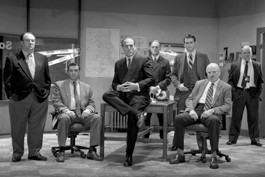
Death of a Fuckin’ Salesman. That’s what many actors, directors and theater fans have affectionately called David Mamet’s Pulitzer-winning Glengarry Glen Ross since the play first exploded onto the stage in 1983. As famous for its outrageously coarse language as it is for its stylized, lean-and-mean plot structure, the show, which just opened a six-weekend run at the Ross Valley Players, is much more than a string of f-bombs and testosterone-poisoned put-downs; it’s a raw, unsentimental dissection of the desperation that propels and thwarts so many middle-class working stiffs.

Beginning in a dingy Chinese restaurant where salesmen gather to one-up each other and trawl for new clients, then moving to the interior of a simple store-front real estate office, the play follows two days in the lives of four salesmen/con artists (Eric Burke, Richard Conti, Tim Earls and Norman A. Hall) who work for a seedy land firm. The RVP production, a bold move for the venerable 79-year-old theater company, is directed by James Dunn with elegance, clarity and attention to detail, but the production is knocked down a notch by a too-leisurely pace and an uneven cast, with performances that range from flat-out excellent to merely adequate.

As the office’s reigning alpha dog, salesman Richard Roma, Burke (last seen at RVP in last year’s superb Cocktail Hour) delivers a performance of ferocious calm, embodying Roma’s sharkish charm with a gleeful malevolence that borders on the sociopathic. Conti, as the bullying David Moss—the second man on the office food chain, motivated more by anger against management than by avarice or ambition—is also excellent, making every line spring to life with colorful choices.

In perhaps the hardest role in the show, Norman A. Hall plays the aging Shelly Levene as a man whose self-esteem has been so battered he’s lost control of everything that used to make him a good salesman. It’s an intricate performance that grows and adds shades of character as the play progresses. As the fourth salesman, the friendly pushover George Aaronow, Tim Earles, who’s mostly been seen in small parts with Sonoma County’s Narrow Way Stage Company, has been given his biggest role to date, and gives his best performance in it, establishing a tone of clueless niceness that carries through to Mamet’s sly surprise ending.


Stephen Dietz has some nice moments in the small role of a sad-sack client trying to back out of a contract, but as the office’s mercurial manager, H. D. Southerland plays just one glowering note and Jason Souza, as a tough-guy cop investigating a break-in of the office, is unconvincing. Ultimately, this is an enjoyable Glengarry that falls short of excellence, but still demonstrates the riveting, haunting power of Mamet’s best play.

Glengarry Glen Ross runs Thursday–Sunday through Feb. 22 at the Barn Theater within the Marin Art and Garden Center. Friday–Saturday at 8pm; Thursday at 7:30pm; Sunday at 2pm. $16–$20; Jan. 23 at 7pm, pay-what-you-will. 30 Sir Francis Drake Blvd., Ross. 415.456.9555.


View All


Museums and gallery notes.


Reviews of new book releases.


Reviews and previews of new plays, operas and symphony performances.


Reviews and previews of new dance performances and events.

Slouching Toward Extinction?

01.21.09 Readers of the Santa Rosa Press Democrat picked unusually slim papers up from their driveways on Monday, Jan. 19. Mondays are always light news days in print, but as executive editor Catherine Barnett explained in a "To Our Readers" note on the front page, such trim is the new norm for the PD, on Mondays at least. Announcing that,...

Start Counting

01.21.09I've only seen the Bunker twice, but so far, with captivating songs constructed from the same three or four chords that pop songwriters have been using since the dawn of time, they're the most promising new band in town. They're nothing fancy—just two guys, Spike Clem and drummer Sam Maurer—and that's exactly why they've been stuck in my head...

Gaza = Warsaw?

01.21.09On Jan. 9, when Congress passed a resolution validating Israel's remote-control massacre of Palestinian people trapped inside Gaza, morally sane people were revolted. Unable to storm Capitol Hill, we were left to helplessly witness the shoah (Hebrew for "holocaust") promised last year by Israeli deputy defense minister Matan Vilnai. The shoah that the Israelis have brought to Gaza is...

Captain Mom

01.21.09 YAR: Captain Maggie McDonogh on one of the three boats in her fleet. Hard to imagine that Tiburon was on the wrong side of the tracks," Maggie McDonogh laughs as she deftly backs the ferryboat The Angel Island away from the dock, and the elegant restaurants and pricey shops of town recede in the distance. The woman nicknamed "Captain Mom"...

Winter? Wine!

01.14.09One of only five wineries in the state to also possess a restaurant license, the Russian River Vineyards did for two years boast chef Greg Hallihan's Stella's Cafe on its property. Stella's closed last summer as the property prepared to sell, Hallihan concentrating on his western Sonoma County steakhouse, Elmo's, in the interim. Now Hallihan and new winery co-owner...

Letters to the Editor

01.21.09tapeheads, uniteI wanted to let you know how much I loved the recent article by Gabe Meline called "I Still Make Tapes" (Dec. 24, 2008). It was so cool to realize there is a kindred spirit out there who still does that; I truly thought I was the only one. I love making tapes and even labeling them like...

Earth and Water

01.21.09In 2007, California passed legislation barring energy companies from doing business with the state if they were also pursuing new coal contracts. O, pure, clean California! Not exactly. While we do not produce coal or have any coal-fired power plants, Californians still use coal to generate electricity and, according to the coal industry itself, the Golden State benefits from...

The Royal Scam

01.21.09 LET'S RIDE: No, wait, let's walk or ride or. . . wha? This is honest-to-God the dumbest product I've ever seen advertised.—Customer review of the Treadmill Bike on BikeForest.comWe've all been to garage sales where stray pieces of forgotten and largely unused fitness equipment are offered, still in the battered box. We've all seen late-night infomercials about the latest running...

Power Play

the arts | stage | ...
11,084FansLike
4,446FollowersFollow
6,928FollowersFollow