Scope and Generosity

05.20.09

A northern neighbor of ours many years ago made the crisp distinction between residents of Canada and those of the United States, wryly insisting on similarity. Canadians, he explained, are simply “unarmed Americans with healthcare coverage.”

Many of us are concerned about our dysfunctional healthcare system, the one institution where one would not expect greed to run ahead of compassion—unless you live in this country, where we are sadly used to it. But change is on the wind; Obama is taking the first steps toward healthcare reform. And just in time.

In a 2008 report by UC Berkeley School of Law professor Jacob Hacker, I found a poetic understatement of our plight. “The Case for Public Plan Choice in National Health Care Reform” includes these words: “Health insurance premiums have skyrocketed, more than doubling from 1999 to 2008, while the scope and generosity of private coverage has plummeted.”

When I think about what my healthcare insurance provided me when I suffered an emergency hospitalization last year, scope and generosity do not enter my mind. In fact, I now know from experience that Michael Moore was not making this stuff up. Go ahead and watch Moore’s documentary Sicko to see what kinds of deaths an insured American can expect at the hands of insurance companies that pay employees bonuses for denying patients needed medical procedures.

These same companies and their allies are trying to stop Obama’s pubic health insurance plan. In a Huffington Post article, U.S. Sen. Jeff Merkley announced, “Republican strategist Dr. Frank Luntz is laying out plans to dismantle any effort to give all Americans access to quality health care. Dr. Luntz, the man who developed language designed to promote preemptive war in Iraq and distract from the severity of global warming, is at it again—this time with a messaging strategy designed to sink our historic opportunity for health care reform.”

To stop Luntz, activists are turning to analysis provided by Hacker and his colleagues at the Center on Health, Economic and Family Security. Drawing from their report, MoveOn’s political action team is passing around “The Five Things You Need to Know About Obama’s Public Heath Insurance Option:”

1. Choice, choice, choice. If the public health insurance option passes, Americans will be able to choose between their current insurance and a high-quality, government-run plan similar to Medicare. If you like your current care, you can keep it. If you don’t—or don’t have any—you can get the public insurance plan.

2. It will be high-quality coverage with a choice of doctors. Government-run plans have a track record of innovating to improve quality, because they’re not just focused on short-term profits. And if you choose the public plan, you’ll still get to choose your doctor and hospital.

3. We’ll all save a bunch of money. The public health insurance option won’t have to spend money on things like CEO bonuses, shareholder dividends or excessive advertising, so it’ll cost a lot less. Plus, the private plans will have to lower their rates and provide better value to compete, so people who keep their current insurance will save, too.


4. It will always be there for you and your family. A for-profit insurer can close, move out of the area or just kick you off its insurance rolls. The public health insurance option will always be available to provide you with the health security you need.

5. And it’s a key part of universal healthcare. No longer will sick people, folks in rural communities or low-income Americans be forced to go without coverage. The public health insurance plan will be available and accessible to everyone. And for those struggling to make ends meet, the premiums will be subsidized by the government.

While I study yet another bill from the Bay Area hospital where I stayed, for charges my insurance company refuses to pay, I hope that Obama’s pubic health option might succeed. I suspect it might give us a way out of this system where greed diminishes the “scope and generosity” of our medical care.


Prison Playing

0

05.20.09

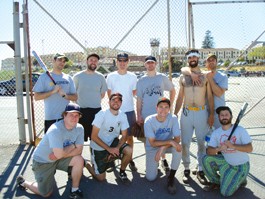
LITTLE LEBOWSKIS: The author is in the second row, next to the bare-shirted guy who got beaned.

From the parking lot of San Quentin State Prison’s East Gate complex, visitors have a sweeping view of the coastline that evokes Camelot as much as Quentin. In the distance loom the green, rolling pastures of the coastline, visible over the parapets that crown San Quentin’s walls; below them, the giant double doors of the prison’s entranceway dominate its facade.

The calm, scenic and politically liberal Marin County of present day seems an odd place for a prison, although it’s had one since 1852, when San Quentin became California’s first. Between the East Gate side and the prison’s neighboring complex, West Block, San Quentin covers 432 acres and houses over 5,300 prisoners, though it is designed to hold just over 3,000, making it one of the largest prisons in the United States. Among the buildings that make up the East Gate complex, the tallest one in the very middle is death row, home to California’s most notorious convicts and the only place in the state where male inmates are executed. Just across the way from the black, hulking building that houses death row there is a baseball field.

At San Quentin, where both baseball and softball are played—the only California prison to have either, or even a field for that matter—America’s great pastoral game has been placed within metal confines. If the prison is a dark spot on the coastline of Marin, the ball field is a glint within.

The prison’s double doors were propped open on a recent clear, warm Sunday, visiting day, as clergymen and family members of inmates filed in for an hour of face time with the incarcerated. Among the visitors, too, was our local softball team, the Little Lebowski Urban Achievers, there to play an afternoon game against the San Quentin Giants, an all-prisoner team that is part of San Quentin’s baseball program dating back to the 1920s. In 1994, the program began allowing games against teams visiting from outside the prison.

Though this would be my first trip to San Quentin, our team had its own mini-history there: two games played last year, one won and one lost. Those who had played spoke highly of the experience, although a friend warned me to expect a lot of heckling, along with certain oddities that could be distracting: sunbathers in the outfield, for example, and the occasional rodent.

This trip, however, proved to be slightly less frenzied, owing mostly to the fallout from a reported race riot that had transpired days earlier. Every black and Latino inmate had been on an indefinite lockdown since that time, and the recreation yard’s population was significantly scaled back.

What visitors to San Quentin experience is a tamed-down version of the yard anyway; inmates with any disciplinary history at the prison can’t play baseball or softball, nor are they allowed anywhere outside when visitors are present. Although one gregarious inmate passing behind our dugout before the game said he’d be “heckling like a motherfucker” after his plea for sunflower seeds went unanswered (such charity is expressly forbidden), his threat proved empty.

Even by nonprison standards, the game that ensued was a quiet one. Good-natured small-talk and sportsmanship dominated the on-field discussion, and spectators who gathered behind the backstop and in certain deep corners of the outfield were, according to teammates who’d played here before, both diminished in number and uncharacteristically restrained. The shirtless umpire, an inmate, called a fair game, drawing only minimal flak from San Quentin’s players.

“One of the things I really like about [the baseball program] is that prison’s a place where it’s not really easy to make real friends—you always think somebody wants something from you,” said Chris “Stretch” Rich, one of the onlookers behind the backstop. Rich, who pitched in college, has played on the prison’s baseball team for seven years and is among the approximately 75 percent of its players who are serving life sentences.

“With baseball, it draws together people from a variety of ethnic backgrounds and races,” he said. “Baseball brings people together. You can take that out into society and make something positive out of that. A lot of people in here committed horrific crimes—and a lot of people don’t want to be that person.”

While more than one inmate described the baseball field as a sort of refuge from prison life, to a visitor its place within a larger system is continuously felt. The field is wedged inside the surrounding walls with everything else; its boundaries ill-defined, and parts of the outfield are shared with joggers, loiterers and gamers, who play cards and chess on a table that’s affixed to the ground in right-center. There were no sunbathers on this trip, but upright passersby abounded, including an intermittent flock of Canadian geese. Next to the field, a doubles match unfolded on the tennis court, alongside full-court basketball game and a solitary boxer on the punching bag.

“You’re a new guy, huh?” said the first inmate I approached, and before I ever said a word. “You got that look on your face like, ‘Oh, I’m at San Quentin.'”

This was Key Lam, an outfielder who plays both baseball and softball at the prison. Lam, whose baseball career was cut short when he entered the prison system at age 20, is one of the prison’s most talented players. On this day, the muscular Lam hit two of the game’s three out-of-the-park homers (our third baseman hit the other), both opposite field shots that cleared the same bungalow, part of the improvised fence in a park whose design clearly required some imagination.

“This is the furthest thing from prison life,” Lam said.

In the end, Lam’s power couldn’t make up for San Quentin’s missing starters, whose absence may have given our team a distinct advantage. While the two games our team played last year were reportedly very close, we would win this contest handily: 27–15. Although, to be fair, that’s an unofficial score, because the game didn’t properly end.

In the bottom of the seventh, which would have been the last inning due to the approaching time limit, the Giants loaded the bases with no outs. The next batter hit a laser that took its first bounce into the ear of our shortstop, whose blood painted the ground at his position. With their precious time outside the walls winding down, the prisoners collectively decided to call the game, and some went over to check on their bloodied opponent. An ambulance arrived minutes later, unloading technicians who were also inmates (its lowest security level occupants, who stay not inside the prison but in parts of San Quentin Village); our player was cleaned up, bandaged and transported to the parking lot, where the rest of us reunited with him.

As the ambulance drove off, we were left with about 10 minutes to mingle. Prison life has never had a very good reputation, and a couple hours of baseball a week wouldn’t seem to change that too much. But the players with whom I spoke were overflowing with gratitude.

“I feel fortunate to have you guys come in and play—for taking time out of your day on a Sunday afternoon, when you could be doing a lot better things,” said Ron Dalton, although nothing could have been further from the truth. “Without you guys coming in here, we wouldn’t have the ability to play.”

Dalton, the Giant’s hefty first baseman and clean-up hitter, had good words for the prison generally. He said he’d been diagnosed with stage three lymphoma while serving time at Solano State Prison, where the medical help was shoddy. He got a transfer to San Quentin some months after the diagnosis and underwent chemotherapy there, noting that he’s now in his fifth year of “full remission.”

“It’s hard to get the kind of medical attention [at other prisons] that I got here,” he said. “San Quentin saved my life.”

Dalton (who is serving a sentence of 14 years to life but has a parole hearing later this year, about which he was optimistic) said he was on the verge of becoming certified as a drug and alcohol counselor, and that various programs at San Quentin, including a college degree program (the only one in the California prison system), have helped him make changes, as have Alcoholics and Narcotics Anonymous, group counseling and baseball. All of it, he said, added up to the hope that redemption is attainable.

“What I want to do is make my past as fully right as possible,” Dalton said. “I want to feel like I’ve given back to the community what I’ve taken. This is part of my path.”

For Dalton and others, it seemed, the experience of playing was humanizing. Inmates repeatedly talked about the “honor” (as one put it) of interacting with the outside world, for which the games provided a setting that was itself evocative of the world outside.

“I’ve been in a lot of other [prisons], and they don’t let nobody come near you. People up here seem to care about you,” said player Shawn Hall.

“It’s like medicine,” added Pat Aronson. “You come out here and feel better. The ‘dregs of society’ is the way they look at us. For people to come in here and to be treated with respect, it’s an honor.”

 Of course, the reprieve is short-lived.

“We got about an hour to shower and get cleaned up,” said “Junkyard Broadway,” as he and the other players packed up their gear following the game. “Then, back to our cells.” 


Letters to the Editor

05.20.09

Frivolous lawsuits?

I worked with [managing editor] Bob Swofford from 2006 to 2008 and observed how he acted with others in the newsroom (“Two Towers,” May 13). I always found him to be professional, fair and a true gentleman. The allegations set forth in the lawsuit seem preposterous to me. I think we all lose when frivolous lawsuits are filed, and that’s just what this seems to be.

Michael Shapiro
Sebastopol

Risk-taker rebuffed

Re the Press Democrat lawsuit, Leigh Behrens intimidated even the big boys in New York. In Santa Rosa, what she may have lacked in approach, she made up for taking risks, which the PD needed to do. The “boys club” didn’t like that, nor were they able to be cutting-edge for their online product.

My job in recruiting was eliminated. I loved working for the PD and for the New York Times. I brought new ideas and felt the resistance toward fast change. I felt and saw first-hand the weaknesses the PD has, and how a select few run the joint in advertising, which, in the end, pays all the salaries. And, yes, they don’t spin on a dime to make or correct changes that could relieve those who padded the profit centers for years, especially in recruitment. The deep pockets of the New York Times are no longer.

I wasn’t part of the “girl’s club” nor did I kiss anyone’s butt, but I’ve got stories and can tell you that Leigh was too cutting-edge, and she was a woman. The news guys just couldn’t take the heat.

Name Withheld
Petaluma


Dirt made my lunch

Ari Le Vaux’s article “Regulating Dirt” had me sympathizing (May 13). Who doesn’t like small family farms, backyard gardens, farmers markets, “your flock of backyard chickens,” etc.? After all, writes Le Vaux, our right to grow our own food is “as inalienable as the right to bear arms.” Those evil lawmakers better not screw with that right. I’m gonna stand guard in my back yard. They’ll take my home-grown turnips when they pry my cold, dead, fingers from them!

Philip Ratcliff
Cloverdale

One word: Ouch

I have something to get off my chest with Thomas M. Harrigan, who responded (Letters, May 6) to Tom Mariani’s April 22 Open Mic column, “Words Fail.” Mr. Harrigan, sir, did you even read Mariani’s column before you went off half-cocked? Mariani wrote about the Orwellian manipulation of language or “double-speak” that can, and does, unfortunately occur all too often in our society, both in and outside of our penal colonies.

Mariani wasn’t whining about anything. With all due respect, Mr. Harringan, sir, the only whiner I hear is the one standing in your corner. Yes, I called you a whiner, and, as a friend, I’d like to recommend that the next time you blow your stack, why don’t you read the editorial first and compose your thoughts well enough to make an adequate and appropriate response before taking that mad cow rush to get your name in the paper.

David Madgalene
Windsor


Double Dutch

05.20.09

The summer movie market includes about 10 sequels. It would be hard labor to do the exact math, but two of them represent the battle of the die-offs: ‘Final Destination: Death Trip’ vs. ‘H2’ (Halloween 2, Aug. 28). The conjunction is all part of 2009’s peculiar doppelgänger effect.

First, we had Liev Schreiber re-creating his part as the bloodthirsty brother from Defiance in ‘X-Men Origins: Wolverine.’ Then we were served a double order of Spocks in ‘Star Trek’ (both of which are summer movies, even if they opened weeks in advance of June 21 or even the traditional Memorial Day weekend, all part of summer-season creep in the industry).

If we were applying one of those irritating Facebook polls to this summer’s films, it would answer the question “What Shakespeare play are you?” with “One of those lesser mistaken-identity comedies with twins.”

Two toy-related movies seem to be doubles. ‘G.I. Joe: The Rise of Cobra’ (Aug. 7) tries to sell strangely Transformer-like super soldiers in a market already anchored by the loftily titled ‘Transformers: Revenge of the Fallen’ (June 24). This spot is as good a place as any to mention ‘Terminator Salvation’ (May 21), directed by McG, who has never made a good film in his life. Consider Terminator Salvation mentioned.

Will Ferrell doubles up twice. He has a small part in ‘The Goods: Live Hard, Sell Hard’ (Aug. 14) as a salesman’s salesman, and he also stars in ‘Land of the Lost’ (June 5), the first of what threatens to become an inevitable chain of Sid and Marty Krofft cinematizations.

Even better than a double is a triple helping of wacky dinosaurs: the aforementioned Land of the Lost as well as ‘Ice Age: Dawn of the Dinosaurs’ (July 1) and the dino skeleton in ‘Night at the Museum: Battle of the Smithsonian’ (May 22).

‘The Time Traveler’s Wife’ (Aug. 14) has steadily resisted adaptation, but now Audrey Niffenegger’s story is ready to go. Eric Bana plays the beaming-out, unstuck-in-time husband, Rachel McAdams is the left-behind wife, and the entirety will, we hope, be more like Portrait of Jennie than a bad episode of Time Tunnel. ‘(500) Days of Summer’ (July 17) is also a story of random-access romance, with Zooey Deschanel teamed up with one of the best young actors around, Joseph Gordon-Levitt.

Under Judd Apatow’s direction, Adam Sandler and Seth Rogen play bosom buddies in ‘Funny People’ (July 31) in what looks like a yukster’s version of Brian’s Song, with Sandler dying offstage while he’s killing onstage. On a more deliberately serious note, repeat offender Nick Cassavetes’ ‘My Sister’s Keeper’ (June 26) has him topping his heart-transplant-on-my-sleeve movie John Q. Sofia Vassilieva, in bald leukemia wig, has a sister (Abigail Breslin) who gets literally and physically sick of being her sister’s bone-marrow donor. Even Nora Ephron’s ‘Julie & Julia’ (Aug. 7) teams Meryl Streep’s Julia Child with a reporter (Amy Adams) who has an obsession with the renowned chef.

‘My Life in Ruins’ (June 5), the comeback vehicle for Nia Vardalos (My Big Fat Greek Wedding), flaunts Greek scenery in a story of a professor turned tour guide. Unfortunately, the Hawaiian tour guides in ‘A Perfect Getaway’ (Aug. 14) aren’t self-deprecating women of a certain age but, rather, serial killers.

The one truly hard-to-resist double order this summer is a one-two punch of kraut-bashing. ‘Brüno’ (July 10) has Sacha Baron Cohen as a faunlike and flamboyant Austrian fashion reporter, romping through the world in his sportswear. ‘Inglourious Basterds’ (Aug. 21), designed to drive proofreaders mad, might just be funnier in coming-attraction form than it will be as a whole movie. But this long-promised piece of Quentin Tarantino Dirty Dozen pastiche looks good/ridiculous. As a Southern commanding officer in the Big War, Brad Pitt demands 100 Nazi scalps each from each and every one of his commandos. And the film includes that scene every World War II movie needs but usually doesn’t have: Hitler flipping out and screaming, “Nein! Nein!” as he receives news of the Yank kill-squad’s rampage.

‘Harry Potter and the Half-Blood Prince’ (July 15) promises the usual magic, spells and private-school mischief, with Jim Broadbent as Horace Slughorn. ‘The Taking of Pelham 1 2 3’ (June 12) is Tony Scott’s retake on a subway-heist movie of the grimy 1970s.

‘Public Enemies’ (July 1) is Michael Mann’s John Dillinger (Johnny Depp) vs. Melvin Purvis (Christian Bale) gangster movie. ‘Shorts’ (Aug. 7) is a Robert Rodriguez fantasy about the transformation of a boring Black Falls, Texas, town by a kid’s imagination. It is indebted maybe to Jerome Bixby Jr.’s short story “It’s a Good Life,” only this time it’s supposed to be cute instead of horrifying.

The new Woody Allen film, ‘Whatever Works’ (June 19), has an indistinct title, just like his career worst Anything Else. Still, Larry David shows up as Allen’s surrogate curmudgeon. ‘The Hurt Locker’ (July 10) is Kathryn Bigelow’s study of the Iraq War bomb-disposal units. ‘All Good Things’ (July 24) features Ryan Gosling and Kirsten Dunst in a detective story by Andrew Jarecki (Capturing the Friedmans). Chris Columbus’ ‘I Love You, Beth Cooper’ (July 10) is a teen comedy about a class valedictorian’s date with the hottest girl in school (Hayden Panettiere).

‘They Came from Upstairs’ (July 31) was once titled Aliens in the Attic, which says it all. ‘District 9,’ an expansion of the short story “Alive in Joburg,” is the South African&–set smart version of Alien Nation (Aug. 14).

Among the animated features, ‘G-Force’ (July 24) presents a team of guinea-pig secret agents, but the previews look like an unsettling mix of early aughties slang (“Off the hook!”) with reference to 1960s secret-agent movies. Expect your kid, if you have one, to ask, “Dad, what does ‘the free world’ mean?'” Far more soulful is ‘Ponyo’ (Aug. 14), Pixar’s John Lasseter bringing in the English version of Hiyao Miyazaki’s Ponyo on the Cliff with the story of a humanoid goldfish.

Ever since reading John Dougan’s book The Who Sell Out, I have been amazed that no one has made a movie about England’s mid-1960s bout with pirate radio. Until now.

‘The Boat That Rocked’ (Aug. 28) stars Philip Seymour Hoffman as a laid-back yank DJ; Richard Curtis (Four Weddings and a Funeral) directs. Like Radio London itself, it has a highly successful sound.


‘Lorna’s Silence’ (Aug. 7) is by the Dardennes brothers, the tremendous Belgian neorealists who made The Son and Rosetta. Surrounded by a summer chock-full of robots blowing up, the Dardennes’ moral seriousness and intelligence are only going to look better.

‘The Proposal’ (June 19) has a Meet the Parents&–style outline, but Sandra Bullock’s timing looks sharper than in her last few outings; also, Ryan Reynolds seems to be picking up his cues well in this screwball comedy about a green-card marriage.

‘Imagine That’ (June 12) has Eddie Murphy rebranding himself as kid-friendly (ketchup on the pancakes—precious!). The Noël Coward&–based farrago ‘Easy Virtue’ (May 29) looks like that bad little theater comedy you suddenly find yourself in, with people too big and old to move, sitting between you and the exit. 


New and upcoming film releases.

Browse all movie reviews.

Modern Jousting

0

05.20.09

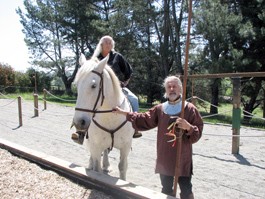
SKILL AT ARMS: Student Diane Warner learns the fine art of 14th-century warfare from Sir William.

Astride a giant white stallion, the rider comes charging down the lane at full canter. “Allez! Allez! ” he shouts, spurring the horse on. His long mane of white hair streams behind him, and his mirror-polished armor glints in the sunlight. Sir Guillaume du Perche, better known as Sir William, expertly catches a three-inch golden ring with the tip of his lance while riding by, and smiles at his success. Dismounting from his trusty steed, Rohan, Sir William cuts a dashing figure in his brown linen tunic, tall leather boots and neatly trimmed beard. His transition from mosquito-abatement worker to stately knight is complete.

While attending a Renaissance fair a few years ago, county employee William Hamersky was intrigued by a vendor selling swords. “I picked one up and had the unique sensation that I had done this before,” he says. The sword was far more expensive than he expected. “But,” he says, “I couldn’t put it down—and ended up buying it.”

He found a school in San Jose where he studied sword fighting, learning to use the long sword, dagger and rapier. He trained for several years in jousting, skill-at-arms games and European martial arts, which include wrestling and hand-to-hand combat, especially important for self-defense and fighting in war. Gradually, William Hamersky became Sir Guillaume du Perche, Sir William for short.

“Jousting originated in the Middle Ages as practice for warfare,” he explains. “Skill-at-arms games, such as ring spearing, running the quintain, archery and spear throwing, were part of the training.” Eventually, tournaments comprising these activities were held, and knights from different countries competed for prizes. The highlight of a tournament was jousting. Initially using only a shield and helmet for protection, two knights would ride toward their opponent, trying to knock him off his horse.

Their lances weighed between 10 and 40 pounds, and were 10 to 14 feet long. In addition to being used for war training, jousting was an alternative means for settling disputes. By the 14th century, knights wore full metal armor, often weighing 90 pounds or more. The weight of man, armor and weaponry necessitated horses bred for strength and speed. Accordingly, Sir William’s steed is a 2,000-pound, 17.3-hands-high Percheron, a French working breed.

True to his heritage, Rohan is trained to respond to commands in French. A gentle giant, Rohan has learned to tolerate the noise of the armor and to be comfortable with weapons, such as spears and lances, that extend beyond his head. “You have to build up riders’ and horses’ confidence,” Sir William says. “It’s all about relationships—and horse work is one phase.”

After moving to Sebastopol two years ago, Sir William bought five acres and built a jousting list, a court outfitted with the equipment needed to practice knightly arts on horseback. He exhibits his skills at Renaissance fairs and other outdoor events, but his real passion lies in teaching. He starts students practicing archery and throwing spears while walking, until their competence increases enough to use a shield and lance and work on horseback. A balsa wood tip is used on the lance so that it shatters on contact, avoiding injury. Sir William stresses that safety is paramount.


“I teach my students how to safely hold the lance and not drop it,” he says. Students also learn to ride without reins because their hands are holding weapons. “My students are usually women in their 50s or young boys of 12,” he says. “If you’re a good horse person, it doesn’t matter your age.”

Proving Sir William’s point, fifty-something student Diane Warner arrives for her lesson. “I’m always doing things that are out of the box,” she says. “The Renaissance is an era that I’ve always dreamed about, and to actually participate is like a dream come true. Sir William is a great teacher.”

 Contact Sir William and his warhorse, Rohan, for lessons or demonstrations at Full Tilt Farm, 2864 Bloomfield Road, Sebastopol. 707.827.3855.


Rocket Air

0

05.20.09

VERTIGO: Old school skateboarder Steve Caballero at the top of the Mini-MegaRamp.

Christian Hosoi stood atop the three-story structure, staring down the long, narrow wooden descent. He’d dropped in on hundreds of ramps in his life, but this time, on this ramp, was different. His heart pounded. “It was the scariest thing I’ve ever done on a skateboard,” he says soberly. “But once I did it, it went from the scariest moment in my life to the funnest day of my life.”

Hosoi and fellow legend Steve Caballero have seen plenty of changes in skateboarding. The most recent is daredevil pro skater Danny Way’s enormous contribution, the MegaRamp, and the high-speed maneuvers executed on the 63-foot tall, 293-foot long structure boasting a 27-foot quarterpipe.

Both Hosoi and Caballero will be judging and riding demos at the Mini-MegaRamp Eco-Cup skate contest June 12–14 at the Harmony Festival, a contest with a $40,000 purse. But don’t let the word “Mini” fool you; the sucker’s huge. Skaters blaze down a three-story drop-in, fly over a 20-foot gap and hit an 18-foot quarter pipe at full speed. Hosoi and Caballero first tried it earlier this year, and both describe it as a combination of horror and elation. “From how high it is, it looks really skinny,” Caballero says. “And once you go down, you’ve gotta jump the gap. There’s no turning back.”

Yes, the thrill is huge. So is the danger. In 2007, pro skater Jake Brown bailed out of a 540-degree McTwist on the MegaRamp during the X-Games and fell 45 feet onto the hard ground. Hosoi was there as a judge, and immediately got on his knees to pray that Brown would survive. “Really, we all thought he died,” he says. “When he ended up standing up and walking off and holding his hands up, I was like, I couldn’t believe it. For the people there, it was so death-defying. Seeing him walking off the ramp blew everybody’s mind.”

Brown—his slam is considered the worst wipeout in skateboarding history—is alive and well and will perform at the Eco-Cup in Santa Rosa, as will fellow pros Bob Burnquist, Omar Hassan, Pierre Luc Gagnon, Lincoln Ueda, Andy MacDonald and Adam Taylor.

The MegaRamp and its mini sibling have their share of critics who denigrate the offshoot phenomenon as being too gimmicky and not “real” skateboarding. Their squawking increased when Way used the MegaRamp to famously jump the Great Wall of China in 2005, a trick right out of the Evel Knievel handbook.

“There are people who are pretty much gonna hate on anything they don’t understand,” Caballero says. “As for me, it’s just another avenue to be creative and push skateboarding to the next level. That’s what skateboarders are always trying to do and achieve. With the MegaRamp, that’s what they’ve done. So for anybody to bag on it and say, ‘That’s not skateboarding,’ they’re pretty ignorant towards what’s going on.”

Hosoi agrees, and stresses that the MegaRamp can’t be fully experienced by watching online. “It’s something that you have to see live,” he says. “Your heart stops, and you really can’t believe it. You’re just amazed by it. That’s what people want—people are looking to be amazed. That type of energy and excitement keeps people alive. People tend to wanna go out and live a little. It pushes them to try hard as well and to really be somebody.”

The Eco-Cup Mini-MegaRamp Contest and Rail Jam goes down June 12–14 at the Harmony Festival, Sonoma County Fairgrounds, 1350 Bennett Valley Road, Santa Rosa. Free with $30–$40 day admission to festival; ages seven–12 only $10. http:-/www.harmonyfestival.com


Catching Air

Like skateboarders today, Steve Caballero and Christian Hosoi grew up around skateparks. But back in the late ’70s and early ’80s, there were scant few of them around. “They weren’t free, either,” explains Caballero. “It was a real privilege to actually go skate a skatepark,” adds Hosoi, whose dad once managed the Marina Del Rey skatepark when Hosoi was only 10. “It was like a dream for us kids, like an amusement park.”

During the 1980s, insurance issues closed most skateparks, but skating refused to die; from ’85 to ’89, it became more popular than it had ever been. The push to build skateparks resurged, and in 1998, California designated skateboarding a “hazardous recreational activity,” virtually eliminating all municipal liability. Skatepark construction exploded.

“I think right now is the best time in skateboarding because of all the different places available,” Caballero says. “We’ve never had so many skateparks in the history of skateboarding. It’s insane. And they keep building them! More and more! They’re not stopping!”

The North Bay is home to some of the best skateparks around; most stay open from dawn to dusk, and most require helmets or pads, although enforcement varies.

Healdsburg The Carson Warner Memorial Skatepark features a shallow, 4-foot, U-shaped miniramp with good coping and big, loose transitions—it’s great for beginners—which is connected via a spine to 6-foot, clover-style carving bowls. Nearly half the park is taken up by a great street area, with quarter pipes, hips, rails and a large funbox. The park’s layout makes for interesting combinations. 1300 Grove St.

Napa This 16-year-old park, small and out-of-date, has a short snake run, an extremely tight bowl with no coping, a metal quarter pipe and a small street area. Yajome and Clinton streets.

Novato Sometimes the simpler designs are the best. This park features large, expansive bowls, connected together with smooth concrete, plenty of hips and fast coping. Lots of open space and deep, seven-foot transitions are great for fast runs. With rails, stairsteps and street area. 1200 Hamilton Parkway.

Petaluma Its humps, banks, volcano, three- and six-foot bowls and long rails are good for beginners. 900 E. Washington St. (Petaluma’s skatepark is eclipsed by newer public parks nearby, and by Petaluma’s Ramp Rats, a privately owned indoor park of mostly wooden ramps for BMX and skateboards at 1004 Lakeville St.; $5–$15 admission fees.)

San Rafael The huge McInnis Skatepark—which cost over $1.6 million—features a washboard bowl with various heights of mini halfpipes; a cloverleaf bowl with three small, tight pools; a key-shaped bowl with a volcano-shaped middle; and a nice 7-foot-to-11–foot-deep peanut pool. 350 Smith Ranch Road.

Santa Rosa The North Bay’s oldest skatepark—and pro skater Tony Trujillo’s stomping ground—is still dear to the hearts of old-schoolers. A long snake run that gets deeper and deeper into a large bowl is the main attraction, providing endless combinations with a Zen-like flow; a funbox, stairset, curb and rail are here too. Locals still talk about the day that Tony Hawk stopped in for a session in 1995. 1725 Fulton Road.

Sebastopol A gem with a perfect mini bowl; a huge banked street area with large funbox; a deep, hipped halfpipe-style bowl with cradle extension; and a smooth, perfectly transitioned deep pool with vert. In Sebastapudlian fashion, it’s outfitted with a living-roof tool shed, a flow-form water sculpture, a bio-infiltration area for managing storm water and several community garden plots. Great for all skill levels. Any graffiti, the park closes for a week! 6700 Laguna Park Way.

Sonoma This older skatepark has held up over the years, with a shallow bowl connected to a three deeper bowls and numerous banks, quarter pipes, rails, a funbox and a stairset. More coping would have helped, but it’s still decent. Verano Avenue at Arnold Drive.


St. Helena (under construction) Due to be finished this year, this park will feature a huge bowl with a cradle extension, a smaller cloverleaf bowl, lots of banks, stairsets and rails. One of the few area skateparks not designed by Santa Cruz’s Wormhoudt Inc., the Crane Park location—right over the home-run fence of the baseball diamond—is being built by Grindline Skateparks and looks outstanding. Crane and Grayson avenues.

Windsor The Pat Elsbree Skatepark is perfect for beginners, with two huge, shallow bowls of loose transitions and no coping; these connect to a deeper washboard vert pool for the more seasoned. Benches and rails abound, with a pair of quarter pipes. 9680 Brooks Road South.


Flight Risk

0

05.20.09

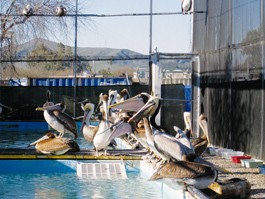
SEABIRD SANATORIUM: Pelicans recover poolside at the International Bird Rescue Research Center in Cordelia in late January.

When word came to the Central Coast WildRescue center this winter that California brown pelicans were showing up in the mountains or wandering on roads far from the sea, wildlife paramedics set out to find them. They saw dozens of dead ones in the greater Monterey Bay area, said WildRescue founder Rebecca Dmytryk. Those that were still alive acted “down,” a term used to describe a bird that is not bright and alert. The 28 surviving pelicans were carefully captured and transported to the International Bird Rescue Research Center in Cordelia at the northern end of San Francisco Bay.

During what came to be known as the “pelican mortality event” this winter, at least 500 pelicans were reported dead or debilitated along the West Coast from Astoria, Oregon to Baja California. Some showed signs of disorientation and some were found in odd places, such as a mountain in New Mexico. Many had severe frostbite on their pouches and feet, leading scientists to believe that the cause of the event was likely related to climate change. With unseasonably warm fall weather in the Pacific Northwest, some 5,000 pelicans had lingered at their summer and fall roosting sites in northern Oregon. When a freezing winter storm hit in mid-December, they were forced to migrate in harsh conditions that included 60 mph winds.

During the event, scientists, vets and rehabilitators shared notes and tested the dead birds. San Diego’s Sea World performed necropsy exams on eight to 10 birds. The U.S. Geological Survey National Wildlife Health Center in Wisconsin tested four. Tests were also run at the California Animal Health and Food Safety Lab at UC Davis and the California Department of Fish and Game’s Marine Wildlife Lab in Santa Cruz. The birds tested negative for avian influenza and West Nile virus, and though there were a few birds that tested positive for domoic acid—a type of harmful algae bloom that has been the cause of bird and marine mammal mortalities since its discovery in 1991—but the levels were low.

David Jessup, senior wildlife veterinarian for the California Department of Fish and Game, compiled information from pathology reports, transect counts and observations from field biologists and clinicians. What he found was a variety of signs and symptoms that weren’t consistent. The findings led him to state in an interim report that the December storm seems to have been the primary cause of the event, but it doesn’t account for all observations or findings. “Some other causes of illness and death remain unexplained,” he wrote.

One thing researchers didn’t test for was saxitoxin, one of the most potent natural toxins known. Saxitoxins are a family of single-celled naturally occurring dinoflagellates that cause paralytic seafood poisoning (PSP) in humans.

Maybe they should have run those tests. While the pelicans dive-bombed for fish in Oregon’s late Indian summer weather, the entire coast of Oregon was closed to mussel harvesting due to elevated levels of PSP toxins. Is it possible that PSP toxins were a factor in the pelican mortality event?

“It’s highly possible,” says Matt Hunter, shellfish project leader of the Oregon Department of Fish and Wildlife, “but without testing it’s hard to say.”

Saxitoxin Spike

Why didn’t they test the birds for saxitoxin? For one, as of late February, Jessup wasn’t aware of the mussel-harvesting closure. Perhaps that’s because there wasn’t a big red-tide event that covered multiple counties like the one California had in 1991. Gregg Langlois, a senior environmental scientist with the California Department of Public Health, had just started his job in 1991 when he witnessed a saxitoxin-laced bloom, or red tide, that covered Marin County’s Drake’s Bay. (Physical discolorations in the water are referred to as blooms, but not all visible blooms are toxic.) There wasn’t a bloom in Oregon this winter, just mussels with enough toxins in their flesh to warrant a ban on harvesting.

Along the West Coast, PSP toxins are associated with upwelling and can threaten human health and coastal economies. To help keep the public safe, shellfish are tested regularly. In California, shellfish are monitored for neurotoxins year-round, in addition to seasonal quarantines. In Oregon, the Department of Agriculture (ODA) tests razor clams, oysters and mussels for PSP toxins and domoic acid, both of which can cause minor illness and more serious problems leading to death. If the bivalves tested show 20 parts per million for domoic acid or 0.8 parts per million for PSP (80 µg- 100 g), the area is closed to harvesting for a minimum of two weeks.

“The closures are not unusual,” says Sarah Schwab, a food-safety specialist with the ODA. “What is unusual is the length of time the beaches were closed to harvesting this fall and winter.”

The ODA closed the entire coastline of Oregon to mussel harvesting on Oct. 10, 2008, and didn’t deem harvesting safe until Jan. 20, 2009, when they reopened the beaches. The highest spike in PSP toxins found was on Nov. 10 in northern Oregon at Silver Point, with 441.4 µg-100 g, and at Cape Meares, with 384.6 µg-100 g, four to five times the threshold amount. Both locations are south of the Columbia River and within foraging range of East Sand Island, the largest communal pelican night roost north of the Farallon Islands.

The numbers seen in Oregon don’t reflect mussels that are particularly “hot,” according to Hunter. To put the numbers into perspective, the 1991 PSP red tide seen by Langlois in Marin County topped out at 10,000 µg-100 g.

But it’s possible that even relatively low concentrations are dangerous to wildlife. It’s unknown how sublethal exposure affects a bird’s long-term health. “We don’t have a handle on the lethal dose of toxins for birds,” Langlois says. “It’s just a black hole.”

Paralytic seafood poisoning toxins are known to bioaccumulate in shellfish, like mussels and razor clams, but not necessarily in pelagic fish like sardines and anchovies. “Normally, we think of PSP toxins as showing up in shellfish,” says Raphael Kundela, a professor in ocean sciences at UC Santa Cruz, “but many organisms eat phytoplankton, including fish.”

In an article in the January 2009 issue of Harmful Algae, a group of scientists reported that they found the first evidence of PSP toxins in northern anchovies and Pacific sardines in Monterey Bay and some California coastal regions. Pelicans don’t eat shellfish, but they do eat sardines and anchovies.

A New Threat

California brown pelicans are getting ready to fly off the state’s endangered species list. In early February, the state Fish and Game Commission voted to take them off the list where they have been since 1971. If approved by the Office of Administrative Law, the pelican will be the first endangered species in the state to be delisted due to recovery. Their numbers have now reached 8,500 pairs.

As pelicans fly into the sunset with their eight-foot wingspan, harmful algae blooms are increasing with virility around the world. Scientists aren’t certain why, but suspect increased nutrients from agricultural runoff and human waste, changes in the climate and the movement of algae in ballast water. In California, there has been a sea change in the dominant phytoplankton community since 2004, says Kundela. Dinoflagellates are on the rise. Scientists don’t know the reason for this either, he says, but they suspect that with less upwelling and warmer surface water, conditions are selecting for more dinoflagellates. Oregon’s waters are changing, too. “When I first started 14 years ago, PSP was a summertime event and domoic acid was a cooler water, winter event,” says ODA’s Dawn Smith. “That’s not the case anymore. We’re now seeing PSP in the dead of winter.”

The good news is that the West Coast is well monitored and regulated. As a result, there hasn’t been a human illness caused by PSP in the last decade.

The bad news for pelicans and other seabirds is that they can’t read the posted signs or check their emails for notices of harmful algae blooms. They gulp what they see, and as an indicator species, communicate what’s going on in our oceans.


Live Review: Santigold, Amanda Blank & Trouble Andrew – The Warfield , San Francisco – May 21, 2009

0

It seemed like the best kind of 80s dance party at the Warfield last night, with bright New Wave fashion onstage and off and music that, for the most part, tastefully referenced the time period’s styles.Santogold’s summer tour kicked off right, with her boyfriend Trouble Andrew. The former pro snowboarder must have learned something from the competitive Olympic spirit because, despite his opening slot, he came to win. Not only was his band visually stunning (featuring a guy in a giant skull mask and a gold chain around his neck, just standing there nodding), they offered kinetic, tight renditions of songs from his recently solid self-titled debut, including a more rocking’ “Chase Money”. His brand of solid post-punky synth-pop makes him the male Santigold with an added dose of kitsch. Trouble Andrew exhibited a great stage presence. Whether rapping or singing (thankfully light on the vocoder-ish effect heard on his recordings), he enthralled the audience, even writhing around the floor like he was Iggy (synth-) Pop. A nice surprise for the crowd, who seemed converted at the set’s end.

Next up was Amanda Blank, whose performance didn’t fare nearly as well. Armed with a just a DJ, a lackluster singing voice, and a short black skirt, she didn’t offer much to supplement her homogenous set of mid-tempo dance tracks. Things improved as she sang less and rapped more, spitting the sex rhymes that have generated much buzz on guest spots with Spank Rock and others. But the songs were still hampered by her palpable reticence (and the complete lack of stage decor or a light show). But half her set was a little too derivative, including her first single “Might Like You Better”, a reworking of Romeo Void’s “Never Say Never”. Things ended hopefully with “I’m the Coldest Bitch You Know”, easily the best song of the set. But we’ll see if she grows as a performer on this tour because her stage moves just do not cut it.

Blank’s best friend from Philly ruled the night as expected. Even with the same nonexistent stage decor, Santigold did everything right, from the visuals (especially two bespectacled Devo-like backup singer-dancers) to the faithful renditions of each song from her stellar eponymous debut LP. Decked out in a shiny gold suit, Santigold (recently changed from Santogold due to legal threats from an infomercial jeweler) was so relaxed and engaging throughout the night that even false starts with her new band didn’t slow the momentum.

Her meager output was actually a good thing, since she had room in her show for side projects & obscure tracks, most notably her verses from the recent Jay-Z track “Brooklyn We Go Hard” and the Africanized “Get It Up”, the best song off last year’s brilliant mixtape with Diplo “Top Ranking”. Another strength is her voice, despite its limited range, which proved dexterous in songs from the feathery alt-pop of “Lights Out” to the throbbing dubstep of initial set closer “Creator”, where she invited half a dozen crowd members onstage for an impromptu dance routine.

Though her songs each sound different from one another, her bassist and guitarist didn’t actually get much of a live workout except for a few songs (best of all a delicious punk song from Stiffed, Santi’s former group). Nonetheless, each song is a stunner and her musical diversity appears entirely organic, a hopeful sign throughout the evening that we may really live in a veritable “post-genre” age.

Even without a wealth of quality material buoying her, Santigold’s down-to-earth charm and onstage comfort would make her an amazing master of ceremonies. “You better not put that near anything hot,” she told a fan early in the show after signing his vinyl copy of her LP,“…not like it’s not hot already.” Everyone laughed, then everyone danced.––– David Sason

Long in the Tooth

0

05.20.09

A moment of clarity hit me this week. While putting my thoughts together for this pick, a couple of incidents stopped me in my tracks. I had just put a movie in my DVD player and was sitting back with a box of Junior Mints when a tooth fell out of my head! Popped right out. The whole thing, roots and all. It was a molar, and it was already dead as I had a root canal 20 years ago, so there was no blood, no pain—but still!

I am at a certain age (my friend Roy calls us the Sonic Boomers) where things begin to go south. I then recalled that the first time I saw Joe Cocker perform. It was 40 years ago! How could that be? I was just a pup, in early high school, and my friends and I arrived at the Kansas City Memorial Auditorium on a snowy December evening for a great triple bill: Fleetwood Mac (the original band, with Peter Green) was the opener, Jethro Tull up next and rounding out the marquee, Cocker.

Because of the weather, and it being a school night so close to Christmas, the crowd was small. In fact, the emcee invited all of us in the balcony to come down to the front of the house to fill it up. We had just settled into our sweet new seats when the acid kicked in.


The sonic beats of Fleetwood Mac had heavy emphasis on the rhythm section, Ian Anderson of Jethro Tull dressed like a resident of Sherwood Forest, swirling across the stage, the sound of his flute bouncing off the walls around us. And then there was Cocker. A white man with a voice like Ray Charles, his face grimacing to reach every note, his body writhing, not in rhythm with the music, but to its own almost spastic glory. From Woodstock to Mad Dogs and Englishmen (one of the best live albums of all time), Joe is still out there getting it done. As am I. Getting old can be a bitch, but it beats the alternative.

A wonderful array of artists are in town for Sonoma Jazz+, minus the jazz, and a tooth. Cocker performs with Keb’ Mo’ on Friday, May 22, at the Field of Dreams, 151 First St. W., Sonoma. 6:30pm. $54&–$104.


Making Cash Green

0

05.20.09

In the Arctic, sea ice is melting. In the United States, houses are foreclosing. And in Washington, the Senate is becoming a real-life Bermuda Triangle for progressive agendas. Proposals for major limits on carbon emissions aren’t getting far in the Senate, where the corporate war on the environment has an abundance of powerful allies.

As for class war, it continues to rage from the top down. Recently, a dozen Democratic senators teamed up with Republicans to defeat a bill that would have allowed judges to reduce mortgages in bankruptcy courts. President Obama supported that bill. But as the Associated Press reported, he was “facing stiff opposition from banks” and “did little to pressure lawmakers” on behalf of the measure. The Senate “defeated a plan to spare hundreds of thousands of homeowners from foreclosure through bankruptcy.”

Big-money vultures are circling the Capitol Dome to feast on the latest multibillion-dollar carrion, whether under the heading of “cap and trade” or “healthcare reform.” And many billions in profits can be found inside yet another supplemental bill to fund war in Iraq and Afghanistan.

Meanwhile, a familiar pattern is unfolding for the most important piece of labor legislation in decades, the Employee Free Choice Act, which would go a long way toward protecting the rights of workers to form unions. Obama says he supports EFCA. But there are no signs that he’ll go all-out for its passage.

There are pluses and minuses on Capitol Hill these days. But on big-picture items, it’s clear that environmentalists and labor-rights activists are mostly up against the corporate wall, and that wall is not yielding.

We need a Green New Deal.

It won’t happen without a lot more effective grassroots coalitions, strong and sustained enough to change power relations for the long haul. But acculturation in the States often encourages us to think along the lines of solo acts. There’s the old American story about the solitary Dutch boy who discovers that a dike has sprung a leak. He inserts his finger, hangs in there heroically by himself and saves the town.

But in the real world, individual heroics are a fool’s gold when compared to the genuine value of building political movements. The immense obstacles to effective grassroots organizing can be overcome not by lone rangers, but by persistent organizers and coalition-builders.

During the last six months, I’ve participated in a lengthy series of meetings with many other local activists. Across two counties in Northern California, we’re about to launch a long-term project called the Green New Deal for the North Bay. It’s just a start. But as we begin a round of public forums throughout the region, we’re in the process of developing a grassroots agenda for far-reaching change that will address two key questions. First, how can we create a sustainable green future that includes economic equity and social justice? Second, how can agendas for economic rights and environmental protection become more integrated and more successful?

Seventy-five years after the start of the New Deal, and nearly 40 years after the first Earth Day, the need for basic change on behalf of social justice and ecology is clear. But ideas are the easy part. In an era of massive environmental damage and vast economic inequality, we’ve got to organize.

Green New Deal community meetings are Thursday, May 21, at 6:30pm at the Sonoma Community Center, 276 E. Napa St., Sonoma. Saturday, May 30, at 5pm at the Santa Rosa City Hall, 100 Santa Rosa Ave., Santa Rosa. Tuesday, June 2, at 6pm at the Petaluma Library, 100 Fairgrounds Drive, Petaluma. Thursday, June 4, at 6:30pm at the Novato School District Office, 1015 Seventh St., Novato. For details, go to [ http:-/www.greennewdeal.info- ]www.greennewdeal.info.

 Norman Solomon, co-chair of the national Healthcare NOT Warfare campaign, is the author of many books including ‘War Made Easy: How Presidents and Pundits Keep Spinning Us to Death.’ In California, he is co-chair of the Commission on a Green New Deal for the North Bay.

Open Mic is now a weekly feature in the Bohemian. We welcome your contribution. To have your topical essay of 700 words considered for publication, write op*****@******an.com.


Scope and Generosity

05.20.09A northern neighbor of ours many years ago made the crisp distinction between residents of Canada and those of the United States, wryly insisting on similarity. Canadians, he explained, are simply "unarmed Americans with healthcare coverage."Many of us are concerned about our dysfunctional healthcare system, the one institution where one would not expect greed to run ahead of compassion—unless you...

Prison Playing

05.20.09 LITTLE LEBOWSKIS: The author is in the second row, next to the bare-shirted guy who got beaned. From the parking lot of San Quentin State Prison's East Gate complex, visitors have a sweeping view of the coastline that evokes Camelot as much as Quentin. In the distance loom the green, rolling pastures of the coastline, visible over the parapets that...

Letters to the Editor

05.20.09Frivolous lawsuits? I worked with Bob Swofford from 2006 to 2008 and observed how he acted with others in the newsroom ("Two Towers," May 13). I always found him to be professional, fair and a true gentleman. The allegations set forth in the lawsuit seem preposterous to me. I think we all lose when frivolous lawsuits are filed,...

Double Dutch

05.20.09 The summer movie market includes about 10 sequels. It would be hard labor to do the exact math, but two of them represent the battle of the die-offs: 'Final Destination: Death Trip' vs. 'H2' (Halloween 2, Aug. 28). The conjunction is all part of 2009's peculiar doppelgänger effect.First, we had Liev Schreiber re-creating his part...

Modern Jousting

05.20.09 SKILL AT ARMS: Student Diane Warner learns the fine art of 14th-century warfare from Sir William. Astride a giant white stallion, the rider comes charging down the lane at full canter. "Allez! Allez! " he shouts, spurring the horse on. His long mane of white hair streams behind him, and his mirror-polished armor glints in the sunlight. Sir Guillaume du...

Rocket Air

05.20.09 VERTIGO: Old school skateboarder Steve Caballero at the top of the Mini-MegaRamp. Christian Hosoi stood atop the three-story structure, staring down the long, narrow wooden descent. He'd dropped in on hundreds of ramps in his life, but this time, on this ramp, was different. His heart pounded. "It was the scariest thing I've ever done on a skateboard," he says...

Flight Risk

05.20.09 SEABIRD SANATORIUM: Pelicans recover poolside at the International Bird Rescue Research Center in Cordelia in late January. When word came to the Central Coast WildRescue center this winter that California brown pelicans were showing up in the mountains or wandering on roads far from the sea, wildlife paramedics set out to find them. They saw dozens of dead ones in...

Live Review: Santigold, Amanda Blank & Trouble Andrew – The Warfield , San Francisco – May 21, 2009

It seemed like the best kind of 80s dance party at the Warfield last night, with bright New Wave fashion onstage and off and music that, for the most part, tastefully referenced the time period’s styles.Santogold’s summer tour kicked off right, with her boyfriend Trouble Andrew. The former pro snowboarder must have learned something from the competitive Olympic spirit...

Long in the Tooth

05.20.09A moment of clarity hit me this week. While putting my thoughts together for this pick, a couple of incidents stopped me in my tracks. I had just put a movie in my DVD player and was sitting back with a box of Junior Mints when a tooth fell out of my head! Popped right out. The whole thing, roots...

Making Cash Green

05.20.09In the Arctic, sea ice is melting. In the United States, houses are foreclosing. And in Washington, the Senate is becoming a real-life Bermuda Triangle for progressive agendas. Proposals for major limits on carbon emissions aren't getting far in the Senate, where the corporate war on the environment has an abundance of powerful allies.As for class war, it continues...
11,084FansLike
4,446FollowersFollow
6,928FollowersFollow