Good as Gold

06.03.09

The best thing about a shakeup, economic or otherwise, is the way it provokes innovation and creative social change. A near fatal experience for human rights attorney Edgar Cahn sparked a brilliant idea for bettering the quality of human life. And almost 20 years later, his idea has materialized in places around the world, evolved through practice and is ready for use by communities where lives are being shaken up by an unreliable economy and by people seeking positive change. It’s called “time banking” and it rebuilds something wonderful, something called the “core economy,” that doesn’t have anything to do with money.

A few of us are just now organizing a time bank over in Napa, and we have several hundred models to study in this country and even more in 21 other countries around the world. The closest time banks are in Oakland and Walnut Creek. One thing that’s apparent is that each one is unique and evolves to reflect the character of the community.

How a time bank functions on the surface is very simple and straightforward: I exchange one hour of my time providing a service to someone in my community, and in return I receive one hour of service. For example, I spend one hour cooking for someone in my community. For someone else, I spend two hours writing web copy. Into my time bank account goes one “time dollar” for each hour of service I provide. Then when I need someone to help in the yard, I search the time bank website or call the organizers, and they locate someone whose service is yard work. I can spend some of my banked time dollars in exchange for that service. It’s an hour-for-an-hour exchange, so a lawyer’s time is worth the same as a gardener’s. Everyone’s service has the same value, because this is a core economic system.

“Core economy” was coined by economist Neva Goodwin to describe the not-for-sale worthiness of relationships and services provided close to home or close to heart. In numerous writings over the years, Cahn emphasizes how the core economy has been damaged by the money economy. The former operates on values including love and trust and reciprocity; the latter, upon price and supply and demand. Both are systems where goods and services are exchanged, and both systems are necessary, but the core economy needs rebuilding. The time banks website (www.timebanks.org) explores how interpersonal connections have suffered by having “paid professionals [do] the work that once was an integral part of family and community life.”


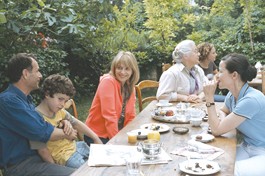
Time banks are changing that. Consider Jane Doe, age 85, who needs to get some groceries but has no car and no close family members in town. In the money economy, she can pay a taxi or call a social-service agency that provides rides to seniors, but one is expensive and the other makes her feel old and dependent. As a time bank member, Jane calls for a ride with another time bank member, exchanging the time dollars she banked by tutoring a child in math. Not only is her need met without spending a dime or depending on an agency, but she feels good about her contribution to the community. She might also make a new friend on her way to the store. If I were the one giving Jane a ride, I’d ask her math questions as we drove and she could ask me for my curry soup recipe.

As for recipes to build local community, I am full of hope for what time banking might bring to my community—and to me, a single mom. I will report back in this column when we see what emerges in Napa. Meanwhile, since my community is full of self-proclaimed “foodies,” I will include part of a recipe found on the time banks website: “Take as many fresh people as can be found locally. Sift out their spare time and individual talents. Blend and mix thoroughly. Season with a healthy sprinkling of reciprocity. Add a hefty heaping of fun. Leave to prove in a warm environment to allow trust to permeate.”


Good Knight

06.03.09


With certain well-known stage shows, simply ordering up a ticket can be an act of faith and courage. As someone who sees 60 to 70 plays a year, many of them repeats of the same favorites over and over, I can’t help but end up with favorites (Proof, which I’ve seen in five different productions; Hamlet, nine productions) and one or two least favorites. Man of La Mancha, Dale Wasserman’s 1965 musical adaptation of Miguel de Cervantes’ 1605 novel Don Quixote, is a show that is beloved by many, but not by me. Despite an intriguing central device—Cervantes spins the Don Quixote story while in prison, using his fellow prisoners as “actors” in his tale—and a song, “Impossible Dream,” which stands as one of the most beautiful and stirring anthems ever written for the stage, Man of La Mancha is a play fundamentally beset by problems.

Structurally, its story-within-a-story-within-a-story concept is not easy to pull off coherently, demanding Herculean feats from its lead actor, who has to play Cervantes playing the mad Alonso Quijano, who thinks he’s a knight name Don Quixote, and to offer defined characterizations of each one. This is not as easily done as said. In the last production of La Mancha I dragged myself to, the actor played all three exactly the same, making it impossible for the audience to feel the pathos and tragedy intended by the playwright.

Then there’s the matter of the rape scene, in which the country peasant girl Aldonza, inspired by the mad “Quixote” to show kindness to a band of ruffians, instead falls victim to them. Attempts are often made to stage this scene as some sort of “ballet” or stylized contrivance, which usually results in an already horrifying scene being drawn out and made even more unwatchable. Suffice it to say, Man of La Mancha is a problem play, and few companies have the resources or genius needed to make it work.

Jim Dunn, on the other hand, is a director whose specialty is problem plays. Having helmed 27 consecutive Mountain Plays, he’s proven that the more problematic a show is, the better it ends up when he’s the director. Such was the case two years ago with Hair, a play even more flawed then La Mancha; in Dunn’s hands, it was spectacular.

So here I am saying that the Mountain Play version of Man of La Mancha, one of my least favorite shows, is not only the best musical I’ve seen this year, it’s the best production of La Mancha I’ve ever seen.

Even the ending got me, so thoroughly caught up in Dunn’s vision was I by the climax that I sat there blubbering along with 2,000 other audience members as Aldonza finds the dying Quijano and shares what his “impossible dream” has meant to her.

In the difficult lead, William Elsman never lets us forget that there is a frightened, somewhat calculating idealist (Cervantes) under Quixote’s fake beard and stagy deliveries. As the madman’s devoted servant Sancho Panza, comic actor Randy Nazarian is pitch-perfect, fusing the vocal comedy of Dom DeLuise with the wild physicality of Nathan Lane. And as Aldonza/Dulcinea, Linda Gaudianni is outstanding, convincingly fierce and fragile at the same. All three have strong singing voices, though on opening day the high notes were challenging them all a bit.


The vast outdoor stage area of Mt. Tam’s Cushing Amphitheater is perfect for this show, allowing Dunn to create the imposing fortress where Cervantes is kept, to populate it with a large cast of fellow prisoners, and to even include the famous windmill with which Cervantes does battle. With such a large canvass, Dunn works wonders (note the second act’s brawl scene, a pandemonium of action) that would have looked lame on a smaller stage. At the same time, he knows when to hold back; the rape scene, staged here more as a taunt-filled abduction, is effectively dramatic, but avoids the kind of audience-shattering detail so many directors choose.

In nearly every way, this show is a triumph. The problems are there, but through cleverly avoidance and misdirection, they hardly seem to matter. Wisely, director Dunn keeps his emphasis on the fun and action of Cervantes’ story, and ultimately convinces us that Quixote’s beautiful dreams, mad or not, are worth fighting for. 

‘Man of La Mancha’ runs Sundays at 1pm through June 21, with one Saturday performance on June 13. $23&–$40. Performances held at the Cushing Memorial Amphitheatre on Mount Tamalpais. Shuttle busses available and recommended. For full details, visit [ http://www.mountainplay.org/ ]www.mountainplay.org.


Museums and gallery notes.

Reviews of new book releases.

Reviews and previews of new plays, operas and symphony performances.

Reviews and previews of new dance performances and events.

Thirst Parlors

0

06.03.09


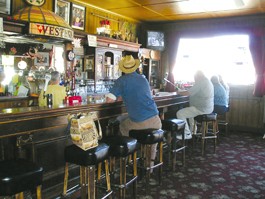
We’ve seen those old saloons in the Westerns. Someone is playing the piano, a curmudgeonly bartender or friendly barmaid slaps a whiskey on the bar, the regulars check out the newcomer. But Hollywood doesn’t begin to do justice to the real “thirst parlors,” as the genteel used to call them, that still survive in the West.

Comfy, cozy places, rich with the patina of years, these saloons continue to offer the pleasures of liquid refreshment, companionship and, often, some decent grub. They usually have a colorful history, strange aged objects hanging on the walls, a piano tucked somewhere and, yes, an appropriate barkeep.

In these days of gentrification and yuppification, it is getting harder to find the genuine article, but I found five tucked into the small towns of western Sonoma and Marin counties.

Rancho Nicasio

This colorful thirst parlor started its life as a hotel for the hardy horseback and buggy travelers in 1868. The Nicasio Hotel burned in 1940 and was rebuilt in its current form. The minute you walk in the door, you know you have found the real thing. This place boasts the most impressive collection of hunting trophies you can imagine: a bear, an African Cape buffalo, elk, caribou, wild boar, a rare miniature deer and that joke animal the jackalope (a rabbit with antlers).

The place has changed ownership from time to time over the years and now belongs to Bobby Brown of rock and roll fame. It has quality live music on weekends. Nasso, with a dry sense of humor and built like a bouncer, is the head bartender.

One story locals pass on is that on Election Day in 1927, authorities showed up to see if alcohol was being served. But the locals got word and all traces of drink had vanished. A baseball field outside the saloon has served some players who went on to the big leagues. 1 Old Rancheria Road, Nicasio. 415.662.2219.

Old Western Saloon

Dating from the early 1900s, this place has slaked the thirst of folks in Point Reyes Station with style for almost a century. Some of its regulars have been known to enter the place on horseback.

Two nudes, one antique and one more modern, hold court over the bar. Although they don’t have official names, one local fondly referred to them as Trixie and Trashy. In its colorful past, not all the nudes were on the wall. In its heyday as a brothel, ladies resided behind doors marked with their floral names. When the place was under repair the owner found transoms with names like Rose and Daisy painted on them.

This thirst parlor does not serve food, but bartender Helen Skinner points out that the Chinese Chuck Wagon parks outside six days a week. Some notables have made it a point to visit the venerable Old Western, including England’s Prince Charles. His photo taken in the doorway stands as witness.

It has been owned by Judith Borello for the last 37 years. She leaves the day-to-day management to her staff, but sometimes shows up riding in her golf cart with a Rolls Royce grill in front. When you pay for beer in this place, it gets rung up on a cash register that dates back to 1913.

On weekends, there is live music on the dance stage. Alas, the old Wurlitzer jukebox that held such gems as “Rag Mop” and “Earth Angel” is no longer functioning, kept now solely out of nostalgia. 11201 Hwy. 1, Point Reyes Stattion. 415.663.1661.

Washoe House

This gem on Stony Point Road in the countryside between Rohnert Park and Petaluma began as a stagecoach stop in the 1859 and is famous for its ceiling. Yes, ceiling. Once, long ago, a rambunctious patron demonstrated his six-shooter and shot a hole in the ceiling. The angry owner insisted he’d have to pay to fix it. The gun-totin’ fellow climbed up on a stool and tucked a dollar bill into the bullet hole and said that should take care of it. Since then, thousands of folks have done the same using thumbtacks instead of bullet holes. The ceiling is completely encrusted with money.

Cheryl Jensen has inherited ownership and takes excellent care to preserve its unique atmosphere. A nude named Lydia presides over the saloon. She was painted by a man named Flint in 1896. A variety of junk adorns the wall in back of the bar—old musical instruments, boxing gloves and such. And of course, there’s a piano against one wall waiting for a musical customer. Stony Point and Roblar roads, Cotati. 707.795.4544.

The Casino

Don’t let the name fool you, there is no gambling here. It was named by the Casini family, who have owned the building since it was built in 1874 as a general store to serve the small town of Bodega. Evelyn Casini laughs, “They sold everything, even insurance.”

Almost 60 years ago, she and her late husband turned the place into the town institution it has since become. Today, Greg and Elizabeth Schimpf, the new owners, are maintaining the traditions, although Evelyn, known as “Mom” by many, still holds court.

The entire town donated its deer-hunting trophies over the years. There is one corner Evie calls “the freaks.” It has deer with malformed antlers and a raccoon. Old photos of Bodega and antique beer signs make visitors nostalgic.

 There’s a small theater in back that is going to get smaller soon.

“We desperately need storage, but we’ll keep a space for local performances,” Elizabeth Schimpf says.

Years ago, Art Casini hired a sign painter who painted the door to dining area and piano with a sign that said “Dinning Room.” No one would let Art change the sign (“We can make noise in there”), so the Dinning Room houses ad hoc town meetings as well as parties, weddings and occasional poetry readings.

There’s home-cooked food—cook’s choice at very reasonable prices—and the Casino even offers late-night service. It is a family-friendly place. There are pool tables and an old-fashioned pinball machine. A grassy outdoor area offers up barbecued oysters and other goodies on summer weekends.

Alfred Hitchcock’s crew used to eat lunch here while filming The Birds. The crew gave Evelyn a couple stuffed crows from the movie set that stand guard over a teddy bear up on a tiny decorative balcony. 17000 Bodega Hwy., Bodega. 707.876.3185.

The Union Hotel Saloon

Dating from Occidental’s rowdy railroad days of the mid-1800s, the Union was taken over in the early part of the 1900s by the Panizzera family. The Italian-born patriarch made some very welcome changes to the menu.

“My dad worked hard, but it was my mom’s cooking that really made the place a success,” Lucille Gonnella remembers. The second generation of Gonnellas runs things now, but the Union Hotel Saloon has remained the same. A lovely lady in skimpy flowing robes graces one end of the bar, and the regulars decorate the rest. It is plastered with odd and puzzling signs that some of the patrons have been trying to fathom for years. Only the bartenders really know the answers to the trickiest ones.

“One of our secrets of success is that we’ve always had really good bartenders,” Gonnella says.

In fact, some locals are convinced that the ghost of one, the late John Wagner, who died in 2005, still presides benignly over the saloon. He worked there the longest, 26 years.

Two other friendly ghosts haunt the Union, Lucille’s late husband, Mahoney, who used to play music on Friday nights, and her son, Mark, who ran the saloon most of his life. But there are plenty of live folks to keep the Union jumping.

The kitchen serves up food that has taken gold medals at the Harvest Fair, and is renowned for its pizza and bruschetta. It, like the Casino, is very much a family place.

There may be other thirst parlors out there, but with these five you can’t go wrong. And oh, if you figure out the sign in the right-hand corner at the Union, please let me know what it means. 3731 Main St., Occidental. 707.874.3444.


Quick dining snapshots by Bohemian staffers.

Winery news and reviews.

Food-related comings and goings, openings and closings, and other essays for those who love the kitchen and what it produces.

Recipes for food that you can actually make.

Spawning Discontent

0

06.03.09

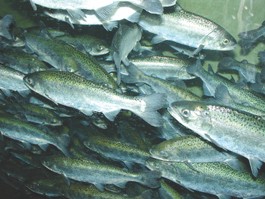
WALK ON WATER? Back in the early aughts, it was well-nigh possible. My, what a difference seven short years have made!

As the state’s commercial fishermen and sport anglers look at another cancelled season for Chinook salmon, the California Fish and Game Commission has green-lighted a short recreational season in the Sacramento River. Scheduled to begin in mid-November, the season will allow anglers one Chinook salmon per day between the Red Bluff Diversion Dam and Knights Landing, just miles from their spawning grounds.

As might be expected, not all ocean fishermen are pleased with the decision, though Department of Fish and Game (DFG) biologists assure that no more than 2,000 late-fall run Chinooks, a healthy race of salmon, will be harvested during the six-week season, which will last from Nov. 16 to Dec. 31. The season, explains DFG biologist Scott Barrow, has been carefully slotted to preclude any capture of individuals from struggling salmon runs, namely the winter-run Chinook, an endangered species that spawn in the Sacramento between January and March, and the fall-run Chinook, which spawn from August through October.

The fall-run Sacramento Chinook was until recently the mainstay of the West Coast’s ocean fishery but is now teetering at roughly 10 percent of its population level in 2002, when more than 800,000 fall-run fish returned to spawn. Last year, only 66,000 made the migration up the Sac, and officials estimate that just over 122,000 will return this fall. The late-fall-run Chinook, by contrast, has numbered between 10,000 and 20,000 fish for decades and is considered stable.

In late 2008, the state allowed a similar Sacramento River salmon season. From Nov. 1 through Dec. 31, anglers caught 1,732 Chinook, according to DFG biologists who carefully monitored the fishing. The catch included several dozen individuals that might have been fall-run fish, according to Barrow.

This year, the season will be delayed two weeks with the hope that all fall-run Chinook will have spawned and died before the opening day.

“Delaying the season should alleviate that incidental fall run catch,” predicts Dan Wolford, who nonetheless opposes the in-river season. Wolford is the science director of the Coastside Fishing Club as well as a voting member of the Pacific Fishery Management Council, whose 13 representatives appeared at a Santa Rosa DFG meeting in late April. All, including Wolford, voiced opposition to the in-river season.

But according to Zeke Grader, director of the Pacific Coast Federation of Fishermen’s Association, which represents ocean commercial fishermen, such an in-river fall-run mortality rate is insubstantial. In fact, Grader supports the river season and believes that permitting anglers to catch and eat a small number of fish, even a handful of fall-run salmon, will help to promote and maintain public interest in a waning resource.

“It’s important that some people have a chance to enjoy our salmon,” Grader says. “This kind of involvement creates the sense of stewardship that ultimately makes people stand up and fight for these fish.”

There will even be a short Chinook season allotted to ocean sport anglers along a 120-mile stretch of shoreline between southern Oregon and the coast of Del Norte County. Here, from Aug. 29 to Sept. 7, each fisherman will be allowed two salmon per day in a season intended to target only the relatively healthy Klamath River fish, which will be congregating in the area as they prepare for their spawning migration.

The DFG’s Barrow says the 2009 Sacramento River season will benefit the state’s economy, which will take an estimated blow of $280 million due to the cancelled ocean salmon season.

“We want to provide some fishing opportunity in what is otherwise a complete closure,” Barrow says. “If we lose people’s interest in fishing, we’ll lose an important source of income in many communities both on the coast and inland.”

Not that Central Valley fishing guides are reaping fortunes from the late fall season. Bill Divens, owner and guide at Salmon King Lodge of Red Bluff, reports that he initially lost 75 percent of his business when the salmon season closed. Frank Townley, a fishing guide in Corning, says he has lost almost 30 percent of his income. The 2008 fall season produced scant cash for each of the two guides.

Congress appropriated a disaster-relief bailout last year of $76.6 million for people impacted by the salmon season closure. From that sum, $46.7 million still remains and is being allotted to commercial fishermen, charter boat captains, in-river guides, salmon vendors and other fishing-related businesses. The fund will be paid out across several thousand paychecks, according to David Goldenberg, CEO of the California Salmon Council.

Among the recipients of the fund are approximately a thousand commercial salmon trollers who have little else to fish for now other than halibut, a few black cod and smattering of slime eels, for which a live fish market has developed in East Asia.

But to bring back the salmon, Grader says, fishermen must look beyond minimal in-river harvest and address bigger issues, like irresponsible water management.

 “Some of these clowns in Sacramento don’t have the guts to tell the Bureau of Reclamation that they’re taking too damn much water [for farmland irrigation]. They’re treating our rivers like plumbing systems rather than living ecosystems. Catching a few salmon won’t hurt the fishery.”

But taking all their water will. 


La Famille

06.03.09

One can generalize that American movies are usually about people with one problem, and French movies are usually about people with a nexus of problems. In Olivier Assayas’ absorbing and smart new film Summer Hours, the dissolution of an extended family illuminates an abstract idea: artistic patrimony, and how it gets scattered to the winds.

Previously, it was the French cinematic patrimony that got scattered, in Assayas’ best-known film here, Irma Vep. Irma Vep concerned a crass and useless modern remake of a pioneering work of French cinema; there was also a sense of mitigation: the grace of Maggie Cheung bringing life even to a film-within-a-film that was better off dead.

At her 75th birthday party, Hélène (Edith Scob) prepares to divide up her worldly goods among her children. These children live all over the globe and don’t have the wherewithal to keep Hélène’s luscious but crumbling home going. The place is stuffed with valuable art pieces, too, which would be doled out someday. The grandchildren are uninterested; the fogs of Corot look depressing in their polychrome world.

Hélène was the longtime companion (and perhaps more) to her uncle Paul, a noted post-impressionist. Among the treasures of the house are the painter’s own last works and the gifts from friends and contemporaries, such as a panels by Odile Redon himself.

This rich but slightly awkward legacy is puzzled out after Hélène drops dead, right after she travels to San Francisco for a retrospective of Paul’s work. The dividing up begins shortly afterward, with the Musée d’Orsay hovering to pick the best material. This museum, which commissioned Summer Hours as a celebration of its 20th anniversary, opens itself up to the camera from galleries to sub-basements. The splitting up of these goods troubles Hélène’s siblings: Frédéric (Charles Berling), an inarticulate economics professor, would love to keep the collection together. That’s not practical; brother Jérémie (Jérémie Renier) who lives in China, working for an athletic shoe firm, wouldn’t be able to visit.

It takes a director with a good memory to recall the young girl Scob was once upon a time, as in Franju’s Eyes Without a Face, and to correctly figure that Juliette Binoche could play her daughter. Binoche is bleached a tawny blonde here. Her Adrienne is a perpetual expatriate; her mother’s tough-minded daughter, she appreciates these family treasures in the abstract but doesn’t want them with her, cramping her style.

Summer Hours mulls over the cultural and financial primacy that has migrated out from France into China and the United States—and where will it go next? Yet it makes no recriminations. Assayas is gentle about the harsh edge of time scraping away things that are traditionally French, leaving behind the world-pop (mono)culture of superheroes and sneakers. (“Which one are you, Batman or Superman?” asks one of Hélène’s grandchildren to another.)


Compare this French elegy to Gran Torino, where the American cultural legacy—canned beer, the proverbial can of whoopass, and tough Detroit cars—get passed on only to those who can earn them. Summer Hours has touches of Chekhov in it, in the idea of a legacy being only appreciated when it’s gone; the old servant of the house Éloïse (Isabelle Sadoyan) is uneducated, but she has perhaps the best sense of what is worth keeping.

Rather than mourning over the end of an era, Assayas looks into the liveliness of what’s next. At a final house party, he and cinematographer Eric Gautier (Into the Wild) ride over the swells of energy like surfers paddling for a wave. They come to rest on a trio of charming young modern girls shaking it to Les Plastiscines’ terrific punk tune “Loser.” In this film about art, it’s as if these young dancers were the Three Graces come to life.

  ‘Summer Hours’ opens on Friday, June 5, at the Rialto Cinemas Lakeside, 551 Summerfield Road, Santa Rosa. 707.525.4840.


New and upcoming film releases.

Browse all movie reviews.

Three Bands, Twelve Bars

0

06.03.09

What makes a great blues band? Is it all in the voice? Is it the believability of the downtrodden heartache in the lyrics? Is it the ability to channel Albert King and Muddy Waters and Hound Dog Taylor while keeping those influences subtle? Does whiskey help? Does one guy in the group need to be blind?

No, what makes a great blues band is that most elusive thing: the feel. Far from any academic test, you know the blues simply when it grabs you in the gut and won’t let go. When it hits some buried emotional tarnish in your soul, and says, hey man, we ain’t so shiny, but we’ll get by. A great blues band is personal catharsis as much as a well-placed E7-10 chord, which is why picking the Best Blues Band in Sonoma County for 95.9 KRSH-FM’s recent contest was such a difficult and much-discussed topic among local fans.

The votes are in, and three bands have come in on top. The Hellhounds, whose newest album Back to Sonoma showcases fine guitar licks, thick harmonica soloing and songwriting that touches on classic blues themes (see “A Thousand Years”), have been raising the roof for years in the area both acoustically and electrically. The Bluesburners feature K. C. Camarillo, a microcosm of Bonnie Raitt circa Home Plate who can nail Sam and Dave, and whose guitarist Mike Marino is so serious about tone that he owns his own pedal company, ToneCandy. Rounding out the pedestal is the SoulShine Blues Band, whose take on “Feels Like Rain,” “Ain’t No Sunshine” and “Born in Chicago” are performed with just the right amount of rough edges.

All three winners kick off the KRSH’s summer backyard concert series in an all-out evening of three chords and the cold, hard facts of life at the Backyard Blues Bash on Thursday, June 4, at KRSH Studios, 3565 Standish Ave., Santa Rosa. 6pm. Free. 707.588.0707.


Betcha’ Didn’t Know

0

06.03.09

In a world where finding out how to filet a fish or write a novel in under a hundred days is as easy as tapping into Google’s infinite database from a cell phone, it’s easy to forget where this enormous stockpile of know-how comes from. Enter Ignite Sebastopol, a friendly reminder of the weird, wacky and waywardly random bits and pieces of savoir faire that the good folks of Sonoma County have to offer.

Here’s the premise: Participants are given five minutes to gab about their passion. Subjects at past events have ranged from the best way to buy a car to the ins and outs of cyborg anthropology—meaning just about everything is fair game. (Above, “surly media nerd” Annalee Newitz discusses in a previous Ignite event whatever it is that surly media nerds talk about.) A hybrid of game show and slam poetry, Ignite is a real, live search-engine grab bag.

Ignite Sebastopol is hosted by O’Reilly Media, the Sebastopol-based company that coined the phrase “web 2.0” and which evinces a desire to spread the word on technological innovations from all over the world. A fatherly figure in the tech realm since 1978, O’Reilly Media has been sponsoring Ignite events across the globe since its Seattle debut in 2006.

Sara Winge, vice president of O’Reilly’s Sebastopol office, says Ignite, the brainchild of two Seattle techies, was born out of a need for a closer community.

“It’s a great opportunity for people to do a talk about whatever lights them up,” Winge says. “I think we all get inspired and energized by seeing what other people are passionate about.”

She adds that this year is already shaping up to have a distinct Sonoma County flavor, with many presentations exhibiting the region’s famous environmental streak.

“The presentations are just so all over the place,” Winge says, recalling past years. “And the event really isn’t about O’Reilly at all. Most of the events are hosted by community members in the locations, so it’s really a very grass-roots event.”

Those who are just dying to share a helpful tidbit of advice or perhaps roast the recent developments on Proposition 8 should visit http:-/ignite.oreilly.com for more information. Ignite Sebastopol is slated for Wednesday, June 10, at Hopmonk Tavern, 230 Petaluma Ave., Sebastopol. 6pm. Free, but reservations are recommended. 707.827.7109.


Museums and gallery notes.

Reviews of new book releases.

Reviews and previews of new plays, operas and symphony performances.

Reviews and previews of new dance performances and events.

Dairy Dilemma

0

06.03.09

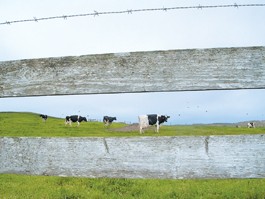
STILL LIFE WITH BARBED WIRE: Meet the happy, lucky cows who live on McClure’s Ranch in Point Reyes.

Four generations of McClures have milked cows on the northern tip of the Point Reyes National Seashore. Since 1896, they’ve watched the fog creep in around their coastal pastures, have felt the wind howl through their barns and have organized their lives around a rigid twice-a-day milking schedule.

That makes them the oldest dairying family on the peninsula, and among the last of a dying breed. “There used to be 13 dairies out here,” says 48-year-old Bob McClure. “Now there are six.”

At least one more historic Point Reyes dairy ranch is poised to close as tough economic times bring unprecedented hardship to the dairy industry. Experts predict a substantial shakeout as small family farmers throughout the country sell their herds and look for greener pastures.

California is the nation’s largest milk producer, pumping out about 39 billion pounds of milk each year, about half of which goes into cheese. Large corporate farms in the Central Valley supply the bulk of our exports, but smaller North Bay dairies are working hard to protect their niche as the state’s oldest producers of high-quality milk and cheese.

Northern California has some of the world’s best terrain for dairy farming, as Spanish missionaries discovered when they arrived with cattle in the 1700s. In later days, dairy farmers migrated north to the region that stretches from Marin County through Petaluma.

The sweetest of this region’s sweet spots is Point Reyes, the fog-prone peninsula bordered by the Pacific Ocean on the west and Tomales Bay on the east. Temperatures average 63 degrees year-round; dairy cattle thrive at 55 and suffer when temperatures climb above 70. The air is humid enough to support dense, sweet pastures that can feed a herd for more than four months a year. A hungry, well-heeled urban population to the south provides a captive market, within easy reach by schooner (in early years), train or truck.

A few Marin and Sonoma county ranchers are upgrading their operations to serve the upscale appetites of Bay Area consumers. Some are converting to organic herds; others have added creameries to make artisan cheeses for diners with sophisticated palates.

Will they succeed? It’s too early to tell, but boosters ranging from environmentalists to agri-tourists are pulling for them.

Fluid Markets

An Irish carpenter who set out to learn the dairy industry, James McClure arrived here in 1896. By 1919, his family had purchased the L Ranch; in 1930, they bought the I Ranch, where Bob and his children were born. Bob still lives there and, with his 79-year-old father, Ronald, tends a herd of 600, growing organic silage on a third of the land and milking 500 cows twice a day, at midnight and again at 11am.

The ranch covers a total of 1,500 acres, almost as far as the eye can see. As McClure describes it, the ranch goes “from the top of that hill to the chicken houses, and from the ocean up there to the ocean by the cliffs over there.”

His house is one of five that straddle the road from Pierce Point Road to dairy central, where the family and their staff milk cows, deliver calves, rehabilitate the mothers and store the feed. Employees live in four of the houses, McClure and his family in the fifth. That makes it easier to roll out of bed for the midnight milking.

McClure’s job, as he sees it, is “to keep cows calving and keep cows alive. That’s the secret to the dairy business.” He doesn’t mention the third variable in any profitable business: finding a market for his product. For most of his life, McClure ran a conventional dairy, riding out the milk market’s regular fluctuations. In December 2007, he converted to organic cows in an effort to gain some control. Clover Stornetta buys his raw organic milk and sells it in Northern California grocery stores.

“I wanted to get out of the rollercoaster cycles of the fluid milk market. I’m not going to do something for nothing,” he says. The decision was easier because he believes that organic sustainable ranching is the right thing to do.

So far it seems to have been a good decision. While feed costs are higher—organic soybean meal is a whopping $1,000 a ton—milk prices have held steady at about $28 per hundred pounds of milk. Compare that with conventional milk, which bottomed out at $8.50 earlier this year. That leaves McClure a little ahead after feed costs and all the other expenses of maintaining his herd. The McClures’ ranch was purchased in 1971 by the National Parks Service, along with all the others on Point Reyes, but they have a long-term lease McClure feels sure he can extend once it runs out.

Over the years, dairies like the McClures’ have become so efficient they can quench Northern California’s thirst with enough milk left over to supply international markets in Asia and beyond. The region is riddled with plants that convert fluid milk into powdered milk, butter and whey for long-distance shipping. Emerging markets in Asia bought California’s surplus in recent years, seeing it as a quick, cheap way to improve the diets of their populations, and U.S. dairy farmers responded by expanding their herds.

“Global demand was increasing until about November,” says Corny Gallagher, Bank of America’s senior vice president for agribusiness. “Then it started to go down. Emerging markets didn’t have the money anymore.”

Exports came to an abrupt halt, sending milk prices to historic depths within a few months and filling warehouses throughout the nation with surplus powdered milk. The U.S. Department of Agriculture is buying some of that stockpile for food banks and nutrition programs, while dairies attempt to slow their production.

Udder Squeeze

At the same time, the price of feeding large, hungry herds, which is fully half the cost of running a dairy, has risen to nearly record highs. Two-year droughts in Africa, Australia, the Ukraine and the Middle East depleted grain reserves and drove up the price of feed corn. By January, dairy farmers found themselves spending nearly $18 to produce milk they could sell for just $8 to $11 per hundred pounds.

The math of that losing proposition isn’t hard to grasp. Depending on herd size, family farms could be losing as much as $2,500 a day. Their choices were fairly limited: hunker down and wait for milk prices to rise, sell their herds or send their livestock to the slaughterhouse.

“Dairy farmers are caught in an unbelievable squeeze,” says Ralph Grossi, past president of the American Farmland Trust. “It’s a matter of macroeconomics. You would expect a rebound in prices by the end of the year, but in the meantime, there will be a substantial shakeout in the dairy industry.”

For prices to rise again, the milk supply will have to shrink. Experts estimate that 300,000 cows must be slaughtered to bring the milk supply into balance with the demand, a painful process of culling herds that otherwise were in the prime of their productivity.

That contraction has already started, with some farmers shrinking their herds and others going bankrupt or calling it quits, says Dan Sumner, director of the Agricultural Issues Center at UC Davis, “the worst is behind us for this cycle. It doesn’t take much to make prices fall, and it doesn’t take much to get them to rise again. The projections suggest higher prices this summer, but many farmers are just in terrible shape.”

Most of the older, established dairies will ride out the crisis because they’ve built up equity over the years, Sumner says. “The younger ones are mortgaged to the hilt and haven’t had time to accumulate the savings to make it. I feel sorry for them.

“The worst news is if you were the 203rd cow in a herd that should have just 200,” he says. “That cow was hamburger on Jan. 1.”

A trade group called Cooperatives Working Together has offered a “herd retirement program” that will buy more than 100,000 cattle at market price from struggling dairy farmers, with two caveats: the cows must be slaughtered, not sold to other farmers; and their owners must promise not to start new herds for at least a year. CWT expects to announce the program totals by the end of June.

The way Bob McClure sees it, each small family farmer who sells out is replaced by a big corporate dairy steps in to fill the void, a process he describes as “the Wal-Marting of the dairy industry.”

Rural Industry

Historian Dewey Livington considers the Point Reyes penninsula an “Eden” that has always supported farmers and their animals, from the Coastal Miwok Indians to Spaniards, Mexicans and immigrants with Portuguese, Irish and Swiss Italian roots, it has supported farmers and their animals.

Butter produced there in the 1800s was praised for its quality and a unique saltiness from grass pastures that were fertilized by fog and ocean breezes. As the San Francisco Bay Area grew in the 1950s, the U.S. Parks Service kept its eye on the peninsula as potential parkland that could stop the suburbs from growing together.

The dairy ranches were purchased one at time, preserving them as part of the National Seashore and in the 1980s getting them listed as a Historic Ranching District. In addition to saving the ranches, that designation preserved a way of life for generations who know little about where their food comes from.

Only about 7 percent of us live on farms now, compared with 80 percent in past eras, Livingston says. “We’re so removed that we like to see farming scenes. It’s almost like a thing of the past that gives you a good feeling. Cows are picturesque. They are icons of beauty.”

Cows also tend the garden in Eden by grazing, keeping the poison oak and brushy undergrowth in check and making room for wildflowers to grow, he says. In addition to preserving the landscape, dairies buoy the economy in many North Coast counties.

Agriculture is Marin County’s largest industry, contributing $15 million a year to the local economy. In addition to producing food, it preserves the county’s rolling landscape and secures its reputation as one of the region’s most beautiful bucolic settings.

“Although this is private farmland, we wanted to think about its benefits to the public,” says Elisabeth Ptak, spokesperson for the Marin Agricultural Land Trust (MALT). While county zoning codes currently protect it from development, a group of local property owners and environmentalists wanted more lasting protection.

They formed MALT, which does that by buying development rights. Farmers are allowed to own and manage the land but are prevented from subdividing or developing it. Many use the cash to reinvest in their businesses or, in the case of dairy farmers, weather economic storms like the present one.

Tomales Bay dairyman Bob Giacomini and his four daughters have done just that, converting a farm that milked 600 cows into an artisan cheese company that turns its own milk into Point Reyes Original Blue.

“All four of us were all raised here, we all went to college, and none of us had any interest in coming back here to milk cows,” says Jill Giacomini Basch, the company’s spokesperson. “But in the 1990s, the dairy got away from Dad. He was turning 60 and didn’t want the stress anymore. He called us all together to say, ‘It’s time.'”

The women brainstormed ideas, came up with the notion of cheese making and ran with it. Three formed the company and by 2000 had begun to make blue cheese. The fourth sister joined them this year.

“An Achilles heel for Dad had always been making milk to sell as a crop and never having anything to offer his friends,” Basch says. “He didn’t have any fruits of his labor. We knew there was a growing market for artisanal cheese, and we thought it might become a profitable business, not just a sideline for Dad.”

Under their guidance, the dairy sold its development rights to MALT and added organic cows in 2004 that supply milk to Clover Stornetta. The conventional herd supplies milk for cheese making.

The Giacomini women also built a methane digester that makes fuel to power the dairy, and by summer will open an appointment-only agri-tourism business, an onsite culinary center that will teach classes and offer farm-to-table tours.

They’re poster children for a campaign that was mounted by the California Milk Advisory Board in 2000, encouraging dairy farmers to shore up their cyclical businesses by diversifying. As point person for that campaign, Lynne Devereaux spent seven years traveling the state, helping dairies to take the risk and connecting them with cheese makers who could teach them how it’s done.

“Artisan cheese isn’t a consideration of most dairy farmers,” she says. “They don’t see it as a way to solve the problem, but they can get added value from their milk by using part of it for cheese.”

When the milk board shifted its attention to handling milk surpluses in 2007, Devereaux found another way to promote small cheese makers: an artisan cheese festival held once a year in Petaluma.

“I had been going to trade shows for years, but I wanted to find a way to bring consumers closer to these cheese makers,” she says. This year’s festival was a sell-out, with about 1,800 people gathering over the span of four days to meet the makers, sample the goods and schmooze with others who share their passion for food.

“We’re going back to eating naturally, the way our forefathers ate,” says Basch, who serves on the festival’s board of directors. “There will always be a subset of the consumer audience that is interested and willing to pay a higher price for these kinds of products.”

Devereaux sees the market for artisanal cheese getting younger, led by 30-year-olds who have grown up with good coffees, gourmet chocolates, fine wines and fresh baked breads. Adding artisan cheeses is a logical progression.

Combine that with the proliferation of high-end markets and the focus on eating locally, and this part of the dairy market is poised for strong growth, she says.


Dedicated consumers are now asking “Who’s on your plate?” rather than “What’s on the menu?”

That said, UC Davis’ Sumner questions whether the organic milk and artisan cheese efforts are enough to save the dairy industry. “Artisan cheese accounts for about 1 percent of their sales, and organic milk between 2 and 3 percent. It’s hard to say how much more it can grow,” he says. “Most people aren’t able to afford $20-a-pound cheese. “At times like this, people are going to cut back wherever they can, which means using the cheapest cheese we can get. What one grocery store is growing now? Wal-Mart. Which one is sinking like a stone? Whole Foods.”

Sumner’s best advice for people interested in supporting the dairy industry is simple. “Drink a lot of milk,” he says.  


Letters to the Editor

06.03.09


Have I told you lately

I am a Marin resident who occasionally picks up the Bohemian. What a delightful surprise to read Bart Schneider’s article on the Van Morrison concert (“Astral Response,” May 13). He really nailed it. I am a boomer “Van Fan” as well. Nowadays, when I run into an old friend at a concert, instead of hitting him up for an extra doobie, I’m more likely to ask if he brought any extra earplugs!

I went to L.A. for the recording of Astral Weeks at the Hollywood Bowl last November. Van’s performance was jaw-dropping. I sat in the second row literally stunned by the music. Your poetic writing brought it all back to me. Thanks so much.

Carol Guida
Mill Valley

Thanks from buzzy

I would like to take this time to express my deepest gratitude, love and respect to thank Roseland Elementary School library assistant Anna Collorafi, counselor Maria Orozco and, most of all, principal Dana Pederson for reading my book Don’t Shoot! I’m the Guitar Man. You saw my passion for helping all at-risk youth, believed in me, and took a chance on a 30-week pilot mentoring program with seven little boys all with gang affiliations and criminal behavior who were making bad choices.

You all felt strongly enough to find funding for this program that helped me help mentor these young children set new goals for themselves other than fighting, stealing, being in a gang or wanting to go to prison. Teaching music, love, respect, truth, trust and equality gave these kids the basic tools to be open to try new ways to walk down another path in life.  Anna, Maria, and Dana: I honor you for being heroes in my eyes and heart for thinking out of the box to help these boys not be at risk but instead to be at opportunity.

Buzzy Martin
Sebastopol


No to new ways to die

While I’m all for scientific progress, I must admit that the idea of a Hovercar 3000 as envisioned by your Sebastopol correspondent (Letters, May 27) scares the daylights out of me. Being a pessimist, I cannot help but think that all the irksome goings-on that currently occur out there on our roads and freeways on a daily basis would be exacerbated in the extreme with the added dimension of having them occur 100 feet in the air at 80 miles an hour. Darwin help us, most drivers out there can’t even work up enough spatial awareness to handle four dimensions (front, back, right and left) let alone six (add up and down). Hovercars? Thanks, but no thanks.

Rich Jones
Monte Rio

Hurry Up please it’s time

Mr. Cheney,

The George W. Bush administration had eight years to make things right, but screwed everything up (lying to the U.N, the American people and propagating the Iraq War). Now the American people want to make sure the world opinion of our country is mended. Please take your Halliburton and Brown & Root stock profits from the Iraq War and shut up!

Lee E. Tolbert
Cloverdale


Marga Gomez, Funny Girl

0

06.03.09

MOUTHY: ‘I can’t dance salsa,’ Gomez says. ‘I can only eat salsa.’

Compiled by Gretchen Giles

Interviewed in these pages 10 years ago, comic Marga Gomez described her dating scene succinctly. “The lesbians I’ve known are not good at dating,” she complained. “We’re good at relationships, so all our dates are like relationships—even a first date. We go to dinner, discuss our innermost secrets and the secrets of our ex-lovers; then we’d have dessert, pay the check and maybe I’d have the guts to pop the question ‘Do you want to come back to my place and weep?’ Then there would be couple’s counseling and division of property by the second date.”

Fast forward a decade, and Gomez is now partnered up, joking that her girlfriend is a smoker, which makes it so much easier to get along with her. “When you’re with a fuck-up,” she joshes, “they’ll give you anything.”

Gomez stars with Ugly Betty‘s Alec Mapa at the 15th annual Gay Pride Comedy Night, an evening of standup followed by an old-fashioned dance party that has gained in popularity every year. There is no star or co-star, as each comic is delighted to be co-headlining. Things are so gosh-darn friendly and giddy that event organizer Ellen Silver even wants straight folks to attend, and given the level of the performers and the $15 ticket, they may just take the plunge.

Count on Gomez to offer some light-hearted conciliation to the recent Proposition 8 decision by the California Supreme Court. “We don’t want our children to know about gays marrying,” she joked during a show before last year’s election. “It’s better that they just know about gays dating—and cruising.”

Asked recently if her career has changed as Latinos become a more visible and vigorous political and cultural force, she says, “I like to call myself the butch Ricky Martin. Yes, there’s more visibility and clout, but there is also more backlash. Hello, Lou Dobbs, swine flu? I don’t get as much bounce from the ‘Latin explosion,’ because I am a Latina who can’t speak Spanish or dance salsa; I can only eat salsa. I’m part of the silent minority in the Spanish majority. Latinas like me get attitude from other Latinos because of our gringo accents. I’m writing a show about this issue, a comedy that I’m opening Off-Broadway later in June. I want to be the voice for Latino dorks.”

After the Santa Rosa gig, Gomez flies back east for a series of gay pride blow-outs before heading to Scotland for the Edinburgh Fringe Festival and then stints in Mexico. She exults, “This will be a great pride month for me. It’s my birthday, my TV special airs, I play Boston Pride, play a week in N.Y.C. off-Broadway, and get to work with Alec Mapa. I’m hoping Alec can hook me up with Salma Hayek. My girlfriend will give me a get-out-of-jail-free pass for that.”

The 15th Annual Pride Comedy Night starring Marga Gomez and Alec Mapa is slated for Saturday, June 6, at the Wells Fargo Center. 50 Mark West Springs Road, Santa Rosa. 8pm. Tickets from $15. 707.546.3600.


Museums and gallery notes.

Reviews of new book releases.

Reviews and previews of new plays, operas and symphony performances.

Reviews and previews of new dance performances and events.

Good as Gold

06.03.09The best thing about a shakeup, economic or otherwise, is the way it provokes innovation and creative social change. A near fatal experience for human rights attorney Edgar Cahn sparked a brilliant idea for bettering the quality of human life. And almost 20 years later, his idea has materialized in places around the world, evolved through practice and is...

Good Knight

06.03.09 With certain well-known stage shows, simply ordering up a ticket can be an act of faith and courage. As someone who sees 60 to 70 plays a year, many of them repeats of the same favorites over and over, I can't help but end up with favorites (Proof, which I've seen in five different productions; Hamlet, nine productions) and...

Thirst Parlors

06.03.09We've seen those old saloons in the Westerns. Someone is playing the piano, a curmudgeonly bartender or friendly barmaid slaps a whiskey on the bar, the regulars check out the newcomer. But Hollywood doesn't begin to do justice to the real "thirst parlors," as the genteel used to call them, that still survive in the West. Comfy, cozy places,...

Spawning Discontent

06.03.09 WALK ON WATER? Back in the early aughts, it was well-nigh possible. My, what a difference seven short years have made! As the state's commercial fishermen and sport anglers look at another cancelled season for Chinook salmon, the California Fish and Game Commission has green-lighted a short recreational season in the Sacramento River. Scheduled to begin in mid-November, the season...

La Famille

06.03.09 One can generalize that American movies are usually about people with one problem, and French movies are usually about people with a nexus of problems. In Olivier Assayas' absorbing and smart new film Summer Hours, the dissolution of an extended family illuminates an abstract idea: artistic patrimony, and how it gets scattered to the winds. Previously, it...

Three Bands, Twelve Bars

06.03.09What makes a great blues band? Is it all in the voice? Is it the believability of the downtrodden heartache in the lyrics? Is it the ability to channel Albert King and Muddy Waters and Hound Dog Taylor while keeping those influences subtle? Does whiskey help? Does one guy in the group need to be blind?No, what makes a...

Betcha’ Didn’t Know

06.03.09In a world where finding out how to filet a fish or write a novel in under a hundred days is as easy as tapping into Google's infinite database from a cell phone, it's easy to forget where this enormous stockpile of know-how comes from. Enter Ignite Sebastopol, a friendly reminder of the weird, wacky and waywardly random bits...

Dairy Dilemma

06.03.09STILL LIFE WITH BARBED WIRE: Meet the happy, lucky cows who live on McClure's Ranch in Point Reyes. Four generations of McClures have milked cows on the northern tip of the Point Reyes National Seashore. Since 1896, they've watched the fog creep in around their coastal pastures, have felt the wind howl through their barns and...

Letters to the Editor

06.03.09 Have I told you lately I am a Marin resident who occasionally picks up the Bohemian. What a delightful surprise to read Bart Schneider's article on the Van Morrison concert ("Astral Response," May 13). He really nailed it. I am a boomer "Van Fan" as well. Nowadays, when I run into an old friend at a concert, instead of...

Marga Gomez, Funny Girl

06.03.09 MOUTHY: 'I can't dance salsa,' Gomez says. 'I can only eat salsa.' Compiled by Gretchen GilesInterviewed in these pages 10 years ago, comic Marga Gomez described her dating scene succinctly. "The lesbians I've known are not good at dating," she complained. "We're good at relationships, so all our dates are like relationships—even a first date. We go to dinner, discuss...
11,084FansLike
4,446FollowersFollow
6,928FollowersFollow