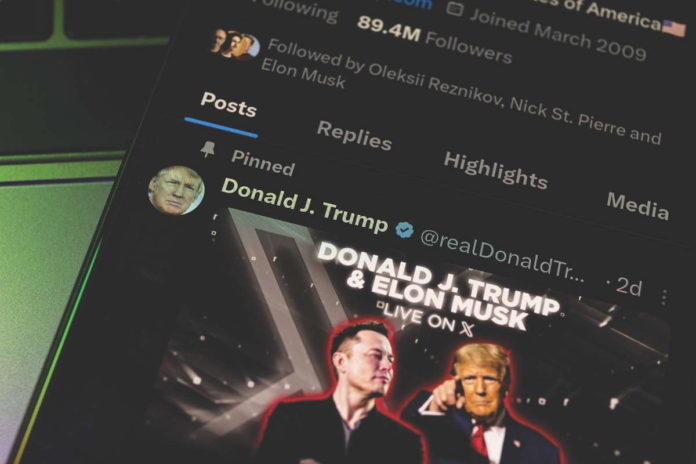
Two decades ago, Elon Musk was 33 years old and had just pumped a $6.5 million investment into a fledgling electric-car company called Tesla. That made him the firm’s largest investor and put him well on his way to taking over Tesla and ousting the company’s two founders. The money came from the sale of PayPal, which he started by merging his own online financial firm with one owned by Peter Thiel, only to himself be deposed as PayPal CEO by Thiel.
That was pretty much Musk’s life in those days: One high-powered Silicon Valley deal after another. Politics, the business of the country and of the wider world at large, didn’t concern him much, except as it affected his high-tech business ventures. He said so himself at a conference in 2015. What political beliefs he did hold were basically mainstream Democratic. He was particularly concerned about climate change, saying in 2018 that continued use of fossil fuels could lead humanity into a new “Dark Ages.”
He voted “100%” for Democratic candidates, at least according to his own statements. While he wasn’t a big political donor, he gave money to candidates in both parties.
In the 2004 presidential election, for example, Musk—a South African immigrant who became a United States citizen in 2002—gave $2,000 each to Democrat John Kerry and Republican George W. Bush. Early in that primary season, he also gave $2,000 to Gen. Wesley Clark, who briefly ran for the Democratic nomination. He said he voted for Barack Obama in both 2008 and 2012. After the 2020 election Musk claimed on multiple occasions that he voted for Joe Biden—but later told his biographer, Walter Isaacson, that he didn’t vote at all.
Now, here we are in 2024 and Musk has left any vestige of his previous vaguely liberal politics behind. To say that Musk has gone all-in for Donald Trump would be a drastic understatement. What happened? What is he doing to make sure Trump gets another term in the White House? More importantly, why? What would a Musk-backed second Trump term mean for the country?
Musk Is Driving the Trump Train
As of Oct. 24, Musk had ascended, like one of his own SpaceX rockets, to become Trump’s second largest donor, mainly through donations to pro-Trump political action committees. In just over the first two weeks of October, he poured $43.6 million into America PAC, a Trump-supporting group he founded along with a few other Silicon Valley multibillionaires. That brought his total America PAC donations to $119 million. Only Timothy Mellon, the 81-year-old heir to the Mellon family fortune, has spent more to put Trump in the White House, giving about $150 million to various pro-Trump PACs.
Musk has not drawn the line at writing fat checks. While billionaires and corporate CEOs don’t shy away from supporting candidates, they typically remain behind the scenes. But in October, with just weeks to go before the Nov. 5 election, Musk hit the campaign trail for Trump—mainly in the crucial swing state of Pennsylvania, which some experts say will be the state that decides the next president.
He literally jumped on stage with Trump at an Oct. 5 rally in Butler, Pennsylvania, the site of an assassination attempt against Trump on July 13. Then Musk went out on his own to stump for Trump across the Keystone State. He held four “town hall” events the week of Oct. 21. In his most outrageous stunt—one that drew a warning from the U.S. Justice Department—his America PAC ran a $1 million-per-day lottery drawing for registered voters in specific swing states who sign a “petition” to support “free speech” and the “right to bear arms.”
Offering financial incentives to vote or to register to vote, or to influence votes, violates federal law. By offering the lottery prize to voters who sign a petition, Musk walks a fine line between legal and illegal, but he appears unconcerned. The Justice Department warned him on Oct. 23 that he may be breaking the law, but after a one-day pause when no $1 million winner was announced, America PAC gave out two such prizes the next day.
Musk has also offered voters in Pennsylvania a quick $100 for signing the “petition,” and $47 in other battleground states.
Just this past Sunday, Musk appeared at Trump’s Madison Square Garden rally in New York City.
Mark Cuban, the 66-year-old billionaire tech entrepreneur and former owner of the Dallas Mavericks NBA basketball team, has made personal appearances campaigning for Trump’s opponent, Vice President—and former California senator—Kamala Harris. But Cuban has no record of making political money donations, and says he has given no cash to Harris or anyone else in the 2024 election cycle.
Musk’s Journey to the Right—what Happened?
How did Musk take such a hard right turn, politically speaking, that he ended up devoting himself to reinstalling Trump as president? Without access to the inner workings of Musk’s mind, it’s impossible to say for sure. But the change has been drastic. Before his 2022 purchase of the social media platform Twitter, Musk had achieved fame as CEO of Tesla, the country’s leading maker of electric vehicles. And yet, Trump has long made a practice of deriding and ridiculing EVs, and continued to do so even after Musk stated earlier this year that he would spend $45 million per month supporting Trump.
Musk’s concern about climate change also puts him in conflict with Trump, or seems to. In 2017, Musk resigned from two of then-President Trump’s advisory councils in protest of Trump’s decision to pull the U.S. out of the Paris Climate Agreement.
“Climate change is real,” Musk said at the time. “Leaving Paris is not good for America or the world.”
Trump believes, as he has frequently stated, that climate change is a “hoax.” As recently as September 2024, in the aftermath of Hurricane Helene which wreaked destruction and claimed 116 lives across the southeast, Trump declared climate change “one of the greatest scams of all time.”
Musk’s own stated views on climate change have softened considerably since he threw his lot in behind Trump. In 2006 he said the reason he got involved with Tesla was to “expedite the move from a mine-and-burn hydrocarbon economy towards a solar electric economy, which I believe to be the primary, but not exclusive, sustainable solution.” And in 2015 he said that “the goal is to exit the fossil fuel era as quickly as possible.”
In 2024, as he stands in Trump’s corner, he now says he is concerned about those who “vilify” the fossil fuel industry because “if we were to stop using oil and gas right now, we would all be starving and the economy would collapse.”
Another of Musk’s recent major concerns has been what he calls the “woke mind virus.” He has even seemingly implied that this “woke mind virus” is the real reason for his political turn to the right.
This “virus,” he said in a July 2024 interview with conservative commentator Jordan Peterson, is what “killed” his son. In fact, the son Musk referred to is not dead, but has transitioned to identify and live as a woman. Musk claimed he was “tricked” into allowing his son to transition.
“I lost my son, essentially. They call it ‘deadnaming’ for a reason,” Musk told Peterson. “The reason they call it ‘deadnaming’ is because your son is dead.”
Musk declared that he “vowed to destroy the woke mind virus after that.”
Musk in the Time of Covid
Musk’s turn rightward, however, can be traced to the Covid-19 pandemic and the various restrictions on business and personal activity that accompanied it. Musk was not alone in that. According to a study by researchers at Simon Fraser University in Canada, pandemics historically have “produced demonizing and scapegoating,” and during the Covid pandemic “violent right wing extremist” online posting activity showed a sharp increase.
A 2021 United Nations report also warned of a rise in violent extremism, and another researcher, Jacob Davey of the United Kingdom-based Institute for Strategic Dialogue, found “quite significant spikes in extremist activity and also conspiracy theories” during the pandemic. According to the U.N. report, enforcement of Covid public health restrictions, the rising economic inequality driven by those restrictions and the overall “erosion of trust in government” were the primary drivers of the spike in extremism.
While it would be neither accurate nor fair to call Musk a “violent extremist,” he did publicly blast Covid restrictions, and his whole world-view appeared to slide to the right during that time. In May of 2020, just three months into the pandemic emergency, Musk announced that he would defy stay-at-home orders and restart production of Tesla cars at the company’s Fremont plant.
His stance was not a surprise. On March 6, 2020, just as it became clear that the mysterious coronavirus illness was a global pandemic and five days before the World Health Organization declared it one, Musk took to his Twitter account to state, “The coronavirus panic is dumb.” About 100,000 people worldwide had already died of the new disease at that point.
In a call with Tesla investors in April, Musk called Covid restrictions “fascist,” and railed that governments should “give people back their goddamn freedom.”
But Musk’s reasons for backing Trump may be more straightforward than any of that. He wants regulations on his products and businesses lifted, or eased up. Musk seems especially eager to make sure that Tesla’s driverless cars avoid regulations. So far, just 19 states have approved the driverless cars to run on public roads.
“National approval is important,” Musk said on an Oct. 23 earnings call. “If there is a Department of Government Efficiency, I will try to make that happen.”
What if Musk Becomes ‘Secretary of Cost Cutting?’
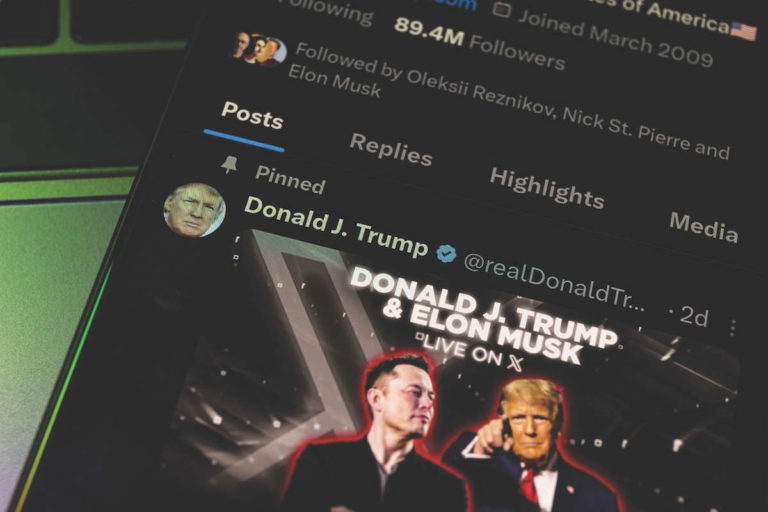
There is no such thing as the “Department of Government Efficiency,” but in his live-streamed conversation with Trump in August, Musk said there should be. Trump seemed to be enamored of the idea because a couple of weeks later, while stopping short of promising a new “department,” he said that if elected he would establish a “government efficiency commission,” and that Musk would be in charge.
A month later, in mid-October, Trump again said that Musk would take a significant role in his administration when it comes to slashing the federal budget. In fact, Trump said that Musk would have “a new position: Secretary of Cost-Cutting.”
Trump at the time claimed Musk had told him, “I could cut costs without affecting anybody.”
But if Musk actually said that, he has since changed his tune. In a “telephone town hall” interview on Oct. 26, Trump said his plans to reduce government spending would cause “temporary hardship.” Musk did not say who would suffer this hardship. With his net worth of $270 billion, it seems fair to say it won’t be him.
So what happens if Musk takes such a prominent economic role in a new Trump administration? We can’t know for sure unless it actually happens, but a look at other situations where Musk’s approach has been applied may give some indication. And the indication is that the country would be in for a severe austerity program with rising poverty and declining social services.
When Musk took over Twitter he laid off about 80% of the social media company’s employees. He also renamed the platform X, which was also the name of his online financial platform he then merged into PayPal. He also slashed costs throughout the organization to the point where some employees brought their own toilet paper to work, according to a report by Fortune Magazine, for fear that the company wouldn’t buy any for its restrooms.
Musk has also said that government employees who are laid off due to his “cost cutting” would receive sizable severance packages, up to two years worth of pay. “The point is not to be cruel or to have people not be able to pay the mortgage,” he said at one rally, as quoted by CNN.
But Musk also offered severance pay to laid-off Twitter employees, a minimum of six months’ worth. In many cases, he never paid any severance at all, according to lawsuits filed by former Twitter employees. In all, more than 2,000 former employees complained that Musk stiffed them on their severance pay.
Even with all of the slashing and burning, Twitter, a.k.a. X, continues to lose money and, according to the trade news site Social Media Today, faces such a significant loss in 2024 that it “could even result in bankruptcy for the former bird app.”
Musk has cut costs at Tesla too, but a large portion of those cuts came by moving production to China. Tesla built an automotive “gigafactory” in Shanghai in 2019—the same year that Trump, as president, ordered U.S. companies to move production out of China. Whether he had the authority to do so remains unclear. The plant produced almost 950,000 cars in 2023.
But moving to China is not much of a solution for increasing U.S. government efficiency, and if Musk’s track record in business cost cutting is any indication, turning him loose on the federal budget would be a risky move, to say the least.
Argentina: Musk-Style Cost Cutting in Action
Another way to see what it might mean if Trump put Musk in charge of “government efficiency” is to look at a country where a leader heartily endorsed by Musk has put a radical program of Muskian cost-cutting into effect.
That country is Argentina, whose new president, self-described “anarcho-capitalist” Javier Milei, has been compared to Trump. After his election in November of 2023, Milei got an enthusiastic thumbs-up from the former president, who told the 53-year-old Milei, via social media, “I am very proud of you. You will turn your country around and truly Make Argentina Great Again!” Milei’s unofficial nickname is “the madman,” and he boasts of taking “a chain saw to the state.”
Musk and Milei have formed sort of a bromance, with Musk hosting Milei at his Austin, Texas, Tesla plant in April where the Argentine president lavished praise on Musk for “everything you are doing for the world,” and the pair “bonded over their support for free markets, the role of tech in development, and the need to cut red tape in order to entice investors,” according to a Buenos Aires Herald report. Musk and Milei said that they would organize “a large event” in Argentina to “promote the ideas of liberty.”
Argentina is not an exact analogy with the United States. The country’s inflation made even the worst U.S. post-pandemic inflation look mild. U.S. inflation peaked at 9.2% in June of 2022. But in Argentina, inflation ran between 40 and 50% during the post-pandemic period, and instead of then cooling off as it did in the U.S., where inflation stood at 2.4% in September, it skyrocketed. In the 12 months leading up to the November 2023 election, Argentine inflation hit 160%.
Milei fired up his “chain saw” as soon as he took office, and during the 11 months since has shut down nine of the country’s 18 government ministries and fired 30,000 public employees. He also chopped the government assistance on which 60% of Argentines depend for health care, electric bills, gasoline and other fundamentals of daily life. His favorite slogan, “No hay plata!” translates as “There is no money!”
What have been the results? The massive, sudden spending cuts have produced Argentina’s first government surplus since 2012, albeit a slight one—0.4% of gross domestic product. The monthly inflation rate has dropped from 26% when Milei assumed office to 4% in August 2024—though the annual inflation rate, which is what most of the world, including the U.S., refers to when talking about inflation rates, still stands at 237%.
Meanwhile, 60% of Argentines now live in poverty, compared to an already-high 44% when Milei took office. With the end to electricity subsidies, typical power bills spiked about 150 percent.
He vetoed a law that would have increased subsidies to public universities, allowing them to keep up with inflation. Public universities have been free for Argentinians, but that system may be forced to change, making higher education and the opportunities for economic advancement that come with it less accessible.
Subway fares in the country’s capital city of Buenos Aires suddenly went up 360% even as the system, used by the city’s low-income residents to get to work and back every day, has become decrepit.
“By slashing state spending, Milei helped send the country into a deep recession,” according to a report by the journal Foreign Affairs. “The government projects a 3.8% decrease in GDP for 2024.”
Will Musk follow the Milei model if he somehow ends up as Trump’s “secretary of cost-cutting?” Trump has to get elected first—and that is exactly what Musk is trying to make happen. But he, and his fellow tech billionaires, may have other reasons for wanting Trump to take the White House again.
The Billionaires’ Tech-xit
If Trump wins the presidential election on Nov. 5, he will become the oldest person ever elected president at age 78—surpassing Joe Biden, who was still 77, though three weeks shy of his 78th birthday, when he was voted in on Nov. 3, 2020. Trump has never released his medical records, but his strange and erratic behavior during the 2024 campaign has prompted nearly 450 doctors and professional health care providers to write an open letter calling on Trump to make his health information public.
From his public assertion that the audience at his debate with Harris “went crazy” when there was no audience there, to a recent campaign rally that ended with Trump on stage swaying to a playlist of recorded pop music for 39 minutes, to his strange insistence that his lengthy, rambling monologues are actually a deliberate rhetorical technique called “the weave,” to his out-of-nowhere comments on late golfer Arnold Palmer’s alleged penis size at another recent rally, Trump “is falling concerningly short of any standard of fitness for office and displaying alarming characteristics of declining acuity,” the health professionals wrote.
But if Trump gets elected and ends up incapable of running the country due to a breakdown in his mental or physical health, what happens?
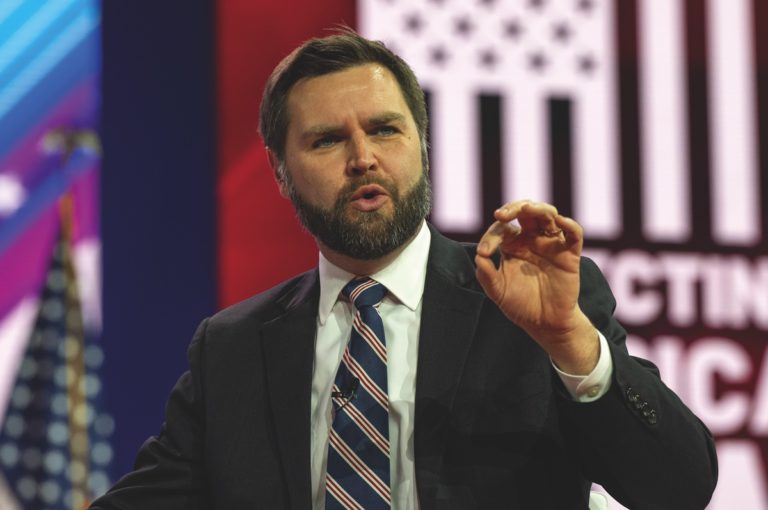
If Trump is truly incapacitated or dies, under the Constitution Vice President JD Vance would ascend to the presidency. Vance spent five years as a Silicon Valley venture capitalist, and though he didn’t accomplish anything noteworthy in that role, he did do an excellent job of making connections with the tech industry’s heavy hitters. Billionaire Peter Thiel, co-founder of PayPal, early investor in Facebook and current co-founder and chair of Palantir Technologies, was the single largest donor to Vance’s 2022 Senate campaign.
By backing Trump with more than $100 million, Musk is also underwriting Vance’s path to the vice presidency. Why are tech billionaires like Musk so interested in this guy? According to a Washington Post report, Thiel and others called Trump personally, “imploring him to add the onetime Silicon Valley investor [Vance] to the ticket.” Trump did just that.
One clue may have come during a recent Fox News appearance by Trump when he said that Musk promised him that a SpaceX rocket would reach Mars before he left office. But for Musk, the goal has never been simply to send a rocket to Mars, but to build an entire city, a colony of one million human beings there.
The dream of separating from the rest of human society is not Musk’s alone, though his plan to do it on Mars is the most outlandish. Thiel in 2008 founded The SeaSteading Institute, which plans to build a self-governing colony on an island, or multiple islands, in the ocean—though his plan to take over an island in French Polynesia was shot down by the local government.
A group of Silicon Valley heavyweights including venture capitalist Marc Andreesen; LinkedIn founder Reid Hoffman; and Laurene Powell Jobs, widow of Steve Jobs; starting in 2018 spent nearly $1 billion to buy land in Solano County with the plan to build a “megacity” there. That plan also ran into local government problems. And Trump himself has also pushed the idea of building “freedom cities” on federal land.
Perhaps the end result of Musk’s all-in effort to elect Trump is not simply to make life easier for his own businesses, to push a right-wing agenda or to slash the federal budget to the point where the government can barely function—but to break free of the United States and even Planet Earth altogether, and create a version of utopia where the tech billionaires finally rule.