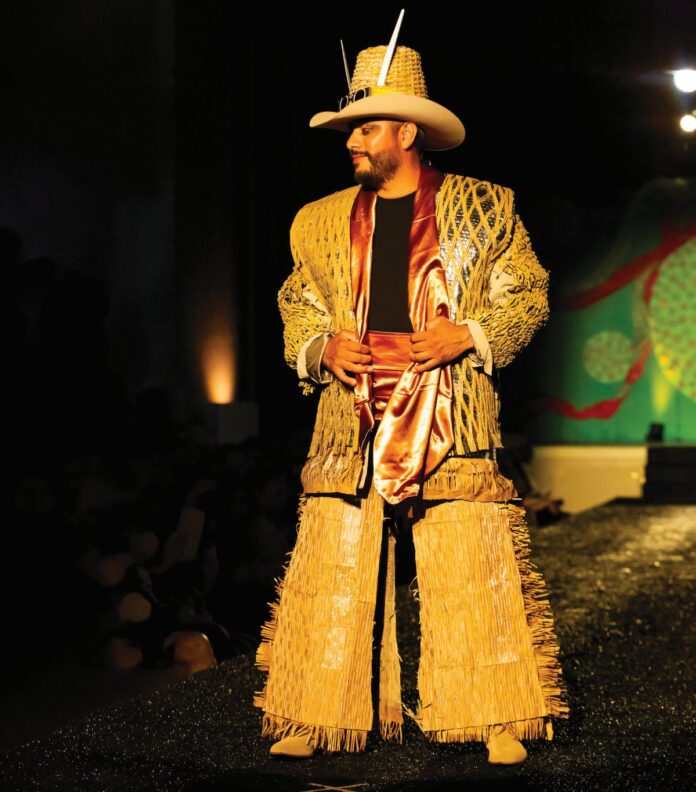
There are few places where a pile of discards, such as plastic netting, aluminum cans, orphaned Barbies or an occasional Solo cup, can be reborn as couture and greeted with applause.
Sonoma Community Center’s 16th annual Trashion Fashion Runway Show, naturally, is one of them.
The crown jewel of a monthlong celebration hosted by the Sonoma Community Center returns this April, turning trash into spectacle. What began as a small gallery event has evolved into a full season—part runway show, part activism, part communal fever dream—peaking with a pair of runway events on Saturday, April 18 at the Sonoma Veterans Memorial Hall.
“It started as a gallery exhibit of costumes made of unconventional materials,” recalls organizer Molly Spencer, tracing the event’s origin to Margaret Hatcher, a costume designer and former art manager at the Sonoma Community Center. “She thought what could be more fun but throw a little runway show and invite your friends and the community to create wearable art.”
The Art of Reinvention
What distinguishes Trashion from the broader fashion ecosystem is its mindset. Every piece begins with ecological constraints: Designers must use materials that have been previously used—rescued from the trash, recycling bins or thrift stores. From there, anything goes.
“The beauty is you do not need to be a trained designer, maker or professional artist to participate,” Spencer says. “All you need is an open mind and willingness to explore. The creativity will follow.”
This democratic ethos has helped fuel the event’s growth from a single-room experiment into a yearlong sustainability program that now includes gallery exhibitions, school outreach and visiting artists from beyond the Sonoma Valley. The runway itself has outgrown its original venue, now drawing crowds of more than 800 across two shows.
And yet, for all its expansion, the core remains intact. “What remains the same is the Sonoma Community Center and Sonoma Valley community’s support of the arts, volunteerism and a source of pride for this truly one of a kind event,” Spencer says.
Judging the Unjudgeable
If the designers face the challenge of transforming waste into wearable art, the judges face something potentially trickier: deciding what makes one collection of transformed recyclables more compelling than another.
For this year’s judge Ryan Lely, the criteria are less about polish and more about presence.
“What I’m looking for is ingenuity, bold use of materials and a clear point of view,” Lely says. “Every artist that participates in this show is already doing something extraordinary by taking a piece of trash and transforming it into fashion. So what really stands out is the creativity behind the choices and the execution of the runway piece.”
To be sure, it’s a delicate balance between concept and execution. A compelling idea can make an immediate impression. And craftsmanship and technique can elevate even a simple premise into something unforgettable.
Lely defines the difference between good and great as “a piece where concept and construction elevate each other.” Still, even he admits the scales aren’t fixed. “Sometimes the concept alone creates that WOW moment, regardless of the craftsmanship,” he explains. “And other times, a piece might have a simple concept, but the craftsmanship is so exceptional that it becomes the WOW moment.”
When Trash Disappears
The real magic trick of Trashion is the moment when a viewer forgets the dress is made of trash.
“For me, a piece feels transformed the moment you stop seeing it as made from discarded materials and see it as something you would actually wear,” Lely says.
That threshold—when the material’s past life dissolves—is where Trashion achieves something magical. It’s also where outsider experimentation can begin to influence the mainstream.
Spencer has noticed that influence. “I see big designer collections that are using materials that Trashion designers have conceived and produced years before that,” she says. “What starts out small may lead to possible exploration of alternative fabrics, and eco-friendly designs in art and fashion.”
In other words, today’s trash could be tomorrow’s couture.
More Than a Show
The runway may be the headline act, but Trashion Fashion Month offers a broader canvas. This year’s festivities include the “Barbies & Bags” Gallery Show and Auction in the Sonoma Community Center’s Gallery 212. The exhibit expands the Trashion ethos into smaller-scale works—dolls, purses, backpacks—each reimagined from discarded materials.
Later in the month, the Trash Bash wrap party doubles as both celebration and exhibition, giving attendees a closer look at the runway pieces and one last chance to bid on gallery items. This year, the event aligns with Sonoma’s Earth Day celebration, honoring and recognizing the environmental values that inform the entire program.
“Trashion Fashion Sonoma’s mission is to celebrate the intersection of fashion, art and environmental sustainability,” Spencer says.
The Labor Behind the Look
One of the more persistent misconceptions about Trashion is that it’s, well, thrown together. After all, if the raw materials are trash, how much effort could really be involved?
Quite a bit, as it turns out.
“Every element, script, practice takes months of planning,” Spencer says. “Some designers collect materials for years and make their outfits that are often on the runway for just about three minutes.”
Planning includes not just the garments themselves but the choreography of the show: runway coaching, rehearsals, staging. This year, participants will work with runway coach Cat Austin to prepare for their moment on a 60-foot catwalk—because even the most avant-garde creation benefits from a confident walk.
The result is a high-concept production that feels polished, where artistry meets community participation.
Why It Matters Now
Trashion’s longevity—16 years and counting—suggests it’s discovered something meaningful. But its current resonance may be tied to a broader cultural current.
“In today’s world of uncertainty of the future, climate change and what it holds for the next generation, this is an intergenerational connection that resonates with all,” Spencer says.
It also offers a now-rare kind of communal experience. In an era of digital everything, there’s something satisfying about gathering in a hall, watching real people wear improbable garments and sharing the collective gasp when something unexpectedly beautiful emerges from the detritus.
The 16th Annual Trashion Fashion Runway Show: Two shows. 1:30pm matinee and 5pm show with post-runway bubbles and bites reception Saturday, April 18, Sonoma Veterans Memorial Hall, 126 1st St. W., Sonoma.
‘Barbies & Bags’ Gallery Show and Auction: Through Saturday, April 25, Sonoma Community Center, Gallery 212, 276 East Napa St., Sonoma.
Trash Bash and Earth Day Celebration: Saturday, April 25, Sonoma Community Center, 276 East Napa St., Sonoma.
Go to TrashionFashionSonoma.org or call 707.938.4626 for more information.