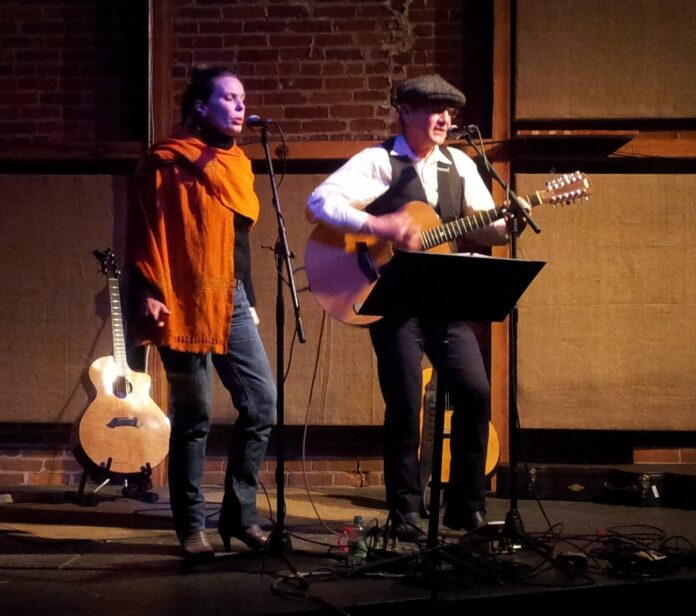
Jan. 24: Tim Flannery at Sweetwater Music Hall

0

628x471.jpg

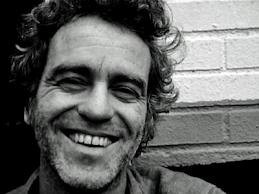
Whenever I’m blue in the off-season, I cue up the video of Angel Pagan, in May 2013, hitting a walk-off, inside-the-park home run in the 10th inning to beat the Rockies. The glory of Pagan’s achievement, however, must be shared by third-base coach Tim Flannery, who had the chutzpah to send Pagan to home plate as the throw came in from center field. Flannery has made plenty of similarly confident moves, a trait he brings to his side career in music. A devout Deadhead with a new solo album, The Wayward Wind, the Giants coach plays his own original songs on acoustic guitar on Friday, Jan. 24, at Sweetwater Music Hall. 19 Corte Madera Ave., Mill Valley. 8pm. $22—$24. 415.388.1100.

Jan. 23: San Francisco Symphony at the Green Music Center

0

sfsymphony.jpg

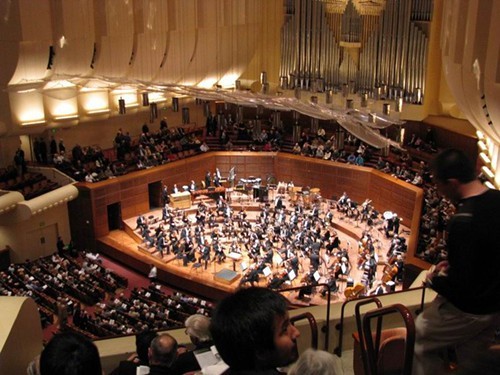
The Green Music Center is usually home to the Santa Rosa Symphony, but this week sees two visiting outfits. On Thursday, Jan. 23, the San Francisco Symphony rolls into the space with violinist Alexander Barantschik, who’ll perform Mendelssohn’s Violin Concerto in D Minor and conduct works by Mozart, Britten and Piazzolla. On Saturday, Jan. 25, Harry Bicket conducts the English Concert in Handel’s opera Theodora, featuring Sarah Connolly, Andrew Kennedy and others (7:30pm; $40—$85). Green Music Center, 1801 E. Cotati Ave., Rohnert Park. 866.955.6040.

Jan. 22: Olivia Laing at Book Passage

0

8646998280_ffc364471a_z.jpg

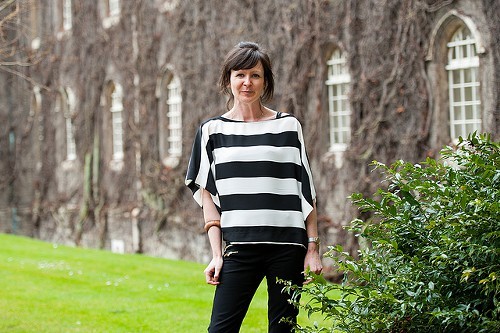
Ernest Hemingway. F. Scott Fitzgerald. Tennessee Williams, John Berryman, John Cheever. Raymond friggin’ Carver. What do these authors have in common? (“They were all overrated white males” is not the answer we’re looking for.) They all ordered booze by the boatful, and in her new book The Trip to Echo Spring: On Writers and Drinking, author Olivia Laing explores why. Having grown up in an alcoholic family herself, Laing removes the romance from drinking to reveal just how destructive the famous men’s habits became; she appears Wednesday, Jan. 22, at Book Passage. 51 Tamal Vista Blvd., Corte Madera. 7pm. Free. 415.927.0960.

Live Review: Mat Callahan sings James Connolly

Mat Callahan at the Arlene Francis Center

The cyclical nature of revolution songs is undeniable. Take a song from 100 years ago and it will be, at least in part, relevant today. Take, for example, the songs of Irish revolutionary James Connolly.
Mat Callahan, who fronted the San Francisco political punk/worldbeat band the Looters in the 80s, has compiled a book of Connolly’s music from original publications long thought lost to history. The book is put together well, with just enough history to give a sense of Connolly’s importance but relying mostly on the man’s own words from his music, all of which was written over 100 years ago. Connolly, a leading Marxist theorist in his day and was executed by the British in 1916.
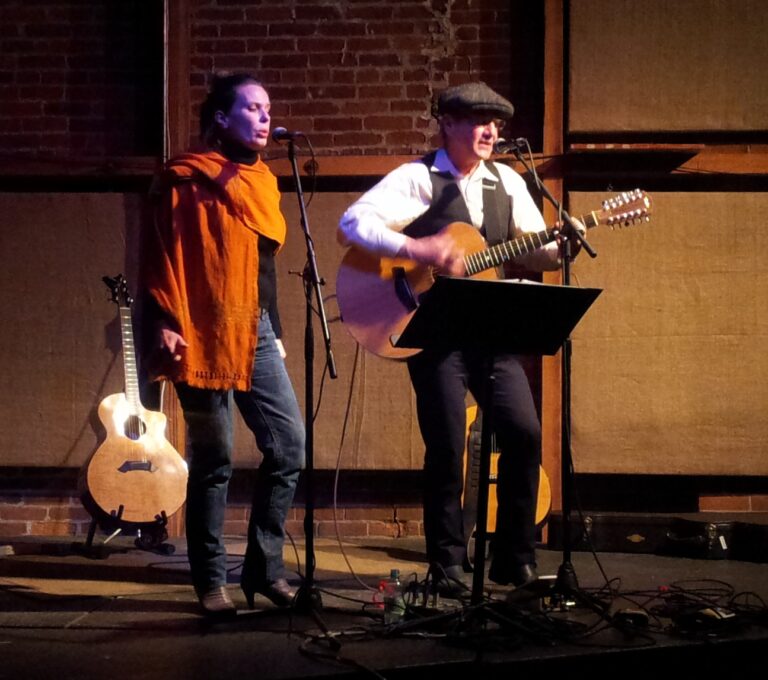
Callahan and his wife Yvonne Moore, who now call Switzerland home, performed about a dozen songs on acoustic guitar and vocals at the Arlene Francis Center Friday night. The performance was the most punk rock thing I’ve seen all year, and will hold that title for at least a while. The duo sent a frozen shiver down my spine with lines like, “The people’s flag is deepest red, it shrouded oft our martyred dead; and ere their limbs grew stiff and cold, their hearts’ blood dyed its every fold.”
Santa Rosan Robert Ethington opened the show with original songs on acoustic guitar, accompanied by his wife Amy on vocals. They played a handful of powerful songs, suggesting they’d be a treat to see as a headlining act.
The album, “Songs of Freedom,” includes fully orchestrated versions of the songs Callahan and Moore played Friday night. It’s got Callahan’s worldbeat sensibility and arrangement, with guitar, bass, drums, Irish whistles, pipes, vocal harmony, fiddle, accordion and harp. The production is excellent, and the arrangements are updated to modern sensibility without losing their original feeling. Some tunes to Connolly’s songs were lost, so Callahan wrote original music to his lyrics. It serves to note that Connolly’s main purpose of putting these revolutionary words to music was for people to sing them and remember them, so many of the tunes are actually traditional country songs or somewhat hokey, simple melodies. They sound best when sung with 100 of your closest, most fed-up-with-the-system friends.
Get the book and CD here. It’s perfect for fans of history, revolution and Mat Callahan, each of which is equally important.
Here’s where you can catch this great show:

Live Review: Mat Callahan sings James Connolly

Mat Callahan at the Arlene Francis Center

The cyclical nature of revolution songs is undeniable. Take a song from 100 years ago and it will be, at least in part, relevant today. Take, for example, the songs of Irish revolutionary James Connolly.

Mat Callahan, who fronted the San Francisco political punk/worldbeat band the Looters in the 80s, has compiled a book of Connolly’s music from original publications long thought lost to history. The book is put together well, with just enough history to give a sense of Connolly’s importance but relying mostly on the man’s own words from his music, all of which was written over 100 years ago. Connolly, a leading Marxist theorist in his day and was executed by the British in 1916.

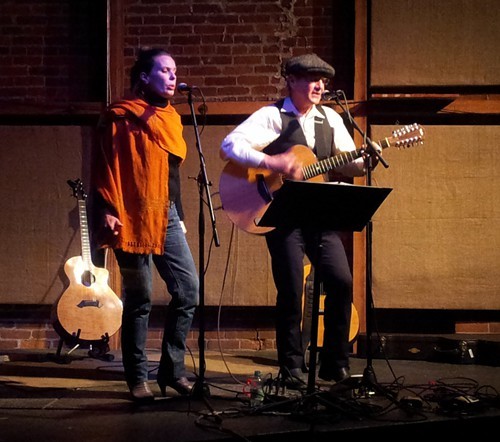
Callahan and his wife Yvonne Moore performed about a dozen songs on acoustic guitar and vocals at the Arlene Francis Center Friday night. The performance was the most punk rock thing I’ve seen all year, and will hold that title for at least a while. Callahan celebrated his 60th birthday three years ago but sends a frozen shiver down my spine with lines like, “The people’s flag is deepest red, it shrouded oft our martyred dead; and ere their limbs grew stiff and dead, their hearts’ blood dyed its every fold.”

The album, “Songs of Freedom,” includes fully orchestrated versions of the songs Callahan and Moore played Friday night. It’s got Callahan’s worldbeat sensibility and arrangement, with guitar, bass, drums, Irish whistles, pipes, vocal harmony, fiddle, accordion and harp. The production is excellent, and the arrangements are updated to modern sensibility without losing their original feeling. Some tunes to Connolly’s songs were lost, so Callahan wrote original music to his lyrics. It serves to note that Connolly’s main purpose of putting these revolutionary words to music was for people to sing them and remember them, so many of the tunes are actually traditional country songs or somewhat hokey, simple melodies. They sound best when sung with 100 of your closest, most fed-up-with-the-system friends.

Get the book and CD here. It’s perfect for fans of history, revolution and Mat Callahan, each of which is equally important.

Jan. 18: Sean Hayes at Hopmonk Sebastopol

0

images.jpg

When it comes to that lazy, loping, drunk-style drumming, it’s hard to beat Sean Hayes’ “When We Fall In.” A combination of folk guitar, doo-wop-style call-and-response and Hayes’ own elegant tenor voice, the song is a standout on Hayes’ 2010 album Run Wolves Run, and showcases everything that’s right with this Bay Area tunesmith who once played Jesus in a film. (These are beardy times, and half the fun of seeing Hayes live is guessing how out of control his facial hair may be at any given time.) Hayes plays this week with locals Trebuchet—who are set to release their (excellent) second album—on Saturday, Jan. 18, at Hopmonk Sebastopol. 230 Petaluma Ave., Sebastopol. 8:30pm. $22—$26. 707.829.7300.

Jan. 17: ‘Thinking Outside the Bottle’ at the Napa Valley Museum

0

ContentImage-645-60431-_MG_6978.jpg

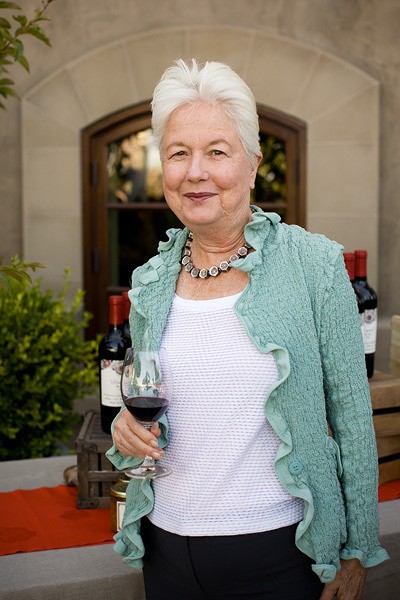
Winery owners come from all areas of the world—both geographically and anthropologically. We’ve got retired dentists, Wall Street bankers, practicing lawyers, Oscar-winning filmmakers and at least 10 artists. At least that’s what the Napa Valley Museum is telling us with its new exhibit, ‘Thinking Outside the Bottle.’ Shining a light on winemakers, viticulturalists and winery owners who refuse to relegate themselves to one art form, the show includes painters, ceramicists and sculptors from Charter Oak, Mendelson, Zacherle and others. Both Margrit Mondavi and Eleanor Coppola are included in the show, too, which opens with a reception on Friday, Jan. 17, at the Napa Valley Museum. 55 Presidents Circle, Yountville. 5:30—7pm. $5. 707.944.0500.

Jan. 16: Colin Quinn at the Wells Fargo Center

0

colin-quinn-long-story-short-alt-1024.jpg

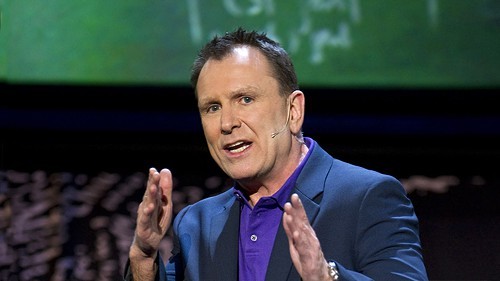
You might think the 1987 classic Three Men and a Baby is all about Steve “hunkalicious” Gutenberg, but you’d be overlooking the scene-stealing Colin Quinn, credited in his first film role as “Gift Shop Clerk.” Of course, over the years, Quinn would go on to expected greatness—most notably trying, in trademark affected grouchiness, to fill the enormous shoes left by Norm MacDonald on Saturday Night Live’s “Weekend Update.” Never known to say nice things about his time working for the SNL Rockefeller Peacock, Quinn turned to comedy clubs, where good Lord, he shines. See him cover 226 years of American history in his show “Unconstitutional” on Thursday, Jan. 16, at the Wells Fargo Center. 50 Mark West Springs Road, Santa Rosa. 8pm. $37. 707.546.3600.

Jan. 15: Albert Lee at Sweetwater Music Hall

0

albert-lee2.jpg

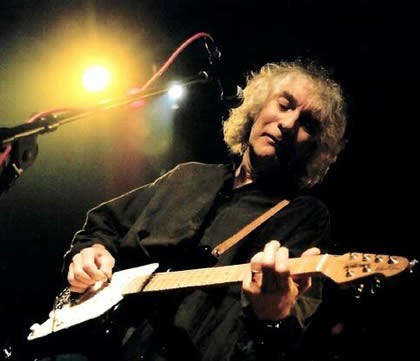
When one can rack up their credits in life and count among them collaborations with Deep Purple, Emmylou Harris, George Harrison and Eric Clapton, it’s time for a celebration. The phenomenal British guitarist Albert Lee plays this week at Sweetwater, and there’s no telling what myriad styles he may unleash on his adoring fans. Having backed the Everly Brothers and played in the Crickets, Lee could go full 1950s—or he could fingerpick his way through early ’70s-style prog rock. Who knows? He’s that versatile. Watch him bend strings and blow minds with his full band on Wednesday, Jan. 15, at Sweetwater Music Hall. 19 Corte Madera Ave., Mill Valley. 8pm. $25—$30. 415.388.3850.

The No-Workout Workout

0

An integrative physician to hard-driving Manhattan professionals, Dr. Frank Lipman encounters a lot of stressed-out patients. Some of them are stressed from working 12-hour days. Others are stressed from working 12-hour days while trying to fit in time for the gym. Still others are stressed from working 12-hour days, going to the gym when they can and feeling guilty or anxious when they can’t. “I try to get my patients to see exercise not as exercise but as movement,” Lipman says. “To get them to move as much as possible in their everyday lives rather than feeling that they have to keep to a rigid exercise regime.”

Lipman’s perspective is informed more by traditional Chinese medicine than the latest sports science, but as it turns out, his view supports new revelations in exercise science. In the past several years, research has shown that exercise isn’t just what happens when you sweat for at least a half-hour running, biking or doing strength or cardio training at the gym; exercise can also be any movement you do during the day, and it can be just as effective at improving health, controlling weight and, in some cases, maintaining or even boosting fitness.

The idea of exercise as a sustained activity separate from the rest of your day dates back to the 1970s, when the American College of Sports Medicine recommended continuous workouts of at least 20 minutes, based on research on elite athletes. “The implication was that if you didn’t reach a certain number of minutes, it wasn’t worth your while. But that’s not true,” says Glenn Gaesser, an exercise physiologist at Arizona State University.

Gaesser recently conducted a study to see if short bouts of activity done throughout the day could deliver the same benefits as one continuous workout. He asked a group of people to walk briskly on a treadmill for 30 minutes or at the same pace for 10 minutes three times a day. He found that participants’ blood-pressure levels were “significantly lower” on the 10-minute interval days.

Previous studies have also shown that taking multiple short walks lowers blood sugar more effectively than sustained walking. Researchers think that being active more frequently throughout the day forces the body to shuttle sugar from food to working muscles instead of storing it as fat.

Cumulative exercise contributes to weight loss in more significant ways, too. A recent Danish study found that when people didn’t work out as long at the gym, they had more energy to move throughout the day, adding up to a bigger caloric burn. The science supports a concept called NEAT, shorthand for “non-exercise activity thermogenesis,” which is the number of calories we burn when we’re not eating, sleeping or doing sustained exercise. It includes every movement you make, from momentary activities like bending over to tie your shoes and gesturing during a conversation to conscious activities like walking a few more blocks and taking the stairs instead of the escalator. When you do enough of these movements, NEAT can cause you to burn up to 2,000 more calories per day.

Consider an average day: drive to work, sit at a desk, sit through lunch, sit in a meeting, drive home, watch TV. Through small changes, we can integrate intentional effort into this same schedule: walk instead of driving, or park farther away; use a standing desk or sit on a Swiss ball; take a walking lunch break; pace the office with your phone glued to your ear; do wall sits while watching TV.

Mayo Clinic endocrinologist Dr. James Levine, who coined the term “NEAT,” thinks being proactive about intentional activity can add up, as shown by the Amish, who live without computers, cars, TVs and smartphones. According to statistics, an Amish man takes 18,500 steps a day, while the average American walks only 5,000. And research shows men need to walk only 3,500 more steps per day, less than two miles, to lose 8.5 pounds in a year without changing their diets.

Yet the Amish, as healthy as they may be, don’t produce a lot of strong recreational runners or tennis players. To be these things, you need fitness, which requires pushing the body beyond its comfort zone. When you stress or overload your cardiovascular system, it adapts to meet the increased load: the heart pumps more blood and oxygen to muscles, where muscle cells increase in number. But can you accomplish all this simply by walking and standing up more frequently?

Maybe. How much exercise a person needs to increase fitness will be particular to that person, dependent upon current activity and genetics. Yet some research shows that cumulative exercise can improve fitness. Researchers in an Irish study asked two groups of people to either walk vigorously 30 minutes a day or split up the workout into three 10-minute walks at the same pace, similar to Gaesser’s setup. After six weeks, scientists found that frequent short walks provided a bigger boost to VO2 max, which is our ability to process oxygen and is one of the classic measures of fitness.

If you want to build strength without the gym, you can get similar benefits by doing some pushups here, sit-ups there and a little body squatting at random. Mini strength workouts done throughout the day can add up to more work than most people can handle in a single session, says Dr. Tim Church, a preventive-medicine researcher at the Pennington Biomedical Research Center in Baton Rouge, La. Better yet, they can be done at home, in a closed office or in an empty conference room.

How can you tell if your “exercise” during the day is paying off? Monitor yourself. If, over time, you’re accomplishing the same work, the same number of flights of stairs and the same number of pushups with less effort, you’re getting fitter and stronger. If your weight drops or stays the same, you’re also getting a similar caloric effect to the gym.

There are also significant benefits to reducing the time you spend sitting. An impressive body of research now shows that prolonged sitting increases the risk of cancer, heart disease and other chronic illnesses, no matter how much you exercise, by slowing blood flow, heart rate and cell turnover. University of Southern California professor of medicine Dr. David Agus has compared the risk incurred by prolonged sitting to smoking a pack and a half a day, while one study found that sitting for eight hours daily increases the risk of premature death by 15 percent, even for those who work out.

If science has loosened its grip on the five-days-a-week gym habit, it has also shown us that less time at the gym is more. Research on high-intensity training suggests that you can maximize exercise’s payoff by working out at a higher intensity for a shorter time. Martin Gibala, a professor at Ontario’s McMaster University, has published mind-blowing research which concluded that six to nine minutes a week of all-out pedaling on a stationary bike can produce the same fitness gains as five hour-long workouts conducted at a comfortable pace. As for weight loss, while short intervals don’t torch as many calories per week as five hour-long workouts, caloric burn during and after doing intervals is significantly higher.

The message is this: less is more. “There aren’t many studies that have proved a minimum effective dose for exercise. But there are many studies that disprove the need to be in the gym for hours per week, let alone per day,” says Tim Ferriss, author of The 4-Hour Body. As the evidence in favor of shorter workouts accumulates, so too does data suggesting that long workouts make less sense for those of us who aren’t elite athletes. Recent research has found that joggers who run fewer miles tend to outlive those who run more than 20 miles a week.

“There is a law of diminishing returns,” Gaesser says. “My guess is that beyond 300 minutes a week of moderate to vigorous exercise, the additional health benefits become rather negligible.” So when you’re at the office or home with the kids, don’t stress about not being at the gym. Movement is movement, and it all counts. “I coach my kid’s baseball team, so I’m running around all over the place,” says Church. “I work hard at not making it a sedentary activity.”

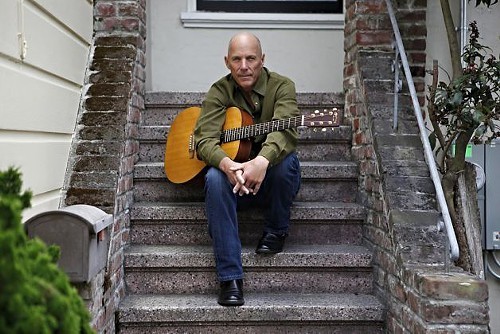
Jan. 24: Tim Flannery at Sweetwater Music Hall

Whenever I’m blue in the off-season, I cue up the video of Angel Pagan, in May 2013, hitting a walk-off, inside-the-park home run in the 10th inning to beat the Rockies. The glory of Pagan’s achievement, however, must be shared by third-base coach Tim Flannery, who had the chutzpah to send Pagan to home plate as the throw came...

Jan. 23: San Francisco Symphony at the Green Music Center

The Green Music Center is usually home to the Santa Rosa Symphony, but this week sees two visiting outfits. On Thursday, Jan. 23, the San Francisco Symphony rolls into the space with violinist Alexander Barantschik, who’ll perform Mendelssohn’s Violin Concerto in D Minor and conduct works by Mozart, Britten and Piazzolla. On Saturday, Jan. 25, Harry Bicket conducts the...

Jan. 22: Olivia Laing at Book Passage

Ernest Hemingway. F. Scott Fitzgerald. Tennessee Williams, John Berryman, John Cheever. Raymond friggin’ Carver. What do these authors have in common? (“They were all overrated white males” is not the answer we’re looking for.) They all ordered booze by the boatful, and in her new book The Trip to Echo Spring: On Writers and Drinking, author Olivia Laing explores...

Live Review: Mat Callahan sings James Connolly

The cyclical nature of revolution songs is undeniable. Take a song from 100 years ago and it will be, at least in part, relevant today. Take, for example, the songs of Irish revolutionary James Connolly. Mat Callahan, who fronted the San Francisco political punk/worldbeat band the Looters in the 80s, has compiled a book of Connolly’s music from original publications...

Live Review: Mat Callahan sings James Connolly

Nicolas GrizzleMat Callahan at the Arlene Francis Center The cyclical nature of revolution songs is undeniable. Take a song from 100 years ago and it will be, at least in part, relevant today. Take, for example, the songs of Irish revolutionary James Connolly. Mat Callahan, who fronted the San Francisco political punk/worldbeat band the Looters in the 80s, has compiled a...

Jan. 18: Sean Hayes at Hopmonk Sebastopol

When it comes to that lazy, loping, drunk-style drumming, it’s hard to beat Sean Hayes’ “When We Fall In.” A combination of folk guitar, doo-wop-style call-and-response and Hayes’ own elegant tenor voice, the song is a standout on Hayes’ 2010 album Run Wolves Run, and showcases everything that’s right with this Bay Area tunesmith who once played Jesus in...

Jan. 17: ‘Thinking Outside the Bottle’ at the Napa Valley Museum

Winery owners come from all areas of the world—both geographically and anthropologically. We’ve got retired dentists, Wall Street bankers, practicing lawyers, Oscar-winning filmmakers and at least 10 artists. At least that’s what the Napa Valley Museum is telling us with its new exhibit, ‘Thinking Outside the Bottle.’ Shining a light on winemakers, viticulturalists and winery owners who refuse to...

Jan. 16: Colin Quinn at the Wells Fargo Center

You might think the 1987 classic Three Men and a Baby is all about Steve “hunkalicious” Gutenberg, but you’d be overlooking the scene-stealing Colin Quinn, credited in his first film role as “Gift Shop Clerk.” Of course, over the years, Quinn would go on to expected greatness—most notably trying, in trademark affected grouchiness, to fill the enormous shoes left...

Jan. 15: Albert Lee at Sweetwater Music Hall

When one can rack up their credits in life and count among them collaborations with Deep Purple, Emmylou Harris, George Harrison and Eric Clapton, it’s time for a celebration. The phenomenal British guitarist Albert Lee plays this week at Sweetwater, and there’s no telling what myriad styles he may unleash on his adoring fans. Having backed the Everly Brothers...

The No-Workout Workout

An integrative physician to hard-driving Manhattan professionals, Dr. Frank Lipman encounters a lot of stressed-out patients. Some of them are stressed from working 12-hour days. Others are stressed from working 12-hour days while trying to fit in time for the gym. Still others are stressed from working 12-hour days, going to the gym when they can and feeling guilty...
12,117FansLike
4,907FollowersFollow
6,928FollowersFollow