Banshee Wines

0

To some, the surprising part of this story is that a few wine country newcomers can grow a 10,000-case brand out of a 500-case lot of wine in less than four years. Even more surprising, they’ve managed to snag a storefront on what surely must be the last remaining block face in Healdsburg that didn’t already have a winetasting room.

Now that the permit has been granted and the lights are on, let’s see what all the wailing’s about.

Cofounder Noah Dorrance’s part of the story begins with arriving in San Francisco for a new job at a startup in 2006, but it doesn’t end with a Google buyout and a vineyard mansion (not yet, says the Missouri native, who admits to having the conventional dreams of a starstruck wine country newbie). Two months later, the startup folded. So Dorrance got a production job at Crushpad, later joining up with Baron Ziegler and Steve Graf, whose taste for wine had drafted them into sales and distribution careers. Now, they’ve got a red-hot, fast-growing new brand and a second label, Rickshaw, to boot.

The three wanted to create a setting similar to those in which people normally drink wine, so there’s no elbow fest at the wine bar here. Instead, a rough-hewn communal table, corner sofas and modish leather chairs provide a range of approaches to lounging around. Wines are poured by the flight or glass; small bites like lentil hummus and house-baked crackers from SHED will be available as soon as the kitchen gets the all-clear.

The interior is a successful look, albeit in flux, because everything’s for sale. A pyramid of wooden crates displays antique odds and ends, while LP records spin on the turntable. There’s something about sitting around and sipping wine, Dorrance says, that puts people in the mood to buy. Including, it is hoped, the wine.

The flagship 2011 Sonoma County Pinot Noir ($25) represents half of Banshee’s production. Here comes artisanal plum licorice, dried orange peel and cherry fruit leather—like the rest of the Pinot lineup, it’s a whiff of raspberry and red cherry perfume, largely absent in overt oak, with a not-too-dry, not-too-sweet finish. Trade up to the 2011 “Marine Layer” ($45) for more complexity and cranberries, or the 2011 Sullivan Vineyard ($50) for wild raspberries, brown spice and general plush fruit. On the crisp and cool slate, there’s 2012 Rosé of Pinot Noir ($20), 2012 Sonoma County Sauvignon Blanc ($18) and 2012 Anderson Valley Chardonnay ($40). They’re doing a nice job here.

Banshee Wines, 325 Center St., Healdsburg. Daily, 11am–7pm. Tasting fee, $10–$20. 707.395.0915.

Threads of Recovery

0

Melissa walked along a dark stretch of Lake Merritt in Oakland, feeling a little woozy. She’d been drinking at an ’80s party hosted by a friend. She knew it was late. Normally she wouldn’t walk alone. But she was only a few blocks from home. It was just a short distance.

About a block from her apartment, a car pulled up and a man yanked her inside before speeding away. Melissa, who asked that her name be changed for this story, watched her apartment building whiz by out of the corner of her eye.

“I had a million things going through my head,” she says. “There was the fear I would never get back out of that car. And this is going to sound ridiculous, but to be honest, my number one prevailing thought—and I must have been a little bit crazy at the time—was that I had my dog at home, and there was no one who was going to come let him out.”

The man stopped the car and raped Melissa, beating her in the face as she tried to fight back. About a half hour later, she thinks, he shoved her out of the car and peeled away. Shocked and dazed, Melissa’s bloody fingers dialed a friend, who immediately picked her up and rushed her to the hospital.

The details of the hospital remain hazy, but she clearly remembers at least two things: they gave her two Power Bars during the more than three-hour exam, and they gave her new underwear, pants, socks, a long-sleeve pajama top and a hoodie sweatshirt.

When Melissa’s friend dropped her off at her apartment building, she pulled the hood up and over her face, shielding herself, and walked the rest of the way. Her dog anxiously greeted her.

“I can’t imagine leaving the hospital in any other state,” Melissa says. “It would have been horrifying and embarrassing, and I think that if I had been in a position where I had to walk home with my bits hanging out of a hospital gown, that’s the memory that would have stayed with me. And I didn’t have to do that. It’s because someone provided comfortable clothing for me.”

That “someone” is San Jose resident Lisa Blanchard, who just one year before Melissa’s attack founded the nonprofit Grateful Garment Project (GGP). In less than three years, the organization has grown from collecting clothes for the Sexual Assault Response Team (SART) facility at the Santa Clara Valley Medical Center to equipping 20 other California counties, including Sonoma County, where Christine Castillo, executive director of Verity—which provides rape-crisis counseling and support—has been integral in establishing the project.

The California Emergency Management Agency reported that in the 2010–2011 fiscal year—the most recent available data—nearly 30,000 people accessed rape crisis centers statewide. The survivors range in age from infants to senior citizens, and include both females and males.

Social workers say the numbers are probably much higher, since sexual assault remains widely underreported due to stigma, shame and victim-blaming. Unlike Melissa’s case, an estimated 75 to 80 percent of victims know their attackers, and there’s sometimes pressure from family and friends to keep quiet.

Sexual Assault Response Team centers often run on what Blanchard calls “duct tape and Band-Aid budgets.” Counties are mandated by the state to have a SART facility, and yet the state allots just $45,000 annually to pay for them, according to advocacy agency California Coalition Against Sexual Assault. That amounts to just $775 per county.

“It’s really kind of staggering to think that all these organizations had little or no resources to help survivors,” Blanchard says. “The nurses or advocates that support the survivors a lot of times bought stuff out of their own pockets.”

In addition to new clothing and prepackaged food, GGP provides books, toys and DVDs for children, privacy screens, and even pieces of exam equipment when older gear breaks down.

Sue Barnes, director of the YWCA’s rape crisis center, calls the GGP’s work “phenomenal.”

“The clothing is huge, because very often the police have had to take them from the survivor because it is evidence,” Barnes says.

Requests regularly come from out-of-state SART centers for information on how Blanchard started GGP and how it operates. She says the focus remains firmly on California for the moment, and she hopes to serve all 58 counties in the future.

“I hope she keeps growing and growing,” says Melissa, who has since moved to Michigan to be near family. “I will be forever grateful.”

For more information, go to gratefulgarment.org.

Full ‘Spectrum’

0

Jazz fusion is experienced on many levels. There’s the Van Halen level (it just plain rocks, and is met with a scrunched “Oh yeah” face), the Rush level (technical ability drops jaws and bulges eyes) and the John Coltrane level (arrangements and chord progressions so out-of-this-world they warrant an aural double take).

Billy Cobham’s 1973 fusion masterpiece, Spectrum, hits on all of these, and adds a groove. The result is an album full of odd time signatures, ripping guitar solos and impressionistic synthesizer sounds with some of the most powerful, technical and musically grounded drumming ever heard. The album’s best song, “Stratus,” features a solid drum groove until the end, when Cobham cuts loose with insane fills in perfect time for what seems like an eternity—and, since the song fades out, it might have been quite longer.

The funny thing is that Cobham, who comes to Napa’s Uptown Theatre on Sept. 27, didn’t set out to make a record like that in the slightest. “I made that record so that I could hand it out to suitors close to New York City, where I was living at the time, to try to get a gig on the weekends, like a wedding or whatever,” says the celebrated drummer via phone from Florida, the night before kicking off Spectrum‘s 40th anniversary tour.

When people told him it had made the Billboard charts, he didn’t believe them. After all, when Spectrum was released (recorded on a $30,000 budget, start to finish) the No. 1 song in the country belonged to Cher—and, not long after, the Carpenters.

So how did an album that was so far out there become one of the most celebrated and critically acclaimed fusion releases of all time? “People saw there was a possibility to combine the complex with the banal, to some degree, and come up with something very positive,” says Cobham. It was, perhaps, the shock of simplicity in a genre known for complexity that took hold of listeners.

Cobham, whose intricate, powerhouse drumming propelled the chaotic world of the Mahavishnu Orchestra, lays down tight grooves on Spectrum, but the album also shows off his fierce chops with numerous drum solos. It displays, as Cobham puts it, “two separate personalities in one project.”

Cobham has taught music in Napa through an online music school, and has visited several times, but this week’s show marks his first performance in the North Bay. “I’m looking forward to this,” he says.

Cobham adds that his feat isn’t otherworldly. “What I’ve done can easily be done by anyone else,” he says. “People are people, and I’m just a person. We all have it in us.”

First-Class Investigation

0

Considering that U.S. Postal Service revenue has been on a steady decline for several years, you’d think one of America’s largest federal agencies would try to recoup as much as possible when entering into real estate transactions. Not so, argues award-winning investigative journalist (and Bohemian contributor) Peter Byrne. In his new e-book, Going Postal: U.S. Senator Dianne Feinstein’s husband sells post offices to his friends, cheap, the Petaluma-based reporter uncovers the sordid results of the USPS’s 2011 decision to award an exclusive contract to CBRE, a commercial real estate firm headed by Richard Blum, husband of
Sen. Dianne Feinstein.

Motivated in part by the U.S. government’s astounding demand that the Postal Service pre-pay $55 billion in employee benefits over the next 10 years to cover the next 75 years of benefits, the agency has resorted to selling off offices, warehouses, parking lots and vacant land worth millions of dollars. But CBRE is selling some of these properties at “bargain basement” prices, writes Byrne, and sometimes to its own clients and business partners, including Goldman Sachs. (The 52 properties sold have a collective assessed value of $232 million, asserts Byrne, and yet CBRE sold them for $79 million less than what they were worth.)

With information backed by expense reports obtained under the Freedom of Information Act, county records, deeds of sale, property tax databases and assessment data, Byrne has constructed a comprehensive look at the financial shenanigans going on behind the mail curtain. Byrne has gone after Dianne Feinstein and Richard Blum for conflicts of interest in the past, but this is the first time he’s thrown the (e)book at them. Going Postal is available for $2.99 exclusively at Amazon.com.
—Leilani Clark

Shared Visions

0

The San Francisco Museum of Modern Art is temporarily closed, and that’s good news for the Sonoma County Museum—it allows, for the first time, a collection of photographs from SFMOMA to appear north of the Golden Gate.

The exhibit, “Photography in Mexico,” opening Saturday, Sept. 28, previously showed at SFMOMA two years ago. In San Francisco, the number of photographs was staggering, but SFMOMA photography curator Corey Keller says she’s going to hang most of the exhibit in the smaller Sonoma County Museum.

Arranged chronologically, the exhibit begins with Edward Weston’s work from Mexico in the 1920s. “I always loved the Westons, because he comes in with a foreigner’s eye to look at this culture that’s unfamiliar but really inspiring to him,” says Keller. “He so appreciates the shapes that were already there.”

From that time, photographers in Mexico started to embrace their own style. “There had been very painterly and pictorials before that, and so the direction of Mexican photography changed,” says Keller. “What the Mexicans really did is took the formal lesson, but they added the political aspect to it. The pictures really marry the aesthetics and the politics.”

Mostly in black and white, some of the images show famous subjects like painters Frida Kahlo and José Orozco, and Rodrigo Moya’s iconic photo of Che Guevara, but most are shots of everyday life. The 1979 photograph Our Lady of the Iguana, shows a Zapotec woman from southeastern Mexico with a crown of live lizards, and recent work in color shows the rolling hills of Mexico City covered with houses far as the eye can see. The diversity of the exhibit combines rural and urban, old world and new realities, young spirits and old souls, all from one country and almost entirely through the eyes of its own people.

When SFMOMA reopens, it will be almost three times its former size, taking up an entire city block and rising to seven stories. As if taking a cue from its well-funded cousin, the Sonoma County Museum is also expanding.

After abandoning plans to move into the long-delayed development at the former AT&T building in downtown Santa Rosa, the museum will expand into the old Conklin Brothers building next door to its current location, which it owns. “I think this is a better building,” says Sonoma County Museum executive director Diane Evans. “The space we were going to have there had a lot of challenges, and it was actually smaller.”

When construction is complete, the current museum will house historical exhibits, with the new space dedicated to art. Beginning in December, the large warehouse space will house monthly pop-up art nights, for which the museum is currently accepting applications, promising a stipend and staff in exchange for ideas, organizing and, of course, art. (Applications can be accessed at sonomacountymuseum.org.) “There are a lot of creative people in this community,” explains Evans, “who maybe don’t have a venue to try something experimental.”

Jesus Wept

0

In his essay “C.O.G.” (“Child of God”), David Sedaris muses about a group of born-again Christians: “There seemed to be some correlation between devotion to God and a misguided zeal for marshmallows.”

Unfortunately, in the film adaptation of the same name, such wry observations are nowhere to be found. Screenwriter Kyle Patrick Alvarez’s C.O.G. contains no narration, only dialogue, which almost works with Glee‘s Jonathan Groff portraying the memoirist’s arrogant younger self. But without the humorist’s narrative overlay, C.O.G. feels jarringly a-Sedaris—mostly because it’s just not funny.

Young David has just finished grad school, so he boards a bus for rural Oregon, determined to find his inner Steinbeck. But the misty West is less idyllic than he’d hoped, and between an ex-con who mocks him for reading, a factory worker displaying dozens of dildos in a case and a caustic vet who hands out Jesus pamphlets and carves wall clocks shaped like Oregon, David whirls between crazies like a drunk with vertigo.

All is fodder for comedy in Sedaris’ dark, self-lacerating essay, but not in the film. Without the author’s voice, it becomes pure plot—and the plot of this little story is tragic. Dildo man tries to rape him. He escapes in a woman’s bathrobe. He moves in with the vet, attends a tearful altar call and is then disowned by the congregation he comes to love for being gay.

Coupled with a moody soundtrack and lingering shots of the Northwestern countryside, C.O.G. is a quiet meditation on many important themes: gender, sexuality, religion. And with his nuanced portrayal of a conflicted, lonely twenty-something, Groff lends even more gravity to the film. But there’s so much darkness, it’s hard not to miss that signature Sedaris tone—the one laughing when his own mother cruelly mocks his crippling OCD. It’s a voice that reminds you that you can laugh, too—and in fact, to stay sane, you must.

‘C.O.G.’ is playing through Sept. 26 at the Rafael Film Center in San Rafael, and opens Friday, Sept. 27 at Rialto Cinemas in Sebastopol..

Try the Castle!

0

‘Call outs.” That’s how fans of
The Rocky Horror Picture Show refer to the lines the audience shouts up at the screen during midnight showings of the perversely enduring 1975 spoof. At Sixth Street Playhouse, where director Craig Miller has staged a spirited production of the original 1973 stage musical (on which the movie was based), “call outs” from the audience are not only tolerated, they are encouraged.

On the Sixth Street website, there’s even a link to the “official” call-and-response script. And though the traditional use of water guns and the tossing of rice, cards and toast is not allowed in the Studio Theater (too dangerous for the actors), the cast is prepared to hear experienced Rocky followers shouting “Asshole!” and “Slut!” whenever stiff Brad (Braedyn Youngberg) and virginal Janet (Julianne Lorenzen) are named, and to cry “Say it!” when the sexually omnivorous Dr. Frank N. Furter (Rob Broadhurst)—to whose castle the wide-eyed newlyweds are lured—pauses with “antici . . . pation!” in the middle of a word.

Such frat-party behavior might normally get one ejected from a theater. Here, such actions will win applause and admiration, and fans who show up in costume (also encouraged) might even win a prize at intermission.

As with the film, which was crucified by critics but was embraced by fans anyway, it seems a bit beside the point to even attempt a traditional review of Sixth Street’s Rocky Horror Picture Show.

The story is thin, the characters thinner, the logic of the “plot” is spotty at best, and what passes for a climax seems tossed together and disappointingly anti-climactic. But the songs by Richard O’Brien, who also wrote the script, still rock with silly, limit-pushing exuberance; the three-quarter-thrust staging in the studio works quite well in bringing the audience close to the action; the cast tackles the show with a fresh sense of can-you-believe-we’re-actually-doing-this exhibitionism; and Miller’s direction emphasizes the joyful deviance of the whole undertaking.

Cast highlights include Broadhurst and Lorenzen (both dazzlingly bold), a strong-voiced Shannon Rider as Magenta and Jake Turner as a peppy Riff Raff.

The only real way to judge this Rocky Horror is by the contagiousness of the actors’ freedom-savoring fun, and despite some opening-night reserve in spots, it’s here in great supply.

Rating (out of 5): ★★★★

Scene Building

0

After being questioned about the dearth of women artists at his events, local concert promoter Jake Ward was inspired by the Free Pussy Riot movement to put on a women’s art and music showcase.

“I do a lot of rock shows, and I wanted to find local rock bands that were all-female,” says Ward, who put out a Facebook call for all-women rock bands in the North Bay that didn’t result in many leads.

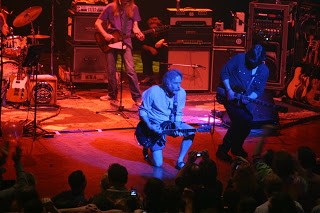
Undaunted, Ward worked with the Arlene Francis Foundation and CMedia to put together a lineup of live music from the She’s (sunny garage-pop from San Francisco teens, pictured above), the Wild Ones, Ashley Allred of Odd Bird and Slinky Minx. Local women artists Sara Davis, Julia Davis, Kaija Sabbah and others are creating new Pussy Riot and feminist-inspired art to be featured in a gallery setting. Speakers include Elaine Holtz, longtime host of Women’s Spaces, and information on the Free Pussy Riot cause will be readily available.

Ward has high hopes of inspiring more women to take up instruments and start a damn band already. “I’m hoping that women who come to this show will think, wow, this could be a whole scene and maybe it’ll grow from there.” The Free Pussy Riot Women’s Art Gallery and Music Showcase happens on Monday, Sept. 30, at the Arlene Francis Center. 99 Sixth St., Santa Rosa. 6–10:30pm. $7 (no one turned away for lack of funds). 707.528.3009.

Libraries for All

0

From my childhood in the Deep South, I have disturbing memories of how black voters were disenfranchised. The South is still trying this, in stupidly and obviously discriminatory ways, such as voter ID laws that recognize gun permits but exclude student IDs.

I expected Sonoma County to be liberal. Over time, I discovered that, while Latinos make up a quarter to a third of the population, they are scarcely visible in local government. More recently, I learned the mechanism. A large part of the Latino population lives in the unincorporated areas of the county. They don’t get to vote for the leaders. That’s more clever than the South ever was.

The most recent example is the new proposed structure for the library, drawn up by Supervisor Mike McGuire’s committee with no representation from the public. Under the old structure, the unincorporated areas of the county contributed 45 percent of the library tax revenue but received less than 5 percent of the services.

In the new structure proposed by the McGuire committee, the cities will each get a rep on the library commission, but the single county rep is not mandated to represent the unincorporated areas. The bulk of the library’s contributors will lose their representation, while McGuire’s district will get three reps.

Committee member (and library commissioner) Julia Freis claims that this is fair because the commissioners don’t represent an area; they represent everyone in the county. One wonders, then, why the commission has never reviewed services to the Spanish-speaking, where Sonoma County lags behind other Bay Area libraries with significant Latino populations.

The library commission backed an out-of-control director for eight years. It spent lavishly on outside consultants and designer furniture. It cut staff, Monday services and evening hours, but, in spite of deep public opposition, it has never put the Monday closures on its agenda.

McGuire’s committee has proposed a new library governance structure that makes it easier for the cities to negotiate leases. For the public, it does nothing to ensure that the new director or the new commission will be any improvement over the old ones.

Karen Guma is a retired Sonoma County librarian living in Petaluma.

Open Mic is a weekly op/ed feature in the Bohemian. We welcome your contribution. To have your topical essay of 350 words considered for publication, write op*****@******an.com.

Want Some Figs?

0

It’s 9am on a late summer morning, and Leon and I are out in the backyard woefully examining our garden’s fecund bounty.

“Hey, there,” a neighbor calls over the fence. “Want some figs?”

We look at each other. We share two thoughts: fresh garden figs, how lovely! And: fresh garden figs, yet another perishable to protect, somehow, from perishing.

“Of course!” I muster a fake heartiness. “We’d love them.”

And of course we would. But we’d particularly love them if we didn’t have our own buncha too much of everything else. And so, when our neighbor comes around the fence with a colander full of sweet green figs just touched with purple blush, the kind of figs that people are paying $7 a basket for right this very minute, I mount a fierce exchange.

“What can I give you?” I ask with urgency. “What do you need? Tomatoes, basil, eggplant, zucchi—”

She interrupts apologetically: “I’m going out of town.”

“How about some basil?” I press. “You have tomatoes, don’t you? Couldn’t you use some basil?”

Not waiting for her response, I rush into the house and grab a pair of scissors. She watches helplessly as I begin to cut tall, fragrant stalks and gather them into an unwieldy bouquet. As I snip, I understand that the basil loves this kind of pruning and that my unwanted gift will just prompt it to produce more.

“Are you sure you don’t need eggplant? Yellow squash? Peppers?” I pant a little bit, breathless with hope.

“No,” she answers, backing slowly to the gate with her green bouquet. “I’m. Going. Away,” she repeats, as if I’m crazy or something.

Truth is, I am kind of crazy. The weight, the burden, the immense outpouring of certain sections of the garden have made me nuts.

I think about women of yore, furiously working in hot summer kitchens to save, catch, preserve and transform their food for the coming winter months. I know that each plum that hits the ground untasted, each blackberry that withers darkly on the vine, is an insult to hungry people everywhere.

I am by no means alone in the glory of way too much, which has prompted the welcome new trend of online harvest exchanges. In February 2012, Santa Rosa’s Spring Maxfield began the “Farmers’ Black Market” invite-only exchange group on Facebook, which now has over a thousand members. Items are rarely sold, mostly bartered, and produce is by no means the only type of item up for grabs; a few recent examples include offers of wooden spools, kaffir lime leaves and goats for slaughtering.

I read these posts with the rapt fascination of an urban novelist. Six meat goats? Opposed, I suppose, to six milk goats. Should I learn how to slaughter animals? It’s the old-new thing, after all. I wonder what a kaffir tree smells like. What would you do with a box of wooden spools?

Still pondering, I wander into the kitchen, where a small cadre of fruit flies now form a short column above the neighbor’s gift of green figs. Shit.

This article originally appeared on FoodRiot.com.

Banshee Wines

To some, the surprising part of this story is that a few wine country newcomers can grow a 10,000-case brand out of a 500-case lot of wine in less than four years. Even more surprising, they've managed to snag a storefront on what surely must be the last remaining block face in Healdsburg that didn't already have a winetasting...

Threads of Recovery

Melissa walked along a dark stretch of Lake Merritt in Oakland, feeling a little woozy. She'd been drinking at an '80s party hosted by a friend. She knew it was late. Normally she wouldn't walk alone. But she was only a few blocks from home. It was just a short distance. About a block from her apartment, a car pulled...

Full ‘Spectrum’

Jazz fusion is experienced on many levels. There's the Van Halen level (it just plain rocks, and is met with a scrunched "Oh yeah" face), the Rush level (technical ability drops jaws and bulges eyes) and the John Coltrane level (arrangements and chord progressions so out-of-this-world they warrant an aural double take). Billy Cobham's 1973 fusion masterpiece, Spectrum, hits on...

First-Class Investigation

Considering that U.S. Postal Service revenue has been on a steady decline for several years, you'd think one of America's largest federal agencies would try to recoup as much as possible when entering into real estate transactions. Not so, argues award-winning investigative journalist (and Bohemian contributor) Peter Byrne. In his new e-book, Going Postal: U.S. Senator Dianne Feinstein's husband...

Shared Visions

The San Francisco Museum of Modern Art is temporarily closed, and that's good news for the Sonoma County Museum—it allows, for the first time, a collection of photographs from SFMOMA to appear north of the Golden Gate. The exhibit, "Photography in Mexico," opening Saturday, Sept. 28, previously showed at SFMOMA two years ago. In San Francisco, the number of photographs...

Jesus Wept

In his essay "C.O.G." ("Child of God"), David Sedaris muses about a group of born-again Christians: "There seemed to be some correlation between devotion to God and a misguided zeal for marshmallows." Unfortunately, in the film adaptation of the same name, such wry observations are nowhere to be found. Screenwriter Kyle Patrick Alvarez's C.O.G. contains no narration, only dialogue, which...

Try the Castle!

'Call outs." That's how fans of The Rocky Horror Picture Show refer to the lines the audience shouts up at the screen during midnight showings of the perversely enduring 1975 spoof. At Sixth Street Playhouse, where director Craig Miller has staged a spirited production of the original 1973 stage musical (on which the movie was based), "call outs" from...

Scene Building

After being questioned about the dearth of women artists at his events, local concert promoter Jake Ward was inspired by the Free Pussy Riot movement to put on a women's art and music showcase. "I do a lot of rock shows, and I wanted to find local rock bands that were all-female," says Ward, who put out a Facebook call...

Libraries for All

From my childhood in the Deep South, I have disturbing memories of how black voters were disenfranchised. The South is still trying this, in stupidly and obviously discriminatory ways, such as voter ID laws that recognize gun permits but exclude student IDs. I expected Sonoma County to be liberal. Over time, I discovered that, while Latinos make up a quarter...

Want Some Figs?

It's 9am on a late summer morning, and Leon and I are out in the backyard woefully examining our garden's fecund bounty. "Hey, there," a neighbor calls over the fence. "Want some figs?" We look at each other. We share two thoughts: fresh garden figs, how lovely! And: fresh garden figs, yet another perishable to protect, somehow, from perishing. "Of course!" I...
11,084FansLike
4,606FollowersFollow
6,928FollowersFollow