I was having tea and Indian snacks with author Ananda Brady on a recent Saturday afternoon, talking with him about his life and his book, Odyssey: Ten Years on the Hippie Trail. We were sitting at an outside table in his compound, talking Buddhism and other spiritual matters, as one does in Bolinas.
The day was warm, the conversation sparkly. As we spoke, a green-hued hummingbird zipped into the picture, hovered over a box of sugar just inches from us. It seemed like an eternity before that hummingbird finally flitted off.
It was a fitting metaphor.
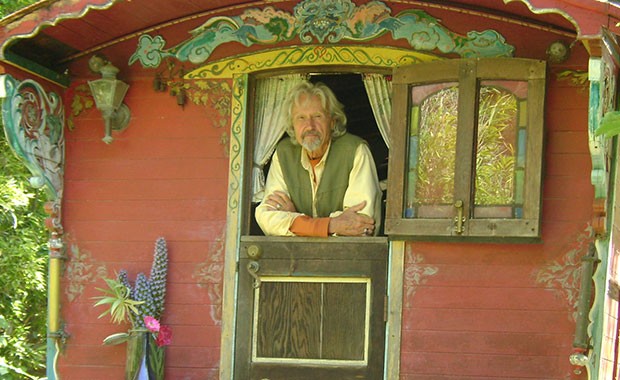
Brady lives up on the Big Mesa in Bolinas
in a hand-hewn Gypsy-circus wagon he built from the ground up, starting with the chassis from a 1955 Chevy pickup truck. The wagon is moveable but it hasn’t moved for years—15 years. “Too much grass growing around the wheels,” Brady said with a laugh.
Brady has another out-building in the compound, the writing space where he put together his 570-page book. His book opens with a poetic tribute to Kerouac, and is deeply flavored with Beat spices.
Odyssey is funny and free-wheeling in its prosody, wryly observed and rich with detail from a 10-year adventure in the 1970s that took Brady, roughly, from Kansas to California to Kansas to Kabul to Kathmandu to Costa Rica—and, eventually, back to California.
His chapter on traveling through Afghanistan in the 1970s is especially poignant in our time of terrorism and war, but there’s no undercurrent in Odyssey of “innocence lost.” These adventures were undertaken in the long, endless shadow of Vietnam. There’s always some innocence out there still waiting to be lost or regained, but Odyssey stands on its own as a historical document.
Brady has entered the Babylon of the internet to publish and promote Odyssey; he had a small-press publisher for the book, but the Amazon self-publishing system had lots of benefits, not the least of which is the author’s ability to flit in and out of the book like that humming bird, making edits and savoring the memories of his long and winding road.
You can buy a copy through Amazon and Barnes & Noble online, or go straight to the source and email Ananda at odysy68@gmail.
For now, here’s an excerpt from the book’s opening chapter. —Tom Gogola
The Zero—the Fool—the un-numbered card in the Tarot, representing the un-anchored point of view, the un-limited range of possibility, the un-classifiable one who—while lightly clutching a small bundle of possessions—is teetering merrily on the brink of a precipice.
Twenty years old, 1966, leaving home, driving with my buddy Brad from Kansas to California in my ’56 Chevy:
Gliding across the dark Mojave bedrock of prickly earth full of rattlesnakes and horned-toads, cactus flowers and tumbleweeds—our windows are down, it’s the middle of night, the glow from the sign atop a forty-foot pole that says simply and irresistibly ‘EAT’ looms in the distance. We slow and pull into the giant graveled truck-stop parking field off the two-lane highway which is the old Route 66, roll up to a pump. “Thirty-six cents for regular! Damn, it’s expensive out here!”
Cutting across the black soft night with its pungent wind blowing through our hair, singing along with “Wild Thing,” and “Paperback Writer” and “California Dreamin'” at the top of our lungs, we’re all exuberance at the approach of our destination. After a while we settle down, to listen to and inhale the magic desert air, to watch the shadows and silhouettes of the cactus, the yucca, the distant craggy bluffs in the faint moonlight. A pack of coyotes skit across the ribbon of asphalt in the far reach of our beams, to go skipping and yelping into the night.
The freeway takes us finally to its end, through the tunnel at Santa Monica at which point it transforms into the Pacific Coast Highway—I get my first glimpse of the Pacific Ocean; it stills my breath, lying vast and mighty in the graying dawn.
Brad slows to a comfortable 35 so we can take it all in. We switch off the radio and glide quietly alongside the walls of the plunging palisades which capture and amplify the roaring hush of the sea. The briny air intoxicated me with love at first sight and as love will do, it filled me with a melancholy for somehow finding a way to claim it – to make this spellbinding coastline my own.
[page]
I make it my own by finding a charming house in the sandy delta of the Topanga Canyon Creek, a two-minute stroll alongside its waters to the Malibu beach. I had many housemates, but for a time they were four girls who happened to work as nude dancers up on Sunset Strip. Tina shared her love with my friend Jerry and me; we went to pick her up one night:
Tina got into the van and was laughing about a new law that forbade totally nude dancing. “So now we have to wear a ‘snatch-patch!’ They gave me one, you wanna see it?” Of course! So she pulled up her skirt, and was absolutely naked underneath. “Oh no, I’m not!” and she proceeded to untie a flesh-colored thread behind her back, then she pulled off the tiniest and most invisible bikini bottom ever invented—a triangular shard of a nylon stocking, with actual pubic hair glued to it. “When I put this on, I’m decent! I’m legal!” It was the funniest thing we’d ever seen, and we couldn’t quit laughing.
We made all kinds of jokes about the law checking for snatch-patches backstage, and the labor force it took to make them for all the girls. A new cottage industry: growing your pubic hair and selling it for extra cash!
So, you see, we had good, clean fun, and I had it all going on, in a short time, through no planning of my own—just good luck. From my little home, I had all the action, all the ethos, pathos and eros that makes for great drama. In two years I rarely went out for entertainment because it all turned up right there under my roof.
It was a time of much soul-searching and discovery for myself and so many others, as though we were hatched like newborns from some galactic sorcerer’s cosmic incubator. Yes LSD, yes marijuana, yes hallucinations—but the genuine visions we also had came from the sincerity of our quests. After two years in the company of goddesses, wizards and just plain crazy people, this college kid from Kansas became filled with an overwhelming lunacy to hoof it around the world—with little money and no plan save a pledge to get to India someday, as I’d been infused with an obsession for India—from within—from the psychic medium of LSD.
A rocky beginning: No cash in the bank. No fat on the bone. Sleep on the ground. Travel alone. Despair. How could I go on? I must go on, so even deeper into Mexico, the day all my money was stolen was the day the adventure kicked into full gear.
Some snippets along the way:
Earlier on this particular morning, living in a bamboo shack on a beach in Costa Rica, I’d eaten six or seven psychedelic mushrooms:
I was stitching up a patchwork quilt for myself, sitting in the cool of a palm in front of our hut. Some erratic flurry of movement along the shoreline catches my eye, and striding toward me with great purpose is a posse of five men. Though they were in street clothes, I knew them instantly to be cops. I was comfortable and involved in my project, so I didn’t feel the urge to jump to attention or straighten my hair. They surround me.
“What brings you fellows here?” I ask in my infinite innocence.
One of them, obviously the chief—el jefe—gets straight to the point in his very good English, “You bring us here, and we know you have drugs!”
I say, “Oh no, I’m sorry, I don’t, but if you need drugs, you should try the surfers.”
“Don’t be funny! We know you have drugs, and we’ll find them, too!”
I motion toward the cabin. “You should check around then, but I don’t think you’ll have any luck.”
I haven’t dropped a stitch. I’m in that ultra-calm state you sometimes get into when you’re really stoned. My American travel-buddy Juaquin is missing all this. Like Luther Burbank he was, and was probably in his garden. The jefe’s henchmen have billy-clubs and mustaches, some with severely pockmarked faces, understandably angry at life. They’re poking around. They search through bags and boxes and go through pockets of our clothing hanging on a rope-line, rudely dropping them in a heap. “What’s this?!” peering into the half-empty, hundred-pound gunnysack of peanuts.
“Peanuts.”
“Why do you have them?”
We make peanut-butter to sell to the surfers, but I can’t tell them that—gainful enterprise is almost as illegal as drugs.
“We like peanuts.”
“Aha!” They’re sure they’ll find the drugs hidden here and dump the whole thing out onto the sand, disappointed at finding nothing. “Have some peanuts,” I say.
On the table are some vegetables and a pile of mushrooms. They’re withered and full of the powerful hallucinogen psylocibin, which turns the stems indigo-blue as they’re drying. They don’t notice them, as they’re looking for “drugs.” I smile to myself. “Are you coming from San Jose?” I ask. “Yes, San Jose.”
“Wow, that’s a long drive. You came all that way just for me?”
“That’s right, Easy,” says the smart one, the plainly clothed capitan; by now he’s bemused and dubs me “Easy.” He squats down and chit-chats for awhile while the dumb ones mill about; when the jefe gives the word, they depart. If he’d have given the word to club me and throw me to the sharks, they’d have done that.
He called me Easy, I chuckled. I knew it was one of the boatmen who had called the law. They didn’t like us and were looking for a way to be rid of us. These cops could have planted anything they wanted or could have trumped up any charge. Hell, if they knew their stuff, they could have made a legitimate bust, with plenty of evidence, and a stoned hippie to boot. The smart one wasn’t quite smart enough—they were looking for coca-een, or mari-whanna; they didn’t know yet what was growing in their own backyard.
[page]
Finally off the continental Americas via Icelandic Airways to Europe. I’m crossing the Strait of Gibraltar to Morocco:
Our ferry cruises out onto high waters, an ocean-going vessel built to withstand the ferocious currents that surge in and out of the massive bottleneck. We pass slowly by the majestic Gibraltar, the one I’d known all my life as the Prudential Insurance Company’s logo—Safe, as the Rock of Gibraltar! We kick into high gear as the waters deepen. Schools of dolphin leap alongside the bow of the ship, keeping pace and ready to dive for pieces of food that they know people will toss to them. I inhale the super-charged air between two continents and two seas, and gaze at the oncoming north shore of the mighty piece of Earth called Africa where millions of people live in states of primal exigency.
I pick my way over the Atlas Mountains and out into the dunes of the Sahara. I’m invited to live with a family of Arabs who live in tents:
One dark day in late morning, the whole bunch of us were holding forth inside the family tent. The flaps were pulled down tight and anchored with stones all the way around. On this day no one went out; a fierce sandstorm was howling across the land and threatening to rip our encampment to shreds. We held fast though the structure was bending and straining at the ropes.
I felt a kinship, as with sailors at sea; we were at the mercy of the whims of mighty forces, our only measure of security being the sturdiness of our tossing craft. I could see how the fundamental shape of these desert dwellings had evolved; they are low-slung and aerodynamic with no vertical surfaces to catch the wind. We were lulled by the quiet bleating of our herd which had positioned itself on the lee side of the tent, huddled down in a tight cluster. Inside we were cozy, a family gathering mixed with tension and excitement.
A closeness fueled by adrenaline held us all in high spirits. We sipped tea, covering our glasses with one hand as a steady rain of powdery sand sifted over and around us. The women had foreseen this big wind coming, and had brought in an extra load of brush the day before. Mingled with the din of the storm, we became aware of another sound, one so familiar yet so out of place as to send a shock of apprehension through us all—an engine was idling just outside the tent. DjiLaLí struggled with the flap, its bottom edges now buried and weighted down with heavy drifts. The headlights from a jeep were sending two dim and dusty beams toward us—the Erfoud police were here, for me.
Some years later, on foot, deep into the untouristed heart of India:
I threaded my way in the scorching heat amid endless toiling of motor workers, food vendors, bundle haulers, cart pushers, brick stackers, bare-footed women working the roads wearing saris and carrying loads of dirt and rubble in pans perched atop of their heads, and often with a baby riding on their hip.
However I was the curiosity as I gave them a moment’s pause in their repetitive lives to gaze upon me in bewilderment as I passed by. I could read the questions on their faces: why wasn’t I, the white American, finely dressed and riding in a car? Why was I eating so poorly and sleeping beside the road? Why was I here in the first place? Indeed. Why was I, the rich American, poorer than they? Why had I been touched by this madness of the wandering mendicant? For what gain am I subjecting myself to all this misery?
In my heart of hearts I know that it’s precisely this lack of normality that is permitting me to view these cross-sections of the world’s humanity. I’ve allowed myself to be stripped of all the defenses that keep me apart from it, and yet I’m not a part of it, but I’m seeing it as closely as I can, and meeting it on its own terms.
At the end of the journey, flying out of Kathmandu, having had ten years of fantastic adventure and having met the woman who would be my wife and mother of our sons, I reflect:
Whatever our belief-systems may be, this god or that, or no god at all—we are each on our own. Our decisions make us the sole arbiter of our own fortune or fate, and we begin with ourselves and those around us. It’s up to each of us to do our honest best for others, and to do our best to be honest with ourselves.
Ultimately, we will be compelled to our destinies by our level of mind, so if we can strive to reach for the highest—to simply recognize the indwelling sacred essence of all beings and all things—to follow the path of introspection that brings us to personal responsibility, to curiosity, amazement, gratitude and a deep appreciation of the miracle that is life—then we will be on the path of dharma, of universal truths.
My understanding of enlightenment—that clichéd and perhaps overworked term of the day—means to me above all that true happiness comes from the light of a caring heart, that the opened heart of love is the heart of all. It’s the doorway through which all else becomes possible, and like the seashore with its sand, the dharma road will never end.