Dec. 19: Fish Food in Healdsburg

0

Originating in Southern Italy as a Christmas Eve tradition, the popular Feast of the Seven Fishes gets the Spoonbar treatment when chef Louis Maldonado prepares a luxurious seafood extravaganza in the traditional style. Indeed, seven sumptuous courses will be served for dinner. Menu highlights this year include big-fin squid with a Vietnamese broth of herbs and chile oil; sautéed abalone with black truffles in a classic French-inspired vermouth suprême sauce; and frozen yuzu for dessert. The feast happens on Saturday, Dec. 19, at Spoonbar, 219 Healdsburg Ave., Healdsburg. 5–10pm. $85. 707.433.7222. 

Dec. 22: Art Night Out in Napa

0


Paint the Town
is Napa’s most creative night out. Taking place in nightclubs and restaurants, and offering painting classes fueled by food, wine and live music, the event encourages you to let your inner van Gogh out to play. Paint the Town is holding its Christmas party at City Winery this week, bringing artists (over the age of 18) of all skill levels together to celebrate the season for a festive night. Art instructors will lead a session where everyone recreates the painting Christmas Fire, with all supplies and a few surprises provided. The party starts on Tuesday, Dec. 22, at City Winery Napa, 1030 Main St., Napa. 6:30pm. $35. paintthetownnapa.com.

The Chicken Soup Rule

0

When it comes to efforts at gun control in a nation sick with mass shootings, I like to cite the chicken soup rule: When you are ailing, it is said that a hot bowl of chicken soup can’t hurt, and it might even help get you on the mend. The broth is not going to cure what ails you, but that’s not a reason to reject it.

The same can be said of gun-control: Eliminating or limiting access to certain assault-style weapons can’t hurt the cause of ending mass shootings, and it might even help stop a few.

But I fear the patient is far too gun-sick for old-timey folk remedies to hold sway. The myth of the government coming to “take your guns away” is one of the more persistent sky-is-falling shriekouts the National Rifle Association and its supporters have been toting out since President Barack Obama was elected.

The NRA’s influence is so pungently hostile to any reasonable efforts at gun control that the Republican Congress won’t even fund a study on gun violence, because the NRA won’t let them. After the recent Planned Parenthood/San Bernardino double-bill of terrorist shoot-outs—and after Congress again chickened out on a background-check bill—Obama said enough is enough and started to tee up executive orders to end the so-called gun-show loophole, and make it difficult for suspected baddies on the no-fly-list to buy a gun.

Obama might as well have said he was replacing the Second Amendment with the Sharia Amendment. The over-reaction from gundamentalists was as intense as it was predictable. The ruddy-faced Constitutionalists of the Northern California branch of the Oath Keepers posted on social media that the Obama move could trigger a revolution in America. Sensing that Obama was going to take away guns that they didn’t yet own, thousands of Californians went to the gun shop to load up on the AR-15s—including many from our peaceable little kingdom of the North Bay. No soup for you!

Tom Gogola is the Bohemian’s news editor.

Open Mic is a weekly feature in the ‘Bohemian.’ We welcome your contribution. To have your topical essay of 350 words considered for publication, write op*****@******an.com.

Fresh Start

0

Born in San Rafael and raised in the Central Valley, singer-songwriter Julie Ann Baenziger has been making bittersweet indie pop under the name Sea of Bees since 2009.

Her powerful, melodious voice and earnest, introspective lyrics have made her a beloved underground figure in her home of Sacramento, though she’s been absent from the music scene of late.

“I just started going out again slowly,” says Baenziger.

After releasing her acclaimed 2012 album

Orangefarben, Baenziger took a three-year hiatus to rest and refocus. This summer, Sea of Bees returned with a sunny, shimmering and imaginative record, Build a Boat to the Sun. Sea of Bees plays with fellow Sacramento rockers Sunmonks on Dec. 18, at Smiley’s Saloon in Bolinas.

“I think I needed a fresh mind,” Baenziger says. “When I was doing music, I got a little burnt, and I got this block in my mind almost.”

Dealing with a slew of personal issues, including a difficult breakup, and feeling the growing pressure of a being in the spotlight, Baenziger had a bout of exhaustion and writer’s block.

“I was in this space of trying so hard that it wasn’t natural, and mentally I hit a wall,” she recalls. “I think I put walls up, too, of how to write. And there shouldn’t be walls; that’s what’s wonderful about music.”

Taking time away from music allowed Baenziger to resolve her issues and helped rekindle her love for music, which she first developed as a teenager in a church choir.

“It was a very slow progression,” she remembers. “I just slowly started taking better care of myself mentally, and just tried to enjoy music again, not think of it as an exhausting job, because it’s really a blessing.”

Early this year, Baenziger says, she felt the fog lift and her imagination soar. She harnessed that feeling of revitalization to craft Build a Boat to the Sun, her most upbeat record to date, and also her best. Catchy guitar and pop hooks sparkle throughout the playful collection, and Baenziger’s ebullient voice seems to resound in joy. Baenziger’s strength as a songwriter is in full bloom, and though she doesn’t know where she’ll end up next, she’s learning to enjoy the ride.

“I think [the album] was like a new birth,” she says. “I feel again like music is an old friend. You can write sad songs when you’re not feeling great, but I want to be in a place . . . where it’s just a part of life to create. I think I’m coming to that place.”

The Happy Chef

0

Perry Hoffman comes from a family of chefs, cooks and gardeners. His grandparents founded the French Laundry and the Apple Farm in Philo. His uncle owns the excellent Boonville Hotel and restaurant. His father is a celebrated gardener, and his mother is a great cook and well-known florist in the Napa Valley. So it’s no surprise that he developed a passion for food at an early age.

“I had this crazy love for it when I was young,” says the 31-year-old chef.

Over breakfast one morning when he was 15, he told his parents he wanted to cook for a living. They didn’t hesitate to tell him what they thought of the idea.

“They were, like, ‘No, you don’t,'” Hoffman says. “‘There’s no way. You’re never going to have a life. You’ll have no family and you’ll make no money. But,’ they said, ‘you’ll probably be really happy.'”

Hoffman chose to focus on the latter part of that advice, and it seems to have worked.

In September, Hoffman was named culinary director at Healdsburg’s Shed, a combination restaurant, event space and gardening, cookware and food market. In spite of 10-hour (and longer) days and a commute from Napa (he and his wife are looking to move closer), he exudes the happiness and enthusiasm of someone doing exactly what he wants to be doing.

“This a dream place,” Hoffman says with a beaming, easy-going smile. “I can learn. I can teach. I can be excited.”

And, of course, he can cook. Quite well, in fact.

The vegetable-centric menu that Hoffman and his cooks have created is accessible and refined, and displays a creative mind, a steady hand and a reverence for locally sourced ingredients. Every restaurant these days claims to be farm-to-table, even though some of those farms are 1,000 acres and grow just one crop in the Central Valley. But Hoffman takes his commitment to locally sourced produce and ingredients to a deeper level. And why not? It’s all around him.

Hoffman sources as much produce as possible from Shed owners Cindy Daniel and Doug Lipton’s 20-acre “HomeFarm” in Healdsburg. Ingredients also come from a who’s who of Sonoma County growers—some even come from the planter boxes in front of the restaurant. He has taken Shed’s mission of providing the tools and ingredients for good living to heart. “For me,” he says, “this whole building was built for a sense of community and coming together, so the food needs to come together too.”

He means that literally. Hoffman’s plates have a natural, fresh-from-the-garden look that belies the thought and finesse that goes into them. Leaves of greens, herbs, flower blossoms, dabs of sauce and delicately placed slices of fish or meat mingle in a casual but thoughtful manner on the plate. There is no tidy separation of meat, starch and vegetables, but rather an artful commingling.

The menu may be rooted in Northern California and Mediterranean cooking, but it borrows ingredients and techniques from Vietnam, the Middle East, India, Japan and elsewhere. More often than not, the focal point is a vegetable or herb, not a hunk of meat. “Protein is almost always an afterthought,” Hoffman says.

Cooking with what is available in the garden was part of Hoffman’s early training at the Boonville Hotel. “There was no plan,” he says. “It was just, ‘Go into the garden and find something.’ I learned to cook that way because it was required. That’s what really got me into the garden.”

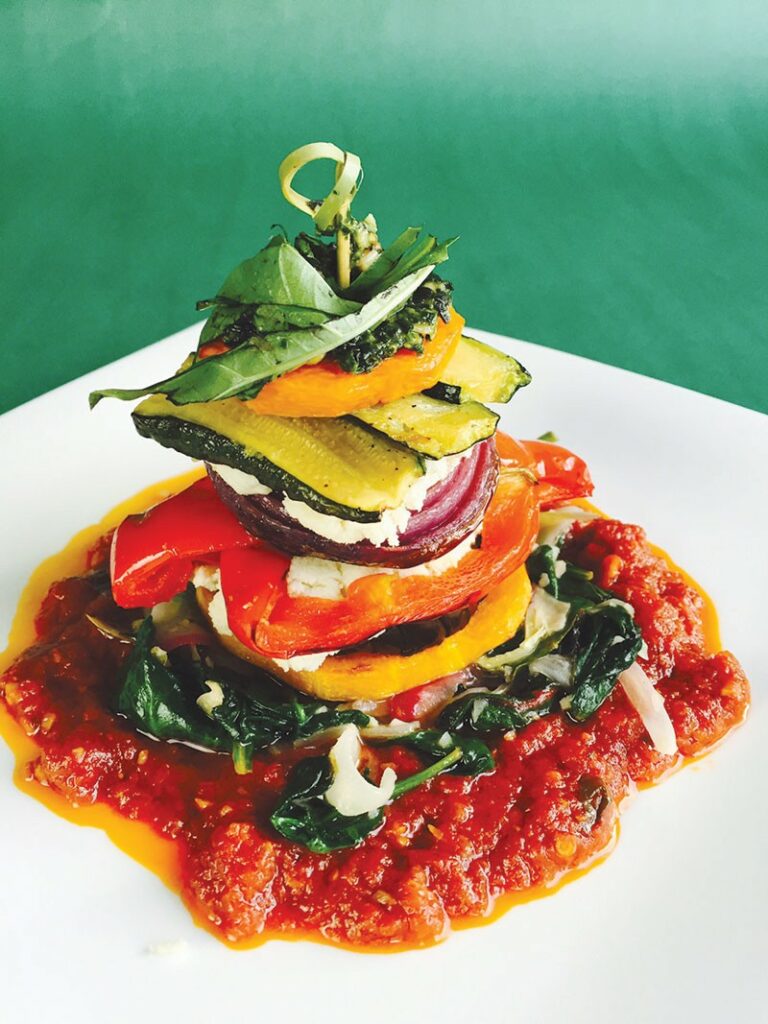
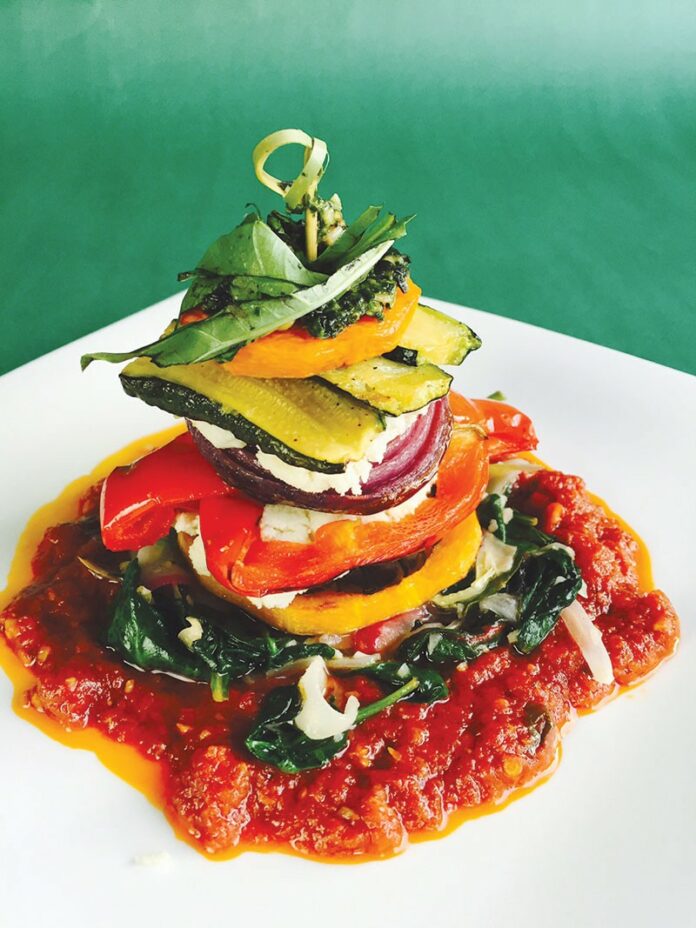
The list of starters is a good example of the chef’s visual and culinary aesthetics. The Pacific yellowtail sashimi is a garden on a plate. Buttery slices of sliced, opalescent yellowtail share space on a wooden platter with sliced kumquats, butter-lettuce leaves, spicy peppercress and a dusting of togarashi, dried Japanese peppers. The varied flavors and textures work superbly together. The Preston Farms carrot salad is another emblematic dish. The sweet, earthy flavors of carrots, dates, lettuce, nigella seeds and a thick stripe of Straus yogurt play harmoniously in the mouth.

Heartier dishes are just as good. I can’t think of a better rainy-weather meal than the braised beef cheeks made into stew with sliced fuyu persimmons, savory cabbage and garnet yams in a light veal broth. The addition of pink peppercorns plucked off a local tree adds a finishing high note of aromatic spice. Pizzas made in the kitchen’s hearth-like wood-fired oven are thin, crisp and chewy, and topped with unexpected ingredients like sunchokes, roasted slices of Meyer lemons and manchego cheese.

“At the end of the day it’s just food, but it really needs to have a soul and a purpose and a vision,” Hoffman says.

He points to a beet and green farro dish as an example of how he approaches cooking. His aim is to create a balance of flavors and textures that riff off a key ingredient, in this case the farro verde, a nutty, chewy, wheat-like whole grain that, when roasted, attains a delicate, smoky flavor. The beets echo the bass notes of the farro, while crèma de lardo (buttery emulsified pork lard spread on little toasts) pays homage to the grain’s Italian roots.

“We’re doing everything we can to complement the flavor of that grain,” he says.

[page]

But reliance on one dominant flavor can go too far, as it does with the salmon tartare. The salmon is fresh and delicious, but the nasturtium leaf served under it overpowers the flavor of the fish and other ingredients.

While his food has a cerebral aspect to it, Hoffman wants to avoid a menu that’s too precious, a criticism some have leveled at Shed for its high-priced cookware and fancy foodstuffs. That’s why he was pleased to see a vineyard worker with muddy boots and pruning shears in his pockets
stop in with his family one night and order a beer and plate of salumi.

“I always want to have a place for that guy,” Hoffman says.

Being excited, and even a little anxious, is a motivator for Hoffman. His first kitchen job was at the late Zinsvalley in Napa, an experience he calls his culinary school. He’s never taken a cooking class.

“I was a really good employee because I was nervous,” Hoffman says. “I always joke around that you cook your best when you’re nervous. That was something that [Zinsvalley] chef Greg Johnson taught me. He said, ‘When you’re comfortable here, I want you to leave. I want you to go someplace where you’re nervous, because that means you’re learning.'”

It’s become an adage Hoffman lives by: Work where you can continue to learn.

“That’s why I made the decision to come here,” he says. “I never had the chance to make kombucha. I didn’t know a lot about it before I came here. For me that was incredibly exciting but also nerve-wracking, because I don’t like not knowing.”

Now that Hoffman is a bit older, he thinks of the nervousness as excitement and creative stress. “That’s a big part of what drives me,” he says.

Andre Moussalli was Hoffman’s sous chef at Domaine Chandon’s Étoile restaurant in Carneros for seven years where Hoffman was executive chef. Moussalli was impressed with Hoffman’s culinary vision and work ethic, and points to his efforts to start a garden and microgreen operation from scratch on an underutilized piece of land in the vineyard.

“It’s just mind-blowing how he accomplished all that stuff,” says Moussalli, who was, given Hoffman’s passion for marrying cooking with gardening, happy to hear about his position at Shed. “That’s his dream job,” he adds.

Rita Bates, a cousin of Hoffman’s who gardens and cooks at the Apple Farm, says the more casual style of cooking at Shed is better suited to his personality, as is the open kitchen.

“He just loves it,” she says. “It’s just exactly what he wants to be doing.”

While Shed is blessed with great product, the kitchen posed some challenges. The downstairs kitchen is just a counter and a wood-fired oven. Upstairs, there is a full production kitchen where a lot of the prep is done, but during meal service there is no running up and down the stairs. That means the staff has to be strategic. Because there is no stovetop or hood downstairs, there are a few more cold or room-temperature dishes.

Some dishes begin in the upstairs and are transferred downstairs to be finished in the wood-fired oven. And after years of working in windowless, closed kitchens, Hoffman says he loves Shed’s setup.

“Working in an open kitchen is really amazing. Instead of being behind double closed doors, I can watch how people eat, what their fork goes into first. If we’re closed off, we don’t get that feedback.”

Looking out the window is a bonus too.

“Here, I feel like every day is a day off, just because I get to see what it looks like outside.”

While Hoffman admires French chef Michel Bras and New York City’s Daniel Humm, the cooks he looks up to most are in his family. His grandmother is in her 80s, but Hoffman says she can still outdo him in the kitchen. His mother sets the bar high too.

“My mom can still cook me under the table,” he says. “She is good. I mean, good.”

Hoffman is clearly in a good head space, and that comes out in the food.

“Four or five years ago, it really started to click for me, everything from textures to flavor profiles to who I am and who I want to be and who do I not need to pretend to be anymore.”

Most of all, Hoffman wants to be happy, and that means cooking, learning and creating. In addition to his talent in the kitchen, what’s most noticeable about him is his attitude. In an era of big-mouthed chefs with bigger egos, Perry Hoffman is a humble and happy exception.

“There’s so much to still learn and so much to strive for.”

The ‘Force’ Delivers

Darth Vader’s iron dream lives on more than 30 years later in a new helmeted menace called
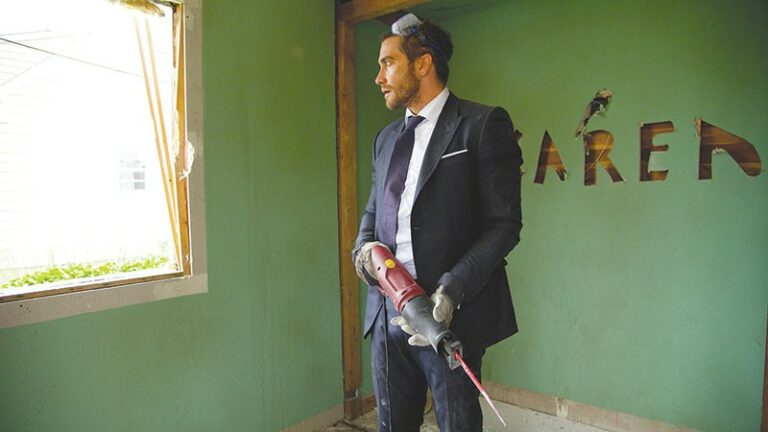
Kylo Ren (Adam Driver). The interesting angle of Star Wars: The Force Awakens is that there’s a Napoleon streak to this Ren. In quiet moments, he prays to the half-melted helmet of Lord Vader. He has doubts about his power.

The plunge into the politics of the Old Republic was part of the lethally boring side of the last three Star Wars films, as was George Lucas’ disinterest in women. But the emphasis on girl power is a new development. The brave Rey (Daisy Ridley) makes this movie, more than the battalions of animators, more than the glorious 65mm locations in Ireland, Iceland and Abu Dhabi.

Rey is a scavenger, circumstantially marooned on the dune planet Jakku, where she encounters an Imperial army deserter named “Finn” (John Boyega). Finn is on the run after he helped a rebel pilot (Oscar Isaac) escape; a secret important to the rebellion is hidden aboard a droid they both know.

So much in this movie is stuff we’ve seen before, from the X-wing dogfights to the rebels lined up as if for a group snapshot at the end, to a predictable catwalk duel. But one reprise is tender: a meeting between General Leia Organa (Carrie Fisher) and the grizzled but still game Han Solo (Harrison Ford). The dialogue is lame, but the exchange of glances says it all between them.

The way the film is built, it can have neither ending nor beginning. It’s leading from a sequel and heading to another one; a temporary victory over the planet-blasting fascists of the First Order leads to new adventures. Though the new characters acquit themselves with fierceness, I had more eyes for the old Bogartian hustler Solo and his gray-haired Wookie, still scheming in the troubled waters of a galactic civil war.

‘Star Wars: The Force Awakens’ is playing in wide North Bay release and galaxies far, far away.

Wild Kingdom

0

Cross a bamboo-lined creek, enter a tiny courtyard, and you’ve left downtown San Rafael and arrived at WildCare animal sanctuary. There’s a musky scent of animals and roomy enclosures of weathered wood, which house all sorts of critters, including Vladimir the vulture, one of the “ambassadors” WildCare brings to schools.

WildCare has been a wildlife resource since the 1970s, and was founded under Bay Area environmentalist Elizabeth Terwilliger’s motto, “You take care of what you love.” Terwilliger was an environmental educator who developed the sanctuary’s multisensory educational approach and philosophy.

WildCare executive director Karen Wilson keeps the organization humming with activity and energy. Among numerous activities and pursuits, the sanctuary partners with other nonprofits like the Humane Society, consults with the EPA on issues around pesticide regulation, and has also weighed in on contentious white deer
and elk issues in West Marin.
The organization’s annual
$2.5 million budget is spread across multiple programs, but lately the fundraising efforts have been targeted at a new WildCare facility to be located at the end of Smith Ranch Road in San Rafael.

As WildCare prepares a migration to new facilities, Wilson says that no matter how much the animal sanctuary expands, she is intent on maintaining “the quirky family feel” that’s evident the minute you walk into this sylvan sanctuary for animals in distress.

They do it all here: guided nature walks for kids; ambassador programs that take animals into the schools; free bilingual family adventures on the weekends; and WildCare Solutions, a service that offers assistance with humane pest control and fields phone calls around the clock from places as far away as Egypt.

Just off the courtyard is the main building, a rabbit warren of spaces that accommodates an animal hospital and office space for staff. Melanie Piazza, the director of animal care, has been with WildCare for 13 years and has an extensive background treating animals. She’s not a veterinarian, but WildCare enlists volunteer local vets whenever surgery is necessary in the hospital. Animals who come here are either euthanized, if they can’t recover and live independently, or become animal ambassadors.

Piazza’s private life comes to a screeching halt during the warm months, which coincide with animals’ breeding seasons. It’s no big secret that humans and animals often live in close proximity to one another in the North Bay, and there’s always another injury to address where animal-human interactions are concerned.

Someone may cut off a tree limb that houses a bird or squirrel nest; ducks may be caught in carelessly discarded fishing lines; an animal may have been shot with a BB gun. WildCare has seen it all, but most of the organization’s patients suffer from injuries caused by domestic cats.

“Outdoor cats wreak havoc on local wildlife,” Piazza says. She loves cats but keeps hers in a “cat-i-o,” a screened-in enclosure.

[page]

Last year, more than 2,000 songbirds were brought to the hospital, but this year, global warming has led to a crisis among seabirds. Unable to find food, hundreds of emaciated, mostly juvenile murres, penguin-like seabirds, are washing up on California shores.

Should you encounter an injured bird or any other small animal, WildCare stresses that you not feed or handle the it. It should be picked up with a towel and put into a box with air holes; larger animals should be covered with a sheet for transport. The Humane Society has a 24-hour contract with WildCare to pick up injured animals and bring them to the facility. Should a bird fly into a closed window, it should be placed in a box or paper bag for a half-hour. If it can’t fly, bring the bird to WildCare.

Though WildCare often treats the common injuries that occur when humans collide with nature, its education component puts an emphasis on preventing such situations from occurring in the first place. That starts with knowing the animals in our midst, and every year thousands of kids and adults from San Francisco to Santa Rosa and the East Bay get involved at WildCare.

Kids learn about banana slugs, spiders and wood rats, which may not interest adults but are perfect specimens for teaching about all the living creatures we share space with. Did you know that banana-slug slime anesthetizes the tongue of any predator who might otherwise find it a tasty morsel? Now you do.

Eileen Jones is the education program manager at WildCare, and brought 30 years of environmental education experience when she came here a few years ago. She designs training programs and coaches the nature guides along with Marco Berger, who speaks French and Spanish, and takes a particular interest in making WildCare activities bilingual-friendly. Berger is also in charge of the “nature van” that visits Bay Area schools with taxidermy specimens of local creatures, and leads free weekend family adventures with (mostly) Latino families.

The organization also fields an ambassador program, led by teacher and biologist Mary Pounder. She brings wild animals into the classroom, including Vladimir the vulture, who, like all ambassador animals, had injuries that meant he could not be released back into the wild. One of Pounder’s main objectives in the classroom, she says, is to teach kids that the animals are not pets. They’d rather live in the wild but can’t because of their injuries.

And then there are the animals that live in the wild but would rather eat your garbage or spray Fido with foul-smelling stuff. The Wildcare Solutions program (headed by Kelle Kacmarcik) offers all sorts of advice on nonlethal and humane methods for evicting unwanted wildlife—raccoons, skunks, etc.—from in and around the home.

When do-it-yourself methods fail, a trained worker can help out. Some solutions are as simple as removing the attraction, such as bowls of water, or making a loud noise when you enter your garden to scare off the skunks.

Poisoning is a big issue the staff deals with on a routine basis. Eighty-six percent of the animals that eat rats and mice and are brought into WildCare for injuries already have rodenticide in their systems. And the poison works its way up the food chain to the raptors, foxes and other animals that hunt rodents.

The organization also deals with a common misconception that trapping and relocating wildlife is a humane approach to ridding the home of unwanted animals. Trapping a raccoon during breeding season can orphan the wee ones, and animals released into unfamiliar territories often suffer undue stress. They can also spread disease. Animals who are treated at WildCare for their injuries are released back into the world exactly where they were found. Unless, of course, the animal was found in your house.

For more info, visit wildcarebayarea.org.

Wild Centennial

0

Author and wild man Jack London packed in 10 lifetimes’ worth of travels and tales in his brief 40 years on earth.

The longtime Sonoma County resident counted gold prospector, war correspondent and even oyster pirate on his list of occupations, though it was his writing that made him a millionaire and allowed him to purchase and live out his days on what is now Jack London State Historic Park in Glen Ellen.

London died on Nov. 22, 1916. For 2016, the park is honoring his memory and life with a yearlong celebration. “Discover Your Call of the Wild” is the park’s invitation to the public to partake in hikes, attend film screenings and readings, and enjoy special concert events throughout the year.

“We want to celebrate his legacy,” says Tjiska Van Wyk, executive director at Jack London Historic State Park. “These activities and programs will demonstrate the contributions he made in the short 40 years he was alive.”

Every month the park will feature a theme that represents aspects of London’s character, kicking off next month with the park’s challenge to participants to walk 500 miles in 2016.

When London was 21, he sailed to Alaska to join the Klondike Gold Rush in 1897. It was there that his most famous books, The Call of the Wild and White Fang, got their inspiration. The park is reflecting the 500 miles London trekked in Alaska’s Yukon Territory with the “Klondike Challenge,” open to anyone willing to take it on.

“We really want to encourage people, through London and his stories, to be inspired, to dream, to live their life to the fullest, as he did,” says Van Wyk.

“We feel like we’ve laid the foundation for a celebration of the man and what the park now offers to the community,” she says.

Van Wyk is especially looking forward to “The Great Read,” a partnership between Oakland and Sonoma Valley libraries in the fall that acts like a Bay Area–wide book club. Thousands of students will read White Fang, and join scholars in school-wide discussion groups. The park is also hosting student writing contests.

For adults, piano concerts and special celebrity readings are all on the schedule. The park’s summer concerts with the Transcendence Theatre Company, Broadway Under the Stars, is getting into the spirit as well, planning a series inspired by London’s exploits.

There will also be demonstrations of London’s pioneering sustainable farming on the park’s Beauty Ranch, and the park will be taking advantage of its 1,400 acres and almost 29 miles of newly restored trails with several special interest hikes that will highlight London’s favorite spots where he drew inspiration and wrote his most enduring works.

‘Discover Your Call of the Wild’ at Jack London State Historic Park throughout 2016. 707.938.5216.
jacklondonpark.com.

Punk-Rock Memories

0

Sonoma County’s underground punk and indie-rock scene has long been a small and tight-knit community, and no event better displays this camaraderie than the annual Nostalgia Fest, featuring band reunions and rare appearances. It all happens Dec. 19 at the Phoenix Theater in Petaluma.

This year’s headliner is Santa Rosa punk pioneer Ralph Spight, who formed and fronted the hardcore band Victims Family with bassist Larry Boothroyd over 30 years ago and continues to play in bands like Jello Biafra & the Guantanamo School of Medicine. Spight will be playing Victims Family songs with Boothroyd and former drummer Eric Strand for a mini-reunion, as well as newer material from his current band the Freak Accident.

The fest’s lineup also features reunions from old favorites like the Heat Creeps, Tower of Swine, Sons of Atom and Bad Kissers. The show will also pay tribute to longtime Sonoma County musician Simon Matthew Carrillo, member of eclectic outfits like Edaline, Kid Dynamo and Desert City Soundtrack, who died in March.

As always, this popular event benefits the Phoenix Theater. This year, proceeds will also go to Miriam Wilding Hodgman, sister of North Bay singer Brian Zero of Siren, who is battling cancer. Nostalgia Fest gets the reminiscing going on Saturday, Dec. 19, at the Phoenix Theater, 201 Washington St., Petaluma. 5pm to midnight. $10–$40 sliding scale. 707.762.3565.

Debriefer: December 16, 2015

0

SALMON CHRONICLES

You can’t swing a dead coho these days without hitting another irate press statement from the Golden Gate Salmon Association (GGSA). The organization issued a bristling statement late last month in response to word from the FDA that it was safe for humans to eat genetically modified salmon. Blech. The association’s executive director, John McManus, said the federal approval of so-called Franken-fish could put already endangered wild salmon stocks in California at even greater risk, because of the potential for cross-breeding.

Despite genetically engineered industry assurances to the contrary, McManus cited reports that say up to 5 percent of non–wild fish could escape the closed tanks they’re kept in and breed with the free swimmers. “No one knows if genetically engineered fish would spell the end for wild stocks if they escaped . . . but it’s not something that any of us wants to find out.”

Days later, the GGSA issued another release—this time blasting Congress for blowing off the salmon crisis as it tried to cough up a drought bill pegged to California’s water shortage, El Niño be damned. McManus charged that the bill under consideration “takes aim at salmon and fishing families throughout the state whose livelihoods hang in the balance,” by honoring demands of the big water-users in the state’s powerful agricultural sector—especially in the San Joaquin Valley—over the needs of a crippled salmon fishery.

“Congress should help rebuild our salmon runs and respond to the drought,” says McManus. “This bill does neither.”

NONPROFIT CONTEST

We ran a cover story earlier this year (“Crisis Management,” Nov. 3) that highlighted the work of the Center for Volunteer & Nonprofit Leadership (CVNL) and other Lake and Napa County nonprofits after the Valley Fire this fall. Now CVNL has announced its first-ever “Heart of Napa” awards for nonprofits in that county. There’s a $20,000 cash prize from the Gasser Foundation that will be spread among entrants in a half-dozen categories, from Volunteer of the Year to Corporate Community Service.

The deadline for applicants in
Jan. 10, and the awards ceremony will be held Feb. 23 at the
Napa Marriott. Check out the CVNL website for details,
cvnl.org/2015HeartofNapa.

KINSEY REPORT

Longtime Marin County supervisor Steve Kinsey recently announced that he wouldn’t seek another term, which means he’ll have to give up his seat on numerous boards once he leaves office next year. One of those is the California Coastal Commission, which Kinsey presently chairs. That’s the organization that rules on who can, and who can’t, develop along the coastline. Kinsey told the press that he wasn’t sure what’s next on his agenda after he jumps out of politics, but Debriefer has a theory.

Just days after his announcement, the Coastal Commission ruled on a highly controversial push by U2’s the Edge to build a multi-building spread for himself along the cliffs of Malibu. After years of debating the proposal, the commission green-lit the plan. This can only mean that Steve Kinsey’s next job is going to be as the Edge’s guitar roadie. You read it here first.

Dec. 19: Fish Food in Healdsburg

Originating in Southern Italy as a Christmas Eve tradition, the popular Feast of the Seven Fishes gets the Spoonbar treatment when chef Louis Maldonado prepares a luxurious seafood extravaganza in the traditional style. Indeed, seven sumptuous courses will be served for dinner. Menu highlights this year include big-fin squid with a Vietnamese broth of herbs and chile oil; sautéed...

Dec. 22: Art Night Out in Napa

Paint the Town is Napa’s most creative night out. Taking place in nightclubs and restaurants, and offering painting classes fueled by food, wine and live music, the event encourages you to let your inner van Gogh out to play. Paint the Town is holding its Christmas party at City Winery this week, bringing artists (over the age of 18)...

The Chicken Soup Rule

When it comes to efforts at gun control in a nation sick with mass shootings, I like to cite the chicken soup rule: When you are ailing, it is said that a hot bowl of chicken soup can't hurt, and it might even help get you on the mend. The broth is not going to cure what ails you,...

Fresh Start

Born in San Rafael and raised in the Central Valley, singer-songwriter Julie Ann Baenziger has been making bittersweet indie pop under the name Sea of Bees since 2009. Her powerful, melodious voice and earnest, introspective lyrics have made her a beloved underground figure in her home of Sacramento, though she's been absent from the music scene of late. "I just started...

The Happy Chef

Perry Hoffman comes from a family of chefs, cooks and gardeners. His grandparents founded the French Laundry and the Apple Farm in Philo. His uncle owns the excellent Boonville Hotel and restaurant. His father is a celebrated gardener, and his mother is a great cook and well-known florist in the Napa Valley. So it's no surprise that he developed...

The ‘Force’ Delivers

Darth Vader's iron dream lives on more than 30 years later in a new helmeted menace called Kylo Ren (Adam Driver). The interesting angle of Star Wars: The Force Awakens is that there's a Napoleon streak to this Ren. In quiet moments, he prays to the half-melted helmet of Lord Vader. He has doubts about his power. The plunge into...

Wild Kingdom

Cross a bamboo-lined creek, enter a tiny courtyard, and you've left downtown San Rafael and arrived at WildCare animal sanctuary. There's a musky scent of animals and roomy enclosures of weathered wood, which house all sorts of critters, including Vladimir the vulture, one of the "ambassadors" WildCare brings to schools. WildCare has been a wildlife resource since the 1970s, and...

Wild Centennial

Author and wild man Jack London packed in 10 lifetimes' worth of travels and tales in his brief 40 years on earth. The longtime Sonoma County resident counted gold prospector, war correspondent and even oyster pirate on his list of occupations, though it was his writing that made him a millionaire and allowed him to purchase and live out his...

Punk-Rock Memories

Sonoma County's underground punk and indie-rock scene has long been a small and tight-knit community, and no event better displays this camaraderie than the annual Nostalgia Fest, featuring band reunions and rare appearances. It all happens Dec. 19 at the Phoenix Theater in Petaluma. This year's headliner is Santa Rosa punk pioneer Ralph Spight, who formed and fronted the hardcore...

Debriefer: December 16, 2015

SALMON CHRONICLES You can't swing a dead coho these days without hitting another irate press statement from the Golden Gate Salmon Association (GGSA). The organization issued a bristling statement late last month in response to word from the FDA that it was safe for humans to eat genetically modified salmon. Blech. The association's executive director, John McManus, said the federal...
11,084FansLike
4,606FollowersFollow
6,928FollowersFollow