Pipette Up

0

There are two ways to get an entirely new perspective on a familiar old town: you can tour another land, very expensively and very far away, to return with new eyes, or you can just hop on a bus that other tourists take to experience your home turf.

Although I’ve lived in Sonoma County for a good few years now, I didn’t know that this winemaking clan lived over here—as a tour bus driver points out at high volume over the loudspeakers of the mostly empty luxury bus I’m riding in—or that that other century-old dynasty occupied that hilltop estate over there. Our destination is Ravenswood Winery. I’ve also been here many times, and noted how the friendly atmosphere of the tasting room has held up remarkably well under corporate overlordship. Heck, I’ve even tasted some of the fresh grape components that go into the Ravenswood Vintner’s Blend Zinfandel in the field. But have I ever sat down for a blending seminar that challenges me to strike a balanced blend with the traditional troika of Petite Sirah, Carignane and Zinfandel? Why, no, this is the first.

Blending seminars are a new addition to the winetasting repertoire. Instead of paying a triple tariff to simply kick back and nibble some cheese with your wine, or even a scallop or two, blending activities require that you roll up your sleeves and contribute. It works, and it’s great for groups.

Our host, Peter Griffith, offers a detailed explanation of what makes Petite Sirah and Carignane crucial to the classic Zinfandel blend. Long story short: tannin, acid, fruit.

Now’s the time when we suck the pipettes. Leaving the group to do their thing, Griffith encourages experimentation in 1 to 20 milliliter increments, sucked into laboratory pipettes and deposited in glasses. Each participant’s favorite blend is dialed in and deposited into a 375ml bottle that, Griffith says, mostly ends up drunk up within 30 minutes of leaving the tasting room. The rest end up on people’s desks—they’re topped with attractive but impervious-looking wax caps.

The wine will actually keep for few years, says Griffith. History, by which I mean my sketchy notes, does not record my final blend, but I believe it was heavy on the earthy Zin, with a good dose of bright Carignane and a miserly dash of what was, to me, an uninspiring Petite Sirah.

After the work is done, blenders are ushered to the members-only area of the terrace to taste Ravenswood favorites like Old Hill Zin and, yes, nibble on cheese while taking in the vineyard view.

Ravenswood Winery, 18701 Gehricke Road, Sonoma. Blending seminars $65 per person, by reservation. 707.933.2332.

Chowder Power

0

In 2004, when Carol and Tony Anello opened their dream retirement business in Bodega Bay, they had no idea Spud Point Crab Co. would become a Sonoma County staple, attracting tourists and locals to their front yard year-round. What was intended to be a small, home-based roadside operation escalated into a 16-hour-a-day labor of love making lots of New England clam chowder. Carol developed the recipe the way she likes it: thick and rich with butter and cream, and balanced flavors of clams and garlic. Carol is passionate about the quality of her chowder, and she adjusts the recipe throughout the year in accordance with the strength of the garlic.

Spud Point’s chowder has become so popular the restaurant recently added a small outbuilding Carol calls “the chowder line.” The facility has not only met Spud Point’s growing need to fill chowder orders faster than food orders, it also gives Carol the chance to do what she enjoys most: connecting with customers.

Despite its reputation for clam chowder, Spud Point Crab Co. has more to offer than just soup. As the name suggests, it also offers fresh, whole crab caught with the company’s three fishing boats. When it comes to Spud Point’s crab, the words “fresh” and “local” are highlighted by the fact that you can actually see the fleet in the marina from your seat on the outdoor patio. Of course, crab isn’t available until the state declares high levels of domoic acid levels in Dungeness crab have dropped.

On Jan. 30, Spud Point will join other local restaurants in a friendly competition for a good cause. The 13th annual Chowder Day in Bodega Bay pits local chowders against each other and raises money for the Bodega Bay fireworks. For $10, participants get a ticket that serves as ballot and map. The map will leads chowder lovers all over Bodega Bay for the tasting. Spud Point’s clam chowder has won first place in the people’s choice category for the past 11 years.

Spud Point Crab Co., 1910 Westshore Road, Bodega Bay, 707.875.9472. Go to visitbodegabayca.com for tickets and
more information about Chowder Day.

So Far, So Near

HIKING REBOOT

Hipcamp takes the sharing economy into the great outdoors

Last summer, carfuls of millennials in trendy hats, plaid flannels and new hiking boots descended on Oz Farm, a vast, rural property five miles north of Point Arena, and settled in yurts and tents on the dusty ground. It looked like an Urban Outfitters catalogue shoot. The tents were provided by North Face and dinner was catered by San Francisco’s Hook Fish Co. Bottomless vodka cocktails, free-flowing wine and kombucha on tap kept the crowd happy.

The organizer of the overnight camping event was Hipcamp, an online startup that aims to upgrade the camping-reservation system and expose nature lovers to new experiences on private and public lands. Founded in 2013 by Alyssa Ravasio and Eric Bach, Hipcamp is often called the Airbnb of camping.

“Hipcamp is everywhere you want to camp,” the company proclaims on its website. “Search, discover and book ranches, farms, vineyards, nature preserves and public sites for camping across the U.S.” Its goal is to simplify and improve the often unnecessarily complicated task of booking a campsite.

Ravasio, the company’s CEO, grew up in Corte Madera, “swimming in the oceans of Stinson, hiking the bluffs of Point Reyes and camping in the valleys of Mt. Tam,” and graduated from UCLA in 2011 with a customized degree in “digital democracy.”

Like many businesses, Hipcamp was born out of necessity and frustration. “I had this dream of spending New Year’s Eve 2013 camping so I could spend the first morning of the year writing in my journal by the ocean,” Revasio says. “After many painful hours of searching, I almost gave up—it was so difficult to figure out where I could go.” She finally booked a place, but missed a key detail.

“Upon arriving,” she says, “I realized that despite searching a handful of different websites, including the state park page, I’d failed to learn that it was home to a beautiful surf break, and I’d left my surfboard at home.”

Instead of spending the first morning of the year writing, Revasio instead watched, envious, as other surfers had all the fun. “I tried so hard to plan this trip, and still failed,” she says. “So we always joke that Hipcamp ‘started with a wave,’ but really, it’s true!”

Hipcamp initially covered only Northern California, an area “blessed with magical coastlines, soaring mountains and beautiful forests,” Revasio says, adding the convenient proximity to tech-capital San Francisco as well. The website now covers all 50 states. Its popularity grew by word of mouth that was fueled by a clever referral program: refer a landowner and receive $100 if the landlord lists the site.

For aspiring campers, things are made easy through a search engine that filters options by such features as “cave” and “beach”; activities such as “kayaking” and “fishing”; and amenities and types of lodging from RV parking to cabins. (Reviews are also provided.) Prices range from $35 for a campground to $175 for a rustic barn with a shower and a stove.

Land sharing and tapping into the private sector is especially important to Revasio. “With Hipcamp, you’re going places that you couldn’t go before,” she says. “You’re also supporting landowners who want to keep their land open and undeveloped.”

Revasio additionally stresses the communal aspect, which allows campers to mingle with owners and experience “the cultural exchange between urban and rural.” Not all owners will greet you personally, cup of coffee in hand, though many are onsite and willing to chat.

“It’s a great chance for two people who are otherwise unlikely to meet to connect and learn from each other,” Revasio says.

Hipcamp is not alone on the camping trail. Reserve America, a much older and established website, was the first to marry camping and technology, though Hipcamp’s youthful team and slick design set it apart and welcome lumbersexual millennials. It’s also right in line with the meet-the-locals premise, which promises an authentic experience and fresh air to cynical urbanites.

Hipcamp might seem aimed at big city dwellers, but it’s also ideal for North Bay residents seeking to discover natural treasures in their own backyard. Driving for an hour or so and checking into a yurt or a coastal cabin can be as far from home as it gets, and who knows, you might end up befriending the plaid-wearing, honey-making, sustainable-farming neighbor you never knew you had.

[page]

HIPCAMP SPOTS IN THE NORTH BAY

Oz Farm, Point Arena

Just across the Sonoma County border in Mendocino County, this is a 600-acre “hippie-commune-turned-organic-farm” that offers a creek for impromptu bathing, seven rustic cabins, redwood campsites and styled-out geodesic domes. There’s a fully equipped community kitchen and an outdoor wood-burning pizza oven.

Wine Farm, Sonoma

A homestead farm with a Chardonnay vineyard that’s got plenty of room for tents between the vines. Refrigerator and bar facilities are available, and so is the opportunity to buy chicken and duck eggs straight from the farm.

Overlook, Salmon Creek

Located on Chanslor Ranch just north of Bodega Bay, this campsite is windy and rugged, and its location, on a small bluff, offers breathtaking ocean views. Salamander Ravine and Turtle Pond are short walks away.

More options

If staycationing the local way is an exciting notion, there are other websites representing homegrown and cozy adventures, often hosted in private residences. Verlocal.com is a relative newcomer that offers workshops and classes from pottery to making ramen in a casual setting. While a good portion of those takes place in San Francisco, North Bay courses include wilderness survival in Marin County and a beekeeping workshop in Napa County.

For food lovers who look beyond the trendy restaurants, there’s EatWith, an Israeli-born initiative that introduces diners to hosts and home cooks interested in hosting a dinner party, a brunch or a tapas affair. Happening mostly in large cities, EatWith nevertheless welcomes new hosts in slightly less central locations, so stay on the lookout, or become a host and contribute to other folks’ staycation.

—Flora Tsapovsky
[page]

STAYCATION IN THE VINEYARD

Few are the cynics who, like one prominent English wine critic, look at a verdant vineyard and see nothing more romantic than a potato field. Lots of folks just love the vineyards and long to roam through the vines of Sonoma County
and Napa Valley under
what some observers
have called a remarkably Tuscan-like experience.

Sound like the right kind of getaway? A number of wineries, most of them small, are adding to their bottom line while helping vacationers do just that by renting out their vineyard houses.

Occidental Road Cellars

Follow a collection of rusted crawlers past the old metal box that used to be the Monte Rio jail and up the drive to Joelle and Richard Prather’s three-bedroom rental overlooking their Horseshoe Bend Vineyards. Located just 70 yards from the Sonoma Coast viticultural area, the vineyard is surrounded by second-growth forest and supplies Schramsberg, Radio-Coteau and other wineries, as well as the Prather’s own efforts—a bottle of which is included with your stay. Rates average $333, Monte Rio jail not included. occidentalroadcellars.com.

Landmark Vineyards

It’s no extravagance to travel across the pond for the weekend, if it’s the placid little pond behind the Landmark tasting room. Here’s a little cottage just for two—or more, with the sofa bed employed—within walking distance of Kenwood area dining and hiking. It starts at $325 a night, a comparative economy rate for private accommodations in wine country. (Clearly, the owners of Pom Wonderful aren’t counting on the extra dough.) A guest suite is also available from $300, including continental breakfast and a bottle of gently oaked Overlook Chardonnay. landmarkwine.com.

West Wines

You’ve seen one lurid, Victorian wallpapered B&B room too many? Stay in a crib owned and decorated by Swedes. Katarina Bonde and Bengt Akerlind rent out a tidy, three-bedroom cottage they call the “Big Oak House” adjacent their tasting room, just outside of Healdsburg. It’s the oak that’s big, not the house, but it can accommodate up to eight people for a big weekend in Dry Creek Valley. Rates from $395 to $650. westwines.com.

Jordan Vineyard
& Winery

Yes, even in rural Alexander Valley there’s at least one way to fulfill your dream of staying in a real, faux-French chateau, complete with private driver: members of Jordan’s Platinum and Gold rewards clubs may purchase winery stays for as little as $50—plus 5,000 points. That’s a lot of wine, so start stocking up soon. jordanwinery.com.

In Napa Valley, county regulations prohibit wineries from operating a rental for less than 30 days at a pop, so options are limited. But they are luxurious.

Poetry Inn

Developer Cliff Lede was careful to build his expansive, five-room bed and breakfast on the same footprint of a previous residence, and it’s located away from his eponymous winery and vineyards, which guests may view from the lobby veranda, from the decks adjoining their rooms—even while naked, from the capacious open-air showers that overlook Napa Valley. Casual luxury is the mode in this joint, where the uniquely furnished rooms are named for beard-scratchers and tortured souls—poets Walt Whitman, e. e. cummings, Robert Frost, Robert Louis Stevenson and Emily Dickinson. The tub in the Whitman is vast, and could very well contain multitudes. Rates start at $650 in winter and top $1,900 in summer—but that does include a three-course breakfast. With kale! poetryinn.com.

—James Knight

Rare Gem

0

The late August Wilson’s penultimate play, the supremely lyrical and gorgeously written 2003 drama Gem of the Ocean, may be set in 1904, but its themes stretch purposefully back in time to the beginning of New World slavery and reach forward to the present, when African Americans are still fighting many of the same struggles.

This timelessness is sewn into the script of Gem like the old quilts and collages that Wilson gave as inspiration for his work, blending lush historical detail and remarkably well-drawn characters into a plot that unfolds like a roll of fabric, with language and dialogue that moves from colloquial specificity to the heart-breaking heights of pure poetry.

In Daniel Alexander Jones’ sometimes baffling but emotionally rich staging, Wilson’s engaging words are embellished with a kind of hand-clapping, finger-snapping, sign-language-style choreography that resembles dance but stops short of having his characters actually burst into ballet or the soft shoe. It’s a technique Jones calls “theatrical jazz,” something the young New York–based director is known for.

Whether Wilson’s tour de force cries out for such initially distracting ornamentation, or whether the story is served or strengthened by this distinctively, almost ritualistically musical performance, is ultimately beside the point. This is, after all, the most mystical and “ritualistic” of Wilson’s 10 Century Cycle plays, and Jones’ aesthetic eventually does make a kind of otherworldly sense. There is a lightness and playfulness to the entire production, which makes it stand out from other productions of Gem I’ve seen, and the sense of determined hopefulness and ragged joy that rises from the story’s accumulating tragedies at times feels almost revolutionary.

The story follows a group of lost, wounded souls who’ve found a refuge in the Pittsburgh home of Aunt Ester (played with brilliant, buoyant groundedness by Margo Hall), who claims to be 285 years old, and serves as the personification of her community’s collective memory of slavery. Throughout the two-and-a-half-hour play, Ester ushers a guilt-ridden newcomer named Citizen Barlow (Namir Smallwood) through initiations that include a guided visualization to a city of bones at the bottom of the sea.

Though there are challenges in this bold, impeccably acted reinterpretation of an American masterpiece, the audience goes along with Barlow on a similar journey, one that is as mysterious and strange as it is illuminating, devastating and beautiful.

Rating (out of 5): ★★★★½

‘Gem of the Ocean’ runs Tuesday–Sunday through Feb. 14 at Marin Theatre Company. 397 Miller Ave., Mill Valley. Times vary. $20–$58. 415.388.5208.

Take It Easy

0

I still remember the iconic cover of the first Eagles album I purchased. A small, black silhouette of a feathered bird with the word “Eagle” imprinted on it, flying off into the sunset somewhere over the desert. After hearing their first single, “Take It Easy,” I had a feeling this group was destined for a good flight and a solid landing wherever it went.

I’m not a musician, but growing up on ’50s and ’60s music, I knew the blended sounds created by Glenn Frey, Don Henley and company would reach a large audience that was ready to move on to another sound, a sound that reflected a softer, more thoughtful combination of melodies and lyrics. After the tumultuous ’60s, that first album, which included “Witchy Woman” and “Peaceful, Easy Feeling” along with “Take It Easy,” was enough to make me see what these guys would follow up with. They did not disappoint.

Their offerings over less than a decade reflected the Zeitgeist of a culture seemingly turned inward and preoccupied with itself. The lyrics were at once more poignant and more acerbic—a moral plea for truth and love, and acute observations of the material excesses rotting society’s foundations. Of course, the pressures of being in a group of creative souls attempting to stay a course true to each individual took its toll. We all know where that usually leads: breakup.

In spite of disbanding 20 years ago, the Eagles have shown the power of their music since they debuted in 1971, 45 year ago. Though I no longer own that round piece of black vinyl purchased for plus-decades ago, I can use my new technology to recapture those days of my youth.

So thanks, Glenn. You took us to the limit, gave us the best of your love and a peaceful, easy feeling to boot. Take it easy, buddy.

E. G. Singer takes it easy in Santa Rosa.

Open Mic is a weekly feature in the ‘Bohemian.’ We welcome your contribution. To have your topical essay of 350 words considered for publication, write op*****@******an.com.

Cross Culture

0

A fearless and funny voice in the counterculture scene since the early 1990s, David Cross wears every comedy hat in the business. Before he was a television show creator, actor and author, Cross was a standup comic who went against the grain of popular culture and helped breathe life into a new comedy scene that is bitingly irreverent.

Coming up in the New York scene alongside Janeane Garofalo and Louis CK, Cross first broke into TV writing for The Ben Stiller Show in 1992, where he met another smart comedy writer, Bob Odenkirk (Better Call Saul). The two created the highly original and uproarious Mr. Show for HBO in 1995. From there, Cross’s career took off, leading to work on other TV comedy classics like Arrested Development, film roles and award-winning comedy albums.

Cross is constantly in creation mode, creating and starring in the comedy series The Increasingly Poor Decisions of Todd Margaret, which returns for a new season this month on IFC. Last year, he teamed again with Odenkirk for the Netflix sketch comedy series W/ Bob & David.

Now, Cross is back in his element, on the stage again for his current tongue-in-cheek standup tour, Making America Great Again! He appears on Sunday, Jan. 31, at the Wells Fargo Center for the Arts, 50 Mark West Springs Road, Santa Rosa. 7:30pm. $35. 707.546.3600.

Letters to the Editor: January 27, 2016

Smile for the Camera

So great to see things like Studio Space Santa Rosa (“Picturesque,” Jan. 20) popping up in Sonoma County. Loving their efforts to support the arts and culture that make S.R. so special.

Via Facebook

Losing Her Religion

Denise Dubois lost “her fear” by totally losing her own identity and joining “the other” (“Learn and Lose the Fear,” Jan. 20). How nice and progressive.

Via Facebook

Bernin’

Some pundits call it strategy, but Elizabeth Warren may be having a crisis of conscience. Behold—the greatest evidence of the “progressive” impotence of a Democratic Party still caressing the special interest of preserving its establishment’s status quo. Exciting times nonetheless. Give em hell, ol’ Bern!

Cotati

Less Is More

Regarding “Into the Woods” at Spreckels (“Encore,” Jan. 13) and Mr. Templeton’s remark that “some of the effects may leave you underwhelmed”: Bravo to Kim Bromley’s sense of staging! The first thing I said to my two daughters after the lights came up was how wonderfully minimal the staging was. To me, that’s the mark of really good theater. You want overwhelming effects? How about how well the actors are miked at Spreckels. By the way, do the performers have to sign waivers at Spreckels? No footlights, nothing between them and that gaping entryway to the underworld, the Spreckels orchestra pit. Talk about a deep theater critique, each performance has an element of Cirque du Soleil daredevilism!

Rohnert Park

Eco-Eating

It was interesting to read that there is a new “-atarian” in town, the climatarian. 
(“The Climate Menu,” Jan. 13). The growing awareness of the impact of our food choices on the planet is encouraging, but this article only takes us half way across the road of climate disaster.

While it’s true that beef and dairy contribute significantly to climate change, when compared to plant foods, pork and chicken are extremely harmful as well. If everyone in the country skipped one serving of chicken per week, the carbon dioxide savings would be the equivalent of taking more than half a million cars off our roads. Don’t just switch from beef to pork or chicken; get the slaughterhouse out of your kitchen and choose a carbon-friendly, compassionate vegan diet.

Penngrove

Write to us at le*****@******an.com.

Jazzed Up

0

Napa’s historic downtown opera house has seen a lot of changes in the past few years. First, national venue and restaurant chain City Winery took residence in 2013 and gave the space a much-needed facelift, though City Winery’s tenure was cut short last year when they opted out of a 10-year lease eight years early.

That departure left the Napa Valley Opera House’s future unclear, yet now it appears the nearly 140-year-old building may be revived, as the world-famous Blue Note Jazz Club plans to take over the venue, located at 1030 Main Street, as its newest location.

“We are in final negotiations, and both sides are confident that we will close this deal in the next few weeks,” says opera house board chair Bob Almeida. “We knew that Blue Note had been looking in Napa for years, so when City Winery approached us about terminating their lease, we decided to pursue Blue Note, and things moved ahead rapidly.”

Founded in New York City in 1981, Blue Note Jazz Club is now an international chain of venues sporting the full spectrum of American roots music, with locations in Tokyo, Milan and, most recently, Hawaii. Considered a musical institution, Blue Note offers world-class performers in intimate spaces, allowing audiences a close-up experience with their favorite artists.

“We thought the vision that Blue Note is bringing is really the best for Napa and the best for the opera house, which we look at as a real community treasure,” says Almeida.

Almeida describes Blue Note’s impending plans in Napa as turning the City Winery model on its ear. The first floor, previously a restaurant only, will be transformed into Blue Note’s primary, seven-night-a-week venue and supper club, a cozy 150-seat space that will feature equal doses of nationally touring acts and regional favorites.

The upstairs Margrit Mondavi Theatre will remain open as well, and will host larger concerts, though Blue Note is opening the space to other local promoters and organizers such as Latitude 38 (BottleRock Napa Valley), the Napa Valley Film Festival and the Transcendence Theatre Company. Almeida says that spreading the events around through other producers will help the space become a destination for music fans of all tastes.

Right now, Almeida says, the lawyers are finalizing the lease details, and he expects Blue Note to take over the space by the end of February and begin routing its top-touring musicians to Napa soon after.

“The quality of the artists that we are going to get in here is going to be pretty amazing,” Almeida says.

Prudent Moves

0

Emphasizing that the next recession might be right around the corner, Gov. Jerry Brown released his $170 billion 2016–17 budget on Jan. 7 with an emphasis on putting a little something aside—$2 billion—for the state’s rainy-day fund. He emphasized prudence and discipline yet again during his 2016 State of the State address last week.

It’s hard to not hover over the idea of a “rainy-day fund” in a state that’s been dealing with a drought for the past four years, and Brown’s budget has a number of drought-beating, water-security items embedded within it, including an update of the Bay Delta Conservation Plan, with $3.6 million earmarked to flow the WaterFix Delta conveyance plan into the broader Delta Plan.

Translated into English, that means that, yes, Brown is pushing ahead with his plan to build two large water tunnels to ensure the flow of fresh water from the Sacramento River southward. The water-security part of the plan has been cleaved from habitat restoration efforts underway in the Delta. The broader effort is now undertaken as the so-called 4A option, which state and federal authorities proposed last April. Now the state Natural Resources Agency is lead agency on the habitat-restoration part of the deal, under the EcoRestore plan, while WaterFix builds the tunnels and associated other infrastructure to hedge against future droughts and their crippling impacts on Big Ag.

The Bay Delta Conservation Plan is just one of a number of budget nuggets released by Brown that are of interest to the North Bay. Here are some of the highlights:

Criminal Justice Reform Brown’s budget summary notably highlights an item for the Sonoma County Main Adult Detention Center that would send $1.5 million in 2016–17 (on top of $500,000 in 2015–16) to provide the county lockup with 10 “jail-based competency treatment beds,” through a contract with the Department of State Hospitals. There are 148 such beds already in use around the state; they are used to help rehabilitate inmates so they are competent to stand trial. The push for competency beds comes as Sonoma County moves forward on plans to build a new facility dedicated to special-needs prisoners after securing $40 million in state money in 2015.

Brown’s budget also responds to two recent lawsuits brought against the state that address broader issues around criminal-justice reform. Under his plan, the state will spend $9.3 million to comply with the ruling in Sassman v. Brown, “which requires the state to expand the existing female Alternative Custody Program to males.” Under this program, inmates serve out the last year or two of their terms in home detention or a residential facility.

This bill could prove a boon for private providers of electronic monitoring services, given the expanded pool of inmates. “It is unclear how many males will ultimately qualify for an alternative placement,” Brown notes in his budget summary. “Consequently, future budget adjustments may be necessary to capture the full impact of this program expansion.”

The state also reached an agreement last year in Ashker v. Brown that hit on the overuse of solitary confinement in prison. The agreement, notes Brown, moves the California Department of Corrections and Rehabilitation “away from a system of indeterminate terms for segregated housing to a system that focuses on determinate terms for behavior-based violations.” The state would save $28 million by shutting down some solitary-confinement units, and Brown pledges to spend $5.8 million “for additional investigative staff to monitor gang activity in prisons as the new segregated housing policy changes are implemented.”

Fire Protection Brown is offering some $300 million to deal with damage from last year’s big fires in Lake and Calaveras counties, but the California Department of Forestry and Fire Protection, CalFire, is hampered in its fire-stopping efforts because of its fleet of 12 Vietnam-era, military-surplus helicopters, which are aging and not up to the task, CalFire says. Brown offers an unspecified figure for the replacement of the choppers and says he is waiting on a procurement plan which should be unveiled this spring, just in time for fire season.

In-Home Supportive Services Sonoma County went through a big fight last year over raising the wages for In-Home Supportive Service providers, as wage agitators failed to convince the board of supervisors to increase their wage to $15 an hour. Those workers currently make $11.65 an hour in Sonoma County, and $13 an hour in Marin County.

Brown says it would be nice, but fiscally foolish, to push for a statewide $15 minimum wage (it’s $10 an hour as of Jan. 1) for all workers, but in the meantime, Brown and the Legislature have to deal with a federal Department of Labor ruling from last year that said IHSS workers are entitled to overtime payment, travel time between clients and wait time related to doctor visits.

Brown also proposed to lift a 7 percent reduction in service hours slapped on IHSS workers around the time of the Great Recession, which he says will cost the state $236 million in 2016–17. The overtime ruling could cost nearly $1 billion a year starting in 2016–17; about half of that would come from the state’s general fund.

“These regulations will lead to over $440 million annually in additional state costs,” notes Brown. The federal overtime rules are anticipated to be implemented in February.

Medical Marijuana Last year Brown signed off on the Medical Marijuana Regulation and Safety Act, a statewide regulatory framework that will oversee the “licensing and enforcement of the cultivation, manufacture, transportation, storage, and distribution of medical marijuana.” Brown is asking for $25 million and 126 new state positions, spread across numerous agencies—Fish and Wildlife, Public Health, Food and Agriculture and the State Water Resources Control Board, among others—to ensure a steady and just roll-out of the new medical cannabis regime.

Sonoma Development Center The feds have pushed the state Department of Public Health to shut down the three so-called state development centers, located in Porterville, Fairview and Glen Ellen. Brown notes that the state entered into a settlement agreement with the Sonoma Development Center that will keep federal funds flowing there through this July or next, “depending on the state’s continued compliance with the agreement.”

The agreement is that the center will close by 2018. Brown would send $24.5 million to the center “to assist in the development of community resources for placement of current developmental center residents.” Another $18 million is earmarked for the three centers to deal with, among other issues, workers’ compensation claims, and to relocate residents and their personal belongings, a big worry for families of some of the long-term residents at the Sonoma County facility.

Slurp’s Up

0

We are lingering over oysters and salads at Saltwater in Inverness and wondering in the aftermath of lunch about all the what-to-do-next ideas at our disposal: the options out here in West Marin are limitless.

Check out the shipwreck in Tomales Bay? Plunge into deep Inverness, the upper reaches of
Pt. Reyes National Seashore, way out at the Tule Elk Preserve? Grab the dogs and head to remote Kehoe Beach for a romp? Pop in at the Vedanta Society retreat for some spiritual soul-scrubbing?

Decisions, decisions. But meanwhile, it’s a pitch-perfect Sunday afternoon in West Marin, a sunny, late January weekend spent dancing between the
El Niño raindrops, and Saltwater is brimming with full tables of revelers, solo diners and couples at the short bar. It’s a weekend for regrouping after the recent big rains: clean the deck, sweep the leaves, get ready for the next barrage of blustery rain and wind. It’s coming.

For now, a cool, clear respite. And Saltwater presents itself as the perfect complement: clean, crisp and wholly competent in its execution and flavorful designs, offering exposed white rafters and an overall vibe of well-appointed casual. Today it feels like a meet-and-greet zone for the workers, artisans and imp-souls who call this part of the world home, who work in and around Inverness and who head to Saltwater for a weekend kickback of chitchat over lunch.

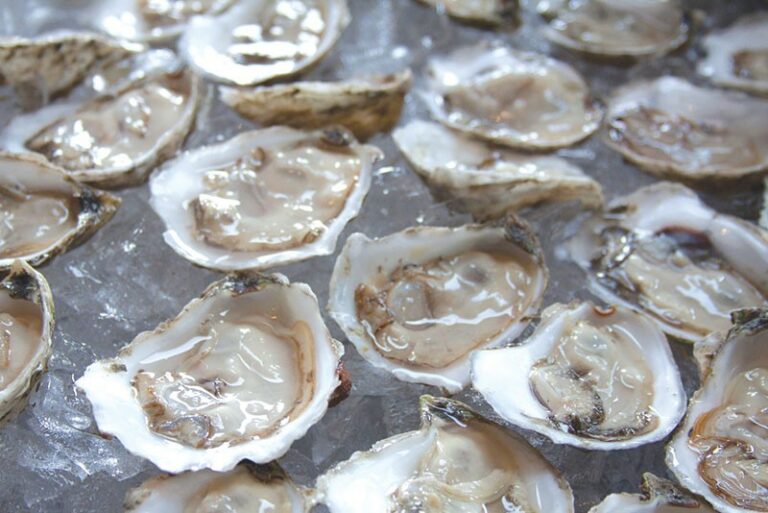
It is practically a given that you are going to order oysters, and Saltwater offers a $40 “raw deal” that features a dozen swimming in their liquor, from various ports of call: Hog Island Sweetwaters, Chelsea Gems from Washington state and Island Creeks all the way from Duxbury Bay, Mass. (no relation to the nearby reef).

Saltwater also offers a trio of cooked-oyster options, and Sunday being Sunday, the day of bacon (and rest), we go for the Devils Oyster barbecue sauce, bacon from Devil’s Gulch Ranch, parsley and butter. The spicy, juicy bivalves are first to emerge from the kitchen of chef Matthew Elias, with the platter of raw jewels to follow. We’re keeping it light today, with two accompanying salads to cleanse the palate and seal the health-lunch deal. The County Line chicory salad ($16) is dotted with sunflower seeds and feta, while the Coke Farm beet salad ($17) is a frizzy heap of mustard frills, chunks of Rogue River blue cheese and toasted pistachios. Sections of juicy, firm beets lurk below the mustard frills, slathered with a patina of the honey-mustard dressing that zings-up the salad without being overly cloying about it.

The lunch menu also features a trio of pizzas ($18–$19) and a couple of homey sandwiches ($17)—bacon with green tomato aioli, roasted radicchio, brioche and pickles, and a grilled cheese on sustaining slabs of Parkside levain.

It’s immediately clear that Saltwater is as much a part of the community out here as, say, Perry’s Deli. At least for today, we’re not seeing the hordes of cyclists who zip through nearby Pt. Reyes Station on any given weekend in their ultra-chic get-ups, hogging the line at the Bovine Bakery. Saltwater instead comes off as a total see-and-be-seen neighborhood place, loaded down with locals enjoying a micro-staycation over oysters and/or a serving of that Double 8 Dairy buffalo-milk gelato.

The pizzas are tempting but for another day—if only they delivered the smoked-cheddar and merguez pie!—and, speaking of community, the restaurant is just now trying to raise funds to replace its 30-year-old pizza oven. Saltwater’s been going strong for almost four years as a neighborhood joint, and owner Luc Chamberland put out a recent call to regulars to help pay for the new oven. He hooked up with the restaurant investment group EquityEats; check out the plan at equityeats.com.

The conversation has run a few avenues this afternoon: the awesomeness of actual, hand-held maps, the mineral content of the various oysters splayed before us and the absence of a righteous hot tub emporium in these parts. Sorely needed.

The hot tub conundrum notwithstanding, there are a million staycation options to think about. Mt. Vision has 1,282 feet of nearby elevation to conquer, a pleasantly mellow adventure. Heart’s Desire Beach, on Tomales Bay—that’s a little ways up the Sir Francis Drake Boulevard from here. The Bolinas Ridge Trail beckons across Highway 1, and back in the
Pt. Reyes National Seashore, the trails are epic, legion, endless and probably kind of muddy right about now: Estero Trail, Meadow Trail, Horse Trail, Bucklin Trail, Fire Lane Trail, Woodward Valley Trail . . .

The Saltwater menu choices are thankfully not nearly as overwhelming as the what-to-do staycation options. A decision is reached as the salad plates are hustled away: it is time for a nap.

Saltwater, 12781 Sir Francis Drake Blvd., Inverness. 415.669.1244

Pipette Up

There are two ways to get an entirely new perspective on a familiar old town: you can tour another land, very expensively and very far away, to return with new eyes, or you can just hop on a bus that other tourists take to experience your home turf. Although I've lived in Sonoma County for a good few years...

Chowder Power

In 2004, when Carol and Tony Anello opened their dream retirement business in Bodega Bay, they had no idea Spud Point Crab Co. would become a Sonoma County staple, attracting tourists and locals to their front yard year-round. What was intended to be a small, home-based roadside operation escalated into a 16-hour-a-day labor of love making lots of New...

So Far, So Near

HIKING REBOOT Hipcamp takes the sharing economy into the great outdoors Last summer, carfuls of millennials in trendy hats, plaid flannels and new hiking boots descended on Oz Farm, a vast, rural property five miles north of Point Arena, and settled in yurts and tents on the dusty ground. It looked like an Urban Outfitters catalogue shoot. The tents were provided...

Rare Gem

The late August Wilson's penultimate play, the supremely lyrical and gorgeously written 2003 drama Gem of the Ocean, may be set in 1904, but its themes stretch purposefully back in time to the beginning of New World slavery and reach forward to the present, when African Americans are still fighting many of the same struggles. This timelessness is sewn into...

Take It Easy

I still remember the iconic cover of the first Eagles album I purchased. A small, black silhouette of a feathered bird with the word "Eagle" imprinted on it, flying off into the sunset somewhere over the desert. After hearing their first single, "Take It Easy," I had a feeling this group was destined for a good flight and a...

Cross Culture

A fearless and funny voice in the counterculture scene since the early 1990s, David Cross wears every comedy hat in the business. Before he was a television show creator, actor and author, Cross was a standup comic who went against the grain of popular culture and helped breathe life into a new comedy scene that is bitingly irreverent. Coming up...

Letters to the Editor: January 27, 2016

Smile for the Camera So great to see things like Studio Space Santa Rosa ("Picturesque," Jan. 20) popping up in Sonoma County. Loving their efforts to support the arts and culture that make S.R. so special. —Erin Rose Opperman Via Facebook Losing Her Religion Denise Dubois lost "her fear" by totally losing her own identity and joining "the other" ("Learn and Lose the Fear,"...

Jazzed Up

Napa's historic downtown opera house has seen a lot of changes in the past few years. First, national venue and restaurant chain City Winery took residence in 2013 and gave the space a much-needed facelift, though City Winery's tenure was cut short last year when they opted out of a 10-year lease eight years early. That departure left the Napa...

Prudent Moves

Emphasizing that the next recession might be right around the corner, Gov. Jerry Brown released his $170 billion 2016–17 budget on Jan. 7 with an emphasis on putting a little something aside—$2 billion—for the state's rainy-day fund. He emphasized prudence and discipline yet again during his 2016 State of the State address last week. It's hard to not hover over...

Slurp’s Up

We are lingering over oysters and salads at Saltwater in Inverness and wondering in the aftermath of lunch about all the what-to-do-next ideas at our disposal: the options out here in West Marin are limitless. Check out the shipwreck in Tomales Bay? Plunge into deep Inverness, the upper reaches of Pt. Reyes National Seashore, way out at the Tule Elk...
11,084FansLike
4,606FollowersFollow
6,928FollowersFollow