Letters to the Editor: March 8, 2016

Time to Speak Up

It’s happening all around. People in practically every state are standing up to the Trump mania of deporting millions of undocumented immigrants, mostly from Mexico and Central America, and supporting their civil and human rights. These are counties and cities, and they number in the hundreds.

Some Sonoma County cities and school districts have issued resolutions proclaiming they will not cooperate and participate in this attempt to vilify and expel a targeted population that most know as neighbors, friends or workmates. These used to be called sanctuary cities, but that term has become anathema for many because of White House threats of withholding federal monies. Whatever the current euphemisms popping up now—e.g., safe havens, indivisible cities, etc.—it’s irrelevant, as the meaning and intent is quite clear. We will not sit idly by while our brothers and sisters and their families are destroyed and they are persecuted for the crime of seeking a better life.

While resistance to this scapegoating of immigrants is evident, the absence of some of the county’s organizations of note—the wine industry and the chambers of commerce—stand out in stark contrast. I’ve not seen one word in any of our local papers by these business entities or their representatives in support of the immigrant community. Where are the employers of so many of these targeted people—vineyards and wineries, hospitality businesses, construction industry, landscaping companies and all the rest—when it comes to standing up for those very people who make those businesses possible?

It’s time for you to speak up on their behalf. This is the time to step up and put your money where it counts and aid those who’ve made your businesses thrive.

Boyes Hot Springs

Community Assets

Somehow it does not seem entirely surprising that after one basic human need (shelter) has attained a luxury status, another one (food) is the next to follow (“A Singular Experience,” March 1). Single Thread restaurant may offer a unique dining experience, but the question is exactly how people, locals and visitors alike, are supposed to consider it a part of the community and even be “proud” of it when the vast majority of us won’t ever be able to afford to eat there. My family’s monthly grocery bill is normally under $300. Also, the word “community” seems to get a lot of use recently, in all sorts of commercial references. Maybe, it’s time to let it regain some of its original meaning. Communities are about safety, trust and human connections, not so much about selling overpriced business ideas.

Sonoma

Way to bring this to the attention
of those of us who’ve yet to
experience Single Thread. I saw that
@thefoodofelan posted about this on Instagram during his visit. He says they should get two Michelin stars. Sounds yummy.

Via Bohemian.com

Write to us at le*****@******an.com.

A Dreamer’s Diary

My family may have brought me to this country physically, but what really brought me here was the United States itself. This country created the situation that prompts immigrants to migrate here from Mexico and other places. Historically speaking, many people in the Americas have migrated, or have been forced to migrate, because of political or economic factors caused by the United States—a country that I no longer choose to call “America.”

America is a continent with a diverse range of people who have been confronting colonialism and imperialism for a long time. I do not think the United States was ever a democracy, since democracies are for the people and this country has not, for a long time, been for the people. It is not for the people of Latin America or for the indigenous people of North America. I am technically a North American. I have Spanish and indigenous blood.

How can I be multiple types of people in this country at the same time? I am at risk of being grabbed by Immigration and Customs Enforcement (ICE) agents even as I am protected from deportation through the actions of the previous president. I’m making art and being in the art world. And, I am just me.

CROSSING THE BORDER

My family migrated from Tabasco, Mexico, to Santa Rosa at the turn of the last century, when I was 11 years old. My parents had decided to move for economic reasons, but it was difficult to get a visa, so we came here through the means that many people come to as a last resort. Our mother took us to Tijuana where one of our aunts was waiting, a woman I had never met before. In this house, a large, round woman called a “coyote” picked us up. The coyote had skin burnt from the sun and dark, curly hair. She drove a minivan.

My mother gave us sleeping medicine on the night we left, and we got into the coyote’s van and she drove us across the border. We were drugged with Tylenol so we wouldn’t talk to the border patrol at the checkpoint. The driver pretended that we were her kids. We were young and I was the oldest, and we could have been her children.

Once we were across the border, I woke up and asked where we were going. My worry was that the coyote wouldn’t give us back to our parents. She could easily have kidnapped us, but she took us to our aunt’s house in Los Angeles, where we waited for our mother.

BETWEEN TWO WORLDS

My first meal in the United States—I remember it clearly—was pineapple pizza with Coca Cola. I remember eating it in a beige apartment served by our very nice aunt. She took care of us until our mother got there—she had to cross the border by foot, and never arrived. But eventually our father did arrive, and he took us to Santa Rosa where a second aunt lived. We stayed in her living room for about a month until we were able to find our own place. We met up with my mom later. She still lives in Santa Rosa.

I turned 12 that year, and that summer one of my new friends took me to the Sonoma County Fair, and we rode the roller coasters. That was my birthday present.

I attended seventh and eighth grade at Lawrence Cook Middle School in Santa Rosa. It was very challenging because I had only been through the second grade in Mexico. When my parents left Mexico with us, I was very upset because they were taking me away from the school where I’d been promised that I’d stay through sixth grade—ironic, since I ended up moving up to seventh grade in the United States.

[page]

My teachers helped me survive middle school and prepare me for high school. I went to Elsie Allen High School and graduated from Santa Rosa High School in 2006 after transferring there in my senior year to focus on studying art. I think the schools are making strides in serving students from different socioeconomic background like me. They are starting to celebrate Latino culture, but there are still some gaps. There was a very supportive community in the schools. Students could access college-prep programs for Sonoma State University. But, culturally, there was also some negativity toward us as students. During lunch one day, a student said he wanted to rape an illegal because he knew she wouldn’t call the police.

I was very shy as a teenager, something people don’t associate with me now now. I spent most of my time creating art while I learned English. When you’re a teen, it’s hard to come to terms with who you are, and as a person of color, a perception of who you are is often imposed on you. Biculturalism is a struggle for many immigrants. I was trying to embrace my culture while living in a new one.

ENDURING QUESTIONS

When I was in high school I wrote a paper for the National History Day competition on the history of immigration in the United States. I wanted to understand how it came to be that immigrants here are oppressed, and what it was that disqualified immigrants from accessing basic human rights. Why does one generation of immigrants after another get treated this way? At the time, I couldn’t write well in Spanish or in English. I just had that question, and it’s one I’m still asking today.

I left the North Bay for New York to go to college. Now, at 28 years old, as I sit here in Christopher Square, in Manhattan, I believe the answer to my old question has to do with religion and money. People deemed second-class citizen do the labor and are kept in poverty because this country is not an equal system for everybody. Too many U.S. citizens stand by their religious beliefs or economic ones as they tell other people how to live their lives and declare them “illegal.”

That has become very apparent to me—and all the more so recently, as I’ve been forced to engage with the realities of Trump’s immigration crackdown. I have to stay out of trouble and I have to make sure I am following the rules, and that where I’m living is safe—both physically and legally. Because of Trump, I’ve moved to a new place, closed my art studio and I put a lot of my artwork in storage to keep it safe.

THE POWER OF ART

After graduating from high school, I attended Santa Rosa Junior College, which gave me a foundation in government, mathematics and art. I transferred to Brooklyn’s Pratt Institute in 2011 on a partial scholarship and graduated with a BFA in 2013, thanks in no small part to the many people who bought my artworks and helped me get through school.

During my time at Pratt, I created a nonprofit program called One City Arts. Now it’s a permanent program at the Luther Burbank Center for the Arts that teaches art to children from low-income backgrounds.

The arts are a leveling factor. Arts and education are important to improve our lifestyle, but they also enhance our sense of belonging in a country where immigrants too often feel displaced. That sense has only gotten worse in recent days. Nationalism and white supremacy have long served to erase the history of the indigenous people of Americas and oppress the immigrant community—a community forced to migrate to a country, for economic or political reasons, that grows increasingly unwelcoming.

I graduated from Yale University with an MFA in painting in 2015. That was something I’d never have expected to achieve because of my background. My time at Yale taught me many things and introduced me to a lot of people and ideas that have shifted my perception of who I am and my perception of what my work is about. Everything I am has been shaped by the United States. And it has been shaped by its people—the people who are always there for me, those who have been aggressive toward me, who have stereotyped me, who forced upon me the internalized oppression of the undocumented that I live with and am trying to overcome.

[page]

THANKS, OBAMA

I was able to go to Italy last summer thanks to the visa waiver program, which was provided by President Barack Obama’s executive order designed to protect “Dreamers” like me from deportation. Thanks to him, we could travel abroad for our studies without fear that we wouldn’t be able to return to the United States. I came forward and registered as a Dreamer when Obama announced the waiver, which discouraged ICE agents from targeting the children of the undocumented. Obama’s 2014 waiver represented a “spiritual pardon” for the former president given the number of people he deported in his presidency.

In Italy, I saw the great works of the Italian Renaissance, but also glimpsed the country’s economic and refugee crisis. I didn’t want to go back to the United States, and I felt the weight of anti-immigrant ideology forced upon me when I arrived back here and went through the immigration checkpoints. I was put in an empty, gray room for questioning and was ultimately allowed back into the country. I rode the train home with somebody I had just met who waited for me on the other side of customs. I wanted someone to wait for me just in case I didn’t come out—in case I was threatened with deportation.

NOT MY DREAM

I never wanted the American dream. It was never my desire. The American dream has been stabbed into the heart of the Americas, the American continent, and it has shaped who I am. It has destroyed many families and it continues to do so. The American dream is a tool used to oppress. This is where I find myself now: trying to create art that can heal me from it all, art that is just, open, contradictory, but also that can try to help.

Identity is a subject that excites me as an an artist, since art goes beyond walls—it crosses all borders. I am excited to talk about identity and to figure out identity through fashion. That’s my big plan—to create a couture fashion line. I’ve been interested in this since I was young, when my grandma gave me hand-tailored dresses that she confiscated from my aunt because they were too short. Given the renewed anti-immigration push by Trump, I’ve been in a dark place and I want to come back to a positive place with positive acts—using my art as an extension into couture, and the connection to identity.

This is the issue Dreamers face now: identity and internalized racism and oppression. For me, those things are imposed on the body. I am creating wearable couture sculptures which have imagery that addresses bicultural identity and which helps free me from the internalized oppression of “illegality.”

I know there are dangers in sharing my story. Now the politics and the beauty I see are all going into the garments that I make. I need to deal with my emotions that way. There is such darkness now. We need something beautiful.

The author would like to thank Belle O. Mapa for her assistance in preparing this article, which is also drawn from a follow-up interview with news editor Tom Gogola.

Catch The Coathangers In Santa Rosa This Weekend

16991821_432022703811548_2319940908581706778_oGarage rock doesn’t get much better than Atlanta’s the Coathangers. Together for over a decade, the three ladies in the band match their power rock hooks with a relentlessly fun brashness that has made them a must-see live act across the states.
Later this year, the Coathangers will welcome a new rip-roaring EP, Parasite, into the world via Suicide Squeeze Records. But, before the record’s June 30th release, the trio is laying down an obscene amount of miles with a full US tour that lands them in Santa Rosa this weekend. The show is being hosted by tireless music purveyor Shock City, USA.
Joining the Coathangers on the show are Oakland’s romantic punks the Younger Lovers, Los Angeles three-chord tearjerkers Girl Tears and local rockers Hose Rips, previously known as Secret Cat, who make their debut under the new name.
Haven’t heard the Coathangers? No problem, click below and listen to the band’s latest single, “Captain’s Dead,” from the forthcoming EP. The Coathangers roll into town on Sunday, March 12, at the Arlene Francis Center. 99 Sixth St, Santa Rosa. 7pm. $12. Get tickets here.

Mike Birbiglia Is Coming to Napa Valley

Comedian, writer, actor and director Mike Birbiglia is one of the most sought-after performers in comedy today. From his masterful one-man shows on topics like sleep disorders, girlfriends and family, to his critically-acclaimed and audience-favorite films “Sleepwalk With Me” and “Don’t Think Twice,” Birbiglia is as funny as he is thoughtful.

On May 13, Birbiglia returns to the North Bay to headline Laugh Lounge 45 at the Napa Valley Performing Arts Center in Yountville. The show is a benefit for two Napa nonprofits celebrating 45 years of service. Aldea Children & Family Services and Cope Family Center were both founded in 1972, and work to address the need for child abuse prevention and mental health services in the Napa Valley. Laugh Lounge 45 will also offer various special packages to Napa Valley restaurants, hotels, resorts and wineries.

Click here for more details on the Laugh Lounge 45 benefit show and click on the video below to get a sample of Mike Birbiglia in action.


March 3: Art Anniversary in Sonoma

0

One of the oldest continuously operating artists’ cooperatives in the state of California, the Arts Guild of Sonoma celebrates 40 years of local art and appreciation by looking back in the ‘Guild Founders Exhibition.’ The show features work by some of the first members of the guild, who helped shape the organization as far back as 1977. Selections include Ray Jacobsen’s paintings, John Mercer’s photography and Donna Guardino’s mixed-media works, among others. On display through April 3, these pieces and their creators will be on hand for an opening reception on Friday, March 3, at Arts Guild of Sonoma, 140 E. Napa St., Sonoma. 5pm. Free. 707.996.3115.

March 4: Seeing Red in Petaluma

0

Portland, Ore., heavy metal purveyors Red Fang perfectly embody their Northwest origins. Since forming in 2005, the band has perfected densely gruff guitar riffs, sludge-soaked rhythms and stoner-rock attitudes over the course of four pounding albums. The band’s last album, 2016’s Only Ghosts, keeps the pedal to the metal with memorable hooks entwined in the frenzied energy. But, really, this is a band you need to see live to fully appreciate. This week, Red Fang bare their teeth live with help from Atlanta’s fuzzed-out foursome Big Jesus on Saturday, March 4, at McNear’s Mystic Theatre, 23 Petaluma Blvd. N., Petaluma. 8:30pm. $19. 707.765.2121.

March 5: SAY Hey in Santa Rosa

0

Last year, Social Advocates for Youth (SAY) helped over 7,000 kids in Sonoma County, including helping homeless youth and their families get everything from shelter to employment opportunities. Spurned by the new administration’s spate of attacks on the less fortunate, several talented young bands and artists are holding a benefit for SAY. Hardcore heroes Acrylics headline the night, with post-punks Slow Bloom and other heavy hitters onstage. There will also be an art showcase, including a new zine by fiercely surreal artist J Party. Support local youth and rock out on Sunday, March 5, at Arlene Francis Center, 99 Sixth St., Santa Rosa. 6pm. $5–$10. 707.528.3009.

March 7: Imported Cinema in Sebastopol

0

Returning for a second year, the Israeli Film Festival shows three diverse contemporary films from the country over three weeks. Hosted by the Jewish Community Center of Sonoma County, this springtime festival is an offshoot of JCC’s popular Jewish Film Festival, and like its predecessor, the Israeli Film Fest’s selections are handpicked by a committee of cinephiles. The festival’s first film is 2016’s Women’s Balcony, a rousing battle of the sexes that focuses on an Orthodox synagogue and a bar mitzvah mishap. Good-spirited and heartfelt, this entertaining comedy screens on Tuesday, March 7, at Rialto Cinemas, 6868 McKinley St., Sebastopol. 1pm and 7:30pm. $10 and up. 707.525.4840.

Play It Black

0

If misery loves company, then Barren Altar demand an audience. The Santa Rosa black metal band is the heaviest and darkest outfit in the latest wave of heavy metal in the Bay Area.

This weekend, Barren Altar join North Bay legends Skitzo and a horde of other metal acts for a show hosted by Star Guitars on March 3 at the Veterans Memorial Building in Santa Rosa.

Heavy metal has become a staple of the region ever since Metallica took over the world in the 1980s, though in the last three decades, the term “metal” has evolved to incorporate subgenres like doom, thrash, death and black metal.

Today’s scene is a diverse mix of these subgenres, and Barren Altar’s blend of doom and black metal is a standout in the field for the pummeling guitars and searing vocals from founding members Ed “the Shred” Fullmer and Ryan Thompson.

Fullmer and Thompson go back as far as 2006, when they put together what Fullmer calls a “series of fake bands” that tested the limits of what you could accomplish in home recordings.

In 2013, they saw Norwegian black jazz-metal band Shining in San Francisco, a show that compelled them to join forces for real.

“I’ve always wanted to do something with Ryan,” says Fullmer. “He’s an amazing vocalist.”

“Everything happened really quick when we first started writing,” Thompson says. “We quickly solidified what we wanted to do, and we were doing some really dark music.”

Down-tuned guitars blasting massive riffs and heavy atmospheric rhythms characterize Barren Altar’s unapologetically bleak sound. “For me, I’m writing music that has a roller coaster of emotions,” Fullmer says.

Within that pitch-black realm, Thompson’s howling, scorched-earth vocals ring out like an otherworldly abomination.

“Our whole thing was writing chaotic music that relished in suffering,” Thompson says. “I think it’s cathartic for everyone involved, but the music itself isn’t supposed to be cathartic; it’s supposed to celebrate misery in the most earnest way we can do it.”

“That is the majority of what it sounds like, but there are certain moments, not happy moments, but moments where there’s a ray of light, so to speak,” Fullmer says.

Whatever their reasons for going dark, Barren Altar are making music for themselves. “We don’t think, ‘How are people going to enjoy this?'” Fullmer says. “Writing this music, it’s what

I need. I can’t think of any other way to do it.”

A Singular Experience

From the outside, Single Thread looks more like an embassy than a restaurant. The cream-colored, two-story Italianate building occupies a corner lot in downtown Healdsburg. It’s imposing and elegant. While it was once the site of a government building, the profusion of potted plants, black awnings and subtle signage reveals that it’s now a house of luxury.

Open the heavy wooden door, step inside the dimly lit foyer, and you enter a carefully calibrated decompression chamber. Serenity pervades the hushed, small space. The attendants behind the reception desk don’t ask for the name of your party or consult a reservation list, but rather greet you by name as if they already know you. They do.

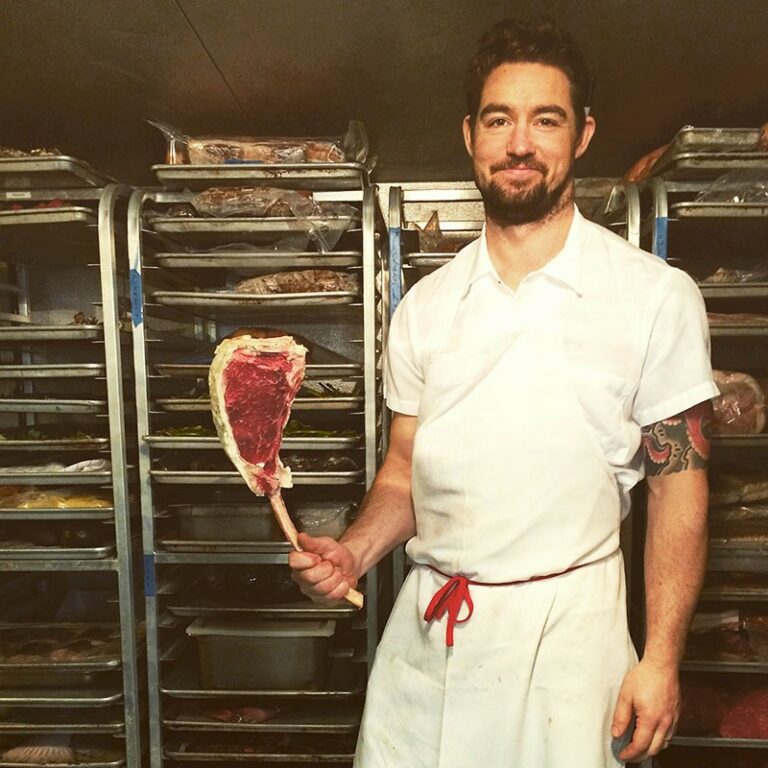
The black and brown hues and earthy calm of the room stand in contrast to the brightly lit kitchen framed by an opening in the wall opposite the front door. Inside the proscenium, chefs in white coats, gray aprons and neat beards move with quiet focus, barely seeming to notice the guests peering in.

Unseen to diners in the kitchen is a wall of nine video monitors that track guests as they flow through different zones of the restaurant—the parking lot, the approach to the front door, the lobby, the hallway of the five-room inn upstairs, the dining room. The video system allows staff to know when someone is about to enter the restaurant. Kind of creepy, but such is Single Thread’s attention to detail in the name of service and hospitality.

Before stepping into the dining room, guests are whisked up an elevator to the roof garden for an aperitif, an appetizer and a leisurely view of the western sky above Healdsburg before heading back down the elevator. Pushing through the dining room door reveals the inner sanctum. It feels like a living room with appealing rooms and corners.

Eames-like chairs were custom-made with seat backs at just the right angle to promote comfortable sitting while eating. Soft overhead lighting, potted plants, floral displays and handmade Japanese pottery arranged around the room like family heirlooms add to the elegant, but inviting effect. It’s good to get comfortable. Meals last three to five hours.

The kitchen is fully open to the dining room. It’s a gleaming room of stainless steel manned by chefs who move around workstations with the deliberate precision of lab techs, hunching over plates or searing meats on an open hearth in a quiet culinary ballet for all to see.

ONE OF A KIND

There is nothing in Sonoma County like Single Thread. While there are upscale restaurants, nothing compares to the ambition, vision and, yes, price of Single Thread. The nine-course,

kaiseki-style tasting menu is $294 per person. The wine pairing goes for $200. For the price, the caliber of the food and professionalism of the staff, the Sonoma County–influenced Japanese restaurant is in a category of one.

Shortly after it opened in December, the James Beard Foundation named Single Thread a semi-finalist for best new restaurant in America. The 2017 Michelin guide won’t be out until the fall, and top new restaurants generally don’t get more than one star, but there are exceptions, and I would not be surprised to see Single Thread collect two on its first time out. Over in Napa County, the French Laundry and Meadowood both have three stars, and Single Thread is clearly looking for entry into that exclusive club.

Single Thread is the creation of chef Kyle Connaughton and his wife, Katina. High school sweethearts, the couple’s career in food and farming has taken them all over the world—Japan, England, Seattle and Los Angeles. Single Thread is the first restaurant of their own.

“The vision was always to have a very small restaurant, just a few [hotel] rooms, something manageable, and for Katina to be able to farm,” says Kyle, whose soft-spoken, cerebral manner calls to mind an academic, albeit one with an arm of vivid tattoos. “It matches almost 100 percent of what we saw in our mind’s eye of how the pieces all work together. It was worth the time and the wait.”

The road has been a long one. The Connaughtons moved to Healdsburg in 2012 with two daughters, a dream and little else.

“There’s this notion that we arrived here one day and said, ‘We’re opening a restaurant,'” Kyle says, referencing some of their critics. “We moved out here without jobs or anything. There was no investor saying, ‘come out and we’ll back this.’ It was 100 percent start-from-scratch.”

The couple had been visiting Napa and Sonoma counties for years and, in spite of their Southern California roots, were drawn to the North Bay.

“It spoke to us much more than Los Angeles,” Kyle says. “This is where we want to be.”

While developing the plan for the restaurant and raising cash, Kyle worked as an editor for Modernist Cuisine, the publishing company and R&D firm founded by Microsoft CTO turned avant-garde chef Nathan Myhrvold, as well as doing private cooking events and teaching at the Culinary Institute of America. Katina, who honed her horticultural skills during their travels, helped create the landscaping for the Barlow in Sebastopol and worked as greenhouse supervisor for Santa Rosa Junior College’s agriculture program.

[page]

AN EARLY OBSESSION

Kyle’s passion for food began as a child, when his father, who sold Olympic-level gymnastics equipment, took him on extended business trips to Japan.

“Japan really spoke to me,” he says. “There was something about the flavors and the aesthetic and the hospitality, the focus on a craft . . . Something just fused for me and it became a very early obsession.”

Back home in Pasadena, Kyle worked as a bus boy in a sushi restaurant before enrolling in culinary school. While still passionate about Japanese cuisine, he switched gears and worked in many of L.A.’s top restaurants—Spago in Beverly Hills, Lucques, A.O.C. and Campanile, many of which were run by chefs who spent their early years in iconic Northern California progenitors like Chez Panisse and Stars. The rustic, farm-centric Northern California aesthetic took root in him alongside his Japanophilia.

“As much as I study, speak and learn Japanese, I will never be Japanese. California is my home and my culture.”

When French chef Michel Bras, one of Kyle’s culinary heroes, tapped him to work at Toya restaurant in Hokkaido, Kyle went running. It was the best of both worlds. He took full advantage of his time in Japan. On days (and nights) off, he also trained in kaiseki, sushi, soba and izakaya in other traditional Japanese restaurants.

From there he was hired as head of research and development at the Michelin three-star-rated Fat Duck in Bray, England, by famed culinary alchemist Heston Blumenthal. Blumenthal is renowned for his inventive, multi-sensory approach to cooking. When added to his experience at Modernist Cuisine, it’s a résumé few chefs can match.

ON THE MENU

Kaiseki is a rarefied, highly symbolic style of Japanese cooking that’s built around a multicourse structure and a deep reverence for presentation and seasonal ingredients. This seasonality goes beyond summer, fall, winter and spring, and draws on more discrete seasonal expressions, like early spring, late winter, etc.

Meals at Single Thread consist of nine courses as well as several small dishes. Each meal begins with hassun, an ever-changing, multi-item course that sets the theme for the dishes to follow. On my visit in late November (a media preview dinner before the restaurant opened to the public), the hassun consisted of mushrooms, sashimi, raw oysters, savory egg custard, and other one-bite wonders nestled in and around a multi-tiered section of wood, moss and leaves. Kyle calls it an “Easter egg hunt for adults.” It was delicious fun and had me anticipating what was to come.

Each course was distinct in terms of ingredients, plateware and cooking techniques, flowing from lighter vegetable and seafood dishes to more substantial flavors of guinea hen and foie gras. Bite after bite, course after course, it was extraordinary.

The black cod dish with leeks, brassicas and a chamomile dashi served in an earthen donabe vessel was among my favorites. Kyle is the author of a book on donabe cookware and cooking. The Japanese clay pot is opened tableside with a flourish to let diners inhale the heady aromas before the pot is taken back into the kitchen and the dish plated and brought out again.

While the style, ingredients and techniques are decidedly Japanese, Kyle stresses that Single Thread is not a Japanese restaurant. Some of the dishes—like the sunchokes with mangalitsa pork and preserved lemon, and the molded Gravenstein “apple” filled with whipped chestnut cream, apple butter and apple sorbet—tasted more of California than Japan.

The challenge of a multi-course meal is not to over- or underdo it. Kyle says he watches to see what plates look like when they come back into the kitchen, adjusting portions up or down to keep pace with diner’s appetites. I did not leave hungry.

Of course, if your idea of fine dining is a cheeseburger with bacon and avocado, Single Thread—with its endless parade of multi-ingredient dishes, custom steak knives with handles made from wood sourced from the farm and proffered to diners from ornate boxes, and $5,000 toilets with warmed seats and lids that rise upon approach—will be insufferable. In that case, stick with the burger joint.

Kyle realizes this experience is not for everybody. Everyone has hobbies and passions, he says. Some would rather spend $1,000 on a Super Bowl ticket or $300 for a pair of jeans than pay for an extravagent meal. To each his own, he says.

“We don’t have the expectation that people are going to say on a Wednesday night, ‘Oh, let’s pop down to Single Thread to have dinner,'” Kyle says. “That’s OK. We want to be, maybe, the special place where you come to celebrate or when you have someone visiting from out of town and you’re really proud of the county you live in and you want to have a place to take them and show the best of what’s here. We want to be a place of pride for people that live here.”

[page]

ON THE FARM

Katina spends her days at Single Thread’s farm, just a few miles from the restaurant near the Russian River. Once she’s done at the farm, she changes out of her muddy Blundstones and jeans to lead the restaurant’s floral department, where she creates the elaborate garnishes for the hassun course and other dishes, as well as the restaurant’s flower arrangements. But it’s clear the farm is her passion.

With her neck-to-knuckles tattoos, black-frame glasses and knockout smile, she doesn’t fit the Wrangler-wearing farmer image. But she’s no dilettante. Katina oversaw the transformation of the five-acre farm from a weedy, former Chardonnay vineyard. With the help of her brother, daughter and daughter’s boyfriend, her goal is to grow as much as 80 percent of the restaurant’s produce. Her biggest challenge this winter? Slugs. The farm is not certified organic but uses chemical-free, organic methods.

“The slugs have been the worst problem we’ve had,” she says with a sigh.

In addition to staple crops like green onions (Single Thread’s logo is a spherical bunch of green onion flowers drawn by Katina’s Portland, Ore.–based tattoo artist), mustard, kale, carrots and cabbage, Katina grows obscure Japanese greens and vegetables. While she’s already been farming the plot for 18 months, she admits she’s still learning how best to work the land.

“It’s going to take some time to get to know each other.”

BLOWBACK

Though Healdsburg is arguably the culinary star of Sonoma County, not everyone was eager to see Single Thread come to town. Months before they opened, the Connaughtons were hit by a rash of opposition by those who saw it as a gilded enclave for the 1 percent. While Healdsburg had long since gone from sleepy farming community to a NorCal Aspen, critics said Single Thread went too far. Adding to that sentiment is the building itself. It’s owned by winemaker Pete Seghesio and it’s built on the site of downtown Healdsburg’s post office, and, as such, the location evokes strong feelings of civic pride and ownership among many long-time city residents.

Kyle has tried to see the upside to the criticism.

“It showed us that it was important to be part of the community and not just say we’re going to come here and build some sort of ivory tower,” he says. “You have to appreciate that people care that much about this community.”

Once Single Thread opened, the negative sentiment seemed to fade and the glowing press reviews came in. But the criticism reignited with a vengeance when news broke in January that a mechanic’s lien had been filed by Mike Behler, co-owner of Behler Construction, against the restaurant’s New York developer. Behler claims developer Tony Greenberg failed to pay him and more than a dozen contractors nearly $400,000. The Connaughtons are not named in the lien, but it hasn’t helped the restaurant’s image.

“Normal people wonder how you could feel good about spending a small family’s monthly grocery budget on one meal,” a reader commented on a Press Democrat story about the contractor’s dispute. “Furthermore, you supported people with Donald Trump’s sense of business ethics, make the working class work on spec and then stiff them.”

In a statement, developer Tony Greenberg said his firm did not withhold payment, but that Behler filed the lien before he had submitted a final bill. Greenberg says more than $400,000 has been set aside to pay Behler and his subcontractors “to ensure that 100 percent of whatever final payments Behler owes each and every subcontractor is covered. We implore Mr. Behler to pay all of his subcontractors in full or release the lien and allow us to pay them directly.”

Behler says he did submit a final bill in December and payment for earlier bills have been delinquent.

“If we didn’t file suit against them, they would just let it go and they wouldn’t be required to pay us,” he says.

In spite of the dispute, he wishes Kyle and Katina well.

“They seem like great people,” he says. “We really have no issue with Kyle and Katina.”

While the lien isn’t the kind of publicity a new restaurant trying to win over locals wants, Kyle says they are committed to Healdsburg.

“We have to be ambassadors,” he says, pointing to work they’ve done with the Sonoma Land Trust and local food pantries. “It’s a small community. We need to show who we really are.”

A STAR ON THE RISE

If a restaurant of Single Thread’s caliber opened in Napa County, it would not be met with complaints over the high prices. Napa has been there, done that. In some ways, the Connaughtons are pioneers in Sonoma County, where the fine-dining scene is not on the same level as Napa’s. The 2016 Michelin Guide lists only two restaurants in Sonoma County with the coveted stars: Terrapin Creek and Farmhouse Inn & Restaurant each have one star. In addition to three stars for Meadowood and the French Laundry, the guide awarded single stars to five other Napa County restaurants. That’s a total of 11 stars.

Douglas Keene’s Cyrus restaurant in Healdsburg was Healdsburg’s premier fine-dining restaurant. It earned two Michelin stars before it closed in 2012, but did not incur the kind of populist criticism leveled at Single Thread.

But Kyle sees Sonoma County’s culinary star as rising, particularly in Healdsburg.

“If it wasn’t me, it would be someone else. And there may be someone else behind me.

There’s so much room here to showcase food at all different levels. I’m excited about the future.”

Letters to the Editor: March 8, 2016

Time to Speak Up It's happening all around. People in practically every state are standing up to the Trump mania of deporting millions of undocumented immigrants, mostly from Mexico and Central America, and supporting their civil and human rights. These are counties and cities, and they number in the hundreds. Some Sonoma County cities and school districts have issued resolutions proclaiming...

A Dreamer’s Diary

My family may have brought me to this country physically, but what really brought me here was the United States itself. This country created the situation that prompts immigrants to migrate here from Mexico and other places. Historically speaking, many people in the Americas have migrated, or have been forced to migrate, because of political or economic factors caused...

Catch The Coathangers In Santa Rosa This Weekend

Garage rock doesn't get much better than Atlanta's the Coathangers. Together for over a decade, the three ladies in the band match their power rock hooks with a relentlessly fun brashness that has made them a must-see live act across the states. Later this year, the Coathangers will welcome a new rip-roaring EP, Parasite, into the world via Suicide Squeeze Records....

Mike Birbiglia Is Coming to Napa Valley

Comedian and filmmaker will perform at Laugh Lounge 45.

March 3: Art Anniversary in Sonoma

One of the oldest continuously operating artists’ cooperatives in the state of California, the Arts Guild of Sonoma celebrates 40 years of local art and appreciation by looking back in the ‘Guild Founders Exhibition.’ The show features work by some of the first members of the guild, who helped shape the organization as far back as 1977. Selections include...

March 4: Seeing Red in Petaluma

Portland, Ore., heavy metal purveyors Red Fang perfectly embody their Northwest origins. Since forming in 2005, the band has perfected densely gruff guitar riffs, sludge-soaked rhythms and stoner-rock attitudes over the course of four pounding albums. The band’s last album, 2016’s Only Ghosts, keeps the pedal to the metal with memorable hooks entwined in the frenzied energy. But, really,...

March 5: SAY Hey in Santa Rosa

Last year, Social Advocates for Youth (SAY) helped over 7,000 kids in Sonoma County, including helping homeless youth and their families get everything from shelter to employment opportunities. Spurned by the new administration’s spate of attacks on the less fortunate, several talented young bands and artists are holding a benefit for SAY. Hardcore heroes Acrylics headline the night, with...

March 7: Imported Cinema in Sebastopol

Returning for a second year, the Israeli Film Festival shows three diverse contemporary films from the country over three weeks. Hosted by the Jewish Community Center of Sonoma County, this springtime festival is an offshoot of JCC’s popular Jewish Film Festival, and like its predecessor, the Israeli Film Fest’s selections are handpicked by a committee of cinephiles. The festival’s...

Play It Black

If misery loves company, then Barren Altar demand an audience. The Santa Rosa black metal band is the heaviest and darkest outfit in the latest wave of heavy metal in the Bay Area. This weekend, Barren Altar join North Bay legends Skitzo and a horde of other metal acts for a show hosted by Star Guitars on March 3 at...

A Singular Experience

From the outside, Single Thread looks more like an embassy than a restaurant. The cream-colored, two-story Italianate building occupies a corner lot in downtown Healdsburg. It's imposing and elegant. While it was once the site of a government building, the profusion of potted plants, black awnings and subtle signage reveals that it's now a house of luxury. Open the heavy...
11,084FansLike
4,446FollowersFollow
6,928FollowersFollow