Best Inlaid Plans

0

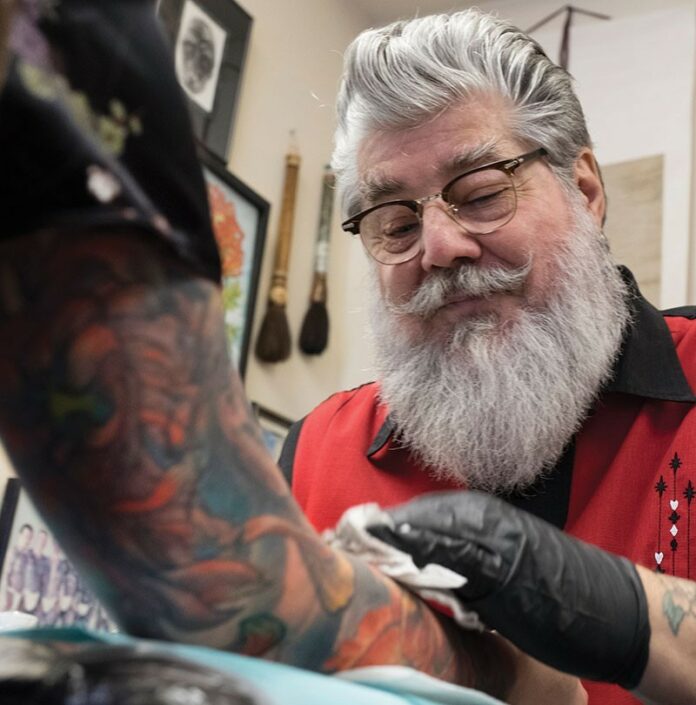
A drilling mistake in 1975 changed the course of Larry Robinson’s life.

Robinson was a few weeks into a new job building guitars. “I drilled right through two basses, and my boss said, ‘Put an inlay in it and we’ll cover it up, refinish it and call it custom.'”

It was his first introduction to inlays, and Robinson was hooked. More than 40 years after this “accident,” I drive to the hinterlands of Sonoma County, eventually reaching a small, nondescript trailer. Stepping through the door of Robinson’s home studio feels like traversing the mythical looking glass: this is where the magic happens.

Art adorns the walls, musical amplifiers are everywhere and a desk is covered in tools. A fan labors to cool the air in the cramped space where Robinson works at his craft.

Inlays—artwork that is carved into the wood of guitars and other string instruments and then filled with materials such as shell, metal or plastic—require meticulous attention to detail, and planning is critical. Robinson’s art is in the details. “I try to be really precise and exact. I’m not necessarily obsessed, but I’m careful.”

“Larry has a true passion for inlay, and it shows in his work,” says David J. Marks, a woodworker and friend of Robinson who lives in Santa Rosa. “He wants to pursue techniques and visions that are the most intricate and complex that I’ve ever seen.”

Tom Ribbecke, a woodworker from Healdsburg, says, “Larry’s work is extraordinary because he always pushes the artistic envelope. He sees things in a way that I don’t—I’m so impressed constantly. Sometimes I’m so moved by what he does, I have to sit down.”

Born in Connecticut, Robinson was accepted into the Hartford Conservatory performing arts school but did not finish. He planned on becoming a classical guitar teacher, but when he hired someone to build a custom guitar for him in 1972, he was so entranced by the process that ultimately the luthier taught him how to build his own instrument.

Three years later, Robinson set out for California to visit a friend, landing in San Francisco, where he was hired at Alembic to build guitars for the likes of Fleetwood Mac and Led Zeppelin under Rick Turner. (Rick Turner Guitars is now in Santa Cruz.) It was here that the fateful accidental drilling took place.

When Turner left to start his own company, Robinson went his own way. He worked at Modulus Graphite, a bass guitar company in San Francisco, but soon grew tired of the commute. In 1984, Robinson left his job, determined to fully support himself in Sonoma County through his own inlay creations.

He quickly made a name for himself. “I had a lot of people asking me to be an apprentice,” Robinson says, “but I’m just not that focused on teaching people with that method.” In 1994, he published The Art of Inlay. Now in its third edition, the book is “basically a how-to,” Robinson says, “an instruction manual that has all the eye-candy you could want.”

In May, Robinson released his second book, The Invisible Line: When Craft Becomes Art. Featuring seven artists involved in the creation of custom instruments—including himself, Marks and Ribbecke—the book explores definitions of art and craft. In the book, Robinson reflects on the emotions invoked by his work at a guitar show where one of his creations, dubbed “Meet the Beetles” (an acrylic instrument with real beetles layered inside it), triggered strong reactions. “Some people hated [it] and some loved it. Few were neutral . . .”

Compared to The Art of Inlay, Robinson says The Invisible Line is “more philosophical. There are few instances where people will tell you how they did something. It’s more about an attitude.” He adds, “[Art] permeates every little aspect of our lives. I wanted to give people a look from our perspective.”

Marks agrees. “It’s a lifestyle. We’re eating, breathing and living this stuff all day long, every day. Your life is revolving around what you love to do.”

Robinson recognizes that any definition of art is entirely subjective. “If anything has been solved by this book, it’s that nobody can tell you what [art] is and what it isn’t.” Ribbecke adds. “We’re not fixing people’s hearts, we’re not solving war and peace in the Middle East. We’re scratching a creative itch and making the planet a little bit of a better place.”

When asked about the legacy he hopes to leave behind, Robinson quotes Frank Zappa: “I don’t care, I’m going to be dead.” But his dedication to each guitar contradicts that sentiment.

“If this is the last inlay that I ever do, my life will be judged upon it. My quality remains consistent.” He says he’s “trying to make the world more beautiful—and trying not to step on too many toes along the way.”

But Robinson isn’t finished yet. “Every time I try to get out of this business—and I have, on occasion—somebody comes along and gives me a nice job to get back into it again.”

Dream Job

0

When Rolando Herrera got his first lesson in terroir, he thought it was just a pretty story.

Herrera was eight when his father moved the family from Michoacán to work in a Napa Valley winery, and felt a bit of an outsider when they returned to Mexico five years later. One day while helping his grandmother tend a family garden plot in the remote, brushy hills, he asked why they didn’t grow vegetables instead on their six-acre market farm down on the flats.

Because, his abuela explained, this is where the sun and soil grow the best produce. He suspected she was saying this to make him feel better about the dusty trek. It wasn’t until some years later when working with wine, Herrera says, that he really got the lesson.

Herrera came back to Napa in the early 1980s and worked in restaurants while going to high school. He made an impression on Stag’s Leap Wine Cellars founder Warren Winiarski, who also made an impression on him: “You have to listen to the wine,” Winiarski counseled. “I felt like running away,” Herrera jokes to winery visitors today. “This man is loco!” But listen he did, and earned repute as a good taster, too, while a cellar rat at Stag’s Leap, where he became cellar master.

Herrera’s affinity for Malbec, which he picked up in Argentina while working as director of winemaking at Paul Hobbs Consulting, shows in his Herrera 2013 Victoria Oak Knoll Malbec ($95), a plum- and fig-scented standout that’s coaxed from cracked soil. Wines labeled “Herrera” are special selections named for each of Rolando and Lorena Herrera’s six children; Mi Sueño (“my dream”) wines are less expensive, but also grown in leased vineyards that Herrera farms for optimum control of the vintage—all of which keeps him busy in what he calls, with a chuckle, “my crazy life.”

You’d never guess the Herrera 2013 Perla Sonoma Mountain Chardonnay ($70) was fermented in 100 percent new French oak barrel and aged for several years more than is common in older oak. Just a whisper of volatile and caramel candy notes add intrigue, while lean citrus and—is that loquat? “Agave,” suggests Herrera—juice the palate.

Sample this, the more “classic” Chard lovers’ Mi Sueño 2014 Los Carneros Chardonnay ($42), and more at the winery’s industrial park location, where low lighting, candles and custom-made furniture from a Mexican village workshop add atmosphere to the barrel-room tasting area.

Mi Sueño Winery, 910 Enterprise Way, Napa. Private tastings daily at 10am, 11:30am, 1:30pm and 3pm. $20–$40. 707.258.6358.

Return to Sender

The California Department of Forestry and Fire Protection (Cal Fire) issued a point-by-point rejection last month of a proposed logging plan on land that crosses Felta Creek in the forested wilds of Healdsburg.

The creek is home to one of the last coho salmon populations in the Russian River watershed.

Ken Bareilles, a 75-year-old Humboldt County businessman, received notice on July 28—the deadline that had been set for approval—that his timber harvest plan had failed to address numerous concerns raised over the proposed 146-acre harvest.

In advance of the Cal Fire decision to delay his proposal and send it back for further public review and input from the owner, Bareilles told the Bohemian that he fully expected the green light from Cal Fire. On July 31, he fired off a sharply worded rejoinder to the Santa Rosa Cal Fire point person on the Felta Creek THP, Dominik Schwab, that raged against the agency’s apparent and, to Bareilles’ mind, surprise turnabout. “Needless to say, I strongly oppose and totally resent your letter which would lead to opening up the [timber harvest plan] for new and additional public comment and big-time additional delay. . . . Your office has to step up to the plate and do you[r] job, not be intimidated by all the letters from the neighbors, unless they point out some truly significant defect in our proposed THP.”

Cal Fire had signaled its apparent approval of the THP well in advance of the July 28 deadline, by which time public comments to the proposal would be reviewed by Schwab. Many of the comments called for a dramatically scaled down logging plan. Schwab’s letter was all the more surprising since the Cal Fire website that tracks progress of timber harvest plans had checked off the “approved” box at least a week before July 28. That led opponents to believe that the project was a done deal.

Soon after a Bohemian reporter contacted Cal Fire about the apparent pre-approval of a process that was putatively ongoing, the “approved” box was subsequently unchecked.

Opponents from state and federal fisheries management agencies, such as the California Department of Fish and Wildlife and the National Oceanic and Atmospheric Administration and Healdsburg locals, have cautioned mightily against a timber harvest plan that they say could undo significant state and federally funded progress made in Felta Creek to restore endangered coho salmon to some level of viability. In recent drought years, Felta Creek has occasionally been the only tributary of Dry Creek to support coho spawning.

The Cal Fire letter to Bareilles demanded that he resubmit his timber harvest plan with additional details on how he planned to protect the fish on his land and cited new information that had animated the decision to delay and send back the THP for further tweaks. The agency also requested that he revise a truck-access plan along Felta Creek Road which runs parallel to the creek.

In his response to Cal Fire, Bareilles claimed he’d been betrayed by the agency as he reiterated what he called basic facts about the land and his proposal, not the least of which is that it’s zoned for timber production. The parcel hasn’t been logged since 1994.

The Cal Fire decision doesn’t put an end to the proposed plan, and Bareilles’ continues to insist that he is within his rights to harvest on his land—and that he’s already done everything Cal Fire has asked of him as a condition of its approval.

In an interview, before receiving Cal Fire’s letter, Bareilles noted that he’d spent tens of thousands of dollars to clean up the 160-acre tract (which he purchased for $2.5 million in 2015) of debris and abandoned cars that he says were left behind by the previous owner. He says he spent between $15,000 and $20,000 to reinforce a bridge so it could bear the weight of dozens of logging trucks.

“I’ve made huge improvements on the land,” he says, describing it as a “junkyard” when he bought it. The property is now on the market for $7.5 million, and Bareilles says there’s at least
$3 million in timber to be harvested. His plan is to harvest the timber and then sell the land. He has no designs on moving to the property and lives in Eureka.

The Cal Fire letter serves to reopen the public comment period for an additional 30 days and also builds in a two-week window for the agency to review additional comments and decide whether Bareilles has addressed the numerous issues highlighted by Schwab and Cal Fire (and the public comments to date). Elected officials, from State Sen. Mike McGuire to Sonoma County Supervisor James Gore, have weighed in with their significant concerns about the THP, now reflected in the Schwab letter of July 28.

In the meantime, there is hope that a deep-pocketed do-good buyer will come forward, or that Bareilles will prune-down his proposed harvest to a spot-harvest plan targeting individual trees, and perhaps protect the endangered coho’s foothold in the process.

‘Once in a Generation’

0

My name is Jay Foxworthy and I’m running for Sonoma County sheriff. I believe it’s important that everyone have a better sense of the person behind the badge, especially when that person may be our next sheriff.

I’m a local boy, raised in Windsor, sometimes by my mother, but mostly by my grandparents. Much of my childhood was spent in poverty, living with a mentally ill, self-medicating, addict mother who was often in trouble with the law. During times of her incarceration, I was raised by my grandparents, an aunt and, sometimes, foster parents.

When I was nine, my mother had a nervous breakdown and I was comforted by a police officer who arrived at the scene. That one moment forever changed the way I saw law enforcement and the positive impact it can have on people. It’s what inspired me to become a cop years later.

As a young man, I served three years honorably in the Army, got my degree from Santa Rosa Junior College and graduated from the police academy in 1996. I applied to the Sonoma County Sheriff’s Department, but I couldn’t get hired here as an openly gay man. Instead, I found work as a deputy sheriff in San Francisco, where I’ve spent the last 22 years learning and practicing community policing policies.

Today, I live in Santa Rosa with my amazing husband, Bryan, and our two incredible adopted children. We’ve also fostered 15 amazing kids over the last decade.

As a result of all of these experiences, I have a unique perspective on the challenges many communities struggle with when it comes to law enforcement.

Our next sheriff should represent all of Sonoma County, with respect toward all. That means respecting immigrants and rebuilding community trust, reducing use of force, working with the community on homeless concerns, hiring for diversity, modernizing jail services and adopting cannabis policies that reflect our community’s values.

We have a “once in a generation” opportunity to set a new course for our sheriff’s office. As we begin this conversation, I hope you’ll reach out to me at foxworthyforsheriff.com and share your ideas too.

Jay Foxworthy is running for Sonoma County sheriff in the June 2018 election. This is the first in a series of planned Open Mics from declared candidates for sheriff.

Kale-a-Bunga! Star Route Farms sold to the University of San Francisco

The “OG” of certified organic farming in California, Star Route Farms in coastal Bolinas, was bought by the Jesuit University of San Francisco this week, it was announced.
News of this sale had been rumored for months around the various gossip-chewing maypoles of Bolinas, and this week the university announced that the deal had indeed gone down, as of Tuesday July 8.
University spokeswoman Ellen Ryder says the purchase price for the farm was $10.4 million, “which included [the] property (land and buildings), equipment, business operations, etc.”
The university will use the 100-acre property as a teaching farm and community-outreach platform, and USF president Rev. Paul. J. Fitzgerald says in a statement that the purchase will enable and enhance “USF’s commitment to environmental and social justice,” central tenets of a Jesuit faith that encourages righteous activism in the name of Jesus and this hot and holy damaged planet of ours.
The purchase will save Star Route for future generations of would-be organic farmers and, as it forever protects a glorious swath of West Marin from a feared onslaught of big-ticket developers who would turn the Bolinas Lagoon-side sprawl into, God help us, a condo complex. That was the fear, anyway, as the aging Star Route founder Warren Weber reportedly spent the past several years trying to find an appropriate buyer.
Weber opened Star Route Farm in 1974 and runs it with his wife, Amy. It provides sustainable, organic vegetables—rows of kale are currently waving in the fresh foggy breeze of Bolinas—to restaurants and markets around the Bay Area.
Says Weber in a statement, “We are very pleased and honored that the University of San Francisco will continue the Star Route Farms legacy. We hope young people, entry level farmers, and farmers around the world who struggle with conventional agriculture will learn from the passion and expertise that USF offers this enterprise.”
Huzzahs were quick in coming from around the Bay Area, from some of the most prominent slingers of organic hash in the country. Alice Waters, the chef and author and founder of the estimable sustainable- and organic-only Chez Panisse in Berkeley, noted that “school supported agriculture is an idea whose time as come” as she praised Weber for continuing the operation and launching an “interactive educational program that can be a model for the rest of the country.”
Traci Des Jardins, the chef-owner of Jardiniere in San Francisco says she’s been buying Weber’s product for decades as she celebrated the new partnership. “The preservation and continuation of this visionary farm will play an important role in educating new generations.”
Looking ahead, the new owners expect a seamless transition to a full take-over of the farm. Current operations will continue, and Weber’s employees’ jobs are safe, assures the university.
Plans in the works include cross-disciplinary research, community education, “and programs focused on nutrition, biodiversity, sea level rise, and more.”
Star Route has indeed come a long way in its pioneering role as California’s first organic-certified farm. Weber’s farm started as a five-acre tract that utilized horse-drawn plows and, as the university notes in its announcement, was a pioneer in adopting “production and post-harvest technologies such as precision planters and hydro-cooling equipment which allowed it to bring the freshest possible product to market.

The Art of the Good Deal

Petaluma has galleries galore, a museum whose building was endowed by Andrew Carnegie and a flourishing arts center. But the best art in town just might be discretely sandwiched between occasional dog shows and a Waldorf charter school.

Located in a voluminous warehouse at the premises of the Sonoma-Marin Fairgrounds and Event Center is what the last scene of Raiders of the Lost Ark might look like if everything was uncrated. Thousands of dollars worth of valuable art, collectibles, and antiquities line the walls or are attractively arranged in the showroom. It’s a veritable museum in itself and it’s all for sale. Welcome to Skip Domingos Auctions, where items from the sensational to the sentimental are going, going, gone to the highest bidder.

“We’re reaching the collectors more,” says Caleb Newberry, who worked with the auction house’s namesake for 15 years before acquiring the business in Spring of 2015. Since then, Newberry has concentrated on integrating contemporary sales practices into a premise that’s existed since 500 B.C. Can’t make it to the auction in person? There’s an app for that, courtesy of Live Auctioneers, an online live auction network that currently boasts over 36 million items listed, including those from Skip Domingos, which can be bid on in real-time as the gavel swings in Petaluma.

Technology aside, Newberry emphasizes the human touch over the algorithmic when it comes to his auctions. They’re conducted live with a big screen, sound system, a veteran auctioneer and an eager crowd seated in folding chairs on the showroom floor.

“With us there’s a living person behind what’s going on,” says Newberry, who is something of a walking Wikipedia when it comes to assessing both the value and validity of an object. He’s honed his knowledge and — as importantly — his instincts, over the years and has cultivated a network of experts who sometimes help confirm the provenance of items.

“It’s an ongoing process,” says Newberry, who, back in the days with Domingos, “…was the guy that went out to the houses and was digging in the crawl spaces and going up into the attics and was barely able to breath in some places – and digging out this one Van Erp lamp out that sold for $27,000.”
Newberry credits programs like PBS’ Antiques Roadshow with amplifying awareness of the antiquities market and bringing in a new generation of collectors. Fortunately for him and his colleagues, Petaluma has long been an industry hotspot.

“Petaluma has always been known as an antique haven — downtown, all the shops, it’s always had what I call ‘sophisticated country,’” he says with a smile. “We have something for everybody. If you’re a construction guy and you’re looking for a new power tool, I’ll have one here eventually. If you’re looking for a vehicle this is a great place to get one. If you’re a jewelry collector interested in vintage, antique jewelry that you just can’t find nowadays, we have it.”
And art? Last fall, he had a Picasso on hand as well as a numbered Rembrandt block print. Original Erté, anyone? Newberry had one of those recently, too.

“People buy these items as an investment,” says Newberry, whose clients include the very wealthy as well as those of more modest means. People are also looking to connect meaningfully with their purchases. Newberry often hears stories from collectors who are pursuing items for personal, nostalgic reasons.

“You can really sense in their eyes the connection they have,” he says, adding that the consignors themselves appreciate knowing that their items have a value beyond their sale price.

“That’s another sense of gratification for me—I get to see people that really have that desire and want to connect with those items,” says Newberry.

For more information, visit www.skipdauctions.com.
Daedalus Howell blogs and podcasts his “Night School of the Mind” at www.daedalushowell.com

Aug. 4: Sweet Insight in Cotati

0

The 2015 documentary That Sugar Film sounds like a treat, until you realize that it’s not all Candyland when it comes to refined sugar. Like the documentary Super Size Me, where Morgan Spurlock stuffed his face with high-fat foods from McDonald’s, That Sugar Film follows Australian actor Damon Gameau as he delves deep into the world of sugar in our food supply, and reveals that even the healthiest-looking snacks are loaded with the unhealthy sweetener. That Sugar Film screens with a panel discussion of health experts on Friday, Aug. 4, at Songbird Community Center, 8297 Old Redwood Hwy., Cotati. 7pm. $10 donation. 707.795.2398.

Aug. 5: Musical Legacy in Petaluma

0

Marking a decade of supporting music programs in Petaluma schools, the Petaluma Music Festival has achieved status as a major North Bay affair, and this year’s lineup is stacked. Headlining the festival is Chris Robinson Brotherhood, who play off their forthcoming studio album, Barefoot in the Head. The rest of the lineup is a baker’s dozen of beloved Bay Area acts and musicians, and the festival boasts family-friendly activities, all-star silent auction items and fine foods and drinks to enhance the musical offerings on Saturday, Aug. 5, at Sonoma-Marin Fairgrounds, 175 Fairgrounds Drive, Petaluma. 11:30am. $50 and up; kids 12 and under, free. petalumamusicfestival.org.

Aug. 5: New Brews in Santa Rosa

0

The Sonoma County Fair is back this week with all the rides, food, live music and horse racing that everyone loves, though the event is not resting on its laurels, and debuts a new one-day celebration of beer and cider this year at the inaugural NorCal Brew Fest. Over 50 purveyors, large and small, from throughout Northern California and the country, will offer unlimited tastings while they compete for the judges’ approval. A ticket to the NorCal Brew Fest also gets you into the fair to enjoy the full experience on Saturday, Aug. 5, at the Sonoma County Fairgrounds, 1350 Bennett Valley Road, Santa Rosa. 1pm. $55. 707.545.4200.

Aug. 6: Chili Dust-Up in St Helena

0

In the world of cooking competitions, chili is the great equalizer. Chefs, winemakers, farmers, firefighters and every other kind of connoisseur are gathering this weekend in Napa Valley to put their chili to the test in the Rutherford Chili Ball. Hosted by the Rutherford Dust Society, a collective of the region’s vintners and farmers, this popular event heaps delicious helpings of chili upon the masses. Kids’ activities, live music, beer, wine and other barbecue favorites are also on hand Sunday, Aug. 6, at Pestoni Family Estate Winery, 1673 St. Helena Hwy., St. Helena. 4pm. $45 and up; kids 6 to 12, $15; kids five and under, free. 707.963.0544.

Best Inlaid Plans

A drilling mistake in 1975 changed the course of Larry Robinson's life. Robinson was a few weeks into a new job building guitars. "I drilled right through two basses, and my boss said, 'Put an inlay in it and we'll cover it up, refinish it and call it custom.'" It was his first introduction to inlays, and Robinson was hooked. More...

Dream Job

When Rolando Herrera got his first lesson in terroir, he thought it was just a pretty story. Herrera was eight when his father moved the family from Michoacán to work in a Napa Valley winery, and felt a bit of an outsider when they returned to Mexico five years later. One day while helping his grandmother tend a family garden...

Return to Sender

The California Department of Forestry and Fire Protection (Cal Fire) issued a point-by-point rejection last month of a proposed logging plan on land that crosses Felta Creek in the forested wilds of Healdsburg. The creek is home to one of the last coho salmon populations in the Russian River watershed. Ken Bareilles, a 75-year-old Humboldt County businessman, received notice on July...

‘Once in a Generation’

My name is Jay Foxworthy and I'm running for Sonoma County sheriff. I believe it's important that everyone have a better sense of the person behind the badge, especially when that person may be our next sheriff. I'm a local boy, raised in Windsor, sometimes by my mother, but mostly by my grandparents. Much of my childhood was spent in...

Kale-a-Bunga! Star Route Farms sold to the University of San Francisco

The “OG” of certified organic farming in California, Star Route Farms in coastal Bolinas, was bought by the Jesuit University of San Francisco this week, it was announced. News of this sale had been rumored for months around the various gossip-chewing maypoles of Bolinas, and this week the university announced that the deal had indeed gone down, as of...

The Art of the Good Deal

Petaluma has galleries galore, a museum whose building was endowed by Andrew Carnegie and a flourishing arts center. But the best art in town just might be discretely sandwiched between occasional dog shows and a Waldorf charter school. Located in a voluminous warehouse at the premises of the Sonoma-Marin Fairgrounds and Event Center is what the last scene of Raiders...

Aug. 4: Sweet Insight in Cotati

The 2015 documentary That Sugar Film sounds like a treat, until you realize that it’s not all Candyland when it comes to refined sugar. Like the documentary Super Size Me, where Morgan Spurlock stuffed his face with high-fat foods from McDonald’s, That Sugar Film follows Australian actor Damon Gameau as he delves deep into the world of sugar in...

Aug. 5: Musical Legacy in Petaluma

Marking a decade of supporting music programs in Petaluma schools, the Petaluma Music Festival has achieved status as a major North Bay affair, and this year’s lineup is stacked. Headlining the festival is Chris Robinson Brotherhood, who play off their forthcoming studio album, Barefoot in the Head. The rest of the lineup is a baker’s dozen of beloved Bay...

Aug. 5: New Brews in Santa Rosa

The Sonoma County Fair is back this week with all the rides, food, live music and horse racing that everyone loves, though the event is not resting on its laurels, and debuts a new one-day celebration of beer and cider this year at the inaugural NorCal Brew Fest. Over 50 purveyors, large and small, from throughout Northern California and...

Aug. 6: Chili Dust-Up in St Helena

In the world of cooking competitions, chili is the great equalizer. Chefs, winemakers, farmers, firefighters and every other kind of connoisseur are gathering this weekend in Napa Valley to put their chili to the test in the Rutherford Chili Ball. Hosted by the Rutherford Dust Society, a collective of the region’s vintners and farmers, this popular event heaps delicious...
11,084FansLike
4,606FollowersFollow
6,928FollowersFollow