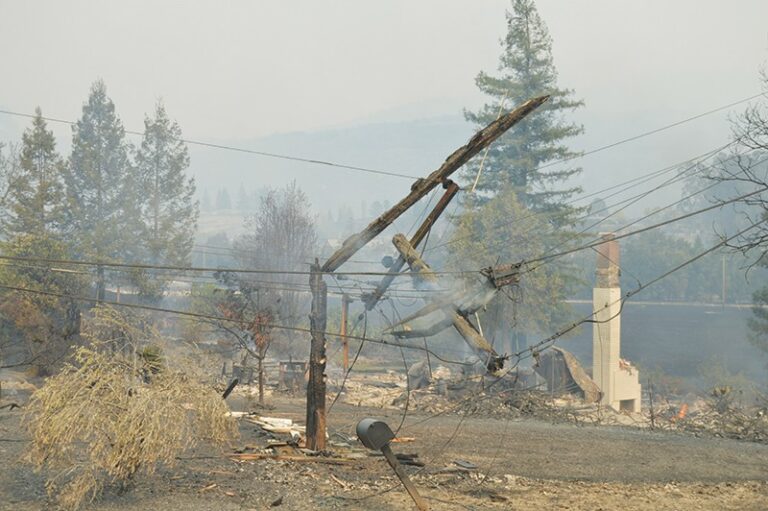
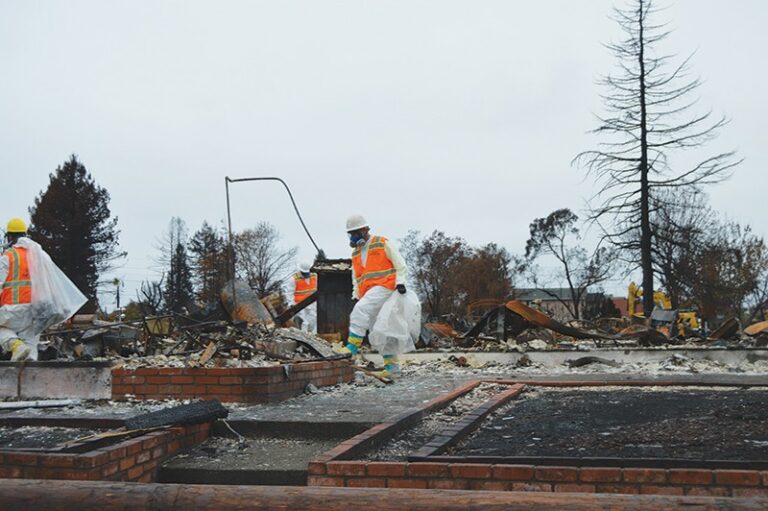
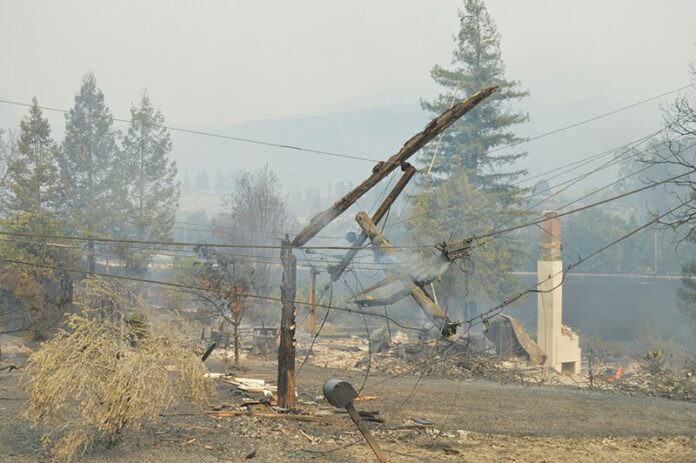
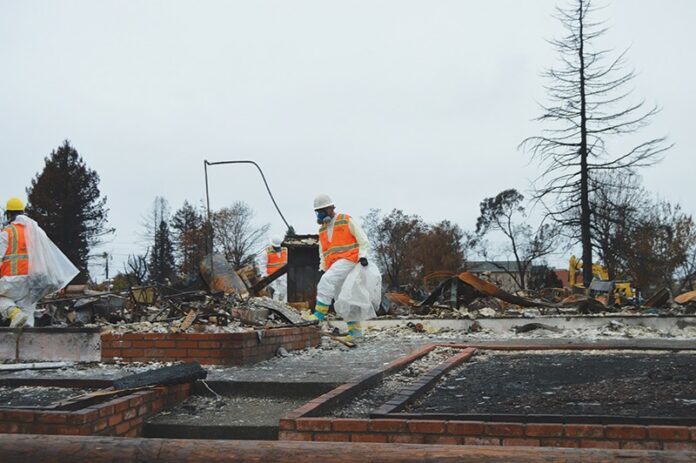
In the wake of the 2017 wildfires, a wave of federal contractors descended on Sonoma County, promising to manage the situation for those recovering from the disaster. It would prove to be the largest wildfire cleanup the federal government had ever managed—but, in many ways, it did not go well.
As the recovery got underway, local politicians told media outlets that they had spotted workers for one company, AshBritt Environmental, operating without proper safety equipment. In January 2018, the same company ceased its debris-removal work for several days while filing complaints against other federal contractors.
In December 2017, an employee of one of AshBritt’s subcontractors was crushed to death by his own truck while working at a Petaluma garbage dump.
A report by KQED published in July last year found that the federal cleanup in the Bay Area was far more expensive per-house than the state-run cleanup after the Thomas fire in 2015.
Meanwhile, AshBritt has been attempting to get more work in the state, in line with the disaster-service company’s time-honored strategy: develop local, state and federal political connections, give money to both political parties, and hope for the best.
In early December 2018, as the cleanup for the Butte County Camp fire got underway, following a U.S. Government Accountability Office report unpacking the federal government’s use of contractors during its response to the 2017 disasters, California officials announced that they would manage the cleanup of the 2018 fires in an effort to solve some of the problems identified in the GAO report.
By the time Governor-elect Gavin Newsom and President Donald Trump met in the wreckage of Paradise in November, both men—or political action committees supporting them—had accepted campaign contributions from AshBritt. A month before the Paradise meet-up, Ashbritt hired Platinum Advisors, the powerhouse Sacramento lobbying firm headed by Darius Anderson, and set out to try and secure the cleanup contracts in Butte County.
But the AshBritt strategy appears not to have worked as it sought to get a piece of the cleanup business in Butte County; AshBritt was rejected for two contracts in this year’s state-run cleanup after submitting high bids, according to a CalRecycle spokesperson.
STILL IN THE RUNNING?
Last Aug. 18, Mark Ghilarducci, director of the California Governor’s Office of Emergency Services (OES), wrote a letter to the U.S. Army Corps of Engineers that detailed the feds’ poor showing in the 2017 cleanup. In Sonoma County alone, he noted, there were “600 reports of over-scraping, 80 additional properties that are so over-excavated a major engineering fix will be required and 260 properties with other damage to septic systems, wells, driveways, and retaining walls.”
The federal government’s 2017 North Bay cleanup cost an average of $280,000 per house compared with $77,000 during the state-managed 2015 Valley fire cleanup, according to an analysis by KQED. AshBritt invoiced the Army Corps for a total of $320,351,681.07 for its work in California from October 2017 through June of 2018, according to federal records.
In December, state officials announced that a state agency would oversee this year’s wildfire cleanup after state and local officials criticized the work of federal contractors during the cleanup effort in the North Bay last year. Ghilarducci also criticized the federal agency for its “egregious oversight” of contractors.
“Given these subcontractors were paid per ton of soil removed, it is probable this over-excavation was an intentional effort to capitalize on this tragedy by defrauding the government,” Ghilarducci wrote.
Ghilarducci’s letter was well-received by Sonoma County Supervisor Shirlee Zane. The letter aligned with the complaints of many fire victims.
“This letter is just awesome, because this is exactly what we were talking about, that these fire survivors were victimized because of the negligence in the hiring of these contractors by the Corps of Engineers,” Zane told the Press Democrat at the time.
In fact, the 2017 cleanup went so poorly that the California officials announced in December that CalRecycle would manage the cleanup of the November 2018 fires instead of the federal government.
HURRICANE KATRINA PARALLELS
The 2017 fires were not the first time AshBritt faced criticism for its work, as the Bohemian has previously reported (See “Fire Wall,” Sept. 18, 2018).
A congressional oversight report about the debris-removal process after Hurricane Katrina swept through the Gulf Coast found that the Army Corps of Engineers awarded no-bid debris-removal contracts to four companies immediately after the hurricane struck.
After receiving federal contracts, the companies went on to set up “contracts with four or more layers of subcontractors collecting a cut, while the people doing the actual work receive pennies on the dollar,” according to the report.
“In addition, there are reports of double-billing for debris, making excess claims based on mileage, receiving payment for ineligible debris, and other fraudulent practices,” the 2006 congressional report states.
The report resulted in a policy change undertaken by the federal government’s disaster-response agencies. Instead of awarding contracts in the wake of disasters, FEMA would now pre-award disaster contracts long in advance of disasters.
The policy change does not appear to have changed the results. Three companies who won contracts after Katrina—AshBritt, ECC and Ceres Environmental Services—were awarded competitive debris-removal contracts in 2014 by the Army Corps of Engineers and were later called on to respond to the 2017 fires by FEMA.
A Dec. 6, 2018, report from the U.S. Government Accountability Office about the use of federal contracts in response to 2017 wildfires and hurricanes found numerous flaws that affected the cleanup process in California.
For instance, federal and state officials had differing expectations about “what structures would be removed from private property and acceptable soil contamination levels,” according to the GAO report.
There were also communication issues identified by the GAO. For instance, state officials were in contact with FEMA officials, but not those in charge of regional contracts, according to the report.
Contractors also exploited a clause in the Army Corps contract allowing them to charge by weight instead of volume.
“While hurricane debris is often priced by volume, [Army Corps] officials stated that the wildfire debris had to be priced by tonnage, and wrapped to prevent contamination,” the GAO report states.
An April 2018 lawsuit brought by a San Francisco law firm alleges that an AshBritt subcontractor, Tate’s Tree Service & Construction, did not pay minimum wage, and failed to compensate employees for lunch breaks, overtime and rest periods, while operating without licenses required to work in California.
AshBritt and Justin Tate, the owner of Tate’s Tree Service, were fined by the Contractors State License Board for operating without the proper licenses, according to KQED. In court filings, lawyers for AshBritt refuted all of the lawsuit’s claims. The case is pending.
The Army Corps will award new debris-removal contracts for its South Pacific Region, the region that covers California, Nevada, Utah, Arizona and New Mexico, in
April 2019, according to the December GAO report.
The Army Corps did not respond to questions about whether the debris-removal contract for the district has been changed in any way to avoid the issues that emerged during the 2017 fire cleanup locally.
[page]
CALIFORNIA CONNECTIONS
In January, AshBritt’s name started surfacing in press coverage of the Butte County fire-recovery process. On Jan. 10, the Sacramento Bee reported that AshBritt’s former CEO, Randall Perkins, had toured the area in search of work. Ten days later, when PG&E announced plans to file for bankruptcy, AshBritt halted its tree-removal work for the utility, according to a report in the Chico Enterprise-Record.
By early 2019, the embattled utility and the disaster recovery had both hired Platinum Advisors, whose founder, Darius Anderson, is also the founder of Rebuild North Bay, the principal in Kenwood Investments and the managing partner of Sonoma Media Investments, which owns the Press Democrat and numerous other publications in the North Bay.
In the new year, state officials have apparently distanced themselves from the cleanup challenges from 2018, if not from Ghilarducci’s letter to the Army Corps. At a Jan. 10 community event in Butte County, Eric Lamoureux, deputy director at OES, downplayed the damage done via the federal debris removal contractors in Sonoma County
last year.
Lamoureux sought to “counter rumors heard that crews left big holes in last year’s Bay Area fire cleanups,” according to the Chico Enterprise-Record. Lamoureux’s account differed significantly from the letter sent by his boss Ghilarducci, to the Army Corps of Engineers just five months earlier.
For its part, AshBritt enhanced its political contributions and charitable donations at the local, state and federal levels after the criticisms against it surfaced late last year.
In October 2018, AshBritt hired Ballard Partners, a lobbying firm known for its close relationship to President Donald Trump. Earlier in the year, the company contributed $500,000 to America First Action, a Trump-supporting political action committee.
In California, AshBritt’s former CEO Randall Perkins contributed $250,000 to the California Democratic Party; current CEO Brittney Perkins donated $29,200 to Gavin Newsom’s campaign in the final months of the state elections, as first reported by KQED. And at the local level, the company has an ally in a local newspaper investor and lobbyist. In October, AshBritt hired Platinum Advisors for representation in Sacramento (according to a state disclosure form published in December)
two weeks after telling the Bohemian that it had no connection to Anderson. AshBritt paid Platinum Advisors $60,000 for its services between Oct. 1 and
Dec. 31, according to a state disclosure form.
REBUILD NORTH BAY
On Nov. 28, 2017, the Community Foundation Sonoma County hosted a conference called Resilience Convening, to discuss local recovery efforts.
In a panel discussion, Anderson represented the Rebuild North Bay Foundation, the nonprofit he founded in October 2017, meant to bridge the gap between businesses and public interest during the regional fire recovery for six months to five years after the fires.
“This is a public-private partnership,” Anderson told the attendees. “We really believe that if we are going ahead and meeting that ultimate goal of building back greener, cleaner and stronger than before the fires, we have to have our people in the public sector as our partners.”
From the beginning, Rebuild North Bay placed itself at the center of the rebuilding process and brought in James Lee Witt, former FEMA director under President Bill Clinton, to lead the organization. Its honorary board boasts a cross-section of shareholders that has included labor representation, a PG&E official and the wife of a Sonoma County supervisor.
“The majority of the money we need to rebuild our community is going to have to come in partnership with the federal government, the state government and local governments,” Anderson said at the November conference.
Jennifer Gray Thompson, who took over for Witt as the organization’s second director, voiced the need for “a new regional reality,” in an interview with the North Bay Business Journal, which is part of the Sonoma Media Investment portfolio of publications.
A slideshow from the presentation also states Rebuild planned to “partner with the Press Democrat” and pledged to “ensure transparency in the community.”
Rebuild North Bay did not respond to an emailed request for comment. An email sent to Platinum Advisors for comment was not returned.
In the months since the conference, Rebuild and Anderson have made the news a few times, but the news hasn’t always made it into the pages of the Press Democrat.
For example, in March, the Bohemian reported that Platinum Advisors took on PG&E as a client just days before state legislators began to consider new legislation to regulate the utility. Steven Malnight, senior vice president for strategy and policy at PG&E, serves on Rebuild North Bay’s board of directors.
Steve Falk, the Press Democrat‘s publisher, told the San Francisco Chronicle last August that Anderson is not involved in newsroom decisions.
[page]
“We have made that line absolutely clear in the sand—and not a single investor [in the Press Democrat] or Darius has stepped over that line once,” Falk told the Chronicle.
But there’s been notable absence of critical coverage of AshBritt in Anderson’s papers in the months since the company hired Platinum Advisors in October. The paper has covered several local press-friendly events sponsored by AshBritt. In early November, for example, AshBritt sponsored a North Bay Business Journal conference about the cleanup process.
The conference was covered in the Journal and the Press Democrat, but neither paper mentioned the complaints about AshBritt’s work in the county (which the Press Democrat had previously covered).
The paper did not mention allegations of possible fraud by federal contractors mentioned in Ghilarducci’s letter to the Army Corps. It did not mention AshBritt’s role in over-excavating local lots, or the December 2017 death of a truck driver hired by an AshBritt subcontractor (an event that the Press Democrat reported on at the time).
The company also contributed $450,000 to construct walls in Coffey Park in partnership with the Rebuild North Bay Foundation, according to the Press Democrat. Rebuild’s website says the project cost $650,000.
The Press Democrat’s coverage of a Nov. 8 ribbon-cutting event featured a photograph of Supervisor James Gore helping to knock the old Coffey Park wall, but failed to mention that Anderson’s firm had by then started to lobby for the company, or that Gore’s wife, Elizabeth, is on the board of Rebuild North Bay.
In response to a Bohemian article about the wall published last September, AshBritt’s then–general counsel Jared Moskowitz said “the suggestion that AshBritt made the donation because of some connection to Darius Anderson is unequivocally false.” Two weeks later, AshBritt hired Anderson’s lobbying firm to represent its interests in Sacramento.
Moskowitz, who served in the Florida House of Representatives as a Democrat when he talked to the Bohemian, was selected to lead the Florida Division of Emergency Management in December 2018.
For the past several months, the Press Democrat has also published a series of special sections on the recovery process titled “Rebuild North Bay.” The sections do not directly mention a partnership with the nonprofit of the same name, but those stories do occasionally mention the nonprofit and include the obligatory mention of Anderson’s ownership stake in the Press Democrat.
Given Anderson’s multiple intersecting interests in California business and politics, Platinum Advisors appeared well-positioned to provide AshBritt with the connections it needed to get more work in California. But it was not to be.
PUBLIC-PRIVATE PARTNERSHIPS
Shortly after founding Rebuild North Bay, Anderson announced the organization’s first hire. Witt was recruited to lead the nonprofit for several months in the hope of connecting local governments with federal disaster response money. At the time, the Bohemian was the only paper in town to highlight Witt’s numerous business interests in the so-called “disaster capitalism” economy.
Witt left Rebuild in early 2018. At the Global Climate Action Summit in September, Supervisor James Gore and Witt gave separate speeches at the same event about the need for “climate resilience” in the coming years.
In his speech, Witt, who has worked as a lobbyist and consultant since leaving FEMA in 2001, announced a partnership with the National Association of Counties called Project Impact 2.
“In early 2019, Project Impact 2 will launch—this time backed by the private sector. This project is a nationwide campaign with the goal of engaging community leaders and the public to tackle future impacts of increasingly frequent and severe weather events and climate change,” Witt wrote in a Nov. 30 op-ed online at msn.com.
Gore’s wife, Elizabeth Gore, serves as president of Rebuild North Bay Foundation’s board of directors.
Gore says he has served as the board chair of the National Association of Counties Resilience Committee since January 2017.
“I met Witt immediately after our fires, but since we as a county had no formal relationship with his firm, I did not work with him,” says Gore, adding that he had a few phone calls with Witt before the Global Climate Action Summit about a possible partnership between the Resiliency Committee and Witt.
“We had a few calls, were interested in the concept, announced a potential partnership at the summit, but ultimately no true partnership was formed,” Gore says.
A spokesperson at the National Organization of Counties says that the organization is still “evaluating how best to advance the concept [of Project Impact 2].”
On Jan. 8, Gore voted along with three other supervisors—Shirlee Zane was not at the meeting—to make Rebuild a fiscal agent for block captain programs in Zane’s district.
“The District 3 block captain group needed a legal entity to act as a fiscal agent to be able to receive the [county] grant funds for the community engagement activities they are going to pursue,” says county spokesperson Briana Khan of the contract.
“Most fiscal agents charge an administrative fee for fund management, but Rebuild North Bay offered to waive fees,” adds Khan.
The supervisor’s vote does not meet state standards for a conflict of interest since Elizabeth Gore’s position on the Rebuild’s board is unpaid, according to Sonoma County Counsel Bruce Goldstein.
Anderson is now listed as Rebuild’s Immediate Past Board President on the nonprofit’s website. Late last year, the Bohemian reported on a multimillion-dollar fraud settlement with the Graton Casino that looped in another of his entities, Kenwood Investments.
Along with his work for Rebuild, Witt also has connections with AshBritt. He has worked on many projects with the company. An AshBritt spokesperson told the Bohemian in September that the company had never worked for or hired Witt, but that AshBritt has been monitored by Witt’s company, Witt O’Brien’s, “dozens of times” in other disaster-recovery efforts.
However, Witt Associates—the consulting company Witt founded after leaving FEMA—and AshBritt are named as partners on the disaster-removal contract with Alameda County signed in 2011.
Under that contract, Witt Associates would use its proprietary software, WittTrak, to track AshBritt’s expenditures and draw up the documents required to file for FEMA reimbursements, among other roles.
“Witt Associates, Inc. consults on public safety and crisis management, with experience in emergency management, from preparedness and mitigation through response and recovery,” an Alameda County staff report from the time states.
The disaster-response world is a small one, and Witt’s consulting companies are well placed in it, largely due to Witt’s experience at FEMA and his political connections.
For instance, some familiar names advised the Little Hoover Commission, a body described online as “California’s Independent Oversight Agency,” in the creation of an April 2006 report on the state’s disaster-response plans.
Ghilarducci, who went on to become the director of Cal OES under Gov. Jerry Brown and now Gavin Newsom, worked as the director of Western States Regional Office of James Lee Witt Associates, according to a list of witnesses interviewed for the report. According to Witt’s 2002 biography, Stronger in the Broken Places, Ghilarducci also worked for Witt at FEMA following the Oklahoma City bombing in 1995.
In his capacity as head of Rebuild North Bay, Witt acted as a liaison between Cal OES and other disaster response agencies, according to an interview he gave to the Press Democrat in 2017 that failed to provide any detail on his numerous outside business interests.
Representatives for Witt and Cal OES did not respond to requests for comment on the relationship between the two men.
Also listed in the report is Leon Panetta, the chief of staff to Clinton who later became Secretary of Defense in the Obama administration. In a 2017 interview with the San Francisco Business Times, Anderson said that he had hired Witt to lead Rebuild North Bay on the recommendation of Panetta.
Last June, the Santa Rosa City Council approved an $88,000 contract for Witt O’Brien’s—a company that resulted from a merger between Witt Associates and another company—to complete an after-action report for the fire department. James Lee Witt is no longer associated with Witt O’Brien’s, according to the website of Witt Global Partners.
PREEXISTING CONTRACTS
AshBritt has a longer history in the Bay Area than first meets the eye.
In September 2014, the Sonoma County Board of Supervisors approved a contract with AshBritt, as an extension of a contract the company signed with Alameda County in 2011.
The contract with AshBritt is known as a “turnkey contractor” for its ability to give full-service response and immediate enhanced access to federal disaster response dollars. It’s meant to provide peace of mind to local governments who lack the resources to plan and implement a disaster response plan on their own.
Politically connected contractors are also necessary to navigate the state and federal bureaucracies and extract as much recovery funding as possible.
“The process of recovering funds from FEMA is highly complex with frequent rule changes, and one in which errors can cost local governments millions,” Alameda County staff advised the county’s board of supervisors in 2011 before signing the contract with AshBritt.
Alameda and Sonoma counties have both extended their contracts with AshBritt until July 31, 2021—but the county’s contract was not in effect during the county’s recovery from the fires, according to Michael Gossman, a deputy county administrator in charge of the Office of Recovery and Resiliency..
“There was never an obligation to use the contract, and so termination never came up,” explains Gossman. “As part of the federal assistance provided, the U.S. Army Corps of Engineers procured work from the contractors the federal government selected, including AshBritt.”