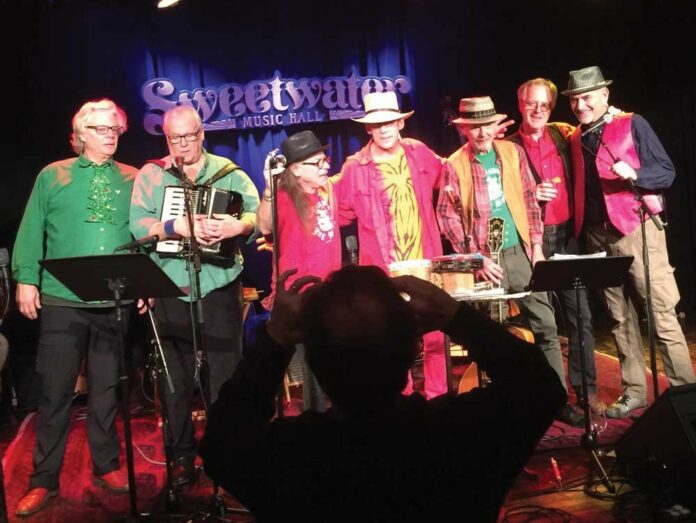
Solid Gold

The spice, sweetness and sadness of life is keener now in the 4K restoration of two of Les Blank’s documentaries, Chulas Fronteras (“Beloved [or beautiful] Borderlands;” 1976) and the shorter follow up Del Mero Corazon (“Straight from the Heart;” 1979). It’s part of the irreplaceable work of a trio of East Bay filmmakers: the late director Les Blank, co-director Chris Strachwitz, and Maureen Gosling.

These collaborators were the heir to Alan Lomax and others who travelled from the swamps to the mountains. The trio worked on about a dozen films on ethnographic music, each one a treasure that preserved sounds being muscled out by monolithic American pop culture.

Chulas Fronteras shows the team at their best, touring the Rio Grande Valley in the years before los narcos fouled it. The film gives eloquent translation to the lyrics of conjunto trios playing at events as formal as a 50th wedding anniversary and as colloquial as a backyard barbecue. They were there at the right time to film aging legends such as “Flaco” Jimenez, Lydia Mendoza and the one and only “Hurican del Valle,” Narciso Martinez. (Meanwhile, the film promoted musicians for a new audience, as Strachwitz reissued their work and sold it out of his Down Home Music store in fogbound El Cerrito.)

Despite the exuberance of the beat, Chulas Fronteras doesn’t neglect the political side of life. Key to this film is the problem of crossing a line that, as Octavio Paz wrote, is not a border, but a scar. This diaspora culture is shown in Grapes of Wrath-worthy detail. We hear El Pinguinos del Norte play their ballad about Cesar Chavez, against documentary footage of the all-ages stoop labor in the potato and onion patches.

Later, the DJ at the Tamaulipas based XEOR, whose show “Chulas Fronteras” gave the film its title, spins a 45 corrido. It’s all about the beating that the state police gave a pair of UFW labor organizers in 1967 at a strike of melon-pickers trying to get more than 25 cents an hour in wages.

Like The River and the Wall, about the borderlands that administration proposes to maim with their wasteful and stupid wall, Chulas Fronteras is a film we need now more than ever.

‘Chulas Fronteras’ and ‘Del Mero Corazón’ open on Friday, Sep 27, at Rialto Cinemas in Sebastopol. Sunday, Sep 29, screening at 1pm includes Q&A with Maureen Gosling, Chris Strachwitz and other special guests. rialtocinemas.com.

Truckin’ Tasty

0

I know the press release is not supposed to be part of the story. But when I looked back at the emails I received about Clif Family Winery’s bruschetteria food truck and the invitations to sample, taste and dine there, and I compared them to the time it took me to actually get over there and sample said food-truck food, I had the nagging thought: how could this not be part of the story?

The story about press agents courting freelance food-and-wine writers isn’t exactly a gritty exposé of how the sausage is made. We’re a free-range lot, after all, and generally treated humanely, if not certified as such. But it generally boils down to offers of free food and wine in connection with something new and unique, in a world of similarly unique enterprises. Free food and wine—what’s the delay? The reality is that each offering’s utility must be weighed against its cost in gas to get there. And back. On a writer’s pay, that’s not being cheap—that’s triage.

So, I missed the Clif Family bruschetteria’s “celebratory media and industry launch party” in August, 2014. And in 2015, I couldn’t make it to the media lunch with the winemaker. And on it went. Was it bad timing, or was it my bias concerning the truck’s principle product, bruschetta? Isn’t that Italian for “pizza toast?”

Nothing against pizza toast, it’s quick and easy. Put your pasta sauce on your bread, sprinkle on the parm and we’re snacking good. All ya gotta do to get a little wine country flair is sub diced tomatoes and drizzle with olive oil—”extra vergine,” of course, which 60 Minutes has informed me is Italian for “super fraudulent,” or “somewhat adulterated,” depending on the dialect.

When Clif Family added a “Farm Feast” option to the menu at their St. Helena Velo Vino tasting room, it was a bit more enticing—more so than, say, “farm to toaster oven.” But, thankless wretch that I am, I didn’t bother to pop in for a nosh until I happened to pass through town one day around lunchtime. What a nosh I was in for.

I always like stopping in at the Clif Family Winery tasting room, just south of St. Helena’s downtown. They’re road cycling–positive, since cofounders Kit Crawford and Gary Erickson (founder of the Clif Bar snack food company) are big fans of the sport, and while the staff is generally prompt and professional, there’s also something a wee more endearingly wine-geeky and real about the young folks there than in some other valley locales.

Some useful facts about Farm Feast: The experience is priced at $75 per person, which seems high until you consider that if you’d lunched at a nearby restaurant instead, $75 would hardly net you a middling wine, let alone any grub. The Clif team starts your lunch slow and easy, with a pour of Sauvignon Blanc, followed by a rosé and an appetizer of arancini, and maybe dukkah—an herb and nut mix they seem particularly proud of. Then there’s a hearty, fresh fagioli e grano salad, which includes farro grain and garbanzo beans grown on Clif Family’s CCOF certified organic farm on Howell Mountain.

They had me at homegrown farro, but farm-to-table garbanzo beans? Who in hell, or more specifically, the world-famous Napa Valley wine region, grows, processes and then serves up house-sourced garbanzo beans—those chunky, wan legumes I’ve never witnessed very far from a tin can, and generally smelling as such? And, why?

Let’s be honest. A similarly situated row of Cabernet Sauvignon on Howell Mountain would probably net about 10 grand on the open market—or something like that. So what’s with the lowly chickpeas? Are the Clif folks putting me on here—flaunting their energy-bar-derived riches, and laughing all the way to the banca?

I wished to talk to the chef, to explain this outrage. Just about then, Clif Family’s affable Executive Chef John McConnell appeared to check on my progress. McConnell explained that the farm team has freedom to experiment, save seeds, collect obscure ingredients like fennel pollen—which is dusted on one of the dishes—and design seasonal, and harvest-specific, menus to match the produce—including vegetables, fruits and herbs—in peak ripeness at any specific time of the year. Crazy as it may sound, I have to say the garbanzos, although saved and dried from the previous harvest, were the best-tasting chickpeas I’ve ever encountered.

McConnell has headed up the food truck since its inception in 2014, and he’s still its biggest fan—you can follow him on Twitter at, get this, jmac_onwheels. It’s more than a food truck; in reality, there’s another kitchen around the corner from the tasting room. Besides sourcing farm-raised ingredients accessorized with meats from quality sources, some organic, McConnell sources his back-of-the-house expertise locally, bringing in graduates from the Culinary Institute of America at Greystone.

At last, the signature dish arrives; bruschette fungi, available à la carte at the truck for $14. It’s much, much more than a pizza toast, after all. Rich, savory and a meal by itself, it’s a fungi on wheels.

Keep It Clean

0

It’s not as cool to get smashed in public today as it was with the older generations,” says musician Kegan Stedwell, who admits she’s been on both sides of that scenario. “Sure, plenty of people still do it, but there’s definitely a movement of younger folks who are interested in having fun without the drugs and alcohol. Smashed is simply not a look that a lot of young people are going for these days.”

Stedwell, a lead singer with the Marin-based, Northern California soul-collective Venus in Scorpio, will perform this Saturday, Sept. 28, at RockSoberFest at the Sonoma-Marin Fairgrounds. The alcohol-free, multi-performer music event—versions of which have already rocked Mendocino County and Marin County—is the brainchild of Marin County’s Jeffrey Trotter, who decided sobriety shouldn’t come between him and his love of music and dancing.

The Petaluma extravaganza features performances by North Bay rock legend John Allair, a longtime keyboardist with Van Morrison. Allair—exuberantly praised for his high-energy, pulse-and-key-pounding, boogie-woogie blues performances—will perform with Julia Harrell. Also on the bill is the surf-punk band The Happys, Americana singer-songwriter Paul Hayward, acoustic-rocker Tyler Allen, John and Camilla Ford, Angel Amador and the Petaluma-based blues band No Account.

“This is one very eclectic lineup,” says Stedwell, who describes her own band as a theatrical musical showcase of great soul tunes, served up with plenty of razzle-dazzle. “We make our shows very entertaining, and if that means two or three costume changes in the course of a one-hour set, then we are all about doing that.”

In addition to the music, there will be food trucks and other vendors exhibiting wares and information, with the emphasis on enjoying beautiful music in an environment where the buzz comes from good company, high energy and great tunes. According to Stedwell, RockSoberFest is a great idea, and one that’s been a long time coming.

“When I was a kid,” Stedwell says, “going places where the adults were all drinking and getting hammered was normal. But times are changing, and I think that’s a good change.” There’s definitely a kind of rebellion taking place, she believes, what with the Sober Curious movement and the rise of intentional sober breaks. “Today,” she says, “some people are actually growing up to think that maybe alcohol poisoning is not a reasonable way to initiate our youth. That’s a beautiful thing.”

RockSoberFest takes place Saturday, Sept. 28 at the Sonoma-Marin Fairgrounds, 175 Fairgrounds Dr., Petaluma. AA meeting at 1pm. Music and dancing 2–9pm. Tickets $10–22. Rocksoberfest.org.

Exhale

Amid a growing crisis over emerging health impacts associated with “vaping” technology, Gov. Gavin Newsom last week announced a big crackdown to confront what he’s calling the “youth vaping epidemic.” The effort is mostly directed at stemming the tide of flavored e-cigarettes and flavored cigarette oils, but the vaping scandal has reached into the burgeoning California cannabis economy as well.

Newsom, who helped usher cannabis legalization into California under Jerry Brown, issued a three-pronged executive order last week to beat back an unexpected development in the state’s nascent legal-cannabis industry: several people have died around the country from lung conditions said to emerge from overdoing it with the vape pen.

Out the gate, Newsom ordered the California Department of Public Health to spend $20 million on a public-relations campaign targeted at keeping kids away from tobacco and cannabis products until they’re of-age, with an emphasis on vaping.

The convergence of weed and tobacco products and the recent spate of deaths prompted the move by Newsom. The state was already dealing with an e-cigarette phenomenon with flavored tobacco products driving concerns over youth smoking when reports started to pop a few weeks ago about mysterious lung ailments associated with vaping cannabis products. Moving forward, Newsom has directed the Department of Tax and Fee Administration to crack down on counterfeit vaping products associated with tobacco, and set a new tax scheme based on the nicotine content of legal e-cigs.

He also ordered the CDPH to come up with a plan to keep vaping products out of the hands of the under-21 set. That will include, according to his executive order, warning signs in stores that sell vaping products that would highlight the health risks now associated with the practice. Newsom’s given the agency until mid-October to come up with new recommendations on the dangers-of-vaping signage that will now join the ironic signage in North Bay medical dispensaries which warn that cannabis can give you cancer.

In a statement Newsom highlighted his especial concern about this issue, given that he’s a parent. He said he understood the anxiety faced by parents when their kids start puffing away on flavored tobacco products, especially given “mysterious lung illnesses and deaths on the rise,” that are now associated with vaping technology.

Into the Flow

I ‌seldom rant publically when I am feeling high on life. But, as a devout sleuth regarding the mysteries of peak periods, and seeing as the past two days showered me with unexpected gifts, a positive rant is overdue.

Background: I’d been stewing for months over the erratic pay habits of two of my employers; one a large corporation, the other a local small-business owner. And while I’ve survived four decades as an “indie contractor” on “verbal agreements,” when money isn’t forthcoming I can slip into self-doubt or blaming.

Fortunately, my life skills include mindfulness and a few coyote-medicine tricks to re-enter more empowering states. During Thursday’s morning meditation, I managed to let go of trying to control or micro-manage the situation, and spent my day appreciating what WAS working all around me.

That afternoon, after coaching a young client in L.A. about his lack of money flow, I found in my mailbox a hand-delivered envelope with all the back pay owed by the local employer. An hour later came an unexpected resolution to returning a cushion I’d bought online: an offer from their customer service department to keep the item, along with a store credit for the amount of my purchase. An unbelievably generous offer!

I’m still on a roll. Doors are literally and figuratively opening for me. At the bank and the library, I’m keenly aware of each “Have a good day” greeting; even the worker at a self-bussing restaurant who took my tray for me; and my friend whose birthday we were celebrating over lunch. She, too, is having a week of sweet flow and gratitude.

Minutes ago an old friend I’ve wanted to reconnect with for ages sent me a message asking if I wanted to catch up this weekend. A lucky coincidence? Nah. My so-called luck turns on whenever I focus on appreciating my life, and then I experience everything from small wonders to amazing synchronicities. When I allow my ‘good’ to flow to me and through me; when I let go of resisting, and embrace the Play of my Moments—Life can be so good.

Marcia Singer, MSW, is a healing artist and performer and mentors stress reduction and self-fulfillment locally, in L.A.—and Denmark! Contact her Love Arts Foundation online. We welcome your contribution. To have your topical essay of 350 words considered for publication, write op*****@******an.com.

Threet Street

I appreciate the attention the Bohemian is giving to what looks like a dedicated effort to eviscerate our hard-won Independent Office of Law Enforcement Review and Outreach and its Community Advisory Council. Both were established in 2016 after the tragic shooting death of 13-year-old Andy Lopez by Deputy Erick Gelhaus. (“IOLERO Review,” 9/18]

Recent maneuvers by the current director, Karlene Navarro, strike a note of alarm in the hearts of people who fought hard for the creation of this office and who have closely followed its activities since inception.

Your piece states correctly that the Sheriff’s Office claimed that the original Director, Jerry Threet, was “biased against police and policing.” What wasn’t mentioned, however, is that Sheriff Rob Giordano said nothing of the sort when Threet delivered his first Annual Report to the Board of Supervisors. In fact, he publicly supported Threet’s work at that hearing. But when the second year of audits revealed many more deficiencies in the Sheriff’s investigations of employee misconduct, Giordano did an about-face and launched a full frontal attack against Threet.

It is ironic that Threet carried out his duties with integrity and neutrality, and now only time will tell how his successor stacks up on the neutrality scale. Our current Sheriff, Mark Essick, vigorously supported IOLERO and CAC during his election campaign, but since his election he now says that he wants to ditch both and favors replacing them with one-off contract audits. He enthusiastically supported Navarro’s appointment.

Perhaps some people are banking on the possibility that the community has forgotten all about Andy Lopez. They are dead wrong.

Founding member,
Police Brutality Coalition

Santa Rosa

My questions about Karlene Navarro’s proposed ordinance to change the mission of her office (IOLERO and CAC) were not as represented in “IOLERO Review.” While I am concerned about how IOLERO’s mission will continue under Navarro, my principal concern is why she has changed it with so little experience on the job. I believe that’s the crux of the story.

What I asked was, “Why would Essick, who ran his campaign for Sheriff on his support for IOLERO and community involvement, want to see a change of ‘perspective’? And why would Navarro, with no involvement in the issues which brought us to this moment and with only six months on the job, ignore the duties of her job and work so hard to reverse the policies of the Board-created task force? We and the Supervisors should be seeking the answers to those questions.”

My concern is with power—who wields it, what they do with it, and why and whether it benefits the public or the powerful (in this case, the Sheriff’s Office).

Santa Rosa

Write to us at le*****@******an.com.

Classic Thrills

0

Halloween comes early to North Bay stages with two productions more commonly seen around that particular holiday. Monte Rio’s Curtain Call Theatre recreates The Haunting of Hill House through Sept. 28, while Healdsburg’s Raven Players present the serial-killing comedy Arsenic and Old Lace through Sept. 29.

Many people, including Steven King, consider Shirley Jackson’s 1958 novel The Haunting of Hill House one of the finest horror novels ever written. Adapted for film twice (and currently a Netflix series), F. Andrew Leslie adapted it for the stage in 1964.

Curtain Call’s previous genre production (Dracula) suffered from a leaden script. This time, uneven performances are problematic. Casting often poses a challenge for smaller community theaters, and this West County troupe is no exception. Where they excel is with scenic design. They somehow manage to fit really interesting sets onto their tiny hall stage and also provide effective technical elements. Here, they successfully create an atmosphere of fear and suspense through lighting, sound and special effects.

It’s an earnest production—good for at least a shiver or two.

Rating (out of 5):★★½

Joseph Kesselring’s tale of the Brewster sisters and their proclivity for poisoning lonely, old gentlemen has pleased audiences for over 75 years. The popular 1944 film-adaptation, directed by Frank Capra and starring Cary Grant as nephew Mortimer Brewster, contains what most film aficionados (and Grant himself) consider the debonair star’s worst performance.

Unfortunately, Michael Hunter appears to base his interpretation of the role on that performance. The eye-popping, face-mugging approach to the character didn’t work on film, and it doesn’t work on stage.

Other performances in this Joe Gellura-directed production do work; including Rebecca Allington and Priscilla Locke as Abby and Martha Brewster; Sophia Ferar as Mortimer’s girlfriend/fiancé; and Eric Yanez as a play-writing cop on the beat. Steve Cannon is actually a touch Karloff-ian as murderous brother Jonathan Brewster (Boris Karloff originated the role) and the reliable Robert Bauer is amusing as Jonathan’s sidekick Dr. Einstein. Michael Romero is a bit young as Teddy, but his appearances bring much-needed energy to the proceedings.

With dated references and its raison d’être (Karloff) long gone, Arsenic is starting to feel old.

Rating (out of 5):★★★

‘The Haunting of Hill House’ runs through Sept. 28 at the Russian River Hall, 20347 Hwy. 116, Monte Rio. Fri–Sat, 8pm. $15–$50. 707.524.8739.russianriverhall.com

‘Arsenic and Old Lace’ runs through Sept. 29 at the Raven Performing Arts Theater, 115 North St., Healdsburg. Fri–Sat, 8pm; Sun, 2pm. $5–$28. 707.433.6335.raventheater.org.

Grape Crush

0

Bacon fat. Smoked meat. Green olive.” Getting hungry? Be thirsty, instead. That’s winemaker David Ramey describing the classic aromas of wine made from Syrah, a classic grape of the Rhône.

This harvest time of year, the story seems to always be about the same grapes: First, it’s about Pinot Noir that’s been picked for sparkling wine—in July! Last, it’s about Cabernet Sauvignon still hanging on the vines—and rain is on the way! Rarely do we hear about the dozens of other grapes being picked. Recently, sommelier Chris Sawyer hosted an opportunity to get to know some of these varieties a little better at a cozy tasting and seminar at Sebastopol’s Gravenstein Grill.

Winemaker Mick Unti, of Unti Vineyards in Dry Creek Valley, says he discovered the wines of France’s Rhône Valley when he was a student. “And it was cheap!” Similarly, as a student on a tight budget in Paris back in 1979, Ramey kept an eye open for the good stuff, for cheap. “Cheap Bordeaux didn’t taste good. But the wines of the southern Rhône were great—and I could afford it!”

The varietal wines at the tasting included Syrah, some fermented along with a splash of the white grape Viognier in the style of the northern Rhône; Grenache, often blended with Syrah and Mourvedre in the southern Rhône style; and a host of other varieties blended in crisp rosés, whites and reds.

The panel echoed familiar laments about Syrah—rumored to have been tainted by the fast rise and faster fall of cheap Australian Shiraz (the same variety by a different name)—while affirming that producers still in the game are really on their game. Some 2,639 tons of Syrah were crushed in Sonoma County in 2018. Compare that to 34,841 tons of Pinot Noir.

Ramey 2015 Rodger’s Creek Petaluma Gap Syrah ($65) A sweet, spicy note, like hickory smoke, or a hint of nag champa, wafts above savory aromas of black and green olive. No marsupial fruit bomb, like some Shiraz; this is a silky, subtle, grown-up wine with grilled red fruit flavors accented with spice and leather, yet it’s not too rustic—like some Rhône—and is well suited to pairing with autumnal flavors.

Look for more Rhône-style wines at these wineries: ACORN Winery, Amapola Creek Winery, Benovia Winery, CRUX Winery, Dane Cellars, Davis Family Vineyards, Donelan Family Wines, Enkidu Winery, GlenLyon Winery, Jeff Cohn Cellars, Keller Estate, The Larsen Projekt, Lasseter Family Winery, Mengler Family Wines, Miner Family Winery, Muscardini Cellars, Odisea Wine Company, Raft Wines, Scherrer Winery, Winery Sixteen 600, Trentadue Winery and Two Shepherds.

The Profiler

0

Malcolm Gladwell is a complete stranger to me. Sure, I’ve read a few of his past books—The Tipping Point, Outliers, Blink and his latest, Talking to Strangers—and listened to most of the four seasons of his podcast Revisionist History. We recently talked over the phone and had an enlightening conversation about his work. Most of the gatekeepers in the modern media world would now consider me qualified to write a profile of Malcolm Gladwell.

Gladwell himself, however, would not. Because the truth is, I don’t really know him at all.

“I’ve always had a baseline skepticism about journalistic profiles,” Gladwell says. “I always feel they’re overly ambitious. The idea that you can sit down with a stranger and come to a reckoning of who they are, and what motivates them, in a short period of time is just nonsense. It’s just not true.”

Gladwell isn’t singling out journalists here. The conceptual through-line of his new Talking to Strangers: What We Should Know About People We Don’t Know is that we’re all downright terrible at reading people we don’t know—gleaning their true feelings, motives or intentions.

“Journalists are not immune from the mistakes that all of us make, and maybe we ought to be a lot more cautious,” Gladwell says. “I think the best journalists do that. The best work, the most successful profiles, are modest in their aspirations. They aim to focus on a very specific part of the person being profiled, as opposed to a global assessment.”

Misreading
and Writing

Throughout his new book, Gladwell lays out example after example of instances where the misreading of strangers resulted in historically catastrophic consequences. The chapter on Jerry Sandusky and the sex-abuse scandal at Penn State includes a couple of examples of profiles that the writers would probably like to take back, including one from the Philadelphia Inquirer that lays it on thick about a pre-disgraced Sandusky’s “ennobling” qualities. But even here, Gladwell’s point is not to shame the writers. On the contrary, the Sandusky section of the book attempts to build a complex case for why the people around Sandusky didn’t understand what was going on at the time. He argues that the fallout from the case led to misinformed scapegoating, including of Joe Paterno.

“I think Joe Paterno was treated abominably. It was completely wrong to blame him,” Gladwell says. “Having read hundreds of pages of the court transcripts, I don’t think a plausible case could be made that Joe Paterno had any inkling whatsoever of Jerry Sandusky’s activities. He did exactly what he was supposed to do—he notified his superiors immediately and turned the matter over to them. That is what he was supposed to do. I’m quite sympathetic to some of the Penn State people who feel that case was mishandled.”

The Sandusky chapter is perhaps the toughest to analyze, and the easiest to criticize, partially because it’s a very limited discussion of a sprawling topic. Entire books could be written about who knew what, and when, in the Penn State story—and, of course, they have. The titles of these books alone make their vastly different conclusions apparent: Game Over: Jerry Sandusky, Penn State and the Culture of Silence will never be confused for The Most Hated Man in America: Jerry Sandusky and the Rush to Judgment. The latter goes even further than Gladwell, arguing that Sandusky may very well be innocent, and that the same “repressed memory therapy” that spurred the fraudulent “Satanic Panic” in the 1980s played a huge role in the case—but he takes 400 pages to explore this argument, compared to Gladwell’s 35-page chapter.

Campus Conundrum

The Penn State case is far from the only controversial topic Gladwell takes on in Talking With Strangers. In a chapter called “Transparency Case Study: The Fraternity Party,” he uses the 2015 case in which Stanford University student Brock Turner was convicted of three counts of felony sexual assault to examine the problem of alcohol abuse on college campuses.

This would be a dicey proposition by any measure: Turner’s assault of Chanel Miller (who was known at the time as “Emily Doe”; she revealed her real name earlier this month) made national headlines when Santa Clara County judge Aaron Persky ignored prosecutors’ recommendation of a six-year sentence and gave Turner six months in county jail (he ended up serving three) plus three years probation.

Perksy’s assertion that Turner’s lack of a criminal record and his upstanding character warranted a reduced sentence led to the judge’s 2018 recall. The case led to changes in California state law about the definition of rape and the mandatory minimum-sentencing for sexual assault of an unconscious or intoxicated person.

“The People vs. Brock Turner is a case about alcohol,” Gladwell writes. He then proceeds to walk a very fine line in defining what his argument is about (a salient point about a lack of education for young people concerning the dangers of blackout drinking) and what it is not (a denial of the seriousness of Turner’s crime).

Gladwell knows that with both the Sandusky and Turner cases, he’s venturing into territory that’s difficult to write—but also difficult to read.

“I have, after 30 years, an enormous amount of faith in my readers. I know who my readers are, and I know my readers read things carefully. Those chapters both require careful reading,” he says. “I am not blaming the victim in the Brock Turner case. I am making an argument about how we prevent these kinds of things in the future. That’s a subtle point, but I think people who listen to my podcast or read my books are totally fine with subtle points.”

Indeed, fans of Revisionist History will be familiar with other times Gladwell took on topics other writers might consider taboo; for instance, the Brown v. Board of Education episode “Miss Buchanan’s Period Of Adjustment” (possibly the best episode he’s produced), in which he attempted to lay out the problems black teachers faced in the wake of the landmark desegregation ruling, without undermining the importance of the decision itself.

Gladwell says he’s not so much drawn to controversial topics as he feels he should be taking them on at this point in his career.

“I would say that I feel I have an obligation to write about those kinds of things because I can. I’m now in a position—having been a journalist for a long time, and having established a reputation for myself and having a readership—to have the freedom to write about those things. I can take the blow,” he says.

“Sure, people will get upset, but it’s fine. I mean, I can handle that. A 25-year-old journalist starting out would be taking a real risk for their career if they were to approach some of these topics. I think when you’re an established journalist, you have an obligation to go where others can’t or don’t want to.”

‘History’ Lessons

The material Gladwell takes on in Talking to Strangers is not the only parallel to his podcast: The whole book is laid out like an episode of Revisionist History, or perhaps a whole season packed into one book. It starts out with one character—Sandra Bland, an African-American woman from Chicago who was the victim of a bizarre and frankly terrifying traffic stop by a white cop in Houston in 2015—and then threads through other stories before returning to Bland’s story and a fierce indictment of the policing system responsible for it. This is a classic setup for a Revisionist History episode—the aforementioned Brown v. Board of Education episode employed the same structure. And Talking to Strangers is so thoroughly character-driven that it, too, seems the result of a lesson Gladwell learned doing the podcast. Though Revisionist History is perhaps most famous for episodes like 2016’s “Blame Game,” which smashed popular misconceptions about the “unintended acceleration” recalls of Toyota vehicles in 2009, 2010
and 2011, I’ve always found the
best episodes to be the ones
solidly built around characters first, and Gladwell’s trademark data-analysis second.

The author says it’s no accident his latest book is so reminiscent of the podcast, and that Revisionist History has had a “profound impact” on the way he writes books.

“The podcast has been the dominant thing in my life now for four years,” Gladwell says, “and it’s the thing I’m most excited about. It’s been a way to kind of—not re-invent, that’s too strong a word, but learn a whole new skill, and think about storytelling in a whole new way. It absolutely influenced Talking to Strangers.”

The most definitive sign of that influence is the fact that instead of the traditional audiobook, in which he reads the text, he actually created—well, basically a podcast. It includes the audio from his interviews for the book, as well as archival tape that he discusses in the book, and music. And he’s more excited about it than the print version.

“It’s like a six-hour episode of Revisionist History,” he says. “This is an emotional book, and I feel like in some ways the audio book is better than the print book, because you get more. You hear Sandra Bland at the beginning talking about ‘my beautiful kings and queens,’ and she stays with you. And at the end, the whole thing, about the cop and the deposition, [State Trooper Brian] Encinia explaining himself, I have that tape. So you hear him, and it becomes really, really visceral and real.

“And then you’re hearing this Janelle Monae song; she wrote a song about all the police shootings where she names all the victims. So it’s a whole overwhelming experience when you listen to it. I really encourage people to experience the book that way.”

‘Blink’ Again

Gladwell cites a number of examples in his new book about how misplaced confidence in our ability to read other people resulted in disastrous consequences. He discusses Neville Chamberlain’s famous failure to judge Adolf Hitler’s intentions, leading him to foolishly return from Munich waving a piece of paper Hitler had signed, and promising “peace in our time.” He examines how the CIA went for years believing they had faithful spies throughout Cuba, only to discover that every single one of them was a double agent working for Fidel Castro. He explains how truly astonishing the con job Bernie Madoff pulled on his victims really was—all because he managed to create a false aura of sincerity and good intentions. On the flipside, in one of the best chapters for explaining our inability to read the people around us, Gladwell deconstructs how Amanda Knox was convicted of murder not because she was guilty, but because she unintentionally acted guilty.

If all of this talk about perception and the length of time it takes to accurately parse information sounds a lot like Gladwell’s 2005 book Blink, that’s because it is. In fact, Talking to Strangers came out of Gladwell’s belief that Blink, a book about snap judgement, had been widely misunderstood and misinterpreted in the media.

Blink was a fascinating and frustrating experience for me,” he says. “Because Blink was really a cautionary tale about our first impressions. It was a story that began with all the ways they work, and then the latter half of the book was about all the ways that we’re misled by our intuition. That didn’t quite come across.

“So this book first of all zeroes in on a particular kind of first impression, which is the relationship with a stranger. But I really wanted to squarely address what can go wrong, and the consequences of that—just as David and Goliath grew out of Outliers, this book grows out of Blink. With a lot of my books, I write it once, then I sit with it, then I come back and tackle the issue again.”

Ultimately, Talking to Strangers looks at the problem of how we misunderstand strangers from both a macro and micro perspective. It suggests the need for reform in our institutions— policing, the justice system and military-intelligence interrogation policies (the section on the biological reasons for the ineffectiveness of torture is a stunner)—and argues that action is needed to bring the systems of society in line with how our brains really work. But on another, individual level, it also suggests that the “default to truth” principle most of us use in everyday dealings with each other isn’t such a bad thing—even if it can be wrong. The alternative, he suggests, can be much worse.

“Let’s make sure that our institutions and practices conform to who we are,” says Gladwell. “But let’s accept ourselves for who we are, and stop pretending otherwise. We should stop beating ourselves up over our fundamental tendency to trust each other, and instead intelligently adapt to it.”

Hemp It Up

More marijuana is grown in California than anywhere else in the U.S., but 10 states, including Colorado, Kentucky and Oregon, leave California in the dust when it comes to the cultivation of hemp. Still, if Santa Rosa Junior College (SRJC) has a say in the matter, California will emerge as a leading producer, especially since the federal government legalized hemp in the 2018 Farm Bill.

This summer, the SRJC Agriculture Department announced the launch of a hemp program at Shone Farm on the outskirts of Forestville, where farmers still grow marijuana illegally in the woods.

The SRJC program is the only one in the North Bay and the state of California as a whole.

When Sonoma County placed a moratorium on hemp last year, supervisors gave SRJC an exemption. Starting in 2020, students at the college will be able to major in hemp, though nearly an acre is already in the ground and growing quickly, outdoors in direct sunlight and in rich composted soil.

The plants are mostly from female clones, though some are from seeds. Students are already tending the crop and learning about it. Local media have emphasized the cash value of the Shone Farm hemp, but Benjamin Goldstein, the dean of agriculture, says the real value is the information it will yield, not any cash in hand. “The real payoff is student interest,” he says.

On a hot September morning, Goldstein led a tour of the experimental crop, which grows between tall rows of corn. The corn serves as a windbreak and a visual shield against thieves. A sign in the field reads, “SRJC Industrial Hemp Research Project: Not for human consumption. No THC. No street value.” Goldstein reminds those who don’t remember or who have never learned, that hemp and marijuana belong to the same genus and species: cannabis sativa.

The hemp plant—which scientists and horticulturists designate as “cannabis sativa (L)”—and the marijuana plant look, feel and smell the same. The only difference is the THC. To be considered hemp, the plant must contain less than 0.3 percent THC. Only a lab test can tell the difference between the two. “We want to show that hemp can help diversify crops on a farm or dairy,” Goldstein says. “As Luther Burbank pointed out—we can grow everything and anything here, from citrus and apples to potatoes, olives and now hemp.”

Sonoma Agricultural Commissioner Tony Linegar is also pro-hemp and eager for it, and marijuana, to be grown legally. Still, Linegar sees potential problems. “Some farmers might use hemp as a cover to grow marijuana illegally,” he says. “Others, who are against marijuana, might weaponize male hemp plants so that they go to seed and pollinate female marijuana flowers and decrease their market value.”

Forestville grower Joe Munson, better known as “Oaky Joe,” takes a characteristically arch view of the nearby hemp farm. “I think the government is illegal,” he says. A medical marijuana provider for more than 20 years—with a history of compassionate care for HIV/AIDS patients—Munson takes a critical view of all rules, regulations, taxes, government inspectors and anything that smacks of officialdom.

But a little bit of law enforcement will go a long way towards destigmatizing whatever stigma remains around hemp, says Linegar—he wants strict enforcement to prevent fraud and says he’s prepared to stay in office beyond the end of December, when he’s slated to retire, to see the Shone Farm through to harvest.

“I think of the hemp project as my swan song,” he says. “I want to see it through.” For Goldstein, who became SRJC’s dean of agriculture in 2017, this year’s hemp crop marks the beginning of a beautiful relationship. “Our program has helped to bring hemp farmers out of the woods,” he says. “We have the potential to recruit research partners from all over California.”

At the Oct. 12 annual Fall Festival in Forestville, Goldstein and others will talk to the public about the hemp project. Last July, the California Department of Food and Agriculture (CDFA) issued guidelines for municipalities interested in pursuing industrial hemp and noted that municipalities around the state, including Sonoma, Napa and Marin, all have local laws of their own regulating industrial hemp production. Neither Marin nor Napa have embarked on industrial hemp projects of their own.

IOLERO Review

The defanging of Sonoma County’s Independent Office of Law Enforcement Review and Outreach continues apace. Last week the county police-accountability’s new director, Karlene Navarro, presented the Sonoma County Supervisors with a plan to gut her office and severely curtail its scope and mission. Navarro took over the post from Jerry Threet, who left at the end of last year.

As public documents from the county indicate, Threet was viewed by the Sonoma County Sheriff’s Office as being biased against police and policing in his role as the county’s first IOLERO director. Navarro, whose husband is a former prosecutor in District Attorney Jill Ravitch’s office, does not appear to have the same issue when it comes to her biases. She was supported by Sheriff Mark Essick and approved unanimously by the supervisors. On Sept. 10 she presented a raft of proposals to the board that left police-accountability activists breathless. Navarro said the supervisors should move to cut the number of persons on the Community Advisory Committee by half and suggested that the CAC no longer have input on policy recommendations made to IOLERO. She also suggested a cut in the number of CAC meetings. Activists in attendance at the meeting last week noted that Navarro’s recommendations were made without any public meetings—and that the they were foisted on the community just a few days before the scheduled vote.

Thanks to the efforts of Supervisor Lynda Hopkins, the vote was postponed to another day. Hopkins’ 5th District includes the area where Andy Lopez was shot. The 2013 shooting of Lopez by an SCSO deputy gave rise to the creation of the CAC and the IOLERO. Its mission is to track law enforcement investigations and public complaints, and, according to the ordinance that created IOLERO, would “include community education and outreach,” and “conveying feedback from the community on law enforcement issues,” among other tasks.

How will the IOLERO mission continue under Navarro? It remains to be seen, says longtime police-accountability activist Susan Lamont. “We and the supervisors should be seeking the answers to those questions,” she says. The board will take up the Navarro recommendations at a future meeting.

Park-Land Protection

Election Day is coming right up, with its usual array of off-year measures and local ballot initiatives. At issue this year is a big vote in Rohnert Park to protect the town’s open space against the pernicious influence of suburban sprawl.

Rohnert Park voters will cast ballots on Measure B this Nov. 5, a measure that attempts to protect the town’s so-called urban-growth boundary. The Greenbelt Alliance is holding a trio of teach-ins on the measure in advance of election day, on Sept. 25, Oct. 6 and Oct. 10 (see www.greenbelt/rohnert-park.org for more info).

Rohnert Park’s urban-growth boundary was created in 2000 when 71 percent of voters there voted to support limits on growth in the city’s perimeter areas. “The UGB is a line around the city that contains development,” says Greenbelt Alliance’s Teri Shore in a statement. “It has safeguarded Rohnert Park for 20 years and needs to be renewed by the voters to avoid a lapse in protection.”

Dodd on Fire

As fire-safety inspections continue around the region, North Bay State Sen. Bill Dodd has punched out a trio of wildfire safety bills that are expected to get the signature from Gov. Gavin Newsom.

“The height of fire season is approaching,” says Dodd, “which underscores the need for immediate action. We can’t sit back and watch our state burn.”

Indeed we can’t. Dodd’s three bills passed the legislature last week. His SB 190 is pegged at vegetation buffer zones and is particularly keyed in on “defensible space,” a newish buzz-phrase that basically means, keep your property free and clear of debris and stuff that can burn. Dodd notes that homes that maintain 100 feet of defensible space are eight times more likely to survive a fire “than homes without a properly maintained buffer.” SB 109’s goal is to enhance awareness and compliance with vegetation removal. Dodd’s SB 209 is a more “meta” sort of legislative initiative, seeking to create a Wildfire Forecast and Threat Intelligence Integration Center to serve as the state’s “central hub for wildfire forecasting,” with capabilities that include weather forecasting and threat assessment abilities.

Finally, SB 247 obliquely targets PG&E in its crosshairs over the energy provider’s inadequate vegetation-removal policies, which were held to be the culprit in numerous of the 2017–2018 California wildfires. That bill would create a Wildfire Safety Division to conduct audits of vegetation-clearing around utility lines, and end the longstanding practice of self-auditing undertaken by utilities and their contractors.

Is Jared Huffman The Antichrist?

Possibly. But he’s definitely not running for President of the United States in 2020. The North Bay congressman was the recent subject of a feature in the Epoch Times that called Huffman out for his non-belief in God—Huffman’s a humanist and agnostic—and in doing so, ventured that he was one of the numerous Dems to throw his hat into the 2020 ring. Huffman took to Facebook to brush back the errant reporting (since corrected online) and to take a shot at the Trump-supporting Epoch Times for pandering in end-times prognostication and for being supported by a cult.

The sect indicated by Huffman is the Fulang Gong of China, a persecuted minority of anti-Communists, whose adherents often participate in Qi Gong healing practices and movement. The Qi Gong practice is popular regionally and one of its teachers is a woman named Vivienne Verdon-Roe. Before she was a Qi Gong teacher, Verdon Roe was a documentary filmmaker who won an Academy Award in 1986 for a film called Women for America, for the World. Her short documentary took on the spectre of nuclear war, speaking of end-times fixations. Huffman, who founded the Congressional Freethought Caucus, has been in the news a few times recently over his agnosticism. Following his Epoch Times moment, he was subsequently interviewed by the Freethought Matters publication and was asked who his favorite historical “freethinkers” were. According to a social media post from the congressman, he rattled off a few names: Kurt Vonnegut, Thomas Paine—and, praise the Lord!—Jesus Christ himself.

Solid Gold

The spice, sweetness and sadness of life is keener now in the 4K restoration of two of Les Blank's documentaries, Chulas Fronteras ("Beloved Borderlands;" 1976) and the shorter follow up Del Mero Corazon ("Straight from the Heart;" 1979). It's part of the irreplaceable work of a trio of East Bay filmmakers: the late director Les Blank, co-director Chris...

Truckin’ Tasty

I know the press release is not supposed to be part of the story. But when I looked back at the emails I received about Clif Family Winery's bruschetteria food truck and the invitations to sample, taste and dine there, and I compared them to the time it took me to actually get over there and sample said food-truck...

Keep It Clean

It's not as cool to get smashed in public today as it was with the older generations," says musician Kegan Stedwell, who admits she's been on both sides of that scenario. "Sure, plenty of people still do it, but there's definitely a movement of younger folks who are interested in having fun without the drugs and alcohol. Smashed is...

Exhale

Amid a growing crisis over emerging health impacts associated with "vaping" technology, Gov. Gavin Newsom last week announced a big crackdown to confront what he's calling the "youth vaping epidemic." The effort is mostly directed at stemming the tide of flavored e-cigarettes and flavored cigarette oils, but the vaping scandal has reached into the burgeoning California cannabis economy as...

Into the Flow

I ‌seldom rant publically when I am feeling high on life. But, as a devout sleuth regarding the mysteries of peak periods, and seeing as the past two days showered me with unexpected gifts, a positive rant is overdue. Background: I'd been stewing for months over the erratic pay habits of two of my employers; one...

Threet Street

I appreciate the attention the Bohemian is giving to what looks like a dedicated effort to eviscerate our hard-won Independent Office of Law Enforcement Review and Outreach and its Community Advisory Council. Both were established in 2016 after the tragic shooting death of 13-year-old Andy Lopez by Deputy Erick Gelhaus. ("IOLERO Review," 9/18] Recent maneuvers by the current director, Karlene...

Classic Thrills

Halloween comes early to North Bay stages with two productions more commonly seen around that particular holiday. Monte Rio's Curtain Call Theatre recreates The Haunting of Hill House through Sept. 28, while Healdsburg's Raven Players present the serial-killing comedy Arsenic and Old Lace through Sept. 29. Many people, including Steven King, consider Shirley Jackson's 1958 novel The Haunting of Hill...

Grape Crush

Bacon fat. Smoked meat. Green olive." Getting hungry? Be thirsty, instead. That's winemaker David Ramey describing the classic aromas of wine made from Syrah, a classic grape of the Rhône. This harvest time of year, the story seems to always be about the same grapes: First, it's about Pinot Noir that's been picked for sparkling wine—in July! Last, it's about...

The Profiler

Malcolm Gladwell is a complete stranger to me. Sure, I've read a few of his past books—The Tipping Point, Outliers, Blink and his latest, Talking to Strangers—and listened to most of the four seasons of his podcast Revisionist History. We recently talked over the phone and had an enlightening conversation about his work. Most of the gatekeepers in the...

Hemp It Up

More marijuana is grown in California than anywhere else in the U.S., but 10 states, including Colorado, Kentucky and Oregon, leave California in the dust when it comes to the cultivation of hemp. Still, if Santa Rosa Junior College (SRJC) has a say in the matter, California will emerge as a leading producer, especially since the federal government legalized...
11,084FansLike
4,606FollowersFollow
6,928FollowersFollow