Family Brand

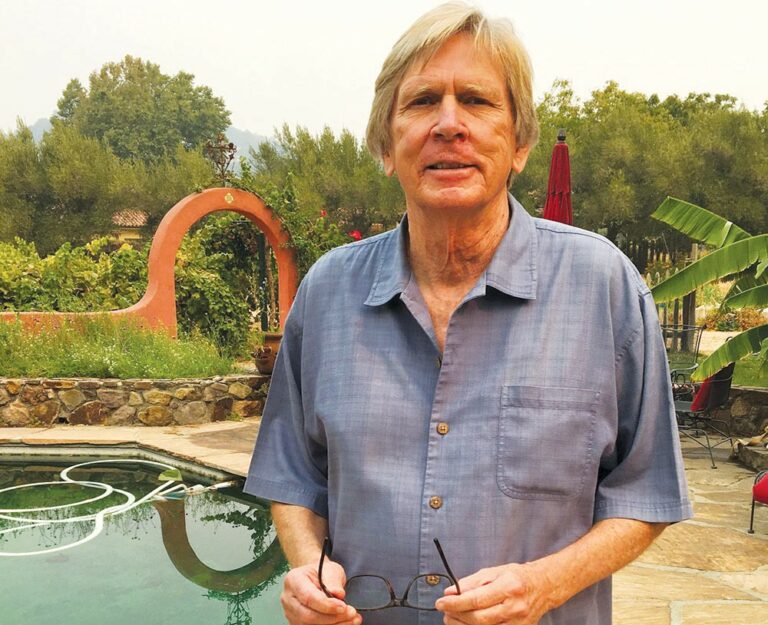
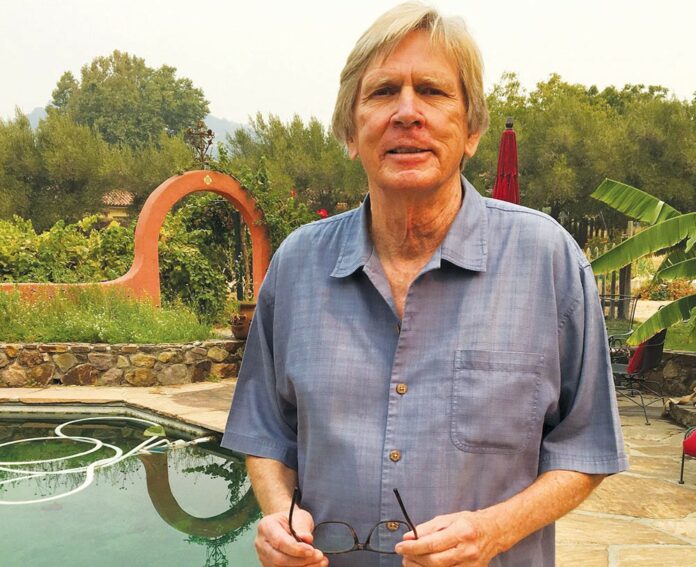
Hans Brand, 53, doesn’t smoke marijuana, but he’s the iconic CEO of an up-and-coming Santa Barbara–based cannabis company, Autumn Brands, that cultivates cannabis in greenhouses— hydroponically and without herbicides, pesticides or any machines. It’s all done by hand.

Born in Holland and a fifth-generation Dutch farmer, Hans came to the U.S at 18 and brought with him the Brand family’s centuries-old sustainable farming practices. His tulips were spectacular, but about five years ago he read the handwriting on the wall and realized that if he wanted to save the farm and provide for his son, Johnny, and his daughter, Hanna, he needed to convert from cut flowers to cannabis.

“We used to grow flowers to look at and now we grow flowers to smoke,” Hanna, 24, tells me on a warm winter day. She’s a Cal Poly graduate and partners with her pal, Autumn Shelton. Hence, Autumn Brands. Hans trained Hanna for sales and marketing, and passed on his farming lore to Johnny.

“Dad can’t retire,” Hanna says. “He’s getting us through the permitting process, running the business daily and he has the final word about all the big stuff.”

One day he might even smoke a joint.

“He’s open-minded,” Hanna says. “He’s learning good stuff about medicinal cannabis.”

The Brands face many of the same hurdles that Sonoma County pot farmers face. Sacramento has not made it easy for the fledgling legal California cannabis industry, especially not for the “legacy” growers who were cultivating on the q.t. before state laws went into effect.

In Santa Barbara, which had some of the richest soil in the state—until malls and housing developments arrived—a mere two-dozen companies have permits to cultivate cannabis. The process can take years.

“The only people who receive permits in a reasonable amount of time are new to the industry,” Hanna says. “We’ve been grandfathered-in so we can grow while we wait. Once a farm receives a permit, the anti-cannabis forces swing into action and appeal.”

Those anti-cannabis forces use many of the same fear tactics that Sonoma County pot foes use.

Autumns Brands is open to the public, but only by special arrangement. Hanna urges visitors to call and make an appointment, and also to stay awhile and enjoy Santa Barbara’s pristine beaches, craft beers, local wines, gourmet foods and eye-popping art. So far, Autumn Brands cannabis is only available in Northern California at Napa dispensary Harvest House.

Jonah Raskin is the author of “Dark Day, Dark Night: A Marijuana Murder Mystery.”

Barbara Baer Launches New Novel in Occidental on Mar. 1

0

Two early-20th century immigrant families, one a group of western pioneers and one a New York–socialite crowd, find their lives suddenly thrown together in Barbara Baer’s new novel, The Ice Palace Waltz. Stanford-educated Baer is the author of three previous novels, and The Ice Palace Waltz is a well-researched and timely tapestry that touches on mining towns and Manhattan speculators. Baer reads from the novel at a book launch event on Sunday, March 1, at Occidental Center for the Arts, 3850 Doris Murphy Court, Occidental. 2pm. Free admission. 707.874.9392.

Sonoma State Hosts Social Justice Week Mar. 2–7

0

Sonoma State University’s Social Justice Week takes the time to engage SSU students and the public in lectures, films, presentations and activities. The week opens on March 2 with a talk and screening featuring Michael Nagler of Metta Center for Nonviolence, a performance by Ballet Folklorico Netzahualcoyotl and more. March 3 includes talks on veterans opposed to war and low-wage workers rising up, and March 4 continues with topics like public banking and killer drones. March 2–7, at Sonoma State University, 1801 E. Cotati Ave., Rohnert Park. Livestream available. Full schedule is at ssusocialjusticeweek.wordpress.com.

Phoenix Rising

0

Revenge Fiction

A decade ago I took a writing workshop in the back of an herbal store in Occidental. Sheltered from the foggy morning inside the cozy, candlelit space, about eight of us gathered around a Dia de los Muertos altar, with our pens and notebooks and steaming cups of tea.

I’d recently met the workshop leader, Dani Burlison, but had no idea what to expect as she passed around a large envelope and instructed us to randomly choose a photo from inside. Our prompt was to write a letter inspired by what we saw, and when I finished reading mine aloud—an apology to a mother and her kids from a guy who wanted to do better—Dani looked awestruck.

“You just conjured my ex-boyfriend Dave,” she said, eyes going wide, “who died two years ago.”

Indeed, I’d referenced purple irises (the very flowers he’d brought her), helping the kids with homework and disappearing on them because of a crippling heroin addiction (check, check). Then I showed her the photo I’d chosen—of Dani and her two kids dressed in black and looking solemn outside of the Phoenix Theater—which, I’d come to find out, she had taken at Dave’s memorial service after the heroin did him in. It was admittedly eerie, and as we burned sage and placed our photos on the altar, I realized that to take a workshop with Dani is to enter a sacred realm where boundaries blur, and anything might happen.

The same can be said of reading her first book of fiction, Some Places Worth Leaving (Tolsun Books, February 2020), a collection of 13 raw, visceral stories loosely based on her own life that take you places you didn’t even know you wanted or needed to go.

“Everything in these stories has happened to some girl or woman, somewhere,” Dani tells me over tacos in her Roseland neighborhood on a chilly Monday afternoon.

The happenings explore the emotional wreckage of assault, abuse and trauma wrought by men—some of them straight-up awful, others just clueless and broken—except that in these stories, many of them don’t get away with it. In fact, one San Francisco writer dubbed this “revenge fiction” in honor of the ways justice gets meted out.

“I feel the satisfaction of taking down the predators and the patriarchy, even if it’s just one story at a time,” Dani says. “I was so tired of the neutrality, of people looking the other way when men behaved badly. I’m spinning my own spells of justice.”

After an editor offered her a deal based on a couple of her stories, she got to work, spending every evening for five months on her couch with her computer, cat and cup of tea to make this book a reality. She knew she might not get another opportunity like this, so she wrote through her impostor syndrome, through the voice that doubted if she could make the leap from nonfiction to fiction.

“The world wouldn’t have cared if I didn’t get these stories written,” she tells me. “But I would have.”

In one of my favorites, “Shark Week,” the narrator heads out to the coast with her “unkind lover” who plans to teach her to surf. But once there, he insists on watching disaster footage and leaves scratches on her neck while she thinks about all the women and girls who go missing: “I thought, too, about … the ways in which we are taken from ourselves. The countless ways women get destroyed or misplaced or lost.” By the end of the story, which does involve a circling fin, the narrator has chosen herself, powerfully illuminating “the ways we manage to escape.”

It’s true—as much as her characters suffer, they also draw strength from loving mothers and grandmothers and friends, they have attuned themselves to the rhythms of nature and ritual, and instead of toppling under the weight of despair, they ultimately move on. As author Dana Johnson comments, Dani “pulls off something miraculous: stories that are devastating and inspiring, stories that are righteous calls for vigilance, tenderness—and fury.” There’s a brutal beauty, a pulsing tension inside her lovely, grounded prose, reminiscent of both Gillian Flynn and the searing story “Heat” by Joyce Carol Oates.

Turns out, fictionalizing her life was liberating. Not only could she detach from the dark subject matter—trigger warnings abound—she could flip the narrative. This is exactly the premise of “It’s a Very Scary Time for Young Men in America,” in which the well-meaning protagonist, Brooke, who’s writing her dissertation about “female privilege and the plight of oppressed men” is forced to confront men’s anger about not being taken as seriously as women, constantly being judged for how they dress and having to teach their sons how not to get preyed upon by girls. The ending involves witchcraft, absinthe and Bloody Mary—a plot full of daring heat, like standing a little too close to a raging bonfire.

The Magic of Rebirth

Growing up government-cheese poor in rural Red Bluff (30 miles south of Redding) as the seventh of nine kids, Dani found solace in the orchards, creeks and fields surrounding her house. She fondly remembers her mother’s veggie garden and the fresh-caught fish her dad brought home for dinner. But after her parents split up and her abusive stepfather moved in, the natural world became even more a means of survival.

“I remember sitting out in the front yard on weekend mornings looking at my mom’s beautiful flowers along the fence—daffodils, blue bonnets, lilacs, black-eyed Susans,” Dani says, surprising us both as tears start spilling down her cheeks. She loved the simple pleasure they brought her, which she now realizes was anything but simple. “Those flowers probably saved my life. There was something so vital about them, about the magic of thriving in nothing but dirt, the magic of rebirth.”

As someone who scores high on the ACE (Adverse Childhood Experiences) test, Dani herself is a paragon of rebirth. After busting out of Red Bluff at 18 she found herself in Los Angeles for a bit before landing in Sonoma County in 1994. She briefly married a guy who made fun of her poetry—”I quit writing for a decade afterwards”—had a baby at age 22 and another at 26, struggled with anxiety and depression, and made it through a few months of homelessness thanks to dear friends and their vacant couches. When Dave, the father of her second child, cleaned out their bank account to buy drugs, she put her last two bucks into her gas tank so she could drive to a food bank and make dinner for her kids that night.

She kept on—channeling her anger into activism through Food Not Bombs and her camaraderie with the disenfranchised into case management with homeless vets. Dani went to Santa Rosa Junior College and New College, funding her master’s degree in humanities by cleaning people’s houses and substitute teaching, all while being a single mom. Through Myspace posts and DIY zines, she found her writing voice again and started an internship at this very newspaper under the tutelage of then-editor Gretchen Giles.

“I told myself I’d give it a year, then I’d get a Ph.D. in anthropology,” Dani says. “But instead, I just kept writing.”

Indeed. Landing a book deal is big for anyone; landing a book deal when you have no agent or MFA, when you can’t even afford to enter book contests—that’s something else. For years, Dani fought her way up through the dirt and made herself into the writer she wanted to be.

“I hustled, researched, networked and took every opportunity, apprenticeship and workshop that I could,” she says.

The result is an impressive range of work that looks both inward and outward—from being celibate for three years and cooking her friend’s placenta for McSweeney’s Internet Tendency to penning a World Watch column for the Chicago Tribune. The Pacific Sun, Los Angeles Review, KQED Arts, various literary journals, The Rumpus, Yes! Magazine, Utne, Hip Mama Magazine—Dani’s words can be found all over.

In 2009 she and former Bohemian staff writer Leilani Clark started offering writing workshops and producing zines as Petals and Bones. Dani also partnered with Napa writer Kara Vernor to co-host the reading and open-mic “Get Lit” series in Petaluma.

“I’ve often felt displaced, on the outside of things,” Dani tells me. “So I just sort of threw together this scrappy writing life. I had to create community myself.”

And she has. People crowd into her living room for her “process” workshops and into a dim “mafia” booth at a whiskey bar on Friday evenings for the salacious fun of Pens and Pints (full disclosure: I am a regular).

Tell Your Stories

These days Dani, energized after a recent breakup, can be found teaching memoir writing to adults through Santa Rosa Junior College and working on a full-length memoir of her own. Speaking of exes: will any of them recognize themselves in her stories?

“Yeah, it’s possible,” she says. I’m reminded of that Anne Lamott quote: “You own everything that happened to you. Tell your stories. If people wanted you to write warmly about them, they should have behaved better.”

Some Places Worth Leaving launches on Saturday, Feb. 29 with a “kind of dark-performance-art-meets-literary-reading” at the Imaginists on Sebastopol Avenue in Santa Rosa. (If you’ve been waiting for the perfect opportunity to wear your black eyeliner and finger spikes, this might be it.)

For everyone who wept or raged (or both) through the Brett Kavanaugh hearings, this book is for you. For anyone who’s ever known this truth—”You wonder if this will be the last of the men who don’t love you or if he’s just one more knot in your string of disappointment”—this book is for you. It’s also for those who sense the redemptive power of nature (most stories take place outside, in forests and deserts, on lakes and beaches) and for those who might need reminding that resilience is in our DNA.

Despite all she’s been through, Dani isn’t bitter. Just the opposite: like her mom’s flowers, like the Naked Ladies that bloom year after year in even the most forgotten cracks of earth, she embodies hope and possibility.

In “My Lady of Coconino County,” the final story in her collection, the narrator’s van breaks down in the Arizona desert as she’s on her way to Arkansas for a fresh start. She’s got two sweaty little kids, hundreds of dollars in van repairs and nowhere to stay. A kind woman offers them a meal, a bathtub and respite from the weary road.

As the narrator reflects back on the experience, she remembers the sound of the air conditioner and the howling coyotes, and ends with this: “I don’t remember if the moon was out, beaming down on nearby Mt. Elden that night, but I like to imagine that it was.”

The Exonerated 5

0

In 1989, police accused five teenagers (four African-American and one Latino) of raping a white woman in Central Park in New York City.

The teens, ages 14–16, were brutally interrogated for over 18 hours until they confessed to the crime and were convicted and sentenced. Shortly thereafter, future U.S. president Donald Trump took out full-page ads in four New York newspapers, including The New York Times, calling for their execution.

Thirteen years later, in 2002, DNA evidence and the subsequent confession from serial rapist Matias Reyes, already in prison, cleared the Central Park 5—Raymond Santana, Kevin D. Richardson, Antron McCray, Yusef Salaam and Korey Wise—of the charges of raping Trisha Meili. But while the law exonerated them, their lives would never be the same. Their experience is only one of many across the United States.

This Thursday, Feb. 20 at 7pm, the last episode of When They See Us, the four-part Netflix series written and directed by director Ava DuVernay (Selma, A Wrinkle In Time) about the Central Park 5 case will show on the big screen at Sonoma State University (SSU). Special guest Kevin Richardson, one of the Central Park 5, now the Exonerated 5, will attend. It is a rare opportunity to hear from Richardson and to see the film on the big screen.

“[Richardson] receives a lot of requests to speak, and I am grateful he chose to join us,” says Mo Phillips, who organized the event for Black History Month at SSU. “Kevin was the youngest of the five young men to be accused, tried and found responsible in this case. He had dreams of playing basketball at Syracuse, played the trumpet, had a strong support system of women surrounding him throughout his life and the case. He continues to struggle daily with the handling of this case, the incarceration and the aftermath. He is married and has kids; he speaks out whenever he can about what happened to them and works with the Innocence Project.”

In 2019, when the Netflix series debuted and brought the story to light again after over a decade after the complete exoneration of the five teens, people asked President Trump to apologize for his call for the boys’ execution. He refused to apologize or even admit he was wrong about them.

Phillips speaks to the experience of racism and subsequent injustices that occurred in this case—and in many other cases—for people of color.

“When I saw the film, it brought up so much for me, as it does for almost everyone I’ve spoken with about it,” he says. “Their story needed to be told and I wanted to get the community talking about issues of injustice, especially towards black and brown members of our communities.”

Last Spring, after Phillips saw When They See Us for the first time, she contacted Mr. Richardson’s agent and asked if he would attend the screening of the mini-series for SSU’s Black History Month.

“I worked with an awesome committee of students, staff and faculty from around campus to plan the month’s events,” she says.

Phillips emphasizes that at the university level in particular, talking about and casting light on all issues of racial injustice is crucial.

“It’s important for us, especially at an institution of higher learning, to engage in the hard conversations and to learn how we can support each other, how we can help to fight for justice and how we can be part of the solution—as our students could be future policy makers, advocates and activists,” she says.

Whether or not one has watched the first three episodes, (available to stream on Netflix) the last episode of When They See Us is relatable, and we need the show’s messages more than ever at this time.

“It shows [the boys] at a point of their most innocent and vulnerable moments and then moves into who they were when they got out of jail/prison and what that experience was like for them.” Phillips says. “I think we can all relate to this, especially right now in our country as we continue to grapple with these same issues.”

Hearing these stories is an important part of creating change. The residents of Sonoma County have a unique chance to hear this story from Richardson’s personal experience as one of the Exonerated Five.

“While we cannot go back in time and effect change, we can effect change moving forward,” Phillips says. “We can affect it by what we do, what we say, what we confront or care about and by how we spend our money, who we vote for, working to change policy, etc. I hope that the attendees [of the screening] get involved in some way, their way, to get off the sidelines and be a part of the solution.”

Kevin D. Richardson

April 19, 1989 started off as a normal day for 14-year-old Kevin D. Richardson, but that night changed the course of his life, and American society, forever. After the brutal attack and sexual assault of jogger Patricia Ellen Meili in Central Park, the New York Police Department rounded up and arrested a total of 10 suspects, including Richardson. Despite there being no DNA and little evidence connecting himself and the four other teens to the crime, Richardson was charged and sentenced to serve five to 10 years in jail. After serving five and a half years for a crime he did not commit, Richardson was put on probation and released from prison.

However, the conviction for the attack remained on his record. In 2002, New York District Attorney Robert Richardson joined forces with the other men falsely convicted and filed a lawsuit for $41 million, which was finally settled in 2014. In 2019, Netflix released When They See Us, a mini-series portraying the famous events of the case. The celebrated and award-winning show has brought the injustices Richardson and the Central Park 5 experienced back into the public’s attention.

Thirty years on, Kevin Richardson is an advocate for criminal justice reform and uses his personal experience with false coercions and unjust convictions to bring about change. He has partnered with the Innocence Project, a nonprofit organization dedicated to exonerating, through DNA testing, wrongfully convicted people.

Corona Road Station Returns to Council

0

The Petaluma City Council is expected to consider a proposed housing development at Corona Road at their Monday, Feb. 24 meeting.

The development, backed by Lomas Partners LLC, a Southern California developer, calls for over 100 single family homes on a property directly agencent to what will someday be Petaluma’s second SMART train station.

Many Petaluma residents have criticized the current proposal as a failure of planning because it does not make adequate use of the fact that the project is located next to a planned train stop.

Approving the current plan will be a wasted opportunity in a time when dense, affordable developments are increasingly crucial to combat climate change and displacement in the Bay Area, opponents of the proposal argue.

The city council’s agenda will be published on Thursday.

Tenants Advocates to Host Event at Petaluma Library

The North Bay Organizing Project (NBOP) and Sonoma County Tenants Union will host an educational forum at the Petaluma Regional Library on Wednesday, Feb. 26 at 6pm.

NBOP describes the event as “an informational workshop to talk with your neighbors, learn about our rights as tenants, new tenant laws, the Sonoma County Tenant Union, and why as renters we should be part of the National Tenant Power Movement.”

Attendees will have a chance to ask questions about new state laws, tenants’ rights and how to join the Sonoma County Tenants Union, a recently-formed group intended to advocate on behalf of renters.

Symphony Hires New Education Manager

The Santa Rosa Symphony has hired Kate Matwychuk to oversee two of the organization’s community education programs: Simply Strings and the Summer Music Academy.

Matwychuk, who grew up in Ontario, Canada, played bassoon in high school before pursuing a career in creative writing and music education in the United States, according to a press release.

“I participated in my city’s youth orchestra and traveled with my own school orchestra and band. Being a musician taught me to be courageous, gave me confidence and opened unexpected doors for me,” Matwychuk said.

Climate Talk in Petaluma

Mary DeMocker, author of The Parents’ Guide to Climate Revolution: 100 Ways to Build a Fossil-Free Future, Raise Empowered Kids, and Still Get a Good Night’s Sleep will offer a public talk from 7 to 8:30 p.m., Monday, Feb 24 at WORK Petaluma, 10 4th Street, Petaluma.

The author, a social justice activist since the 1980s, believes it’s crucial to speak with kids in age-appropriate and empowering ways, but “also important to speak with other adults. Only the ruling generation has the financial, social, and political clout necessary to make the sweeping changes scientists say we need before we pass climate tipping points.”

For more information, visit https://workpetaluma.com/climate-revolution.

Flammable Romance

The two-woman, huntress-gets-captured-by-the-game romance Portrait of a Lady on Fire offers a lot, particularly ravishing color that makes the actresses look like Fragonard paintings, with the spirit of the French revolution waiting in the wings to give the story some yeast. Also seen in director Céline Sciamma’s film is that French precision in defining feelings that makes an encyclopedia of the passions.

Sometime in the latter half of the 1700s, painter Marianne (Noémie Merlant) arrives at an island off Brittany in a rowboat in a rough sea. She shows her spirit right away. When her box of canvases is knocked overboard she jumps in after them, shoes and all. Marianne learned the trade from her artist father, and is on this island to paint Heloise (Adèle Haenel), the daughter of a countess.

But the daughter refuses to pose. The portrait will be sent to a potential husband in Milan who wants a good look at this convent-raised girl, and Heloise doesn’t want to be auctioned off. Heloise also seethes because her elder sister fell or jumped from a seaside cliff, under circumstances that become cloudier the more they’re explained.

The seduction between artist and model is slow and tantalizing, since Marianne must covertly sketch the girl without being discovered. As the portrait progresses, it becomes a painting in which the love between painter and model is unignorable.

On the whole, Sciamma masters the waxing and waning of moods. There’s a rowdy game of slapjack; later Heloise poses with a mirror over her naked loins so that Marianne can see herself reflected, the better to draw a self-portrait.

One takes away Heloise’s tousled hair and rich, bedroom half-smile, and tends to overlook Sciamma’s trouble settling on an ending. There is creeping anachronism here in the style of the paintings themselves, in an irresolute bit about magic mushrooms.

The especially picky could consider the way marriage was looked at among the gentry of the era. In 1700s Italy, there would be no reason why Heloise couldn’t have a female companion, since her husband would most certainly be out with a companion of his own.

‘Portrait of a Lady on Fire’ opens on Feb. 21 at Rialto Cinemas in Sebastopol.

Meaty Matters

0

North Bay ranchers face a new challenge after the owner of the region’s last slaughterhouse announced last year that it will no longer process meat from small, independent producers.

The news comes five years after a Marin County rancher, backed with investment from a Silicon Valley businessman, saved the slaughterhouse from closing.

In February 2014, the United States Department of Agriculture (USDA) announced a recall of 8.7 million pounds of meat processed at a Petaluma slaughterhouse owned and operated by Rancho Feeding Corporation over the previous year.

“[Rancho] processed diseased and unsound animals and carried out these activities without the benefit or full benefit of federal inspection,” a USDA press release from the time states.

The news hit the local food community hard. After decades of consolidation within the meat-processing industry, Rancho operated the last USDA-approved slaughterhouse in the Bay Area, a wealthy region full of health-food fanatics.

In a March 1, 2014 New York Times opinion piece, Nicolette Hahn Niman, the co-owner of Niman Ranch, explained some of the inter-related problems facing the industry.

“From 1979 to 2009, California went from having 70 slaughterhouses to 23,” Niman wrote. “Because it is more complicated and costly to do so, nearly all large facilities refuse to work with smaller farms. This makes slaughtering the most serious bottleneck in the sustainable food chain.”

Shortly after the USDA’s recall announcement, David Evans, the owner of Marin Sun Farms, swooped in to save the slaughterhouse from closure. According to press coverage from the time, Marin Sun Farms received financial backing from Ali Partovi, a Silicon Valley interest who had taken an interest in local agriculture several years earlier.

In April 2011, Patrovi wrote an article for TechCrunch laying out his thoughts on the organic food industry titled “Food Is The New Frontier In Green Tech.”

“Like energy, food and agriculture are big, slow, and highly regulated sectors,” Partovi wrote. “But also like renewable energy, there might be opportunities for innovation and profit in ‘renewable food,’ fueled by consumer preference today and by shifts in policy tomorrow.”

Between 1990 and 2009, the organic-food market in the U.S. grew from $1 billion to $25 billion, Partovi noted in the article.

“The biggest obstacle impeding Marin Sun Farms’ growth today is inadequate capital,” Partovi wrote. “It cannot secure land, water, and animals fast enough to meet the growing demand. This dynamic reminds me of the early days of [the online shoe sales company] Zappos, when Tony Hsieh was desperately seeking capital to secure shoes fast enough to meet the growing demand.”

For almost five years, Marin Sun Farms continued to serve small producers as promised. But last fall, Evans informed independent producers that the slaughterhouse would no longer be able to serve them.

In November, Claire Herminjard, Evans’ wife and business partner, told the Petaluma Argus-Courier that the cannabis industry has caused the company’s labor costs to increase.

Sarah Silva, farm manager at Petaluma’s Green Star Farms, which produces eggs, chickens, pigs, lambs and more, says Marin Sun Farms’ announcement reinvigorated a conversation about finding an alternative solution for small-scale, USDA-approved meat processing.

“This might be a blessing in disguise,” she told the Bohemian.

Silva, the farm manager, says the multifaceted problems facing the local producers are in large part due to an industrial agriculture which has led consumers to expect cheap meat, even if the process used to grow it is environmentally destructive.

The lack of a local slaughterhouse creates yet another problem. Even if producers raise and market their animals in the North Bay, most now need to transport their animals long distances for processing.

Silva says she now has to process a large number of animals once every few months at a distant facility rather than once every few weeks as she did at Marin Sun Farms. That means she has to store large amounts of meat for longer periods of time.

In late January, Silva stopped selling meat at local farmers markets in part because she now spends more time transporting animals for processing. Instead, she has turned towards a community-supported agriculture (CSA) model in which customers subscribe to monthly distributions of food.

While that’s not as convenient for Green Star’s customers, it is now a necessity, Silva says.

Within the agriculture community there is talk of setting up a mobile meat-processing operation. While discussions are in the early stages, there is more momentum than Silva has seen in her 12 years in the local farming community.

Although other communities have set up mobile-processing operations and the USDA seems increasingly receptive to the idea, the local discussions are still in the early phases and ranchers impacted by Marin Sun Farms’ decision are still busy managing their day-to-day operations, Silva says.

To succeed, the group of ranchers will need approval from a variety of regulatory bodies, including the USDA and North Coast Regional Water Quality Control Board.

A USDA inspector would accompany the mobile unit and inspect animals before, during and after the slaughter, according to Karen Giovannini, the Agricultural Ombudsman at the Sonoma County University of California Cooperative Extension who is looking into the laws governing mobile slaughterhouses, a few of which already exist on the West Coast.

“Up until recently, most of the animals [raised on small farms in Sonoma County] never left the county,” Giovannini says.

Because they are relatively cost efficient and save ranchers the trouble of shipping their animals long distances for slaughter, mobile-processing units could be the wave of the future.

Still Our Friend

0

The North Bay’s Logan Whitehurst was many things. He was a son, a brother, a multi-instrumental musician, a wildly creative singer-songwriter, a bandmate and an indie-rock inspiration to many. But more than anything, Whitehurst—who died from brain cancer in 2006 at the age of 29—was “Your Friend, Logan.”

Those three words were how Whitehurst signed all his correspondences, and they’ve inspired young filmmaker Conner Nyberg and producer Matlock Zumsteg to collaborate on making a documentary, Your Friend Logan: The 4-Track Mind of Logan Whitehurst, which is currently raising funds through a Kickstarter online campaign that ends on Feb. 29.

“I met Logan in, it must have been 1998,” Zumsteg says. “He gave me a copy of his first album ‘Outsmartin’ The Popos’ on cassette tape. I listened to it and I was amazed. It was like I had met Weird Al or something. His music is so full of fun and whimsy.”

Zumsteg, who is a sketch and improv comedian with the Natural Disasters, became fast friends with Whitehurst.

“He was somebody that I really admired,” says Zumsteg.

Musically, Whitehurst was best known as the drummer for Petaluma-based bands the Velvet Teen and Little Tin Frog, and his solo project Logan Whitehurst & The Junior Science Club, in which he recorded and played every track and instrument.

Outside the North Bay, Whitehurst’s fans include radio-legend Dr. Demento, who called Whitehurst’s 2003 album, Goodbye My 4-Track, “the ‘Sgt. Peppers’ of comedy music albums.”

At the time of his death, Whitehurst was on the verge of breaking out, and for years Zumsteg has wanted to find a way to get the word out on Whitehurst’s music.

Cut to Greenville, South Carolina, where a young Conner Nyberg discovered Whitehurst’s music online by chance in 2013 and became obsessed with his songs about happy noodles and robot cats.

Now 20 years old and about to enter film school, Nyberg knew—even at age 13—that he wanted to find out more about Whitehurst by making a documentary. In doing research, Nyberg met Zumsteg, and the rest is history.

Nyberg plans to interview dozens of people who knew Whitehurst best and incorporate original animations and rare archive material to create an intimate and celebratory film.

“This seems like a great opportunity to share Logan and his story,” Zumsteg says. “What Logan left behind is so beautiful.”

‘Your Friend Logan’ is accepting donations on Kickstarter.com through Feb. 29.

#DeleteFacebook

0

I’ve been recovering from a recent bout of digital marketing. I don’t want to go into where or how I got it, just that it’s left me itchy in that way that creative types get because we needed the money. This sounds more venereal than intended, but then, courting a certain virality was part of the gig.

The scratch for this itch? Maybe some old school Internetting. Hmm. Remember when blogs were a thing? Did it. Email newsletters? Clicked “here” to unsubscribe. I’ve been off and on the podcast ride enough to admit it the siren song was really just loving the sound of my own voice all along.

I’m also hastening an end to my tenuous relationship with social media. I ceded my Twitter account to Russian robots months ago and now I’m contemplating further social media decouplings. TikTok? Don’t get it, don’t care. Instagram? I can barely live my own life let alone curate it to look better than yours

I long ago converted my Facebook profile into a “page,” which is the social media equivalent of Kal-El giving up his superpowers in Superman II — sure, you can become mortal but then you can’t really do anything and you can’t get your powers back unless you find that magic glow stick (and that, my friends, was last seen at a SOMA warehouse in the 90s).

Thereafter, Facebook has merely served me as a “distribution vector,” as “infrequent electronic letter”-writer and thinker Craig Mod aptly describes his similar use of social media. Perhaps I’ll hire a Russian bot to post for me rather than going all-in on #deletefacebook, which requires an AI to figure out how to do it anyway.

This is the general thinking: If I’m going to scream into a hole on the Internet, I should own it and my personal data with it. That way, I can more effectively market to myself and turn a vicious circle of posting to ZERO readers into a virtuous cycle of affirming the work of Number Fucking ONE.

Also — I’m just gonna say no to SEO. Now Google can’t find me and stalk me with ads for every search term I’ve ever entered. I recently dropped the E when searching for Moleskine notebooks and have been pursued by blister protection products since.

And no more digital sharecropping for the likes of @Jack and Zuck and probably Putin. I could never muster the algorithmic mojo to viably surface on their platforms anyway. In this infowar, I’m not interested in being a hostage. So, I’m going to tend my own online Victory Garden and make it fertile ground — even if that means it’s only full of my own manure.

Daedalus Howell lives at
daedalushowell.com.

Family Brand

Hans Brand, 53, doesn't smoke marijuana, but he's the iconic CEO of an up-and-coming Santa Barbara–based cannabis company, Autumn Brands, that cultivates cannabis in greenhouses— hydroponically and without herbicides, pesticides or any machines. It's all done by hand. Born in Holland and a fifth-generation Dutch farmer, Hans came to the U.S at 18 and brought with him the Brand family's...

Barbara Baer Launches New Novel in Occidental on Mar. 1

Two early-20th century immigrant families, one a group of western pioneers and one a New York–socialite crowd, find their lives suddenly thrown together in Barbara Baer’s new novel, The Ice Palace Waltz. Stanford-educated Baer is the author of three previous novels, and The Ice Palace Waltz is a well-researched and timely tapestry that touches on mining towns and Manhattan...

Sonoma State Hosts Social Justice Week Mar. 2–7

Sonoma State University’s Social Justice Week takes the time to engage SSU students and the public in lectures, films, presentations and activities. The week opens on March 2 with a talk and screening featuring Michael Nagler of Metta Center for Nonviolence, a performance by Ballet Folklorico Netzahualcoyotl and more. March 3 includes talks on veterans opposed to war and...

Phoenix Rising

Revenge Fiction A decade ago I took a writing workshop in the back of an herbal store in Occidental. Sheltered from the foggy morning inside the cozy, candlelit space, about eight of us gathered around a Dia de los Muertos altar, with our pens and notebooks and steaming cups of tea. I'd recently met the workshop leader, Dani Burlison, but had...

The Exonerated 5

In 1989, police accused five teenagers (four African-American and one Latino) of raping a white woman in Central Park in New York City. The teens, ages 14–16, were brutally interrogated for over 18 hours until they confessed to the crime and were convicted and sentenced. Shortly thereafter, future U.S. president Donald Trump took out full-page ads in four New York...

Corona Road Station Returns to Council

The Petaluma City Council is expected to consider a proposed housing development at Corona Road at their Monday, Feb. 24 meeting. The development, backed by Lomas Partners LLC, a Southern California developer, calls for over 100 single family homes on a property directly agencent to what will someday be Petaluma's second SMART train station. Many Petaluma residents have criticized the current...

Flammable Romance

The two-woman, huntress-gets-captured-by-the-game romance Portrait of a Lady on Fire offers a lot, particularly ravishing color that makes the actresses look like Fragonard paintings, with the spirit of the French revolution waiting in the wings to give the story some yeast. Also seen in director Céline Sciamma's film is that French precision in defining feelings that makes an encyclopedia...

Meaty Matters

North Bay ranchers face a new challenge after the owner of the region's last slaughterhouse announced last year that it will no longer process meat from small, independent producers. The news comes five years after a Marin County rancher, backed with investment from a Silicon Valley businessman, saved the slaughterhouse from closing. In February 2014, the United States Department of Agriculture...

Still Our Friend

The North Bay's Logan Whitehurst was many things. He was a son, a brother, a multi-instrumental musician, a wildly creative singer-songwriter, a bandmate and an indie-rock inspiration to many. But more than anything, Whitehurst—who died from brain cancer in 2006 at the age of 29—was "Your Friend, Logan." Those three words were how Whitehurst signed all his correspondences, and they've...

#DeleteFacebook

I've been recovering from a recent bout of digital marketing. I don't want to go into where or how I got it, just that it's left me itchy in that way that creative types get because we needed the money. This sounds more venereal than intended, but then, courting a certain virality was part of the gig. The scratch for...
11,084FansLike
4,446FollowersFollow
6,928FollowersFollow