Renowned Glen Ellen artist Bryan Tedrick recently completed the installation of his latest massive sculpture work, a 28-foot-tall steel bear that stands on the grounds of Kenwood’s St. Anne’s Crossing Winery.
Tedrick specializes in large metal work, and recognizes the compulsion to interact with his large scale pieces, which are created with the intention of allowing viewers to touch and climb, and his artwork has become a regular highlight of the annual Burning Man festival. Tedrick says this is the largest piece he’s ever completed.
St. Anne’s Crossing owner, Ken Wilson was first introduced to Tedrick’s work through the striking Bull structure on the street in Cloverdale, but really fell in love when Tedrick’s Coyote, first debuted at the 2013 Burning Man festival, was installed at the Geyserville Sculpture Trail. Wilson later purchased the Coyote–which now reigns over Dry Creek Valley at the front of Wilson Winery. He also purchased another of Tedrick’s pieces, dubbed “Lord Snort;” a giant wild boar which also debuted at Burning Man and now lives at Soda Rock Winery in Alexander Valley. The new bear sculpture actually incorporates recycled steel from the Soda Rock Winery Tasting Room which burned down in the 2019 Kincade Fire.
St. Anne’s will be hosting an event to officially welcome the 15-ton steel sculpture this Saturday, Jan. 29, at 1pm. Wilson and Tedrick will be in attendance at Saturday’s event. Reservations are encouraged to allow St. Anne’s staff to maintain capacity limitations. Wilsonartisanwines.com.
North Bay theatre came back with a vengeance in mid-2021 when restrictions were lifted and theaters could once more welcome audiences inside. Almost every theatre company in the region returned to live production with solo shows, comedies, and the occasional musical.
The New Year brought news of Omicron–a more contagious variant of the coronavirus–and an explosion of new cases. Some theatre companies found it difficult to proceed with rehearsals after positive Covid test results were reported by cast and crew members. Other companies found it challenging to open with the Sonoma County Health Officer’s order restricting large indoor gatherings.
Consequently, live theatre finds itself once more scrambling. These are the shows originally scheduled to open from mid-January through early February that have moved their opening dates and/or adjusted their runs:
Pass Over – Marin Theatre Company in Mill Valley
The acclaimed drama’s opening moves to Feb. 2.
Sherlock Holmes and The Case of the Jersey Lily – Ross Valley Players in Ross
The case won’t open till Feb. 4.
Amy and the Orphans – Cinnabar Theater in Petaluma
The opening of this poignant comedy is delayed until Feb. 11.
The Complete Works of William Shakespeare (Abridged) – Raven Players in Healdsburg
The Raven’s remount of this irreverent summary of Shakespeare’s works now runs Feb. 11–20.
Either – Left Edge Theatre in Santa Rosa
The U.S. premiere of Ruby Thomas’s new play about relationships is now scheduled for Feb. 11–20.
The Glass Menagerie – Main Stage West in Sebastopol
The Tennessee Williams classic will now run Feb. 11–25.
Master Class – Sonoma Arts Live in Sonoma
Diva Maria Callas will be left waiting till Feb. 11–27.
Hair– 6th Street Playhouse in Santa Rosa
The self-proclaimed American Tribal Love-Rock Musical has rescheduled its opening for Feb. 12.
The Legend of Georgia McBride – 6th Street Playhouse
This homage to the drag queens who mentored the playwright is now scheduled for Feb. 17–March 20.
The Music Man – Spreckels Theatre Company in Rohnert Park
The quintessential all-American musical has been postponed until the Fall of ’22.
The Who’s Tommy – Novato Theater Company in Novato
“We’re Not Gonna Take It” may be this show’s motto after experiencing its second postponement after a single preview performance in March of 2020. The new opening date is TBD.
All these dates are—of course—subject to change. Check the producing company’s website for the latest information on each production.
It’s as if they’re trying to dilute themselves with the shabby math. To my ear, such turns of phrase underscore our country’s clinical obsession with youth—read: abhorrence of the aged and aging. I used to assume this was just one side of a spectrum, with the fear of death looming at the other.
Then I entered my late 40s and realized it wasn’t about death at all but about sex—as always, duh.
The collective anxiety that time destroys sex appeal drives whole industries, including my industry, which insisted that this topic be covered in this week’s edition.
Here’s the thing, though—I’m not anti-aging—I am unapologetically Pro-Aging. But I also have enough marketing sense to know that we need to sexy-up our terms if we want anyone to get behind our cause, especially the youth. First move: artfully obfuscate by removing the word at the heart of the issue by finding a metaphoric alternative. What ages well? Wine, cheese and Keanu Reeves …
Most of us in Wine Country have a passing vino vocabulary, so let’s go with “vintage.” Ergo, I’m not middle-aged—I’m “vintage Gen X.” Thus, I’m also a proponent of the “Pro-Vintage” look which, conveniently, doesn’t require any creams, serums, procedures or snake oils—just benign neglect.
Speaking of which, ever notice how every time Meta’s founder-bot is called before Congress, we learn social media apps are damaging the self-images of young people? Can we reasonably assume, then, that the beautifying filters that digitally scrub the laugh lines from our faces are damaging older people, too?
I decided to find out. I downloaded an app, took a selfie and swiped away a few decades in seconds. As Arthur C. Clarke said, “Any sufficiently advanced technology is indistinguishable from magic.” Presto.
I looked much younger, but I also didn’t look like me. I looked like the Uncanny Valley tour-guide version of me, circa 1990. That’s when I realized, this is what a lot of people look like online—a little too shiny. Wait … is everyone online using anti-aging apps? Don’t tell me. I don’t want to know. But I can say I was never this pretty—see photo above—when I was that age, but, like everyone eventually realizes, we’re all better looking than we think at the time. So, take a look in the mirror now and know that your future self will approve. Relish it. Because it’s a matter of time before someone says, “Age is only a filter.”
We often speak here about spiritual awakening, including what it feels like—terrifying; why it’s necessary—to know what we really are; and how it unfolds. And so let’s take a look at a character we’re all likely familiar with and examine how he becomes enlightened, empowered and reborn.
George Lucas drew heavily on the work of mythologist Joseph Campbell when creating the first three Star Wars movies, giving protagonist Luke Skywalker an archetypal hero’s journey. But Luke’s journey dramatizes much more than apprenticeship to a martial art or conversion to a forgotten faith, and draws on trials and symbols associated with initiation into a knightly spiritual order with keys to the secret workings of the universe. But in order to rise to knighthood, Luke must undergo an ego death.
Star Wars opens with a naive blond farm boy straight from Germanic legend, bored and restless, wholly unaware of what fate has in store. When all attachments to material life are burned to the ground, he has nowhere to go but into the supernatural realm of “outer space” and fulfill his rendezvous with destiny.
Along the way he meets a guardian of the ancient tradition known as the Jedi. The order has lost all connection to the supreme center, and the balance of the galaxy has tipped to evil. The kind of man who lives in this faithless era, when the tradition goes underground, awaiting the arrival of a Parsifal type who will “find the grail” and “heal the injured king,” is exemplified by the materialistic nonbeliever Han Solo.
Through a conscious act of will—and this is key—Luke endeavors to learn the ways of the Force, the binding energy of the cosmos. It’s what alchemists posited as the Great Magnetic Agent, what was created, according to the Book of Genesis, when God said, “Let there be light.” Luke’s first attempt to establish contact with this higher power is awkward, but his devotion is eventually rewarded. When he is the last man standing in the face of evil and must venture beyond himself, he hears the voice of his master admonish him to “use the Force” and let the power he has discovered act through him as divine will.
Luke’s first victory over evil is only the beginning. He has discovered the Force, but does not understand it or know how to control it. And the wisdom tradition tells us there are two wars, of which the one with our enemy is the lesser. The greater war, the one leading to immortality, is with ourselves.
“Move forward, the mind also thinks of moving back.” —The Principles of Tai Chi Chuan, Master Chang San-Feng, 12th century C.E.
With these wise words to start our new year, yet another in the great cannabis adventure, I thought it would make sense to look at the history of cannabis in its spiritual home, here in the Bay Area. Which is another way of saying I picked up a copy of Home Baked: My Mom, Marijuana, and the Stoning of San Francisco, by native daughter Alia Volz.
I don’t think I’ve ever done a book review before, but when my buddy—let’s call her “Bella Eclair,” to protect her identity—gave me her signed copy of the book with her highest, ahem, recommendation, I was intrigued.
Chronicling her life growing up in the world of professional pot brownies decades before legalization, Volz shares an insider story on how black-market commercialization set the groundwork for our beloved legal cannabis market of today.
But the book is so much more than that. Volz’s almost claustrophobically detailed family history is just as much a revelation of the very essence of ’70s and ’80s San Francisco, the magic place that drew my friends to cut high school, drive up from the Peninsula, and buy records in the Haight and focaccia sandwiches in North Beach.
Volz’s tale of Sticky Fingers brownies is as hilarious as it is tragic. Once sold on the sly in the vacant hull of legendary Ransohoff’s department store in Union Square, in what we would now call a pop-up market; among the first to incorporate “superweed” sensemillia—insider tip: we call this “weed” now; and chowed down to facilitate spiritual conversations among a cast of characters laying horizontally on an array of beds, these brownies made life fun.
They also made life bearable. Volz’s parents spent a great deal of the ’80s serving their product to the gay population decimated by the AIDS epidemic. Just as cannabis is recognized for its medicinal properties by governments today, so were those properties known among its users then. And have been for thousands of years.
Among my favorite passages are those chronicling the twin tragedies of San Francisco in the ’70s—the assasination of Harvey Milk and the People’s Temple Massacre. The connections are myriad and heartbreaking, and so very close to the heart of the community within which the modern age of cannabis was born, right here in the Bay Area.
This is our “meta” issue … and I don’t know what “meta” means. Which is OK with me, by the way. I don’t want to know what meta means; I pride myself on not knowing what it means. Only the lure of filthy lucre is enough to entice me into losing my integrity by finding out what it means. My time here on Earth has been, in many ways, graced by supernatural guidance and influence for all my blessed 53 years in spite of not knowing what meta means.
What I do know is that Facebook recently changed its name to Meta … but not really. Because it’s still called Facebook. Is that, in and of itself, meta?
Please don’t answer that question for me. It’s not a real question. I was thinking out loud. I’m getting paid to write this. I only wrote it to reach my word count.
Sidenote: Ignorance is bliss. And I love bliss.
What I thought meta meant was, like, “global.” Or, “big picture.” Like, “the whole thing.” But that doesn’t sound right. That sounds more like the definition for the word universal.
My boss, who I call Hoss, told me that meta means “self-conscious.” If that is what meta means, then I am inherently the most meta thing ever descended from the finned creatures that once sprouted legs and crawled forth from the watery blue depths to walk God’s alarmingly green Earth. Because I’m so self-conscious that I get wobbly walking the crosswalk in front of cars knowing that the drivers are all watching me and maybe even goggling my sagging old-man ass much to their condescending amusement. Which is a horror, quite honestly. On all levels. I wouldn’t recommend any of it to anyone.
But I get the feeling that meta doesn’t inherently suck as a concept, so I’m probably wrong.
My colleague is writing an article about writing an article, and that, I am told, is meta. And that is such an awesome concept that I wish I’d thought of it first, and I can’t wait to read his article.
But I’m still not exactly sure what meta means. And, am I stealing his idea by writing an article about not knowing what meta means? Kinda sorta, but not exactly—which makes it seem like it’s OK if I do. Because his article is sure to contain actual information, while mine does not. And that is a significant difference.
Well, I’d better get started on my research to find out what meta means. Hoss ordered me to. Don’t anyone hold their breath. Carry on as usual; my people will contact your people when realization occurs.
Mark Fernquest lives and works somewhere north of Facebook HQ. He is SOOOO meta.
Read the Bohemian’s previous coverage of SMART’s freight takeover here, here and here.
Last Wednesday, Jan. 19, the Sonoma-Marin Area Rail Transit district’s board of directors selected a company to take over the agency’s recently-acquired freight operations.
Beginning on March 1 and lasting for three months, the temporary contract with Willits-based Summit Signal is the SMART’s most recent step in taking over freight operations from Northwestern Pacific Railroad Company (the privately-owned railroad company which currently serves four customers in Petaluma twice a week and stores trains filled with Liquified Petroleum Gas for Bay Area refineries).
Throughout the freight takeover process, beginning in May 2020, SMART’s board of directors appears to have made decisions before receiving complete financial information and has allowed agency staff to present conflicting financial projections without explaining the reason for the discrepancies. The interim freight contract raised still more questions because Summit Signal, the company SMART selected, does not have any experience operating a freight railroad, while two companies who submitted competing bids do.
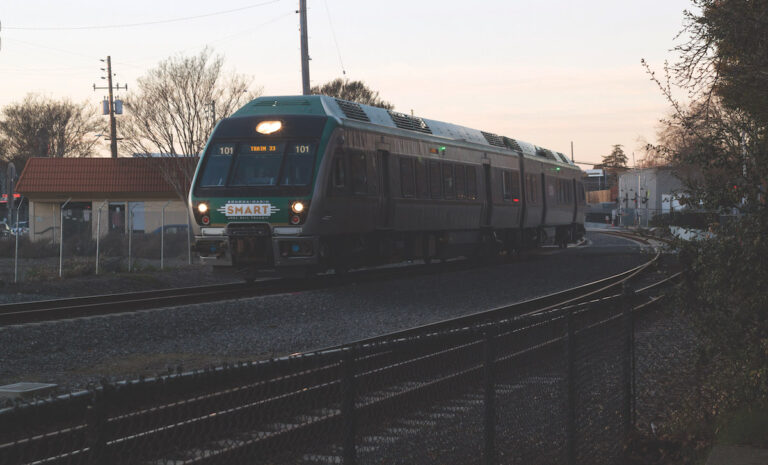
ALL ABOARD Passengers board a southbound SMART train in downtown Santa Rosa on Monday, Jan. 24. Photo by Will Carruthers.
On Friday, Jan. 21, the Bohemian/Pacific Sun sent the agency’s new director, Eddie Cumins, and several other staff members questions requesting clarification about the process of awarding the freight contract and other related issues mentioned in this article. On Monday, instead of answering the questions, SMART spokesman Matt Stevens said that he had sent the questions to the agency’s public records coordinator to search for documents, a process which often takes weeks. The Bohemian/Pacific Sun reiterated that we were requesting answers to specific questions, not filing a public records request. We also forwarded the questions to David Rabbitt and Barbara Pahre, the chair and vice chair of SMART’s board of directors. No representative of SMART responded before our print deadline.
At a May 20, 2020 meeting, 11 of 12 SMART board members voted to inherit freight services in the North Bay, after the state decided to shut down the North Coast Railroad Authority, a heavily-indebted agency which owned rails running through the North Bay up to Humboldt County.
As the Bohemian/Pacific Sun reported last November, at the time of the meeting, SMART’s directors had little information about the financial prospects of the business they were taking over.
Doug Bosco, the CEO of NWP Co, the company which leased rights to run freight on NCRA’s lines, has repeatedly declined to share complete information about the company’s revenues and operating costs with SMART. At the May 2020 SMART board meeting, Bosco said that the company brought in about $2 million in revenue per year but declined to share additional information. Bosco, a former congressman representing the North Coast in the 1980s, is an investor in Sonoma Media Investments, which owns the Press Democrat and numerous other print publications in Sonoma County.
Read “Freight Railroaded” and “Train Lines” to learn about the curious relationship between the NCRA and NWP Co, and the process of shutting down the NCRA.
In late August 2020, three months after agreeing to take over freight, SMART started searching for an outside firm to study the financial prospects of the North Bay’s freight rail market. At the time, SMART was aiming to hire a consultant by Oct. 22 and complete the report within three months. Instead, the agency ended up hiring a consultant, Project Finance Advisory Limited, in February 2021.
SMART published a five-page executive summary of the full report in August 2021, followed by the final report on Dec. 9, 2021, almost 11 months after the original planned completion date.
The agency released the executive summary as part of a Request For Information seeking input from rail companies interested in temporarily taking over freight services on SMART’s lines. All told, 11 companies responded, with many expressing interest in the opportunity and asking questions about SMART’s freight plans.
However, at a Nov. 17 board meeting, SMART staff did not reference the consultant’s executive summary or the responses from freight rail companies. The board was asked to decide whether the agency should operate freight in-house or hire an outside company to manage freight and business outreach on behalf of SMART. The board also considered whether SMART should continue NWP Co’s practice of temporarily storing train cars filled with LPG near Schellville.
Go figure
Instead of using figures from the consultant’s executive summary, a presentation by SMART’s Chief Financial Officer Heather McKillop cited differing revenue and cost estimates based on “conversations with NWP Co.” In the same presentation, McKillop estimated that operating freight in-house would cost $1.7 million per year, while hiring an outside company to manage the freight operation in part or full would cost SMART between $3 million and $3.4 million per year. (Read our coverage of the Nov. 17 meeting here.)
McKillop’s staff report and slideshow presentation did not offer the public any specific insight into how she had calculated the estimated operating costs.
SMART’s board voted to handle freight in-house, an exceedingly rare arrangement in the freight world, where private companies most frequently operate freight lines.
To David Schonbrunn, a long-time transit advocate and president of TRANSDEF, the presentation was an example of “faith-based accounting” seemingly designed to make handling freight in-house appear to be the most financially desirable choice.
“[The calculation] was based on absolutely nothing. In my view, it was preposterous that they made an actual decision on that basis,” Schonbrunn said.
At the same meeting, the board of directors voted to get rid of one of NWP Co’s most lucrative income streams: storing LPG cars.
Explosive revelations?
NWP Co began storing full and empty LPG cars at Schellville in 2016 despite opposition from SMART, which shared ownership of the lines with NCRA, the agency which NWP Co leased freight rights from. At SMART’s Nov. 17 board meeting, Sonoma County residents raised concerns that the tanker cars might explode or leak, damaging the environment, homes and businesses and leading to massive legal claims against SMART. They also submitted a petition signed by over 400 citizens.
While critics of the LPG storage claim that the cars are highly dangerous, state and federal rail regulators offer a different picture. Though there have been LPG explosions in the past, the risk of a massive explosion is low, even if a train derails in transit.
According to a Federal Railroad Administration spokesperson, the last time an LPG-filled car “catastrophically failed” was in 1996, when a 36-car train derailed in Weyauwega, Wis. Of the 14 train cars filled with LPG, three cars caught on fire. A fourth car exploded after two hours of fire.
Terrie Prosper, a spokesperson for the California Public Utilities Commission, which regulates railroads and numerous other industries, saidthat, “Chain explosions are not common with LPG cars.”
According to CPUC data, six railroads, including NWP Co, currently store LPG in various locations around the state. Employees in the CPUC’s Rail Safety Division track the location of hazardous materials being stored by railroads in monthly reports, checking whether the railroads storing hazardous materials are complying with federal regulations.
For SMART, the LPG decision was political. At the November meeting, SMART director Susan Gorin, who represents the area where the tanker cars are stored on the Sonoma County Board of Supervisors, said that voters in her district would oppose a crucial SMART sales tax renewal if SMART allowed the LPG cars to stay in Schellville. Quickly falling in line, the board voted to end LPG storage as soon as possible.
Several weeks later, SMART finally published the consultant’s full freight market report.
The full report paints a fairly grim picture of the prospects of increasing freight revenue and highlights the fact that LPG storage was the most lucrative freight business opportunity currently available.
“Without assistance from public or alternate funding sources to help level the competitive field, it is unlikely that a meaningful number of area businesses would elect to ship by rail [instead of by truck],” the report states. The report goes on to say that there could be opportunities to install some new freight spurs and set up transloading facilities, locations where multiple companies can access a freight spur with trucks. However, those options will cost SMART, and the businesses who use them, money up front to set up.
Although it is more in-depth than any other previous analysis by SMART, the Dec. 9 report does not recommend a path forward and is more limited in scope than SMART originally planned.
“The portion of the study that will provide an operational review, financial analysis & modeling, development of a strategic plan, and recommendations for freight business investments as described in the September 2020 [Request For Proposals] has been deferred at SMART’s request and is therefore not included in this initial report,” the report states.
One reason SMART may have requested the consultant hold off on the financial analysis is that the agency has still not gained access to NWP Co’s full financial records. Emails obtained from the SMART via public records request show that NWP Co provided SMART’s staff and consultants with some of the company’s recent financial data, but required that the consultants writing the report sign non-disclosure agreements. SMART did not provide copies of the NDAs before our print deadline.
With their hands tied, the consultant’s freight report ends with a disclaimer: “The information and preliminary conclusions presented in this report may be further refined and developed following receipt of complete financial and traffic records from NWPCo. and additional information from various customers. Once that information is obtained and financial modeling conducted, it will be possible to formulate strategic policies to guide decision making and investments regarding SMART’s freight business.”
Still, that lack of “strategic policies” hasn’t stopped SMART from pushing ahead.
Photo by Chelsea Kurnick
Second thoughts
At a Jan. 5 meeting, following another freight report from McKillop, board members Barbara Pahre, Judy Arnold and Deborah Fudge seemed to have second thoughts about eliminating LPG storage after McKillop told the board that SMART would lose approximately $42,000 per month—$504,000 per year—in revenue by eliminating LPG storage.
“Is there a way to safely store the LPG [cars] on our tracks? I mean, it’s an amazing financial hit to us,” Pahre said at the meeting. “Have they [refineries and freight companies] ever taken into account how those could safely be stored away from people and away from other areas? I don’t need to have that answered right now, but if that information is available, I think that would be important to us as we move forward.”
In response to comments by Pahre and other board members, Gorin reminded her colleagues of their November vote and questioned whether any of the other board members would like to have LPG cars stored in their districts. The board stuck to their November decision.
At the board’s next meeting, on Jan. 19, board members unanimously approved a staff recommendation to hire Summit Signal to manage SMART’s freight operations for three months beginning on March 1, the day after NWP Co has agreed to stop running trains on SMART’s lines. The original contract will cost SMART up to $395,000.
Summit Signal’s contract costs only half what McKillop—SMART’s CFO—previously estimated SMART would pay to contract out freight services. In November, McKillop stated it would cost SMART between $3 and $3.4 million per year to partially or fully outsource freight services. Yet, if Summit Signal’s current three-month contract was extended to a full year, it would cost SMART only $1.58 million.
SMART did not respond to questions about what accounts for the major discrepancy between McKillop’s November estimates and the cost of Summit Signal’s contract.
SMART’s lack of transparency about their decision-making process and financial calculations is cause for concern, says Schonbrunn, the transit advocate.
“[They] should have been thorough in documenting everything and then stop appearing like they’re trying to slip something over on the public. That’s what it looks like, whether it is or isn’t is a little harder to say, but it sure looks like there’s something going on that they’re trying to hide. That’s never good.”
NOTE: A shorter version of this article appeared in print on Wednesday, Jan. 26. We have added additional detail to the online version.
A friend who has been living in New York for almost twenty years since we both graduated from Petaluma High in 2002 is moving back to the area, now with a young child and East Coast partner. I inquired as to what kind of place they wanted. They responded, “2.5 bedroom house in Petaluma or Sebastopol.”
I moved back to the Bay in March of 2020, single with 0 kids, and moved five times before finding a semi-permanent spot. I was in San Francisco, back in Western Colorado shortly, West Marin, Petaluma, and then finally found some “affordable” housing in the heart of downtown San Rafael above some storefronts.
Sonoma County has changed and I felt it was necessary to warn my friend about what to expect. First, Petaluma itself has taken the red path and Trumper energy has all but taken over the small city. During the Winter surge of late 2020 and early 2021, one of the most popular indoor/outdoor restaurants/bars played Fox News while no one wore a mask, even in the kitchen, and the shift manager would shame you if you asked to be seated away from the groups of mask-less patrons. Another brew pub had an ignorant “#OpenSonomaSchoolsNow” banner up while they disregarded county orders to keep people from gathering and continued to serve. At the same time, hipster barbers with non-ironic Hitler Youth haircuts flaunted their mask-less faces at Petaluma Market.
Sonoma County COVID case counts still tend to be double or triple what they are in Marin County, and are more than half of what they are in San Francisco, where there are way more people and much higher population density.
She could look for spots in Marin County where you don’t have to drive more than five minutes to be in beautiful hiking spot and the cases are less; and where the Trumpers are at least hidden in plain sight, and the ones who are not, usually get drowned out by all the white women virtue signaling in Pixar swag while they talk down to any and all service industry workers.
I had to move back because I wanted to spend more time and help my 91-year-old grandmother, who had to evacuate her home year after year due to fires. For that simple reason I cannot safely hang out at most places in Petaluma. But I also do not support any business that thinks it’s okay to politicize and disobey common sense safety that keeps people like my Grandma alive. I wouldn’t cough in your grandma’s face when I have the flu.
To my friend, build a family wherever it is easiest; but don’t support anyone in Sonoma County who doesn’t give a shit about you and your families health and well-being.
In 1996, a horror film shot in Marin and Sonoma County by master director Wes Craven changed the rules of the genre by going meta.
The now-iconic Scream ushered in a new era of self-aware slashers and played with the conventions of movies in a fun and gory manner. Since that first tongue-in-cheek bloodbath, the Scream franchise has kept audiences guessing who the killer is behind the Ghostface mask with sequels that explain the rules of surviving horror movies and, sometimes, break them.
So, how does a critic review a movie when the movie knows that the audience knows that the movie knows that the audience knows that the movie knows it’s a movie?
With the latest chapter of the series—the so-called “re-quel” simply titled Scream—in theaters now, critics are—or are not—enjoying a new round of meta-chills. And, much like the rules of horror, there are rules to reviewing a horror movie.
Rule No. 1: No Spoilers! This is a longtime reviewer rule that became an unwritten rule of society once Netflix began dropping entire seasons of shows at once. Additionally, the Scream franchise differs from most slashers in the fact that Ghostface is a different person—or people—each time. Knowing who the killer is going into the movie really changes the experience, and not for the better. So, while it’s tempting to tip one’s hat to the ending, it’s essential not to spoil the fun.
Rule No. 2: Praise the original and bash the sequels. There’s a trend among horror movie reviewers to recognize a great original movie while bemoaning almost all the sequels that come after. The Scream films mostly follow that trend, except for Scream 2, which is now recognized as an excellent follow-up. With a 77% positive rating on Rotten Tomatoes, the new Scream is actually the best-reviewed part-five horror movie out of the major franchises, though critics like Peter Bradshaw, of the Guardian, and Christy Lemire, of FilmWeek, almost seem surprised they liked it—because that’s against the rules. Rule No. 3: Make it personal. Horror movies are always personal for the viewer, and the things that scare us differ as much as our individual experiences. Good critics know this, and let the reader decide for themselves, such as when Rolling Stone film-critic David Fear and Us Weekly critic Mara Reinstein refer to the audience as “You,” and ask, “Do you like scary movies?” If you do, you’ll like the new Scream, in theaters now.
Renowned Glen Ellen artist Bryan Tedrick recently completed the installation of his latest massive sculpture work, a 28-foot-tall steel bear that stands on the grounds of Kenwood’s St. Anne’s Crossing Winery.
Tedrick specializes in large metal work, and recognizes the compulsion to interact with his large scale pieces, which are created with the intention of allowing viewers to touch and climb, and...
North Bay theatre came back with a vengeance in mid-2021 when restrictions were lifted and theaters could once more welcome audiences inside. Almost every theatre company in the region returned to live production with solo shows, comedies, and the occasional musical.
The New Year brought news of Omicron–a more contagious variant of the coronavirus–and an explosion of new cases. Some...
I hate when people say, “Age is only a number.”
It’s as if they’re trying to dilute themselves with the shabby math. To my ear, such turns of phrase underscore our country’s clinical obsession with youth—read: abhorrence of the aged and aging. I used to assume this was just one side of a spectrum, with the fear of death looming...
We often speak here about spiritual awakening, including what it feels like—terrifying; why it’s necessary—to know what we really are; and how it unfolds. And so let’s take a look at a character we’re all likely familiar with and examine how he becomes enlightened, empowered and reborn.
George Lucas drew heavily on the work of mythologist Joseph Campbell when creating...
“Move forward, the mind also thinks of moving back.” —The Principles of Tai Chi Chuan, Master Chang San-Feng, 12th century C.E.
With these wise words to start our new year, yet another in the great cannabis adventure, I thought it would make sense to look at the history of cannabis in its spiritual home, here in the Bay Area. Which...
This is our “meta” issue … and I don’t know what “meta” means. Which is OK with me, by the way. I don’t want to know what meta means; I pride myself on not knowing what it means. Only the lure of filthy lucre is enough to entice me into losing my integrity by finding out what it means....
A poem
By Jack Crimmins
there’s a man with a blanket on
standing at Round Barn Park
in Santa Rosa’s historic West End
head to toe covered and his
shopping cart is laden down
with tarps and assorted bags
overflowing really he’s
got a ton of stuff there’s
a freeze warning here
in California though
people in the East
would laugh wishing
the temperature would
get as high as freezing
everything’s relative and
somehow at this...
Read the Bohemian's previous coverage of SMART's freight takeover here, here and here.
Last Wednesday, Jan. 19, the Sonoma-Marin Area Rail Transit district’s board of directors selected a company to take over the agency’s recently-acquired freight operations.
Beginning on March 1 and lasting for three months, the temporary contract with Willits-based Summit Signal is the SMART’s most recent step in taking...
A friend who has been living in New York for almost twenty years since we both graduated from Petaluma High in 2002 is moving back to the area, now with a young child and East Coast partner. I inquired as to what kind of place they wanted. They responded, “2.5 bedroom house in Petaluma or Sebastopol.”
I moved back to...
In 1996, a horror film shot in Marin and Sonoma County by master director Wes Craven changed the rules of the genre by going meta.
The now-iconic Scream ushered in a new era of self-aware slashers and played with the conventions of movies in a fun and gory manner. Since that first tongue-in-cheek bloodbath, the Scream franchise has kept audiences...