As cold temperatures descend on the North Bay, advocates are pushing for more measures to protect people living on the street.
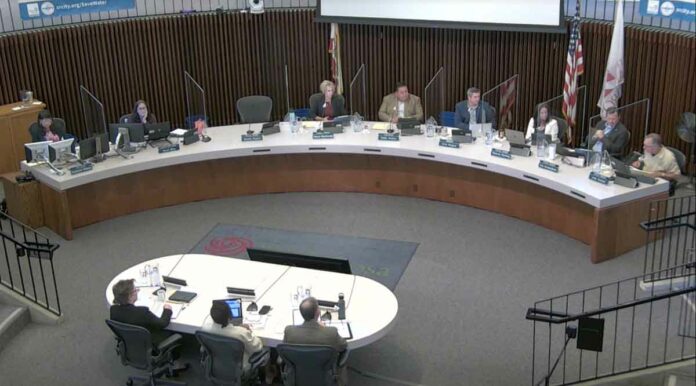
In a statement released on Friday, Nov. 18, the Sonoma County Human Rights Commission called on the county to provide “immediate relief” during freezing conditions by opening public buildings, including the Veterans Memorial Hall and Sonoma County Fairgrounds buildings, to offer additional emergency shelter for unhoused people.
In the days leading up to the announcement, temperatures outside had dipped into the low 30s three days in a row, leaving those without access to shelter—estimated around 2,000 across the county—at risk of hypothermia, frostbite and other health effects.
In recent years, local agencies and their nonprofit partners have offered some additional space for people to stay out of the cold during the winter, but never nearly enough to fit all of those in need. Despite the fact that Santa Rosa declared a state of emergency around homelessness six years ago, the Human Rights Commission argues local governments don’t treat this annual emergency the same as others.
“It is well established that in times of other emergencies, municipal buildings have been designated in a matter of hours to house and care for large numbers of people such as wildfire victims complete with food, water, and adequate facilities for the newly homeless,” the Nov. 18 statement reads in part.
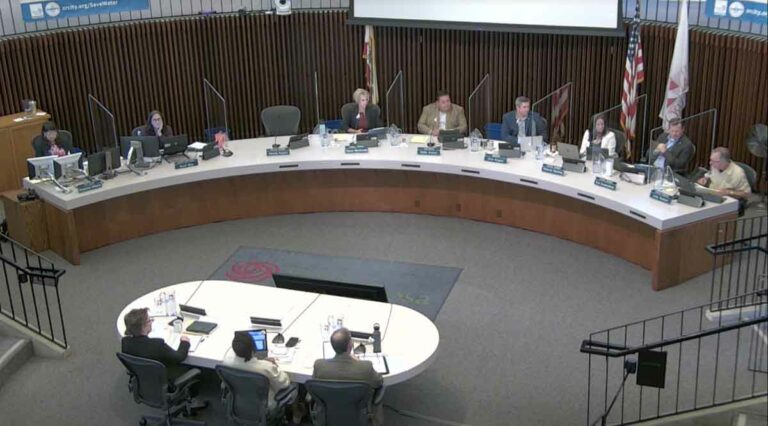
The commission’s plea came three days after the Santa Rosa City Council approved a new plan to reduce homelessness to “functional zero” within five years. The goal, which the city’s website acknowledges is “ambitious,” is defined as reaching a status where “homelessness is rare and brief and the availability of services and resources match or exceed the demand within the community.” Crossing the “functional zero” finish line would require the city to offer enough short-, mid- and long-term resources to serve those in need.
Currently, Santa Rosa, as with numerous others around the state, is far from that goal, despite budgeting $5 million on services this year.
Between February 2020 and February 2022, Santa Rosa’s homeless population increased by 13.5%, from 1,461 to 1,658, according to two point in time counts from those months.
Core to the problem is that local governments simply don’t offer enough temporary, let alone permanent, housing options to meet the need. Santa Rosa’s plan states that, currently, roughly 1,409 people would accept permanent housing, however the city’s system only has the capacity to serve 582 people a year, leaving a “permanent housing gap” of 827 units.
Meanwhile, people continue to cycle through the city’s emergency shelter system. The average length of stay is 79 days, with only 16% of people being successfully placed into permanent housing.
The plan outlines three “strategy areas” in order to achieve functional zero. Bullet points call on the city and its partners to expand mobile outreach services, create more housing options, and improve data collection and collaboration with other local agencies.
One thing seems sure: Hundreds of people will remain homeless as temperatures dip this winter, whether or not local agencies offer additional temporary shelter options.
Santa Rosa’s new plan is available for review at www.srcity.org/3735/Homelessness-Solutions-Strategic-Plan.
There is no way to talk around the issue. There is a dearth of hip-hop support in the North Bay.
Nevermind that one of the greatest to ever spit truth through a mic came up in Marin City. Tupac Shakur’s firework streak of fame failed to ignite a scene in the only predominantly Black city in Marin. If it had, we might not even know it, because where would it be showcased?
Santa Rosa’s own b-boy, Vocab Slick, tours nationally but is all but unknown in his hometown. It is time for that to change.
“I’m probably the only national touring [hip-hop] artist from here; why can’t I get booked at home? It started to occur to me. Oh, they don’t even know. I’m from here. They think I’m from Oakland. They think I’m from San Francisco,” said Slick over a sketchy phone line from a tour bus somewhere in the North West.
Long the home of reggae, psychedelic blues rock and anti-fascist white boy punk, I am here to tell you that the North Bay has more music to offer.
“So that’s given me the idea to tap back into the community,” said Slick. “Guys like me, we’ve been here, we’ve been doing this, and people are starting to understand what we’ve been trying to do all along.”
Hop-hop shows tend to draw local attention for the wrong reasons. Assumptions of violence and drugs dog bookings, even though these issues can be found easily throughout the county with no connection to rap or hip-hop.
“Let’s just say it; it’s very racist. Black eye on the community here, because they don’t, I don’t, how can I say this and be politically correct…” he trailed off.
“That’s okay, this is the Bohemian,” I offered. “You say it your way.”
“Okay, so I’m basically pretty much the only white guy anywhere I go in the scene, right?” he said. “And I’m fine with that.”
“[Different] cultures offer something for everyone, but you have to be able to be comfortable in your own skin enough to be the only person of your ethnicity in that room sometimes,” he said. “When you’re able to do that, it’s a beautiful place to be in because then what you get to do is learn and listen.”
“What Sonoma County needs to do is open their eyes to inclusivity and understand that culture and music is way beyond white/Black. You know what I mean? It’s beyond that,” he said. I do know. Let’s spread that gospel, Slick.
“People look at a hip-hop show, and instead of saying, Oh, somebody’s gonna get shot there. Oh, let’s go there and dance,” he added.
Speaking of the importance of venues like the Whiskey Tip showing up for the hip-hop scene, Slick said, “If it wasn’t enough for Whiskey Tip to be a part of the Roseland community, the [staff and management] has gone above and beyond to give a space to local creatives to share their art.”
Vocab Slick’s album, ‘Language,’ is out now on iTunes and Spotify.
Folks who like their fairy-tale endings in the “and they lived happily ever after” vein may find themselves challenged by Marisela Treviño Orta’s The River Bride.
Part Brazilian folklore and part Brothers Grimm at their grimmest, it’s the tale of two sisters and the men in their lives. Santa Rosa’s 6th Street Playhouse has a production running on their Monroe Stage through Nov. 27.
The playhouse’s small black box stage has been turned into an Amazonian fishing village, where Belmira (Bethany Regan) is about to be married to Duarte (Lorenzo Alviso). Duarte was the childhood sweetheart of Belmira’s older sister, Helena (Lauren DePass), but the passive Helena stepped aside once the assertive Belmira set her sights on him. Belmira sees Duarte as a way out of the village.
Duarte and the sisters’ father, Señor Costa (Daniel Villalva), are out casting their nets for the wedding feast when they discover an unconscious man—fully clothed in a Panama suit and with a bandaged head—entangled in their net. They bring him back to the village, where the sisters and their mother (Jannely Calmell) revive him. He identifies himself as Moises (Terrance Smith) and is immediately taken with Helena.
After a fast courtship, Moises proposes immediate marriage. As a matter of fact, he must be married by sundown. Helena hesitates just long enough for Belmira to move in. Belmira has found a better way out of the village, or so she thinks.
More a rumination on regret than love, director Marty Pistone has gathered a design team and cast that hit all the right notes in the telling of this melancholy tale. Giulio Caesare Perrone’s nicely evocative set, Luca Catanzaro’s lighting, Pamela Johnson’s costuming, Ben Roots’ sound design and Nate Riebli’s original compositions work in harmony with a terrific ensemble of performers to bring a real sense of otherworldliness to the stage.
Life is a series of hard choices, and a leap of faith is often necessary to make those choices, particularly when it comes to love. Taking the leap can lead to a joyous life. Not taking it can lead to a life of regret. Either way, there are no guarantees. That struggle is the heart of the show, and the entire cast brings that heart to life.
Take a leap of faith and see this show.
‘The River Bride’ runs through Nov. 27 on the Monroe Stage at 6th Street Playhouse, 52 W. 6th St., Santa Rosa. Thurs-Sat., 7:30pm; Sat-Sun, 2pm. $22–$44. 707.523.4185. 6thstreeetplayhouse.com
After discovering definitive proof that Vikings reached the shores of North America 1,000 years ago, anthropologists have since learned that the Nordic explorers felt dissed that they weren’t invited to the first Thanksgiving.
Recently translated Viking ship logs indicate that “no one even tried to reach out, despite the fact that we predate the arrival of Columbus, the Virginia settlement and the pilgrims and their stupid hats.”
Other recently resurfaced documents indicate that the pilgrims allege they did invite the Vikings, but the invite was lost in the mail. The Vikings dispute this since the U.S. postal system would not be invented until 1775.
Scholars suggest the pilgrims excluded the Vikings due to their tendency to drunkenly chant, “We have the need, the need for mead!”
After that, it seems the offended Vikings took their boat and went home. Or did they?
Several genealogists have conjectured that descendants of these Nordic North American explorers may live among us today, and that vestiges of Viking culture may persist in modern form.
“Take, for example, the recent proliferation of beards among cohorts of young, male-identified hipsters,” observes Dr. Indra Mudavarthi of the Freestone Institute’s department of genetics and gerontology. “When we see this kind of atavistic evolutionary trait—long red, braided beards on man-bun and skinny jean-wearing 20-somethings—we could actually be looking at malnourished Vikings.”
Mudavarthi contends that with proper care and feeding, these so-called “vike-lings” could eventually reach their full final form as full-blown berzerkers. “Thanksgiving, it’s the perfect opportunity to fatten them up,” she says.
“Their vegan diets aren’t good for growing Vikings,” says Murdavarthi, who claims to have raised several Vikings in captivity last summer on a diet consisting of organic reindeer jerky and a variety of locally-made microbrews. “They wouldn’t eat anything else once they were weaned off of plant-based ‘burgers’ and oat milk.”
Fearing arguments about politics, religion and whether or not we can “Make Valhalla Great Again,” members of the eastern seaboard-based Mayflower Supper Club Society, who claim to be descendants of the original pilgrims, expressed reluctance when pressed by Mudavarthi to invite her Viking brood to their annual “first Thanksgiving” re-enactment.
“We might have room at the kiddie table, but then, of course, there are concerns about child welfare,” said the dining society’s president and spokesperson, Todd Aswegan, citing unfounded rumors of alleged cannibalism historically amongst Viking sailors.
She added, grumbling, “You eat one oarsman and everyone thinks cannibalism is like your thing.”
In the 1960s, there was a TV show called A Man Called Shenandoah. A man with amnesia would ride into a town in the American West, take on a problem, solve it and then leave.
The townspeople would thank him, and he would say, “It was the least I could do.” I never understood that. If that was the least he could do, shouldn’t he have tried to do more?
This month, lots of “Shenandoahs” have arrived in Sharm El Sheikh and will likely do the least they can do to address the climate catastrophe before moving on.
At COP27, some of the worlds’ most powerful people will hear that the oceans are dying and that we have harmed life in the oceans in many ways, including with factory farm run-off, chemical pollution, trawler fishing, ship collisions, plastic waste, deep-sea drilling, untreated sewage, ocean dumping and naval bombing exercises.
They will be told that we must act now if we are to save ourselves. That’s key: People will think about taking some action because saving humanity is considered a noble goal—but it will be the least they can do.
Saving the oceans and their inhabitants is certainly about human survival, but it’s about more than that. Often when someone mentions how bad the situation is, a listener will say, “Yes, I’ve stopped using plastic straws!” But isn’t that the least a person can do? It would be so much better to stop eating fish.
It’s because of fishing that billions of fish are suffering in hideous ways as they’re hauled out of their aquatic environment to die in agony on their way into human stomachs.
We can use whatever strengths, talents, personal power and freedom we possess to go far beyond the least we can do, to figure out the most we can do and do it.
Ingrid Newkirk is the founder and president of People for the Ethical Treatment of Animals (PETA) and author of ‘Animalkind.’
Let Twitter die, quietly. No more “news” stories about the humiliations, carnage and suffering. There are alternatives in the social media world for all the truly desperate to post their angst. Try Mastodon; go back to MySpace, Reddit, etc. Giving those who are considering remaining on Twitter another reason to leave. No publicity, just an empty dark space where advertisers would place their dollars.
Gary Sciford
Santa Rosa
Say ‘Self-destruct’
Based on the recent midterm elections, top level Democratic National Committee officials are developing a top secret strategy to make Republicans sound stupid in the run-up to the 2024 election.
It’s called Operation: Just Let Them Talk.
Craig J. Corsini
San Rafael
Inspired by Cows
Very impressive environmental investigative reporting (Don’t Look Down!, Nov. 16). During the 1950s and ’60s, I spent my childhood summers endlessly roaming Point Reyes. Darn those cows then, damn those cows now. Those cows were the inspiration for my participation in the removal of grazing cattle from certain public lands in eastern Oregon. With good science and good lawyers, it can be done.
These fall inspired cocktails made with local ingredients are sure to tantalize.
Pumpkin Bourbon Smash Cocktail
Who needs a pumpkin spice latte when you can have a pumpkin spiced cocktail? This Pumpkin Bourbon Smash has all of the spiced goodness of pumpkin pie with a whiskey kick and is sure to be a hit as a pre-Thanksgiving meal drink or at any fall gathering.
Ingredients
2 oz Griffo Distillery Stony Point Whiskey
1 oz pumpkin spice syrup (Sonoma Syrup Company makes one)
1/4 oz lemon juice
4 oz soda water
Lemon wedges
Directions
Fill a cocktail shaker with ice. Add pumpkin spice syrup, bourbon and lemon juice for the cocktail. Shake well. Fill rimmed rocks glass with ice. Strain the cocktail into the glass.
Top with soda water. Give the cocktail one final stir and serve.
You can either purchase these ingredients separately to make this cocktail at home or simply buy a Pumpkin Bourbon Smash Cocktail kit from Griffo, which includes everything you need to make 12 cocktails.
Pumpkin Spice White Russian
We think this pumpkin spiced version of a White Russian is so delicious, you might never go back to the original. Alternatively, if you’ve never been a fan of White Russians—this one will change your mind.
Ingredients
1 oz Griffo Distillery cold brew coffee liqueur
1 oz Hanson’s vodka
½ tsp pumpkin pie spice
2 oz heavy cream
Ice cubes
Cinnamon sticks, optional for garnish
If you don’t have a pre-blended pumpkin pie spice mix, you can easily make some by blending together 1 teaspoon ground cinnamon, 1 teaspoon ground ginger, ½ teaspoon ground nutmeg, ½ teaspoon ground cloves and ½ teaspoon allspice.
Directions
Add the coffee liqueur, vodka, pumpkin pie spice, heavy cream and ice cubes to a cocktail shaker. Shake together for 10 seconds. Pour into a low ball or rocks glass over ice. Garnish with a dusting of pumpkin pie spice and a cinnamon stick.
Gravenstein Gimlet
Originally created for the Gravenstein Apple Fair, this apple-icious twist on a classic gimlet from Spirit Works Distillery incorporates apple jelly, grenadine and lime-coriander bitters with gin and lime.
Ingredients
1.5 oz Spirit Works Distillery Navy Strength Gin
.75 oz lime juice (fresh squeezed is best)
.5 oz grenadine
1 heaping teaspoon Fourteen Magpies Gravenstein Apple Jelly
Jewish Community Center Sonoma County presents its 27th Annual Jewish Film Festivalfrom 1 to 7pm, Tuesdays, Nov. 29 to Dec. 20, at Sebastopol’s Rialto Cinemas, and streaming online. This year’s lineup features films with several strong, fascinating female characters with effervescent performances from the actresses depicting them. Featuring an international lineup of films as yet unseen in Sonoma County, the program includes selections from France, Netherlands/Germany and the United States. Highlights include a career-crowning performance by French screen legend Françoise Fabian and the poignant genre-defying musical-documentary, A Kaddish for Bernie Madoff, in which the disgraced financier is metaphorically, and musically, “disowned.” A Hanukkah candle lighting will precede the Dec. 20 screenings. Tickets are $15, and $18 at the door, and season passes are $60 (pass holders can choose to watch each film either in-person or at home). For tickets, trailers and a film guide, visit jccsoco.org.
Napa
Terracotta Corridor
An exhibition of 21 clay sculptures, “Terracotta Corridor,” opens in the Napa Valley with an artist talk and reception at the Culinary Institute of America, Copia, followed by a bike tour from 1 to 4 pm, Saturday, Dec. 3. Presented by Rail Arts District (RAD) Napa and Mission Clay Products, the free outdoor exhibition features work by 11 ceramic artists from the Mission Clay Products Arts and Industry residency program. A selection of work from some 400 artists who participated in the program will be showcased in the RAD. On Dec. 3, RAD Napa executive director Shelly Willis will moderate a conversation from 1 to 2pm between participating artist John Toki and Bryan Vansell, the founder and director of the Arts and Industry residency program. The conversation will be immediately followed by a reception and bicycle tour guided by Toki and Chuck McMinn, president of RAD Napa. To sign up and secure a bicycle for the tour, email in**@*ad.org. For more information, visit radnapa.org.
Yountville
2nd Annual Latke Throw Down
Presented by Bardessono Hotel & Spa, the 2nd Annual Latke Throw Down takes place from 5 to 7pm, Thursday, Dec. 15 at the Yountville Community Center, 6516 Washington St. For those in need of a refresher, a latke is a type of potato pancake that is traditionally prepared to celebrate Hanukkah. This year’s Latke Throwdown features an array of local luminaries in competition, including Jim Leiken, executive chef of Bardessono; Shane Soldinger of Silver Trident; Paul Brown, the partner/chef/baker of Paulie’s Bagels and Winston’s Café; and Itamar Abramovitch, Blossom Catering Company. The judges include Stacey Bressler of Bressler Vineyards, Rabbi Niles Goldstein of Congregation Beth Shalom of Napa Valley, Loveski Deli’s chef Christopher Kostow and Yountville community member Ada Press. Judd Finkelstein returns to emcee the event. Tickets are $10, with proceeds benefiting Parents CAN, a non-profit organization that provides parenting support. Reservations are encouraged and can be confirmed by emailing ev****@********no.com (reserved tickets are paid for at the door).
Sausalito
Winter Open Studios Returning for its 53rd year, the 2022 Winter Open Studios presents the work of over 100 working artists from a variety of disciplines from 11am to 5pm, Saturday and Sunday, Dec. 3 and 4, in Sausalito’s historicICB Building, which had its start as a World War II shipbuilding warehouse. The artists who work in the building will be on hand to discuss work on offer, which includes sculpture, abstract and figurative paintings, photographs, fiber arts, jewelry, sound installations and more. This event is located at the ICB Building, 480 Gate Five Rd., Sausalito, and is free and open to the public, though guests are asked to register online at bit.ly/icb-art. For more information, visitwww.icbartists.com.
ARIES (March 21-April 19): One of your callings as an Aries is to take risks. You’re inclined to take more leaps of faith than other people, and you’re also more likely to navigate them to your advantage—or at least not get burned. A key reason for your success is your keen intuition about which gambles are relatively smart and which are ill-advised. But even when your chancy ventures bring you exciting new experiences, they may still run you afoul of conventional wisdom, peer pressure and the way things have always been done. Everything I have described here will be in maximum play for you in the coming weeks.
TAURUS (April 20-May 20): Your keynote comes from teacher Caroline Myss. She writes, “Becoming adept at the process of self-inquiry and symbolic insight is a vital spiritual task that leads to the growth of faith in oneself.” Encouraging you to grow your faith in yourself will be one of my prime intentions in the next 12 months. Let’s get started! How can you become more adept at self-inquiry and symbolic insight? One idea is to ask yourself a probing new question every Sunday morning, like “What teachings and healings do I most want to attract into my life during the next seven days?” Spend the subsequent week gathering experiences and revelations that will address that query. Another idea is to remember and study your dreams, since doing so is the number one way to develop symbolic insight. For help, I recommend the work of Gayle Delaney: tinyurl.com/InterviewYourDreams.
GEMINI (May 21-June 20): The TV science fiction show, Legends of Tomorrow, features a ragtag team of imperfect but effective superheroes. They travel through time trying to fix aberrations in the timelines caused by various villains. As they experiment and improvise, sometimes resorting to wildly daring gambits, their successes outnumber their stumbles and bumbles. And on occasion, even their apparent mistakes lead to good fortune that unfolds in unexpected ways. One member of the team, Nate, observes, “Sometimes we screw up—for the better.” I foresee you Geminis as having a similar modus operandi in the coming weeks.
CANCER (June 21-July 22): I like how Cancerian poet Stephen Dunn begins his poem, Before We Leave. He writes, “Just so it’s clear—no whining on the journey.” I am offering this greeting to you and me, my fellow Cancerians, as we launch the next chapter of our story. In the early stages, our efforts may feel like drudgery, and our progress could seem slow. But as long as we don’t complain excessively and don’t blame others for our own limitations, our labors will become easier and quite productive.
LEO (July 23-Aug. 22): Leo poet Kim Addonizio writes a lot about love and sex. In her book, Wild Nights, she says, “I’m thinking of dating trees next. We could just stand around all night together. I’d murmur, they’d rustle, the wind would, like, do its wind thing.” Now might be a favorable time for you, too, to experiment with evergreen romance and arborsexuality and trysts with your favorite plants. When was the last time you hugged an oak or kissed an elm? JUST KIDDING! The coming weeks will indeed be an excellent time to try creative innovations in your approach to intimacy and adoration. But I’d rather see your experiments in togetherness unfold with humans.
VIRGO (Aug. 23-Sept. 22): In her book, Daughters of the Stone, Virgo novelist Dahlma Llanos-Figueroa tells the tale of five generations of Afro-Cuban women, her ancestors. “These are the stories of a time lost to flesh and bone,” she writes, “a time that lives only in dreams and memories. Like a primeval wave, these stories have carried me, and deposited me on the morning of today. They are the stories of how I came to be who I am, where I am.” I’d love to see you explore your own history with as much passion and focus, Virgo. In my astrological opinion, it’s a favorable time for you to commune with the influences that have made you who you are.
LIBRA (Sept. 23-Oct. 22): In accordance with astrological omens, here’s my advice for you in the coming weeks: 1. Know what it takes to please everyone, even if you don’t always choose to please everyone. 2. Know how to be what everyone wants you to be and when they need you to be it, even if you only fulfill that wish when it has selfish value for you. 3. DO NOT give others all you have and thereby neglect to keep enough to give yourself. 4. When others are being closed-minded, help them develop more expansive finesse by sharing your own reasonable views. 5. Start thinking about how, in 2023, you will grow your roots as big and strong as your branches.
SCORPIO (Oct. 23-Nov. 21): Even if some people are nervous or intimidated around you, they may be drawn to you nonetheless. When that happens, you probably enjoy the power you feel. But I wonder what would happen if you made a conscious effort to cut back just a bit on the daunting vibes you emanate. I’m not saying they’re bad. I understand they serve as a protective measure, and I appreciate the fact that they may help you get the cooperation you want. As an experiment, though, I invite you to be more reassuring and welcoming to those who might be inclined to fear you. See if it alters their behavior in ways you enjoy and benefit from.
SAGITTARIUS (Nov. 22-Dec. 21): Sagittarian rapper and entrepreneur Jay-Z has stellar advice for his fellow Sagittarians to contemplate regularly: “Ain’t nothin’ wrong with the aim; just gotta change the target.” In offering Jay-Z’s advice, I don’t mean to suggest that you always need to change the target at which you’re aiming. On many occasions, it’s exactly right. But the act of checking in to evaluate whether it is or isn’t the right target will usually be valuable. And on occasion, you may realize that you should indeed aim at a different target.
CAPRICORN (Dec. 22-Jan. 19): You now have extra power to exorcize ghosts and demons that are still lingering from the old days and old ways. You are able to transform the way your history affects you. You have a sixth sense about how to graduate from lessons you have been studying for a long time. In honor of this joyfully tumultuous opportunity, draw inspiration from poet Charles Wright: “Knot by knot I untie myself from the past / And let it rise away from me like a balloon. / What a small thing it becomes. / What a bright tweak at the vanishing point, blue on blue.”
AQUARIUS (Jan. 20-Feb. 18): In accordance with current astrological rhythms, I am handing over your horoscope to essayist Anne Fadiman. She writes, “I have always felt that the action most worth watching is not at the center of things, but where edges meet. I like shorelines, weather fronts, international borders. There are interesting frictions and incongruities in these places, and often, if you stand at the point of tangency, you can see both sides better than if you were in the middle of either one.”
PISCES (Feb. 19-March 20): Over the course of my life, I have been fortunate to work with 13 psychotherapists. They have helped keep my mental health flourishing. One of them regularly reminded me that if I hoped to get what I wanted, I had to know precisely what I wanted. Once a year, she would give me a giant piece of thick paper and felt-tip markers. “Draw your personal vision of paradise,” she instructed me. “Outline the contours of the welcoming paradise that would make your life eminently delightful and worthwhile.” She would also ask me to finish the sentence that begins with these words: “I am mobilizing all the energy and ingenuity and connections I have at my disposal so as to accomplish the following goal.” In my astrological opinion, Pisces, now is a perfect time to do these two exercises yourself.
It’s an October morning at Point Reyes National Seashore and I’m scooting under barbed wire fences, wary of sliding into cow pies.
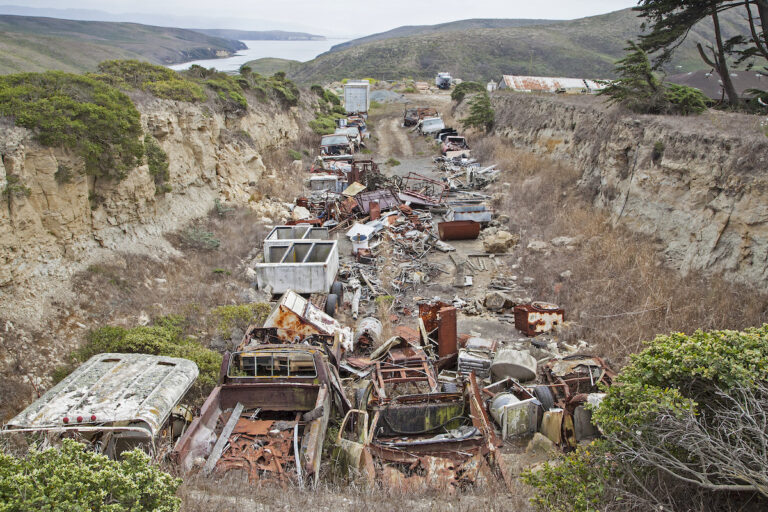
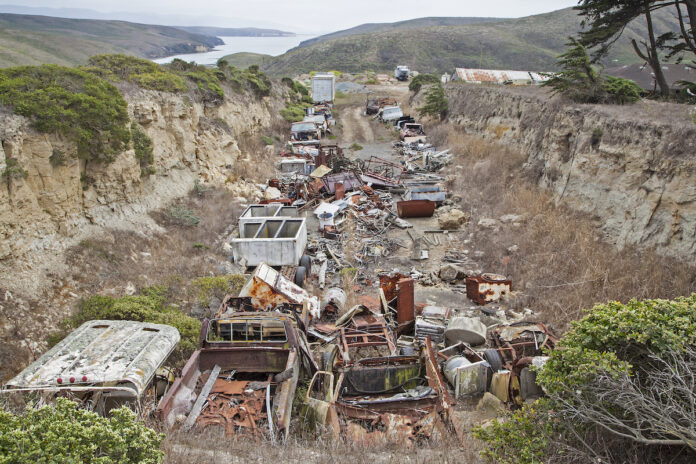
My guide on this safari is Jocelyn Knight, wildlife photographer. We’re stalking a toxic waste dump hidden from public view behind a hill at “Historic E Ranch, established circa 1859” land lorded by the National Park Service.
Park regulations require Seashore pastures to remain open to the public, but the dump is inside the E Ranch “core” of barns and dwellings, and the public is disallowed.
To avoid encounters with park rangers or others who might want to thwart our mission to photograph the dump, we crawl on hands and knees through a thorny thicket, around a pond polluted with old tires, empty barrels, oxygen-depleting algae.
Duckwalking up the hill toward the dump, dried out dirt clods seem to explode underfoot. We deploy hand signals, as there’s a large dog we’d rather not greet. It’s all a bit nerve wracking.
A year ago, August, Knight made this trek by herself, photographing a trench packed with broken car and truck bodies, oily engines, fuel containers. She emailed the evidence to Park Superintendent Craig Kenkel. He replied, “When leaseholders violate lease conditions, our approach, if possible, is to hold the leaseholder responsible for correcting the violation. Thus far, Mr. Nunes is doing so.” Kenkel cautioned Knight not to revisit the site without an invitation from the Nunes family, which leases and operates E Ranch.
But we intend to find out if the waste was removed. Rising to full height, Knight shoots the dump, snap, snap. Much of the waste is gone, but there are still dead machines, piles of tires, plastic barrels. Kenkel and the Department of Interior did not respond to inquiries about the toxic waste dump. Members of the Nunes family did not respond to requests for comment.
There’s another type of environmental disaster at E Ranch. According to a Marin County Environmental Health Services (EHS) investigation in June, “There was a very puddled (appeared to be sewage) area in the cow pasture adjacent to the [E Ranch] home. … It is clear that [the] present leach field is not accepting sewage from the tank properly.” According to EHS investigators, a septic tank was installed without the required permit; its sewage level exceeded the operational limit; they could not locate a leach field. The ranch land drains into the Pacific.
TIRES PILED A year after it was brought to park officials’ attention, a trash heap remains at E Ranch in violation of a lease agreement. Photo by Jocelyn Knight
The Nuneses have farmed in Point Reyes for more than a century. In 1971, they sold E Ranch to the Park Service, leasing it back for cattle grazing; the family also runs a dairy at A Ranch adjacent to the Lighthouse. A third of the park is given over to cattle and dairy ranching by the lineal descendants of European farmers who settled Point Reyes in the mid 19th century.
Park histories portray these “multi-generational ranching families” as “stewards of the land,” and the ranches are listed on the Register of Historic Places. Since the 1970s, Parks has spent millions of dollars improving commercial ranching infrastructures at the “historic” ranches, even as cattle trample Indigenous archeological sites, and bovine and human wastes contaminate pastures, streams, estuaries, bays, wetlands and the ocean.
In February, motivated by a hiker’s discovery of raw sewage pooling in a pasture, Marin EHS began inspecting ranch septic systems, for the first time in modern memory. More than half of the 17 septic systems examined had serious leakages; seven were so far out of compliance with regulations that they require completely new installations. Simultaneously, the California Water Quality Control Board investigated environmental conditions at Seashore dairies, finding many instances of animal wastes leaking into coastal waters.
In a systemic failure of oversight, the local, state and federal agencies charged with protecting the environment of Point Reyes have allowed agricultural wastes to assault it. And this is not an isolated case. A 2022 study byEnvironmental Integrity Project determined that more than half the waters of the United States are polluted by agricultural sources due to the failures of environmental agencies to enforce the Clean Water Act of 1972.
But these agencies are being pressured to remove beef cattle and dairy ranching from Point Reyes by members of the public and national environmental organizations who are collectively sounding an alarm in the press and filing lawsuits to protect the park.
Manure meadow
In January, environmentalist organizationssued the National Park Service in federal court, alleging violations of the National Environmental Policy Act. Resource Renewal Institute, Western Watersheds Project and the Center for Biological Diversity are demanding that Parks protect the degraded ecology of Point Reyes by discontinuing cattle and dairy ranching.
The environmentalistsargue that ranching “violates the Point Reyes Act, which established the Point Reyes National Seashore in 1962 for the purposes of ‘public recreation, benefit and inspiration;’ the Organic Act, which requires the agency to leave natural resources ‘unimpaired’ for the benefit of future generations; and the Clean Water Act by allowing ranches to circumvent water quality standards.”
Opposing the environmentalists, the Park Service asks the court to expand the scope of allowable ranching activities, and to greenlight 20-year ranching leases to a score of family-owned businesses, renewable in perpetuity. The Department of Interior, led by Secretary Debra Haaland, intends to strengthen the grip of industrial ranching at the Seashore by constructing 20 road projects, 16 bridge-culverts, 59 miles of fencing, 25 ponds to hold liquified manure, pumps, pipelines, barns and worker housing.
These actions will block wildlife corridors and render already polluted lands and waters even more inhospitable for increasingly scarce predators, mammals, fish, rodents, native plants, frogs, butterflies and migrating birds, according to governmentstudies and expertcritics of the ranching plan. Environmentalists are asking authorities to unburden the land, allowing it to naturally restore itself from centuries of agricultural pollution. The parties are in confidential settlement talks as we go to press.
Decades of scientific studies, including anEnvironmental Impact Statement published by the National Park Service in 2020, demonstrate that ranching in the Seashore is harming rare and endemic plants and animals and aquatic life, some to the point of extinction. Fecal bacteria, phosphorus, nitrates, ammonia and pathogens flush into Tomales Bay and the Pacific.
\According to U.S. Department of Agriculture formulas, bovines deposit more than 130 million pounds of manure onto Point Reyes lands and into waterways every year. Adding to this ecological harm, unmaintained septic systems have long been leaking sewage into the watershed.
Last year, more than 100 environmental groups and thousands of individuals petitioned the California Coastal Commission to intervene. But, in September, it voted 6-5 to approve extending the leases, in return for Parks’ promise to reduce the negative impacts of animal waste if it can find the funds to do so. Opposed, commissioner Dayna Bochco remarked, “There isn’t a person who has the ability to think straight who thinks this [plan] is a good idea.” Marin County Supervisor Katie Rice voted to approve the plan, while Sara Aminzadeh (Marin) and Caryl Hart (Sonoma) voted no.
NOAA’s draft
The U.S. Department of Commerce’s National Oceanic and Atmospheric Administration (NOAA) is charged with protecting commerce inthe marine environment. In March 2021, NOAA’s Fisheries Service issued an inter-agencyBiological Opinion or BIOP assessing Parks’ plan to extend ranch leases and agricultural infrastructure at Point Reyes. Much, but not all of thelanguage and content of the BIOP was based on aBiological Assessment made by Parks.
Under the Endangered Species Act, Parks was allowed to grant its rancher-lessees the status of “co-applicants” when it asked NOAA to render its Biological Opinion, because ranchers’ proposed actions could be environmentally destructive. Environmental groups who proposed to restore the damaged environment were not granted this special advisory status.
Under the Freedom of Information Act, this news organization obtained internal communications on NOAA’s drafting of the BIOP, much of it redacted. According to its “consultation history,” NOAA officials met with ranchers in January, 2020 and again in August. In November, pursuant to this “co-applicant” status, NOAA sent selected draft sections of the BIOP to the Point Reyes Seashore Ranchers Association for review and suggested edits.
Members of the public and environmental organizations were not allowed to see, much less comment upon, these drafts, marked “confidential” and “not for public distribution.” NOAA spokesperson Michael Milstein said, “It is normal during consultations to share this so the parties understand what they are responsible for implementing.”
For months, NOAA officials “went back & forth on revisions” with Parks and the ranchers, generating more than 22 drafts. The NOAA staffer in charge of the BIOP wrote, “This project is SNAFU,” commonly defined as “a chaotic mess.”
In late December, theranchers’ association officially requested revisions. “The draft BIOP omits … important context [that] minimize[s] the impact of cattle grazing on the fish and critical habitat.” The association asked for changes in scientific terminology, and asserted that since, in its opinion, building fences, roads and ponds “would benefit fish and habitat” construction activities should not be mentioned as harming fish.
On Jan. 29, 2021, NOAA “requested a 21-day extension … due to necessary revisions in response to rancher applicants.” Milstein said the agency “does not have anything describing the changes between drafts of the BIOP.” But a redacted Feb. 18, 2021 email between the officials in charge of the BIOP begins, “Revised after receiving info from the park today ….” Most of the next two pages areblacked out.
Asked to comment on the practice of allowing ranchers to review drafts and propose changes to the BIOP, whilst equally concerned parties, such as conservationists, were disallowed, Western Watersheds Project’s California director, Laura Cunningham, remarked, “This is shocking and totally disregards the public process and science.”
A fish tale
In its final Biological Opinion, NOAA focused on specific threats to salmon, while acknowledging the truism that cattle grazing “degrades water quality by increasing levels of contaminants such [as] fecal indicator bacteria.” NOAA noted that nutrient-laden manure supercharges the growth of noxious weeds and algae that can harm and kill many forms of aquatic life, including salmonids.
The BIOP recognizes that active ingredient pesticides used at Point Reyes “are likely to also adversely affect the food base for salmonids” and can “lead to altered development of embryos.” Herbicides, soil erosion and fecal wastes negatively impact the habitability of streams used by protected fish, NOAA found.
NOAA did not mention that, according to U.S. Environmental Protection Agency formulas, the park’s 5,000 cows annually belch more than a million pounds of methane, a greenhouse gas that heats oceans and harms protected species. It did acknowledge that building roads, expanding ranching facilities and “dewatering” streams would “impair water quality,” “adversely affect critical habitats” and exterminate about 3% of the park’s “endangered” and “threatened” salmon species. But because these commercial ventures would not make extinct the resident species of salmon, NOAA approved the plan.
Justifying this counter-intuitive decision, NOAA cited Parks’ promise to require its ranchers to “mitigate” ecological harm by finding millions of dollars to invest in “best management practices.” Historically, cattle and dairy ranching in Point Reyes have relied upon government subsidies to survive; neither Parks nor NOAA explained how ranchers will finance construction projects and the considerable expense of damage mitigation.
It turns out that Parks was already out of compliance with a similar agreement it made with NOAA in 2004.Fifteen years later, NOAA admonished Parks for failing to deliver required “annual summaries or 3-year detailed reports … summarizing in-stream suspended sediment fecal coliform, channel bed conditions, water temperatures, and riparian vegetation conditions.” NOAA’s Milstein said that Parks is now in compliance with those historical reporting requirements.
Echoing NOAA’s underlying concerns, the San Francisco Bay Regional Water Quality Control Board wrote to Parks in 2019 that its plan to extend ranching “could potentially increase discharges of sediment, pathogens, nutrients, and pesticides [and] sewage generation.” And in 2020, the U.S. Environmental Protection Agency complained Parks’ plan was not adequately assessing the future impacts of climate change, nor the “potential for discharge of pollutants into sensitive water bodies.” Parks did not change course.
Got milk?
California State Sen. Peter Behr was a founder of Point Reyes National Seashore. Behr told historian John Hart, “I don’t think we are going to see any significant change [in the park] unless the dairy industry goes broke. … They have the most powerful lobby of any industry in the country.” In Farming on the Edge,published in 1991,Hart reported that agencies charged with monitoring water quality in the park were missing in action, and that, “After rainstorms [shellfish] harvesting [in Tomales Bay] is stopped for fear of contamination from faulty septic tanks and … cow manure.”
U.S. Sen. Dianne Feinstein and North Coast Rep. Jared Huffman receive significant campaign donations from dairying and agribusiness. They wield influence over the budgets of Parks, NOAA and other environmental agencies. Both politicians strongly support expanding ranching at the Seashore. Other proponents include organizations run for and by ranching industries, the pro-businesseditorial board of Marin Independent Journal, Marin Conservation League and rancher-governed Marin Agricultural Land Trust.
Opposition to ranching at the Seashore includes more than 100 environmental groups, the Indigenous-led Coast Miwok Tribal Council and Alliance for Felix Cove, a retired National Park Service attorney, ecological biologists, rangeland experts, wildlife and water quality specialists, software engineers, nature and wildlife photographers, animal rights and vegan activists, conservationists, bird watchers and hikers. Since 2020, local, regional and national press has frequently reported the pro-wildlife message of hundreds of people who regularly engage in peaceful protests at the Seashore asking for an end to environmentally destructive ranching.
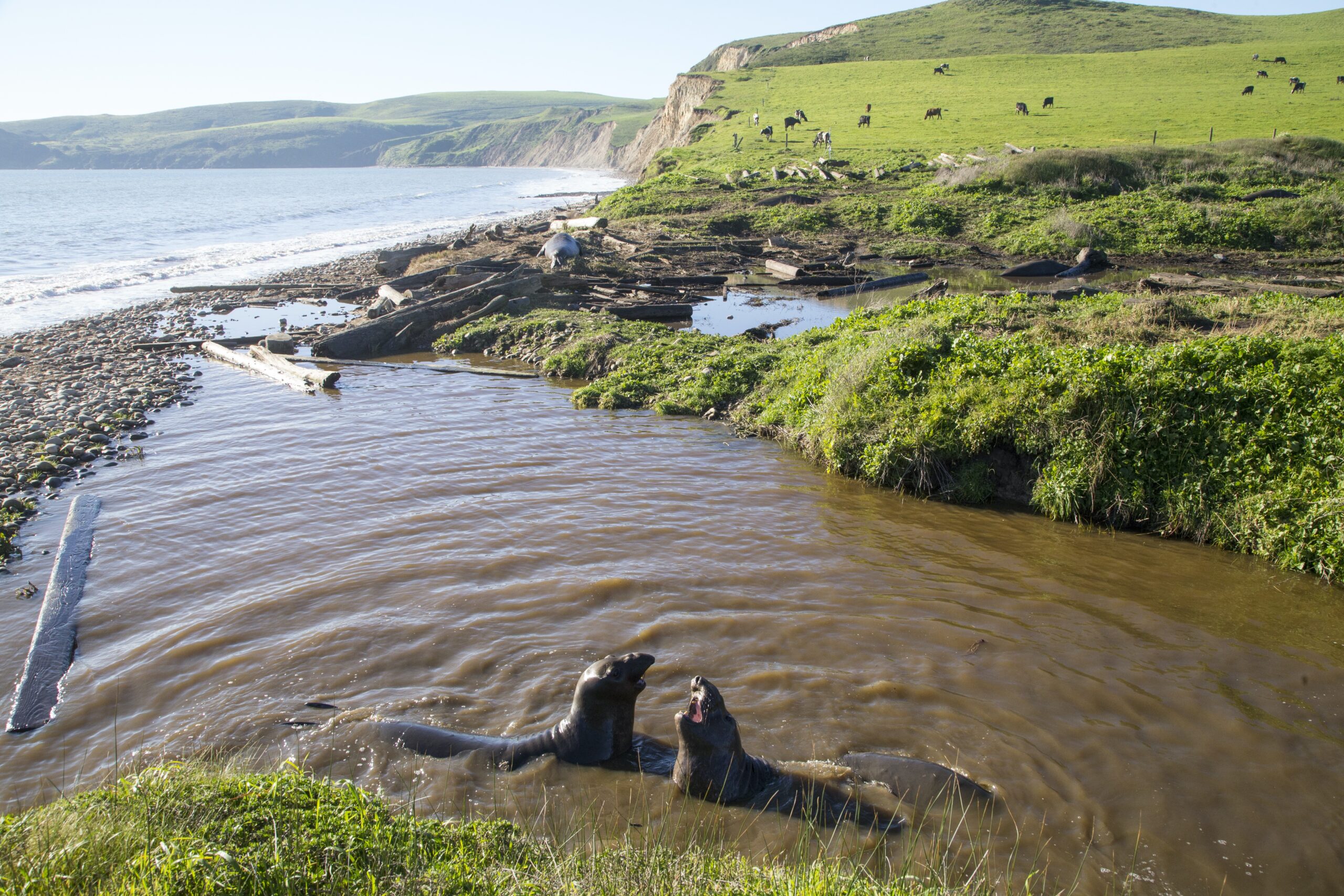
POLLUTED Elephant seals raise pups in a lagoon adjacent to B Ranch where, earlier this year, E. coli levels were measured at 11.5 times greater than the maximum exposure allowed. Photo by Jocelyn Knight
Got guns?
Western United Dairies is a trade organization that lobbies for extending ranch leases at the Seashore. On April 8, 2021, its Marin representative emailed executives at the Water Board complaining about press coverage of demonstrations at Point Reyes. Melissa Lema wrote, “For you and your staff contacts, dairies in the national seashore have been dealing with rampant, often unmitigated and sometimes violent protesters for months, with yet another demonstration planned this Saturday in the park.” Western United Dairies did not respond to a request for an example of the purported violence.
Portraying peaceful protestors as violent is a common public relations tactic, but there is a deeper level of potentially violent reactivity emerging in this developing situation, and it is not coming from conservationists and protestors. According to USASpending.gov, since 2019, Point Reyes park administrators have spent $54,000 buying guns and ammunition. In 2019, they purchased Sig Sauer and Luger pistols with silencers and some 30,000 bullets.
In 2022, administrators spent $12,612 on a “LessLethal Launcher” capable of firing “less lethal” bullets and tear gas, and $8,333 on “frangible” bullets, which fragment upon impact. The recent expenditures on weapons and bullets are more than 10 times amounts spent on weaponry in comparable years. Point Reyes staff did not respond to a query about why they are stocking up on lethal and less-lethal anti-personnel weapons.
Wastewater waivers
Laurie Taul is the Water Board official who oversees Point Reyes. According to records received via a public records request, on Jan. 12, 2021, Taul informed her boss, “On Monday, Albert Straus [owner of Straus Dairies which sources raw milk from Point Reyes] emailed me and [he] is concerned that Coastal Commission staff are asking for a water quality plan from the Park for the ranches and dairies. It sounds like he feels this is redundant because we [already] require the dairies and grazers to prepare plans and report annually.”
Those reports are self-reports, and the Water Board had not inspected a Point Reyes dairy since 2007, said its Bay Area manager, Xavier Fernandez.
A 2003 report by Taul observes that dairy runoff “may include manure waste, wastewater, milk barn wash, silage leachate, irrigation tailwater, dead animals, waste milk, medical waste, spoiled feed, bedding.” Dairy waste poses “a significant threat to both surface and groundwater quality, irrespective of herd size. Animal waste discharges … contribute pathogens, ammonia, salts, and sediment to nearby streams.”
For its part, the Water Board asks dairy ranchers to “visuallyinspect the closest water … to monitor any change in water quality resulting from facility operations.” Ranchers are required to self-certify “under penalty of law” that they have not seen any water quality problems.
However, an examination of annual reports from all five of the Point Reyes dairies operating throughout 2021 did not find a single instance of a ranch operator affirming, “Based on your visual inspections and observations during the past year, did you discover any threats to water quality or pollutant discharges to surface or groundwater?” When it started to use its own eyes, the Water Board discovered “high risk” threats to water quality at three dairies, and less serious issues at two dairies.
In an April 2021 memo, Taul acknowledged that fecal bacterial levels in Point Reyes waters were exceeding allowable standards. She relied on recent tests commissioned by Western Watersheds Project, because Parks had discontinued testing in 2013. Taul wrote that the Water Board has long depended upon Parks to inspect the ranches, but now, “We plan to inspect [the] ranches and dairies at our earliest opportunity.” That opportunity did not arrive until 10 months later, when a hiker stepped in a puddle of raw sewage in a pasture at B Ranch and complained to the Water Board, environmental groups and reporters.
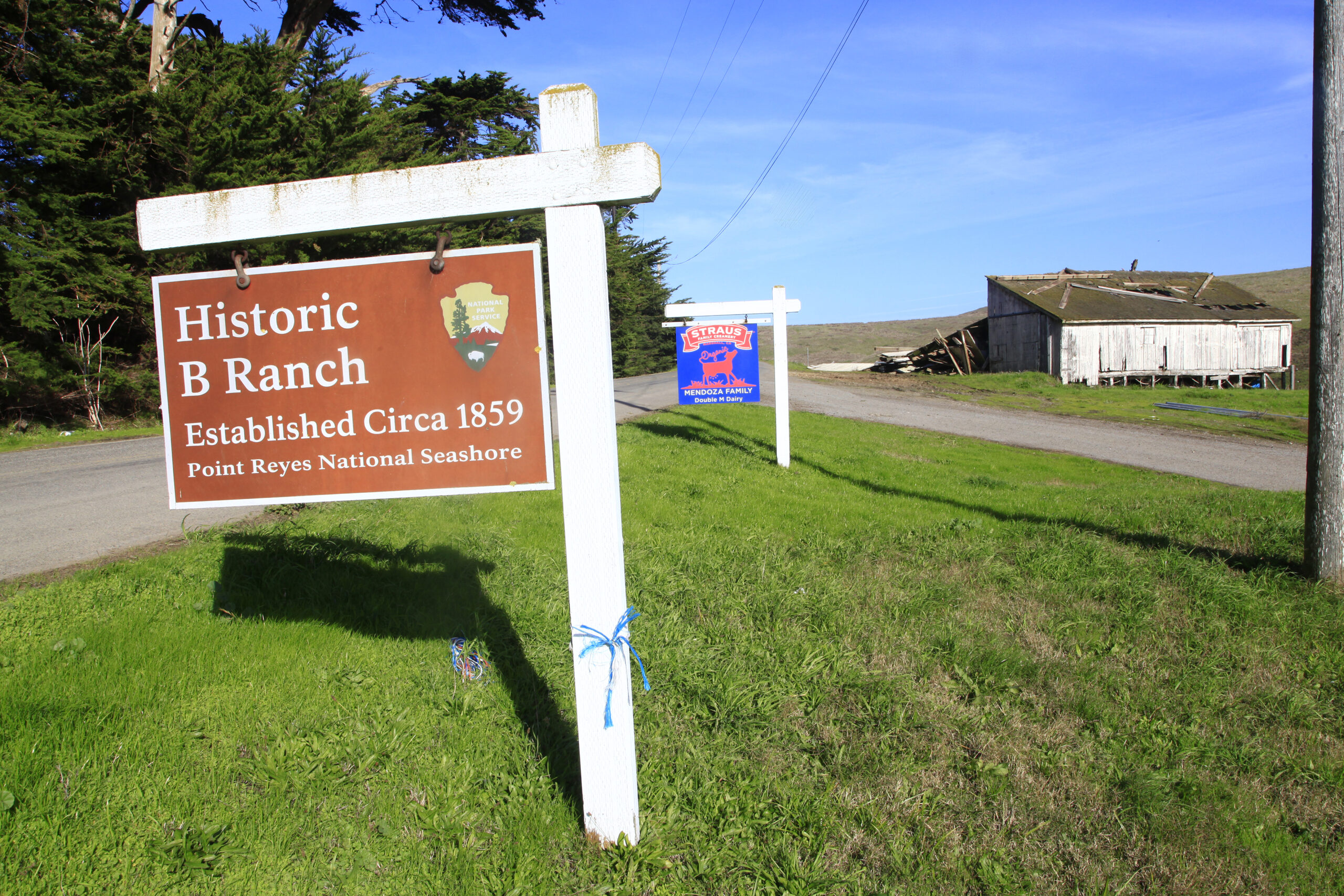
MODERN DAIRY Straus Organic Family Creamery sources milk from B Ranch. Photo by Jocelyn Knight
Nightmare at B Ranch
B Ranch is leased and operated by Jarrod Mendoza as Double M Dairy. According to Water Board inspectors, “the [B Ranch] loafing barn is in poor condition and is currently unusable.”
Consequently, hundreds of dairy cows were housed in a field “adjacent to three wastewater ponds full of liquefying manure.” Pond and stormwater diversion systems were dysfunctional.
Mendoza did not have “a complete and updated Waste Management Plan,” nor required records documenting inspections. There was erosion on grazing pastures due to “too much animal traffic.” “There were no measures to prevent soil and manure from washing off [a livestock] crossing into the creek below.” According to the Board, “best management practices” were largely lacking. Ground water quality was testing below standards.
To help meet a state regulation that requires dairies to regularly test the quality of ground waters, the Water Board has outsourced that task to an industry group that, since 2019, has offered Point Reyes ranchers a non-laboratory-based testing service which cannot detect fecal bacteria. Water Board records reveal that the Sonoma Farm Bureau’s 2018 and 2021 field tests of a site near B Ranch found that levels of nitrogen, ammonia and other “measures all exceeded benchmarks. … indicating that the facility’s stormwater discharges are likely adversely impacting water quality.” But no action was taken until the raw sewage complaint was filed.
Concurrent with the Board’s first inspection of a Point Reyes dairy in 15 years, Marin EHS and Parks were motivated to inspect, for the first time, a septic system serving five houses and 19 bedrooms at B Ranch. The “system was non-functional. … Two pipes originating from the four residential dwelling units in the ranch core were observed to be discharging raw sewage into the cow pasture.” Under one residence, “staff identified a broken pipe … discharging sewage into the space beneath the house.” A septic tank appeared to be discharging sewage into a pasture. Inspectors could not locate a tank serving the farmworker’s restroom.
In sum, human bodily waste was sluicing into fields of bovine effluvia, blending into a fecal soup percolating downhill into a wetland bordering Drakes Bay, where a culvert spews stinky, brown sludge into a lagoon where elephant seals raise their newborns. This year, water quality tests in the lagoon measured E. coli levels at 11.5 times greater than the maximum exposure allowed. Mendoza did not respond to requests for comment.
Ranch leases require that ranchers pay for and maintain the septic systems. However, as the B Ranch disaster unfolded, Parks chose to pay for installing six porta-restrooms, new pipelines, a 5,000-gallon septic tank, and drafting “a conceptual design that can be used for compliance approval and planning purposes.” On Feb. 23, Parks noted, “We are currently purchasing supplies and material to connect the two septic lines that daylight into the pasture area.”
The sludge thickens
The Water Board went on to inspect the Seashore’s four other operating dairies, including the McClelland Dairy at L Ranch, which drains into the Tomales Bay and Abbotts Lagoon. Operated by Robert and Jolynn McClelland, the dairy sells to the Organic Valley brand. Inspectors noted that the dairy did not have a current Waste Management Plan for two manure ponds separated by a stream.
“The ponds are undersized. … the facility includes one unused and condemned barn … there were no Best Management Practices in place to prevent pollution discharge …. the calf corral likely discharges sediment and possibly manure into the adjacent pastureland. … the second waste pond [could] discharge into the downhill pastureland and drain toward the nearest stream.”
Marin EHS determined that the L Ranch septic system serving six houses was non-functional. The operators were told to pump and cap it and rebuild from scratch. In emails obtained from the county agency, Inspector Gwen Baert wrote, “It appears the Park Service doesn’t want to be heavy-handed, but I think we should be.” The McClellands did not respond to requests for comment, nor did Parks.
Marin EHS went on to examine 42 septic systems on 17 Park ranches leased to ranchers. Baert explained to colleagues, “Marin County did not have an agreement with the National Park Service to do routine sanitary surveys, it is quite possible that the inspections that were conducted this year represented the first time that many of the ranches and dairies had a sanitary review of the septic systems.”
Water protectors to the rescue
A National Park Servicestudy of Point Reyes in 2013 by Anitra Pawley and Mui Lay found “numerous ranches, dairies and pasture lands that contribute to water quality degradation through bacteria and nutrient loading from animal waste and runoff [and]failing septic system leach fields result in nutrient and pathogen loading. … Kehoe and Abbotts Lagoon periodically exhibit high bacterial counts affecting human uses including swimming and shellfish harvesting. … There is clear evidence of significant declines in some nearshore fish species.” Parks declined to comment on any of the facts and events presented in this story.
In 2021, tests sponsored by Western Watershed Project found unacceptable levels of pathogens at Point Reyes beaches. Last winter, Turtle Island Restoration Networks sponsored a more comprehensive testing regime.
As rosy dawn light splashed the parking lot at Abbotts Lagoon in January, about 30 people accepted labeled vials from geoenvironmental scientist Douglas Lovell. Once a week for two months, volunteers—ordinary folks trained in the rigorous protocols of water sampling techniques by Lovell—took water samples at 14 sites covering four watersheds in the park.
Slogging through brambles and muck and tangles of barbed wire outside the ranch cores, they captured 125 specimens to be analyzed in the Bay Area labs of McCampbell Analytical.
In late October, Lovell released his full report, with these highlights.
The level of fecal bacterial indicators in the waters draining from J and L ranch are so elevated, “it is likely that visitors to Kehoe Lagoon and Kehoe Beach have contracted gastrointestinal illness from exposure to cattle manure pathogens.”
“The National Park Service claim that conventional cattle manure management practices will adequately protect surface water quality is false … protection …. will require reduction of the active dairy herds.”
“A Ranch and B Ranch drainages are significantly impaired … bacteria concentrations were more than 10 times the [allowed measure].”
The overall cattle manure load in the sampled watersheds is sufficient to cause dangerous agal and cynobacterial bloom.
“The National Park Service has not warned park visitors of these risks despite full knowledge of the risks.”
These findings are not unexpected; Parks, the Water Board, NOAA, the EPA, Marin EHS and the Coastal Commission have known about the deleterious impacts of beef and dairy ranching for decades. The agencies have long acted as if they are charged with protecting ranching from the existential needs of wildlife, native plants, aquatic life and not the reverse.
HOSED A pipe used to spread manure across B Ranch. Photo by Jocelyn Knight
A sad story
An environmental history of Tomales Bay published by Parks in 2009 explained:
“Dairy farmers had typically sought properties with creeks that would provide water for their stock, but these same creeks carried animal wastes into the bay. When manure washed into the estuary, the high levels of ammonia in the waste poisoned fish and posed threats to human health. In rainy weather, sewage ponds overflowed, and waste material washed into the nearby waterways. The 10,254 dairy cows and beef cattle in the watershed produced 1,066,574 pounds of manure per day in 2000. Cattle also increased erosion as they trampled streambanks, causing [48,000 tons of] silt to wash into the bay [every year].”
At the millennium, Parks hydrologist Brannon J. Ketcham, reported:
“[Water testing] has revealed degraded water quality conditions below most of the dairy operations within the Seashore … identifying fecal coliform and toxic ammonia as primary indicators. … High pollutant levels … are attributed to direct access to water [by cows] or persistent sources (septic systems). … The waters of [the Seashore are] extremely diverse, valuable, and sensitive [and] dependent upon the water quality. … best management practices have not been established … streams within the pastoral zone … support endangered or threatened species.”
Ketcham complained that a lack of funding for testing had stymied a pressing need to “meet the detailed monitoring requirements … necessary on most watershed[s] within the pastoral zone. … A complete inventory of the water quality … has never been performed.”
Ketcham noted, “Dairy runoff … does affect water quality on Drakes Bay and offshore waters of northern Point Reyes. [Parks] is currently working with these ranches to improve dairy facilities and management to correct these problems.”
Parks, the Water Board and Marin Resource Conservation District have spent more than $10 million in the last decade on “bestmanagement practices” at the Seashore, primarily installing miles of barbed wire fencing to, in theory, keep cattle from defecating into ponds, streams, estuaries. In practice, many fences are broken due to lack of maintenance, and cattle freely wallow in waters throughout the park. Fencing makes public lands inaccessible to hikers, boaters, swimmers, fishers. It disrupts wildlife migration and cuts off their access to water.
Fence-confined bovines unload millions of pounds of concentrated fecal matter into pastures adjacent to ponds and streams. When the rains come, fences cannot stop bacteria from infiltrating the waters.
Science of fencing
Parks has responded to queries about water pollution by citing a2021 study on the Kehoe Creek and Abbotts Lagoon watersheds by Ketcham and Park ecologist Dylan Voeller, who oversees environmental monitoring at the dairies, and Benjamin Becker, a Parks employee.
They opinethat pollution levels may be waning due to “best management practices,” i.e., fencing, and spraying liquid manure on fields to lower the levels of overflowing manure ponds.
Inverness-based financial software architect Ken Bouley disagrees. In an analysis submitted to a California Coastal Commission hearing in September, Bouley detailed his belief that the Voeller-Ketcham study is flawed by a “paucity of data and omitted explanatory variables.”
Meaning he assessed the authors did not examine enough data points to substantiate their opinions, and that they neglected to adequately consider statistical models that could contradict their conjecture that fencing lowers the rate at which fecal pathogens sluice into streams, and that, therefore, the best way to reduce cow-induced pollution is to build more fences. Bouley observed “that even after numerous, costly projects, water quality still exceeded regulatory thresholds between half and three-quarters of the time.”
He found an error in the study’s data sourcing that called into question its concluding opinions. Bouleybrought up the matter with Voeller, who agreed that there was an error, although he stood by his opinions. Neither Ketcham nor Voeller responded to requests for comment.
Parks also refers to a 2019 study co-authored by Voeller and David Lewis, who directs the University of California Cooperative Extension, Marin and is a board officer of Marin Conservation League. Their paper opines that the installation of fencing had likely caused a “downward trend” in fecal bacterial counts over 19 years.
The study discounts stream samples taken after rainstorms that exhibited increasing trendsin levels of fecal bacteria. And the removal of 780 acres from cattle grazing during the study period was a one-time effect which may have lowered pollution levels temporarily but may not represent a trend. Voeller and Lewis admit, “It is often difficult to demonstrate, beyond a reasonable doubt, that grazing management practices result in quantifiable water quality improvements.”
It is not difficult to demonstrate that the UC Cooperative Extension is quantifiably funded by agribusiness. The Extension self-describes as “part of the agricultural community, we help farmers implement more efficient growing methods and solve pest management problems.” Public records show that the Extension has received tens of thousands of dollars in donations fromchemical corporations that produce artificial pesticides and livestock feed additives. Major donors include Dow AgroSciences and Bayer Corporation (which owns Monsanto Company and its controversial Roundup pesticide). Lewis did not respond to requests for comment.
Sacred lands
Point Reyes embraces scores of ancient Indigenous sites destroyed by ranching and the indifference of the National Park Service. A 1998 Sonoma State University archeological study by Barbra Polansky observed a shell midden located on the trail that leads to Kehoe Beach:
“There is a recently constructed National Park Service bathroom facility on the South side of the trail, adjacent to traces of the midden.”
The Department of Interior dug a latrine on top of a sacred burial ground. It has similarly desecrated other sacred sites at the Seashore and throughout North America. But increasingly faced with governmental environmental malfeasance, people all over the world are starting to listen to the lessons of Indigenous science and the Land Back movement—the topic of an upcoming story on how and why the battle for Point Reyes is a contest for the future of life.
This investigation is supported by the Fund for Investigative Journalism and Reporters Committee for Freedom of the Press. Support journalism at www.peterbyrne.info.
As cold temperatures descend on the North Bay, advocates are pushing for more measures to protect people living on the street.
In a statement released on Friday, Nov. 18, the Sonoma County Human Rights Commission called on the county to provide “immediate relief” during freezing conditions by opening public buildings, including the Veterans Memorial Hall and Sonoma County Fairgrounds buildings,...
There is no way to talk around the issue. There is a dearth of hip-hop support in the North Bay.
Nevermind that one of the greatest to ever spit truth through a mic came up in Marin City. Tupac Shakur’s firework streak of fame failed to ignite a scene in the only predominantly Black city in Marin. If it had,...
Folks who like their fairy-tale endings in the “and they lived happily ever after” vein may find themselves challenged by Marisela Treviño Orta’s The River Bride.
Part Brazilian folklore and part Brothers Grimm at their grimmest, it’s the tale of two sisters and the men in their lives. Santa Rosa’s 6th Street Playhouse has a production running on their Monroe...
After discovering definitive proof that Vikings reached the shores of North America 1,000 years ago, anthropologists have since learned that the Nordic explorers felt dissed that they weren't invited to the first Thanksgiving.
Recently translated Viking ship logs indicate that “no one even tried to reach out, despite the fact that we predate the arrival of Columbus, the Virginia settlement...
By Ingrid Newkirk
In the 1960s, there was a TV show called A Man Called Shenandoah. A man with amnesia would ride into a town in the American West, take on a problem, solve it and then leave.
The townspeople would thank him, and he would say, “It was the least I could do.” I never understood that. If that was...
Dead Bird
Let Twitter die, quietly. No more “news” stories about the humiliations, carnage and suffering. There are alternatives in the social media world for all the truly desperate to post their angst. Try Mastodon; go back to MySpace, Reddit, etc. Giving those who are considering remaining on Twitter another reason to leave. No publicity, just an empty dark space...
Hosting a holiday happy hour or dinner party?
These fall inspired cocktails made with local ingredients are sure to tantalize.
Pumpkin Bourbon Smash Cocktail
Who needs a pumpkin spice latte when you can have a pumpkin spiced cocktail? This Pumpkin Bourbon Smash has all of the spiced goodness of pumpkin pie with a whiskey kick and is sure to be a hit...
Sebastopol
Jewish Film Festival
Jewish Community Center Sonoma County presents its 27th Annual Jewish Film Festival from 1 to 7pm, Tuesdays, Nov. 29 to Dec. 20, at Sebastopol’s Rialto Cinemas, and streaming online. This year’s lineup features films with several strong, fascinating female characters with effervescent performances from the actresses depicting them. Featuring an international lineup of films as yet unseen...
ARIES (March 21-April 19): One of your callings as an Aries is to take risks. You're inclined to take more leaps of faith than other people, and you're also more likely to navigate them to your advantage—or at least not get burned. A key reason for your success is your keen intuition about which gambles are relatively smart and...
It’s an October morning at Point Reyes National Seashore and I’m scooting under barbed wire fences, wary of sliding into cow pies.
My guide on this safari is Jocelyn Knight, wildlife photographer. We’re stalking a toxic waste dump hidden from public view behind a hill at “Historic E Ranch, established circa 1859” land lorded by the National Park Service.
Park regulations...