Round Eyes in the Middle Kingdom

0

China White


Gemma La Mana

Commie Dearest: Filmmaker Ron Levaco,
age 2, on a beach in China.

A Polish Jew hits
the road with Mao

By Zack Stentz

“NEVER THE TWAIN shall meet,” predicted Rudyard Kipling of East and West, a statement often quoted to express the supposedly alien and irreconcilable natures of the Orient and Occident. But if it’s true, then what is one to make of Israel Epstein, the subject of the fascinating new documentary Round Eyes in the Middle Kingdom?

Born in Poland, Epstein migrated with his radical Jewish parents to China when he was 2 years old. His family became part of the large community of Western expatriates living there during the strife-torn ’20s and ’30s. But when most foreigners fled the country during or after the 1949 revolution that brought Mao Zedong to power, young Epstein became a Chinese citizen and opted to remain, throwing his lot in with Communism, which he saw as the Chinese people’s best hope for peace and dignity . “There are lots of Asian Americans, so why not a non-Asian Chinese?” Epstein asks rhetorically in the film.

The answer to the “why” is a choice that has puzzled filmmaker Ron Levaco for nearly half a century. Interwoven with Epstein’s story are the circumstances of Levaco’s own early childhood as an Eastern European Jewish child in China–where he lived from his birth in 1940 until his immigration to the United States after the revolution. “There’s no question the story of Epstein had haunted me since childhood,” says Levaco of this family friend, “because my father, who was very much a capitalist, was so much the opposite of this gnomish, enigmatic man that I couldn’t understand why my father felt so close to him.

“And I discovered that the link between the two men was heart. Both men were very compassionate toward the Chinese people, but my father didn’t have the political world view or the impetus to figure out how to cope with these problems he saw.”

While Levaco père may not have followed his friend Epstein’s path of revolutionary solidarity, his perspective, too, can be found in Round Eyes, in still photos and 8mm film footage interspersed among the archival footage and interviews with Epstein that collectively make up the film.

More difficult than inserting his own family memories into the narrative was Levaco’s subject, who proved to be difficult to contact and wary of being interviewed. And what is one to make of a man who, despite being kept in solitary confinement for five years during the paroxysms of the Cultural Revolution, continues to defend the Chinese government and admonishes the filmmaker not to focus too much on his imprisonment because “it’s only a small part of the larger story”?

“I have a very tangled sense of Epstein,” Levaco admits. “On the one hand, I understand him to be incredibly rigid, but I imagine if we sat down with Mother Teresa or Albert Schweitzer we’d find them to be pretty rigid, too. I think that a person who is deeply committed to a cause, and sees that cause like a shining beacon in the dark, will roll right over a lot of questions, like how he felt about being in prison.

“It was my task also to try and present this man as fairly as I could, so he wouldn’t think I’d done some hatchet job, yet at the same time to present to a Western audience this Communist who supported a revolution which, a few years later, saw Chinese pilots in Mig-15s shooting down our guys in Korea. We’re talking about an enemy.”

Though not as tortured as Epstein’s, Levaco’s own path toward making Round Eyes was nonetheless a convoluted one, including a 25-year detour as a professor of film theory at San Francisco State University. “When you go into a film Ph.D. program, you usually have to put your camera down in favor of research,” explains Levaco, whose own research included the definitive book on Lev Kuleshov, early Soviet filmmaker and montage theory pioneer. “And that deferral was very painful to me.”

Levaco now spends most of his time lining up theatrical and television venues for Round Eyes to play. “I hope the audience will be put on the horns of a dilemma,” he says, “and will realize that sometimes this life presents us with extremely difficult political choices, like Epstein’s choice between [anti-Communist Kuomintang leader] Chiang Kai-shek and Mao Zedong.

“Mao turned out in many ways to have been a monster, but at the moment of that choice, like going down a river that suddenly forks, you’ve got to take the fork that looks best at the time and follow it down to wherever it leads.”

That the viewer leaves the theater understanding and even sympathizing with Epstein’s own “political ‘Sophie’s choice,'” in Levaco’s words, is a testament to Round Eyes‘ power and achievement. And despite the impressive foreignness of the setting and the enigmatic nature of Epstein himself, his decision comes across as a choice grounded not in the peculiarities of Chinese or Jewish culture or Marxist ideology, but in a universal human sympathy for the oppressed and mistreated.

Indeed, by the end of Round Eyes one may be reminded of the other, lesser-known half of Kipling’s quote, which, like Levaco’s film, celebrates the impulses that transcend the barriers of culture and geography: “But there is neither East nor West, border, nor breed, nor birth/ When two strong men stand face to face, though they come from the ends of the earth!”

Round Eyes in the Middle Kingdom plays at the Raven Theater on Monday, Oct. 14, at 7 p.m. Ron Levaco hosts a post-screening discussion. 415 Center St., Healdsburg. $4-$6. 433-5448.

From the October 10-16, 1996 issue of the Sonoma Independent

This page was designed and created by the Boulevards team.
© 1996 Metrosa, Inc.

Talking Pictures

0

Son of Hugo

Globetrotting naturalist
Douglas Quin explores
Hugo Van Lawick’s
newest film

By David Templeton

Writer David Templeton takes interesting people to interesting movies in his ongoing quest for the ultimate post-film conversation. This time out, he takes in the sumptuous wild-life epic The Leopard Son with award-winning musician and naturalist Douglas Quin.

Hugo Van Lawick is to wildlife cinematographers what Orson Welles is to aspiring actor/directors–though Hugo has yet to shoot a wine commercial. His spectacular ’60s-era images of the respected primatologist (and then wife) Jane Goodall working among Africa’s chimpanzees are legendary. For 30 years, his shots of wildlife on the plains of the Serengeti have served as a benchmark to those unfearing souls who ache for the chance to put a camera (or a microphone) right in the snarling face of nature.

“I was certainly inspired as a young man by the work of Jane Goodall and Hugo,” nods composer/naturalist Douglas Quin, after meeting near his Sonoma home to see Van Lawick’s latest cinematic offering, The Leopard Son, a miraculous encapsulation of two dramatic years in the life of a Serengeti leopard cub.

“Amazing!” Quin exclaims as the film comes to an end. “Every shot is a work of art. It’s just beautiful.” His appreciation is in part informed by his own experiences on the plains of Tanzania, not as a photographer, but as a collector of wildlife sounds. “When you spend days and weeks in these places, you realize just how difficult it is to translate those experiences to film, to tape, to video, whatever the medium is.”

Quin’s own quest for things that go bump in the night has taken him to Africa, to the Brazilian rain forests, to the North Pole. Later this month he’ll depart for the continent of Antarctica, where he will spend six weeks following penguins, seals, and icebergs. His recordings, which are used in a variety of museum and zoo exhibitions around the world, are also the basis of some extraordinary musical compositions, such as the recent Oropendola: Music by and from Birds, an evocative weaving of natural bird song and man-made melody.

At the moment, however, Quin has ears only for Africa.

“The wind is a constant there,” he recalls softly. “I was reminded of how much I was always struggling with recording with all the wind at dusk. There was almost always wind out on the plains, rustling in the grasses. There are so many sounds. The sound of baboons encountering a leopard is quite distinct. A lion roar will carry for miles. You hear that roar and no matter where you are, everything stops, looks up, gets a fix on it–as in, ‘Where’s that?’ and ‘I don’t want to be near that!’ Birds. Animals. Everything stops right in its tracks. It’s really an amazing sound.”

And leopards?

“I was there six months and I only saw two leopards,” he shrugs. “One with a kill of a gazelle, up in a tree, sleeping and resting. You really have to look for them. Hyenas are also fairly elusive. I followed one for three hours and then–poof!, it was gone. Baboons, however, are right there in your face.”

And they’re nasty, too.

“They have teeth you wouldn’t believe,” he smiles. “I remember putting together dinner the first night I was in Kenya. All of a sudden, one baboon comes and sits about 50 feet away. Just sits, looking at us. Ten or 15 minutes went by, and we were surrounded completely. Then the larger ones would approach, one at a time. One would come, and I’d toss rocks at it to make it back up, and while I was preoccupied with him, another one would come, while a third made the run for the food. They worked in twos and threes and fours, and just played me till I didn’t know where I was going. I was just spinning around. In the end I packed up the food and put it in the car, and we ate in the car. Four or five baboons can put together quite a strategy for getting what they want out of you. They have the patience of Job.”

Or, one might say, the patience of a wildlife artist, of a Hugo. Or of a Quin.

“There is a lot of waiting around,” Quin agrees. “But in that waiting there is a kind of peace and stillness, of being attentive. I think it speaks to that hunter instinct of being alert. Of all senses being primed for experience. It’s exciting to be attentive for long periods of time.

“So much of our daily lives is about distractions, and overcoming or masking our hearing and sight. Because we have this to do and that to do, our lives become sort of parsed out into these tasks that don’t always involve paying attention. Life conspires, in most situations, to prevent us from having that attentive, sensory stimulation in overdrive.

“What was so beautiful about that film,” Quin adds, “was that the richness of every shot was almost overwhelming, and then you realize that years of this guy’s life, of that heightened sense of awareness to the world around him, is brought into every single frame. It truly boggles my mind.”

This page was designed and created by the Boulevards team.
© 1996 Metrosa, Inc.

Open Studios

0

Eye Sight

By Gretchen Giles

PLACE A VASE of flowers on a table and jump back. Although most of us see to relatively the same degree, we all look at similar objects and know them in vastly different ways. The humble ink splotch lies in silent testimony. And ain’t that the beauty part of being alive? Which is why it is such a kick to snoop around artists’ studios, getting a glimpse of how an eye trained in a manner vastly different than your own takes in the world. And ain’t that the beauty part of ARTrails?

Now in it’s 11th year, this open-studio event flings wide the workplace doors of artists, allowing the public to come in, sniff around, ask questions, and buy stuff.

At least painter Kathleen Thompson-Siegel doesn’t have to worry about doing the dishes first. Her studio–unlike those of many of the ARTrails participants–is separate from her home, housed in a renovated transmission shop west of Santa Rosa’s Juilliard Park. Shelved in cardboard boxes and leaning against the walls are her water-motif paintings, explorations of the power of rejuvenation and of color work whose names would give challenge to lipstick manufacturers. “I was trying to come up with colors that you can’t name what they are,” she says.

“I’ve had a really tumultuous year, emotionally,” she continues, lightly stroking one of the many upsurging water images found on her canvases. “I’m interested in the fountain as a symbol of the cleansing of the psyche, you know–hope and faith. And that just came up unconsciously, and it was almost like a dream afterwards to figure out what it meant.”

Intending to create work whose purpose is to heal and to calm, Thompson-Siegel is pleased to see that effect affecting others, relating the story of a young autistic boy who was literally moved by her work in a Healdsburg gallery. Standing before her large gouache-washed canvases, the boy began to sing softly to himself and to dance. His mother stood by and cried. “That to me was a gift,” Thompson-Siegel says quietly.

Working on a number of canvases at once, she also involves herself in the secrets of encaustic work, in which the surface is layered in wax, with objects scratched and tucked in, creating thickly veneered pieces. “It’s a whole different approach, which is really great, because I think that if I just did one thing it would be too redundant. This informs the paintings and the paintings inform the other.

“I’m really grateful to be doing this,” she continues. “Someone once told me that there isn’t just one art world, there are many art worlds, and it has to do with personal, internal growth and just growing up. Discovering what you like–this is what I’m doing.”

ARTrails runs Oct. 12-13 and 19-20 at various studios from 10 a.m. to 5 p.m. Free. For maps, call 579-ARTS.

From the October 10-16, 1996 issue of the Sonoma Independent

This page was designed and created by the Boulevards team.
© 1996 Metrosa, Inc.

Stitch-te Naku

0

Creation Myths

By Zack Stentz

Those crafty spiders. When they’re not catching flies, building ornate webs, or turning Peter Parker into a web-slinging superhero, they’re busy creating the Universe, at least according to quite a few Native American folklore traditions.

Several tribes in the American Southwest share the tale of Stitch-te Naku, the “Spider Old Woman” who creates the world and its inhabitants as she weaves her web, a rich and compelling metaphor for the creative act. So it was only logical that a creation myth inspire another generative act, as when New York composer Katherine Hoover was moved to create a musical composition out of Stitch-te Naku’s story, joining the elite company of arachnid-inspired compositions like “The Tarantella,” “Itsy-Bitsy Spider,” and “Theme from Spider-Man.”

The piece Stitch-te Naku will have its world premiere on Saturday, Oct. 12, in Sonoma County as part of the Rohnert Park Chamber Orchestra’s inaugural concert of the 1996 fall season, and organizers couldn’t be more thrilled. “We’re stretching our budget on this one,” says RPCO executive director Linda Temple, “especially to get [internationally renowned cellist] Sharon Robinson, but it’s worth it to us because the composition and the story are so wonderful.”

Temple even saw some opportunity for cross-promotion in Stitch-te Naku‘s constructionist theme. “We tried to get an architectural firm to help underwrite the performance, because of the whole theme of building and creation in the composition,” she recalls. “It didn’t work, though.”

In the grand tradition of Sergei Prokofiev making the orchestra’s various sections represent a young boy, a wolf, and hunters in his classic Peter and the Wolf, Stitch-te Naku also links character with instrument, in this case the agile spider with the equally dextrous cello playing of Sharon Robinson, for whom Hoover custom-wrote the work. “I can see the comparison with Peter, though I think this piece has a very different tone. It has a lot of dignity to it, and the cello especially has a real ‘singing’ quality to it,” says RPCO conductor Nan Washburn, explaining that by ‘singing’ she means “not just a lot of fast showy notes like many cello solos.”

Other works in the “Folk Tales and Tunes”­titled opening night concert include influential American composer Henry Cowell’s Old American Country Set in honor of his centennial, Jose Bragato’s Graciala y Buenos Aires, and–for those die-hard classicists out there–Italian Symphony by Felix Mendelssohn. “All of the works have the common theme of the composers reacting to non-classical, folk influences,” says Washburn of the evening’s common theme. “Even Mendelssohn, a German-Jewish composer, was inspired by the traditional songs he heard on his first trip to Italy.”

Also linking the works is the RPCO’s characteristically adventurous approach to musical programming. “We want to prove to the community here that we have our own identity and fill a different niche than the Santa Rosa Symphony,” says Temple. “We don’t rely so much on traditional classical music–the ‘three Bs’ of Bach, Brahms, and Beethoven–but try to emphasize, modern, living composers, including works by women and people of color.”

But to Washburn, choosing the riskier path of lesser-known living composers over the work of safely dead European masters offers rewards far wider than following some abstract affirmative action­like quota. “I’m excited because when audiences come for the premiere, they’ll be witnessing and participating in the creation of a new work as it’s played before an audience for the first time,” she says of her opening-night dress rehearsals. “And because our setting is more intimate than some big concert hall, and the composer will be there, it’ll be a completely different experience for the audience. At how many classical music concerts can you watch a work being performed for the first time and then meet the composer after the show?”

Stitch-Te Naku premieres Saturday, Oct. 12, at 8 p.m., and Sunday, Oct. 13, at 2:30 p.m. Spreckels Performing Arts Center, 1540 Snyder Lane, Rohnert Park. $13-$17. 584-1700.

From the October 10-16, 1996 issue of the Sonoma Independent

This page was designed and created by the Boulevards team.
© 1996 Metrosa, Inc.

National Parks

The Fall of the Wild


Illustrations by Mott Jordan

The National Park Service can no longer provide the necessary supervision to spare its 80 million acres of wilderness and historic treasures from the ravages of time and tourism–so it’s trolling for corporate sponsors

By Christopher Weir

AS CONGRESS DANCES over the hot coals of an election year, politicians from both major parties are supporting legislation that would create ten “official sponsors” for the National Park Service. The goal is to raise $100 million to shore up the park system’s shrinking budget and crumbling infrastructure. And while it remains to be seen if the messianic legions of corporate America can stave off park degradation, you can at least brace yourself for nature documentaries “brought to you by Exxon, official sponsor of the National Park Service.”

Across the country, national park attendance is exploding, visitor and management services are disintegrating, and maintenance backlogs are mounting. Bottom liners growl that there’s simply not enough taxpayer money to do the trick, and that the recent christenings of new parks are a drain on finite fiscal resources. Park advocates counter that such arguments enshroud dysfunctional priorities that would trash our national heritage.

What’s clear is that the National Park Service can’t muster the management required to protect its charge from decay and overcrowding. “They’re having to postpone so much,” says Don Fogg, a veteran volunteer with the service’s western regional information office. “The term is ‘deferred maintenance,’ which means letting things go to rack and ruin until such time as they have money to fix them.”

In fact, the National Park Service deferred maintenance backlog exceeds $4 billion while the annual operating shortfall hovers above $500 million. Obviously, it’s going to take much more than corporate marketing stunts to turn things around. So the question remains whether the proposed alliance between Capitol Hill, Bambi and big business is truly a step toward national park salvation, or merely another maneuver to deflect a real commitment to preserving our national treasures.

What in the Hell Went Wrong?

WHILE ALL OF THE 369 holdings of the National Park System are affected by budget woes and shoestring management, nowhere is the strain more evident than in the wilderness areas, where precious ecosystems are being crushed under the weight of their own allure.

At Sequoia National Park, raw sewage erupts from enfeebled visitor areas. Yosemite’s formerly pristine high meadows are now overrun, while many of the more than 4 million annual visitors run roughshod over the park’s increasingly unsupervised roads and trails. At Arizona’s Petrified Forest National Park, more than 12 tons of petrified wood have been stolen.

Yellowstone is shutting down campgrounds and museums, and the Grand Canyon’s famous views are throttled with smog. At Great Smoky Mountains in Tennessee, 3.8 million cars a year have created an ecology of gridlock, while the seasonal ranger staff has been reduced by 70 percent. Everywhere, stray trash drifts unmolested while toilets wait to be cleaned. Unfortunately, the sordid list goes on and on.

“The use of the parks has been increasing, especially during the recession, because sometimes it’s the only thing people can afford,” says Mary Ann Matthews, state forestry coordinator for the California Native Plant Society. “And so at the very time usage is going up–particularly among first- and second-time visitors–the opportunities to educate them and to enforce the rules are just not there. It’s a terrible situation.”

In 1946, national park attendance was 22 million. Today, it exceeds 270 million. Within five years, it will top 300 million. Even more problematic than the sheer attendance numbers is the fact that visitation stress is more exponential than incremental. Take a park infrastructure designed decades ago, subject it to visitor loads far exceeding the original specifications, then factor in the decay inherent to time and neglect, and the result eventually becomes an explosive sort of ruin.

On another front, the sprawl of megalopolis continues to encroach upon park borders, importing social ills and further threatening ecosystem integrity. And as the pressure cooker of urban angst and suburban soullessness heats up, ever more people seek the relative solitude of a Yosemite or Zion. In other words, it is precisely the wrong time to abandon the park system to corporate caprice and ritualistic budget slashing. The psyche of postmodern politics, however, does not acknowledge that wildlands don’t die with a bang, but rather a whimper.

“The direct impact of neglect,” says Ernest Quintana, superintendent of Joshua Tree National Park, “is so subtle that it’ll almost be too late when people are going to wake up and say, ‘What in the hell went wrong? Why didn’t somebody do something about it?'”

Millions of acres have been added to the park system in recent years, yet the National Park Service’s annual budget is shrinking–down $67 million this year to $1.32 billion. Adjusted for inflation, the gap is even wider. Vital but perpetually delayed maintenance and acquisition projects haven’t a prayer of being implemented.

In this era of gloomy deficits and collective sacrifice, belt-tightening measures are aglow with an aura of necessity, but upon closer examination, the budgetary whining that threatens the national parks is transparent.

The same Congress that is groveling for $100 million in corporate park donations somehow found $493 million to add to the B-2 stealth bomber program for fiscal year 1996. (This hugs-and-kisses overture to the politically potent Southern California defense industry came despite a Pentagon analysis that indicated the existing program was sufficient.)

Meanwhile, Bob Dole (with Bill Clinton on his heels) panders to election-year headlines by advocating the temporary repeal of a 4.3-cent-per-gallon gas tax, which would siphon $3 billion–more than double the park service’s budget–from the public coffers.

Have we really reached the point where smoke-screening the price gouging by multinational oil companies is more important than adequately preserving our national sanctuaries?

Yes, we have. So call in the Fortune 500.

Logos-a-Go-Go

THE CONCEPT OF official park sponsors invokes one of capitalism’s cultural taboos: the philosophical dilemma. As history has told, at the altar of the marketplace, it’s not where you draw the line, but how you play the game. So now a nation that is beating its chest about welfare reform also is asking for handouts to clean up its heritage. So now we’re poised to license our country’s most precious monuments–our history and natural legacy–to the same corporate marketing tundra as football bowl games and New Year’s parades.

The pending legislation, which has broad backing and the endorsement of the Clinton administration, would establish an elite coterie of corporate benefactors to the tune of about $10 million each. They would be the first “official sponsors” in the history of the National Park Service.

Ostensibly, guidelines will be established to codify sponsor modesty and restrict the flow of corporate logos. Publicity would be confined to advertising and public relations, and the parks themselves would be spared obvious corporate fingerprints, such as Jack-in-the-Box mascots emblazoned on “Welcome to Death Valley” signs. Nevertheless, many fear the legislation could become a Trojan Horse through which big business will increasingly ensnare our national parks within a culture of privatized dependency and economic spoon-feeding.

“The use of the term ‘official sponsor’ diminishes the dignity and independence of the National Park System,” says Sierra Club chairman Michael McCloskey. “We are worried about the whole image of this proposal leading to a relationship of undue influence on the system by major companies.”

Adds Brian Huse, Pacific regional director for the nonprofit National Parks and Conservation Association, “We have extreme concerns about corporate sponsorships of parks. While there are instances where corporate support has been a tremendous benefit for park units, anything with as broad a scope as this has to be looked at very carefully for a number of reasons. It could simply become too easy to overrun our parks with commercialization.”

Corporate support is, in fact, already integrated into the circuitry of the National Park System. Canon USA, for example, has donated $1 million that is being applied to wildlife habitat protection in 20 parks. Target Stores not only has pitched in $1 million toward restoration of the Washington Monument, but also is actively soliciting more donations for the project. A number of smaller companies and foundations regularly contribute to various park programs without fanfare or publicity blitzes.

McCloskey and Huse don’t dispute the effectiveness of such donations, but are concerned that the sponsorship legislation comes perilously close to letting the “tail wag the dog.” Indeed, it’s a big leap from restrained benevolence to congressionally orchestrated, multimillion-dollar annual auctions for the right to crow about being an “official sponsor” of the park system.

“We’re concerned,” McCloskey says, “that if these arrangements are struck with companies selling consumer products, that this will unleash pressures to sell those products at concessionaire stores within the parks. These are supposed to be temples of nature and history, not temples of commerce. … This whole effort reeks of misplaced emphasis.”

It also is quite possible that the park system won’t get a cent for its soul. “If this succeeds in raising a fair amount of money for the park system,” McCloskey says, “Congress could very well then turn around and cut that much money out of the budget, and the parks would be no better off. That kind of thinking has permeated this particular Congress. There are real dangers that this might not improve the position of the parks at all, but rather merely increase their dependency.”

The park service, while jittery about the proposal’s potential implications, is in no position to split hairs on the issue. “With the way the budget is, the parks are having to rely on these other sources,” says Ann Holeso, public information officer at Death Valley National Park. “That’s the kind of chance you’ve got to take right now.”

Huse, however, maintains that the predicament is to some degree illusory. “Quite frankly,” he says, “there wouldn’t be a need to develop a corporate sponsorship device if Congress would do its job and appropriate adequate funds to keep our parks in first-class shape.”

Second-Rate Power

THE NATIONAL PARK System has become a sort of political roadkill upon which the vultures of expediency increasingly prey. Entrance- fee income is hijacked and diverted to the general fund, industry ghoulishly pounds on the door of park resources and a powerful congressional clique advocates closure of more than 100 park units. And to the struggling system, the funds obtained from corporate sponsorship would be little more than a fiscal Band-Aid.

The funding woes besetting the National Park System not only threaten America’s heritage, but also its status as the global leader in park development. “Our country has always led the world in establishing and protecting parks,” Matthews says. “And it has been a tremendous stimulus for saving ecosystems around the world.”

Today, the world watches as the nation revered for its swift resolve during battle and crisis allocates slightly more than one half of one percent of its budget (about $10 per taxpayer) to the tarnished sacraments of its legacy. It watches the health of America’s parks degenerate at the same time park funds are being raided.

Another contentious issue is that of entrance-fee increases, which are being considered in other pending legislation. The income derived would not be applied to habitat protection or interpretation programs, but would at least reinforce visitor management services. That is, if federal banditry doesn’t divert the cash flow to the Pentagon or welfare rolls.

“It’s not really a matter of raising the entrance fees,” says Joshua Tree’s Quintana. “It’s what are you doing with the money that’s being collected right now.”

In the 1980s, similar legislation–which was supported by the Park Service director–promised to enrich the system with entrance- fee increases. “And when it got passed,” McCloskey says, “the money was just put in the general fund, and the system got nothing out of it. Sure, we had the increase, but no increase in the welfare of the parks. These promises are frequently breached.”

In other words, entrance fees have become just another circuitous tax inhaled by the labyrinthine Treasury. Proponents of fee increases like to compare the price of tickets to Disneyland or two McDonald’s Happy Meals to the relatively inexpensive–and often free–access to national parks. But when you buy a Happy Meal, you get what you pay for, while at the parks you may get nature, but you’re paying for things like Patriot missiles.

For Quintana, fee collecting has become an exercise in futility. “I do get a small percentage of it back, but then it’s tied to my collecting of fees and it’s not enough to even pay for the fee collection, so I have to offset the difference with money that is given to run and maintain the park.”

Even if increased fees were circulated exclusively within the system, they wouldn’t necessarily benefit it. “There’s this thing called offset,” Quintana says. “When you get special monies, a lot of times they’ll take it away from somewhere else, so you really don’t get ahead. There’s no net gain.”

Another dubious configuration allows park concessionaires to enjoy low rents and steady crowds while often contributing less than 3 percent of their gross–which collectively totals $700 million–to franchise fees. At state-run parks, franchise fees usually exceed 10 percent, while at major-league ballparks, concessionaires regularly pay more than 30 percent.

Meanwhile, external forces continue to apply pressure on park ecosystems. Clear-cuts have advanced to the borders of Olympic National Park, while a potentially devastating gold mine project at Yellowstone’s front step was barely averted by a Clinton-orchestrated federal land swap. A proposed 2,000-acre landfill bracketed on three sides by Joshua Tree will supposedly employ innovative engineering to mitigate soil leaching and water contamination. Of course, people don’t go to arid Joshua Tree for its roaring streams, but rather for its profound solitude, to which the 24-hour din of a mammoth dump operation is pure anathema.

The rural West–home of the most ardent so-called congressional “eco-thugs”–is increasingly, and perhaps legitimately, concerned that its open spaces more and more are beginning to resemble a federal and environmental police state. And while recent park system additions constitute a mere fraction of these spaces, they’ve become symbolic of increasingly authoritarian federal landlording.

The western “wise use” movement, however, fails to offer viable alternatives for sparing such jewels as the Mojave from the funeral march of Kaufman and Broad­studded suburbia.

And unlike such ideological cesspools as EPA standards, Bureau of Land Management leases and broad wilderness protection legislation, national parks represent neither partisan bickering nor unclear mandates. Americans recognize their natural treasures, Civil War battlefields and historic monuments as intrinsic to the nation’s identity. And they want them preserved in perpetuity.

A Pox on the Polls

THE NOTION THAT Congress acts as a proportional representation of its constituencies is, in the case of our national parks, a tawdry myth. Year after year, Congress condemns the park system to operational shortfall. Yet poll after poll confirms that an overwhelming and bipartisan majority of Americans cherish the integrity of their national parks.

Says Chuck Clusen, senior policy analyst for the Natural Resources Defense Council, “The national parks are to the American culture and history as the great cathedrals of Europe are to European culture and history. They are a definitive part of our identity.”

The pending corporate sponsorship legislation will probably be incorporated into the “omnibus” parks bill, which aspires to address some of the park service’s more obvious predicaments, as well as ensure sound management of San Francisco’s Presidio Trust. And this omnibus bill, which should come to a vote soon, is being inexcusably vandalized by unpopular special-interest “riders.”

“What was once a good deal for the American public,” Huse says, “has become a freight train for political wants and needs. For example, we’re now looking at big threats to federal parks and wilderness in Alaska through the opening of Arctic National Wildlife Refuge to oil and gas drilling, as well as removal of significant wilderness protection from Glacier Bay National Park.”

So either many of the controversial riders sneak through, or they send the omnibus bill in a tailspin toward veto. Either way, the park system suffers.

The National Park Service Organic Act, signed into law by President Woodrow Wilson in 1916, charges the park service to “conserve the scenery and the natural and historic objects and the wildlife therein and to provide for the enjoyment for the same in such manner and by such means as will leave them unimpaired for the enjoyment of future generations.”

Congress has systematically violated this fundamental precept of American life. Will Yosemite and other parks disappear if this principle is not reconfirmed and reestablished? No. Will they be sadly disfigured? Yes.

“It’s very hard to see incremental change,” Huse says. “If you’re going to a park year after year, you don’t notice that the paint has peeled a little bit more, that there are a few more social trails compacting what was once a pristine meadow. And so we become inured to these minor but, over the long term, devastating changes. … If this trend continues, your kids, my kids, future generations will not have access to a Grand Canyon like we know it.”

Quintana suggests that the burden for change rests squarely on the taxpayers. “Congress is doing its best to provide us monies while at the same time trying to reduce the deficit and provide for other departments,” he says. “It’s going to take the American people to stand up and say, ‘We want more emphasis placed on our national parks.’ If the public does not stand up and say that, it will never happen.”

But Americans already have expressed their undivided support of the National Park System. Congress, however, isn’t listening–its special-interest stupor seemingly insensible to the priorities of an increasingly disenchanted electorate. Ultimately, corporate sponsorship is not a solution to the National Park System’s troubles, but rather another symptom of a widening divide.

From the September 12-18, 1996 issue of Metro

This page was designed and created by the Boulevards team.
© 1996 Metro Publishing, Inc.

Douglas Quin

0

Playing by Ear


tunes in to Antarctica

By David Templeton

IN LESS THAN 10 DAYS, Sonoma composer Douglas Quin, having checked and rechecked his necessarily minimal baggage and high-tech recording equipment, will board a plane destined for Christchurch, New Zealand. After a brief stopover, he will catch a military transport bound for McMurdo Air Force Base on Ross Island on the Ross Ice Shelf off the coast of Antarctica.

There, after several days of intensive safety training, Quin will spend six austral summer weeks working outside in temperatures ranging from a balmy 32º to 10º Fahrenheit–that’s 22º below freezing, warm for Antarctica. His tasks will include boring holes in the ice, through which aquaphones will be lowered on 30-foot cables into waters teeming with coccolithophorids and krill. He will mount parabolic microphones on stainless steel poles to record the shudders of the ice. He will aim boom mikes in the direction of lovesick seals. And that’s not all.

“I’ll be celebrating my birthday on the ice,” he says, clearly thrilled, an unstoppable grin spreading across his face. “I’ll turn 41 in the company of Weddell seals and penguins.”

Quin, a renowned musician, composer, naturalist, and “sound artist,” is a former teacher whose decade-long interest in bio-acoustics–the pursuit and acquisition of uncontaminated natural sounds, often requiring 200 hours of field recording for a yield of 15 minutes of usable sound–have led him from the Brazilian rain forests to the plains of the Serengeti to the tundra of the Alaskan Arctic.

These sonic forays into the wild have resulted in thousands of hours of field recordings. Much of this auditory information is employed within Quin’s imaginative musical compositions, such as Oropendola: Music by and from Birds (available in CD from the Dutch label Apollo Records), an evocative weaving of bird song, insect vocalizations, electronic music, and the more traditional instrumentations of flute and clarinet. He has composed similar nature-music hybrids for the Lawrence Pech Dance Company in San Francisco and for dozens of music festivals and radio stations throughout America and Europe. His efforts have brought him numerous awards, fellowships, and grants.

An art and theater instructor at Georgetown Prep School in Rockville, Md., until August of 1995, Quin relocated to Sonoma County, where he now works with fellow bio-acoustics pioneer Bernie Krause, the man whose recordings helped lure Humphrey the Humpback Whale from the San Francisco Bay. Wild Sanctuary, the company Krause started several years ago, has set the industry standard for sound-based environments for zoo, museum, and aquarium exhibitions. With a digitized library of hundreds of thousands of distinct creature and habitat sounds, Wild Sanctuary is a bit like a candy store in which Quin is the sweet-toothed kid.

And sweet indeed is the anticipation with which Quin awaits his upcoming Antarctic adventure, a prestigious honor made possible by the National Science Foundation’s Antarctic Artist and Writer’s Program. The result of this excursion, in addition to the fresh data he’ll be bringing back to Wild Sanctuary, will be a soundscape composition titled Australis/Borealis: Sounding Through Light, combining the sound recordings and a chamber ensemble complete with chorus. While “on the ice,” Quin will upload sounds and images, along with weekly journal entries.

“I feel so thrilled to have been invited by the National Science Foundation to be a part of this process,” Quin says. “It’s a very enlightened, and I think important, component to the overall work in Antarctica.” Each year, a handful of artists in a variety of disciplines are sent to this ultimate Southern destination, to experience and translate a part of the world that most of us will likely never see. Quin’s co-explorers will include a photographer and a children’s picture-book author.

“In some ways, this program brings together two disciplines that have been divided from Leonardo da Vinci on. This is a way for people, through art, to understand science.”

As an added distinction, Quin will be the first such honoree to visit Antarctica with the intention of collecting its sonic qualities.

“I have a narrow window of only a few weeks during which the male Weddell seals are very vocal as a part of their breeding cycle. They have 12 different types of vocalizations in 34 different categories.

“To be able to take that sound, to give it a musical voice,” he continues, “that’s going to be one of my challenges, and may present a different facet of their sounds.”

Quin will not be after vociferous seals alone, but the full spectrum of Antarctic life.

“I’ll visit the penguin rookeries,” he grins. “Emperor penguins, Adelle penguins. I’ll record the songs of whales and pelagic birds–skuas, petrels, albatrosses. Anything that makes sound.”

Separate from the utterances of the continent’s many creatures are also the remarkable sounds of the continent itself.

“The ice breaking up along the sea edge, that breaks up in the late spring, just when it’s turning to summer,” Quin says. “Fissures cracking along. Farther inland, I’ll record the glacial ice streams and also the calving of icebergs as they break off from the tip of the glacier.

“There’s a lot of sound out there,” he says, waving an arm presumably toward the earth as a whole. “Most of what we know of the world we’ve learned through hearing. When I think about what I’m about to do, to record natural sounds in an environment this inhospitable, I know what a lofty goal it is. I’ve heard people say that once you’ve seen Antarctica, it changes you somehow.

“Of course, all things are reliant on the weather,” he adds. “It could close in for a couple of months and be nothing but summer raging blizzards. In which case the only sound you’ll hear is the sound of one person’s teeth chattering.”

From the October 10-16, 1996 issue of the Sonoma Independent

This page was designed and created by the Boulevards team.
© 1996 Metrosa, Inc.

Diversity Symposium

0

Race Matters

By Paula Harris

SONOMA STATE UNIVERSITY Professor Robert Coleman-Senghor, a 56-year-old African American with gray flecks in his dark hair, leans forward and gazes intently at the sun-struck campus garden, silently formulating his thoughts before speaking in his resonant voice. “People don’t want to talk about race–they feel discomfort–but there’s a need to talk, a need to look at the whole spectrum,” says Coleman-Senghor, who teaches English and American Multicultural Studies at the Rohnert Park campus.

Yet the pending California Civil Rights initiative, which seeks to end racial and gender preferences in affirmative action programs; possible changes in immigration law; and other diversity and civil rights issues are creating confusion, particularly in California, Coleman-Senghor says.

“We are rapidly moving in a more multicultural direction than ever before, but we’re not prepared to deal with it,” he adds.

With this in mind, Coleman-Senghor and several other SSU faculty members are organizing a three-day symposium intended to open up a dialogue on diversity.

The conference, entitled “The Dividing Line: The Legacy of the Doctrine of ‘Separate but Equal’ and the Future of Civil Rights in California,” will also acknowledge the 100-year anniversary of Plessy vs. Ferguson, the U.S. Supreme Court decision that ruled in favor of segregation.

The 1896 ruling affirmed a Louisiana statute requiring railway companies to provide “separate but equal” accommodations and facilities for “the white and colored races.”

“‘Separate but equal’ was determined by whites in power and it meant separate bathrooms, separate water fountains, and separate places in the train,” explains Coleman-Senghor, noting that the ruling led to a century of apartheid-like conditions in the Deep South that ended only with the ’60s civil rights movement.

Although subsequent Supreme Court decisions have overruled Plessy vs. Ferguson, many say the impact of that earlier ruling is still felt today. “Present-day events are powerfully infused with the forces of the past. The Plessy vs. Ferguson decision has defined the way we think and go about our daily lives,” says Coleman-Senghor. “The legacy of cultural segregation is still here–we still have ‘red lining,’ where banks won’t provide loans to people in certain areas [defined by race]; and we still have covenants and private clubs [that exclude certain races, religions, and genders].”

He adds that conversations about ethnic differences and questions arising from diversity have to be addressed with frankness and persistence. “This has to be a long process; it cannot be given over to Sesame Street, ” he says. “The images of racial harmony on Sesame Street didn’t translate into the attitudes on the street.”

According to Coleman-Senghor, the moment children leave the benign world of Sesame Street and begin school, they are bombarded with other kinds of images and associations pertaining to race, so they struggle with their identity and end up being separated into ethnic groups, primarily for a sense of protection. “In America, a group identity, in racial terms, is everything,” he says.

While Coleman-Senghor speaks of the “enrichment” of diversity and of tolerance for other races, he eschews the “politically correct” idea that race should be ignored completely.

“We don’t want people to be colorblind,” he says. “Being colorblind means that you don’t recognize my difference, which is not necessarily my physiology, but my whole outlook. We’re not blind to people’s religions, nor do we want to be ethnically blind; we appreciate the idea of the diversity of the nation.

“We are a society that operates on the basis of racial differences, and we do not necessarily have to abandon the idea of recognizing racial differences in order to achieve national unity.”

The symposium will focus on roundtable discussions and small group conversations on issues such as “Plessy and the Culture of Segregation”; “Beyond Black and White: The California Model”; “Can the Arts Transform the Politics of Ethnic Difference?”; and “Does Race Matter?”

“We’re not going to do a black/white thing,” says Coleman-Senghor, referring to similar conferences at Harvard and Princeton universities. “We’re Californians and we’ve got more diversity and differences within this diversity.”

He describes the panel of speakers, which include Asian Americans, Hispanic Americans, Native Americans, and African Americans from the business, art, and law communities, as “a microcosm of the community we are already a part of and moving toward.”

Among the many symposium participants, six keynote speakers will frame the discussions: Sherley Ann Williams, critic, poet, educator, and author of Dessa Rose: A Riveting Story of the South During Slavery; Gerald Viznor, poet, novelist, and scholar whose works include Manifest Manners: Post-Indian Warriors of Survivance; Brooke Thomas, author and chair of the English Department at UC Irvine; Angelo Ancheta, attorney and director of the Asian Law Caucus; Frances Aparicio, professor of Romance literature and American culture at the University of Michigan; and George Fredrickson, professor of U.S. history at Stanford University and author of The Arrogance of Race.

“At the heart of Plessy vs. Ferguson is the question of the viability of a national ethos of political and social equality,” says Coleman-Senghor. “We want to ask if it’s possible to achieve a national consensus around the meaning of equal protection and whether or not, as a people, we have the will and means to achieve it.”

“The Dividing Line: The Legacy of ‘Separate but Equal’ and the Future of Civil Rights in California” will be held Friday-Sunday, Oct. 18-20, at SSU, 1801 E. Cotati Ave., Rohnert Park. For more information, call 664-4056 or see the World Wide Web site.

From the October 3-9, 1996 issue of the Sonoma Independent

This page was designed and created by the Boulevards team.
© 1996 Metrosa, Inc.

Talking Pictures

0

Bimbo Power


Andy Schwartz

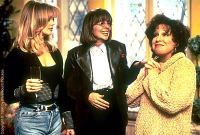
Terrible Troika: Goldie Hawn, left, Diane Keaton, and Bette Midler screech in ‘The First Wives Club.’

Tama Janowitz considers youth and beauty

By David Templeton

Writer David Templeton takes people to interesting movies in an ongoing quest for the ultimate post-film conversation. This time out, he teams up with Tama Janowitz, author of the ’80s cult-hit novel Slaves of New York, to check out the slapstick comedy The First Wives Club.

IN TAMA JANOWITZ’S newest novel, By the Shores of Gitchee Gumee, an outspoken single mother instructs her children in the facts of life, quizzing them with the question “How far will beauty get you?”

“From 18 to 40!” is their programmed reply. “Longer with plastic surgery!” Later on she tells them, “You can’t judge men by the same standards as women. They have no standards.”

I recall these lessons as I meet Janowitz at a theater in downtown Berkeley, where the New York­based author is conducting a series of Gitchee Gumee readings. We have met to see , starring Bette Midler, Goldie Hawn, and Diane Keaton as 40-something divorcées plotting revenge on the ex-husbands who left them for younger women. It promises to have some of the same juicy, high-spirited male-bashing that Janowitz has made into an art form.

Sadly, cinematic art is nowhere in evidence up on the screen. The film turns out to be loud, shrill, unwise, and unfunny. Following a mid-movie trip to the men’s room, I discover Janowitz standing out in the lobby.

“Are you enjoying the film?” she asks sweetly. I am not. Ten minutes later, we are gleefully ordering milkshakes in an ice cream parlor across the street.

“I was hugely disappointed,” Janowitz intones. “Because to see a woman’s film–a film about women–is very rare, and I was looking forward to it. And normally, I feel such contempt and disgust for these men that do dump their wives and get some 20-year-old replacement–but in this case, I started to actually understand why all the men did it. These women were just so awful.”

Janowitz, whose best-selling 1986 novel Slaves of New York earned her an international cultlike following, has sculpted a reputation as a wry, painfully acute observer of urban human absurdities, the love-hate relationship between the genders (and all the various sexual inclinations contained therein). In Gitchee Gumee–a tremendously funny satire that could start a whole new genre of welfare chic–the narrator is Maude Slivenowicz, an amoral, impoverished 17-year old whose view of sexuality is informed by her encyclopedia-like knowledge of the sex lives of insects.

Janowitz writes affectionately, even optimistically, about her characters, male and female, maintaining an aura of believability that is not belied by the occasional extremism of their actions.

Perhaps if The First Wives Club had tried for some of that believability, Janowitz might have hung around for the end credits.

“I kept thinking these women should go out and get some kind of a life,” she exclaims, jamming her spoon eagerly into her shake. “They had no sympathy, as people just getting revenge on their husbands. There’s no charm in watching people hell-bent on revenge.

“On the other hand, I do really think it’s just awful how it happens so much in our society, that women are left alone as they get older and men are considered more desirable.

“You wouldn’t believe the men in New York,” she continues. “Some of them are millionaires many times over, and they’re the most hideous specimens, completely lacking in charm. Nevertheless, they have any woman they want, presumably because the women want the money.”

As with the acquisitive ultra-bimbos in First Wives, and certainly with the pragmatic Maude Slivenowicz, youth and beauty, while they are had, are powerfully exploitable assets.

“That’s the power that women have in our society,” Janowitz agrees. “You’re 20 years old, young, nubile–you’re feared, you’re hated, and you’re desired. When you get older, no matter how powerful you are, as a woman, you may have power, but you’re not feared anymore, and you’re not desired.”

BEAUTY as exploitable currency has many forms, Janowitz reports. “I know men who just call up the fancy modeling agency and say, ‘Who’s new in town?’ I’m not suggesting [these models are] prostitutes. I’m not sure that these men are even capable of having sex. But it’s the social thing of going out and showing off in public to other men. They’re saying, ‘Look what I’m capable of possessing!’ But it doesn’t work the same way with older women and younger men.

“I was talking to a girlfriend,” she laughs, “and I said, ‘You know, if I died tomorrow, my husband would have so many women comforting him, it wouldn’t be believed. They’re comforting him now because I’m out of town for a week. But if I was alone in New York for a week . . .”

She drops her spoon into a now-empty cup and smiles, letting the silence speak for itself.

Join David Templeton and Tama Janowitz on the World Wide Web for a discussion of First Wives Club on Saturday, Oct. 5, at 4:30 p.m. through CompuServe’s “Native’s Guide to New York” forum.

From the October 3-9, 1996 issue of the Sonoma Independent

This page was designed and created by the Boulevards team.
© 1996 Metrosa, Inc.

Sherman Alexie

Seeing Red


MARION ETTLINGER

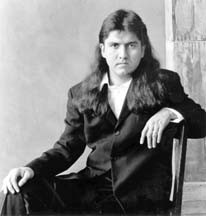
Portrait of the artist: Poet, author, and standup comic Sherman Alexie doesn’t smile for the camera.

Author Sherman Alexie is one angry young man

By Gretchen Giles

THERE’S A KILLER on the loose, a lone man with a honed blade and a particular predilection for removing the blue eyes and the hairlines from white heads. Terrorizing Seattle, he silently walks the night streets, embodying that which Caucasians hate the most: the red man. Or is it the red woman? Whatever–whites and reds just don’t mix, each group caroming off each other in a racial fury that lies so close to the surface that we are each and every one of us just a Buck knife away from committing heinous acts of homicidal brutality.

Buy it?

Well, people are buying it by the droves, buoying up sales of Sherman Alexie’s novel Indian Killer (Atlantic Monthly, $22), a whodunit with no who and plenty of anger to go around.

“You know, it’s not like I’m walking around like [Nation of Islam leader] Louis Farrakhan or something,” says Alexie, speaking by phone from his Seattle office. “I don’t live my life with all of this anger, and when I was writing this book, it was cathartic in some ways. Actually it was a very easy book to write, and actually–I enjoyed the process,” he chuckles, “as much as you can enjoy writing a book about interracial murder.”

A Spokane/Coeur d’Alene Indian who grew up on a Pacific Northwest reservation, Alexie knows firsthand of what he speaks. The author of two other books of prose–The Lone Ranger and Tonto Fistfight in Heaven (Atlantic Monthly, 1993), and Reservation Blues (Atlantic Monthly, 1994)–as well as several books of poetry, at a creaky age of 29, Alexie is coming darn near to his stated goal of publishing some 10 books before he gets really old and turns 30.

A direct result of Alexie’s feeling of being misunderstood, Indian Killer was written in reaction to criticism. “In my first two books of fiction,” he says, “people talked about how dark and depressing they were, how full of Indian angst they were–and they weren’t. They were very funny and comic novels. There was certainly a lot of tragedy, but a lot of comedy as well. So I sort of wrote this book as a response, to kind of give people an idea of the kind of anger and the kind of rage that is in the Indian community, as well as that which is in the white community, directed toward Indians.”

And show it he does, producing matter-of-fact prose delineating white men beating, cussing, raping, verbally abusing, and beating again the modern-day Indian (Alexie’s preferred term). As for the Indian characters in the novel, well, they just laugh–homeless or no, in anger or at peace. Laughter is Alexie’s sinew of characterization for the native peoples.

“Indians are funny,” he says simply. “I mean, the funniest groups of people on the planet that I’ve ever been around are Indians and Jews. So I think that that says something about using humor to ward off centuries of oppression and genocide. I’ve heard Jews make jokes about Hitler. I’ve heard Indians make jokes about Custer–that takes a lot of strength.”

Centering around the slow mental dissolution of John Smith, an Indian of indeterminate lineage adopted into a white family (and presumably going crazy as a result of being raised by whites and denied his true heritage), Indian Killer weaves the many stories of Smith, the Native American activist Marie–so distraught by her color as a child that she sandpapers her face–her psychopathic cousin Reggie, and assorted evil white types who variously appear as Indian wannabes, stupid do-gooders, and racist pigs. This is not pretty reading, nor is it recommended for perusal around the lunch table.

Alexie is unconcerned.

“I figured reaction to the book would be mixed,” he says. “People are freaked out by it. I mean this book to start discussion, I mean this book to be controversial, I mean this book to affect and offend.”

Included in the scenes of Indian Killer is one that deeply affected Alexie in reality. A bright child, he transferred from the reservation schools at a young age, assimilating into the predominantly white institutions of the Seattle area. Seated one afternoon in a pizza parlor with his girlfriend and other friends, young Alexie watched a painfully drunk Native American man stumble into the restaurant, look blankly around, and fall thickly onto a stool. Alexie’s girlfriend leaned forward. “I hate Indians,” she hissed. No one said a word, suddenly acutely aware of Alexie’s skin color.

This scene appears in the pages of Indian Killer, savagely illuminating how it feels to be thus humiliated. “It’s about completely ingrained racism, so ingrained as a fundamental problem that people aren’t even aware of it,” he says. “That’s the problem, that people aren’t even aware of it, and that this young woman whom I loved when I was 14, could be capable of such an incredibly cruel statement.”

Indian Killer wasn’t cathartic enough to wring clean the lifetime of oppression lived by Alexie. “I’m a colonized man,” he stresses, “we’re a colonized people. This is South Africa here, and people don’t want to admit that.

“The United States is a colony, and I’m always going to write like one who is colonized, and that’s with a lot of anger.”

Sherman Alexie reads from and signs Indian Killer on Thursday, Oct. 10, at 7 p.m. Copperfield’s Books, 138 N. Main St., Sebastopol. Free. 823-8991.

From the October 3-9, 1996 issue of the Sonoma Independent

This page was designed and created by the Boulevards team.
© 1996 Metrosa, Inc.

Fall Foods

0

Comfort Food

By Gretchen Giles

THERE IS A SATISFYING SAVAGENESS about the fresh foods of summer. The ingredients are either sliced, peeled, grilled, frappéed, or actually torn into stuff for the plate and palate. One often sits around half-nude imbibing such nourishment out in the elemental heat of the waning twilight. And it is not unusual for summer foods to be eaten in small human gatherings around fire, like meals shared by the cave dwellers.

But come autumn we return to our more civilized natures. First off, it’s getting a mite bit chilly for that half-nude thing, and the squirt of a unskinned grapefruit is less satisfying for an October breakfast than a steaming bowl of cinnamon-spiked, raisin-plumped oatmeal enlivened with the sweet grate of an entire Gravenstein apple.

Because the fact is, in the fall, most of us begin to feel terribly like a cat that’s just been spayed–all soft and comfortable, instincts distinctly subdued–with an innate longing for food just as soft and comfortable as we are. Food that is slow-cooked, meats whose roasting overwhelms the scent of the house, the secret tastes of vegetables that are coaxed, dirt-clung, from the loam.

This is the time for casseroles, cassoulets, the fussy work of creamy risotto, stocks and soups and stews, and just most anything that resolves itself into terrific leftovers. The definition of the perfect fall dish is when one can truthfully lean across the table and utter the phrase “This always tastes better the second day.”

Sunday afternoons in old novels are often dominated by the smell of roasting chicken, perfuming the angst and wonder of the protagonist’s childhood, marking the return from church. For those of us whose remembered Sunday afternoon smells include the long-stale odors of parents’ Saturday night parties, a new tradition can be readily founded by opening the oven door and recklessly throwing a panned bird into its maw.

Almost that simple, roasting a chicken is a lot easier than say, pie, which has long held the “easy as” distinction. A lie, this pie, as anyone who’s ever struggled unsuccessfully with rolling pin, ice-cold water, and the grim stick of wet flour can attest.

(Actually paté’s a helluva lot easier to make than pie, but it’s doubtful that the phrase “as easy as paté” will ever catch on like wildfire in American society.)

But chicken’s a cinch when washed and patted dry, the body filled with the quarters of a yellow onion, salt and pepper, half a lemon, and a pungent sprig of fresh rosemary. Splurging on the free-range wisdom of a Rocky chicken makes for the best possible yellow-skinned flavor (and just knowing that the bird spent it’s life happily pecking around at worms in the dirt can help to assuage any guerilla vegetarian emotions that might ambush you at the table).

Being careful not to dwell on the plucked roaster’s resemblance to the heft of a baby, separate the skin of the breast from the meat, and push fresh sage leaves and butter into the two pockets that will form. The butter helps self-roast the bird and the sage will flavor as well as adorn the breast, darkly patterning through the skin as it crisps and goldens. A handful of butter rubbed liberally all over the body helps, too. Just don’t talk a lot about it at dinner.

Tie the bird’s drumsticks together with kitchen twine, tucking the fatty cavity flap (which I will continually call the bishop’s pope and will continually be wrong about) so that it secures the body closed. Place the chicken breast down on a rack in a roasting pan. The elevation of the rack helps prevent the stew-in-your-own-juices phrase taken from the world of poultry and used so liberally in adolescence. Cover loosely with a foiled tent and roast at 400 degrees for 20 minutes. Turn the heat down to 350 and then let 20 minutes a pound be the guide (though don’t actually believe that; the true tests are bloodless juices running from the thigh or breast, and the ability of the drumstick to easily be waved back and forth). Midway through, flip the bird so that the breast browns beautifully. Baste.

MAKING RISOTTO is like courting Elizabeth Taylor: lots of trouble but damn well worth it. Beginning with a base sauté of finely chopped onions, leeks, garlic, and shallots in sweet butter, pour one cup of the Arborio rice in with the onion family and stir to coat, roasting each individual grain until it begins to opalesce slightly. Meanwhile, busily heat 4 cups of either chicken or vegetable stock. Add this hot liquid (which must stay that way) 1/4 cup at a time to the risotto, stirring ably and allowing the stock to be completely absorbed each time. The Arborio package will also say this–believe it. Do this with the repeated ability of a mindless automaton until all the liquid is gone, absorbed, finito. Add a bunch of grated Parmesan and a goodly chop of fresh parsley. Stir, cover, serve.

Fresh crookneck and zucchini squash wrested straight from the failing plants in the garden can be sautéed with plenty of chopped garlic in butter and olive oil. Those purchased and encased in plastic from the local large-chain grocery store taste fine, too–give up that guilt.

Sprinkled at the last moment with fresh oregano, the squash sit well on the plate next to the chicken and rice. A final salad of butter lettuce studded with crunchy bits of chopped pear, crumbled gorgonzola cheese, and toasted walnuts is enlivened with a dressing begun from 1/4 cup balsamic vinegar in a small bowl. Added to that is a teaspoon of Dijon mustard, a grind of pepper and shake of salt, a press of garlic, and a small chop of fresh basil. Stirring constantly with a fork, pour a thin, steady stream of extra-virgin olive oil into the dressing base until it takes on a thick, lustrous quality. Dress the salad to taste. Good bread, a light red wine, candles, kids with napkins in their laps, Miles Davis on the player.

One small happy moment–sometimes it seems immensely selfish to ask for more than that.

From the October 3-9, 1996 issue of the Sonoma Independent

This page was designed and created by the Boulevards team.
© 1996 Metrosa, Inc.

Round Eyes in the Middle Kingdom

China WhiteGemma La ManaCommie Dearest: Filmmaker Ron Levaco, age 2, on a beach in China.A Polish Jew hits the road with MaoBy Zack Stentz"NEVER THE TWAIN shall meet," predicted Rudyard Kipling of East and West, a statement often quoted to express the supposedly alien and irreconcilable natures of the Orient and Occident. But if it's true, then what...

Talking Pictures

Son of HugoGlobetrotting naturalist Douglas Quin exploresHugo Van Lawick's newest filmBy David TempletonWriter David Templeton takes interesting people to interesting movies in his ongoing quest for the ultimate post-film conversation. This time out, he takes in the sumptuous wild-life epic The Leopard Son with award-winning musician and naturalist Douglas Quin.Hugo Van Lawick is to wildlife cinematographers what Orson Welles...

Open Studios

Eye SightBy Gretchen GilesPLACE A VASE of flowers on a table and jump back. Although most of us see to relatively the same degree, we all look at similar objects and know them in vastly different ways. The humble ink splotch lies in silent testimony. And ain't that the beauty part of being alive? Which is why it is...

Stitch-te Naku

Creation MythsBy Zack StentzThose crafty spiders. When they're not catching flies, building ornate webs, or turning Peter Parker into a web-slinging superhero, they're busy creating the Universe, at least according to quite a few Native American folklore traditions. Several tribes in the American Southwest share the tale of Stitch-te Naku, the "Spider Old Woman" who creates the world and...

National Parks

The Fall of the WildIllustrations by Mott JordanThe National Park Service can no longer provide the necessary supervision to spare its 80 million acres of wilderness and historic treasures from the ravages of time and tourism--so it's trolling for corporate sponsors By Christopher WeirAS CONGRESS DANCES over the hot coals of an election year, politicians from both major parties...

Douglas Quin

Playing by Eartunes in to AntarcticaBy David TempletonIN LESS THAN 10 DAYS, Sonoma composer Douglas Quin, having checked and rechecked his necessarily minimal baggage and high-tech recording equipment, will board a plane destined for Christchurch, New Zealand. After a brief stopover, he will catch a military transport bound for McMurdo Air Force Base on Ross Island on the...

Diversity Symposium

Race MattersBy Paula HarrisSONOMA STATE UNIVERSITY Professor Robert Coleman-Senghor, a 56-year-old African American with gray flecks in his dark hair, leans forward and gazes intently at the sun-struck campus garden, silently formulating his thoughts before speaking in his resonant voice. "People don't want to talk about race--they feel discomfort--but there's a need to talk, a need to look at...

Talking Pictures

Bimbo PowerAndy SchwartzTerrible Troika: Goldie Hawn, left, Diane Keaton, and Bette Midler screech in 'The First Wives Club.' Tama Janowitz considers youth and beautyBy David TempletonWriter David Templeton takes people to interesting movies in an ongoing quest for the ultimate post-film conversation. This time out, he teams up with Tama Janowitz, author of the '80s cult-hit novel Slaves...

Sherman Alexie

Seeing Red MARION ETTLINGERPortrait of the artist: Poet, author, and standup comic Sherman Alexie doesn't smile for the camera.Author Sherman Alexie is one angry young manBy Gretchen GilesTHERE'S A KILLER on the loose, a lone man with a honed blade and a particular predilection for removing the blue eyes and the hairlines from white heads. Terrorizing...

Fall Foods

Comfort FoodBy Gretchen GilesTHERE IS A SATISFYING SAVAGENESS about the fresh foods of summer. The ingredients are either sliced, peeled, grilled, frappéed, or actually torn into stuff for the plate and palate. One often sits around half-nude imbibing such nourishment out in the elemental heat of the waning twilight. And it is not unusual for summer foods to...
11,084FansLike
4,606FollowersFollow
6,928FollowersFollow