
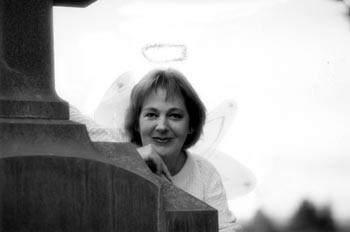
Karen Leonardhas

Sacred Bones

Author Karen Leonardhas revised Jessica Mitford’s 1963 investigative classic The American Way of Death. Now she has a bone to pick with funeral home directors

By Stephanie Hiller

D EATH is not only sometimes painful, frequently inconvenient, and only seldom desired, it’s expensive. From nursing homes to fancy hospitals, the process of leaving the planet is enormously costly, yet enormously profitable for those who usher us out. Not the least of our beneficiaries in death is the undertaker. And today, the price of a funeral, never a bargain basement deal, is exorbitant.

Our “remains,” as the mortician prefers to call a cadaver, are a valued commodity for a prosperous $16 billion-a-year industry tending to some 2 1/2 million deaths a year. And just like the other industries that supply the food, the medicine, and all the other goods and services on which we depend, the funeral industry is becoming increasingly corporatized. Says author Karen Leonard, head of the Sebastopol-based Redwood Funeral Society, one of 150 similar groups nationwide that provide funeral information to consumers, “You know the song lyric, ‘My soul belongs to the company store’? Well, your body belongs to Wall Street.”

And, she laughs heartily, “It’s become nothing more than a commerce of corpses.”

Leonard is also the researcher for the revision of the late muckraking journalist Jessica Mitford’s best-selling exposé of the funeral industry, The American Way of Death, originally published in 1963 and just released in a new edition by Knopf.

“Decca,” as Mitford was known to her friends, was the idol of the intellectual left until her death in 1996 at the age of 78, and the heroine of investigative journalists everywhere. “She was amazingly funny,” syndicated columnist Molly Ivins once said about her, “and such a class act. She was just enchanting.”

Born to a highly aristocratic English family, Mitford was a confirmed Communist till her dying day.

“She was engaged with life at every moment,” says Leonard, who lived and worked at Mitford’s home during the months before the journalist’s death. “She’s the only person I know who cut a rock-‘n’-roll record in her 70s. She liked to have an entourage of people around her all the time. They were from all walks of life, but she treated them all with the same gracious hospitality.”

Leonard first met Mitford at a national meeting of the Funeral and Memorial Societies of America and was outraged to discover that Mitford’s address had received no prior publicity.

While carrying out her own activities, Leonard hurriedly set up appointments with reporters. None of them showed. Mitford, who had been waiting alone in her room for two and a half hours, was beside herself. She came into the lobby and “all but raised her cane at me! I was devastated. My dream was to work with Decca on one of her books.”

IT was the corporatization of the industry that spurred Mitford to revise her book. She felt that people need to know that Duffys’ Funeral Parlor, though it still bears the family name, may no longer belong to the Duffys.

Careful to conceal their ownership of established, no longer independently owned mortuaries, three large corporations have been taking over the U.S. industry during the past 10 years, performing one out of every five funerals nationwide. More than half the industry in California is corporate-owned, and out of 3,000 cemeteries and crematoria, only 300 remain independent.

The most well-known cremation outfit, the Neptune Society, is owned by Stewart Enterprises, the third largest international conglomerate.

The corporatization of the industry means that we have less control over our own dead bodies. Texas-based Service Corporation International, the Loewen Group, and Stewart have jacked up their profit margin by consolidating such services as embalming and funeral transportation to accommodate several mortuaries at one time, creating highly lucrative economies of scale. But the profits have not been passed on to the consumer.

Chain mortuaries usually raise prices–sometimes as much as 100 percent–after acquiring an established independent home. With funeral prices increasing three times faster than the cost of living, final arrangements are now the third largest expense families face. “It’s a cornered market,” Leonard is quick to point out. “Everybody dies.”

For the most part, survivors, too busy and often too distraught, are not inclined to shop around. The average full funeral in America is now $4,850, according to the National Funeral Directors’ Association. Add another four grand for the average cemetery charges, and an American death costs as much as most folks in this country spend for the down payment on a house.

Leonard, 45, began researching the funeral industry 10 years ago, when she became a partner in a highly unusual enterprise: the Funerary Art Gallery in San Francisco. It all started one day when Leonard was talking with a couple of old friends about their careers. A student of gerontology at Sonoma State University, Leonard was very disappointed when she figured out that the only way she could make a living in that field was in administration.

Her friends had similar frustrations. Leonard’s best friend of 27 years told the group she had recently received a news clipping from her mother depicting a woman selling caskets. Her mother’s scribbled comment read, “Maybe this is what you and Karen should be doing.”

“We thought of artists and craftspeople making caskets. Overnight we were hearing from artists all over the world,” Leonard says. “A lot of them were very famous artists and had incredibly uniquely wonderful stuff. Artists had always paid a role in memorialization until the American funeral industry set up, and now everything was mass manufactured.”

People who came to the gallery looking for a reasonably priced casket later returned, saying funeral directors wouldn’t take their caskets “because the bottom might fall out!” Sometimes mortuaries even damaged the caskets, then claimed they were of inferior quality. Disturbed, Leonard went undercover to search for an honest funeral director.

At one of the biggest mortuaries in San Francisco, she and her partners were met at the door by two funeral directors. “It was plush city, and we were nervous, because we were retailers, we were the enemy,” Leonard says. They were shown a film in which two types of casket were displayed, the protected and the unprotected. “I asked the funeral director what they were protected from,” Leonard says. “He leaned forward, put his hands on the desk, and said, ‘Aliens and foreign objects reaching the body of your loved one.'”

The metal and mahogany boxes sealed with a tight rubber gasket create an anaerobic environment in which bacteria thrive, reducing the body in a matter of months to a noxious putrefaction and releasing gases that are capable of exploding the container. Indeed, when the casket is headed for a mausoleum, the savvy mortician will pop the seal on the way to the cemetery, just to let in some healthy fresh air, to avoid possible damage to the crypt walls if the lid blows.

LEONARD had just finished reading The American Way of Death. “I loved it! I thought it was the best book I had ever read,” she says. Entering the casket room, Leonard was amazed to discover that the selections were arranged exactly as Mitford had described 20 years earlier, with the lower-priced items arranged in the “Aisle of Resistance” and the better models in the “Aisle of Prosperity,” a sales design created many years ago by the infamous W. M. Krieger to seduce the consumer into buying the “better”–fancier, cushier, longer-lasting–casket.

Leonard visited lots of funeral homes. Then one day she found what she was looking for. At Pacific Internment, she met funeral director Frank Rivera, an ex-cop. “While I was in the office, he was on the phone,” Leonard recalls, “telling a customer, ‘You don’t have to do embalming to view the body.’

“That’s when I knew I had found an honest funeral director.”

Leonard calls embalming “the heart and soul of the American way of death. It’s what makes undertakers necessary,” she says, making it very clear that she’s not in this just for the fun of it.

Preparing the body, transporting it, and arranging the memorial service do not require special training or professional certificates; these tasks can be performed by the families.

But embalming is a technical procedure that must be learned, and, involving as it does the removal of essential bodily fluids, it is highly regulated. Hence it is embalming alone that endows the funeral director with the professional status–and inflated income–he or she craves. Most people assume that embalming is required for reasons of public health and that it preserves the body. Neither is true.

If anything, embalming is the hazard. Blood-borne pathogens removed from the corpse are a biohazard, and the toxic chemicals used in the process are pollutants.

Nor does an embalmed body last longer than a refrigerated stiff. Why, then, are bodies embalmed? Funeral directors speak about the importance of the “memory picture” of the beloved that retains the appearance he had in life. Such a picture is essential for grief therapy, funeral directors murmur. For many families, it’s an unforgettable image of debt.

Pacific Internment offered the consumer a choice. Prices were reasonable; the casket sold for twice, not five times, the wholesale price. But it would not have been appropriate for Leonard to advertise her favorite mortuary at the gallery. Instead, she began posting price lists of all the mortuaries so that her customers could be informed.

The law requires that a price list be offered at the outset, but many mortuaries skip this step, or offer 10-page brochures that the bereaved do not read. Leonard began consulting with customers, informing them of their rights.

Leonard’s education in funeral affairs was advanced considerably when, quite by accident, she called the Bay Area Funeral Society, thinking it was a funeral home. Started by Mitford’s husband, attorney Bob Treuhaft, the society was the most radical of the non-profit consumer organizations. There she met Ernie Landauer, who persuaded her to open a branch in the North Bay.

“There were 2,000 names on the membership list. Unfortunately, no one had checked on these people for a long time,” Leonard says. “More than half had moved on from that address–or from this life.”

It was through her work for the Funeral and Memorial Societies that Leonard had the opportunity to meet Mitford again–under more favorable circumstances. Landauer urged her to write Mitford and report her own activities on the consumer’s behalf.

“She won’t know it’s you,” he advised. Leonard began a correspondence that culminated in a phone call one stormy day in 1995. Says Leonard: “‘I’m thinking of revising The American Way of Death,’ she told me, ‘but I just can’t consider doing it unless you’ll be my researcher.'”

Leonard went to the author’s home in Oakland with some trepidation. Mitford was rushing out to attend a protest against the hospital that had recently cared for her; she didn’t recognize the woman she’d railed against some years before. Among all the Funeral and Memorial Societies nationwide, Leonard is the only member who is not a retiree.

“Most of the funeral societies have become middlemen for the funeral industry,” Leonard explains. “The members are elderly, white, well educated. Their main interest is lowered costs, and the industry provides services to them at slightly reduced rates.”

The Redwood Funeral Society, by contrast, has become a true consumers’ advocacy organization, doing price surveys, educating the public about consumers’ last rights, and actively advocating for legislation to protect the consumer from the tricks of the undertaker’s trade. A rule designed to do just that was passed in 1972 in response to the outcry raised by Mitford’s book, but it has not been enforced.

THIS SPRING, the RFS completed a survey of Sonoma County funeral homes. Those owned by the three corporate giants charge as high as twice as much as the others, and three times as much as Pacific Internment’s Frank Rivera does. Prices for direct cremation (no funeral, no embalming, no viewing the body) range from $905 at Pleasant Hill Mortuary to a whopping $1,839 at Eggen & Lance, which is owned by SCI. By contrast, Pacific Internment offers direct cremation for $530 to members of the RFS, who can prearrange without prepaying, avoiding the industry’s prepayment trap, which allows them to use members’ money while members pay the interest on it, and never turns out to be quite enough to cover all the costs when the time comes. Leonard states unequivocally that the FTC has gone “into cohoots” with the National Funeral Directors Association. “For 10 years,” she says, “SCI had had to tell the FTC when they purchased a new mortuary. SCI went to the FTC to reopen the ruling, stating that this was too much of a financial burden.

“The FTC generously dropped the requirement!”

The consumer advocacy board of the Department of Consumer Affairs is composed entirely of members of the industry. “When you go to Sacramento, you can tell the public is not welcome,” says Leonard. The goal of the board is not to handle complaints or otherwise protect the consumer. “It’s to raise the requirements of funeral directors to make sure small business people cannot afford to get into the business, and to make themselves professionals like doctors and lawyers,” Leonard says.

A 1997 ruling states that nobody who has not obtained training approved by this board of funeral directors and embalmers is permitted to help arrange or discuss funeral transactions, or even participate in arranging for transporting a dead body. Not only must you have proper training; you must work for a mortuary.

“Most people didn’t even know you had the right to care for your dead,” says Leonard, “so I went on an educational campaign–and they started doing it!”

The Natural Death Care Project in Sebastopol, for example, exists to guide families through the process of caring for the body at home and transporting it to the crematorium in a simple cardboard or pine box, without the intervention of a funeral director.

In the past five years, over 300 deaths in Sonoma County have been handled this way, at enormous savings. But more important, families who have cared for their dead say that the experience of washing and preparing the body and laying it out at home is not at all creepy or weird; it is actually rewarding, allowing for full closure with the beloved friend or relative and a firm sense of the reality of death.

Local funeral directors say the industry has been affected by the work of the Natural Death Care Project and others to the tune of $70,000 a year. And word is spreading. The NDCP is planning to do workshops with health-care professionals at Kaiser this summer on alternatives to the fraudulent practices of the funeral industry. The Redwood Funeral Society is trying to develop a special project to inform the clergy of their parishioners’ options.

It’s free choice that Karen Leonard is after, and the right to our sacred bones. “We have to take apart laws that amount to restraint of trade. . . ,” she says. “The funeral industry doesn’t [have the right to] tell us how to deal with our deaths. We [should] decide what we want.”

How a society cares for its dead reflects the values it holds dear. For Leonard, the reign of the modern-day mortuary shows that we are still confusing monetary worth with human worth, still believing that spending a lot of money can prove or else compensate for the love we felt but couldn’t share.

“We have to change the way we deal with our dead,” Leonard says. “We have to take a look, as a culture, at the soundness of our minds.”

Karen Leonard will discuss The American Way of Death Revisited on Monday, Sept. 28, at 7 p.m. at Copperfield’s Books, 2316 Montgomery Drive, Santa Rosa. .

From the September 24-30, 1998 issue of the Sonoma County Independent.

© Metro Publishing Inc.

Lost in Cyberspace

Resignation Rag

By H.B. Koplowitz

They had sex, sort of. He lied about it, sort of. So what. When you raise your hand and swear to tell the truth, the whole truth, and nothing but the truth, it’s supposed to mean something. Impeach the bastard. Let him go. He committed adultry. So did you. Round and round and round it goes, and when it will ever stop, God knows. Ironically, there’s only one person with the power to make Monicagate go away, and only one way for him to do it. It may be the only power he has left.

But until he does, the rest of us will have to resign ourselves to more Monica madness, even in cyberspace.

Ironies abound in this Greek-American tragedy. Ironically, the same Congress that gave us the Communications Decency Act to control smut on the Internet publishes Independent Counsel Kenneth Starr’s smut on the Internet. And Americans who said Congress should stop obsessing over Monica Lewinsky get their first exposure to “Thomas“, the Congressional website that keeps track of legislation, because they wanted to see Starr’s report on Monica Lewinsky.

“Thomas” was created by Congress in 1995 to make information about federal legislation freely available to the public. Named after Thomas Jefferson (who, ironically, had his own moral turpitudes), the website lets you look up legislation by bill number, keywords and other search options. “Thomas” also has an online version of the Congressional Record, bill summaries, House and Senate calendars, roll call votes, public laws, committee reports, a guide to how laws are made and historical documents including broadsides from the Constitutional Convention and Continental Congress, the Declaration of Independence, the Federalist Papers and the Constitution.

An estimated 5.9 million people read Starr’s report on the Internet the first two days, including 3.6 million who read it at news sites. But plebs seeking their morning Monica shot got a different kind of jolt if they logged onto the website of the New York Times on Sept. 13. For much of that day, the Times website was hijacked by hackers, who replaced its front page with a rant from self-described “Internet terrorists” calling themselves HFG, or Hacking For Girlies.

No damage was done, but like recent hacks of Motorola, Justice Department and CIA websites, the real danger is in what they COULD have done. Instead of posting juvenile jokes about cigars, theoretically, HFG could just as easily have changed the content of “Times” stories, and even of Starr’s report.

Of course, juvenile Monica websites continue to proliferate. Links to many can be found at “The Best of Monica Lewinsky“. Numerous sites have versions of “Clinton Body-Count“, a list of persons associated with the Clintons in one way or another, from Vince Foster to Barry Seal, who have died under “questionable circumstances.”

And if you’re too lazy to wade through the “legalisms” of the Starr report and want to get straight to the sleazy stuff, the website of the “Kenneth Starr Report Analyzer Engine” lets you type in strategic words and phrases, such as “obstruction of justice” or “cigar,” and each occurrence is displayed on your screen.

Is the Starr report about impeachment (12 occurrences) or sex (367)? Does the report focus more on perjury (32), or oral sex (72)? You make the call.

It’s only fitting that Starr’s report was first released to the public on the Internet. Cyberspace has been on top of this scuzzy story from the beginning, especially through Matt Drudge’s Drudge Report, which first revealed details of an affair between the president and an intern. Now Drudge is reporting that a video has surfaced of the prez getting chummy with yet another young lady near the Oval office, and that other White House groupies are on the verge of revealing their own close encounters of the Clinton kind.

And the hits just keep on coming. The next big video release is expected to be Clinton’s testimony to the Grand Jury, and coming soon, Monica II, testifying live on TV in front of the House Judiciary Committee. It’s tragic that a Commander in Chief would be hounded from office for having an affair. Ironically, in this instance it also appears inevitable.

As does the possibility that if Clinton does not resign, there will be yet more stories of “youthful indiscretions,” and the nation will be treated to what is being called the Doomsday Scenario, a bipartisan scorched earth policy in which all the skeletons in all the closets of Congress, courthouses, statehouses and news bureaus are outed.

They will have gotten themselves, and won’t that be fun.

From the September 24-30, 1998 issue of the Sonoma County Independent.

© Metro Publishing Inc.
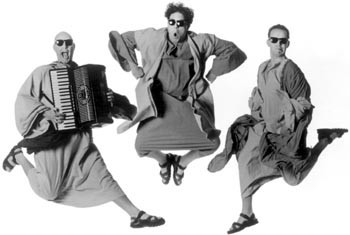
Kindertransport

0

Dark Journey

Kindertransport.

‘Kindertransport’ tells story of survival

By Daedalus Howell

BEFORE ENTERING Actors’ Theatre’s production of Kindertransport, audiences are advised to stuff their pockets with the Kleenex thoughtfully provided in the atrium. You will need it. You’re going to cry. Consider wearing a life preserver, perhaps even hip-waders.

Inspired by the real-life evacuation of 10,000 Jewish children from prewar Nazi Germany and their subsequent placement in English foster homes, Kindertransport chronicles the emotional predicament of a woman navigating the harrowing floodwaters of survivor’s guilt.

The play simultaneously depicts two epochs in the woman’s now normal English life. Evelyn (née Eva Schlesinger, marvelously portrayed by Mollie Boice and Rebecca Miller as the mature and younger versions, respectively) has spent a lifetime reinventing herself so as to obscure a painful past that includes the loss of her parents and the lascivious advances of a child-abusing Nazi, among other hardships. To Evelyn’s deep chagrin, her original identity is exhumed by her inquisitive 20-something daughter, Faith (played by Michelle Olmstead), from a trunk in a family storage room. An emotional cataclysm ensues as Evelyn systematically deconstructs the Memory Lane she has built to bypass her former life.

Director Tim Hayes’ spare production strips the play down to its essential emotional elements, leaving no room for the easy manipulation often associated with material of this nature. Hayes seems to engender real sentiment on the part of his players, and the audience benefits. It makes the difference between seeing a play and experiencing it.

Boice is simply exhilarating as she moves her character heedlessly into the play’s emotional white water. Her Evelyn is whole and palpably pained, and her experience is so effectively conveyed that it becomes our own.

Miller expertly portrays Eva’s transformation into Evelyn, traipsing from German to English accents with expert character shading, as when her voice subtly quavers when she first insists on being called Evelyn.

The play’s emotional tautness mercifully slackens with the comic asides of the gracefully understated Olmstead, whose comedic sensibilities are well suited for the part of the nosy daughter Faith. Adding further comic relief is Cameron McVeigh, who ably inhabits a handful of roles, including an officious English postal worker and a persnickety officer. McVeigh also does chilling turns as a Nazi and as a German children’s book character, the Rat Catcher (a riff on the Pied Piper, the play’s key motif).

Sheri Lee Miller is superb as Evelyn’s biological mother, Helga, whose spiritual deterioration marks one of the play’s rueful plot points. Also turning in a fine performance is Betty Cole-Graham as Evelyn’s adoptive English mother, Lil.

Yes, Kindertransport throws open a lot of emotional floodgates, but in the end, it will invariably buoy your soul.

Actors’ Theatre’s production of Kindertransport plays through Oct. 24 at the Luther Burbank Center, 50 Mark West Springs Road, Santa Rosa. Thursdays-Saturdays at 8 p.m.; Sundays at 2 p.m. Tickets are $6-$12. 523-4185.

From the September 24-30, 1998 issue of the Sonoma County Independent.

© Metro Publishing Inc.
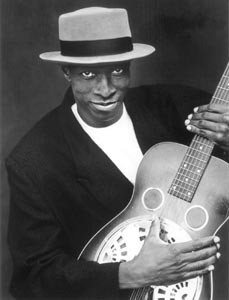
Reduced Shakespeare Company

Bible Belt

The Bible: The Complete Word of God (Abridged), playing Oct. 8 at the Sebastiani Theatre.

Reduced Shakespeare takes on the Big Book

By Patrick Sullivan

THEY’VE MADE a splash at the Kennedy Center, been called blasphemous by religious protesters, stolen the show in broadcasts on NPR and the BBC, and wowed the crowd in London and Jerusalem. They’ve even braved an uncertain welcome in the sunny but conservative city of Texarkana, where liquor sales end at the dusty Texas border. But Reed Martin of the Reduced Shakespeare Company says coming back to play at the Sebastiani Theatre in his hometown of Sonoma is still no walk in the park.

“It’s funny, but I do get nervous,” Martin says. “I grew up here. Most nights I’m at the theater, I don’t know anyone in the audience. Then we do a benefit for the Sebastiani and there are 400 people and I know all of them.”

Martin serves as both writer and performer in the unique three-man theatrical troupe, which has built a growing international reputation for … well … reducing things. The complete works of William Shakespeare, the history of the United States, and Wagner’s bloated Ring Cycle have all come under the company’s satirical knife. Now the company is bringing The Bible: The Complete Word of God (Abridged) home to Sonoma County.

Whatever the source material, Reduced Shakespeare’s method is the same: Take weighty (even ponderous) cultural material that occupies armies of dedicated scholars, and render the whole thing in hilarious fast-forward on the stage. That simple recipe has been packing houses around the world for more than a decade.

“I think we’re successful because we just have a really good time doing it,” Martin says. “The sloughing around isn’t always enjoyable, but those two hours onstage are always fun, and I think people see that.”

The company–which was founded by former member Daniel Singer of Santa Rosa–combines slapstick, cross-dressing, and sight gags with more subtle jokes that delight even people who love Shakespeare (or American history) the most. There are no sacred cows, and even the audience itself is fair game.

“If any latecomers come in to the show, we thrash them,” Martin says with a laugh. “Or if somebody’s crinkling a candy wrapper, well, everybody in the audience is looking at them anyway, so we might as well stop and make a bit of it. … We come through the fourth wall and just react to whatever’s happening.”

The act requires an unusual set of skills, to say the least. Ordinary theater hardly prepares someone to bounce around the stage re-enacting the death of Abraham Lincoln at top speed. At first glance, then, Martin’s résumé sounds oddly traditional–even stuffy. He has a B.A. in theater and political science and an M.A. in acting. He’s even performed in very ordinary productions of Hamlet. As the Reduced Shakespeare folks might say, “Boring!” But then, things get unusual.

“After eight years of university, I ran away and joined the circus to work as a clown,” Martin says. “Which left everyone saying to my parents, ‘What do you think about that?'”

After two years of clown work, where he learned how to work an audience, Martin fell in with the Reduced Shakespeare and was soon touring the world. Before long, the company was performing in England. But weren’t they worried about insulting the Bard in the country of his birth?

“It turns out it’s nothing like that,” Martin says. “I mean, if anything, the British have had Shakespeare forced upon them even more than people here. And also, as with all of our subjects, it’s done affectionately. We’re mocking ourselves as much as we’re mocking the subject matter. … I think they’re flattered that we spend so much time on it, and we do it the way they think three stupid Americans would do Shakespeare.”

THAT’S NOT TO SAY that everyone appreciates Reduced Shakespeare’s irreverent approach to the sacred texts. Sign-waving protesters greeted the company’s Bible show when it played in Ireland. A lawyer in England tried unsuccessfully to use that country’s blasphemy laws to shut down the play. And in Texarkana, some religious students dramatically expressed their distaste for the troupe’s unique take on American history.

“One of the speeches in the history show is full of anagrams,” Martin recalls. “You rearrange the letters in American and it spells ‘I can ream.’ You rearrange the letters in George Washington and it spells ‘Gaggin’ on wet horse.’ And if you rearrange the letters in Spiro Agnew, it spells ‘Grow a penis.’ Right about then, we had 150 home schoolers in the balcony stand up in unison and walk out. So I think we did our job that day.”

But although the actors have fun with their source material, Martin says they also show it respect. In particular, he insists that the troupe was careful to make the Bible show “irreverent, but not blasphemous.” Religious people, he says, tend to enjoy the performance once they actually see it.

“Opening night in Ireland, we had four clergymen in the audience,” Martin says. “Three of them loved it, and one wasn’t that tickled by it. I don’t know that he found it blasphemous, but I think it just made him sort of uncomfortable. I guess if you’re sitting there in collar, every time a joke comes up, everybody looks at you to see if they can laugh.”

That respect also means that Reduced Shakespeare gets the facts straight, except when they skew for comic effect. Some even call the company’s work educational: Could this be the only way to get modern audiences to flock to see Shakespeare?

“Well, we’ve had that question in another form,” Martin says wryly. “The negative side is ‘Are you pandering to people’s short attention spans?’ … But I think we get people interested. People who don’t have a proclivity won’t go see Hamlet anyway. But we do definitely get teachers who tell us that the kids went to see our show and then they wanted to do Romeo and Juliet in the school production.”

Controversy, whether educational or religious, is not the main problem facing Reduced Shakespeare. The real challenge, Martin says, is finding new material, new cultural monuments to cut down to size. So what’s next on the troupe’s agenda?

“I just got back from Los Angeles, from rehearsing our new show, our first musical,” Martin says. “We’re condensing the Millennium. We’re calling it The Millennium Musical, Abridged to the 21st Century.”

The Reduced Shakespeare Company will perform The Bible–The Complete Word of God (Abridged) on Oct. 8 at 8 p.m. at the Sebastiani Theatre, on the downtown plaza, Sonoma. Tickets are $17 for adults, $12 for seniors and for children 12 and under. 996-2020.

From the September 24-30, 1998 issue of the Sonoma County Independent.

© Metro Publishing Inc.

Keb’ Mo’

0

Mo’ Blues

Slow Down.

Frank Ockenfels


Bay Area bluesman Keb’ Mo’ at LBC

By Alan Sculley

I KNOW I’m known as an acoustic blues guy and I know I’m in that genre,” says bluesman Keb’ Mo’. “I know that’s probably my best genre. Probably my best performances are in that area.

“But I don’t know, I think at the end of the day people just want to feel good. They put on a record, they just want it to sound good. They want it to make them feel good. It should flow with life. If it doesn’t follow the little box I’m supposed to be in, about what I’m supposed to be, so be it.

“Because if I stay what I’m supposed to be, then there’s a group of people who talk about why you don’t try something else. And then when you do something else, people wonder why you don’t stay the same way. So you know, Ricky Nelson says it the best: ‘You can’t please everybody, so you’ve got to please yourself.'”

It took Keb’ Mo’–his real name is Kevin Moore–some 20 years to define himself as a blues player with the release of his 1993 self-titled CD. But it’s not as though he hadn’t recognized his affinity for the style long before that.

In fact, he remembers as a teenager being absolutely enthralled by a performance by acoustic blues artist Taj Mahal, who today remains a major influence. “He came right to my school,” Moore recalls. “It was like an inkling, a preview of things to come. I always felt that show was for me.”

But at that point, Moore didn’t feel that he could answer his calling to the blues. It was the 1970s and blues had fallen out of favor in urban areas like Compton, the L.A. suburb where Moore grew up.

“I wanted to be hip. I was afraid, which was indicative of my life for the next 20 years,” he says.

By the late 1980s, Moore still hadn’t found his focus, but he stuck with music, taking odd jobs along the way to make ends meet. Finally in 1990, things started to fall into place when he was invited to play a role as a musician playing Delta blues music in Rabbit Foot, a play produced by the Los Angeles Theater Center.

The role gave Moore the opportunity to delve further into the music of such acoustic Delta blues artists as Big Bill Broonzy and Mississippi John Hurt. “You have a month to really dig through that music and really explore it and get into it while the actors are learning their lines. It’s a wonderful process.

“You talk about the music, you talk about the motivation of the piece, how the music relates to what you’re doing to it.”

In the course of preparing for his role, Moore discovered that Delta blues was a style that felt natural to him. “It was closer to the source,” says Moore. “It was closer to the heart of where blues came from. I could feel it.

“I could feel the Delta calling.”

SINCE THEN, Moore has been on a fast track. A cassette of his songs netted him a deal with Okeh Records, a label that was being relaunched by Epic Records. His 1993 self-titled debut immediately earned him recognition as a blues artist to watch, and his 1996 follow-up, Just Like You, cemented Moore’s stature as one of the most promising new artists in blues. That CD won the 1997 Grammy for Best Contemporary Blues Album, and Moore also won prestigious W.C Handy Awards in 1997 and 1998 as Acoustic Blues Artist of the Year.

Now Moore is hoping to build on those achievements with his third studio CD, Slow Down. The CD may redefine Moore’s image. With the exception of the solo acoustic “I’m Telling You Now” and a cover of Robert Johnson’s “Love in Vain,” the remaining 10 songs feature full-band arrangements. Several tunes, such as “Soon As I Get Paid” and “Muddy Water” rock quite convincingly. While Moore’s songwriting on Slow Down has justifiably been praised, a few early reviews of the CD have found fault in the slick production.

“I think the polish people are hearing isn’t necessarily in the performance, but in the post-production, the mix rather than the presentation of it, and in the care taken in recording,” says Moore, who co-produced the CD. “We sat down and we got sounds, and we spent a little more time beforehand.

“But we went in and performed.”

Keb’ Mo’ performs Friday, Oct. 9, at 8 p.m. at the Luther Burbank Center, 50 Mark West Springs Road, Santa Rosa. Tickets are $25. 546-3600.

From the September 24-30, 1998 issue of the Sonoma County Independent.

© Metro Publishing Inc.

Helen Caldicott

0

Bombs Away

David Young/Carolyn Johns


Anti-nuke activist Helen Caldicott is back

By Dylan Bennett

AUSTRALIAN pediatrician Helen Caldicott says she is not a Christian, but speaking with her you find yourself muttering words like “Jesus” and “God.” That’s because she’s talking about Armageddon. No, not the blockbuster summer movie about asteroids from space, but the man-made reality of nuclear war and the possibility of radiation raining on Earth.

Caldicott, the co-founder of Physicians for Social Responsibility and the author of the 1979’s influential Nuclear Madness and three other books, is easily the world’s best-known anti-nuclear activist. And after 25 years of revealing the dark truths of the atomic age, Caldicott won’t sugarcoat her analysis. “I think that within 10 years, 10 countries will have the bomb, and within 20, if America doesn’t stop this madness, we’ll have a nuclear war,” says Caldicott, during a phone interview from New York. Her Australian accent, knowledge of medicine, and biting honesty–together with dry sarcasm and the scolding, loving tone of a mother and doctor–make for a successful oratorical style. “That’s my prediction. And my children and grandchildren will then have no future.”

Caldicott presents her lecture “Paths to Peace in the 21st Century” on Oct. 3 at Sonoma State University. Her appearance supports the Abolition 2000 movement, a global coalition of more than 1,000 non-governmental groups calling for the elimination of nuclear weapons and the reallocation of resources to human and environmental needs. The group hopes to stage an international nuclear abolition convention, similar to the successful landmine convention, in the year 2000.

But why all the fuss? Didn’t the nuclear threat decrease after the Cold War? “Well, everyone thought it had,” says Caldicott. “America has still got 12,000 [nuclear weapons]. And Russia’s still got 9,000–21 times the number needed to produce nuclear winter.” Caldicott, 60, argues that the combination of political and economic instability in both Russia and the United States and the development of new, improved nuclear weapons adds up to a high-risk situation. “[Russian President Boris] Yeltsin is clearly gone–he’s non-functional psychologically and mentally. And that’s a very scary situation. And when he goes, God knows who will be in,” Caldicott says. “This country is in a terrible catastrophe at the moment. Japan supports America’s foreign debt. Japan’s on the slide. If Japan keeps sliding, this country will collapse. Now, it’s under those situations that international politics become extremely unstable. With the world laced with nuclear weapons as it is now, we are in a very terrifying situation, and I think people don’t really understand that.

“We’ve got a new situation now where the scientists in the labs are building new and wonderful nuclear weapons to the tune of $4.5 billion a year for the next 10 years: more than they spent at the height of the Cold War. And that will encourage every country in the world to build nuclear weapons.

“So what is happening is pure evil.”

WHO BENEFITS from this dismal status quo? “The nuclear elite, the nuclear priesthood, the wicked ones,” answers Caldicott, once again waxing biblical. And why would they work so hard to pollute their own world when they clearly have enough money? “It’s power as well,” she says. “It’s testosterone poisoning.”

“Helen Caldicott is a very inspirational speaker,” says Elizabeth Anderson, director of the Sonoma County Peace and Justice Center, which is co-sponsoring the event. Anderson is calling on local residents to create a peace team as part of a global network to abolish nuclear weapons while focusing on environmental, health-care, and voting projects.

But how realistic is it to abolish nuclear weapons? “The ending of the Cold War wasn’t realistic, was it?” offers Caldicott. “I mean, I had eight death threats. If you had asked me if I really, truly believed the Cold War would end, I would had to have told you, no. But it did. So miracles occur. And we’re capable of doing the most enormously important things.

“If we give up on that, we might as well give up on the human race.”

Dr. Helen Caldicott will speak on Oct. 3 from 7 to 9 p.m. at the Evert Person Theater at Sonoma State University. Admission is $10 in advance, $12 at the door, $5 for students. 664-2122.

From the September 24-30, 1998 issue of the Sonoma County Independent.

© Metro Publishing Inc.
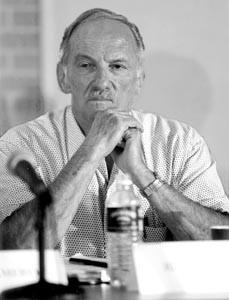
Eric Bentley

Center Stage

Music man: Bentley brings his cabaret act to Sonoma State on Sept. 29.

Author Eric Bentley still shaping theater

By Patrick Sullivan

FOR SOME FIVE decades, Eric Bentley has been a major force in the world of American theater. His criticism in The New Republic in the 1950s cut the likes of Tennessee Williams and Arthur Miller down to size. His own plays have provided fascinating reinterpretations of the lives of Galileo and Oscar Wilde. His books, such as The Playwright As Thinker, have helped shape contemporary ideas about the dramatic arts.

Last, but hardly least, Bentley’s translation and promotion of the works of Bertolt Brecht helped introduce the controversial German playwright’s work to the United States. Indeed, Brecht scholars have been eagerly awaiting the publication of Bentley’s latest work, Bentley on Brecht, due out this fall. That book was Bentley’s initial reason for his upcoming swing through the Bay Area, but things didn’t work out as planned.

“I was originally coming out to do some readings in bookstores of my new book,” Bentley says from his home in New York City. “But the book isn’t ready, and I’m coming anyway.”

Bentley, now 82, will instead appear at Sonoma State University on Sept. 29 to perform his unique cabaret act and to speak about his personal and professional relationship with Brecht.

But what exactly does Bentley think the world’s most famous communist playwright, who brought the class war to the stage, has to offer the apparently very capitalist world of the 1990s? Does Brecht have any relevance to contemporary theater?

“Well, yes, but I think it’s not along the lines of his politics,” Bentley says. “I was never really a part of that. I always maintained that Brecht’s work had merit quite independent of any communist propaganda. I’m glad I said that then, because it’s even more true now that the Soviet Union is gone. Either nothing is left or we’re left with good plays that simply happen to be good plays, like other people’s.”

Bentley first met Brecht in 1942 at UCLA and soon began translating the playwright’s work into English. It was Brecht’s strong interest in bringing ideas and issues to the stage that attracted the attention of Bentley.

“I was a budding playwright and an adapter of other people’s plays, and I was not happy with the theater scene as it was at the time,” Bentley says. “Brecht’s kind of theater appealed to me. It put me on a new track in my own life.”

After Bentley went on to become a theater critic, he quickly became well known for his blunt observations on contemporary drama. His caustic criticism put him at odds with some playwrights, including Tennessee Williams and Arthur Miller.

“I had arguments, even quarrels with them,” Bentley recalls. “But I was harsh on Brecht too, at times. I suppose I was a contentious kind of critic.”

Miller and Williams even teamed up to threaten Bentley with a lawsuit in the early ’50s after the critic argued in print that the two playwrights owed much of their success to Elia Kazan, the director who brought their work to the stage. But the lawsuit vanished after the two realized they wouldn’t win.

Bentley’s life has been jam-packed with accomplishments of a wildly eclectic nature. The playwright also made a name as a scholar at some of the most prestigious educational institutions in America. In the late ’60s he came out of the closet and declared that he was gay–an experience that he says helped inspire Lord Alfred’s Lover, his play about Oscar Wilde. But surely the venerable Bentley’s most surprising accomplishment is his decades-long career performing in nightclubs, in which he plays music from Brecht’s The Threepenny Opera, among other works.

Still, Bentley’s first love remains the theater. So he was extremely pleased when he was recently inducted into New York’s Theater Hall of Fame, though it also felt a bit strange.

“I was very flattered, and the people who handled it were very nice,” Bentley says with a chuckle. “The fellow who presented the citation was the drama critic of the Wall Street Journal, which I thought was good going for me and Brecht. We’re now recognized on Wall Street.”

Eric Bentley appears Sept. 29 at 7:30 p.m. at the Warren Auditorium, SSU, 1801 E. Cotati Ave., Rohnert Park. Tickets are $10 for general admission, $6 for students and seniors. 664-2353.

From the September 24-30, 1998 issue of the Sonoma County Independent.

© Metro Publishing Inc.

Transit Tax

Green Daze

Michael Amsler


Environmentalists split over transit tax measures

By Janet Wells

IF DIVIDE-and-conquer is one strategy of victory, Sonoma County’s pro-development community might benefit greatly from a split in the environmental community over November ballot measures to raise $811 million in sales taxes for local highway expansion and public transportation.

Most of the time, Sonoma County environmentalists and the business community occupy opposite sides of the table. But in this case, after eight years and 1,000 meetings, a substantial number of high-profile local environmentalists have signed on–along with business leaders–in support of a compromise plan that would increase the county’s sales tax 1/2 cent on the dollar over the next 20 years to pay for transit projects that other environmentalists now say would be “a tragedy in the making.”

The business community didn’t have to do much to instigate this fracture among the greens, a community that is as diverse as Sonoma County itself, with a wide range of issues, viewpoints, and agendas. The rift is pitting Sonoma County Conservation Action, the county’s largest environmental group and a proponent of the tax measures, against the 1,200 local members of the influential Environmental Defense Fund, a New York-based organization that opposes the sales tax.

Measure B, an advisory “wish-list” of transportation projects, and Measure C, a 20-year, 1/2-cent increase in the county’s sales tax, are “divisive on a couple of levels,” says Greenbelt Alliance North Bay field representative Chris Brown, whose organization is neutral on the Sonoma County tax measures.

“If it was just money for highways, environmentalists would be against it, I’d guarantee it,” Brown says. “But there are some good elements–bike paths, rail, other environmentally friendly forms of transit that are appealing to some environmentalists. But with these good features, it’s still a lot of money for widening roads, which encourages people to use cars.”

A polarized environmental community was on view last week at a transit tax forum with longtime environmental activists sitting on opposite sides of the dais during a panel discussion at the Santa Rosa Public Library.

The discussion was moderated by the Sierra Club, which has taken no official position on the two ballot measures. The non-binding Measure B gives no dollar amounts, but, according to Sierra Club figures, the wish-list would spend $564 million in new sales tax revenues over 20 years, allocating $228 million for widening the highway, $130 million for rail between Healdsburg and San Rafael, $97 million for local road improvements, $66 million for bike paths, pedestrian trails, and buses, $37 million for improvements to Highway 116, and $6 million for administration.

A separate Marin County ballot measure would raise an additional $300 million for a series of transit projects, including an extension of a proposed commute rail line from Willits to Larkspur.

Oddly enough, the outcome of both sides’ arguments is that either way voters will be giving in to the evil reign of the automobile, which, most agree, is at the root of Northern California’s air, traffic, and land-use problems. Proponents warned that a “no” vote will trash any chance of getting funds for rail, thus eliminating a major public transit option. Opponents cautioned that a “yes” vote will commit far too much money to a wider freeway, thus encouraging more car travel.

The 80 audience members clapped and cheered at most anti-car comments, but revealed during a show of hands that only three people had taken the bus that day, and only 10 sometime during the week. Morning commute patterns in Sonoma County show about 13 percent of people on public transit, 12 percent in car pools, and a whopping 75 percent driving alone in their cars.

“Sonoma County was developed around the automobile, but it can’t go on that way,” says Bill Kortum, chairman of Sonoma County Conservation Action, which has endorsed the measures. Kortum–regarded as the dean of the local green community–started working on a compromise solution after the 1990 defeat of similar transit measures in Marin and Sonoma counties that didn’t spell out how the money would be used.

“My effort is to use transportation as a mechanism to change the way we do business in this county. To change the pattern of the way we develop, away from sprawl,” he says. “How do you do that? You’ve got to have developers who are much more ingenious, who offer pedestrian and transit-oriented development.”

Kortum readily admits that rail, which naysayers have labeled “the train to nowhere,” would attract almost laughably low use–at first. “The rail would be the first in the nation with a suburban-to-suburban destination, and a fairly small number will ride it, but the beauty is that you build it as you need it,” he says.

Kortum cites consultant Peter Calthorpe’s recent study on Sonoma County transportation needs, upon which the transit plan is based. It states that 64 percent of all new jobs in Sonoma and Marin counties will be located less than a mile from train depots in Marin and Sonoma counties and could be served by rail.

“There is enough money to get the tracks up. We buy more as the demand is there, as people recognize that a transit-oriented lifestyle is much more preferable to getting stuck in traffic every day,” Kortum says. “My motivation is to have the public invest in that rail corridor, buses, and bike paths. We had to buy into the highway on this in order to get rail.”

Sierra Club member Don Sanders agrees: “People are deeply frustrated by congestion on Highway 101, and they want it fixed, even those who consider themselves environmentalists,” he says. Sanders calls Measures B and C an “imperfect solution, but necess-ary. Killing these measures inevitably will kill our chances for alterna-tive transportation measures in this county. People want the highway widened. If we don’t pass these measures in this election, demand will come back focused exclusively on more lanes.”

OPPONENTS of the measures say the specter of political blackmail isn’t worth settling for a system that will only make the county’s transport-ation problems worse.

“I don’t agree with my fellow environmentalists that we have to make this compromise,” says retired Windsor resident Richard Gaines, who served on the National Air Conservation Commission in the early 1970s and is part of the Campaign Against Wasting Millions. That group emerged two weeks ago. Gaines has several gripes with the measures: The rail system proposed is too slow and provides too few trains for efficient commuting; the freeway widening requires 10 million tons of gravel taken out of the Russian River, which will undermine the county’s drinking-water filtration system; and widening the freeway won’t alleviate traffic.

“The Calthorpe Report says that the project will result in a 10 percent reduction in delays in the morning commute. This means nine minutes [of waiting] instead of 10 for nearly $1 billion,” Gaines says. “We can’t build our way out of the traffic mess. What if we took the money we spend on roads and spent it on a rail system? Our problem is we don’t see ahead to the future.”

Many environmentalists would like to see no new lanes on any freeway, in step with the Sierra Club’s national transportation policy. But if highway expansion is inevitable, owing to political pressure or popular vote, user fees such as toll lanes or a gas tax would be the preferred way of getting people out of their cars.

“Sales taxes artificially lower the cost of driving. You pay when you buy diapers or shoes,” says panelist Michael Cameron of the Environmental Defense Fund.

“It hides the cost of the road from the person using it, so basically it encourages driving,” says Dan Kirshner, senior economic analyst for EDF. “Say it’s reasonable to charge higher sales tax for driving free. Why don’t we do that for movies? Do you think there would be longer lines if movies were free?

“Why do people drive so much? Because no one has to pay for it,” Kirshner adds. “We’re not anti-car. We’re just thinking that simple economics ought to apply to cars like everything else. A gas tax is a step in the right direction. At least when you drive more, it then would cost more.”

The fractured environmental community is mirrored by the board of the Greenbelt Alliance, a conservation group that has been in the forefront focusing on open-space issues in the county. Although former field representative Christa Shaw spent countless hours helping draft the measures that tried to balance environmental and development interests, several board members are adamantly against widening freeways, no matter what the peripheral benefits.

The group is remaining neutral on Sonoma County’s measures, with the idea that somebody will have to be around after the election to bring the environmental community back together.

“Staying neutral does give us the opportunity after the election to play peacemaker,” Chris Brown says. “We can walk through the minefield without offending anybody and get people talking again.”

From the September 24-30, 1998 issue of the Sonoma County Independent.

© Metro Publishing Inc.
Talking Pictures

0

Film Fight

Simon Birch.

Author Marianne Wiggins takes on the ‘Simon’-izing of ‘Owen Meany’

By David Templeton

David Templeton takes interesting people to interesting movies in his ongoing quest for the ultimate post-film conversation. This time out, Templeton inadvertently sparks a moral crisis for esteemed British author Marianne Wiggins when he invites her to see the controversial film Simon Birch.

WHEN I FIRST invited Marianne Wiggins to see Simon Birch–based loosely on John Irving’s best-selling novel A Prayer for Owen Meany–the esteemed British author (John Dollar, Almost Heaven) was more than willing.

An avid supporter of John Irving’s work (The World According to Garp, The Ciderhouse Rules, etc.), Wiggins had, in fact, once written a glowing review of Owen Meany for the Sunday Times in London; this was back in 1989, shortly after the book’s publication in England. At that time, Wiggins met Irving and immediately recognized him as a kindred spirit: a fearless moralist with a keen sense of the ironic and a passion for chronicling the outrageous flip-flops of fate.

Wiggins’ own work has for years explored similar territory. Her latest–the elegant, heart-stopping Almost Heaven–follows a troubled American war correspondent who returns home from Bosnia and is quickly thrown together with an enigmatic woman suffering from amnesia. What follows is a journey across the weather-battered American South, with the duo attempting to dodge God’s practical jokes (“Say what you will about that sonofabitch The Almighty,” says one character, “but The Bastard can aim when He wants to”) while searching for the missing pieces in both their lives.

An ample showcase of Irving’s mischievous genius, Owen Meany is the tale of an odd, enigmatic, dwarfish boy who claims to know the exact date of his future death, and who believes that he is the handpicked instrument of Almighty God (even though he has accidentally killed his best friend’s mother with a baseball–another example of God’s superior aim!). With its scathing indictments of Catholicism, moral hypocrisy, and the Vietnam War, Owen Meany still stands as Irving’s most fiercely political work.

It could have made a great movie.

What Wiggins did not learn until after she agreed to see the film–the plan was for her to see it in New York and discuss it with me afterwards–was that Irving, appalled at the studio’s handling of the material, has sought to distance himself from the movie. He’s forced Disney, the studio that made the movie, to state in the credits that the film was merely “suggested by” Irving’s book. Furthermore, Irving withdrew permission to use any of his characters’ names.

Which explains why little Owen Meany has been renamed Simon Birch.

“Gee, I feel I should apologize,” I find myself telling Wiggins, “for sending you to this movie.”

“Except, David,” she cuts in, gently, “you didn’t. You didn’t send me to it–you sent me away from it. I made the mistake of finding out that John Irving has distanced himself from this film. I respect John. So I’ve got a moral dilemma here,” she says. “If the author of the novel doesn’t want you to–well, basically, look, he just took the money and ran, didn’t he? We have to be fair about that, but he’s gone rather public with his impression that it is not true to the novel.

“And I’m a novelist,” she continues. “So I feel I must stand with Irving on this. Your asking me to go to see it wasn’t enough of a moral stimulus to make a flanking movement around the author of the book.”

Would that I had taken a similar moral stance, I quietly think. Perhaps Simon Birch does deserve to be judged on its own merits, but as a fan of the book, I was entirely unable to separate the movie from the much better, far richer story it chose to ignore.

“I remember when A Prayer for Owen Meany came out in England,” Wiggins recalls, “and the impression it made. I remember it exactly, because it was March of ’89, and believe me, ’89 was an important year for me, when I was reviewing this.” 1989 was the year that Wiggins went underground with her then-husband Salman Rushdie, fleeing the death sentence placed on Rushdie by Iran’s Ayatollah Khomeini as punishment for the author’s irreverent book The Satanic Verses.

“I should also like to make the point, being fair about this, that just because John doesn’t like the movie doesn’t mean it’s a bad movie,” Wiggins continues. “I think that movies are not books, as books are not movies, and gorgeous translations will always be argued about. There are those people who think that Anthony Minghella made a fabulous movie out of The English Patient. There are those who loved the book and hated the movie. There’s this constant discussion. That’s why we talk about movies. That’s why we talk about art in the way that we do.”

There is a brief pause.

“But now I have a problem with John for selling the book to people who … what? Wanted to make a different film. But I have to assume that the filmmaker was wanting to convey some of the irresistible moral questions of the book.

“That said, though, I must still keep my stand, that, boy! I would go to the barricades with John Irving. Because he is a strong moral voice, and he takes on these hard questions. Questions of ‘Now that we’ve lost our moral center, where are we going to go?’ And ‘What are we going to call a god that isn’t really a god?’ This is at the heart of all the people I want to stand side by side with. All the writers I respect are taking on those questions. And that includes artists and musicians, and yes–it goes into makers of cinema as well.

“If you’re grappling with how to explain the unexplained,” she suggests, “then you are making great art.”

That stops her for a moment. Marianne Wiggins pauses again to think it through.

“You know what?” she finally says, slowly, thoughtfully. “I suppose that if that’s what Simon Birch is attempting to do–to grapple with those questions–then who am I, really, to say it’s a movie that people shouldn’t go see?

“Who knows?” she adds, happily. “Perhaps after seeing Simon Birch, they’ll be inspired to read Owen Meany. And that wouldn’t be a bad thing at all.”

From the September 24-30, 1998 issue of the Sonoma County Independent.

© Metro Publishing Inc.

Betty Carr’s Apple Pies

0

Spice Girl

Michael Amsler


Platefuls of motherly love from Mom’s Apple Pies

By Marina Wolf

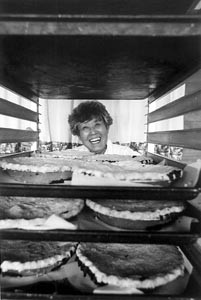
SLICES OF MOM’S Apple Pies are practically a fifth food group at the annual Harvest Fair, where “Mom,” aka Betty Carr, has been serving up flakey pieces of Americana for the past 12 years. Before Thanksgiving, more than a thousand of those juice-dribbled pies–baked in frenzied all-nighters with the help of her three adult sons and one hired assistant–will be boxed up and sold at 10 bucks a pop from their rambling roadside cafe on Highway 116 just south of Forestville.

Betty’s pies hold a place in the hearts and stomachs of residents countywide. But the owner of Mom’s Apple Pies still ducks her head like a little girl when talking about the word of mouth that has made her pastries a local institution.

“I don’t like to advertise and get people’s hopes up,” Carr says, her brown eyes twinkling. “If I ever don’t meet expectations, I’ll feel terrible.”

Seems odd for her to worry. As Mom, Carr has been baking and selling pies for almost 15 years. She freely admits that her husband, Harry Carr, who died in 1992, was the driving force behind Mom’s Apple Pies and the couple’s other projects, a Sebastopol egg farm, the Egg Basket store in Fulton, and Carr’s Drive-In in Forestville.

But Betty’s pies, with their simple fillings and tender crusts, put Mom’s on the map.

And it was Betty Carr’s city roots that kept them from migrating even further north, possibly all the way up to Oregon. “I didn’t want to be so far away from [San Francisco’s] Japantown. … I’m a city girl, I’m not really a country person,” says Carr, who had been born and raised in Nagoya, Japan, and had been living in Oakland at the time of her marriage.

But Carr adapted to life on the five-acre ranchette that they bought in the middle of the 500-acre Frei orchard in 1970. She recalls learning to drive stick-shift on an old pickup truck to get their farm’s eggs to a warehouse nine miles away in Santa Rosa’s Railroad Square. “Mr. O’Toole–well, now it’s Michael’s Garage–Mr. O’Toole could hear me grinding. ‘Oh, there goes Betty!’ ”

O’Toole, Frei, Walker … the familiar names of west county families are scattered through Carr’s reminiscences like butter in dough. Though many folks are still around, others are fading into street-sign obscurity. Carr notes each passing with a resigned shrug. She gets the dish from the farmers who come in and make their own coffee in the mornings, but of course she’s the first to notice when her sources get dug up for carefully wired rows of chardonnay.

Still, there are plenty of neighbors to help supplement the crop from the Gravenstein trees on Carr’s seven-acre property. Gravensteins aren’t good keepers–they turn mushy sooner than many other varieties–so it’s a good year when she can get cold-storage Gravensteins all the way through the winter holidays. Then Carr has to work with pippins or Granny Smiths from elsewhere.

This year the crop has been particularly limited owing to El Niño’s moist spring and also Carr’s switching over to organic growing methods on her own apple trees, which she says has improved the flavor but has substantially reduced the crop. “I will definitely be using fresh Gravensteinsthrough the Harvest Fair,” says Carr, “but after that it’s availability only.”

Truly the celebrated local apple makes an outstanding filling, with just enough inherent sweetness to minimize the need for added sugar. But whether there are Gravensteins or Grannies between them thar crusts, the fans come year-round. In response to popular demand, Carr is putting some Mom’s Apple Pies T-shirts in the dusty showcase out in the narrow hall. On the whole, however, she is not inclined to innovate.

She keeps the crooked little complex with its ancient trailer add-ons neat as a pin, and bakes her pies from the same recipes she learned in her home economics courses at a small Illinois college in the ’50s. She says nothing has changed, but deflects a request for baking hints. “Everybody has their own taste,” she demurs. “Some use more shortening, some more spice. But I really don’t do anything special.

“Well,” she pauses, “you shouldn’t handle the crust too much. It gets tough.”

The Harvest Fair on the weekend of Oct. 2-4 runs from 10 a.m. to 8 p.m. on Friday, and from 10 a.m. to 7 p.m. on Saturday and Sunday, at the Sonoma County Fairgrounds, 1350 Bennett Valley Road, in Santa Rosa. Admission is $5 for adults, $2 for kids ages 7-12 and, on Friday only, for seniors; kids under age 7 get in free. Discounts must be purchased by Oct. 1. 545-4203.

From the September 24-30, 1998 issue of the Sonoma County Independent.

© Metro Publishing Inc.

Karen Leonardhas

Sacred Bones Author Karen Leonardhas revised Jessica Mitford's 1963 investigative classic The American Way of Death. Now she has a bone to pick with funeral home directors By Stephanie Hiller D EATH is not only sometimes painful, frequently inconvenient, and only seldom desired, it's expensive. From nursing homes to fancy hospitals, the process...

Lost in Cyberspace

Resignation Rag By H.B. Koplowitz They had sex, sort of. He lied about it, sort of. So what. When you raise your hand and swear to tell the truth, the whole truth, and nothing but the truth, it's supposed to mean something. Impeach the bastard. Let him go. He committed adultry. So did you. Round and round...

Kindertransport

Dark Journey Kindertransport. 'Kindertransport' tells story of survival By Daedalus Howell BEFORE ENTERING Actors' Theatre's production of Kindertransport, audiences are advised to stuff their pockets with the Kleenex thoughtfully provided in the atrium. You will need it. You're going to cry. Consider wearing a life preserver, perhaps even hip-waders. Inspired...

Reduced Shakespeare Company

Bible Belt The Bible: The Complete Word of God (Abridged), playing Oct. 8 at the Sebastiani Theatre. Reduced Shakespeare takes on the Big Book By Patrick Sullivan THEY'VE MADE a splash at the Kennedy Center, been called blasphemous by religious protesters, stolen the show in broadcasts on NPR and the BBC, and wowed the...

Keb’ Mo’

Mo' Blues Slow Down. Frank Ockenfels Bay Area bluesman Keb' Mo' at LBC By Alan Sculley I KNOW I'm known as an acoustic blues guy and I know I'm in that genre," says bluesman Keb' Mo'. "I know that's probably my best genre. Probably my best performances are in that area. ...

Helen Caldicott

Bombs AwayDavid Young/Carolyn JohnsAnti-nuke activist Helen Caldicott is back By Dylan BennettAUSTRALIAN pediatrician Helen Caldicott says she is not a Christian, but speaking with her you find yourself muttering words like "Jesus" and "God." That's because she's talking about Armageddon. No, not the blockbuster summer movie about asteroids from space, but the man-made reality of nuclear war and the...

Eric Bentley

Center Stage Music man: Bentley brings his cabaret act to Sonoma State on Sept. 29. Author Eric Bentley still shaping theater By Patrick Sullivan FOR SOME FIVE decades, Eric Bentley has been a major force in the world of American theater. His criticism in The New Republic in the 1950s cut the...

Transit Tax

Green Daze Michael Amsler Environmentalists split over transit tax measures By Janet Wells IF DIVIDE-and-conquer is one strategy of victory, Sonoma County's pro-development community might benefit greatly from a split in the environmental community over November ballot measures to raise $811 million in sales taxes for local highway expansion and public...

Talking Pictures

Film Fight Simon Birch. Author Marianne Wiggins takes on the 'Simon'-izing of 'Owen Meany' By David Templeton David Templeton takes interesting people to interesting movies in his ongoing quest for the ultimate post-film conversation. This time out, Templeton inadvertently sparks a moral crisis for esteemed British author Marianne Wiggins when he invites her...

Betty Carr’s Apple Pies

Spice Girl Michael Amsler Platefuls of motherly love from Mom's Apple Pies By Marina Wolf SLICES OF MOM'S Apple Pies are practically a fifth food group at the annual Harvest Fair, where "Mom," aka Betty Carr, has been serving up flakey pieces of Americana for the past 12 years. Before Thanksgiving,...
11,084FansLike
4,606FollowersFollow
6,928FollowersFollow
