Battle of the Blues

Smoking Guns

Local bands duke it out at Battle of the Blues

By Natalie Sibert Freitas

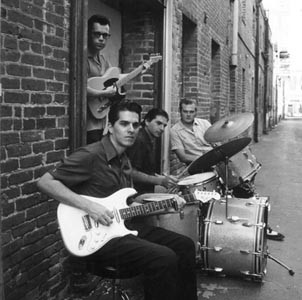
WHICH IS SONOMA County’s best up-and-coming blues band? Maybe you have an opinion already formed in your mind, or perhaps you don’t have a clue as to what the local blues scene has to offer. In any case, on Thursday, Dec. 2, we’ll get an answer of sorts when four local blues bands duke it out for the title at the first Annual Battle of the Blues at Rumors Nite Club in Santa Rosa.

Ron LaFranchi, Sonoma County native and owner of Hedgehog Productions, is the mastermind behind the event. A good deal of LaFranchi’s motivation for the contest sprang from his frustration about how other battle of-the-band events are often run.

“I wanted a less political approach to selecting a winner, which is why the audience will vote to select the winners,” he says.

Generally, so-called expert panels are used in judging such contests, but LaFranchi’s approach is a more honest one–it acknowledges that music fans are sometimes better judges than those in the business.

LaFranchi chose the battling bands based on their talent, original material, and the fact that they are lesser known. The lineup currently includes the Aces, Hall of Mirrors, Hott Spell, and Blue Blazes.

“I could have easily added Eric Lindell to the bill, for example, but I felt there are other bands that are as deserving but less visible,” he says.

The location is equally important to LaFranchi: “I also wanted a good venue and found Rumors to be that,” he says. “It has a capacity of 500, a large stage, probably one of the largest dance floors in Northern California, and an exceptional sound and light system.”

The competition will feature a wide variety of blues stylings, and each band will be given a 45-minute set to perform original material and one cover tune.

“Having the bands play a cover song will help give the audience some point of reference, since it’s unlikely they’ll be familiar with the originals,” LaFranchi said.

Attendees will receive a ballot with their admission ticket. The votes will be tallied and the winners announced at the end of the event. The lucky first-prize winner will receive recording time at Prairie Sun Recording Studios–pure gold to any musician.

LaFranchi is no stranger to the local music community. He manages the bands Pen Fifteen, Powerbalance, and Butter B Down and has produced a long list of benefit concerts for Kid Street Theater, the Polly Klaas Safety Fair, and, most recently, the “Rockin’ for Rio” show put on to help flood and mudslide victims of Rio Nido. As if that weren’t enough, LaFranchi also booked the Moonlight Restaurant & Bar in Santa Rosa for a two-year spell and is currently booking live acts on Thursdays at Rumors.

LaFranchi’s desire to renew interest in the local blues scene also plays a huge role in his creating this contest.

“Unfortunately, many of the blues bands in this county are cover bands, and my heart is in supporting original blues music,” he says. “The Battle of the Blues will be an annual event to continue to support original blues music and hopefully build up the blues audience once again.”

Catch the Battle of the Blues on Thursday, Dec. 2, starting at 6 p.m. at Rumors Nite Club, 120 Fifth St., Santa Rosa. Tickets (for 21 and over only) are $10 and are available at Stars Music in Petaluma and Santa Rosa, Backdoor Disc and Tape in Cotati, and Rumors Nite Club in Santa Rosa. For details, call 545-5483.

From the November 24-December 1, 1999 issue of the Sonoma County Independent.

© Metro Publishing Inc.

‘Greed: The Multi-Million Dollar Challenge’

0

Seven Deadly Sins a potential windfall

By Bill English

SAINT THOMAS Aquinas never actually ranked greed as one of the Seven Deadly Sins. He preferred to call it avarice. But then old Tom was never a program director for Fox Television. When you work for Rupert Murdoch, you’ve got to keep it punchy. Greed has a ring to it that mere avarice can never hope to achieve. The word has an underbelly odor of insatiable appetites, a scent you can smell right through your fiber-optic cable.

Welcome to Greed: The Multi-Million Dollar Challenge.

Here’s a new program that bills itself as the most dangerous and richest game show in TV history. In this time slot, contestants climb the Tower of Greed on their way to the ultimate prize of $2.2 million. There’s nothing demure or refined about Greed. But this isn’t a shameless attempt to cater to the lowest common denominator, either. No, this is a bona fide art form–a total revelation into the utter darkness of the human heart.

Greed is more than good–it’s pluperfect.

The show is emceed by veteran game-show host Chuck Woolery. You will recall that Woolery became a household name by hosting The Love Connection. Today that classic would surely be renamed The Lust Show and have a much harder edge. The genius of The Love Connection was the payoff. Chuck gave contestants to each other. OK, the show threw in a cheap date, but the bottom line was that you won a member of the opposite sex. Back then, Woolery was more than aware of his status as a prime-time pimp–but now Chuck has become a full-blown Satan.

The ardent scent of The Love Connection was tame compared to the animal nose of Greed. Here’s an hour on Thursday night that simply reeks of base and carnal desires. And Chuck is all over depravity like gonzo journalist Hunter S. Thompson at a Republican fundraiser. Greed has exposed the wolf in Woolery. He gleefully dangles cash beneath the noses of salivating players as he asks them: “Do you feel the need for greed?” When the Terminator lights begin to flash, the whole studio holds it breath. Will one of the players turn on a fellow contestant and eliminate him or her? One woman, when recently challenged for her share of the big bucks, almost burst out in tears. She knew she was doomed, a weak link cut from the herd

Greed is indeed an awesome show, but why stop there?

SURELY, all the Deadly Sins are worthy of prime time? Who could deny that America is ready for The Sloth Show? Think of it as a contraction of the “nothing” concept that made Seinfeld such a smash. In fact, The Sloth Show might well be a new vehicle for Jerry. You could bring back all the old characters–only they’d do much less. The whole show could be shot on Jerry’s couch.

Or what about The Hour of Envy?

Talk about a surefire hit! In an era when the rich have so much and the poor so little, it would really stir things up. Hosted by President Trump, it would feature the first head of state ever to preside over a game show. Trump would drag the disenfranchised kicking and screaming through the lavish lifestyles of his trendy friends until the needy were openly weeping.

Cruel, you say? Well then, let’s play The Gluttony Game.

Hosted by a digital reincarnation of John Candy, this show would feature contestants eating themselves to death. Too gross? Are you kidding me? Think of the product-placement possibilities. Food companies would be clamoring to get edibles on this feast of entertainment.

Of course, with Jerry Springer already airing the anger thing, that pretty much leaves us with pride. Not really much happening here. Because anyone with a shred of pride wouldn’t humiliate him/herself on national television for any amount of money.

But never underestimate the ability of the American people to wallow in shame in the eye of the tube. At times it seems as if we’re all scampering for one last moment in the spotlight before they close the set.

OK, kill the floods–that’s a wrap.

From the November 24-December 1, 1999 issue of the Sonoma County Independent.

© Metro Publishing Inc.
‘The Insider’

0

The Insider.

Inside Out

A seasoned whistle blower talks about media censorship and ‘The Insider’

Writer David Templeton takes interesting people to interesting movies in his ongoing quest for the ultimate post-film conversation. This is not a film review; rather, it’s a freewheeling discussion popular culture.

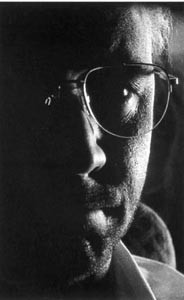
PETER PHILLIPS never watches 60 Minutes. He doesn’t read Time or Newsweek. And, contrary to what you might expect from a professional news-watcher, Phillips never watches the news. Instead, he scans the transcripts of news reports and random news programs; he pours over newspapers, absorbing “a couple hundred publications” every week.

He does not own a television. “Well, I had a TV, with satellite service, for one day,” he says with a chuckle.

The intense, soft-voiced, white-bearded Phillips is the director of Project Censored, the renowned 24-year-old program–an offshoot of the Sociology Department at Sonoma State University–that monitors news and news services, producing a best-selling annual compendium of important stories ignored, often for dubious reasons, by the mainstream media.

Of his aforementioned one-day perusal of the major news programs, Phillips has this to say: “It was nothing but garbage. All day long. Then there was a MSNBC special on Hitler. Then they started comparing Hitler to Milosevic–and that just pissed me off. That’s simple-minded NATO propaganda. It’s bullshit.

“I haven’t watched TV since.”

He takes a breather to get another cup of tea. When he returns, sliding his mug onto the scarred coffeehouse table, Phillips–who looks a little like Santa Claus, only edgier–smiles broadly. “So what were we talking about?”

Well, we were talking about 60 Minutes. And before that, we were talking about The Insider. A new Disney film starring Al Pacino as former 60 Minutes producer Lowell Bergman and Christopher Plummer as the intimidating reporter Mike Wallace, The Insider tells the sordid, engrossing true story of Jeffrey Wigand, a reluctantly heroic tobacco company insider who lost everything–and suffered numerous death threats–when he agreed to speak to Wallace on camera about his employer’s misdeeds.

After Wigand’s segment was filmed, the network buckled under in the face of a lawsuit threatened by the tobacco company that Wigand had worked for. After a bitter fight–in which Bergman, who shortly thereafter left the network, resorted to leaking his story to the New York Times–the segment was finally aired.

But 60 Minutes’ reputation had been forever soiled.

IRONICALLY, it was the story of how 60 Minutes sat on Wigand’s interview that was widely reported, while the substance of that interview–that tobacco companies had been deliberately engineering cigarettes to be more and more addictive–was downplayed.

Phillips liked the film.

“Unfortunately, it says too little about a big problem,” he shrugs. “The Insider is saying that there are still good journalists out there, and that is true. There are good journalists, firm believers in the First Amendment. And they are increasingly bent and pushed around by Big Media.

“And it’s true, it’s all true,” Philips continues. “But the problem is far worse than that. At the end of the movie, 60 Minutes has fixed its problem, they’ve come clean, they’ve run the story–only now they’re a little bit bent.”

The truth, according to Phillips, is that 60 Minutes was always bent–along with every U.S. mainstream newspaper and news organization. “It’s been said before,” says Phillips. “We are the best-entertained, least informed society on the planet.”

As an example, he mentions the inordinate attention given to the O.J. trial–and the stifling effect it had on other, more vital journalistic endeavors.

“Eighty-three column feet were devoted to O.J. in the Los Angeles Times the year of the trial,” Phillips divulges. “Why didn’t they write about how Chevron hired the helicopters that flew toward the Nigerian oil platforms, guns blazing, killing the student demonstrators?”

The powers that be, obviously, felt we’d rather hear about the private life of Kato Kaelin.

“These people who are supposed to be exposing the system are actually supporting the system,” Phillips concludes. “When you get as wealthy as Mike Wallace, when your contract is paying you millions a year, you can’t help but feel a little beholden to the powers that be.

“Because, guess what? You’re part of it now.”

From the November 24-December 1, 1999 issue of the Sonoma County Independent.

© Metro Publishing Inc.
Holiday Treats

0

Something new: Steve Bernstein of 21st Century Pastry in Petaluma puts new twists on traditional fare.

Sweet Talk

Local bakers share holiday secrets

By Paula Harris

FORGET VETIVER, geranium, and bergamot. At this time of year, the sweet fragrance of Christmas cookies, pumpkin pies, or rugelach turning golden in the oven is the ultimate aromatherapy. The enticing scent envelops the kitchen and transports you back to a time when your grandmother was baking for the holidays. It subconsciously fills you with that warm secure feeling of being nurtured. And it causes a childlike twinge of excitement because it signifies the beginning of the festive holiday season.

In my family, the holidays really began with an annual visit from my grandmother, who would arrive from the north of England proudly bearing an airtight old biscuit tin crammed with layers of home-baked goodies: strawberry jam tarts, glistening like red jewels; sunny lemon-curd pastries; and tiny sweet-mince pies dusted with powdered sugar.

We’d dip our hands into this aluminum treasure trove and extract a flaky treat. We loved them all (even the couple that were always invariably “decorated” with a stray hair from Nanna’s white cat). I think we especially prized this holiday offering because no one else in the family knew how to make pastry.

The days when apron-clad grandmothers and aunts regularly clustered over cookie sheets and pastry boards may be gone, but there’s something about the holidays that compels even those folks who do little baking throughout the year to scrub out their cake pans and dust off their candy thermometers.

Yet the thought of baking can send cold shivers down the spine of even the most proficient of cooks. Some bakeries, such as Healdsburg’s Downtown Bakery and Creamery, understand the dilemma of yearning to bake but feeling incapable. They offer their popular old-fashioned “Sugar Baby” pumpkin pies either fully baked or as a kit consisting of a frozen ready-to-bake shell and a container of filling. “So you can bake it yourself at home,” the packaging exclaims. Foolproof!

But why is baking so scary?

“It’s because baking is not quite as freeform as regular cooking–there’s a bit more chemistry involved,” explains Michelle Marie DeFors, owner and pastry chef at Michelle Marie’s Patisserie in Santa Rosa. “Beginners should start with a tea bread,” she suggests. “Pies can be a bit daunting.”

According to DeFors, even many inexperienced bakers have a problem making pie crust. “Things like rolling it out, dealing with shrinkage, and being sure to let the dough rest before putting it into the pie plate can all cause problems,” she says.

So does this pastry chef, who often fields “emergency” calls from home bakers begging her to help save their failed works in progress, have any tips to share?

“I think it’s best to freeze the pie crust first before putting in the filling,” she says. “And if your crust has droopy edges, make a little foil collar for the sides and fix it on with paper clips, then remove it later to finish browning.”

FOR DEFORS, who grew up in Sebastopol, the flavor of apples became synonymous with the holidays. “My whole family loves food and we all baked together,” she recalls. “Those special apple cakes, pies, and streusels played a big part in our holiday traditions.”

She advises that once you get more accomplished in the baking world, you can experiment a little. “Take something from a memory and alter it into a new idea,” she says. “It’s fun.”

Beth LaFrance–whose homey business Beth the Baker in Sebastopol will feature cranberry orange-nut bread, pumpkin bread, and gingerbread for the holidays–has a few more tips. “Always measure accurately and don’t stray from the recipe, because that can really upset the balance,” she says. “Try one simple recipe, follow it faithfully and make it as close to consumption as possible, because freshness counts.”

If you’re making Christmas cookies, you don’t need to keep peeking in the oven, she adds. “When you can smell the cookies, they’re probably done.”

According to LaFrance, the art of baking is unique because you start out with a bunch of ingredients that look nothing like your finished creation. “It’s not like making soup or roast beef,” she says.

Is there one baking item that LaFrance couldn’t live without? “Definitely parchment paper,” she immediately replies. “I use it for everything. My food never touches a tray or a baking pan. The parchment paper keeps the food from sticking and the bottoms from burning.”

HOW DO bakers come up with new holiday creations? “It’s a selfish thing according to our own taste,” says Steve Bernstein, of 21st Century Pastry in Petaluma. Bernstein and his business partner, Phyllis Heagney, sit face to face in a small room and throw out ideas for new seasonal treats. “We like intense flavors and different twists on traditionalism,” he adds.

Making their debuts at 21st Century this year are chocolate cranberry marzipan tart, chocolate pumpkin shortbread tart, and Scottish cranberry shortbread tart.

“I don’t think my creativity developed until I was in the field,” says Bernstein. “However, my grandmother was a great influence–her favorite was coffee; she used it in everything–for years. I thought coffee Jell-O was normal,” he quips.

That particular culinary encounter influenced Bernstein’s coffee chiffon pie with orange juice in the crust. “Baking is a science more exact than cooking and a recipe has be to followed to a T. It shouldn’t be fiddled with unless you know what you’re doing,” he advises. “But it’s nothing to be afraid of–if you follow the directions.”

The holiday season is pastry chef Condra Easley’s favorite time of year. “It seems so magical in here,” says the co-owner of Renaissance Pastry in Santa Rosa.

She describes some of the bakery’s winter delights: linzertortes topped with cranberry-raspberry-blueberry compote cooked with honey, cinnamon, and orange; pumpkin cheesecakes with a gingersnap crust; and traditional “bûche de Noël” Yule logs.

“I like to bring together flavors that evoke childhood memories–good childhood memories and hopefully not [bad] flashbacks,” Easley says with a laugh. “When I was barely able to reach the counter, my aunt had me up on a chair to bake chocolate chip cookies.”

Easley likes to experiment with various harmonizing flavors, “natural combinations like caramels and pears or apples and walnuts,” she explains.

She offers the following timesavers for home bakers: “Make the pie dough ahead of time, roll it out, cover it really well, and freeze it. Then let it defrost a bit before putting it in the oven, or roll it out the day before and keep it covered in the refrigerator,” she says.

“And make holiday cookies ahead of time and keep them in the freezer in Ziploc bags. Then pull them out and decorate them later.”

Anything else?

“Always use the best possible ingredients or you might as well just buy the pie from a big-box discount store. Use good-quality unsalted butter, imported chocolate bars, and real vanilla extract instead of artificial,” she says. “Oh, yes, and put a lot of love into it.”

Pumpkin Pecan Pie

If you can’t decide between the two holiday favorites, this pie from Renaissance Pastry offers the best of both worlds.

Single pie crust:

1 1/4 cups all-purpose flour 1/2 tsp. salt 1/3 cup cold Crisco 3 tbsp. cold water

Pumpkin pecan filling:

2/3 cup dark Karo (corn) syrup 3/4 cup medium brown sugar Pinch of salt 2 tsp. melted butter 4 whole eggs 1 cup Libby’s solid-pack pumpkin 1/2 tsp. ground cinnamon 1/2 tsp. ground nutmeg 1/2 tsp. ground allspice 1/4 tsp. ground ginger 1/4 tsp. ground cloves 1 tsp. pure vanilla extract 2 cups toasted pecan halves

To make pie crust: In a food processor, cut together the flour, salt, and cold Crisco by pulsing until mixture has a texture like cornmeal. Add cold water and pulse. Mixture should form a ball and travel around the bowl. Add more water if you don’t see that. (If you don’t have a food processor, use a bowl and cut in fat with a pastry blending tool or two cold knives.) Do not overmix or dough will be tough. Form into a ball. It is not necessary to refrigerate unless you have overmixed. Roll out dough on a lightly floured surface until approximately 12 inches in diameter. Ease onto a 9-inch pie plate to avoid stretching. Trim edge to 1/2 inch beyond edge of crust and make a decorative border. Refrigerate until ready to use.

To make filling: In a medium bowl combine Karo syrup, brown sugar, salt, and melted butter. Stir in eggs and mix well. Add pumpkin, spices, and vanilla. Add nuts and pour into unbaked pie shell. Bake at 350 degrees for 20 to 30 minutes. Cover edges of crust if it browns too quickly. Pie is done when firm and slightly puffed.

Serves 8.

From the November 24-December 1, 1999 issue of the Sonoma County Independent.

© Metro Publishing Inc.

Concert for a Landmine-Free World

0


Blowin’ in the Wind

Music stars rally for landmine-free world

By Greg Cahill

ROBERT MULLER knows how it feels to get blown away. As a Marine lieutenant serving in Vietnam in 1969, Muller was walking next to an armored tank when it ran over a landmine. The heavy steel-tank tread absorbed most of the blast, but the concussion sent him flying. “It was like one of those cartoon-character-type things,” he recalls, during a phone interview from his Washington, D.C., office. “I literally got blown away with the pulverizing tread in a cloud of black smoke. I wound up in some nearby hedges. I was a little stunned–not really sure what happened.

“Right away, I started pulling an inventory of my limbs,” he adds, with a nervous laugh. “I was miraculously unaffected.”

A few days, Muller’s luck ran out. During a firefight, an enemy bullet severed his spine, leaving him paralyzed below the waist. “A bullet took me down,” he says, “but the leading causes of casualties for U.S. soldiers in the Vietnam War were landmines and booby traps.”

In 1984, Muller returned to Vietnam and Cambodia, where he was stunned to see the high number of amputees and lack of support services. As the head of the Vietnam Veterans of America Foundation, Muller decided to do something to help. With funding from the U.S. Agency for International Development, the VVAF has supplied landmine victims with more than 4,000 prosthetic limbs, nearly 1,000 orthotic braces, and more than 2,000 wheelchairs, free of charge.

More recently–with the help of a lot of high-profile friends in the music biz–Muller has set his sights on the elimination of the small, cheap explosive devices that have caused so much misery. That effort has resulted in an international treaty banning antipersonnel landmines, which in 1997 earned Muller and others the Nobel Peace Prize. The United States has not ratified the treaty, which is backed by 135 nations, because it would require the elimination of anti-tank mines from the U.S. arsenal.

But Muller is determined to rally public support for the treaty.

On Dec. 2, the Campaign for a Landmine-Free World will host a benefit concert at the Luther Burbank Center, featuring an all-star lineup of country and folk artists. Scheduled to perform are Emmylou Harris, Steve Earle, Bruce Cockburn, Nanci Griffith, Patty Griffin, and a special guest.

While celebrity concerts for the landmine campaign began in 1997, thanks to the support of Harris, the three upcoming Bay Area dates are the first in a series of singer/songwriter-in-the-round concerts benefiting the Nobel Prize-winning organization.

TWO YEARS ago, Harris traveled with Muller to Vietnam and Cambodia to learn firsthand about the hidden threat posed by landmines. “She is a strong advocate on behalf of the work that we do with war victims,” Muller says. “She has called upon the music community to get behind this cause, and the response has been overwhelming.”

Last year, Harris performed at the Nobel Prize Award ceremony in Olso, Norway. She later headed a benefit concert for the campaign at Constitution Hall, in the nation’s capitol, which featured Earle, Willie Nelson, Sheryl Crow, and Lucinda Williams. “That got a lot of media attention and brought a lot of support,” says Muller, adding that the purpose of all this celebrity action is to put pressure on the United States to sign the treaty.

“Music has consistently connected us to people–more so than any speeches or lectures that we give,” he explains. “When these people have stepped up as spokespeople, they capture audiences, and the message is amplified in support of our work in a way that as advocates we just don’t have the ability to do. And the musicians love to do it.

“So we’re all very excited about it.”

PROCEEDS from the concerts support several VVAF projects co-funded by the United States and several other nations. VVAF helps pay for the surveying of minefields and the clearing of explosives. The organization also operates the largest amputee rehabilitation projects in Cambodia, Angola, Kosovo (where the VVAF serves as the coordinating agency for the United Nations), and Sierra Leone.

During his visit to the Bay Area, Muller will meet with representatives from J Winery and other local vintners involved in Roots for Peace, a wine-industry project that is funding the removal of landmines in Croatia (a breakaway state of the Yugoslavian Federation) and helping to restore that republic’s devastated agricultural industry.

Such efforts make Muller hopeful that public support for the VVAF campaign is growing, but he remains discouraged that the U.S. government is steadfast in its refusal to support the international treaty.

“It’s very disappointing,” he says. “When we began this campaign, it was the United States that had inspired the movement around the world. A lot of people don’t remember that we were the first country in 1992, unilaterally, to give up the trade in landmines. That meant we couldn’t sell them or give them away.

When our key political liaison in the U.S. Senate, Sen. Patrick Leahy from Vermont, called upon the Senate for that initiative, on a roll call vote he got unanimous vote in support of the ban–something you don’t see every day.

“The next year, President Clinton went before the U.N. General Assembly and told delegates that this is a very dangerous weapon and that we’ve got to get rid of it. Two years later, he went back again and called on the world community to get rid of landmines through an international treaty. So after the United States led the way to get something going, at the end of the day not to have the United States as one of the 135 countries that have signed this treaty is a real bitter disappointment.

“We’ve got to get the United States on board if we want to pick up any more key players.”

The current concert series , Muller says, is a way to accomplish that goal. “We want to keep this issue out there in the public arena,” he says, “so that people understand that while we’re doing the humanitarian work of helping the victims and clearing the lands, we still need to turn off the spigot.”

At press time, there were a few tickets left for the Concert for a Landmine-Free World, Thursday, Dec. 2, at 8 p.m. at the Luther Burbank Center for the Arts, 50 Mark West Springs Road, Santa Rosa. Tickets are $45-$85. 546-3600.

From the November 24-December 1, 1999 issue of the Sonoma County Independent.

© Metro Publishing Inc.
‘Toy Story 2’

0

Sonoma filmmaker John Lasseter, defender of plastic playthings, returns to tell a brand-new ‘Toy Story’

FEW FILM FANS will be surprised to hear that filmmaker John Lasseter–the mild-mannered creative genius behind the computer-animated hit film ‘Toy Story’–is, and has always been, an enthusiastic devotee of toys. Yes, he’s a toy fan: a defender, an advocate, a sympathizer, a fiercely passionate apologist for toys. He identifies with them, and he feels their pain.

“I love toys,” crows Lasseter, speaking by phone from his car phone on his way home from Pixar studios in Pt. Richmond. “I’m just a big goofy kid at heart when it comes to toys.”

Consider this: Lasseter co-wrote and directed the ultimate toy movie, the aforementioned Walt Disney/Pixar Studios mega-hit Toy Story, as well as its upcoming, equally toy-happy big-screen sequel Toy Story 2. (Lasseter, of course, had already made one film from a toy’s perspective: the charming Oscar-winning, 1988 computer-animated short Tin Toy.)

A longtime resident of the town of Sonoma, Lasseter is joined in his semi-idolatrous fondness for plastic playthings by his five energetic sons. Between the six of them, Lasseter & Co. are a devoted toy-appreciation society, a certified toy-collecting force of nature.

Just one thing, though.

“The kids have their toys,” Lasseter says. “And I have my toys.”

Lasseter’s personal stash–several floor-to-ceiling shelves worth–is nothing but a toy collector’s dream, with vintage one-of-a-kind tin toys, Hot Wheels, G.I. Joes, and lots of Toy Story toys, the last gleaned from the 1995 Oscar-winning film and all residing in Lasseter’s office at Pixar.

“The boys love to come to work and play with Daddy’s toys,” Lasseter says, laughing. “They’re like bulls in a china shop. I just freak out.”

It was his sons’ rambunctious relationship with their dad’s office toys–and his own growing ambivalence regarding his part in the enormous Toy Story collectible industry–that gave Lasseter the first germ of a plot for Toy Story 2, in which an eerie toy-collector kidnaps Woody, the tightly wound cowboy-doll and star of the first episode who, it turns out, is a valuable collectible. Woody’s one-time nemesis Buzz Lightyear ends up leading a band of toys in rescuing their friend from becoming a permanent museum piece. Unfortunately, Woody–who always had a bit of an insecure streak in him–has grown to like being thought of as a valuable collectible.

“This time, it’s Buzz who gets to say to Woody, ‘You are a toy! You’re not a collectible. You are a child’s plaything!’ ” says Lasseter.

Woody’s Roundup: Cast and crew members plan to attend the gala local premiere of the much-anticipated film.

TOY STORY 2 holds the special distinction of being only the second animated Disney film to receive a big-screen sequel. (The first was 1977’s The Rescuers, which was followed in 1990 by The Rescuers Down Under.) Follow-ups to such films as Pocahontas, Beauty and the Beast, The Lion King, and Aladdin have all been released directly to video.

“Once we’d come up with a story for the sequel,” says Lasseter, “based on the strength of that story and the enthusiasm of Tom Hanks and Tim Allen [who have reprised their work as the voices of Woody and Buzz, respectively], all of us at Disney and Pixar decided that this was a film that belonged on the big screen.”

In conceiving the sequel, Lasseter and his writers watched Godfather, Part 2 and The Empire Strikes Back, over and over.

“Those are two examples of movies that were not just good films unto themselves,” Lasseter explains, “but sequels that actually made the first films seem better and stronger when you looked back on them.”

According to Lasseter, that’s just the case with Toy Story 2, which hits the big screen on Nov. 24. Hollywood insiders are now predicting that Lasseter’s film will become one of the highest-grossing Thanksgiving week films of all time.

IT’S HARD to believe that just a few years ago, when word first got out that Disney was preparing a computer-animated feature, a number of industry critics suggested that Walt Disney–the hallowed progenitor of large-scale, hand-crafted animation–might be spinning in his grave.

Lasseter still cringes to hear such remarks.

“Are you kidding? Walt would have loved computer animation, from the moment he saw the first image of it,” Lasseter says. “He’d have loved what this medium is capable of. Walt was an innovator, a man who pushed technology to its limits in finding better and better ways to tell a story.

“Because first and foremost, Walt Disney was a brilliant storyteller.”

There’s little doubt that he’d have loved Toy Story, arguably the most tightly plotted, well-structured animated film in the history of the Disney studio.

Besides, Uncle Walt loved toys too.

“In the first movie,” says Lasseter, “we did a lot of thinking about how the world would look from a toy’s point of view. So I have to laugh at the way I sometimes reacted when my sons wanted to play with my toys, telling myself, ‘Hey John, didn’t you learn anything from the first movie?’ Toys were put on this earth to be played with. Just because some guy named Tom Hanks happens to have autographed my Woody doll doesn’t mean the toy deserves to be locked away on a shelf.

“I mean, what kind of life is that for a toy, to never again be played with by a child?”

And that, says Lasseter, is what Toy Story 2 is all about.

“The most tragic thing,” he says, “even worse than a toy being lost or stolen, is when a toy is outgrown by the child who once loved it. That’s the kind of rich, emotional terrain that made us want to do this movie.

“Think about it. Being outgrown by a child. It’s something that eventually happens to every single toy. It’s a toy’s version of mortality.

“A lot of people want to live forever,” Lasseter concludes. “But a toy just wants to be loved forever.”

From the November 18-24, 1999 issue of the Sonoma County Independent.

© Metro Publishing Inc.

Cin Cin

0

Cinfully delicious: Chefs John Gillis and Gina Armanini, both of Glen Ellen’s Girl and the Fig fame, have moved their culinary expertise to Calistoga, creating the sensational Cin Cin.

Cinsational!

Three cheers for Calistoga’s Cin Cin

By Paula Harris

SINCE CALISTOGA is just a hop, skip, and a scenic 18-minute drive on undulating Calistoga Road from Santa Rosa’s Rincon Valley, you can almost believe this small country town belongs in Sonoma County. What the heck, let’s forget boundary lines and adopt it. On a recent blustery fall evening, we strolled down the Old West-style main street, with its old-fashioned street lamps and warmly glowing shops, and were stopped in our lazy tracks by a chalkboard beckoning from one street corner. “Tonight,” it announced in large happy script, “Grilled rabbit–Lamb osso bucco with gnocchi–New wines beaujolais/chablis/zin/syrah!”

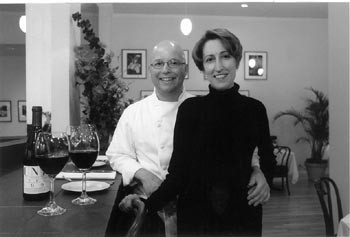
We were outside Cin Cin. The chalkboard worked its magic and lured us into the handsome restaurant for dinner. Chefs John Gillis and Gina Armanini, both of Glen Ellen’s Girl and the Fig fame, opened the Italian-inspired bistro in neighboring downtown Calistoga this summer, and we were eager to try it.

Cin Cin (pronounced Chin Chin and meaning “cheers” in Italian) has a very architecturally aesthetic dining room. Lots of clean lines but not at all cold or sterile. The walls are a light eggnog color, and incandescent egg-shaped lamps hang from the ceiling. A pair of potted palms stand like leafy sentinels by the door in their terra-cotta urns. The sound system plays tasteful classical and Italian selections.

There are beautiful framed black-and-white photographs depicting Georgia O’Keeffe-type blooms, and outdoor scenes of fields and clouds. The tables are all white and silver (crisp white linens, tea lights in glasses, silvery breadbaskets, white china, and gleaming wine goblets). There are also counter seats by the open kitchen.

The baked goat cheese ($8.50) was soft and luscious. The warm pile of cheese (which had only the softest bite of tanginess) was set on a crispy fig leaf (according to our server) from the owner’s garden. The leaf seemed glazed with a slight honey flavor. There were plenty of toast slices on which to smear the chèvre. As a nod to their last employ, the chefs included a handful of sweet, juice-laden black mission figs to the dreamy dish. One quibble: the vinaigrette on the accompanying salad greens was a bit too tart and jarring against the creaminess of the baked cheese.

The warm salad of duck confit ($8.50) may be called “salad” but sure ain’t rabbit food and was very welcoming on this autumn evening. It consisted of generous shredded duck, toothy white flageolet beans, French beans, and some feathery frisée greens all dressed in a pancetta-shallot vinaigrette. Highly recommended for its flavor combo, substantial texture, and ability to fill and warm the tummy.

Risotto with roasted wild and cultivated mushrooms and truffle oil ($15.50) boasted outrageously plump and moist grains of rice and a melange of mushrooms that seemed to invoke the smokiness of grilled meat. “It’s positively steaklike,” announced our vegetarian companion, sporting a silly grin. However, on another visit he was less pleased with a pasta special ($15) containing fava beans, goat cheese, and heirloom tomatoes, because the fettuccine was clumped together.

The grilled quail ($18) was well presented, with two slender birds resting on a bed of delicate butternut-squash risotto. The golden birds were not overcooked and were flavored with a thyme demi-glace.

ONE OF THE MOST outstanding dishes was the lamb osso bucco ($17). Served in an oversize soup bowl, the hearty but highly tender lamb shanks were surrounded by a super-thick rich gravy that begged to be dunked with crusty bread. Airy cushions of house-made gnocchi added soft texture, although their flavor was somewhat lost beneath all the brawny flavors. A marvelous robust dish to come home to after toiling in the fields (or at the computer) all day.

Armanini has created some fine desserts. Gravenstein apple galette ($6.50) was served warm in a pool of brandied caramel sauce and accompanied by vanilla bean ice cream. The shakes of powdered cinnamon around the edge of the plate gave the dish a spicy burst.

The wafer-thin baked cannoli ($7) was filled with sweet fresh ricotta, dark chocolate, and candied orange. Melted chocolate and a variety of candied nuts completed the yummy picture.

Cin Cin has an exciting eclectic wine list, with bottles from France, Spain, Australia, Italy, Sonoma and Napa counties, and California’s Central Coast. Many wines are available by the glass. Even so, many patrons bring in their own bottles (there’s an $8 corkage fee).

The staff is knowledgeable and caring, and the pace is luxurious and unrushed. But reservations are greatly recommended (the restaurant turned away many who arrived later in the evening without them).

Cheers to Cin Cin–it’s definitely worth the short jaunt.

Cin Cin Address: 1440 Lincoln Road, Calistoga; 942-1008 Hours: Wednesday-Monday, 5:30 to 10 p.m. Food: Italian-inspired bistro Service: Knowledgeable and professional Ambiance: Classy Price: Moderate to expensive Wine list: Excellent varied selection by the bottle or the glass Overall: 3 1/2 stars (out of 4)

From the November 18-24, 1999 issue of the Sonoma County Independent.

© Metro Publishing Inc.
‘Angels in America’

0

AT’s ‘Angels in America’ soars

By Daedalus Howell

“THERE ARE NO angels in America,” suggests a character in playwright Tony Kushner’s Pulitzer Prize-and Tony Award-winning gay fantasia Angels in America. Actors’ Theatre’s intimate staging of the Broadway monolith (expertly directed by Argo Thompson) proves the character wrong. AT’s production is strewn with angels–in the form of a talented cast and crew.

A pre-apocalyptic tapestry of subplots concerned with the encroaching AIDS epidemic and political conservatism of the early ’80s, Angels is pulled together by the imminent demise of dandified paramour Prior Wallace (Cameron McVeigh), whose infection with AIDS gradually overtakes him throughout the duration of the play. This leads to the implosion of his relationship with his highstrung lover Lois Ironson (Peter Downey), a talkative, white-collar type who is emotionally ill-equipped to endure the tragedy.

Meanwhile, insufferably bombastic and ethically challenged attorney Roy W. Cohn (Joe Winkler) is also diagnosed with AIDS (though his power-broker ego is in denial) while he attempts to convince his lackey Joseph Porter Pitt (Dodds Delzell) to accept a Justice Department position to get him out of a scrape.

Pitt, a Mormon whose central conflict hinges on his moral approach to his work and the fact that he is a repressed homosexual, finds himself in several quandaries, not the least of which is the fact his Valium-addicted wife openly resents him.

Kushner’s blissfully meandering text raises innumerable issues germane to both ’80s and ’90s America and then offers cogent answers.

Director Thompson exceeds himself in bringing this three-act behemoth to the diminutive AT stage without forgoing any of the spectacle that is, in part, this show’s trademark. He has assembled and activated a top-drawer cast that brings out the poignancy and humor of the work.

McVeigh is a revelation as the unabashedly fey Prior: witty, pretty, and gay, McVeigh’s character never disintegrates into nellified clichés. Complementing McVeigh is the equally dexterous Downey as his nebbishy lover Louis. Brought in as a pinch hitter to replace another actor two weeks before opening night, Downey turns in an excellent performance that hits all the right notes.

Winkler’s Cohn, a garrulous poison-pen love letter to the real-life lawyer historically associated with the wrongful execution of Ethel Rosenberg, is a powerhouse performance rife with gruff intensity. Winkler draws Cohn as both hilariously comic and unexpectedly sympathetic. Winkler’s scenes with Delzell’s knock-kneed gofer Joe shine particularly as the two characters’ moral sensibilities repeatedly clash, producing myriad dramatic sparks.

Likewise, Danielle Cain’s Harper, the pill-popping wife, emerges as a truly tragic figure when sharing the stage with Delzell. Armond Dorsey does a delightfully frenetic turn with ex-drag queen Belize, often wresting scenes from his stage mates with a deft gesture or well-deployed line.

Throughout, the sonorous voice of an angel, spoken with heavenly effect by Bronwen Shears, hovers in the wings. Shears also steals the show as an elderly real estate agent who preserves half-smoked cigarette butts in a baggy in a brief scene with Phoebe Moyer.

AT’s production marks a triumph for local stages, proving once and for all that size doesn’t matter when talent is at play.

‘Angels in America’ continues through Dec. 18 on Thursdays through Saturdays at 8 p.m. and Sundays at 2 p.m. at the Luther Burbank Center, 50 Mark West Springs, Santa Rosa. Tickets are $8-$15. 523-4185.

From the November 18-24, 1999 issue of the Sonoma County Independent.

© Metro Publishing Inc.

The ‘Zapruder Film’

0

Author Walter Mosley on the death of JFK and significance of Zapruder film

Writer David Templeton takes interesting people to interesting movies in his ongoing quest for the ultimate post-film conversation. This column is not a review; rather, it’s a freewheeling, tangential discussion of life, alternative ideas, and popular culture.

UP UNTIL NOW, author Walter Mosley has ranked among those very few Americans over the age of 35 who’ve never seen John F. Kennedy’s head explode. That’s about to change.

Sliding into a front-row seat at the Carolina Theater, in Durham, N.C., Mosley is upbeat, awaiting his first glimpse of the historic “Zapruder Film,” Abraham Zapruder’s legendary 44 seconds of accidental footage that graphically captures the bloody assassination of JFK in Dallas on Nov. 22, 1963. The still-shocking footage is being shown this morning as part of Duke University’s annual Double Take Documentary Film Festival, an international gathering of documentarians and fans of “reality-based moviemaking.”

Well, it doesn’t get more real than this.

The lights dim. The screen bursts into light, revealing, in silent, grainy black-and-white, the soundless approach of the presidential motorcade. There’s an audible intake of oxygen in the theater, as the audience holds its collective breath. Kennedy’s open-top vehicle glides into view. Sitting beside Jacqueline Kennedy, the first lady, JFK waves to the assembled crowd. Suddenly he leans over, clutching his throat.

“Was that it?” Mosley whispers, then flinches as the president is struck by a bullet in the skull. As Kennedy falls forward, Jackie frantically crawls out over the back of the car, pleading for assistance. The motorcade continues to roll along, as if nothing has happened, and finally disappears from view. The screen goes black, accompanied by a vast release of breath all around the room.

“That was kind of disturbing, wasn’t it?” remarks Mosley, a few minutes later, as we emerge from the theater in search of breakfast. “It’s weird that I never saw that before. Back then I wouldn’t have wanted to see it, and later on, we were never in the same place at the same time, me and that piece of film.”

Now based in New York, Mosley is the award-winning author of over a dozen books, including Devil in a Blue Dress (the basis of the Denzel Washington film of the same name, and the first in a series of Easy Rawlins mysteries), along with the groundbreaking science fiction thriller Blue Light. Part storyteller, part philosopher, part moralist, Mosley has made a career of wrapping up keen cultural observations in the entertaining skins of numerous popular genres.

“It’s interesting, you know, the Kennedy assassination. I don’t think it means a whole lot to me now,” he tells me, after we’ve found a table in the restaurant of a nearby hotel. “At the time Kennedy was assassinated, we all compared it to Lincoln’s death. We thought it would have the same historical impact, but it doesn’t seem to have. Lincoln pervaded history for 100 years, because of his assassination. I don’t think you can prove that Kennedy’s death really changed anything.”

“But I know plenty of people,” I argue, “who look at Kennedy’s murder as the moment that American idealism was killed forever.”

“But Kennedy’s death was only part of that,” Mosley replies. “There was Vietnam, and all the riots on campuses, and then Martin Luther King and Bobby Kennedy. America’s loss of innocence would have occurred whether or not JFK died.”

We spend the next few minutes trying to list the other American presidents who died in office.

“I have to reach to remember McKinley, ” Mosley admits, “who I think was killed in 1901. But who were the others? Garfield?”

“What was Garfield’s first name?” I ask.

“I don’t remember,” he replies. “But I think Garfield was killed in office. I think Lincoln was the first. Garfield was the second. McKinley was the third.”

“So Kennedy was the fourth?” I surmise. “Didn’t some president die from drinking a cold glass of milk on a hot day?”

“I thought it was from eating bad shellfish on a boat in Alaska,” Mosley counters, seriously. “But I can’t remember which president. See, look at this conversation. All this history gets tainted. We barely remember the names of the assassinated. It’s like a good trivia question. I think Kennedy will be one of those trivia questions that only hardened historians will remember.”

“I can’t tell if you think this is a good thing or a bad thing,” I observe. “How important are the little details of history?”

“Good question,” Mosley replies. “I’ve asked kids, ‘Who was Martin Luther King?’ and they say, ‘He was the first black president.’ I think about it and I say, ‘Hmmmm. I guess that’s good in a way that they’d think that, even if it’s wrong.’ ”

“Because it shows there’s a level of acceptance for the idea of a black man in the White House?” I ask.

“Exactly,'” Mosley replies, nodding. “If they think it’s already been done, they might vote for another one when they’re old enough to vote.

“You know,” he says, returning to our original point of discussion, “the ‘Zapruder Film,’ as a piece of filmmaking, is even a little metaphorical. You see the police coming around the corner on their motorcycles. Then you see the most powerful man in the country, the prince, roll into view with his princess sitting next to him–and he’s shot down in broad daylight. Bam.

“And it’s still a mystery!” he continues, throwing up his hands. “It’s a mystery! That’s kind of wonderful. In a way, the ‘Zapruder Film’ is a marvelous symbol of what living in America is like. That there are things going on here that we don’t get.

“We sit here, in America, and we look around saying, ‘What’s happening? Why can’t my kids get good jobs? Why can’t my kids buy a house and have a good life? Why is there homelessness? Why, when I go to a hospital, do they not give me the best available treatment?’

“There are reasons, of course,” Mosley allows, “but we can’t understand them. This film speaks to all that. It’s a symbol of obfuscation. We live in a country where nothing is ever made clear. We’re being messed with, but whom do we blame?

“So the ‘Zapruder Film’ is like the beginning of a story with no satisfactory ending. And if that isn’t our lives in a nutshell, I don’t know what is.”

From the November 18-24, 1999 issue of the Sonoma County Independent.

© Metro Publishing Inc.

Holiday Movies

Galaxy Quest.

Hollywood Holiday

Winter season delivers usual chestnuts and handful of true gifts

By

ONCE UPON A TIME, before chestnut blight, Americans used to troop out into the frost to gather the semi-edible fruit of these spreading trees. After roasting their nuts over an open fire, they’d dine on that characteristic chestnut flavor–underripe yam, puréed with instant mashed potatoes. What they couldn’t eat, they’d toss to the pigs or shove up a turkey. Today, we can only listen to Nat King Cole–them of us dinosaurs who have ears for Nat King Cole, that is–singing about those elusive chestnuts.

Or else we can pile into the car and head out to the googleplex, where cinematic chestnuts, turkeys, and pigs all three are available in cornucopic abundance. And here it is, the place itself. As they say in AA, everything I’ve learned, I’ve learned in these rooms.

Behind these glass doors in the winter season is the prestigious stuff, grade-grubbing pictures with Oscar written over them. Here, these glass doors would say if glass doors could talk, here awaits Tom Hanks and Robin Williams, fighting twin lumps in their throats . . . in this cubbyhole is Meryl Streep trying on a new accent or a new disease . . . and here’s Gwyneth Paltrow–wait, sorry, that’s a broom handle, honest mistake.

Before us lies the valedictory season, in which the explosions and crashed cars are put aside in favor of human drama, of attractive people with attractive problems. And so, the eternal cycle of the movie release schedule continues. A gentle snow is falling, metaphorically speaking. Soon it will be time to head into the hills to prepare for that most sacred of holidays–Sundance. Once again the Rockies will echo with the merry chirping of cell phones and the yodels of publicists.

Some noteworthy releases of the upcoming season:

Mansfield Park (late November or sometime in December) Patricia Rozema, who did the glossy, elegant women-loving-women film When Night Is Falling, adapts Jane Austen’s lesser-known novel about Fanny Prince (Frances O’Connor), poor relation of Lady Bertram and Sir Thomas. Harold Pinter co-stars (!).

Bicentennial Man (sometime in December) Robin Williams in a Pinocchio story as an android that covets human feelings.

Flawless (late November or sometime in December) After two brain-dead episodes of the Batman franchise and 8mm, a movie fearlessly critiquing the snuff-film industry, Joel Schumacher goes intimate with a New York story about a gruff security guard incapacitated with a stroke (Robert De Niro). Enter his upstairs neighbor and speech therapist, a drag queen (Philip Seymour Hoffman).

The End of the Affair.

The End of the Affair (Dec. 3) More Moore, in an adaptation of Graham Greene’s novel about infidelity and ambient Catholic guilt during the blitz in London. Neil Jordan (Interview with a Vampire) directs.

The Green Mile (Dec. 10) Directed by Frank Darabont, who filmed The Shawshank Redemption, this movie concerns a saintly death-row prisoner (Michael Clarke Smith) in the South in 1935 and a Gump-like guard (Tom Hanks) who begins to believe in the convict’s supernatural yet benign powers.

Stuart Little (Dec. 17) Robert Minkoff, co-director of The Lion King, directs a live-action and animated version of E. B. White’s well-loved children’s book about the suburban mouse-boy. Michael J. Fox does the voice of the mouse.

Magnolia (Dec. 20) Paul Thomas Anderson’s follow-up to Boogie Nights is a magical-realist Altmanesque survey of various disappointed lives in Los Angeles’ San Fernando Valley. The cast includes Julianne Moore, William H. Macy, Jason Robards, Tom Cruise (in a cameo), and Melinda Dillon–and welcome back to Dillon, who was one of the best actresses in ’70s movies, in such films as Close Encounters of the Third Kind and Slap Shot.

Girl, Interrupted (Dec. 21) It’s a drama about a women’s psychiatric hospital with an all-star cast–Winona Ryder, Angelina Jolie, Vanessa Redgrave, and Whoopi Goldberg)–as the inmates. James Mangold (Heavy, Cop Land) directs.

Snow Falling on Cedars (Dec. 22) Based on David Guterson’s novel, this story of murder in the Puget Sound during the 1950s stars Ethan Hawke. Scott Hicks (Shine) directs.

Man in the Moon (Dec. 22) Director Milos Forman’s biography of a historical enigma: the ill-fated comedian/performance artist Andy Kaufman, whose theater-of-cruelty routines made the man a sort of stand-up tragedian. Those old enough to remember Kaufman’s early death are still not convinced it wasn’t yet another of his cruel pranks. Jim Carrey plays Kaufman.

The Talented Mr. Ripley (Dec. 24) Patricia Highsmith’s novel–the source for that gorgeous Mediterranean chiller of 1960, Purple Noon–is revisited for a new version by Anthony Minghella, late of The English Patient. Matt Damon, Gwyneth Paltrow, Jude Law, and Cate Blanchett co-star in a story of a case of identity theft by Highsmith’s handsome sociopath Ripley.

Any Given Sunday (Dec. 25) Aided by appropriate quotes from Vince Lombardi, Oliver Stone does football, with Al Pacino as an aging coach, Dennis Quaid as a quarterback on the way down, James Woods as a sinister orthopedist named Dr. Mandrake, and Cameron Diaz–excuse me, no, that was another broom handle–as the owner of the Miami Sharks. Plus! Elizabeth “Showgirls” Berkley as “a gorgeous high priced escort.” And Charlton Heston as The Commissioner.

Galaxy Quest (Dec. 25) An irresistible comic premise: the semi-employed veterans of the 1970s television show Galaxy Quest are given a call for help from desperate extraterrestrials who have monitored Earth’s TV broadcasts. Sigourney Weaver and Tim Allen co-star.

Next Friday (Dec. 25) Ice Cube stars in the sequel (which he also scripted and directed) to Friday, his funny, pleasing, lackadaisical comedy about everyday life in South Central L.A.

Angela’s Ashes (January) Alan Parker directs Emily Watson and Robert Carlyle in the adaptation of the Frank McCourt bestseller of Irish starvation, immigration, and infant death–to which a rereading of Flann O’Brien’s bitter satire The Poor Mouth might be an after-movie anecdote (“Émigration is thinning out the remote areas, the young folk are setting their faces toward Siberia in the hopes of better weather”).

Fantasia/2000 (New Year’s Day) In IMAX: the millennial version of the Disney prestige item, complete with seven new sequences and two holdovers.

All dates subject to change. No guarantee of quality is implied by the above descriptions. Films may be smaller than described. No liability is assumed on the parts of the Sonoma County Independent or its heirs from moviegoers disappointed, confused, overcharged, lulled to sleep, or pestered by sassy teenagers. Happy holidays!

From the November 18-24, 1999 issue of the Sonoma County Independent.

© Metro Publishing Inc.

Battle of the Blues

Smoking Guns Local bands duke it out at Battle of the Blues By Natalie Sibert Freitas WHICH IS SONOMA County's best up-and-coming blues band? Maybe you have an opinion already formed in your mind, or perhaps you don't have a clue as to what the local blues scene has to offer....

‘Greed: The Multi-Million Dollar Challenge’

Seven Deadly Sins a potential windfall By Bill English SAINT THOMAS Aquinas never actually ranked greed as one of the Seven Deadly Sins. He preferred to call it avarice. But then old Tom was never a program director for Fox Television. When you work for Rupert Murdoch, you've got to keep it punchy. Greed...

‘The Insider’

The Insider. Inside Out A seasoned whistle blower talks about media censorship and 'The Insider' Writer David Templeton takes interesting people to interesting movies in his ongoing quest for the ultimate post-film conversation. This is not a film review; rather, it's a freewheeling discussion popular culture. ...

Holiday Treats

Something new: Steve Bernstein of 21st Century Pastry in Petaluma puts new twists on traditional fare. Sweet Talk Local bakers share holiday secrets By Paula Harris FORGET VETIVER, geranium, and bergamot. At this time of year, the sweet fragrance of Christmas cookies, pumpkin pies, or rugelach turning...

Concert for a Landmine-Free World

Blowin' in the Wind Music stars rally for landmine-free world By Greg Cahill ROBERT MULLER knows how it feels to get blown away. As a Marine lieutenant serving in Vietnam in 1969, Muller was walking next to an armored tank when it ran over a landmine. The heavy steel-tank tread absorbed most...

‘Toy Story 2’

Sonoma filmmaker John Lasseter, defender of plastic playthings, returns to tell a brand-new 'Toy Story' FEW FILM FANS will be surprised to hear that filmmaker John Lasseter--the mild-mannered creative genius behind the computer-animated hit film 'Toy Story'--is, and has always been, an enthusiastic devotee of toys. Yes, he's a toy fan:...

Cin Cin

Cinfully delicious: Chefs John Gillis and Gina Armanini, both of Glen Ellen's Girl and the Fig fame, have moved their culinary expertise to Calistoga, creating the sensational Cin Cin. Cinsational! Three cheers for Calistoga's Cin Cin By Paula Harris SINCE CALISTOGA is just a hop,...

‘Angels in America’

AT's 'Angels in America' soars By Daedalus Howell "THERE ARE NO angels in America," suggests a character in playwright Tony Kushner's Pulitzer Prize-and Tony Award-winning gay fantasia Angels in America. Actors' Theatre's intimate staging of the Broadway monolith (expertly directed by Argo Thompson) proves the character wrong. AT's production is strewn with angels--in the form...

The ‘Zapruder Film’

Author Walter Mosley on the death of JFK and significance of Zapruder film Writer David Templeton takes interesting people to interesting movies in his ongoing quest for the ultimate post-film conversation. This column is not a review; rather, it's a freewheeling, tangential discussion of life, alternative ideas, and popular culture. ...

Holiday Movies

Galaxy Quest. Hollywood Holiday Winter season delivers usual chestnuts and handful of true gifts By ONCE UPON A TIME, before chestnut blight, Americans used to troop out into the frost to gather the semi-edible fruit of these spreading trees. After roasting their nuts over an open fire, they'd dine...
11,084FansLike
4,606FollowersFollow
6,928FollowersFollow
