Dwight Yoakam Performs at the Marin Center

0

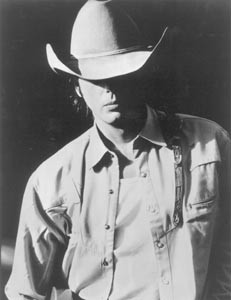
Musical maverick: Dwight Yoakam performs this week at the Marin Center.

Back in the Fast Lane

Dwight Yoakam revs up his career

By Greg Cahill

DWIGHT YOAKAM, whose last big hit was 1994’s “Fast As You,” is hurtling down an L.A. freeway, car phone pressed to his ear while he chats about the new projects that he hopes will jump-start his stalled recording career.

Yoakam is no stranger to the fast lane. After rising out of the San Fernando Valley honky-tonks 20 years ago, the Kentucky native helped launch the neotraditionalist movement that revived the insipid Nashville sound, scored a slew of hit country singles, and netted an armful of gold and platinum records.

These days, Yoakam is pedal to the metal. He’s back with his first album in three years–the oddly titled live solo-acoustic CD dwightyoakamacoustic.net (Reprise)–a new website, a fresh perspective, and a nationwide tour that brings him this week to the Marin Center in San Rafael. The concert will feature five new songs from the forthcoming Tomorrow’s Sounds Today album, still in the works and due out at the end of the summer.

Tooling down the road and on the tail end of a marathon publicity blitz for his concert tour, Yoakam is bright, enthusiastic, and affable while anticipating the future.

“I’m feeling great,” he says. “The tour dates are going fantastic.”

Little wonder. With the country-music charts dominated by slick pop divas like Faith Hill and cookie-cutter urban cowboys, the scene can sorely use Yoakam and his spirited honky-tonk anthems cut in the mold of Merle Haggard and Buck Owens.

Indeed, the new solo album–a retrospective of his 15-year career–has been hailed for its intimacy, with Yoakam putting his distinctive stamp on each well-worn tune. “I was performing some of those songs last year in concert,” he explains. “The audience response to it was very positive, and we thought that it would be something we could do, not so much as a retrospective, but as a special communication to a core group of fans. I had no idea that it would generate the type of interest that it has.

“You know, the first three years that I was on tour, it really felt like I was introducing this music to the audience on any given night. From the time we were out from 1994 and on, I realized that it was less like introducing myself to new audiences than it was like visiting a friend.

“So this album became a note to that friend, as opposed to a formal letter.”

The solo acoustic sets also took on a new meaning for the singer and songwriter. “It was almost as if I was experiencing the songs for the first time,” he says.

OVER THE YEARS, Yoakam has proved uncompromising. He built a reputation as a Nashville renegade, dismissed by country writer Holly Warren as a stylish Hollywood cowboy. At 43, he’s still a country-and-western sex symbol with a knack for boot-scootin’ across the stage in a pair of faded skintight Levi’s (28-inch waist, 36-inch leg) while humping his guitar and peeking seductively from beneath an oversized white Stetson that hides his balding plate.

It’s an image that catapulted the honk-tonkin’ troubadour into superstardom.

But Yoakam packs solid musical credentials. Ostracized from Nashville in the late ’70s for being “too country,” he moved to L.A. in 1978 and formed the Babylonian Cowboys. Pete Anderson–who still plays lead guitar in Yoakam’s band while handling album production duties–joined the following year. The band made its mark in rowdy honky-tonks, eventually moving into L.A. punk clubs and playing on bills with X, the Dead Kennedys, and the Butthole Surfers. But it was his association with Los Lobos and the Blasters that endeared Yoakam to the then-burgeoning roots-rock audience.

In 1986, he released his critically acclaimed debut, Guitars, Cadillacs, Etc., Etc. (Reprise). Its first single, a cover of Johnny Horton’s “Honky Tonk Man” and the title track, rocketed to No. 3 on the country-and-western charts. As Rolling Stone noted, he proved that straight-ahead country could go platinum.

As the head of the neotraditionalist country movement, Yoakam followed that success with a string of Top 10 hits. Although his 1996 album, Gone, went gold, it failed to produce any country hits. And 1997’s Under the Covers, a collection of cover tunes, found Yoakam artistically adrift, courting the swing craze and failing to connect. A Long Way Home, released the following year, featured bluegrass legend Ralph Stanley but only a couple of high points.

Meanwhile, Yoakam starred in a handful of well-received film roles, including one as the protagonist in 1996’s Southern Gothic killer flick Sling Blade. “I hope it continues as a means of expression,” he says of his film work. “As an actor, you’re only as good as the material and the skills of the filmmaker in whose hands you find yourself.”

Last year, he tested the waters as an auteur, writing, directing, and starring in South of Heaven, West of Hell, a western set for release later this year. He also plans to write another screenplay in the spring.

Yet music continues to be his first love. “It is as much, if not more so, a gratifying experience and something that’s inseparable from me as a person,” he says enthusiastically. “I began writing songs while I was touring and capturing every musical thought that I had on tape on a Walkman because I realized I didn’t have the time to set aside months alone to just write. It freed me and brought me back to the realization that I have a stream of musical dialogue with myself on an endless basis. It’s been with me since such an early age and is so ingrained as a part of my thought process that I was almost oblivious to it. But I discovered that I didn’t need a formal relationship with the song–I just needed to develop the thesis statement so I could then go back to it. And that’s what’s led me to the material on A Long Way Home and also on this album, Tomorrow’s Sounds Today.

“Coincidentally, I hadn’t thought about this before, but I’m struck by the significance of that title–I’m capturing tomorrow’s sounds today in the moment that they occur, even if they aren’t fully realized.

“It’s the horizon effect.”

On that note, his cell phone beeps for call waiting, and Yoakam bids farewell before heading off down that long open highway.

Dwight Yoakam performs Friday, Aug. 18, at 8 p.m. Marin Veterans Auditorium, Avenue of the Flags, San Rafael. Tickets are $28&-$50. 415/472-3500.

From the August 17-23, 2000 issue of the Sonoma County Independent.

© Metro Publishing Inc.

The Demise of the North Bay’s Agricultural Heritage

0

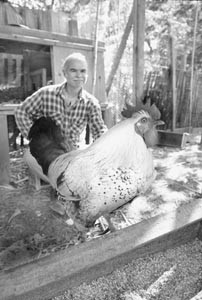
West county state of mind: Kokopelli Farm owner Shepherd Bliss contends that in the rush to accommodate growth in Sonoma County, many of the simple pleasures that lured us here in the first place are being lost forever.

Photos by Michael Amsler

Dispatch from the Farm Front

One farmer’s views on the demise of the North Bay’s agricultural heritage

By Shepherd Bliss

GIANT YELLOW BULLDOZERS have pounded the ground loudly behind my small, green, west Sonoma County farm for weeks. As I patiently pick berries, aggressive builders widen a narrow, dirt country lane (where neighbors used to stroll amid majestic oaks) to clear the way for more huge, expensive houses. Eager developers cut down tall black oaks and spreading valley oaks to make room for a shiny new road in this once secluded community. They shatter our rural peace, bringing stress to an otherwise serene scene. Not since serving in the U.S. Army during Vietnam have I endured such relentless shaking of the ground.

This feels like war against the land and its many natural occupants–further ordering it for human control, domination, and habitation.

The beauty of the oaks and the meandering lane have been replaced by monotonous, one-dimensional levelness. “What’s that new freeway doing back there?” one regular customer bemoaned.

I miss quietly sauntering down that rolling country lane and resent the spread of gated estates into formerly more open communities.

My farm has been invaded by working machines. My soundscape has been occupied by loud, ugly noises that have replaced the songbirds. I put on earmuffs to keep the sound out, but I still hear it and feel it rattling my dishes. There is nowhere to hide; this is my home.

Wildlife has fled roadside habitats and come to the property to which I hold title. Though they have damaged my crops and livestock in search of food, water, and shelter, I receive them and know that their stay will be temporary. When humans build, we displace much of nature and wildlife, most of it silent and invisible. Innocent animals must then find new habitats, if they can. Uprooted vegetation, of course, perishes.

I walk the land each day, feeling directly with my feet, watching life grow. I touch animals, plants, and soil each day, feeling them with my bare hands. Sights and sounds are less beautiful here than they used to be, and I smell more pollution in this country air. Stars are less visible at night. These things get to me. Sometimes I am rough, forcefully pulling “weeds” from the ground and protecting livestock from predators. My feelings are more raw and close to the surface than when I lived in the city. Memories of loss emerge. So what follows is not always diplomatic.

I get angry, beneath which is a deep sadness.

IN THE EARLY 1990s I bought this rundown farm outside Sebastopol and restored it to a viable business with the support of such groups as the Community Alliance with Family Farmers. I could never afford such a farm today, with prices for land driven so high by the alcohol-beverage and high-tech industries.

Formerly independently owned local wineries have been bought up by powerful “spirits” corporations like Seagrams, Brown Forman, and Allied Domecq, and integrated into the global alcohol industry. The British Allied Domecq recently moved into its new 6.6-acre warehouse in Windsor, the largest single building in Sonoma County and a sign of similar monstrous buildings in the future. Mammoth high-tech corporations from around the world are buying up small, local telecom startups for billions of dollars. Alcohol-beverage and high-tech incursions are the one-two punches to Sonoma County’s environment, local agriculture, and rural legacy.

I usually appreciate the harvest–working hard outside all day, seven days a week, sunup to sundown, falling asleep under tall, fragrant redwood trees. In addition to my crops, my field is full of poppies, lupines, and other wildflowers that blow in with the wind, and even supports coyote bush and oaks planted by jays and squirrels. Working the land, looking into the skies, and extending my body brings both exhaustion and serenity. But the 2000 harvest has been an assault on my senses and psyche–tiring me out and making me irritable.

People follow the local Farm Trails and come directly to Kokopelli Farm for organic berries, apples, eggs, and tours. I enjoy bringing a full, aromatic tray of berries up from the field and watching mouths and eyes open wide as saliva begins to flow. “Yum, yum” sounds of appreciation follow. People from the city come to the farm and pick their own, emerging with a wide smile surrounded by a deep purple color. Or they gather eggs of various sizes and colors from over 15 breeds of free-ranging hens, noticing how my jungle fowl look like raptors from the age of dinosaurs. People return home refreshed by this rural, pastoral experience among abundant plants and instinctual animals. They savor the unpredictable elements, such as wind–that exuberant dance partner of the trees.

Soothing farm sounds from chickens, cows, horses, wild birds, and blowing leaves were supplanted this year by loud earth-moving machines with their manufactured sounds of “progress.” Headaches and a wounded feeling replaced my usual farm pleasures. The high-pitched pinging of huge machines going backwards and warning of danger is especially damaging. I moved to the country seeking solitude–away from such relentless industrial ravages. Now Sonoma County is being suburbanized by various forces, including the high-tech gold rush.

As a result, this year the median price of homes in Sonoma County increased more than anywhere else in the nation, and Forbes magazine listed us as the country’s third most dynamic economic region. This is not good news for the wild birds, native plants, and small farms already here, many of which will be displaced. Sonoma County has been discovered, internationally, for its income-producing capacity. Tremendous growth will follow.

We are accelerating down the Silicon Valley highway.

Santa Clara County used to have a rich, vibrant agriculture based on over 6,000 small family farms. Now it offers congested traffic, the highest housing costs in the nation, and the most federal Superfund hazardous-waste sites in the United States–but hardly even a fruit stand.

I AM ACCUSTOMED to seeing mainly trees out back, a few black-and-white milk cows, a couple of large golden Belgian workhorses, and many quail and deer, as well as hawks, vultures, and various other birds. Occasionally I see a fox, skunk, raccoon, mink, snake, gopher, badger, or other nocturnal animal. After the months of destruction to build the road and houses, I wonder how things will change. I have been busy planting trees along my perimeter for years, but I will never be able to hide the cars, the swelling tide of people, and all the activity they bring.

The “spoilers,” to use California poet Robinson Jeffers’ description, are multiplying. In “Carmel Point,” Jeffers laments, “This beautiful place defaced with a crop of suburban houses. How beautiful when we first beheld it.”

We are losing the beauty of Sonoma County, as have other areas once they are “discovered” and transformed.

I used to enjoy driving around, especially in the west county with its scenic, diverse beauty. Now I feel nature receding, as huge houses and regimented, precise vineyards replace forests and orchards. I never know when I am going to turn a familiar corner and see some new industrial vineyard or starter castle. A sense of loss gnaws at me. Being surrounded by trees is inspiring, but all the building in the county saddens me.

Giant corporations, such as Finland’s Nokia, the world’s largest maker of cell phones, plan to fill in wetlands to build office complexes. Petaluma has already filled in many wetlands, including those violated to construct its main telecom center, ironically named “Redwood Business Park.” Redwood trees are beautiful, but this faux “Redwood Park” is ugly. The best buildable land has already been built out.

The telecom gold rush has just started and threatens to destroy much of the county’s remaining natural beauty and existing rural culture. More global corporations will follow.

Sonoma County’s sense of place is changing, rapidly and dramatically, but not for the better. The natural environment here historically has been diverse–rugged coast, redwoods and oaks, rolling hills, rich soils, ample rain. Into that came an agriculture that developed a rural culture around it. Both the original natural environment and the rural legacy are now threatened, especially by the high-tech onslaught and the wine monoculture.

THE ALCOHOL-beverage industry’s talk of aerial spraying of highly toxic pesticides to combat the glassy-winged sharpshooter, a vineyard pest recently discovered in the North Bay, poses another threat to traditional farming. Such spraying would harm organic gardens and farms, doing considerable “collateral damage” to beneficial insects, and to animals, humans, and our county’s soul.

Even the possibility of spraying is unsettling, especially since authorities can declare an “agricultural emergency” and trespass on private property without permission. We already have an “agricultural emergency,” but it is not caused by a tiny “pest.” As recently as 10 years ago, wine accounted for only 20 percent of Sonoma County’s agricultural revenue; it is already over 50 percent and moving toward Napa’s 90 percent. The wine monoculture is Sonoma County’s “agricultural emergency.”

Although scientists and environmentalists warned against transforming Sonoma County’s diverse agriculture into a monocrop, the alcohol-beverage industry took a gamble. It may lose that gamble, though its political operatives in Washington, Sacramento, and Santa Rosa have pledged millions of our tax dollars to try to bail it out and to punish those of us who follow organic and sustainable farming practices. A better solution would include a moratorium on planting any more vineyards in Sonoma County for now.

More people with their technology and machines means less nature. Exotic, non-native plants–including wine vines–draw “pests,” such as the glassy-winged sharpshooter. Even if this particular insect is eliminated, others will follow to restore nature’s balance to an overcultivated region where more of nature is pressed into service to humans. The Pierce’s disease that the sharpshooter brings is not new; it decimated 40,000 vineyard acres in California in the l880s, and no cure is yet known. Chemical agriculture is on a collision course with nature. The sharpshooter is more a symptom of a larger problem than the problem itself.

Perhaps the glassy-winged sharpshooter is actually a gift horse in disguise. Perhaps this tiny insect and the arsenal that is being prepared to combat it will wake up more people to how degraded our view of nature has become, as if it exists mainly to serve business and the global economy–at any cost, even that of our own health and soul.

INSTEAD of merely delivering a blow against the alcohol industry, perhaps the sharpshooter’s hit will be against industrial/ chemical agriculture by stimulating a mass movement against it. I have heard more talk of civil disobedience against aerial spraying than I have heard in a long time. Trainings for local nonviolent action against spraying are now scheduled to start.

In saying these strong things about the alcohol-beverage industry, I do not mean to dismiss the many good vineyardists and authentic growers in the wine industry. A sustainable wine industry will be built on the labor of such good farmers, even if the sharpshooter harms the current overplanted industry.

This year I lost my main customer–a local grocer with three stores who sold out to a huge chain. Though promising it would continue to support local farmers, that chain now imports fruit from Europe and Latin America.

I feel things closing in on me, a way of life dying.

Death is as common on farms as in wars. Plants and livestock are vulnerable and perish. Growth can emerge from death and decay. But it is hard to get used to death, especially the death of woodlands and orchards mowed down to accommodate houses and industrial vineyards, the twin threats to Sonoma County’s quality of life and environment.

I drive up to the graveyard on a hill in the town of Bloomfield and to a cemetery outside Graton, still surrounded by apple orchards, but probably not for long. So much is dying in Sonoma County today that we will not be able to bury it all in the area’s small rural graveyards–signs of the past. Many deaths accumulate in my soul, settling into a place where their lives will be remembered.

New farmers used to come to Sonoma County every year. We would welcome them and educate them about the tasks of tending the ground and its bounty. Most food growers can no longer afford land here. The local economy is being replaced by the global economy. We are losing control of the making of decisions that influence our lives and the land that we live on.

Now Sonoma County gets many new high-tech people and some new winemakers each year. But the wine industry has only a small agricultural component; most of those who prosper in wine are not farmers with dirt under their fingers, but lawyers or businessmen good at making money.

Some of my neighboring farmers have already moved away–seeking the country living they once had here. I recently lost my best source of manure for fertilizer. Traditional farmers depend on a network of relationships with people, plants, animals, and the elements; when those relationships end, a local farm economy is endangered.

Sonoma County is becoming what Kentucky farmer Wendell Berry calls a “colony.” Berry describes “the power of an absentee economy once national and now increasingly international.” He observes, “The voices of the countryside, the voices appealing for respect for the land and for rural community, have simply not been heard in the centers of wealth, power, and knowledge.”

The colonization of Sonoma County is changing our socioeconomic structures and culture. I wonder if global corporate power and all its wealth will make it difficult to pass legislation–such as the modest Rural Heritage Initiative, the growth measure that will appear on the November ballot–that would help preserve rural culture by keeping control of Sonoma County’s future in the hands of local people.

Small family farming is unfortunately on the way out–in Sonoma County, across the state, and throughout the rest of America. Our culture has been based on that agrarian tradition. I already miss the vibrancy I once felt and lament the loss. Remnants will remain. A few hardy farmers will continue in agriculture, in the old ways.

Blessings to them.

Shepherd Bliss is the owner of Kokopelli Farm. He has written for the Independent on the corporatization of the wine industry and other topics.

From the August 17-23, 2000 issue of the Sonoma County Independent.

© Metro Publishing Inc.

Plans For A Wine Country Casino

0

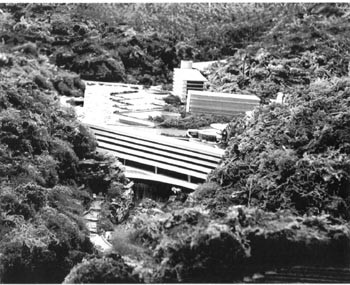
At a crossroads: The architectural model for the proposed $100 million gaming facility details the location of the mammoth–175,000-square-foot–casino and hotel complex. Neighbors and public officials want it built someplace else.

Roll of the Dice

Critics take a stand as Pomo tribal leaders push ahead with plans for a Wine Country casino

By Jeremy A. Hay

REG ELGIN, a spry 61-year-old former Marine, leads a visitor down a dusty road alongside a small, roughly triangular canyon, the sides of which are grown thick with manzanita, madrone, scrub oak, and small pines. Elgin is spokesman for the Dry Creek band of Pomo Indians, and the canyon is part of the tribe’s reservation, the Dry Creek Rancheria–75 acres of steep, arid hillside overlooking the Alexander Valley.

The canyon, located above the winding, two-lane Highway 128, is also the future site of a project that Elgin says represents the tribe’s hopes and dreams for a more prosperous and healthy future–a planned $100 million casino, hotel, and restaurant complex.

“We have an opportunity now, and it’s called economic development,” says Elgin, a full-blooded Pomo. “We will go from nearly zero income to a place where we can afford to offer tribal housing, educational scholarships, youth programs, and health services.”

The tribe’s partner in the development is Mark Advent, a Las Vegas casino designer and developer who is best known for his opulent New York, New York casino on the Vegas strip. Advent’s vision for the project, Elgin says, “has probably come as close as anyone to mirroring our hopes and dreams for a world-class casino, with none of the neon and glitz and gaudiness, with nothing up on the hill where people could see it, with no visual or noise pollution.”

A photograph of the model of the casino shows a flat, five-story terraced structure rising from the very bottom of the canyon, surrounded by sloping walls of trees and foliage. Tennis courts and two rectangular four- or five-story buildings are located on the flat roof of the larger base. The mammoth structure sits well below any of the surrounding ridgelines.

According to Advent, the casino itself, together with the restaurant and hotel facilities, will occupy about 175,000 square feet, while the entire structure, including parking areas, will top out at about 1 million square feet. The design, he says, was “inspired by Frank Lloyd Wright’s principles of blending the environment in harmony with the architecture.

“We will aspire to greatness, Elgin says, “and we will get that.”

LARRY CADD, a lifelong neighbor of the reservation, sees in the proposed casino–which is expected to operate around the clock, seven days a week–an entirely different prospect. He and other Alexander Valley residents opposing the project say it will bring with it overwhelming traffic problems and may signal the beginning of the end for the valley’s bucolic existence.

Cadd, whose house sits about 500 yards from the proposed site, doesn’t argue with the Pomos’ right to develop the casino on their land, and he agrees that “it will be out of sight for me and the majority of people.”

But he says the tribe, like any property owner, has a responsibility to consider the project’s impact on the surrounding community.

“It’s not just a matter of building a casino and having a little traffic problem,” he says. “It’s a matter of absolutely, completely jamming the road shut, which is going to interfere with their own ability to operate their business, and it’s the beginning of the commercialization of this area.”

On March 21, 14 days after the passage of Proposition 1A, which legalized Nevada-style gambling on California’s Indian lands, Sonoma County supervisors, while acknowledging they have little or no say in the matter, unanimously approved a resolution that “strongly opposes the establishment of an Indian gaming facility in Alexander Valley.”

Casino opponents have formed a task force to look for what they hope will be a more suitable location, and have asked for help in that effort from Rep. Mike Thompson, D-Arcata, as well as other local politicians. Two weeks ago, local opponents of the Dry Creek casino joined protesters from throughout the state on the Capitol steps to ask Gov. Gray Davis to help curtail the gaming facilities.

During the 1990s, casino foes successfully defeated a pair of planned Indian gaming facilities, one in the Fountain Grove area of Santa Rosa, the other just a mile south of Petaluma.

A meeting with tribal leaders, task force members, and representatives of Thompson, Assemblywoman Virginia Strom-Martin, D&-Duncans Mills, and state Sen. Wes Chesbro, D-Ukiah, is scheduled for Aug. 29.

Tribal leaders and Advent, their partner in the project, agree that the rural hillside isn’t the best possible location. It is out of the way, is difficult to build on, and has inadequate water and sewage. But they note with some irony that their limited options result from historical events that are hardly the fault of the tribe, whose reservation was created by the government in 1915.

“Would we prefer to have a location that would be more accessible and visible in a more commercial district? Sure,” says Advent. “Would the Dry Creek band of Pomos, when they were displaced and their homelands taken from them, would they have preferred to be in a more accessible location? Sure. But that’s not an option.”

THE 1988 federal Indian Gaming Regulatory Act gave Indian tribes permission to operate gambling businesses on their reservations. But the act also said that, with few exceptions, gaming is not allowed on land acquired after 1988 and placed into trust for a tribe.

“We hope they’re successful in finding an alternative site,” Advent says, “and if the task force were to create a legal solution, we would certainly work together and be open-minded to that kind of alternative.”

Cheryl Diehm, a district representative for Thompson, says the congressman has said that “if everyone agrees, and if suitable land can be found to be put into trust for the tribe to locate their casino on, [he’ll] work in Washington to make that happen.

“We have to come up with something that’s attractive to the tribe and the developer,” says Cadd. “Everyone has to be happy with it, otherwise it won’t work.”

What would be the first Indian casino in Sonoma County was one of dozens of similar projects unveiled by tribes around California in the wake of Prop. 1A. Many of those plans are now being opposed by people who argue that because Indian lands are considered sovereign and largely exempt from state or local regulations, the casinos may be built without regard to their impact on surrounding communities.

ACCORDING to Elgin, in recent years, the Dry Creek Pomos had received as many as a dozen offers to help develop a casino project on their reservation. Some three dozen Indian casinos were already operating throughout the state, some for almost a decade, often in a sort of ongoing legal shadowland while battles were fought in court and with the Wilson administration over what level of Indian gaming was allowed. Elgin says the tribe opted, despite the millions of possible dollars at stake, to wait both for the right offer and until the legal coast was entirely clear.

“At no time did we ever think about flouting the law and hoping we’d get away with it,” he says, suggesting that the tribe’s restraint in the past should help reassure critics that the casino development will go forward in a manner sensitive to the surrounding community and area.

“We’re not thumbing our nose at people,” he says. “The future of the valley includes us. We go to the same schools, shop at the same stores, use the same banks.”

An environmental impact report commissioned by the tribe and showing how it intends to mitigate the casino’s impact on traffic and address the water and sewage difficulties will be completed by Aug. 21, Elgin says, in time for a question-and-answer tour of the site scheduled for county officials.

Meanwhile, an interim casino is slated to open next spring. Preliminary site work is already under way and five of the 12 Pomo families living on the reservation have been relocated to new homes.

Construction on the permanent casino complex is tentatively scheduled to begin next summer.

From the August 17-23, 2000 issue of the Sonoma County Independent.

© Metro Publishing Inc.
‘As Bees in Honey Drown’

The sweet stuff: Morgan Forsey stars in As Bees in Honey Drown.

Fame Game

‘As Bees in Honey Drown’ takes on celebrity culture

By Patrick Sullivan

EACH ONE sets out alone, but they arrive by the busload, wandering in wide-eyed crowds through the Port Authority or down Hollywood Boulevard, full of confirmed ambitions and untested talents. The honey-sweet propaganda of our celebrity culture pulls them in by the millions, but these aspiring actors and musicians soon learn that Nashville, Hollywood, and New York can be as merciless to the would-be famous as a backyard bug-zapper is to a hapless moth.

One small step above these pitiable swarms is Evan Wyler, the young writer at the center of Douglas Carter Beane’s As Bees in Honey Drown, a scorching take on the fame game now onstage at Actors Theatre in a production directed by Argo Thompson.

After nine years of struggle, Evan (played by Peter Downey) has finally published a novel to critical acclaim. But that doesn’t mean his need to succeed is any less. Indeed, we get a taste of how desperately hungry Evan is to cement his celebrity in the play’s first scene, when a domineering magazine photographer easily bullies the shy young man into taking off his shirt for a sexy picture to accompany a profile piece. “Now fuck the camera,” the photographer orders, and Evan obeys, though it seems clear that it’s actually the camera that’s fucking him.

That compromise will not be his last. When this little lamb encounters someone who wants more than a bit of fleece off his back, we learn that Evan is willing to sacrifice anything–from his artistic integrity to his sexual identity–to see his name in lights.

The predator in question is a glamorous woman with the unlikely name of Alexa Vere de Vere (played by the charming Morgan Forsey), who swoops down upon Evan with a modest proposal that promises to make him rich and famous. One character describes Alexa as “a combination of every woman I’ve ever loved in any movie,” and her mix of sexual chemistry and big talk about rock-star clients and investors in Milan easily seduces the hungry young writer. But Evan soon learns that her name isn’t the only unlikely thing about her.

Alexa is a whirlwind of cigarette holders and little black dresses, a nonstop talker who always says less than the truth. Her verbal powers overwhelm her prey: “I don’t believe in agents, do you?” she asks Evan, and he quickly agrees. It’s not giving too much away to reveal that Alexa is a con artist, though the exact nature of the con she’s running on Evan is more complicated than it first appears.

But there’s one problem here. If you’re a grifter, success lies less in what you say than how you say it. If you throw around phrases like “great lashings of butter,” you’d better not stutter. That advice goes double for an actor playing a con artist.

Unfortunately, by opening night Forsey hadn’t quite mastered the verbal dexterity required for the part of Alexa. To be fair, it’s not an easy role, and there were times when the actress succeeded admirably in carrying it off. But even slight stumbles have a big effect in a part this tightly written. Alexa is meant to cast a spell, but every fumbled line mars the enchantment.

Perhaps that’s one reason the play picks up in the second act, when Evan starts to reclaim both his life and the stage space from his oppressor. After discovering Alexa’s deception, the writer is torn between ideas of revenge and more complicated emotions. Downey does a convincing job of portraying his character’s transition from wide-eyed vulnerability to hard-won wisdom, and by the end we’ve learned as much about his maturing psychology as we have about Alexa.

We also meet Mike (played by Michael Fontaine), a talented but unknown painter from Alexa’s past who may play a prominent role in Evan’s future. Fontaine shines in this small but important role by delivering a nuanced portrait of a thoughtful man shot through with equal parts regret and resolution. Maybe that’s only fitting: in a play meant to critique the flash of celebrity without accomplishment, this understated performance is one of the chief highlights.

As Bees in Honey Drown continues Thursdays-Saturdays at 8 p.m. and Sundays at 7 p.m. through Sept. 16 at LBC, Actors Theatre, 50 Mark West Springs Road, Santa Rosa. Admission is $18. 523-4185.

From the August 17-23, 2000 issue of the Sonoma County Independent.

© Metro Publishing Inc.
Reggae on the River

0

BJah love: Celebratory spirit and a sense of community pervade the annual reggae festival. Photograpn by Shelley Lawrence

Tribal Revival

Reggae on the River keeps ’em coming back for more

By Shelley Lawrence

HOT, POINTY ROCKS. Blazing sun. No grass, no shade, and thousands of sweaty people producing body heat for four days. Sound appealing? Not to me. But it did to the nearly 10,000 people who paid $100 a pop to be a part of the 17th annual Reggae on the River festival early this month.

Reggae on the River–which serves as a benefit for Humboldt County’s Mateel Community Center–is the most popular reggae festival on the West Coast. Each year, thousands of college kids, Rastafarians, families, hippies, and people from every walk of life check in for a weekend of music, food, and atmosphere on the banks of the Eel River, near the old logging town of Percy. Indeed, the festival sells out annually before the lineup is even announced.

What keeps them coming back for more?

“It’s the party of the year! I wouldn’t miss it for anything,” says one 10-year festival veteran. “Each year, I go and see people that I only see one weekend a year, but that I’m as close to as any of my friends at home. There’s a feeling of affinity between the people that you get to party with at every reggae [festival]. Everybody gets together and roughs it for a weekend. Once you create that history–you’ve done it a few times and have stories to share–it develops a feeling of family between the people that go together.”

“It’s definitely a family,” agrees Scout, second-in-command of the festival’s security staff. “I’ve been coming for 13 years, and my pay is reasonable, but that’s not why I’m here. I love the people that come, although they’re different from year to year.”

We arrived on Thursday afternoon, hot and cranky from traveling for three hours in 100-degree heat. The last thing we wanted to do was search for a campsite. We decided to check out the digs before we packed our stuff in, and were glad that we did. A bunch of acquaintances who’d been camped since Monday had saved us room under a pavilion as large as a small house. When we set up our tents, we had the coolest sarong-enclosed front yard ever.

When the gates opened on Friday morning at 6, the onslaught began. What on the prior afternoon had been an area of hot rocks and a handful of naked hippies bloomed today into a mecca for sunhatted campers with their hauled-in couches, vans, and tents . Before the afternoon concerts began, we wandered through “the bowl,” the actual concert site–an enormous outdoor stage surrounded on one side by food and beer vendors and on the other side by festival-gear vendors selling straw hats, cowry-shell necklaces, handmade hippie clothes, and the other usual festival accouterments. Behind the stage lay the Eel River, which we swam in after the tiring business of shopping for appropriate earrings.

On Friday evening after the headlining act Mixmaster Mike (DJ for the Beastie Boys), we returned to camp. Down the path in the volunteer campground stood three school buses with a huge parachute stretched over the top to form a dance hall. There was a DJ spinning house and hip-hop records in a cage on top of one of the buses. On closer inspection, I recognized him as an old friend from Sonoma County.

The reggae vibe had intermingled with the usual hip-hop vibe (or maybe it was the ganja smoke in the air?), and there were a bunch of frat boys alongside dreadlocked Rastas, all feeling the one love. Unfortunately, security pulled the plug after we’d been there only about 15 minutes (no generators are allowed at the event).

WE CRUISED UP and down the rocky camping and parking area, the happening place of the evening, and wound up at a school bus with history. Founded a few years back by the Wicked Crew, a collective of Bay Area house DJs who’ve since become too well known to bother playing reggae, the bus announces its destination above the windshield as HEAVEN. After grooving out to amazing Jamaican DJs, we returned to camp to regroup and collect more beer. The girls decided to stay at camp for a relaxing evening around the keg, and the fellas went out to have an “I can party harder than you can” testosterone competition.

We slept in till 10 on Saturday. After waking and breakfasting on fresh fruit and Zima, I wandered around the bowl, alone, snapping shots and listening to music by Natural Vibrations and Johnny Dread. Backstage, I ran into Fantuzzi, world-famous hippie and poster-boy for the original Woodstock (on the cover of Newsweek) and emcee for the Woodstock of the ’90s (he describes the 30th anniversary celebration as “a nightmare”).

When asked how the reggae festival scene has changed since the ’60s, he replied, “I don’t get tired of it. It’s the tribal revival getting started with the youth. The next generation takes the movement and moves it! It’s an honor and a blessing to have been chosen to be an ambassador of joy.”

With such legendary performers as Bunny Wailer, Jimmy Cliff, and Anthony B. encouraging festival-goers to practice peace, unity, and “one love,” it’s easy to see how acceptance and understanding between people of all ages, races, and social classes can grow. Reggae on the River offers world-class music 24 hours a day with thousands of people all in the same frame of mind. I’m sold!

Next year, I’ll be one of the hordes buying a ticket before I even know who’s playing. As a friend aptly put it, “If you didn’t like reggae music before you went to Reggae on the River, you’ll like it afterwards!”

From the August 17-23, 2000 issue of the Sonoma County Independent.

© Metro Publishing Inc.
Erotic Art Show at the Soundscape Gallery

0

Heated glances: The walls of the Soundscape Gallery get a new look during the Erotic Art Show with such work as Nick Bennett’s Cayenne (above).

Photograph by Michael Amsler

Intimate Visions

Erotic Art Show returns to Soundscape Gallery

By Bill English

THE JAPANESE call it the moment of clouds and rain–the point of human climax. Normally, it’s an intimate span of time shared only by lovers‚ but at the sixth annual Erotic Art Show at Soundscape Gallery in Santa Rosa, this blissful juncture is hung on the wall for all to see. The show extends the boundaries of erotic expression with work in a wide range of media by some 20 artists. The walls are lined with everything from metal sculptures, paintings, and drawings to edible erotic cakes–but everything in the show challenges viewers to draw their own line distinguishing art from pornography.

Expect little help from the artists. For them the issue is purposely blurred. Soundscape owner Marc Silver offers no apologies for the raw nature of some of the pieces in the show. For most of the year Soundscape offers high-end audio/video entertainment systems, but for two months in late summer the walls and floors are graced with carnal images.

“I want to do something with an edge,” Silver says. “A real erotic art show. Something that pushes the envelope. I’ve had people walk into the store during the show‚ look around at the walls, and say: ‘I’m not going to do business with you.’ I’m sure this show has cost me thousands in retail sales over the years.”

Silver, 51, does show some restraint. Nothing offensive is visible from the Mendocino Avenue storefront during the show. But unsuspecting people still wander in looking for quality sound‚ only to get an eyeful.

“I put warning signs up all over the front of the store,” Silver says. “I even use that crime-scene police-barricade tape to alert customers that this show isn’t for everyone. But innocent people still come in.”

While many art shows of nude studies profess to be erotic, some of the work at the Soundscape Gallery goes well beyond a tasteful picture of a nude torso to hang over the couch. Many of these pieces venture into the realm of unabashed lust. Be prepared for a major turn-on.

The aforementioned image of the moment of orgasm was shot by Santa Rosa photographer Stephen Fitz-Gerald. While the model’s pouting lips and beads of sweat are arousing, the picture also has a reverent quality. Fitz-Gerald shot the picture of an ex-lover whom he clearly cared about a great deal.

“The difference between pornography and art is the difference between good and bad photography,” says Fitz-Gerald. “The subject matter and content don’t matter. It’s the form that’s important. This photo is an ode to all women.”

Of course, one man’s ode is another man’s beaver shot. Nick Bennett’s composite photography work gleefully combines the influences of David Hockney, Salvador Dali, and Hustler Magazine‘s Larry Flynt. In one large and dramatic untitled piece, the model is gazing into the camera with her legs spread and her aroused womanhood highlighted with moist fingers. The in-your-face nature of the work has a powerful effect. Bennett of Middletown seems joyous about pushing the ultimate female button.

“It’s the most sexual of my images–it really has tooth,” says Bennett. “I feel it’s the most potent method of pointing out the sexual nature of the female form. It’s the classic beaver shot. I looked at a lot of porno to come up with this. I was surprised how willing women were to model for these kinds of sexual compositions.”

But this is not a show strictly about male artists getting women to shed their clothes and inhibitions. Photographer Dorothy Reich of Santa Rosa has participated in the last five erotic art shows at Soundscape.

“I have always focused on the nude,” says Reich. “Ninety percent of my work deals with the male form. I like the male body, the diversity of hard and soft lines. Someone recently called me Mrs. Mapplethorpe. That’s great. The man did inspire people to collect erotic photography.”

Image conscious: Pure porn mixes with more subtle works like Elliot Burke’s Three Faces (above) at the Erotic Art Show.

KAREN D’ANGELO, who dubs herself the Queen of Wands, is not satisfied with erotic art that is merely seen. She wants you to be able to munch on it as well. Now you can have your cheesecake and eat it too, because D’Angelo puts nudes on cakes and cookies.

“My company [Edible Images] has the ability to turn any photograph into an edible piece of art,” says D’Angelo. “I appreciate all five senses. When you’re working with food, you imbue the art with a new energy. Why not eat erotic art? Nothing lasts forever.”

Silver feels the Erotic Art Show is an important community service that offers a venue for this seldom-seen form of art. He makes his selection of the artists shown at the event with care.

“Eroticism should have a loving quality,” Silver says. “I don’t include anything dealing with violence or children. I believe in consensual acts. I go to a lot of art events throughout the year looking for artists. The number of submissions I get every year is incredible.

“The hardest part is telling an artist no,” he continues. “I had a 16-year-old girl submit a simple line drawing of a nude. It just wasn’t erotic. I don’t think she’s ever actually seen anyone naked.”

One of the most mysterious works in the show is a large painting by Joe Jaqua of Santa Rosa. The painting, titled Mrs. Maxwell Stays for Lunch, features three figures in what appears to be a stately Italian salon. A woman in lingerie is mounting a submissive man while another, fully clothed lady looks on.

“I leave the story line of the painting up to the viewer,” Jaqua says. “The image does beg for the imagination to explain what’s going on, but that’s not the job of the artist. I’m merely trying to convey a feeling of sexuality and fun.”

Anyone who stands before these works will be tested. How far is too far? Your own attitudes and values will largely determine what you see. One thing’s for sure: this show is a hot ride in the back seat of erotic pleasure that makes no apologies for human lust.

Jaqua seems to typify the attitude of many of the artists in the show.

“If you’re offended by this kind of work‚” he says, “don’t stand in front of it too long.”

The Soundscape Erotic Art Exhibit and Sale opens Monday, Aug. 21. An artists’ reception will be held on Saturday, Aug. 26, from 5 to 9 p.m. Prizes will be awarded for the most outrageous costumes. Parental guidance is recommended. Regular visiting hours are weekdays, 11 a.m. to 7 p.m., and Saturdays, noon to 5 p.m. The show continues through Oct. 31 at Soundscape, 314 Mendocino Ave., Santa Rosa. For more information, call Marc Silver at 578-4434.

From the August 17-23, 2000 issue of the Sonoma County Independent.

© Metro Publishing Inc.
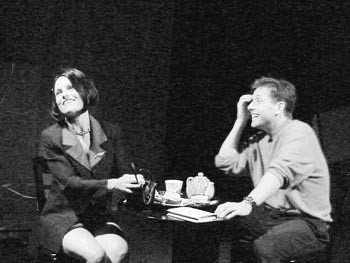
‘Love’s Labour’s Lost’

0

A renowned novelist sticks up for love and romance–but isn’t so sure about ‘Love’s Labour’s Lost’

Writer David Templeton takes interesting people to interesting movies in his ongoing quest for the ultimate post-film conversation. This is not a review; rather, it’s a freewheeling, tangential discussion of art, alternative ideas, and popular culture.

Frank Baxter has been doing his homework. In preparation for a mid-morning screening of Love’s Labour’s Lost–the much-reviled new film by Kenneth Branagh, adapted from the play by William Shakespeare–Baxter, an author and professor of ;iterature at the University of Michigan, voluntarily set himself the chore of reading the play in the Bard’s original text.

Every single word.

On an airplane.

Baxter is currently touring the country to promote his new book The Feast of Love, a delightfully complicated medley of interconnecting love stories that some have compared to Shakespeare’s A Midsummer Night’s Dream. Faced with such large gobs of travel time, Baxter grabbed a late-night in-flight opportunity to read the play.

“It took me about four hours,” he says, his eyes glazing over to indicate exactly how long those four hours seemed.

Love’s Labour’s Lost,” he dramatically intones, “isn’t really among Shakespeare’s best works. Is it?”

According to armies of scholars, in fact, Love’s Labour’s Lost is so flighty and inconsequential a play that many insist Shakespeare couldn’t possibly be its real author.

The plot, such as it is, deals with the King of Navarre and his three best friends, bachelors all, who make a solemn vow to devote themselves to intellectual study for three whole years, during which they will all abstain from the company of women. Almost immediately, they break that vow when the princess of France, accompanied by her three ladies-in-waiting, comes calling on a diplomatic mission.

Before you can say “Act Two,” the bachelors have each become infatuated with a different lady. They skulk about, sighing and moaning. Each begins composing sentimental love poems, professing his undying devotion to the lady of his choice.

For their part, the ladies–after toying like cats with their would-be suitors–ultimately proclaim the love-struck bachelors to be unmarriagable, since the men have demonstrated a certain inability to keep their vows.

In Branagh’s film version–set in 1939 and starring Alicia Silverstone (making a bold stab at singing), Adrian Lester, Nathan Lane and Branagh himself–the poems have been dropped entirely, replaced by classic love songs by Cole Porter and Ira Gershwin. These are performed in full-scale musical sequences, complete with tap-dancing and the occasional water ballet. While most critics have labeled L3 an affront to Shakespeare, others (mainly those who, like Baxter, have read the play) have instead suggested that Porter and Gershwin are the real victims.

Baxter, however, enjoyed the movie.

To a degree.

“I thought it was close to brilliant, at times,” he admits after the show. “It was very clever. My problem with the movie wasn’t that Branagh threw a bunch of classic songs into a Shakespeare play. My complaint is the particular songs he used. I think they undermined what Shakespeare was trying to say about love.

“In my reading of the play,” he explains, “it’s saying that it’s okay to be infatuated with love, infatuation’s fine–but it’s equally important to keep your word. But in Branagh’s musical version, the songs he’s chosen–Dancing Cheek to Cheek, The Way You Look Tonight, Can’t Take That Away From Me–mostly go in the direction of just saying how wonderful it is to be infatuated.”

“So,” I insert, “you’re saying that the immature adolescent sentimentality of the songs runs counter to Shakespeare’s suggestion that love be approached with a sense of maturity and responsibility? And of course, popular love songs have always been about the infatuation part of love. They’re almost never about responsibilities and commitments.”

“Funny you should mention that,” Baxter replies. “When the pre-pub copies of this new book began to appear, I did a phone interview with a woman who began by asking, ‘You’re actually writing about love? Do you really think people talk about love anymore?’ This was a woman in her mid-twenties, and it struck me as very interesting.

“So I started to think about what’s happening culturally,” he continues, “and I thought that maybe, for a generation that is interested in being cool and ironic– though ‘love’ may not exactly have become a taboo subject, yet–infatuation is certainly off the table. Infatuation is something young people simply don’t want to talk about.

“It was a shock to me.”

Baxter is on a roll now.

“I got a review that said my title Feast of Love was a dreadful title,” he reveals. “It said that no one, man or woman, would dare carry a book called the Feast of Love onto a subway. And next to the article was another review of a book by a L.A. writer named Rachel Resnick, whose book is called Go West Young Fucked Up Chick. She thought that was a wonderful title.”

He laughs again, a gentle rumble tinged with rueful amusement.

“I keep thinking of the way the movie’s tone swings back and forth between earnestness and irony, and that the irony is usually often more entertaining that the earnestness,” Baxter muses. “It’s as if we know how to process the irony, but an earnest view of love is too hard to swallow.”

Not as hard to swallow as Alicia Silverstone singing, but I get his point.

“Perhaps,” he murmurs, “all this discomfort with love is a reaction to the older generations’ fondness for serious love-songs and sentimentality, a swing of the pendulum in a direction away from all that.

“If so, we only have to wait for the next generation, when the pendulum begins to swing back.”

From the August 10-16, 2000 issue of the Sonoma County Independent.

© Metro Publishing Inc.

Jeremy Rifkin

Commodifying the human experience: an interview with author Jeremy Rifkin

By Tamara Straus

JEREMY RIFKIN believes one day soon you will wake up and find that virtually every activity outside your immediate family has become a paid-for experience. Almost everywhere you turn, almost anything you do will be based on an arrangement that involves forking over cash: think cable subscriptions, fitness club memberships, monthly installments on a leased car. On this near-dawning day, your life, in effect, will have become someone else’s mini-mart, a storehouse of commercial relationships with companies that base their worth not on what they produce but on how much of your time they own.

Sound frightening? Well, it should, according to Rifkin, a fellow at the Wharton School Executive Education Program and the author of such dystopian polemics as The Biotech Century and The End of Work. In his latest book, The Age of Access (Tarcher/Putnam), Rifkin charts the development of what he calls “the new culture of hypercapitalism,” in which owning material goods becomes secondary to paying for access to them–and a customer’s “lifetime value” becomes the ultimate market commodity.

Rifkin is an economist by trade. He lectures to CEOs about the social ramifications of their business practices and runs a nonprofit in Washington, D.C., called the Foundation on Economic Trends. His foundation is, among other things, currently suing Monsanto for not adequately testing its agricultural products.

But what Rifkin really is–when he puts fingers to keyboard–is a social science polyglot. His new book is a distillation of current thought on psychology, cultural anthropology, economics, and philosophy. It is, in many ways, a popularization of the ever-elusive theory of postmodernism. Rifkin uses such favorite postmodern terms as “immateriality” and “decenteredness” to describe how cyber networks, electronic commerce, and lifestyle marketing are resulting in a final, nightmarish stage of capitalism. In this last stage, the commercial sphere wallops the cultural one, and Homo erectus is reborn a time-stressed consumer whose most powerful tool is his credit card.

There is not much new in this quasi-Marxist approach to 21st- century socioeconomics. Yet unlike the postmodern treatises of Fredric Jameson and Jean-François Lyotard (both of whom are literary philosophers with a penchant for apocalyptic vitriol), Rifkin’s book is a mostly sober analysis of how capitalism is restructuring itself, backed up by close observation of the business world and hard statistical evidence.

Whereas Jameson writes without great substantiation about “the great global multinational and decentered communicational network,” and Lyotard poetically bemoans the “disappearance of the Idea that rationality and freedom are progressing,” Rifkin writes plainly and supports his postmodernist arguments with economic data. In The Age of Access, we learn, for example, that the average American visits a mall every 10 days for approximately an hour and 15 minutes; that the service industry now accounts for more than 77 percent of employment of the U.S. workforce; and that a typical U.S. citizen is bombarded by more than 3,500 advertising messages a day, thanks in part to U.S. television networks that now broadcast 6,000 commercials per week.

“What I was trying to do with this book is wade through all this postmodernist stuff and take what I thought was real and eliminate what I thought was bull, and get down to how this relates to economics,” writes Rifkin. “What people don’t understand is that we are entering a totally different form of capitalism.”

Rifkin’s main point is that the new era we are entering is as different from market capitalism as market capitalism was from mercantilism. Power is no longer based on property but on access to services. Business is no longer determined by place but by the decentered nature of cyberspace. Markets, the mainstay of industrial capitalism, are giving way to what Rifkin calls networks.

“In a market, you have a seller and a buyer and you exchange property, which is the way we’ve defined capitalism since Adam Smith,” says Rifkin. “In networks, there aren’t any sellers and buyers. There’s no exchange of property. There are servers and clients, suppliers and users and ‘just-in-time’ access to what you need, but the property never alienates. In other words, it stays in the hands of the suppliers and they lease it.”

Rifkin doesn’t just hope to influence social and cultural critics with his book. He also has spent more than the last half year introducing business leaders around the world to his Age of Access theories because, as he puts it, “they haven’t really thought about what they’re doing.”

“One of the things that really hit me while writing,” he says, “is it’s all been just about the hardware and software until now. Bill Gates and Alvin Toffler and my friend John Nesbitt–none of them have a social vision that’s powerful enough to share these fruits in a way that’s a leap forward for humanity. It’s all about cell phones and e-mail.”

FOR RIFKIN, what corporate leaders are failing to understand is that cultural capitalism, as he calls it, is threatening the very foundation of modern life. Rifkin points out that, historically, culture has always preceded commerce, yet now we are in a situation where commerce has become the primary institution–and culture, coopted and commercialized, is derivative. This, he believes, is leading to a breakdown in social trust that could have dire consequences for the very idea of freedom and the workings of a healthy civil society.

“Unfortunately, the market has become the defining presence in our lives,” writes Rifkin, “and it is deconstructing that whole civil and cultural sector. The AOL&-Time Warners, the Bertelsmanns and the Sonys, what they’re really selling is the cultural diversity of thousands of years of human life–everything from travel and tourism to destination entertainment centers.”

Opponents of Rifkin’s book will probably say that he is a technophobe and a neo-Luddite whose economic theories are skewed from spending too much time reading about postmodernism and fulminating about the Internet. To some degree, his main argument–that people’s very life experience is being commodified–seems an impossibility for those of us who know the difference between Disneyland and a walk in the park. Yet his historical analysis of economics is ultimately persuasive, for in the new economy, access to consumers, whether it be by an Internet magazine or a car company, is becoming more important to a company’s bottom line than selling actual products. Branding and marketing are key to the success of a business–as is customer loyalty. The AOL&-Time Warner deal, which took place while Rifkin’s book was at the printer, is item No. 1 in defense of his arguments.

Moreover, no one can accuse Rifkin of jumping to conclusions or not doing his homework. The Age of Access took him six years to write. It is based on 350 books and 1,000 articles, assembled from 50,000 index cards and 2,000 pages of notes. It is, above all, the most accessible summary to date on how corporate capitalism–gone global and now virtual–is affecting business, society, and individual identity.

Yet there are dubious arguments in his book. One of the weaker sections follows too close on the heels of postmodern philosophers in describing what Rifkin calls the “protean persona.” In his view, men and women in the Age of Access do not define themselves in terms of having a good character or a strong personality as their grandparents did, but in terms of being “creative performers” who “move comfortably between scripts and sets as they act out the many dramas that make up the cultural marketplace.” This postmodern person is constantly on the hunt for new experiences in the form of paid-for performances, entertainment, and fantasies. He is even, as a result, beginning to exhibit multiple personalities, particularly in cyberspace, where donning and discarding identities can be accomplished in a blink of an e-mail.

Like Jameson and his postmodernist-in-arms, Jean Baudrillard, Rifkin seems to believe that 21st-century man will emerge functionally schizoid, as in a sci-fi novel. As opposed to his forefathers, who sought to be autonomous and self-sufficient, this new person will be dependent on others–via telecommunications–to confirm the various parts of his fragmented identity. This argument smells strongly of an intellectual’s rush to connect up the dots. I wonder whether Rifkin is really serious when he writes that this new person, a networking junkie, will live by the belief that “I am connected, therefore I exist.”

RIFKIN REALIZES he may be somewhat out of bounds in describing the psychological consciousness of the dotcom generation. “The jury is out,” he says. “You can also make the case that kids are multitasking, they’re parallel processing, they’re more connected with the rest of this planet.” In the end, he says his main concern is that young people be aware that their “postmodern play” is taking place in a commodified cultural marketplace.

One might ask at this point: Whither progress in Jeremy Rifkin’s brave new world of hypercapitalism? Are there no upsides to the Age of Access? Are we doomed to fulfill the postmodernists’ screeds of 20 years ago, to live a life of short-lived connections, virtual realities, and commodified experiences?

The way out of the hypercapitalist conundrum, says Rifkin, is through social movements, such as the campaigns for biodiversity and cultural diversity, that underscore the local and the cultural. “If we lose the sense of place, the sense of being, if you will, we may lose our sense of responsibility to intimate relations,” he writes. “The contrarian rallying cry of our time should be ‘Geography counts, culture matters!’ ”

Rifkin is hopeful that those cries will grow louder. “I think Seattle was the beginning of a powerful coming together of movements that can provide an antidote to the forces of global cultural production,” he says. “Suddenly we had the biodiversity groups coming together with the cultural diversity groups and organized labor–and these groups are all lodged in geography, which is where intimacy and empathy and real solidarity happens.”

Rifkin–ever the activist, ever quick to deconstruct a trend–will certainly champion this solidarity. Yet he is skeptical about the future of social progress. In the same breath that he mentions Seattle, he adds: “It is not out of the question that cultural diversity can be exhausted. If you lose the rich cultural diversity of thousands of years, it’s as final and devastating as losing biodiversity.”

Rifkin’s postmodernist colleagues are undoubtedly nodding in agreement. The question now is: Will business leaders–or, better, politicians–pay any attention?

From the August 10-16, 2000 issue of the Sonoma County Independent.

© Metro Publishing Inc.

Les Claypool

0

Fisher of men: Les Claypool of Primus is sailing solo once again.

Sportin’ Life

Les Claypool casts about for a creative spark

By Greg Cahill

“DURING THE PAST couple of years, I’ve been very uninspired by music in general,” says Les Claypool, head honcho of the Grammy-nominated thrash-funk group Primus, during a phone interview from the west Sonoma County home he’s dubbed Rancho Relaxo. “Nothing’s really gotten me. Since I did this Oyster Head thing [a one-off jam session a few months ago that teamed the avant-rock bassist and vocalist with guitarist Trey Anastasio of Phish and drummer Stewart Copeland of the Police] and played with some musicians that are very spontaneous, I’m excited again. I’m very much into playing music–and music that has nothing to do with image or MTV or demographics or any of that.

“It’s just music for music’s sake.”

Enter Col. Les Claypool’s Fearless Flying Frog Brigade, an improvisational rock band that will perform a handful of West Coast dates, including a night at the Phoenix Theatre in Petaluma on Aug. 20.

In recent months, Claypool has been getting serious about the jam-band scene, a Grateful Dead&-inspired spinoff that includes such popular bands as Phish, Widespread Panic, Blues Traveler, Moe, Vinyl, and Rat Dog (with former Grateful Dead guitarist Bob Weir).

This latest phase of Claypool’s long and varied career started earlier this year at Super Jam, an annual event organized by a New Orleans promotion company that enlists musicians to perform once-in-a-lifetime freewheeling jam sessions. “It’s this scene where you’re encouraged to go out and improvise as much as possible,” Claypool explains. “It’s not necessarily new, but it is fresh to me. Since New Orleans, the sort of jam-band hippie community has embraced me, and I’ve been getting offers to do various things.”

Offers to do similar projects began pouring in. Some recent ones involved jam sessions at the Mountain Air Festival with Frog Brigade and ex&-Grateful Dead bassist Phil Lesh. Other projects have included a date with the New York band the Disco Biscuits (at the JamBand.com awards ceremonies) and another at the Gathering of the Vibes, under the moniker Rat Brigade, which featured some of the same musicians who will join Claypool at the Phoenix Theatre and upcoming dates on both coasts.

“So it’s just this thing that has been perpetuating itself,” he says. “I’m enjoying it–having a great time.”

The rambling repertoire is a far cry from the tightly broken rhythms and surreal lyrical tales for which Primus is known. “A lot of the stuff we’re doing is a variation on different cover tunes,” he says. “We’ve done Pink Floyd, Beatles, King Crimson, Tom Waits–various songs that serve as a structure to jam around. When we did Frog Brigade at Mountain Air, it was Jack Irons and Tim Alexander on drums, so we did an 11-minute version of Led Zeppelin’s [drum solo opus] ‘Moby Dick.’ It was pretty awesome. I just sat back and enjoyed it.

“But that’s the spirit of it.”

At the Phoenix Theatre, the band will consist of former Primus drummer Jay Lane and keyboardist Jeff Chimenti, both of Rat Dog; (Primus co-founder) Todd Huth on guitar; and guitarist and multi-instrumentalist Eenor.

The addition of Eenor marks a move by Claypool to tap deeper into the avant garde. He met the East Bay musician (whose own band is called Channel 23) after running an employment ad in several Bay Area newspapers.

“I was really taken by his playing,” Claypool says, “so I called him up, and subsequently he’s now playing for Frog Brigade.

Skerik, a Seattle-based avant-rock saxophonist with Critters Buggin’, might also perform at the Petaluma date.

THIS LATEST FORAY into the avant-rock world is in the spirit of Primus, however–the band that the All Music Guide once called “a post-punk Rush spiked with the sensibility and humor of Frank Zappa.” The band has recorded 10 CDs over the past decade and gone through a couple of personnel changes. In 1996, Claypool released a solo album, Les Claypool and the Holy Mackerel’s Highball with the Devil (Interscope), a surrealistic set of “pure self-indulgences”–lyrically cartoony, sonically hallucinogenic song sketches laced with smatterings of twangy surf guitar, early Pink Floyd psychedelia, herky-jerky rhythms, and abstract jazz stylings.

Claypool also has maintained another side project, Sausage, that is somewhat more collaborative than Primus and features former Primus members Huth and Lane. The trio has recorded one album, 1994’s Riddles are Abound Tonight (Interscope), and the three toured together that same year.

More recently, Claypool can be heard plucking the bass on the tongue-in-cheek “Big in Japan,” from Tom Waits’ 1999 CD Mule Variations (Enigma).

An avid cartoonist and aspiring film writer, Claypool recently completed his second screenplay, now making the rounds in Hollywood. He describes it as being “another semi-suburban, mythical, drug-hazed, comedic tragedy,” and then adds with a big laugh, “Wow, that’s the first time I actually had to do a one-liner on it.” MEANWHILE, the current round of jam sessions is allowing Claypool to rekindle his creative spark after the dissolution of the punk-funk scene that once thrived in the San Francisco area. “You know, years ago we had a scene with Primus that was pretty incredible–it was us, the Limbomanics, Mr. Bungle, Psychofunkapus, and Fungo Mungo. Since [Primus] has grown and become an international act, I find that I’ve lost touch with a lot of what’s going on in the Bay Area. And to an extent, there doesn’t seem to be that much of a scene [in the region]; it’s pretty scattered and unorganized.

“Still it’s great to get to play with local musicians again–I’ve been checking out a lot of local acts and just jamming with a bunch of local musicians.

“For me, that’s very exciting. I’m beginning to feel more like a musician again, instead of some rock star with a big house in the country who goes out and plays on big stages every now and again.

“So it feels good.”

Col. Les Claypool’s Fearless Flying Frog Brigade performs Sunday, Aug. 20, at 8 p.m. at the Phoenix Theatre, 201 Washington St., Petaluma. Tickets are $18. 762-3566.

From the August 10-16, 2000 issue of the Sonoma County Independent.

© Metro Publishing Inc.
Bear Korean

0

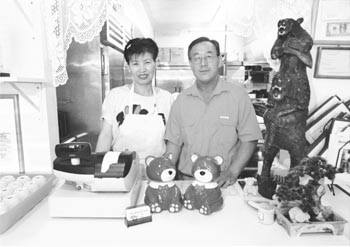
Bear hugs: Bear Korean owners Song Ae Ko and Chong Su Ko.

Kimchee Kitchen

Cotati’s Bear Korean satisfies a taste for the exotic

By Paula Harris

THE FIRST THING we notice about the Bear Korean Restaurant in Cotati isn’t the vaguely seafood fragrance in the air, or the simple tables covered with bowls of presumably exotic fare, or even the pretty illuminated aquarium decorating the front of the plain lunchroom–it’s the Korean karaoke.

The would-be songfest is in the form of a video blaring garishly from a color TV set elevated to deity status up in the corner. This karaoke video is unsettlingly entrancing. We have menus before us, but still can’t tear our eyes away from the poised and posed Asian couples modeling the story lines of unfamiliar songs, while the bouncing ball skips along over the lyrics–shown in Korean characters. The canned music plinky-plinks along relentlessly from one tune to the next. It’s like being trapped in an elevator.

Still, some customers seem to be enjoying the entertainment, gazing up at the screen while they raise chopsticks and small teacups to their mouths. In the past few months, since the restaurant opened, Bear Korean has attracted quite a following of regular clients (Korean and otherwise), all drawn to its exotic home cooking and tasty take outs.

The informal dining room is plain, clean, and comfortable, with a brown-and-white linoleum floor, pale gray walls with minimal art work (plus a few photos of family or maybe they’re clients). There are various sports trophies on a couple of shelves near the cash register. You can peek into the partly open kitchen, which is framed by lace curtains, and see what appears to be three multigenerational members of a family busy at work over the sizzling stoves and grills.

OUR SERVER is a rather quizzical fellow who seems to take a perverse delight in being flummoxed by non-Korean-speaking clients’ questions about the menu (a couple of items have absolutely no explanation of their content). He brings us cups of tea. The brew surprisingly is served cold (maybe to quench the spiciness of some of the food) and has a refreshing corn and barley flavor. He also brings us a dish containing a cluster of pungent white shreds–dried squid. The taste is fishlike, but the texture is dry and chewy.

There’s no wine on the menu, but there are bottles of OB–a light-bodied lager brewed in Seoul. It complements the food very well.

The server makes quite a production of bringing out nine small plates of various condiments and lining them up along the table. These are the panch’an–the various side dishes brought out at the beginning of a Korean meal. Our side dishes tonight include radish prepared two ways (spicy and sweetish); a mouth-scorching leek-based kimchee; cold spinach; mashed potato salad with apples; mung bean sprouts; yellow squash; and opalescent, slightly salty Korean bean cake. There’s also, of course, the standard kimchee of fermented cabbage in fiery chili marinade, the hallowed Korean dish (and everyone has his or her own secret recipe) that is said to have magical properties. Indeed, kimchee experts claim the taste comes from the fingertips of the maker.

All in all, quite an array of tastes and textures.

A GREAT BARGAIN is the jin man du ($4.25), the steamed wonton appetizer. We are surprised by the quantity: 10 fat little dumplings resting on a cabbage leaf on a steamer shelf. The parcels are crammed with minced pork and vegetables.

The rice omelet ($6.95) is an enormous roll resembling a burrito. But instead of a tortilla, the outer wrapper is a pale gold omelet curled around a tasty filling of vegetable fried rice. The whole thing, which has a kind of egg foo yung flavor, is draped with a thick brown sauce that tastes a bit like tamarind.

Another dish, japchae ($8.95), is a heaping salad of translucent slim buckwheat noodles dressed in sesame oil and chili sauce and containing various veggies like raw cucumber and carrot. It’s an unusual hot-cool flavor combo that’s very satisfying.

When the server brings me pork bul go ki ($10.95), Korean-style barbecue pork–instead of the pork gal bi ($11.95), the barbecue pork ribs that I’d ordered–I decide to just go along with it. This is another large portion (served with steamed white rice), featuring slices of meat and sliced fried onions sizzling on a hot metal plate. The charcoaly, slightly spiced pork is well flavored, but, disappointingly, rather tough.

Next time I’ll be sure to try the ribs.

There are no desserts at Bear Korean, but the server grins and brings us each a stick of Korean Haitai melon-flavored chewing gum in a fuschia pink wrapper to finish off the meal. As we leave, masticating furiously on the fruity adhesive, the karaoke video starts back up, finally playing something we recognize: “Tie a Yellow Ribbon.”

We beat a hasty retreat. But we’ll be back!

Bear Korean Restaurant 8577 Gravenstein Hwy., Cotati; 794-9828 Hours: Daily, from 10 a.m. to 10 p.m. Food: Korean Service: Friendly, though not very helpful Ambiance: Informal and comfortable Price: Inexpensive to moderate Wine List: No wine available Overall: 2 1/2 stars (out of 4)

From the August 10-16, 2000 issue of the Sonoma County Independent.

© Metro Publishing Inc.
Dwight Yoakam Performs at the Marin Center

Musical maverick: Dwight Yoakam performs this week at the Marin Center. Back in the Fast Lane Dwight Yoakam revs up his career By Greg Cahill DWIGHT YOAKAM, whose last big hit was 1994's "Fast As You," is hurtling down an L.A. freeway, car phone pressed to his ear while he chats...

The Demise of the North Bay’s Agricultural Heritage

West county state of mind: Kokopelli Farm owner Shepherd Bliss contends that in the rush to accommodate growth in Sonoma County, many of the simple pleasures that lured us here in the first place are being lost forever. Photos by Michael Amsler Dispatch from the Farm Front One farmer's views on the...

Plans For A Wine Country Casino

At a crossroads: The architectural model for the proposed $100 million gaming facility details the location of the mammoth--175,000-square-foot--casino and hotel complex. Neighbors and public officials want it built someplace else. Roll of the Dice Critics take a stand as Pomo tribal leaders push ahead with plans for a Wine Country casino ...

‘As Bees in Honey Drown’

The sweet stuff: Morgan Forsey stars in As Bees in Honey Drown. Fame Game 'As Bees in Honey Drown' takes on celebrity culture By Patrick Sullivan EACH ONE sets out alone, but they arrive by the busload, wandering in wide-eyed crowds through the Port Authority or down Hollywood Boulevard, full...

Reggae on the River

BJah love: Celebratory spirit and a sense of community pervade the annual reggae festival. Photograpn by Shelley Lawrence Tribal Revival Reggae on the River keeps 'em coming back for more By Shelley Lawrence HOT, POINTY ROCKS. Blazing sun. No grass, no shade, and thousands of sweaty people producing...

Erotic Art Show at the Soundscape Gallery

Heated glances: The walls of the Soundscape Gallery get a new look during the Erotic Art Show with such work as Nick Bennett's Cayenne (above). Photograph by Michael Amsler Intimate Visions Erotic Art Show returns to Soundscape Gallery By Bill English THE JAPANESE call it the...

‘Love’s Labour’s Lost’

A renowned novelist sticks up for love and romance--but isn't so sure about 'Love's Labour's Lost' Writer David Templeton takes interesting people to interesting movies in his ongoing quest for the ultimate post-film conversation. This is not a review; rather, it's a freewheeling, tangential discussion of art, alternative ideas, and popular culture. ...

Jeremy Rifkin

Commodifying the human experience: an interview with author Jeremy Rifkin By Tamara Straus JEREMY RIFKIN believes one day soon you will wake up and find that virtually every activity outside your immediate family has become a paid-for experience. Almost everywhere you turn, almost anything you do will be based on an arrangement that...

Les Claypool

Fisher of men: Les Claypool of Primus is sailing solo once again. Sportin' Life Les Claypool casts about for a creative spark By Greg Cahill "DURING THE PAST couple of years, I've been very uninspired by music in general," says Les Claypool, head honcho of the Grammy-nominated thrash-funk group Primus,...

Bear Korean

Bear hugs: Bear Korean owners Song Ae Ko and Chong Su Ko. Kimchee Kitchen Cotati's Bear Korean satisfies a taste for the exotic By Paula Harris THE FIRST THING we notice about the Bear Korean Restaurant in Cotati isn't the vaguely seafood fragrance in the air, or...
11,084FansLike
4,606FollowersFollow
6,928FollowersFollow