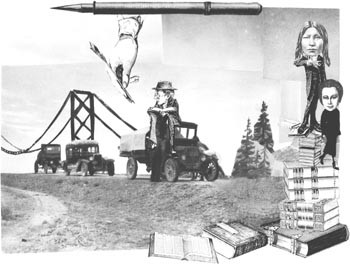
The Wide-Eyed Gourmet

A signature dish loaded with pleasant memories

By Marina Wolf

WHEN I VOLUNTEERED to cook and coordinate my sister’s wedding rehearsal dinner, I originally envisioned as the centerpiece a pork tenderloin or a rack of lamb–some festive piece of animal protein that would symbolize abundance (and cook by itself). But at the crucial moment, after the recipes had been tested and it was time to write the shopping list, I chickened out and reverted to lasagna, a family favorite that has become my trademark.

Marina’s lasagna, they call it in casual conversation.

But it is not my lasagna, any more than it is the lasagna of anyone who buys the same brand of lasagna noodles. The recipe is right there on the box, and I have to refer to it every time. The pasta aisle is always the first stop on the shopping trip;

otherwise I wouldn’t know the rest of the ingredients. My family sees me squinting at the box every year, and still the lasagna sits up there on a pedestal, along with green salad and garlic bread made with a head of garlic and an obscene amount of real butter.

That’s my signature supper.

Clearly, a trademark dish has little to do with originality. All it takes is repeated exposure with enough positive memories attached. It’s the opposite of “familiarity breeds contempt.” Trademark dishes require only an occasional familiarity, an acquaintance that is infrequently met and therefore cherished.

Take my mother’s rolls. They are fluffy and white, flaky from the dabs of butter that have been scattered through the dough. These rolls are, as far as I can tell, well within the capabilities of any moderately skilled home cook. The recipe was handed down through church cookbooks and family members. It is not a state secret. And yet the time it takes to knead and shape the soft dough renders them impractical for all but the festive table. This rarity gives the rolls a special haze of unattainability; otherwise they’d become just another piece of daily bread. Between holidays, even to this day, I ask about the rolls: When are we going to have them next? And when they do appear, wrapped in a dishcloth to keep warm, I pay attention.

Trademark foods aren’t necessarily a family matter, either. Occasionally on a Saturday morning, my friends will mention scones with a sigh and a look of longing. One friend of mine has as her personal dish a spiced carrot soup that has become a delicious harbinger of the colder months, as reliable as the ducks flying south.

Some dishes are more amenable to the trademark process, foods that look more complicated than they really are, for example (elaborately spiced foods or anything baked falls into this category, with bonus points for spicy dessert breads). And trademarking never involves creating something new. Sometimes all you need is a new mold for that Jell-O salad, and everyone will think you invented it.

The buzz is the key, and you are your own publicist, so if you want to be remembered for a certain dish, make sure to mention your specialty at other times throughout the year.

“Remember the time when I made too much lasagna and we ate it for a week afterwards? Remember the time when we stayed up until 4 making those doughnuts?”

Casually, over time, a cloud of warm memories will develop around your specialty.

Of course, living legends always are in danger of being pigeonholed, and 15 years after I learned to make lasagna, I sometimes want to flex my culinary muscle a little. “I can cook things other than this overcheesed casserole!” I cry, and search for something, anything, to shock, or interest, or expand my family’s palates. But no matter how well prepared, these feeble stabs at self-assertion are met with indifference.

Everybody wants the lasagna.

So in the end I just shrug my shoulders and fire up the hot water. It’s better to be remembered for pasta than for nothing at all.

From the December 28, 2000-January 3, 2001 issue of the Northern California Bohemian.

© Metro Publishing Inc.

Ahdaf Soueif

Ahdaf Soueif highlights changing cultural climate in Egypt

By Andrea Perkins

A CAPTIVATING read on many levels, Ahdaf Soueif’s novel The Map of Love (Anchor; $14 paper) is perhaps most valuable for its exposure of that permeable membrane between characters’ actions and the politics that surround them.

Using her character’s private lives to highlight the changing cultural climate in Egypt over a 100-year period, Soueif splices journal entries and letters with deeply researched historical events. Sometimes it’s hard to tell if the book’s politics are the backdrop to its personal stories or vice versa.

“The personal is the political,” Amal, one of the book’s two heroines, says at one point.

Soueif deftly reveals the inner workings of Egyptian high society from the beginning to the end of the 20th century, shattering Western misconceptions of Islamic culture, which still abound today. (When I told my grandmother I was moving to Egypt to work for a magazine, she was convinced that the minute I stepped off the plane I’d be taken hostage by terrorists and thrown into a harem full of scantily clad women.)

Having grown up both in England and in Egypt, Soueif maintains an ideal balance between East and West, displaying a deep understanding of both without pretending to be neutral or dispassionate about the plight of Egypt. She toys with (and eventually transcends) familiar literary genres like the “19th-century romance” and “the memoir of an Englishwoman traveling abroad.”

There is no precedent for this kind of book. Not only is it rare for an Arab writer to write in English, but it is rarer still for an Arab woman to write at all, especially about sex and politics.

The book starts in midsentence, as if the reader has casually stepped into the stream of time. It is 1997, and Isabel Parkman, a New York journalist, is struggling with her mother’s Alzheimer’s disease. While her mother, Jasmine, is losing her grasp on the past, Isabel’s obsession with her own history is triggered when she finds an old trunk in Jasmine’s house. The trunk belonged to Isabel’s great-grandmother, an Englishwoman named Anna Winterbourne. Though the journals and papers inside the trunk are written in Arabic, French, and English, Isabel pieces together what her mother has kept hidden: their Middle Eastern ancestry.

Isabel meets Omar al-Ghamrawi, a famous conductor and frustrated Arab nationalist. Enamored, she tells him about her assignment to go to his homeland to interview the Egyptians about the millennium. She also tells him about the trunk. He suggests she take it with her to Cairo, where his sister, Amal, might help her translate the Arabic journals. And it is through Amal that we arrive at Anna Winterbourne’s saga. Amal has just returned to Cairo after a dysfunctional marriage in England. She dives into the trunk’s story and learns that she and her brother are in fact Isabel’s cousins.

ANNA’S JOURNALS start at the beginning of the 20th century. After the death of her first husband, she travels to Egypt, hoping to find the light-filled world of John Frederick Lewis’ Orientalist paintings. Once there, however, she realizes that because she is English, the “real Egypt” is beyond her reach.

She soon finds that the restrictions placed on Arab women are not so different from those placed on women back home. Some aspects of Egyptian life actually afford her more liberty than she has known before. Conventions like the veil and mashribiyya screen (behind which women once sat and listened to the men’s conversations) provide her with the unusual power of invisibility. Subtly, Soueif suggests that “the veil” may be no more a vehicle of oppression than the caked-on makeup some women wear.

Soueif (with her doctorate in linguistics) makes language a major theme in The Map of Love, dwelling over its layers of embedded meaning. She also shows how language can be a used as tool of colonization and, at times, an obstacle to communication rather than the means of it.

Soueif’s careful chronicling of the turmoil that surrounds Anna, Amal, and Isabel becomes a “map” to the current situation in the Middle East, offering an angle not generally found in mainstream media representations of the region.

From the December 28, 2000-January 3, 2001 issue of the Northern California Bohemian.

© Metro Publishing Inc.

The Wide-Eyed Gourmet

Munching on McMuffins and vending-machine cuisine

By Marina Wolf

A JOURNEY of a thousand miles starts not with a single step, as might be supposed, or even with a single suitcase. It starts with the first Egg McMuffin.

Of course, this is my own journey. Yours may start with two tabs of Vivarin and a cinnamon roll, or a latte and a banana, with the peel flung ceremoniously out the window at the first on-ramp. We all have our own rituals for eating on the road.

Travelers cannot eat the way they do at home. Can we agree this is impossible? The fridge has been replaced by a malfunctioning cooler, the dining-room table makes way for the dashboard, and the trusty microwave has been replaced by a less savory-looking mini-mart model that has seen the inside-outs of too many overheated cheez-dogs.

Some travelers bemoan these changes; they become known as city folks, candy-ass tourists, or Californians (or whatever scapegoat state is next to yours). The savvy traveler adapts, thrives, and then comes to find a whole new sense of security in the away-from-home appetites that emerge.

Now, there may be people who lapse into uncontrollable veggie-eating and develop a fixation on dry, whole-grain toast. I don’t see a lot of them in my travels. Mostly I see other people like myself: we become pigs or kids or some happy combination of the two. Cleaning out the car at the end of a trip is like emerging from a dream, and the longer the trip, the weirder the dream: Did I really eat two packages of beef jerky, potato chips, 10 mandarin oranges, a whole package of menthol cough drops, a Mounds bar, a McMuffin, and three hash browns?

The funny thing is, much of what I eat when I travel, I only eat when I travel. I have no patience for jerky the rest of the time, but on the road it’s a soothing thing, salty chewing gum that lasts for miles. Ditto for the McBreakfast and all those oranges consumed in one 24-hour period.

It’s garbage, this on-the-road eating. But I don’t really want to change it, though I go through the motions of meal planning at the beginning of almost every trip. I start out with little bottles of orange juice and maybe granola bars, a gallon or two of water, my own thermos of coffee. But like a much-loved CD or the extra double-D batteries, these healthy ambitions get lost quickly in the inevitable entropy of travel. Granola bars crumble only to re-emerge two months later as empty wrappers from car-seat crevices (perhaps the seats have their own appetites, which include more fiber). Orange juice undergoes a miraculous transformation into weak, fast-food coffee (more caffeine, and the cups fit better in the rickety little cupholders). And any vows to eat salad for lunch and a well-rounded dinner come to naught somewhere between rest stop 15A and the “Next Services 52 miles” sign, when ranch-flavored corn nuts, a chocolate bar, and a breath mint suddenly seem like reasonable items on the lunch menu mainly because they’re the only things available in the roadside vending machine.

Not that I don’t have some standards when it comes to what I eat on the road. It can’t drip, thus eliminating many otherwise excellent foods such as mangoes, popsicles, and ramen noodle soups. It has to fit in the cupholder or the little change reservoir and be something that I can pick up without looking at. And preferably it leaves residue that I can lick off my fingers.

But basically I want something that has no relationship to my normal diet. I want to mark each trip as outside of my day-to-day life. I want to slip from conscientious to unconscionable as easily as we cross from one county to the next, and I’ll wake up tomorrow with the unspoiled appetite of a child.

Pass the corn nuts, please. The journey begins now.

From the December 21-27, 2000 issue of the Northern California Bohemian.

© Metro Publishing Inc.

Gift Books

Three story collections will have ’em beggin’ Santa for more

By Patrick Sullivan

THEY WRAP up into neat little packages, they fit snugly under the smallest tree, and they’re cheaper than a PlayStation 2. Yup, books would make the perfect holiday gift, except for one inconvenient fact: Nobody reads anymore.

OK, perhaps that’s a slight exaggeration. Let’s be prudent. Let’s be diplomatic. Better to say that an awful lot of people don’t seem to have much time for reading in this busy era of virtual this and 24-7 everything else. (And no, all you grouchy ultra-literary types, we don’t want to hear your snarky little ideas for turning everybody’s television sets into flower planters.)

So, if you like books, or at least like giving books as gifts, you have two choices. Go ahead and give your nephew that unexpurgated version of Les Miserables (in the original French? Sure, why not?), and know that even the back cover will probably never be read.

Or (and this is the right answer, in case you hadn’t guessed) you could latch onto a literary form that’s been around for . . . well, a long time, but that seems more relevant than ever in our oh-so-busy age. And we’re not talking about porn.

Seldom has the short story seemed so strong. Some of the best authors of turn-of-the-millennium America are working in this form, which requires both boundless creativity and rigorous discipline from the writer–but only 20 minutes here and there from a reader.

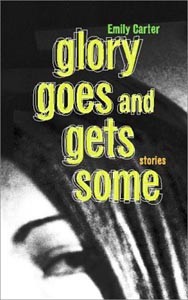
First, check out what may be the year’s best bundle of short fiction: Emily Carter’s Glory Goes and Gets Some (Coffee House Press; $20.95). This series of linked stories mostly follows the adventures of sardonic young hipster as she moves from drug-addicted squalor to recovery in the bland Midwest to the appalling discovery that a shared needle somewhere along the way polluted her bloodstream with the AIDS virus. How does a 30-something recovering heroin addict with an incurable disease find new life and new love? Answer: Very carefully.

Carter’s prose is wild, exuberant, and sensual in the best possible way, full of both vivid neon images and sarcastic critical distance. Finely wrought, but never cautious, this is the end of the millennium the way it should be written.

Of course, not everyone on your list will appreciate the needle-sharp kiss of Carter’s fiction. For something more conventional–in both style and subject matter–try Light Action in the Caribbean (Knopf; $22), a new collection of shorts from Barry Lopez, best known for such non-fiction work as Arctic Dreams.

Lopez writes like a fox stepping across a field of new-fallen snow–lightly and carefully. With barebones sentences, he puts together deceptively simple-seeming stories that subtly take on flesh and trot gracefully across the page. Among the best of the work in this collection: “Emory Bear Hand’s Birds,” in which an Indian inmate shakes a prison to its foundations with nothing more than his knowledge of wild animals; and “The Deaf Girl,” in which a man wanders into a small town and watches from the porch of his hotel as a horrendous tragedy slowly plays out before his eyes.

Finally, there is The Best American Short Stories: 2000 (Houghton Mifflin; $13), a collection of shorts from 21 writers assembled by this year’s guest editor, author E. L. Doctorow (Ragtime). From Geoffrey Becker’s “Black Elvis,” in which an Elvis impersonator discovers the real power of the legend he has made his life, to Annie Proulx’s “People in Hell Just Want a Drink of Water,” this truly is among the best short fiction you’ll find on the shelves. Or under the tree.

From the December 21-27, 2000 issue of the Northern California Bohemian.

© Metro Publishing Inc.

This Year in Music

0

Pop Life

Old farts top year in review

By Karl Byrn

THE RISE of Britney Spears, ‘N Sync, and the boy groups has in recent years fueled a music-industry focus on younger audiences. Alt-rock marketing of the mid-’90s targeted 20-something Gen-Xers, but “tweeners”–preteens and young teens–are the tastemakers for today’s hits. Top 40-style radio formats have made a comeback, flush with tweener hits from such breakout R&B, dance, and rock talent as Nelly, Destiny’s Child, Pink, Papa Roach, and Creed.

But during this year, the collective pop music ear turned slightly away from tween-targeted sugarcoating to hear a different, deeper voice. As much as anything, 2000 was a year dominated by established artists.

This dominance took two forms: Veterans of the ’60s, ’70s and ’80s reasserted icon status with their umpteenth releases; and breakout acts from the late ’90s achieved journeyman status by delivering on anticipated follow-ups. Oldies like Neil Young, Paul Simon, Merle Haggard, Johnny Cash, Patti Smith, Madonna, U2, B.B. King and Eric Clapton, Iron Maiden, Sonic Youth, Sade, Emmy Lou Harris, and LL Cool J all received devoted plaudits for their new works–and, in many cases, topped the year’s concert box-office receipts. Meanwhile, developing acts like Radiohead, Limp Bizkit, Outkast, Erykah Badu, Wyclef Jean, the Wallflowers, Joan Osbourne, D’Angelo, Godsmack, Green Day, Elastica, Everlast, and Matchbox 20 sought to strengthen the promise of their initial noteworthy success.

A few factors guided this shift in attention to established acts. As the industry reaped huge numbers selling to tweener tastes, Boomer-aged parents buying Britney & the Boys for their kids (or simply hearing them at home and everywhere else) have been forced to pay closer attention to the pop market.

With older music fans paying more attention and spending more money on their kids’ music, a window of opportunity opened for Boomer heroes like Clapton, Simon, Harris, and U2 to again stand in the spotlight and make waves with a captive audience.

The dawn of Internet music, uninhibited by traditional industry marketing, has also created a reverse interest in the well-known. Younger audiences more at ease with new technology take Napster, MP3 files, and CD burning as a given. For hit-oriented tween-ers growing past the industry’s kiddie-pop forcefeedings, the next logical step is mixed CDs, a venue in which they essentially create their own new releases. Tweeners are becoming less dependent on whole albums, which leaves the record companies with Boomers and Gen-Xers, two demographics weaned on the classic concept of the album as a work of art, much more accustomed to ingesting new music in the album form.

Additionally, the warm reception given to veteran and journeyman acts was something of a response by older audiences to Eminem’s The Marshall Mathers LP, a lippy work by a new youth-oriented artist that, in terms of its pervasive impact on pop music discourse, was clearly the album of the year. Kids loved his rebelliousness, politically correct do-gooders hated his hatred, and most parents simply chose to ignore his genuine ugliness. Eminem forced music fans to have an opinion, but his success heralded more than a rekindling of the age-old debate over pop music virtues.

He’s one of the first superstars in a new generation of pop music icons, and the vehemence with which older ears dismissed this uncomfortable album signaled a desire for the values of more familiar artists.

THAT’S ONE REASON why U2’s All That You Can’t Leave Behind has received glowing praise despite being a yawner. Lauded for its kinder, gentler melodicism, U2’s new disc has a high comfort level. Without saying much, they sound good–or do they?

Are these new works by established artists just the comfortable adult versions of tweener bubblegum?

There is a predictable guarantee to Madonna’s sassy electro-funk, Merle’s confessional hillbilly jazz, Neil’s this-time-I’m-acoustic old-age musings, Smith’s literate call to arms, and Sade’s languid fireplace soul.

In 2000, veterans made it easy for older fans to like new music again.

For excitement, though, the upcoming journeymen faired a bit better. Radiohead’s Kid A may have been the album of the year for convincingly creating a musical introspection that thwarted our guitar-rock expectations. Outkast’s Stankonia raised the ease of Southern hip-hop to a hyper-techno pace. The tough country-rock of Shelby Lynne’s I Am Shelby Lynne saved her from major-label reclamation and gave her indie-style hipness. Wyclef Jean’s alt-hip-hop referenced Kenny Rogers and Pink Floyd. Soulfly’s world-metal employed Sean Lennon. D’Angelo’s Voodoo sounded as if it came from a New Orleans connection to Mars. With all ears open, developing artists almost had carte blanche to evolve.

So where did that leave the truly veteran ear?

If Boomers and Xers were really paying attention, they saw that the new releases by their favorites fit into the pop market’s ongoing quest for diversity. Hearing ’90s leaders like Wyclef, Outkast, and Radiohead evolving is reassuring. For Boomers needing a more secure rebuttal to the tweener scene, there are always old farts talking about aging–Joni Mitchell’s misplaced stab at torch songs, Simon’s dismissal of his rock-and-roll memories as something less than godlike.

My favorite old-fart moment of the year was Warren Zevon’s cover of Steve Winwood’s “Back in the High Life Again,” from his typically sardonic and unsettlingly sober disc Life’ll Kill Ya. With only acoustic guitar and his cracking, unsure voice, Zevon recast Winwood’s ’80s synth-world-pop classic as a pure confessional moment. When he unsteadily sings the key line, “All the eyes that watched us once/ Will smile and take us in,” it’s nothing short of newfound optimism.

This year, the extra notice given to Zevon and other vets amounted to a good reason to feel that strong.

From the December 21-27, 2000 issue of the Northern California Bohemian.

© Metro Publishing Inc.

Michael A. Bellesiles

Fresh perspective on our love affair with firearms

By Patrick Sullivan

IF THE GUN FANS have a Doomsday Clock, it must have been set at one minute to midnight in the months following the bloody massacre at Columbine High School. Gun-control laws started spraying out of state legislatures faster than armor-piercing bullets from a modified AR-15. Even the National Rifle Association’s main man, eagle-faced actor and NRA president Charlton Heston, was starting to resemble that hurt hawk from the Robinson Jeffers poem: “The intrepid readiness, the terrible eyes/ The wild God of the world is sometimes merciful to those/ That ask mercy, not often to the arrogant.”

Some people were starting to think–with either fear or hope–that guns were on their way out of American life. They really should have known better.

The most obvious sign that the way of the gun is far from dead is the victory of George W. Bush, who won a fiercely contested election in which the NRA spent millions on his behalf. But there are other omens: after a significant decline, the NRA’s membership is growing again. And there is something else, something harder to quantify: the horror of Columbine seems to be fading. The gun is back.

What makes gun culture so resilient? Historian Michael A. Bellesiles may have some answers. In Arming America: The Origins of a National Gun Culture (Knopf; $30), Bellesiles goes looking for the roots of our country’s unusually passionate relationship with firearms. What he finds is so startling as to be revolutionary. Popular fancy locates the birth of our national obsession with guns in the rugged nature of early American life. Our movies and popular fiction present life in 18th- and early-19th-century America as a constant struggle of the firearm-toting frontiersmen against British soldiers, aggressive Indians, and dangerous wild animals.

But in Arming America, Bellesiles argues that guns were actually fairly rare in early America. Drawing on a mountain of probate, military, and business records, as well as travel accounts and personal letters, he makes the case that gun ownership was once the exception: “America’s gun culture is an invented tradition,” he writes. “The notion that a well-armed public buttressed the American dream would have appeared harebrained to most Americans before the Civil War.”

There’s an amusingly iconoclastic aspect to this. Our notion of the effectiveness of America’s citizen soldiers during the Revolutionary War rests on such engagements as the Battle of Bunker Hill. More often, though, poorly trained and armed militiamen (perhaps quite sensibly) turned and ran at the first sight of the enemy. Most Americans showed up for military service unarmed, and what firearms they were given usually came from Europe because domestic production of firearms remained almost nonexistent.

Many volunteers were completely unfamiliar with guns, and they were often terrible shots, even accounting for the notorious inaccuracy of their muzzle-loaded weapons: “One group of Americans hiding near the road fired a volley at Major Pitcairn from ten yards,” Bellesiles writes of an attempt to ambush a British officers. “All missed. They did, however, frighten Pitcairn’s horse, which ran off, leaving the rider unhurt, though shaken, on the ground.”

The general ignorance of–and even hostility toward–guns continued throughout the early life of the young republic. It took the social transformations wrought by the Civil War to change those attitudes: “The Civil War transformed the gun from a tool into a perceived necessity,” Bellesiles writes. “The war had introduced the majority of American males to the use of firearms; peace brought those weapons into their homes.”

Bellesiles lays the responsibility for the creation of our powerful gun culture on two other forces: a military-minded government eager to arm its people; and gun manufacturers like Samuel Colt eager to make money.

The real significance of Arming America, though, lies less in any assignment of blame than in its offer of the possibility of an alternative. Contrary to popular belief, America has not always bristled with guns; they are not an inextricable part of our national character. That fact removes a suffocating inevitability from the debate over gun control.

We may choose to regulate guns more strictly, or we may not. But history hasn’t made the decision for us.

From the December 21-27, 2000 issue of the Northern California Bohemian.

© Metro Publishing Inc.

Pesticide Spraying

0

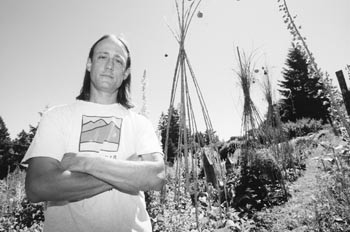
Bucolic battleground: Dave Henson, director of the Occidental Arts and Ecology Center, fears that pesticide use around vineyards in the area will contaminate the center’s extensive organic gardens. Henson plans to resist attempts to enforce ground spraying.

Civil Wars

Opposition mounts against forced pest spraying

By Shepherd Bliss

A TEMPORARY ban imposed last week by Sonoma County agricultural officials on a powerful pesticide that caused the recent death of hundreds of birds has underscored mounting opposition to a controversial forced-spraying program designed to battle a tiny vineyard bug.

Defiant supporters of the No Spray Action Network met this week and on Dec. 11 at a barn near the Santa Rosa Creek to forge plans to fight forced spraying to combat the glassy-winged sharpshooter, an insect that can spread bacterial Pierce’s disease and threatens grapevines. Both meetings were called in response to the Dec. 5 decision by the county Board of Supervisors to authorize spraying against people’s will to protect the region’s $2 billion wine industry–a decision that has led some to pledge civil disobedience.

“We have spent over 20 years working on our 80-acre organic farm, and we are not about to let anyone spray it with deadly pesticides,” says Dave Henson, director of the Occidental Arts and Ecology Center.

The No Spray group is developing rapid response teams to help people defend their homes from spraying in the event that the county declares an infestation.

The state defines an “infestation” as five bugs, which can trigger spraying for a mile surrounding the insect. Sonoma County Agriculture Commissioner John Westoby has the power to authorize the spraying. Nonviolent training sessions will begin in January to educate residents about their rights and how to effectively resist.

Kurt Erickson of the Rural Alliance was buoyed by the cooperative tone of the barn meeting, which he characterized as “determined, firm, unswerving resolve, but not harsh or rude. It was clear-eyed and focused.”

Meanwhile, the statewide Pesticide Action Network–a coalition of over 140 environmental groups–on Dec. 12 sent a strongly worded letter to California Secretary of Food and Agriculture Bill Lyons signed by local farmers, and by health, community, and environmental groups opposed to the spraying. In the letter, PAN cited the president of the California Certified Organic Farmers, wine-grape grower Phil La Rocca: “History has shown that wholesale applications of broad-spectrum pesticides to control pests is not effective.”

“This runaway spray program threatens the health of California’s communities, ecosystems, and organic farms,” notes PAN spokesperson Jessica Hamburger.

Glassy-winged sharpshooters hitchhike on landscaping plants, like the single one that arrived in a Healdsburg nursery earlier this year and the egg casings that were discovered as well. They feed on ornamental plants, citrus, and grapevines. Harmless to people, they can transmit Pierce’s disease to some plants. Under the plan adopted by the supervisors, city residences are more likely to be sprayed first. Thus far, forced spraying has been used in residential areas in Fresno, Tulare, Sacramento, Contra Costa, and Butte counties rather than in the countryside.

“They are willing to spray our yards with [the pesticide] carbaryl,” observes No Spray leader Mari Russell, a cancer survivor. “The Environmental Protection Agency considers carbaryl (sold under the brand name Sevin) to be a possible carcinogen. We are the expendable front line [of their battle against the bug].

“Carbaryl is a suspected endocrine disrupter, interfering with the hormones that control growth and reproduction. It contaminates ground water and is toxic to beneficial insects like bees and ladybugs. Nontoxic and noninvasive solutions must be implemented [instead].”

Pesticides used against the sharpshooter elsewhere in California are nerve toxins, such as the Nemacur that recently killed hundreds of birds in Alexander Valley and injured frogs elsewhere. Like canaries in a coal mine, critics say, these animals indicate the potential threat of pesticides to human health.

Activists led by the Town Hall Coalition, a west county organization that has fought vineyard expansions and related issues, scored a major victory last week when county agricultural officials suspended the use of Nemacur. More than 400 birds died after its use by the Klein Family Vintners. Nemacur bears a warning label with skull and crossbones and the words “Poison, Danger, Peligro.” The small print reads, “This pesticide is toxic to fish and wildlife. Birds feeding on treated areas may be killed.”

Critics contend that, like Nemacur, carbaryl poses too high a risk to people living near sprayed areas. It’s time we learn from history, they say. “Many chemicals have been used in the past when manufacturers claimed they were safe, only to be banned after they were discovered to be harmful–DDT, Lindane, Dursban, and, recently, Diazinon, just to name a few,” contends No Spray’s research committee co-coordinator Rosemarie MacDowell. “They are used, harm is done, then they are banned.”

Tara Treasurefield of the Town Hall Coalition, adds, “Why wait until carbaryl damages wildlife? Its use should be suspended now, since we know that it will be deadly.” That belief is echoed by other local activists. “It defies logic to believe that chemicals that kill bugs are not going to have a negative effect on human health,” comments No Spray leader Helen Kochenderfer of Sonoma County’s Peace and Justice Center, who advocates civil disobedience if the forced spraying begins. “It’s a personal affront to people who spend years minimizing their exposure to toxics for the county to plan to leave their yards dripping with chemicals.

“People have to act; nobody is going to save us but ourselves. ”

Will Shonbrun of Sonoma Valley notes, “Our government must put the health of people and our environment first, not the economic interests of one industry. Who is willing to risk the health of his/her child from pesticide poisoning so that a wine grower may profit? Certainly not I.”

Organic farmers and gardeners, local officials, teachers, parents, students, physicians, and others attended the Dec. 11 gathering at the Summerfield Waldorf School barn. Sebastopol Mayor Larry Robinson, Sebastopol City Councilmember Craig Litwin, and Sonoma Vice-Mayor Ken Brown were among two dozen speakers.

Sebastopol, Sonoma, and Cotati city councils all have passed resolutions opposing the forced spraying plan.

“The motivations for our actions are as important as the actions themselves. Love for this land and the resolve to protect it can be a sustaining energy which endures and leads to the best possible outcome,” says Robinson. “Love of this land will, ultimately, be far more effective than anger against those who would destroy it.”

Yet the No Spray group does not oppose all pesticide use, only that which infringes on nonvineyard areas. “If grape growers use pesticides on their own land, that is their legal choice,” says Shonbrun, “but they do not have the right to subject others to chemical poisoning.”

But, critics point out, when authorities spray at private homes and public properties, including schools, roadsides, and parks, they have crossed the line. “Forced spraying is an in-your-face violation of constitutional rights,” says Christine Walker. “I would defend my family and my neighbors’ property against toxic chemicals.”

Vicki Oldham of the Mendocino Environmental Center–whose timber-war veterans have attended Sonoma meetings–adds, “A farmer’s’right to spray ends at his property, and chemical drift will not be tolerated.”

The No Spray Action Network will hold its next public meeting Tuesday, Jan. l6, at 7 p.m., at Summerfield Waldorf School, 655 Willowside Road, Santa Rosa. For details, contact no*********@***oo.com or 707/874-3119.

From the December 21-27, 2000 issue of the Northern California Bohemian.

© Metro Publishing Inc.

Dysfunctional Family Holiday Dinners

0

Reality Bites

Surviving dysfunctional family holiday meals

By Marina Wolf

HOLIDAY dinners with family are exercises in controlled lunacy. This is so true that in print it looks ridiculous. But I just wanted to say it so that you know you’re not alone in your fear. I blame illustrator Norman Rockwell for our collective ambivalence about special-occasion family dinners. His bucolic depictions of family life have lingered in the public imagination as a blueprint for familial bliss, especially the one where everyone is gazing at Dad hovering over the turkey as if he were bringing in Baby Jesus on a platter. Did you know he lived in New York City?

Not Jesus, Norman Rockwell.

That dining-room scene was probably inspired by the eternal fighting of the family in the next-door apartment and the scrawny plucked pigeons that were the specialty of the butcher down the street. It was Rockwell’s fantasy, don’t you see? Of course, now it has become the impossible ideal that everyone else resents even as we long for it. Face it, no matter how much linen and china and plastic centerpieces we pile on the table, we’ll never make it to a Rockwell moment. We’ve been up too late, or drinking too much, and getting that dull throbbing headache from too many nights on a fold-out foam mattress.

And look at the meal itself! It’s a travesty of justice, civility, and gastronomic logic, all rolled into a two-hour feeding frenzy. One sibling persists in a childhood hatred of all things tomato except ketchup, a young nephew eats nothing but bread, on his plate and everyone else’s. And even though we’re all adults now, and there’s plenty of food left, we eye the other plates to make sure we didn’t get ripped off in the serving-size department.

Feel free to join the chorus, because your family dinners probably have weird characters, too, like an uncle who refuses to stop burping because he thinks it’s unhealthy to suppress gastric functions, or a sister who cleans out her fridge and brings the contents out to family potlucks. But family dinners never stay in the present, with their motley, but surface, issues about eating habits and politics. Somehow, in front of the audience of in-laws, the primal dramas get stirred back up, and that’s a recipe for excitement, if not indigestion. The debate may start out about the stuffing, but stick with it long enough and the whole thing will somehow degenerate into a no-holds-barred blowout about who got better gifts back in 1977 and what that says about each personality present.

Even if there are no actual doors slammed or obscenities yelled, while Mary and the Christ Child look down from on top of the piano and the mashed potatoes get cold, the feelings are there.

Luckily for me, my family has never been much for repressing emotion. Individually and collectively we have mood swings that could kill a horse at 50 paces. So when everything’s going well at the dinner table, we get a little jumpy, like soldiers who have been in the trenches for a week and can’t get used to peacetime quiet. We feel most at home when voices are raised and there’s a little roughhousing around the edges. We’re at one another from the moment we start planning the menu until after the dessert dishes are washed. It’s an inevitable result of too many people packed around the table, too many cooks in the kitchen, each with our own tastes and techniques, and all of them fair game for debate.

Some years are worse than others. I remember one year, when I was 16 or 17, it got so bad that I stormed out of the house to walk four blocks in the snow without a coat. My grandma followed me in her slippers, begging me to come back and finish making the gravy. If not for that serious issue, I might have kept going and frozen to death on my way to the next town.

I remember that day every year around the holidays–there are, on average, three or four such crises on each visit. My girlfriend has witnessed some of it, and we talk every winter about starting our own, healthy, humanistic traditions at home. Maybe we’ll stay in pajamas all day and eat our dinner out of little white boxes with wire handles.

But every year I end up rejecting the new world for a few days and returning to the old, to a family landscape, to the roast beast prepared by nine cooks, and the stuffing that launched a thousand fits.

And sometimes, in the middle of all the chaos, peace descends, a completely unexpected gift from the universe. Such a moment stands out in my mind from a couple of years ago, a moment of utter contentment that came upon me while I was directing dinner preparations.

The house was warm and good-smelling. Everybody kept taking swipes at the appetizers (the highest compliment to the chef, as everybody knows); the night was young, so we had time after dinner for dessert, Scrabble, and then more dessert. One brother was making jokes and laughing at them in that toothy way of his; another brother was frying some onions on the stove. Dad was taking a nap in the living room with a sleeping grandchild lying on his belly like a baby monkey, and I was draining a can of black olives and eating one for every five in the bowl.

Does it get any better than this?

From the December 21-27, 2000 issue of the Northern California Bohemian.

© Metro Publishing Inc.

Gift DVDs

0

A potpourri of new DVDs

SINCE the invention of TV in the 1950s, we of the human species, like it or not, have grown increasingly dependent on visual stimulation. With the onset of music videos and video games, with their narcotically satisfying quick cuts and rapid edits, our brains have become increasingly addicted to the flickering stimulation of the mighty moving image. We suck it up, like a drug, through our wide-open eyeballs, and we are happy. You cannot deny it. It’s true and it’s real and it’s happening to you. And though certain neo-Luddites will cry out against it, nostalgically wishing that our cerebral cortexes might all spontaneously regress to a pre-MTV, pre-video, pre-television state, these people are wasting their wishes. We will not go back. We will not go back.

Here then, for all the happy image-addicts on your Christmas list, are a few suggestions of new and unusual DVDs that will be sure to invoke some brain-pulsing rapid-eye movement, even while you’re wide awake, staring merrily at the tube in the dark.

How the Grinch Stole Christmas

Sure, technically speaking, there’s more frenetic energy and visual stimulation in the new live-action Jim Carrey version of this Dr. Seuss holiday classic. But that’s not available on DVD yet, and the original cartoon version is way more colorful. The DVD version features a mini-documentary about the Grinch’s musical feats–“Songs in the Key of Grinch”–along with an interactive Grinch trivia game and a trippy little interview with June Foray, the voice of Cindy Lou Who.

Excalibur

This 1981 Round Table acid-trip was a fantastic blend of medieval eye candy and some very hallucinogenic plotting. The DVD includes feature-length commentary by director John Boorman, who explains the thought processes behind the best film in the history of Sword-and-Sorcery cinemas. Enjoying its 20-year anniversary in 2001, Excalibur is also interesting for early-in-their-career performances by Liam Neeson, Patrick Stewart, and Gabriel Byrne.

Repo Man

Served up in a nifty tin that looks like a box with a license plate for a lid, the new collector’s edition of this genre-defying classic includes a soundtrack CD and a book of behind-the-scenes photos. The DVD itself, about a punk who repossesses a car with an alien in the trunk, includes in-depth commentary by director Alex Cox, a gallery of photos, and the Repo Man comic strip.

Cannibal: The Musical

Billed as Oklahoma-meets-Bloodsucking Freaks, this filmed version of the stage play by South Park‘s Trey Parker contains some of the most bizarre images ever put on tape, including snowbound gold miners singing and dancing their hearts out, literally. The DVD has bucket loads of extras.

Aliens

Yes. Alien was more eerie and elegant–and more downright scary–than its frenetic sequel, but 1986’s sequel, Aliens, by director James Cameron, is so mesmerisingly fast-paced and crammed with rapid-fire imagery that your brain can barely contain it all. That’s cool. The DVD features gobs of extra stuff, including 17 minutes of restored footage and a behind-the-scenes documentary.

Pink Floyd: The Wall

What moron said that Michael Jackson’s Thriller was the best video ever filmed? This 1982 feature-length rock-and-roll phantasmagoria, directed by Alan Parker and based on Pink Floyd’s anti-war masterpiece, is the most amazing blend of rock music and reality-bending imagery since the Who’s Tommy.

2001: A Space Odyssey

This one’s obvious. Since its initial release in 1968, Stanley Kubrick’s mind-blowing fantasia on space, time, intelligence, evolution, and a conflicted computer named Hal has been waiting for this moment. As we hover on the actual brink of the year 2001, our brains are thirsty for the dual hits of special FX light-show weirdness and nostalgia. (Extra! Extra! Makes a great “theme gift” when wrapped up with a CD of Richard Strauss’ grand soundtrack theme to 2001, Thus Spake Zarathustra).

From the December 21-27, 2000 issue of the Northern California Bohemian.

© Metro Publishing Inc.

‘The Literature of California’

Best of the West

New literature collection declares California’s cultural independence

By Jonah Raskin

CALIFORNIA has long been a place of mythical proportions–Turtle Island to the Indians, El Dorado to the Spanish conquistadors, and Continent’s End to the pioneers from the Eastern seaboard. Successive waves of immigrants, émigrés, and exiles have regarded it as both Promised Land and Purgatory, a refuge and a quagmire. Long before I arrived here, I created my own myth of California, cobbled together from novels like John Steinbeck’s The Grapes of Wrath and Nathanael West’s The Day of the Locust, and from films like Howard Hawks’ The Big Sleep and Roman Polansky’s Chinatown.

My California was dark, dangerous, disillusioning–an American nightmare where cops were corrupt, millionaires were criminals, and men in power betrayed “The People” time and again. Not surprisingly, I identified with Tom Joad, the Okie fugitive on the run from the law, and with Jake Gittes, the L.A. detective in Chinatown done in by his own best intentions.

Of course, I had to see the state for myself, and when I finally arrived in 1975 I was surprised. California struck me as elusive and mysterious, a mirage that rose out of the Pacific, a vast nation within the nation itself.

Like other writers before me, I set out to find the California behind the billboard along the side of the road. After a quarter of a century and thousands of miles later, I’m still searching, though I’ve mostly come to accept California as a landscape where we’re free–at least freer than in most other places–to make up our own myths and to live or to die by them.

The Literature of California: Writings from the Golden State (University of California; $24.95)–published just in the nick of time for the 150th anniversary of California statehood–serves as a useful reminder of California’s mythic appeal and towering stature as a literary powerhouse second to none. More than 600 pages long, and representing nearly 70 writers–not including the anonymous Indian authors–The Literature of California is a kind of declaration of cultural independence from New York City, the self-crowned capital of the American literary world.

And this is only the first of two hefty volumes; the second will cover the literature of the state from 1945 to the present, a period in which California writers multiplied furiously and raised their diverse voices to reach every corner of the globe.

This is not the first major anthology of California literature. That honor belongs to Joseph Henry Jackson’s Continent’s End, which appeared in 1944 and is acknowledged here. Other anthologies followed, including Gerald Haslam’s Many Californias (1999).

But this anthology is bigger and better than previous volumes, in part because three of the editors–James D. Houston, Maxine Hong Kingston, and Al Young–are creative writers themselves and because they spring from rich cultural backgrounds: European-American, Asian-American, African-American.

All too often California ethnic writers and women writers have been overlooked or ignored, but that doesn’t happen in these pages. Indeed, never again will anyone be able to say with impunity that California is the province of white male authors. Jack Hicks, the fourth member of the editorial team, is a professor of creative writing at UC Davis and the director of “The Art of the Wild,” an annual conference for environmental writing, a genre with a long California literary tradition that’s amply represented in these pages.

The Literature of California isn’t perfect. I would have included the insightful chapter “The Character of California” from The American Commonwealth (1888) in which James Bryce, the British diplomat and historian, wrote that California is the “most striking” state in all the United States and that it “has more than any other the character of a great country.”

IT’S A PLEASURE to find James M. Cain represented here, but I’d have chosen a chapter from his psychologically sophisticated Southern California novel Mildred Pierce rather than from his famous tour de force The Postman Always Rings Twice. Moreover, I would not have omitted the novelist and critic Tillie Olsen. Granted, her novel Yonnondio wasn’t published until 1974, but it was written in the 1930s in California–as well as in Minnesota–and it deserves to be included along with the epic and poetic novels of the Great Depression. (The editors promise that Olsen will appear in volume two, but that’s too late.)

Moreover, while there’s plenty of poetry, fiction, memoir, and history, there isn’t a single selection from the theater or the silver screen. An excerpt from a screenplay–say Citizen Kane–would have recognized the craft of the much maligned Hollywood author.

Readers may notice that a favorite writer or work of literature is absent from this anthology. To include every worthy writer and work would take volumes. Indeed, picking and choosing from so many outstanding authors isn’t easy. On the whole, the editors of The Literature of California have chosen wisely, fairly, and with an appreciation for both literary creativity and historical significance.

The book is divided sensibly into four sections that are organized chronologically. The first section, “Indian Beginnings,” includes creation myths and initiation chants from a dozen different tribes. The second section, “One Hundred Years of Exploration and Conquest, 1769-1870,” offers writings by European and American empire-builders as well as humble settlers. The third, “The Rise of a California Literature, 1865-1914,” provides space to internationally renowned figures like Mark Twain and Jack London, as well as to lesser-known authors like Mary Hallock Foote and Edith Maud Eaton. The fourth and final section, “Dreams and Awakenings, 1915-1945,” includes writings by Robinson Jeffers, John Steinbeck, Upton Sinclair, and William Saroyan, all of whom helped make California a compelling metaphor for America itself.

THERE IS a lively introduction to the whole book, as well as spirited introductions to the four separate sections and to the work of each author. Both clear and concise, these mini-literary essays are also inspiring.

“Modern California literature starts with Robinson Jeffers,” the editors proclaim. “Almost single-handedly, he set California literature in the national eye.”

I’ve usually turned to T. S. Eliot and Ezra Pound, Jeffers’ expatriate contemporaries, but after reading lines like, “I’d sooner, except the penalties, kill a man than a hawk” and “We have geared the machines . . . we have built the great cities; now there is no escape,” I’m more likely than ever before to turn to Jeffers’ high personal, yet apocalyptic verse.

Of course, like most anthologies, this one has old favorites: Mark Twain’s famed short story “The Celebrated Jumping Frog of Calaveras County”; a spectacular selection from Robert Louis Stevenson’s The Silverado Squatters; and William Saroyan’s “The Daring Young Man on the Flying Trapeze,” which has often been required reading for high school students, perhaps because, as the editors point out, Saroyan was “the prime optimist.”

But read “The Daring Young Man on the Flying Trapeze” again, or read it for the first time, and you may be surprised by how contemporary it feels, how acrobatic the language, and how the story manages to mix sadness and joy, the dream and the nightmare. Saroyan was an existentialist author before the existentialists, a Beat novelist before the Beats, and perhaps he ought to share credit with Jeffers as one of the founding fathers of both California and American fiction.

The editors don’t only play it safe and stick with widely recognizable authors and nationally acclaimed works of literature like The Grapes of Wrath, The Day of the Locust, and The Big Sleep.

My greatest joy derived not from rereading old favorites, but from discovering writers I had never read before, especially Toshio Mori, a Japanese-American who was born in Oakland in 1910, and whose literary career was interrupted in 1943 when he was arrested, sent to an internment camp in Utah, and had his book Yokohama, California withdrawn from publication until World War II was over. Three of Mori’s stunning short stories are included here–“The Woman Who Makes Swell Doughnuts,” “The Eggs of the World,” and “He Who Has the Laughing Face.”

I wish there were more. They are as fragile and as durable as eggs, as common as doughnuts, and yet as strange and haunting as any short story by Kafka or Gogol.

There are gems throughout this volume, and there are playful stories, essays, and poems, as well as socially responsible works about race, class, and gender. M.F.K. Fisher’s “The First Oyster,” which appears near the end of the book, is funny and delightful. It’s puzzling that a prose stylist of her genius has rarely appeared on college reading lists, but perhaps this anthology will help change that.

ONE WONDERS what New York reviewers and critics will have to say about The Literature of California–if indeed they say anything about it at all. The East Coast literary establishment has often ignored California literature and rebuked and scolded California writers as rude and unlettered, crude and unartistic.

Still, it doesn’t really matter what New York says or what New York thinks, and our writers ought to stop looking over their shoulders at New York. California doesn’t have to prove itself to anybody anymore, and The Literature of California doesn’t have to take off its hat to any other anthology of American, French, or Russian literature. Ours is as rich, as deep, as heartfelt, and as soulful as any literature in the world.

Jonah Raskin is an SSU communications professor and the author of ‘For the Hell of It: The Life and Times of Abbie Hoffman.’

From the December 21-27, 2000 issue of the Northern California Bohemian.

© Metro Publishing Inc.

The Wide-Eyed Gourmet

A signature dish loaded with pleasant memories By Marina Wolf WHEN I VOLUNTEERED to cook and coordinate my sister's wedding rehearsal dinner, I originally envisioned as the centerpiece a pork tenderloin or a rack of lamb--some festive piece of animal protein that would symbolize abundance (and cook by itself). But at the crucial moment, after...

Ahdaf Soueif

Ahdaf Soueif highlights changing cultural climate in Egypt By Andrea Perkins A CAPTIVATING read on many levels, Ahdaf Soueif's novel The Map of Love (Anchor; $14 paper) is perhaps most valuable for its exposure of that permeable membrane between characters' actions and the politics that surround them. Using her character's private lives...

The Wide-Eyed Gourmet

Munching on McMuffins and vending-machine cuisine By Marina Wolf A JOURNEY of a thousand miles starts not with a single step, as might be supposed, or even with a single suitcase. It starts with the first Egg McMuffin. Of course, this is my own journey. Yours may start with two tabs of...

Gift Books

Three story collections will have 'em beggin' Santa for more By Patrick Sullivan THEY WRAP up into neat little packages, they fit snugly under the smallest tree, and they're cheaper than a PlayStation 2. Yup, books would make the perfect holiday gift, except for one inconvenient fact: Nobody reads anymore. ...

This Year in Music

Pop Life Old farts top year in review By Karl Byrn THE RISE of Britney Spears, 'N Sync, and the boy groups has in recent years fueled a music-industry focus on younger audiences. Alt-rock marketing of the mid-'90s targeted 20-something Gen-Xers, but "tweeners"--preteens and young teens--are the tastemakers for today's hits....

Michael A. Bellesiles

Fresh perspective on our love affair with firearms By Patrick Sullivan IF THE GUN FANS have a Doomsday Clock, it must have been set at one minute to midnight in the months following the bloody massacre at Columbine High School. Gun-control laws started spraying out of state legislatures faster than armor-piercing bullets from a modified...

Pesticide Spraying

Bucolic battleground: Dave Henson, director of the Occidental Arts and Ecology Center, fears that pesticide use around vineyards in the area will contaminate the center's extensive organic gardens. Henson plans to resist attempts to enforce ground spraying. Civil Wars Opposition mounts against forced pest spraying By...

Dysfunctional Family Holiday Dinners

Reality Bites Surviving dysfunctional family holiday meals By Marina Wolf HOLIDAY dinners with family are exercises in controlled lunacy. This is so true that in print it looks ridiculous. But I just wanted to say it so that you know you're not alone in your fear. I blame illustrator Norman Rockwell...

Gift DVDs

A potpourri of new DVDs SINCE the invention of TV in the 1950s, we of the human species, like it or not, have grown increasingly dependent on visual stimulation. With the onset of music videos and video games, with their narcotically satisfying quick cuts and rapid edits, our brains have become increasingly addicted to...

‘The Literature of California’

Best of the West New literature collection declares California's cultural independence By Jonah Raskin CALIFORNIA has long been a place of mythical proportions--Turtle Island to the Indians, El Dorado to the Spanish conquistadors, and Continent's End to the pioneers from the Eastern seaboard. Successive waves of immigrants, émigrés, and exiles have...
11,084FansLike
4,606FollowersFollow
6,928FollowersFollow