Briefs

0

Mondavi Picket

Laid-off farmworkers at the financially troubled Robert Mondavi Winery recently received an unpleasant surprise along with their pink slips. According to some farmworkers, the severance package the winery offered this year–two weeks pay for every year worked plus three months of health insurance–was roughly half of what farmworkers were offered last year. While the company has stated that this year’s severance packages are fair, 25 workers, some of whom have worked for Mondavi for decades, picketed the company’s Oakville Winery Oct. 29 and 30 to protest the reduced severance package. The company announced the layoff of 360 employees last month, and is currently negotiating a $1.3 billion buyout offer from beverage industry mega-corporation Constellation Brands Inc.

Flows Downhill

It looks like the 50 residents of the Faerie Ring campground in Guerneville won’t have to find a new place to live this winter after all. Citing problems with the campground’s septic system that date back to January, county code enforcers threatened owner Jim Friedman with a $27,598 fine at an abatement hearing Oct. 14. Such campgrounds are home to more than 1,500 low-income people living in Sonoma County. After the hearing, Friedman submitted plans for a new septic system, and the penalty was reduced to $9,797. That’s good news for Faerie Ring residents, many of whom would have been out of a home if the campground was shut down and subject to Sonoma County’s new law regarding the homeless that makes it a misdemeanor to camp outside of a campground or live in a vehicle.

Death-Row Real Estate

How hungry are Marin County’s developers for new land? Their appetite was on full display at an Oct. 27 forum that discussed the proposed expansion of death row at San Quentin Prison. It seems the prison, with its posh bay view, would make a great site for commercial and residential development, or so say county officials and realtors. Problem is, with nearly 6,000 prisoners, including more than 600 on death row, San Quentin is currently operating at twice its designed holding capacity–thus the proposed $220 million expansion, which includes a new maximum security compound to house 1,408 inmates. Developers argue that the prison, built in 1936, has outlived its usefulness. Corrections officials argue that re-siting the facility is not feasible. For most prisoners on death row, the gas chamber offers no escape from the squalid conditions: according to the Death Penalty Information Center, since capital punishment was reinstated in 1976, California has executed just 10 prisoners (Texas leads with 325 executions), ranking it 29th in the country when it comes to state execution rate.

From the November 3-9, 2004 issue of the North Bay Bohemian.

© Metro Publishing Inc.

International Latino Film Festival

0

Chilly Scenes: A mail-order bride comes to the snowy reaches of Montreal in ‘A Silent Love.’

Size Matters

International Latino Film Festival proves bigger is better

Every year since its debut at the Lark Theater in the fall of 1997, the San Francisco Bay Area’s International Latino Film Festival has grown measurably larger. This fact will no doubt seem run-of-the-mill to certain jaundiced film-festival observers, who will surely point out that film festivals are expected to grow, expected to increase the number of films they show from year to year and should probably add to the number of calendar days they runs, at least in the first several years, until, like the celebrated Sundance Film Festival or Cannes, such things as the festival’s length and number of films shown are more or less set in stone.

What is remarkable about the Latino Film Festival is that its growth, while certainly hitting all the expected marks, has also been noticeably geographical.

Now launching its eighth annual celebration of Latino film and culture, the festival screens 80 films from 14 different countries, exhibiting in 13 venues across seven cities, from San Jose to Healdsburg, including screenings at the Castro Theatre, the Palace Legion of Honor, La Peña Cultural Center and numerous North Bay venues. The festival opens on Nov. 5 and bounces up and across the Bay Area, back and forth, ultimately concluding back in San Rafael on Nov. 21.

This, by anyone’s measure, is one huge film festival.

The Latino Film Festival is usually as ambitious in its artistic scope as it is massive in its MapQuest distance estimates. It was created by festival director Sylvia Perel to provide Bay Area residents with an opportunity to view what she feels are the finest, most innovative, thought-provoking and little-seen gems made by maverick filmmakers throughout Latin America and Spain–including those by Latinos in the United States. This year’s lineup is no exception.

North Bay screenings are scheduled for the Lark and Raven theaters, Dominican College, Smith Rafael Film Center and the Pickleweed Community Center. The slate at the Lark includes an assortment of films of particular note that Perels has subtitled “The Jewish Experience in the Hispanic World.” These begin with Mexican director Marcela Arteaga’s historical dream-poem Remembrance (Nov. 14), which tells the story of Luis Frank, a Lithuanian Jew who grew up in New York, fought in the Spanish Civil War, was captured by the Nazis while fighting in France, survived Auschwitz and later made his home in Mexico, where he spent the rest of his life.

The film is built of memories, the flotsam and jetsam of one remarkable, restless man’s incredible life story. Beneath the surface, it’s a testament to creating a sense of home and country in the midst of cultural rootlessness.

Topically related is El Abrazo Partido (Lost Embrace), which captured the 2004 Silver Bear Award when it played the Berlin Film Festival, and is now having its West Coast premiere on Nov. 20. The film, directed by Daniel Burman, is a sensitive exploration of personal cultural conflict, as the Argentina-born grandson of Polish holocaust survivors finds himself having to choose between a life in the rocky economy of Argentina, where his family relocated after the war, and a new life in Poland, the land his grandparents left behind and the home of his ancestors. A klezmer-soaked food and wine reception titled “To Life! ¡Fiesta Judía!” follows.

Human Condition: ‘Farmingville’ examines racial tensions.

Also at the Lark is director Juan Carlos Desanzo’s Eva Perón–The True Story (Nov. 12), a lavish biopic about the beloved Argentine actress turned first lady, arguably among the most powerful women in Latin American history. No one sings in this version, but the movie was shot in locations where the actual events occurred, which ought to attract plenty of local Eva-philes.

The film follows Eva (Esther Goris) from her youth and young adulthood as an actress in Buenos Aires through her marriage to President Juan Peron, her run for the vice presidency and her death from cancer at the age of 33. A “Noche de Tango” party with live music and tango dancing, food, winetasting and a silent auction follows Eva at the Gallery Bergelli just down the street.

From its title, A Silent Love (Nov. 13), one wouldn’t guess that Argentine director Federico Hidalgo has created a delightful, funny, bilingual romantic comedy. A Silent Love follows the ups and downs of a mail-order marriage between a mild-mannered, middle-aged Canadian professor and a young Mexican knockout with impulse-control issues–and a mother who comes along with the marriage.

Having relocated his new wife and mother-in-law from Mexico to Montreal, the professor finds that the age difference between him and his bride is an even larger obstacle than the cultural and language issues, and before long he finds himself connecting with his mother-in-law, who, after all, is more his type. A popular ticket at the recent Sundance, this is a love triangle movie with a lot of spice.

For two days, a week apart, the festival moves to the beautiful grounds of Dominican University, where the cinematic highlights include KordaVision (Nov. 11) and Farmingville (Nov. 17). KordaVision, by Cuban filmmaker Hector Cruz Sandoval, is an artfully conceived documentary featuring the photographic work of Alberto Díaz Korda, who committed his artistic passions to capturing the soul of Cuba. Korda, whose photo of Che Guevara titled Guerrillero Heroico became an icon of the ’50s and ’60s, is thrown together in this unusual film with other legendary Cuban photographers, and even sits down to talk with Fidel Castro. It’s an illuminating and fascinating step inside the mind and art of a rebel genius.

Farmingville, directed by Catherine Tambini and Carlos Sandoval and filmed in the States with Spanish and English subtitles, won the Special Jury Prize at this year’s Sundance Film Festival. It’s a detailed exploration of the Long Island community of Farmingville and the attempted murders there of two Mexican day laborers, which made headlines around the country. While such racially motivated conflicts have come to seem commonplace in the rural corners of the country, and especially in areas close to the border of Mexico, the Farmingville crime represented the first time such violence occurred in American suburbia.

The filmmakers spent a year living and working in Farmingville, gathering firsthand accounts of the story from local residents, political activists and other day laborers. It’s one of those films that challenges accepted notions of the American Dream and makes a case for tolerance on all sides of the issue.

Up at the Raven Film Center, the festival reaches as far north as it gets (next year, Ukiah?), with an update on a Shakespearean classic and an expertly told coming-of-age story. Love Hurts (Nov. 17), directed by Fernando Sarinana and filmed in Mexico City, is a modern-day retelling of the Romeo and Juliet story (yeah, it’s been done before, but not like this), in which a poor, comic-book-loving, graffiti-spraying skateboarder named Ulises falls hard for Renata, the pretty rich girl he bumps into at a ritzy shopping mall.

With stars in their eyes, the mismatched kids pledge undying love, naive to the reaction their families, culture and Mexico City itself will have to their class-crossing romance. Visually inventive, with a smoking soundtrack of rock and hip-hop, Love Hurts is Shakespeare with the heat turned up.

Hector (Nov. 18), filmed in Spain and an award-winner at this year’s Festival de Malaga, is director Gracia Querejeta’s father-and-son drama about a 16-year-old boy who must confront his own anger and a major family mystery after his mother dies. He moves to a new city where he gains a new guardian in the form of his eccentric aunt, and ultimately is reunited, awkwardly, with the father he never knew. Though the story may sound a bit familiar, the setting is gorgeous and colorful, and the acting is magnificent.

The festival ends with great logic in San Rafael’s largely Latino Canal District, where a one-day, family-oriented screening of two films plays at the Pickleweed Center on Sunday, Nov. 21. Wizards and Giants, the first animated film from Mexico in 30 years, is filled with fanciful characters, including plenty of the titular wizards and giants. My Son Is a Genius, from Argentina, billed as a “hip, fast-paced caper” with dashes of comedy, mystery and assorted family-friendly weirdness, follows a video-game-addicted 14-year-old as he solves a daring art museum robbery.

From Che to Romeo to Eva to wizards, this year’s International Latino Film Festival truly aims to provide something for everyone.

In the North Bay, the International Latino Film Festival screens Tuesday, Nov. 9, through Sunday, Nov. 21. For complete details, screenings, times and locations, visit www.latinofilmfestival.org or call 415.454.4039.

From the November 3-9, 2004 issue of the North Bay Bohemian.

© Metro Publishing Inc.

The War on Terror

0

: War as an extreme form of terror all on its own. –>

How our war on terrorism feeds the flames

By Howard Zinn

I call it “our” war on terrorism, because I want to distinguish it from Bush’s war on terrorism, and from Sharon’s and from Putin’s. What their wars have in common is that they are based on an enormous deception: persuading the people of their countries that you can deal with terrorism by war. These rulers say you can end our fear of terrorism–of sudden, deadly, vicious attacks, a fear new to Americans–by drawing an enormous circle around an area of the world where terrorists come from (Afghanistan, Palestine, Chechnya) or can be claimed to be connected with (Iraq), and by sending in tanks and planes to bomb and terrorize whoever lives within that circle.

Since war is itself the most extreme form of terrorism, a war on terrorism is profoundly self-contradictory. Is it strange–or normal–that no major political figure has pointed this out?

Even within their limited definition of terrorism, the governments of the United States, Israel and Russia are clearly failing. As I write this, three years after the events of Sept. 11, the death toll for American servicemen has surpassed 1,000, more than 150 Russian children have died in a terrorist takeover of a school, Afghanistan is in chaos and the number of significant terrorist attacks is reported as having risen to a 21-year high in 2003, according to official State Department figures. The highly respected International Institute for Strategic Studies in London has reported that “over 18,000 potential terrorists are at large with recruitment accelerating on account of Iraq.”

With the failure so obvious, and the president tripping over his words trying to pretend otherwise (saying on Aug. 30, “I don’t think you can win” and the next day, “Make no mistake about it, we are winning”), it astonishes us that the polls show a majority of Americans believing the president has done “a good job” in the war on terrorism.

I can think of two reasons for this.

First, the press and television have not played the role of gadflies, of whistleblowers, the role that the press should play in a society whose fundamental doctrine of democracy (see the Declaration of Independence) is that you must not give blind trust to the government. They have not made clear to the public–I mean vividly, dramatically clear–what the human consequences of the war in Iraq have been.

I am speaking not only of the deaths and mutilations of American youth, but the deaths and mutilations of Iraqi children. (I am reading at this moment of an American bombing of houses in the city of Fallujah, leaving four children dead, with the U.S. military saying this was part of a “precision strike” on “a building frequently used by terrorists.”) I believe that the American people’s natural compassion would come to the fore if they truly understood that we are terrorizing other people by our “war on terror.”

A second reason that so many people accept Bush’s leadership is that no counter-argument has come from the opposition party. John Kerry has not challenged Bush’s definition of terrorism. He has not been forthright. He has dodged and feinted, saying that Bush has waged “the wrong war, in the wrong place, at the wrong time.” Is there a right war, a right place, a right time? Kerry has not spoken clearly, boldly, in such a way as to appeal to the common sense of the American people, at least half of whom have turned against the war, with many more looking for the wise words that a true leader provides. He has not clearly challenged the fundamental premise of the Bush administration: that the massive violence of war is the proper response to the kind of terrorist attack that took place on Sept. 11, 2001.

Let us begin by recognizing that terrorist acts–the killing of innocent people to achieve some desired goal–are morally unacceptable and must be repudiated and opposed by anyone claiming to care about human rights. The 9-11 attacks, the suicide bombings in Israel, the taking of hostages by Chechen nationalists–all are outside the bounds of any ethical principles.

This must be emphasized, because as soon as you suggest that it is important to consider something other than violent retaliation, you are accused of sympathizing with the terrorists. It is a cheap way of ending a discussion without examining intelligent alternatives to present policy.

Then the question becomes: what is the appropriate way to respond to such awful acts? The answer given by Bush, Sharon and Putin has been military action. We have enough evidence now to tell us that this does not stop terrorism, may indeed provoke more terrorism and at the same time leads to the deaths of hundreds, even thousands, of innocent people who happen to live in the vicinity of suspected terrorists.

What can account for the fact that these obviously ineffective, even counterproductive, responses have been supported by the people of Russia, Israel and the United States? It’s not hard to figure that out. It is fear, a deep, paralyzing fear, a dread so profound that one’s normal rational faculties are distorted, and so people rush to embrace policies that have only one thing in their favor: they make you feel that something is being done. In the absence of an alternative, in the presence of a policy vacuum, filling that vacuum with a decisive act becomes acceptable.

Yes, we can try to guard in every possible way against future attacks, by trying to secure airports, seaports, railroads and other centers of transportation. Yes, we can try to capture known terrorists. But neither of those actions can bring an end to terrorism, which comes from the fact that millions of people in the Middle East and elsewhere are angered by American policies, and out of these millions come those who will carry their anger to fanatic extremes.

The CIA senior terrorism analyst who has written a book signed “Anonymous” has said bluntly that U.S. policies–supporting Sharon, making war on Afghanistan and Iraq–“are completing the radicalization of the Islamic world.”

Unless we reexamine our policies–our quartering of soldiers in a hundred countries (the quartering of foreign soldiers, remember, was one of the grievances of the American revolutionaries), our support of the occupation of Palestinian lands, our insistence on controlling the oil of the Middle East–we will always live in fear. If we were to announce that we will reconsider those policies, and began to change them, we might start to dry up the huge reservoir of hatred where terrorists are hatched.

Whoever the next president will be, it is up to the American people to demand that he begin a bold reconsideration of the role our country should play in the world. That is the only possible solution to a future of neverending, pervasive fear. That would be “our” war on terrorism.

From the October 27-November 2, 2004 issue of the North Bay Bohemian.

© Metro Publishing Inc.
Swirl ‘n’ Spit

0

Swirl ‘n’ Spit
Tasting Room of the Week

Darioush Winery

By Heather Irwin

Lowdown: It’s a little bit Napa. It’s a little bit Persia. It’s a whole lot winery theme park. Welcoming visitors with four rows of 25-plus-foot-tall columns and a stone facade quarried near the ancient city of Persepolis, one might find this new Silverado Trail winery, oh, perhaps a bit aesthetically over the top. But it isn’t every day one is invited to lounge inside a faux ancient palace and sip wine among the well-heeled.

Opened to visitors this summer, Darioush has already become a destination spot for Napa visitors as much for its incredulous architecture and design as for its outstanding wine. Suffice to say, it’s worth whatever haul you have to make out the Silverado Trail to get there. Prepare to take your time, though. The staff, even on a weekday, seems a bit frazzled at the sheer number of people bellying up to the crackled-glass bar. Fortunately, there are glass bowls of pistachios strategically placed to nourish you during the wait.

Mouth value: In less than five years of production, Darioush has become wildly popular for its Bordeaux-style wines. Reds were the only wines available during the fall winetasting, though the winery does make a limited amount of Chardonnay and Viognier. The 1999 Cabernet Sauvignon ($29) is a pretty spectacular value. You know you’re in Napa with this Cab–a big, ripe, juicy drink that nearly bowls you over with its fruit and subtle spice. Even more impressive is the 2000 Red Table Wine ($38). Don’t be misled by the humble name. This is a luscious blend of Cabernet Sauvignon, Merlot, Cabernet Franc and Petite Verdot that has an incredible nose and is very drinkable despite its youth.

Prices skyrocket with the 2001 Cabernet Sauvignon ($64), but let your mouth be your guide. The 2001 Cab has a depth and smoothness that the ’99 lacks. Even better was the 2001 Signature Shiraz that whets the palate with smells of toasty espresso. A little earthier, a little sexier and with an amazing mix of fruit and spice, this pricey but delicate Shiraz brought a tiny tear to my eye. OK, perhaps that was my Visa bill.

Don’t miss: In addition to being a winery, Darioush will soon also be home to the Khaledi family, who are natives of Iran. It’s well worth wandering around inside and out to soak in the amazing details–including a small amphitheater–of this 22,000-square-foot estate.

Five-second snob: The winery is named for its owner, Darioush Khaledi, who emigrated from Iran in the 1970s. Growing up in one of the country’s most notable wine-growing regions (who knew–Iranian wine?), Khaledi’s father was an amateur winemaker who inspired Darioush’s passion for the grape. In a rags-to-riches story, Khaledi left his country with almost nothing and has made his fortune as the owner of a large grocery business.

Spot: Darioush Winery, 4240 Silverado Trail, Napa. Open daily, 10:30am to 5pm. Winetasting, $10. 707.257.2345.

From the October 27-November 2, 2004 issue of the North Bay Bohemian.

© Metro Publishing Inc.
Open Mic

0

After the Election

Taking the next steps toward Democracy U.S.A.

By Steven Hill

Coming down the home stretch, the push is on to re-defeat George W. Bush. Everyone from the Democratic Party, labor unions, philanthropic foundations, pragmatic Greens and progressive media are rallying behind the Kerry-Edwards ticket. But if the effort is successful in ousting Bush, then what? What are the plans beyond the November 2004 election? Allow me to point toward some badly needed direction.

Even if John Kerry is elected, that will not change the fact that representative democracy in the United States is severely broken. It’s gotten so bad that even the New York Times and Wall Street Journal have made the case for the overhaul of key institutions and practices. Unless American democracy is remade in fundamental ways, progressives can forget about enacting much of the usual list of desired changes in foreign policy, healthcare, corporate regulation, labor laws, the environment, media and civil liberties. A functioning democracy is a prerequisite to having an economic system that works for everyone instead of just the rich and powerful.

Usually, so much of the well-intentioned progressive effort seems scattered. The challenge is, can we imagine a common vision that lasts beyond this November’s election? In my mind, such a common vision must have at its forefront the remaking of our broken democracy.

But “democracy” and “representative government” are not just fuzzy terms; they involve precise institutions and practices, and we know a good bit now about which of those institutions and practices are best, particularly for enacting a more progressive agenda. They include public financing of elections, free media time for candidates, full (proportional) representation for legislatures, instant runoff voting for executive offices, overhaul of the unrepresentative U.S. Senate, abolition of the Electoral College, universal voter registration, fair ballot-access laws, inclusive political debates, a national elections commission to develop fair and efficient election administration and a right-to-vote constitutional amendment. We also need a more robust public broadcasting sector funded by consumer fees (like consumers pay for cable TV) instead of by a fickle Congress.

Let’s call this the Democracy U.S.A. agenda. Sure, it’s an ambitious one, but we will never significantly impact the broader social, economic and foreign policy agenda until we change the rules of the game that are blocking progress. In other words, until we remove the boulders in the road, there will be no passage. The Democracy U.S.A. agenda is what will remove the boulders.

Already, publications like The Nation and others are asking “what’s next” after November. Conspicuously missing from their vision is a stirring call for remaking our democracy. I’ve spoken with many of these leaders, and too many of them find these systemic barriers to be bothersome inconveniences into which they are not going to invest much time or resources. That’s troubling, because that attitude will lead progressives down still more dead ends.

For instance, most of these progressive and Democratic party leaders do not want to deal with the fact that the antiquated 18th-century methods we use to elect the president, the U.S. Senate and the U.S. House favor Republican and conservative candidates over Democratic and progressive ones due to built-in, systemic reasons. It’s like having a foot race where Democrats and progressives start out 10 paces behind Republicans and conservatives, election after election.

The presidency and the Senate are skewed because they give more representation per capita to low population states, which today are mostly the conservative states of Bush’s Red America. This has real-world impact on national policy and federal tax appropriations, with Red America receiving more in federal taxes than they pay out, even as they gripe about big government and welfare cheats.

The House is skewed because the Democratic vote has become highly urbanized and can be packed into fewer districts. The fact is, when the national vote is tied (or even when the Democrats have more votes, like Gore did in 2000), the Republicans win more House seats than Democrats.

Democrats and progressives will make little progress on the broader national agenda until we address these barriers that affect all three branches of the federal government (since the conservative Senate confirms conservative Supreme Court and lower court judges).

After the November election, no matter who wins, progressive activists, leaders, funders, Democrats and non-Democrats must become focused on enacting the Democracy U.S.A. agenda. The Democrats should do this not only because it is in their self-interest, since current methods favor Republicans/conservatives, but because making our democracy more fair is the right thing to do. In other words, at this point, what is fair and right favors the Democratic party.

New Democratic party leaders like Barack Obama seem to be more open to these ideas, as are Howard Dean, Congressmen Jesse Jackson Jr., Dennis Kucinich and others. Let’s hope they are the future of the party, because now is the time to push the Democracy U.S.A. agenda out there boldly.

The overhaul of our democracy is the pressing issue of our times. It is a steep hill to climb, but climb it we must. Without more focused attention on the Democracy U.S.A. agenda, progressive ideas and policies will continue to languish near the sidelines of American politics, rather than the center.


Steven Hill is senior analyst for the Washington, D.C.- based Center for Voting and Democracy, and author of ‘Fixing Elections: The Failure of America’s Winner Take All Politics.’


From the October 27-November 2, 2004 issue of the North Bay Bohemian.

© Maintained by .


‘The Terminator’/’The Road Warrior’

0

: ‘Vote Hummungus’ (or else) is a painting by French artist J-Master. –>

In the worst-case scenario, can anyone stop the Terminator?

By R. V. Scheide

In a few short days, an election that many pundits are calling the most important in generations will take place. For Democrats, liberals and progressives, much is at stake. The country, according to the latest polls, remains fiercely divided. One wrong move by either party in the final days could tip the election. Naturally, we here at the Bohemian hope that the vote sways in the liberal direction. But we would be remiss if we did not anticipate the worst-case scenario. Therefore, using the tools of science and of science fiction, we offer this projection of one possible future if things go drastically the wrong way on Nov. 2.

Science, of course, has always been on the liberal side, at least in the idealistic sense. For decades, if not longer, scientists have been documenting the environmental havoc modern civilization has wreaked upon the earth, from global warning to the depletion of the world’s oil reserves. Few thinkers have put these elements together more succinctly than Santa Rosa resident Richard Heinberg, core faculty member of New College of California and author of five books, including his latest on the coming global energy famine, Power Down: Options and Actions for a Post-Carbon World (Consortium; $16.95).

“How is the world most likely to respond to energy resource depletion in the decades ahead?” Heinberg asks. “One possible answer: with increased competition for remaining resources (especially oil and natural gas), leading, in the worst-case scenario, to the general destruction of human civilization and most of the ecological life-support systems of the planet.”

According to Heinberg, the Bush administration, with its preemptive-strike doctrine and the invasion of Iraq, is well down the path he calls the “last one standing.” The United States is literally prepared to go toe to toe with any nation in the world in order to maintain control of precious dwindling resources, particularly oil. Moreover, Heinberg sees little evidence that Democrats or even the Greens have the power to turn us from this path. Still, he holds a special contempt for the Bushies: “[I]t seems to me that the current administration goes far beyond the levels of corruption and incompetence that Americans have come to expect from their elected leaders in recent decades.”

Which brings us to Republican California governor Arnold Schwarzenegger. Last year during California’s unprecedented recall election, the five-time Mr. Olympia and megastar of futuristic action thrillers such as The Terminator accused then-governor Gray Davis of both corruption and incompetence, citing Davis’ bungling of the state’s energy crisis, his borrowing to balance the state budget and his proclivities for political fundraising.

What a difference a year makes. Today, Gov. Schwarzenegger, who’s heading down the same deregulatory road that led to the last energy crisis, who borrowed $15 billion to balance the budget and who has demonstrated unmatched prowess as a fundraiser, is the toast of the state, if not the nation.

His image is everywhere–on the homepage of every single California state department website, on Nevada billboards encouraging businesses to move to the Golden State, on TV commercials urging viewers to vote no on the two casino propositions on this year’s ballot, as well as the referendum that would force medium-sized and larger businesses to provide health insurance for their employees. Perhaps no leader since Stalin has depended so much upon image alone. The supposedly nonpartisan governor has even gone so far as to personally endorse Republican legislative candidates around the state. Merely being photographed putting his arm around Pat Krueger, Republican candidate for Assembly District 7, which includes Santa Rosa and Napa County and has traditionally voted Democrat, has transformed a long-shot outsider from New Hampshire into a genuine contender for the seat.

There’s a lesson here for Democrats, liberals and progressives, but we’ll get to that in a minute. In the meantime, let’s complete our worst-case scenario. Due to some unforeseen event just days before the election (for the sake of argument, let’s suppose the Rev. Jerry Falwell and a tearful Mary Cheney publicly announce that her faith in Christ has “cured” her of lesbianism), George W. Bush wins reelection. Believe it or not, it gets worse. Thanks to Schwarzenegger’s tireless campaigning and fundraising, Republicans are swept into office in record numbers, and for the first time in decades, become the state’s majority party. To partially appropriate one of Arnold’s film titles, it’s the rise of the machine–the dubious construct of brawn, celebrity image and pure, unadulterated narcissism that is Schwarzenegger.

If existing evidence is any indication–Arnold’s secret meeting with Enron CEO Ken Lay just months before the recall and the $800,000 donated by Chevron to various Schwarzenegger committees and the state Republican Party in exchange for allowing the giant oil corporation to influence the California Performance Review in its favor–the governor and the new Republican legislature will move the state quickly down the “last one standing” path, privatizing everything in their wake, from public electric utilities to the state’s dwindling supplies of water. Cheap energy? Medical services for the poor? School hot lunch programs? It’s hasta la vista, baby. Blow up those boxes!

Meanwhile, the second Dubya administration pursues the same flawed and disastrous polices of the first Dubya administration, as the international community stands aghast. The war in Iraq spreads to Iran and Syria. Oil reserves are either impaired or sucked dry, pushing the price above $100 a barrel, leading to global stagflation on a level not seen since the 1970s oil crisis. Media conglomeration reaches its peak when FOX CEO Rupert Murdoch buys out CNN, MSNBC, CBS, ABC and NBC, and merges them into one Super FOX network. The new super network changes its slogan from “Fair and Balanced” to “All Is for the Best.”

Americans are hypnotized by this one and only news source and its new champion, Gov. Arnold Schwarzenegger, who handily wins reelection to the state’s top position by a landside in 2006. Shortly afterward, President George W. Bush proposes a constitutional amendment to allow foreign-born citizens to become president. It is ratified by Congress and the states in record time, paving the way for the Terminator’s presidential bid in 2008. The question is, will there be any United States left to govern?

This is not so far-fetched as it would seem. Probably sooner rather than later, the international community will challenge the world’s last superpower, not on the battlefield, but in the financial arena. In roughly 2007, after it becomes clear that oil reserves are indeed decreasing, OPEC will peg oil sales to the Euro instead of the dollar, leading to the total collapse of the U.S. economy. Unable or unwilling to accept its diminished global status, the Bush administration unleashes its nuclear arsenal, hastening the Rapture its more evangelistic components have been praying for all along.

What will it be like, this rapture, this Armageddon? For one possible answer, we turn to science fiction, namely one of the 20th century’s finest efforts on celluloid, Mad Max 2: The Road Warrior, the 1981 film directed by George Miller and starring Mel Gibson. Set in the postapocalyptic wasteland of the near distant future, the film’s opening narration tells us it will be “a time of chaos, ruined dreams and a wasted land.” After the planet blew itself up (“for reasons no one can remember”), the civilized world discovered that “without the fuel, they were nothing. They’d built a house of straw. Without the fuel, the thundering machines stopped.” Ordinary men like the film’s hero, Mad Max (Gibson), are crushed by the chaos. “Only those mobile enough to scavenge, brutal enough to pillage, would survive.”

In The Road Warrior, then, we find a microcosm of Heinberg’s last one standing, a vision of one possible world to be: a small band of people, suspiciously dressed like Israel’s famed lost tribe, is holed up in a desert compound built around an oil rig. Outside the compound, a brutal gang of motorcyclists and dune buggy drivers sporting Mohawks and S&M bondage gear wage a campaign of terror in order to get to the precious fuel inside the compound. Their leader, Lord Hummungus, Warrior of the Wasteland, Ayatollah of Rock ‘n’ Rollah, played by 6’8″ Swedish strongman Kjell Nilsson, admonishes the compound’s occupants.

“I’m gravely disappointed,” he states with a guttural European accent over the loudspeaker system on his stripped-down 10-wheeler. “Again you have made me unleash my dogs of war. Look at what remains of your gallant scouts!” Two scouts are crucified on a special rack attached to the 10-wheeler’s front bumper. “Why? Because you are selfish. You horde your gasoline! You will not listen to reason.”

“There has been too much violence, too much pain,” he continues, words muffled by the aluminum slave mask covering his radiation-damaged facial features. He offers the people in the compound a choice. “There can be no healing without pain, but I am offering a compromise. Just walk away. Give me the pump, the oil, the gasoline and the whole compound, and I will spare your lives. Just walk away, and I will give you free passage through the wasteland. Just walk away, and there will be an end to the horror.”

Naturally, the people in the compound refuse and enlist the cynical loner Mad Max to deliver them out of the desert and unto the promised land. Could such a figure be the source of our salvation in the present day? It’s doubtful. First of all, despite Mel Gibson’s phenomenal popularity, by definition no one likes a cynical loner, and as far as Democrats, liberals and progressives are concerned, Gibson finally showed his true filmic “passion”–along with a disturbing Messiah complex–earlier this year with The Passion of the Christ.

For sci-fi film buffs, it may be tempting to turn to that other great depiction of the coming apocalypse, The Terminator, in search of a leader. In that film, Schwarzenegger plays a monosyllabic robot (a role disturbingly similar to his present gig as governor) sent back from the future to kill Sarah Connor (Linda Hamilton). Relying only on a human sent back from the future and her own female intuition, Sarah gamely terminates the Terminator, despite two attempts by Arnold to grope her breast. While Linda Hamilton has so far expressed no interest in politics, Hillary Clinton could easily reprise the Sarah Connor role come election 2008. With Heinberg serving as her energy adviser, she could even incorporate what he believes may be our final hope in a new book, It Takes a Lifeboat.

But to choose Sarah, aka Hillary, to face the Terminator in the next presidential election, assuming there is one, is to ignore the lesson Schwarzenegger has already taught us. Actually, to be fair, tennis star Andre Agassi, with those spiffy Canon camera commercials in the early 1990s, taught us the lesson first: image is everything. No actor turned politician has proven this more than Arnold, not even the late Ronald Reagan.

That’s why, for campaign 2008, the Bohemian enthusiastically endorses Lord Hummungus, the Warrior of the Wasteland, the Ayatollah of Rock ‘n’ Rollah, for president. Clearly, the Hummungus is superior to the Terminator in every respect. For one, he’s out of the closet (in the film), something that Schwarzenegger will never be able to claim, at least until someone releases those alleged Mapplethorpe photos from the secret vault. At 6’8″, the Hummungus towers over his shorter, girlie-man opponent. He’s a much better speaker, and in fact has more lines in The Road Warrior than Arnold spoke in all three Terminator films combined. Finally, after Bush gets that constitutional amendment passed, foreigners will be eligible to run for president.

Yes, the Hummungus is brutal, homicidal, perhaps even psychotic. But in the worst-case scenario, that’s precisely the kind of man (or woman) Democrats, liberals and progressives are going to need. If Bush wins, it’s time to stop pussy-footing around. It’s time to put the feet to the fire. There can only be one last man standing. Long live Lord Hummungus!

From the October 27-November 2, 2004 issue of the North Bay Bohemian.

© Metro Publishing Inc.
Bruce Palmer

0

: Bruce Palmer’s bass playing was unconventional. –>

Remembering Bruce Palmer’s singular solo

By Bruce Robinson

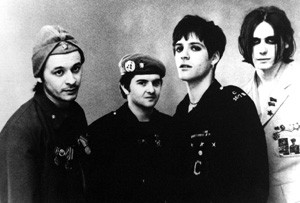
The music fades in with the song already underway: congas are chattering, a flute chirps languidly while a burbling bass holds down the center. Minutes pass, the tempo shifts while the meter remains indeterminate and some nearly comprehensible vocals come and go. The track is titled “Alpha–Omega–Apocalypse,” fairly descriptive of its trance-jam expansiveness, and it runs nearly 17 minutes. Little wonder that its source is now hailed as one of the intriguingly obscure recording projects of the psychedelic era.

That album, The Cycle Is Complete (Collector’s Choice), the lone “solo” album by one-time Buffalo Springfield bass player Bruce Palmer, is, in its way, a quintessential example of the free-flowing musical ethos of the fading 1960s. Defiantly anticommercial, it was originally released in 1971 on the mostly jazz Verve imprint. It’s hard to say which is more surprising, the fact that Palmer was offered the opportunity to create a record on his own or the iconoclastic aural legacy that resulted.

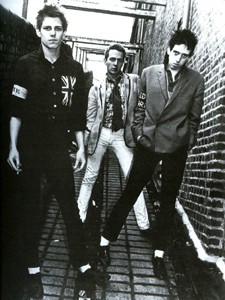
Palmer, who died Oct. 1 of a heart attack at 58, was a Nova Scotia native who hooked up with Neil Young in Toronto in 1966 in the band the Mynah Birds (which also included one Ricky James Martin III, later known as funk superstar Rick James). When that group’s early sessions for Motown went nowhere (James was busted for being AWOL from the Navy), Young and Palmer drove Neil’s hearse to L.A., hoping to find Stephen Stills and start a new band. Against all odds, they crossed paths with Stills and Richie Furay on Sunset Boulevard, and with the addition of Dewey Martin on drums, Buffalo Springfield was born.

Although Palmer neither sang nor wrote any of the Springfield material, his surging bass lines were a key element in the band’s pioneering sound. “Bruce would lay down a groove, and we could have done anything,” Stills once said of his former band mate. “He was the focus that balanced Neil and me.”

Onstage, Palmer was an enigmatic figure, perpetually wearing dark glasses with hair hanging down around his face as he stood, back to the audience, churning out his distinctive lines. That stance, now a cliché, gave the Springfield an added measure of intrigue, but Palmer supplied some core energy as well. His bass often provided a melodic counterpoint to the vocal line, while somehow also affirming the harmonic underpinnings on the downbeat. (In addition to the obvious “Mr. Soul,” listen to “Leave” and “Hot Dusty Roads” from the first album. Palmer’s assertive bass also drives a poorly recorded “Bluebird” bootlegged from the Fillmore West in 1967, but he wasn’t around to cut the tamer studio version.)

But for all his talent, Palmer was apparently not very focused on his music. Deportations for pot busts and a traffic violation interrupted his participation in the sessions for the band’s second album, and Buffalo Springfield scattered before their third and final album was completed, just two years after they joined forces. Despite support from Stills and Young, Palmer failed to land the bass job with CSN&Y, so he was at loose ends when the solo recording opportunity arose.

In John Einarson and Richie Furay’s There’s Something Happening Here: The Story of Buffalo Springfield, Palmer recounts being invited to record for MGM, and writing his first song as a demo to get the gig. But the actual sessions were an extended instrumental jam with Rick James and four guys from the post-David Lindley Kaleidoscope. “It was spontaneous music, over two hours long, so I had to edit it down to 45 minutes,” Palmer said. “I handed it to [the company] and they dropped their drawers. I gave them what I thought music was about, and not what they thought music was about. . . . They released it and I retired. I had a laugh at the industry’s expense.”

How that album stands up now is highly subjective. The CD reissue label, predictably, boasts that “this stuff predates new age, trip-hop and two or three other related contemporary musical currents,” and it’s hard to argue with their chronology, if not their musical analysis. The Cycle Is Complete is idiosyncratic and self-indulgent, but that’s not necessarily a bad thing, depending on your tolerance for unstructured jamming.

Palmer mostly made good on his retirement. Aside from playing on Neil Young’s Trans, and a short-lived trip around the oldies circuit with Dewy Martin as Buffalo Springfield Revisited in the ’80s, he lived out his life in Canada, away from the maelstrom of rock stardom that he tasted in Hollywood.

If nothing else, the title of his long-forgotten solo disc may have been a personal affirmation.

From the October 27-November 2, 2004 issue of the North Bay Bohemian.

© Metro Publishing Inc.

2004 Election Picks

0

North Bay Bohemian
2004 Election Picks

NATIONAL

President and Vice President
JOHN F. KERRY AND JOHN EDWARDS

U.S. Senate
BARBARA BOXER

U.S. Representative
1ST DISTRICT – DEMOCRAT MIKE THOMPSON
6TH DISTRICT – DEMOCRAT LYNN WOOLSEY

STATE

State Senate
3RD DISTRICT – DEMOCRAT CAROL MIGDEN

State Assembly
1ST DISTRICT – DEMOCRAT PATTY BERG
6TH DISTRICT – DEMOCRAT JOE NATION
7TH DISTRICT – DEMOCRAT NOREEN EVANS

PROPOSITION 1A: Local Government Revenue: YES
PROPOSITION 59: Public’s Right to Know: YES
PROPOSITION 60: Political Parties: NO
PROPOSITION 60A: Surplus Property: YES
PROPOSITION 61: Children’s Hospital Bonds: YES
PROPOSITION 62: Open Primaries: YES
PROPOSITION 63: Mental-Health Taxes: YES
PROPOSITION 64: Litigation Limits: NO
PROPOSITION 65: Local Revenue Guarantees: NO
PROPOSITION 66: ‘Three Strikes’ Law Changes: YES
PROPOSITION 67: Emergency Medical Taxes: YES
PROPOSITION 68: Commercial Gaming Expansion: NO
PROPOSITION 69: DNA Database: NO
PROPOSITION 70: Indian Gaming Expansion: NO
PROPOSITION 71: Stem-Cell Bond: YES
PROPOSITION 72: Healthcare Mandate: YES

COUNTY
A selection of some of the most important races

Sonoma County
MEASURE K: Petaluma Parcel Tax for Schools: YES
MEASURE M: Sonoma County Transit Tax: YES
MEASURE N: Affordable Housing in Unicorporated Areas: YES
MEASURE P: Cotati Big-Box Store Limit: YES
MEASURE Q: Healdsburg Hotel Tax: NO
MEASURE R: Petaluma Campaign Reform: YES
MEASURE S: Petaluma Cross-Town Connector: NO
MEASURE W: Sebastopol’s Palm Drive Hospital: YES

COTATI CITY COUNCIL
GEORGE BARICH
TANYA BOONE-ALVA

HEALDSBURG CITY COUNCIL
TOD BRILLIANT
MIKE MCGUIRE

PETALUMA CITY COUNCIL
SPENCE F. BURTON
CINDY THOMAS
PAMELA TORLIATT

SANTA ROSA CITY COUNCIL
CAROLINE BAÑUELAS
VERONICA JACOBI
JOHN SAWYER

Napa County
MEASURE T: Rural Dining District: NO
MEASURE V: Napa County Hotel Tax Increase: NO
MEASURE W: Jamieson Canyon Road Expansion: NO

AMERICAN CANYON CITY COUNCIL
JOAN BENNETT
BRENDA KNIGHT

CALISTOGA CITY COUNCIL
DON HOLINSWORTH
LEE YOUNGMAN

Marin County
MEASURE A: Marin County Transit Tax: YES
MEASURE B: Genetically Modified Organism Ban: YES
MEASURE C: College of Marin Facilities Bond: YES

3RD DISTRICT SUPERVISOR – CHARLES MCGLASHIN
SUPERIOR COURT JUDGE – FAYE D’OPAL

From the October 27-November 2, 2004 issue of the North Bay Bohemian.

© Metro Publishing Inc.

Microwavable Meals

0

: Finding the love in the frozen-food aisle. –>

Adventures in microwavable meals

By Heather Irwin

Peering into the grocery freezer case, I’m just not feeling receptive to Hungry Man. It’s 10pm, for God’s sake, and I’m standing here, glassy-eyed, listening to the Boy extol the virtues of the Hungry Man brownie. And the Hungry Man corn. And something about Salisbury steak. But I’ve already started pushing my cart slowly away from the testosterone-jacked boxes, which are seriously giving me the creeps.

I’ve certainly got my own little frozen-food fetishes, which include Lean Cuisine peanut noodles, Stouffer’s macaroni and cheese, and just about anything from Amy’s Kitchen. But, really, I swear that’s it.

Which is, of course, a lie. I’m a realist, and a girl’s gotta find sustenance on a tight schedule. You can only do foie gras and $9 boutique sandwiches so often before the purse strings and belt loops start to get uncomfortably tight.

And whatever our peculiar yen, it turns out the Boy and I aren’t alone in our fondness for the frozen-food experience. According to the American Frozen Food Institute, nuked meals have become a $26 billion industry, with something like 94 percent of us tossing semisolid blocks of meatloaf and macaroni into our carts on a semiregular basis. Yes, dear readers, we are chilling in a frozen-food nation.

So after reaching into yet another freezer to microwave yet another dinner-in-a-box, I’ve got a pretty good idea as to what’s edible and what’s better used as a moist doorstop. I’m guessing you do, too, out there with your soggy lunch bag and overstuffed freezer. Let’s compare notes.

Flashback to the 1970s. On the occasional PTA night or hurried weekend, Mom would heat up some sort of mystery meat in those nifty compartmentalized trays. As kids, we found the whole thing rather exotic. But some 30 years ago, pot pie, steak, macaroni and meatloaf were the staples of the frozen-food aisle. Not much to fantasize about, other than watching the nifty apple dumplings puff up in the oven.

Things really took off in the late 1980s and ’90s, when microwaves become as ubiquitous as televisions. Today, frozen foods are big business, and as adorably mom-and-pop as your organic frozen tofu lasagna may look, the big food conglomerates have a lock on most of what you’re eating. The Heinz company owns (among others) Linda McCartney Meals, Boston Market Frozen Entrées, Ethnic Gourmet, Rosetto, Delimex and Smart Ones. ConAgra gets us from childhood (Kid Cuisine), through our lean college years (Banquet) and into our paunchy middle age (Healthy Choice). The leader in the budget category is Luigino’s, with the Michelina’s, Yu Sing and Budget Gourmet brands under its corporate belt. Other than the big guys, however, one of the most consistently yummy brands, which sticks to its organic ideals, is local producer Amy’s Kitchen.

While the usual Hungry Man-type stuff still sells well, ethnic foods are gaining fast. Suddenly we’re hankering for pad thai and taquitos, though most frozen food has little in common with the true cuisine of Asia or Latin America. I’m willing to accept the discrepancy and move on.

Pad thai (and its cousin, peanut noodles) are the new caesar salad. Honestly, you really can’t escape some version of sweet-spicy Asian noodles on pretty much any menu. So its not surprising to find a bevy of Asian inspired knockoffs in the frozen aisles ranging from ungodly nasty to better-than-expected. One of the best: Seeds of Change peanut noodles, though there may be too much requisite broccoli filler to give it an unqualified thumbs up. Better: Ethnic Gourmet chicken pad thai with hot, sweet, nice bits of chicken and tofu and crispy little carrots. Plus, you can actually find the little bits of peanut. Yum.

There was a time, not that long ago, when nine out of 10 dinners I served to my ex-husband involved a Budget Gourmet box. It may explain our demise. It was also because we were both out of work, and you can’t beat 99 cents for a hot meal. With a heavy emphasis on Italian foods, Michaelina’s is the workhorse of everyday frozen dining. You know you’ve had them. You can probably still taste the slightly plastic and cardboard tang. The best choice: lasagna Alfredo. Lots of cheese, pasta and just a few sprigs of green stuff to make you feel like you’re eating right.

Though it can be hard to find, if you’ve got the money to splurge a little, Michael Angelo’s eggplant parmesan can’t be beat. Crispy and cheesy with a tangy tomato sauce, it’s a meal for two.

In the lunchtime microwave lineup–you know, where everyone puts his or her frozen meal in a line next to the microwave, waiting for those four minutes of fame–Trader Joe’s is so frequently in the mix as to warrant a separate mention. Comfortable straddling the line of mediocrity, TJ’s wins most of its points for pretty OK flavor relative to fairly low cost, both of them good things. All of the small frozen pizzas, especially the chicken barbecue, are repeat winners. I’m also a fan of the lasagna, and will eat the chicken pad thai in a pinch–but that would be a really hard pinch. TJ’s chicken masala cooks up nicely and smells like heaven, though I still prefer Ethnic Gourmet’s version.

Newer to the namesake frozen-food aisle is Safeway brand. The best of the bunch was a chicken salad wrap. You provide the lettuce, then heat up the gingery ground chicken and pour on the crispy noodles. A shocker was a Safeway brand crème brûlée dessert. The little puddings come in individual dishes and have a package of sugar you can broil or torch on top. The taste was remarkably sweet and creamy, despite the fact that I overnuked it.

Honestly, I have no idea what Welsh rarebit actually is, other than some sort of sharp cheddar cheese sauce that my mother has been ladeling over toast for 30 years. It’s comfort food, and I actually adore it (despite telling my mother to the contrary). If you can locate Stouffer’s Welsh rarebit, a holy grail of cheesiness, covet it. Love it. Do not share it. It is frozen gold.

We also found a relative newcomer to the mix–Smokey Robinson’s red beans and rice. Though a bit salty, the mix of beans, turkey sausage and rice came out pretty dang tasty. The soul is in the bowl, baby.

Another big winner was TGI Friday’s loaded potato skins in the red and white box. Just toss a few of these into the oven. You’ll thank me later. Note, however, the oven is critical to crispiness. Ignore at your peril.

Baking, if you have the time and the oven, really does make a difference with all frozen foods. Things that are supposed to crunch actually do, rather than limply sighing in your mouth. You also avoid all that guilt about irradiating your genitals or whatever.

Which, as I eat yet another frozen meal at my desk, should probably be the least of my concerns.

From the October 27-November 2, 2004 issue of the North Bay Bohemian.

© Metro Publishing Inc.

Calling All Progressives

0

: Can progressives, given the current political climate, ever expect to make significant changes? –>

The bottom line: beat Bush, then hold Kerry’s feet to the fire

By R. V. Scheide

Less than two weeks before the election, Peter Camejo, Green Party presidential candidate Ralph Nader’s running mate, is still fighting the good fight. It’s been a long battle for the Northern California businessman and political activist, and this political season, crisscrossing the country as part of Nader’s quixotic quest for a progressive presidency, he may be facing his toughest, and loneliest, battle yet.

That’s because the people normally considered to be Nader and Camejo’s constituency–Green Party members, progressives and liberal Democrats– have quite frankly been scared senseless by the administration of President George W. Bush. From the Patriot Act to preemptive attack to the war in Iraq, progressives are running scared. That’s as true here in Marin, Sonoma and Napa counties–perhaps the most progressive three-county region in the United States–as it is anywhere.

Interviews with a dozen leading North Bay progressives reveal that while they all agree wholeheartedly with the policies promoted by Nader and Camejo’s progressive campaign, most are supporting Democrats John Kerry and John Edwards, with few reservations. There’s plenty at stake for progressives in this election, they say, particularly on the state and local level. But when it comes to the presidency, it’s anybody but Bush, which is to say, Democrat John Kerry, the only other candidate with a legitimate shot at winning. Via telephone from Vermont, Camejo minces no words at this apparent abandonment of progressive principles.

“People say, ‘How do we stop Bush?'” he says. “It doesn’t matter what the reasons are–anybody but Bush. But by doing this, we are allowing people just like Bush to get in there. Nothing Bush has done could have been done without the cooperation of the Democrats.”

Nevertheless, with few exceptions, North Bay progressives are uniting behind John Kerry. Call it a sign of the times. The driving factor in what may go down as the meanest, nastiest presidential campaign in U.S. history is fear, and when it comes to the Bush administration, there’s plenty to be afraid of.

A Green Party member and former mayor, Sebastopol City Council member Larry Robinson sits on one of the few Green majority city councils in the United States. He has great respect for Nader and Camejo, as well as Green Party presidential candidate David Cobb, but says, “My personal feeling is there is more at stake here. In every possible arena, the Bush administration is turning back the significant progress of the past 100 years. If the election is close, the Republicans will find a way to send it to the Supreme Court, which we know is for Republicans. I want to see as large a victory as possible.”

Fairfax mayor Frank Egger, long active in North Bay environmental issues, is equally frightened of the Bush administration and adamantly supports Kerry. “There’s no choice there,” he says. “Four more years of Bush, and we won’t recognize our country. We won’t recognize our state.”

Lowell Downey, co-chair of the Napa County Green Party, is also supporting Kerry, but reluctantly. “I feel like I have to, but I feel very disappointed,” he explains. “I was very disappointed that Kerry had nothing to say about the environment in the last debate. Having been a longtime Nader supporter, it’s been very disheartening to see the way the Democrats have gone after Nader.”

It’s no secret that the Democratic Party is actively attempting to undermine the Nader campaign, which is currently on the ballot in 34 states, along with write-in campaigns in eight other states, including California. Memories of the Bush-Gore 2000 debacle in Florida still linger, and Democrats are leaving nothing to chance. If that means playing a little dirty pool, so be it. Democratic National Committee chairperson Terry McAuliffe has repeatedly begged Nader not to run at all.

For Camejo, this is one of the things about the present campaign that hurts the most. He can comprehend voters taking thoughtful stands on the issues, including whom to vote for president. “We understand that. That’s a position. But to say not to run . . . The whole left is torn; they’re angry at each other,” he says. But those who choose Kerry should be aware of what they’re getting into, he insists. “Bush is not some weird thing that accidentally happened. This is what corporate America wants. The two parties are going to dominate us no matter who wins. When you accept the Democratic Party framework, you’re moving people who are dedicated to social change into an organization that’s against social change.”

“The environment, conservation, growth and immigration just aren’t dealt with by the Democratic Party,” agrees Chris Malan, a Napa County Green Party member who ran unsuccessfully for a supervisor seat in 2002. “It’s all talk and no action. It’s always about the public having to fight to protect precious resources and get conservation programs in.” Still, Malan says, “Go Kerry! Decades of work have been dismantled in just four years by one president.”

There are a few local progressives who are sticking to their guns. Tod Brilliant, a creative consultant who’s running a renegade campaign for a seat on the Healdsburg City Council, has been wearing his “Proudly Voting Nader” T-shirt a lot lately. “It’s amazing how much heat you get for being pro-Nader these days,” he says, “especially from those who voted for Nader last time. To me, right now, it’s not really very empowering to be a true progressive. Bush has everyone’s sphincter wound up so tight.”

Sept. 11, 2001, may have been the day that everything changed–except Tod Brilliant. “My personal ethics haven’t changed that much in four years,” he says. “I’ll always vote my conscience. Without idealism, there’s no reason to get up in the morning. There’s nothing to live for. That said, I totally understand why people are voting for Kerry.”

And then, of course, there are your crusty Greens.

Napa County Green Party member Glen Baker voted for Barry Goldwater in 1964 before meeting Ralph Nader in 1966. He’s written in Nader for president in every election since, and plans on doing the same thing this election.

“I’m sick of it. I’ve been staying away,” he says, referring to the current state of politics. “If Bush gets reelected, I’m leaving the country.”

Longtime Sonoma County political activist Daniel Solnit would like to see Bush defeated but thinks that local progressives will do little harm if they vote their conscience. “We’re a safe state,” he assures. “Enough people are going to vote for Kerry so that it won’t make that much of a difference. This election is really about damage control. Kerry is by no means a progressive, and I’m amazed that some Democrats are trying to convince themselves otherwise.”

State of Decline

If Peter Camejo had somehow won last year’s recall election, chances are that this year’s state ballot, with its 16 propositions, would look considerably different. Among other things, Camejo proposed raising taxes on the top 5 percent of the state’s wage earners. If that had happened, he says, “Today, there’d be a surplus in the budget, and that’s after we lowered college tuition to preexisting levels.”

Instead, voters chose Arnold Schwarzenegger. “Arnold said he wouldn’t raise taxes and he wouldn’t cut education,” Camejo says drily. “He’s done both.”

Indeed, Schwarzenegger was forced to float a $15 billion bond to balance the state budget, which taxpayers will be forced to pay back, with interest. Camejo points out that the top 1 percent of income earners in California pay a lower tax rate than the poorest 20 percent. But legislators have repeatedly declined to inject fairness into state and local tax codes or solvency into the budget process. “Every attempt to go around this is what’s stopping us in California,” Camejo says.

Instead, voters must face a myriad of initiatives, many of which are designed to shore up the sinking ship of state, particularly in the area of vital social services. For North Bay progressives, the 16 propositions offer much to support, but also offer much to oppose. Sometimes, conditions blur.

“For the cities and the counties, Proposition 1A is the most important,” says Larry Robinson, who’s surprised to find himself in the position of fiscal conservative, thanks to the state’s continued raids on city and county coffers. Proposition 1A still permits the state to borrow from cities and counties, but forces it to pay the money back in a set period of time, with interest. The initiative enjoys unanimous support from the progressives interviewed for this story.

Likewise, so does Proposition 59, which would increase the public’s access to government information, especially at the local level. “As a former city councilman, I can tell you at this point, access is drastically limited,” says Petaluma’s David Keller. A longtime activist on local water issues, Keller once had to file a state public records act request to receive information on the Sonoma County Water Agency’s hush-hush plans for a multihundred-million dollar water-treatment plant, even though local ratepayers, including Keller’s constituents, would be footing the bill for the plant.

All of the progressives interviewed support Proposition 60, which keeps the present primary and general election system, and vehemently oppose Proposition 62, which would permit open voting in the primaries but allow only the top two vote getters, even if both are from the same party, to face off in November.

“Proposition 62 is going to kill the chance for any third party and lock in a system of less diversity and less choice for voters,” says Solnit. “It sounds good–but we’re a nation of electoral idiots. Americans understand their election process less than any other country.”

“What’s the point of having parties if it’s a free-for-all only during the primary season?” asks Keller. “What’s the point of having an election at all?”

Former two-time Petaluma City Council member Matt McGuire calls Proposition 64, which would limit the right to sue the government and corporations for damages to only the specific individuals who have been harmed, “the right to pollute” proposition; progressives are unanimous in their opposition.

“I do believe there are frivolous lawsuits,” says Camejo. “I’ve had frivolous lawsuits filed against me. But obviously where Proposition 64 is coming from is to deny the public the right to due process through the courts.”

Progressives also more or less unanimously support Proposition 61, the children’s hospital bond; Proposition 63, a tax on those who earn more than $1 million annually to pay for a drastically needed expansion in state and county mental-health services; and Proposition 72, which would require medium- and large-sized companies (can you say WalMart?) to pay 80 percent of their employees’ healthcare premiums.

“In Fairfax, we provide healthcare benefits to our employees,” says Mayor Egger, who in addition to his municipal duties has driven a bakery truck for most of his life. “I’ve been a union person the whole time, bought a home, raised a family and made a decent living, and one of the reasons why is the healthcare benefits we get from the union.”

Ain’t that America: fresh, hot sweet rolls delivered right to your doorstep. But then there’s all those big-box stores, like the Carnegie Hall-sized Lowe’s which incensed Cotati citizens have been opposing for all the wrong reasons. They could care less that Yardbirds, which funded Measure P, the anti-big-box measure, doesn’t pay its employees anything close to a living wage. Proposition 72 will force the big boxes to take care of their employees medically, and that’s a good thing.

“Any working person who has healthcare benefits should support Proposition 72, because it protects those benefits,” says Egger.

Most progressives also support Proposition 66, which would require that the last offense committed by a felon sentenced under the “three strikes” law be violent. Larry Robinson believes that the “three strikes” law, as it stands now, is “punitive, fear-based, not rational and not helpful.”

Somewhat surprisingly, most progressives are against both propositions 68 and 70, which seek to tax the earnings on the Native American casinos mushrooming across the state. While gaming remains one of the few successes Native Americans have enjoyed since being nearly exterminated by whites, such increasingly larger casino projects as the Federated Indians of Graton Rancheria’s proposed complex in Rohnert Park are drawing fire from environmentalists and those who believe that gambling destroys the social fabric.

Marge Piaggio, a coordinator for Marin County Peace and Justice Coalition, a collection of numerous progressive groups with a mailing list of 1,500 members, says the coalition opposes both casino measures, but admits that, “With the level that we disenfranchised Native Americans, we sort of have it coming.”

Camejo opposes Proposition 68, but hasn’t yet made his mind up yet about Proposition 70, which would tax all Native American casinos at the same rate as any other business operating in the state.

“I’m definitely voting no on Proposition 68,” he says. “On the other one, I’m not so certain. This is the one thing Native Americans have had some success at.”

But even though he admits to buying an occasional lottery ticket, Camejo says, “Gambling is a fundamentally negative thing. It’s regressive taxation and it’s also highly dangerous. When you put a casino on a block, you’re drawing people in, you’re destroying families. I’m not opposed to gambling, but I would regulate it to death.”

Interestingly, the one initiative progressives seem to be disagreeing about the most is Proposition 71, which if passed would establish a $3 billion general obligation bond to fund stem-cell research.

“I’m going to vote no,” says Egger. “We’ve got a governor who’s cut the car tax and balanced the budget on the backs of the cities.” He would have preferred a revenue bond instead of a general obligation bond. “It’s really questionable whether this is going to benefit the public.”

David Keller disagrees, first addressing those who might be opposed to stem-cell research on religious grounds. “I once heard an interview with the Dalai Lama,” he says. “He was asked what happens if science conflicts with the tenets of Buddhism? He replied, ‘You change Buddhism.’ That’s where I’m at on this.” As for the cost, Keller says, “The state is so far in debt, it’s a matter of where we put our resources. We don’t invest in health, transportation or scientific research. It’s $6 billion [with interest] over 30 years. People think government comes free. It doesn’t.”

“I’m totally for it,” Camejo agrees. “We definitely can afford it, in a different sense. Regardless of the cost, its about being for stem-cell research.” Or as Keller puts it, it’s about searching for the truth.

Chris Malan supports Proposition 71 for another reason. “My son broke his neck three years ago and he’s paralyzed. It’s strictly personal. We have to do something–and I was against Gov. Schwarzenegger’s $15 billion bond.”

Highway to Hell

Keller’s support for Proposition 71 goes to the heart of a subject he talks about often: who funds the commons? By “the commons,” he’s referring to all of the things that supposedly belong to us: the government and the services it provides, such as healthcare and public transportation; and the environment, which provides the air we breath, the water we drink and the parks and open spaces we enjoy. As things stand now, the commons are not faring well. “The neocons and the Republicans have basically decided to defund the government,” he says. You get what you pay for. In our case, not much.

That doesn’t mean progressives can’t turn things around. At the state and national level, North Bay progressives for the most part are lining up to support the traditional slate of Democratic candidates, most of whom have respectable track records supporting left-leaning causes: Barbara Boxer for U.S. Senate; Mike Thompson for 1st District U.S. representative; Lynn Woolsey for 6th District U.S. representative; Carol Migden for Third District state senator; Patty Berg for 1st District state assemblywoman; Joe Nation for 6th district state assemblyman; and Noreen Evans for 7th District state assemblywoman.

However, the real meat for progressives comes at the local level.

“I’d say there’s a huge amount at stake for progressives if they keep their eyes on local issues,” says Daniel Solnit. City council races, for instance, are often decided by fewer than 100 votes. “We still have some control over these institutions.” In addition, all three counties feature local transportation measures on the ballot–always a concern for progressives seeking to reign in growth. And in Marin County, there’s a genuine progressive measure on the ballot, Measure B, which seeks to ban genetically modified organisms in the county.

“I was one of five sponsors of Measure B,” says Egger. “We collected 15,000 signatures in five weeks. It’s vital that we get this approved.”

“There are lots of organic farmers in Marin County,” adds Marge Piaggio. “If they have contamination from GMO seeds or pollen, it finishes them; they lose their certification.”

If approved, Marin would join Trinity and Mendocino counties, which have already enacted anti-GMO measures. Similar measures are on the ballot in Butte, Humboldt and San Luis Obispo counties, and Solnit, who chairs GE-Free Sonoma County, hopes to have a measure on the Sonoma County ballot in March.

But here’s where the rubber meets the road: transportation issues–which is to say the Highway to Hell, the ungodly black strip that links us all together in ways that mostly have to do with the amount of oil left in the planet, which by the estimates of most geophysicists, is now less than half the original existing supply. That’s why the price at this writing has pushed over $50 a barrel. In all three North Bay counties, widening and repairing existing roads is the issue that won’t go away.

Marin County’s Measure A would increases the local sales tax by .5 percent in order to raise $280 million over the next 20 years to improve local transportation. The Marin County Peace and Justice Coalition has endorsed the measure, particularly because 50 percent of the money raised will be spent on public buses.

“It’s not perfect, but it’s better,” says Piaggio. “It’s shocking that the people who work cleaning the big, fancy houses in Mill Valley can’t even catch a bus home.”

A similar proposal in Sonoma County, Measure M, increases the sales tax by .25 percent in order to raise an estimated $470 million over the next 20 years. However, because 80 percent of the money raised would go to expanding Highway 101 and fixing local roads and only 20 percent goes to public transportation, Sonoma County progressives are split on the measure.

“I think it should be supported,” says Martin Bennett, who sits on the executive board of the North Bay Labor Council. “If it doesn’t pass, we have serious problems putting together a coalition to support a comprehensive transportation plan.”

Sounds a little bit like the war in Iraq.

Liberal Santa Rosa City Council members Mike Reilly and Noreen Evans support Measure M. So far, environmental groups such as Sonoma County Conservation Action have remained neutral on the issue, which is fine with Bennett, who has devoted much time and energy attempting to mend fences between environmental and labor interests. But other local progressives are anything but neutral.

“I’m not supporting Measure M,” says Keller. “It’s skewed way too heavily to Highway 101 and road expansion, something that’s readily available from state and federal money. The real ringer is, no one is factoring in the casino traffic. It’s the same old outdated, nonfunctional thinking. Finally, it’s not a good idea because it’s based on the total illusion that two years from now we can get a rail-only measure passed.”

“It’s an awful lot of money for automobile transportation and very little for rail,” says Solnit. “We’re at peak oil. Building more roads for more cars doesn’t make sense.”

Or as Healdsburg’s ever-provocative Tod Brilliant puts it, “I’m Mr. Super Rail. I could give a shit about widening the freeway. I don’t think Measure M is good enough.”

Widening and improving local roadways is where progressives break their picks. Keller will tell you that the proposed expansion, which will turn Highway 101 into three lanes of hot, black asphalt running north and south between Novato and Healdsburg, will only improve the existing traffic conditions, which everybody agrees are horrendous. But he will also tell you that the cities and local developers see the expansion as an opportunity to grow even more, bringing more traffic, more roadway expansion and, inevitably, more environmental degradation.

Bennett, on the other hand, is concerned that many people in Sonoma County, perhaps most, aren’t even making a living wage. New projects mean new jobs, and in many heavy industries, that still means union in the North Bay. At the same time, the SRJC instructor is deeply concerned with the mainstream business model that sacrifices the environment for the common good.

It’s a complex formula, and to be honest, no one progressive has yet figured it out. The Napa County Greens aren’t waiting around for answers. Measure W on the ballot is an advisory seeking to expand Jamieson Canyon Road, a treacherous bit of roadway linking I-80 and Highway 29. According to Lowell Downey, the measure is being sold on the idea that nearby Solano County has agreed to provide housing for Napa’s underpaid farmworkers.

“There is no such agreement,” Downey says. “Basically, Napa County is saying it isn’t going to provide housing to those people.”

Downey’s closer could be applied to every roadway measure on this year’s ballot: “The traffic issue is a big nightmare,” he says. “The burden on the roads in Sonoma and Napa is getting out of hand, and something has to be done, but this isn’t it.”

Sebastopol’s Robinson has been stalking his city’s streets drumming up support for Measure T, which raises the city’s sales tax 1.25 percent to provide funding sucked out of the city’s coffers by the state. In the end, it all boils down to the road most frequently traveled. “It will help make up for some of the funding Sacramento has been taking from us for 12 years,” he says, “so we can pave our streets.”

Will the Real John Kerry Please Stand Up?

With many focusing their energy and their vote on once again defeating the lesser of two evils, smaller concerns such as fixing pot holes and providing a living wage have taken a back seat. Can progressives, in the current political framework, ever expect to effect positive change within the existing system?

“I think you’ve raised the $64,000 question,” Peter Camejo chuckles, pausing to muse what that might cost in today’s dollars. “How do we change society? You can’t change it till you recognize the problem.” Still, he thinks “America will change. How, exactly, we get there, I’m not sure. But our campaign is a step in the right direction.”

Indeed, North Bay progressives remain certain that they can change things within the existing system.

“I’ve been slammed by all the newspapers, including yours,” says former Petaluma City Council member Matt McGuire. “But I had the best rep for bringing both sides together. If you have an intelligent majority, you really can get things done.”

Robinson is equally optimistic. “There are some people in the environmental movement who think we cooperated too much with the business community,” he says. “There are some people in the business community who expected more cooperation from the city council. On the whole, I’m finding a tremendous amount of support for what we’re doing.”

As far as the presidential election is concerned, many progressives are supporting Kerry with the hope that he will turn out to be more liberal than his current campaign indicates. Will the real John Kerry stand up after the election?

“I think so, because right now he still has to appeal to mainstream America,” says Chris Malan. “People care about the environment, but if you put too much emphasis on it, you’re considered a radical. It irritates and frustrates me to no end that both candidates don’t talk about the environment.”

“If Kerry does win, we’ve got to remind him of who it was that made his victory possible,” says Robinson. “The real work begins Nov. 3. My fear is that if Kerry wins, progressives will again become complacent. If Bush wins, we’ll be so demoralized, it will be a generation before we recover.”

From the October 27-November 2, 2004 issue of the North Bay Bohemian.

© Metro Publishing Inc.

Briefs

Mondavi PicketLaid-off farmworkers at the financially troubled Robert Mondavi Winery recently received an unpleasant surprise along with their pink slips. According to some farmworkers, the severance package the winery offered this year--two weeks pay for every year worked plus three months of health insurance--was roughly half of what farmworkers were offered last year. While the company has stated that...

International Latino Film Festival

Chilly Scenes: A mail-order bride comes to the snowy reaches of Montreal in 'A Silent Love.'Size MattersInternational Latino Film Festival proves bigger is better Every year since its debut at the Lark Theater in the fall of 1997, the San Francisco Bay Area's International Latino Film Festival has grown measurably larger. This fact will no doubt seem run-of-the-mill to...

The War on Terror

: War as an extreme form of terror all on its own. -->How our war on terrorism feeds the flamesBy Howard ZinnI call it "our" war on terrorism, because I want to distinguish it from Bush's war on terrorism, and from Sharon's and from Putin's. What their wars have in common is that they are based on an enormous...

Swirl ‘n’ Spit

Swirl 'n' SpitTasting Room of the WeekDarioush WineryBy Heather IrwinLowdown: It's a little bit Napa. It's a little bit Persia. It's a whole lot winery theme park. Welcoming visitors with four rows of 25-plus-foot-tall columns and a stone facade quarried near the ancient city of Persepolis, one might find this new Silverado Trail winery, oh, perhaps a bit aesthetically...

Open Mic

After the Election Taking the next steps toward Democracy U.S.A.By Steven Hill Coming down the home stretch, the push is on to re-defeat George W. Bush. Everyone from the Democratic Party, labor unions, philanthropic foundations, pragmatic Greens and progressive media are rallying behind the Kerry-Edwards ticket. But if the effort is successful in ousting Bush, then what? What are...

‘The Terminator’/’The Road Warrior’

: 'Vote Hummungus' (or else) is a painting by French artist J-Master. -->In the worst-case scenario, can anyone stop the Terminator?By R. V. ScheideIn a few short days, an election that many pundits are calling the most important in generations will take place. For Democrats, liberals and progressives, much is at stake. The country, according to the latest polls,...

Bruce Palmer

: Bruce Palmer's bass playing was unconventional. -->Remembering Bruce Palmer's singular soloBy Bruce RobinsonThe music fades in with the song already underway: congas are chattering, a flute chirps languidly while a burbling bass holds down the center. Minutes pass, the tempo shifts while the meter remains indeterminate and some nearly comprehensible vocals come and go. The track is...

2004 Election Picks

North Bay Bohemian2004 Election PicksNATIONALPresident and Vice PresidentJOHN F. KERRY AND JOHN EDWARDSU.S. SenateBARBARA BOXERU.S. Representative 1ST DISTRICT - DEMOCRAT MIKE THOMPSON6TH DISTRICT - DEMOCRAT LYNN WOOLSEY STATEState Senate3RD DISTRICT - DEMOCRAT CAROL MIGDENState Assembly1ST DISTRICT - DEMOCRAT PATTY BERG6TH DISTRICT - DEMOCRAT JOE NATION7TH DISTRICT - DEMOCRAT NOREEN EVANSPROPOSITION 1A: Local Government Revenue: YESPROPOSITION 59: Public's Right...

Microwavable Meals

: Finding the love in the frozen-food aisle. -->Adventures in microwavable mealsBy Heather IrwinPeering into the grocery freezer case, I'm just not feeling receptive to Hungry Man. It's 10pm, for God's sake, and I'm standing here, glassy-eyed, listening to the Boy extol the virtues of the Hungry Man brownie. And the Hungry Man corn. And something about Salisbury steak....

Calling All Progressives

: Can progressives, given the current political climate, ever expect to make significant changes? -->The bottom line: beat Bush, then hold Kerry's feet to the fireBy R. V. ScheideLess than two weeks before the election, Peter Camejo, Green Party presidential candidate Ralph Nader's running mate, is still fighting the good fight. It's been a long battle for the Northern...
11,084FansLike
4,446FollowersFollow
6,928FollowersFollow

