

Brent Hartinger


Get Over It: Tacoma author Brent Hartinger wants gay teens to have the ‘boring, ordinary’ sweetness of life.

Face Time

Author Brent Hartinger gives gay teens a model

By Gretchen Giles

Tacoma author Brent Hartinger writes books and plays for young adults, such teen lit as The Last Chance Texaco and a popular science-fiction series. But what might set Hartinger apart from other novelists aiming at a younger audience is that, as a middle-aged gay man, Hartinger writes about young gay men. Oh, and young bisexual women. And avowedly straight best friends. And homosexual sex at summer camp. And bisexual sex at summer camp. But mostly, he writes about the lonely gift of being different.

Professing not to like young children (“They annoy me”), Hartinger prefers adolescents, even promising that if a young adult who attends one of his readings can sincerely tell him to his face that it wasn’t enjoyable, he’ll pay the kid for his time. Area teens have a chance to put Hartinger to the fiscal test on May 10 when he appears at Copperfield’s Books in Montgomery Village.

In Hartinger’s newest work, The Order of the Poison Oak (Harper Collins; $15.95), we follow a frank and funny self-deprecating narrator named Russel Middlebrook. Russel is a junior at Goodkind High School, an institution that seems ironically named to a gay teenager who was thrust unwillingly out of the closet in 2003’s Geography Club, to which this is a sequel.

Desperate to no longer be “the gay kid” at school, Russel happily accepts a summer job as a camp counselor far away from home. He’ll be able to reinvent himself and no longer be identified to others simply by his sexual orientation. Accompanied by his best friends from Geography Club, the bisexual Min and heterosexual Gunnar, Russel sets off for an unfettered summer of adventure.

During the course of the book, Min and Russel are both seduced by the same Adonis-like creep, Gunnar awkwardly finds true love and everyone learns a lesson, of course. After all, it’s a teen novel, and we adults appreciate the expediency of having our kids instructed while being entertained. But what Russel learns is that while he may look unscathed, he bears the same scars as the group of young burn victims who are his first charges. Is being gay really tantamount to having survived a life-and-death emergency by fire?

Speaking by phone from the Washington state home he shares with his partner of 13 years, writer Michael Jensen–an author who specializes in the gay Western genre–Hartinger briskly acknowledges the connection. “Yes,” he says. “I’m not trying to say that anyone had it worse or better. There are feelings that people in situations share. The scars are different, but they’re both there.”

For Hartinger, such scars are mostly incurred during the teen years. “My books, especially the gay books, have a sizable twenty-something-and-older audience,” he says. “I’ve given a lot of thought to why that it is. The one thing that all adults have in common is that we were all teens, so these experiences really resonate. Gay adults will say, ‘I like your books because they give me a chance to relive the adolescence I never had.’

“One of the many things that makes my blood boil is that gay teens are robbed of so many of the boring innocent things: holding hands in the hallway, going to the prom. When you have to keep your feelings hidden, you are robbed of all these innocent experiences that help us learn how to be adults, how to love, how to be part of a community. People feel that they’re able to recapture their adolescence; that’s part of the reason I write the books, to rewrite my teen years and to give them a purpose and a happy ending.”

Fortunately, The Order of the Poison Oak reads less like an exercise in personal therapy than an updating of Holden Caulfield’s cantankerous teenage voice. What ultimately interests Hartinger, who founded a gay youth foundation in Tacoma, is that “a teenaged character is filled with so much dramatic possibility”–that, and the fact that there is so little reflection in our society for gay youth. “When I first starting working with gay teenagers, I was sort of an unwitting role model,” he says. “They would look at my life and idolize it, and it made me really uncomfortable. Now that I’m older and have more confidence, I understand how few role models there are of adult gay men in long-term relationships; they’re just not visible.

“When you’ve got a typical straight kid, there’s a picture in his mind from movies and other media. When they’re able to look at me, I can help give them a picture. We’re not perfect, but we’re here and we’re integrated in our community.”

Brent Hartinger appears with his partner Michael Jensen to talk about their lives, work, relationship and ‘The Order of the Poison Oak’ on Tuesday, May 10, at Copperfield’s Books. 2316 Montgomery Drive, Santa Rosa. 7pm. Free (money-back guarantee!). 707.578.8938.

From the May 4-10, 2005 issue of the North Bay Bohemian.

© Metro Publishing Inc.

Briefs

0

Briefs

Place Your Bets

Those casinos just keep rolling along, with no less than two new Native American gaming facilities currently proposed for bucolic Cloverdale, in the far northern reaches of Sonoma County, There’s one by the Cloverdale Rancheria band of Pomo Indians and the other by former Cloverdale Rancheria tribe members–and prominent Cloverdale citizens–the Santana family. Unfortunately, as those who’ve visited “Clovertucky” can attest, the town just ain’t big enough for two casinos. Come to think of it, if Sen. Diane Feinstein has her way, the town might not be big enough for one. According to the Stop the Casino 101 Coalition, the organization fighting the Graton band’s proposed gaming facility in Rohnert Park, the senator declared at her weekly breakfast meeting on April 21 that the 55 casinos currently in the state are enough and not one more should be built. Feinstein’s change of heart seems pretty dang convenient, considering how her husband, Richard Blum, has raked in a small fortune via his investments in Perini Corp., the Massachusetts company that’s constructed a handful of casinos throughout the state, as previously reported in these pages ((, Feb. 9).

Getting Soaked

Residents in the unincorporated Sonoma County area of Larkfield/Wikiup aren’t on the Sonoma County Water Agency’s teat and thus pay high rates for privatized water from Cal-Am, a subsidiary of German-owned water giant RWE, infamous for its practice of draining the coffers of Third World countries dry. Rather than let this same set of circumstances occur at home, Larkfield/Wikiup residents may want to take a page out of Santa Cruz County’s playbook, where supervisors recently approved a ballot measure that would give residents of Felton the chance to buy back their formerly public water utility from Cal-Am. Expect the Felton decision to be Topic A at the Larkfield/Wikiup Water Advisory Committee public forum on Saturday, May 7, from 10am to noon at the Riebli School, 315 Mark West Springs Road, Santa Rosa.

Green Martin

Irrepressible Napa City Council member, two-time mayoral candidate and muckraking newspaper owner Harry Martin has finally gone and done it: the plain-talking populist has registered with the Napa County Green Party. “He’s never been happy with the Democrats or the Republicans,” reports Lowell Downey of the Napa Greens. “He looks forward to participating with us.” Martin has two years left to serve on his third term as councilman. Valley Land Stewards beware.

From the May 4-10, 2005 issue of the North Bay Bohemian.
© Metro Publishing Inc.

Open Mic

0


Dark Ages

The renewed threat to academic freedom

By Tony White

Two years ago, when I returned from an educational trip to Cuba, someone gouged “communist bastard” into my office door at Sonoma State University. When I read about students accusing Santa Rosa Junior College instructors of advocating the overthrow of the government in favor of communism, it was a chilling reminder of that dark moment in recent American history: McCarthyism.

While my door could be replaced, the smear tactics employed by the SRJC students were more menacing, and violated the trust, civility and open discourse which should govern the conduct of students and faculty alike. By not publicly admonishing these students that their “dirty tricks” were unacceptable in an academic institution, the SRJC administration has failed to defend the faculty and academic freedom.

This was not an isolated event, but part of a national campaign by conservatives to smear liberal professors and stifle criticism of government policies in the name of academic freedom. Instead of engaging in a public debate on national issues or government policies, these conservatives use labels to characterize opponents as un-American, communists or supporters of terrorism.

They are also mean-spirited, making anonymous and unsubstantiated charges that threaten their targets’ financial security, not to mention their academic freedom. The latter tactic is spreading. In California, a legislator has introduced Senate Bill 5, labeled the “Student Bill of Rights,” which would seriously inhibit the free expression of ideas in the University of California and the California State University.

In a recent opinion piece in the Press Democrat, a former school superintendent not only praised the students for their courage, but repeated their charges of communist indoctrination. But neither he nor any of the students have cited a single example by any of the targeted instructors and none of the accusers had attended their classes.

Like other critics of academia, he concluded that since the majority of professors are registered Democrats, they are liberals who “reflect the far left.” Even if the majority of college and university faculty are registered Democrats, does that tell us anything about how they teach math, geology, physics, accounting or history? And how does voter registration in a centrist party lead to implied charges of communism and treason?

These same critics also claim that liberals have a litmus test for hiring and promoting faculty, but they offer no evidence to prove this claim. During years of service on numerous hiring and promotion committees, I can testify that a candidate’s political ideology never once entered the discussion. To even inquire about a candidate’s political views would violate their rights and provide grounds for a lawsuit.

In a recent syndicated column, Cal Thomas cited studies which show that the majority of college professors are liberals who support abortion rights and gay marriage and do not regularly attend religious services. While not surprising, these views or behavior do not differ significantly from mainstream America, especially among professionals.

Although I agree that university faculty tend to be liberal, this is not the result of any conspiracy or bias in the hiring and promotion process. It is because of the unique nature of academia and the attraction which college teaching has for someone who is intellectually curious, thinks critically and wants to make a difference through teaching young minds.

Unlike the corporate world, the military or government service, academics are encouraged to question authority, conduct independent research, discover new information or ideas and challenge the canon. Ideally, the goal is an ongoing search for the truth through objective research and the open discussion of opposing views. Without academic freedom and the protection of tenure, this would not be possible.

College should be viewed as an opportunity for students to grow intellectually and be challenged by new information and ideas. If this clashes with their pre-college views, the perception may be that the instructor is not only liberal, but also anti-American, when, in fact, the objective is to present a more comprehensive view of history.

My own liberalism stems from one of the greatest of American traditions: sympathy for the underdog and protection of the weak. That includes public support for education and access to higher education, without disruption from ideologues with a political agenda.


Tony White is a professor of history and global studies at Sonoma State University.


From the May 4-10, 2005 issue of the North Bay Bohemian.

© Maintained by .


Cook It!

0

Cook It!

Mom’s Meal

By Gretchen Giles

She endured perhaps as much as 48 hours of agony, gained an ungodly amount of weight and lost it again, subjected herself to the indignities of both the human body and the medical profession, didn’t get a full night’s sleep for well on years, has pretended to actually enjoy Cheerios and spinach, has relearned algebra, feigned interest in the rules of soccer and memorized all the Disney song lyrics, and what does she get? One single day.

That single day this year is Sunday, May 8, and Mom deserves at least one carefree meal for the pain and joy and suffering and blessings of which motherhood is variously composed.

The breakfast-in-bed route is certainly welcomed, but allow us to suggest adding a family-made dinner to the menu. The following recipe, adapted from that which chef Andy Wild of Andy Wild Catering recently printed in the Stag’s Leap winery’s newsletter, uses the abundant roses of the season in an easy and elegant meal that will wow everyone. As a plus, pounding chicken breasts is a marvelous exercise in outsourced aggression for young cooks, and picking a rose from the garden and then cutting it up for dinner is a thrill that knows no age limit. Rose water is found in the mixers section of the hard-liquor aisle for reasons we’re too unsophisticated to understand. For ease, serve over a bed of regular boxed rice pilaf, being careful not to use any that’s too spiced–you want the flavors of this glory to shine.

Andy Wild’s Rose Petal Breast of Chicken
2 whole boneless breasts of chicken, skin on
2 tbsp. olive oil
2 tbsp. fresh ginger, peeled and minced
1 clove garlic, sliced thin
1/4 c. dry sherry
2 tbsp. rose water
1 tsp. honey
2 tbsp. minced chives
1/4 c. slivered almonds, toasted
1 c. rose petals julienned (please only use those whose growth you’re familiar with; you don’t want to eat commercially grown roses)
1 rose for show

Lay chicken skin side down between two sheets of wax paper and pound to a uniform thinness. Season to taste with salt and pepper.

Heat sauté pan with oil over medium heat, add chicken skin side down, cook until golden and then flip and cook until juices run clear. Remove to warmed platter, cover and place in low oven to stay warm.

Add ginger and garlic to sauté pan, and cook until garlic is golden. Add sherry, rose water and honey. Simmer for two minutes, adding half the rose petals.

Slice chicken into strips, and lay over rice pilaf. Pour sauce from pan over. Garnish with chives, almonds and remaining of rose petals. Add another rose to the plate for that special lady. Happy Mother’s Day!

From the May 4-10, 2005 issue of the North Bay Bohemian.

© Metro Publishing Inc.

‘The Hitchhiker’s Guide to the Galaxy’

0

Apocalypse Now!: Comedian Geoff Bolt registers some professional disappointment that the earth didn’t explode as well as it could have in ‘Hitchhiker’s Guide.’

Big Bangs

On the combustive impact of ‘Guide’

By David Templeton

In its ongoing quest for the ultimate postfilm conversation, Talking Pictures takes interesting people to interesting movies.

Having acquired large cups of strong coffee to chase the taste of artificially buttered popcorn from our aggrieved palates, comedian Geoff Bolt and I have located a secluded spot in which to discuss the film we’ve just seen, The Hitchhiker’s Guide to the Galaxy. Based on the popular books by the late Douglas Adams, the new film features ugly aliens, two-headed politicians, singing dolphins and the complete and total destruction of planet Earth.

In anticipation of said demolition, I’ve brought along a laptop and a couple of DVDs–Star Wars: A New Hope and Superman–each featuring other prominent planetary explosions. As I’m cueing up the destruction of planet Krypton in Superman, I ask Bolt–a noted comedian and actor, frequent sidekick of Steve Young in an award-winning series of Toyota commercials and the big brain behind Bolt’s Unified Field Theory, a traveling variety/science/comedy/improv show–to tell me what he thought of Hitchhiker’s Guide.

“What’s the best exploding planet you ever saw on film?” I ask.

“That would have to be Star Wars, wouldn’t it?” Bolt replies. “Alderaan blowing up. That was so sad. ‘I’ve felt a great disturbance in the Force, as if millions of voices suddenly cried out in terror and were suddenly silenced.’ It reminded me of my early days in elementary school, though it wasn’t a million voices; it was more like 300 of us, K through six.”

With that, I push “Play” on my laptop, and the planet Krypton neatly explodes in a tremendous blast of combustible confetti-like stuff, enhanced by the eerie, creepy sounds of metallic shards being twisted into unnatural shapes.”Wow! That’s a pretty good one!” Bolt admits. “It’s always a little bonus when a planet explodes in a movie, isn’t it? I think all movies should have exploding planets.”

“It would have improved My Best Friend’s Wedding,” I point out.

“Definitely,” he agrees.

We are now ready to watch the granddaddy of all exploding planets, the aforementioned demise of Alderaan in Star Wars.

“Punch it,” Bolt says. I hit “Play.” Surprisingly, for all its dramatic buildup and digitally added impact rings when the planet blows up, the destruction of Alderaan turns out to be much shorter in duration than either of us remembered.

“I think they didn’t linger as long on it as in Superman,” Bolt suggests. “It’s like they cut away too fast out of respect for the dead or something, but that diminished the impact a little. And the sound effects in Superman were better, I think. OK. I change my mind. I’d now have to say that Superman has the better exploding planet.

“And I have to say,” he continues, “and I don’t know about you, but compared to Superman and Star Wars, I was kind of disappointed with the way Earth blew up in Hitchhiker’s Guide to the Galaxy. Earth didn’t really explode so much as implode, and that just felt wrong. I think they chintzed out on us. Of the three, Hitchhiker definitely has the least impressive exploding planet. ‘Here you go, stuck-up humans. You think that the death of your planet should be really big and impressive and dramatic. Well, look at this–all you get is a little poof, and it’s gone.’ Isn’t that ironic?”

“I think that was the point,” I say.

“I think it probably was the point,” Bolt agrees. “It’s about the futility of our dreams and the grandiosity and self-aggrandizement of our pathetic little species, the inherent falseness of our own sense of specialness in the universe. Hmm . . . OK, now I’m depressed. Maybe we should watch Krypton blow up again. It seems to help.”

Nodding, I push “Play.”

From the May 4-10, 2005 issue of the North Bay Bohemian.

© Metro Publishing Inc.

Flea-Market Finds

Art of the Deal

The haute culture of flea-market finds

By Kristy Hoffman

I have a confession: I am addicted to the thrill of bargaining at the flea market. It all began while regularly attending the Cupertino flea market as a child, where I constantly went back to look for the next best toy. I have since moved on to more fashionable items. Whether I am hunting for a 1960s chiffon dress, brooches, vintage beaded cardigans, cowboy boots, Marc Jacobs shoes or sunglasses you name it, I have probably found it, bought it or fought over it at a flea market.

I went through a phase where I was addicted to vintage airline bags. The appeal of wearing one and vicariously living through the bag’s history, wishfully hoping some swank airline stewardess from the ’60s once owned it, is the reason I treasure them.

But I won’t settle for a $45 Pan Am bag from a vintage store. After satiating my initial desire with a Japan Airline bag, I finally found the Pan Am one I had been longing for on the shoulder of a woman at the Santa Rosa Junior College flea market. I immediately mustered up the courage to ask her if it was for sale. As we flea market shoppers know, everything has a price. With empty pockets from buying other items, I had only 60 cents to offer for the bag. She sold it to me.

The art and skill of getting the better deal holds more value and esteem than paying for something at a fixed price. Flea markets, garage sales and estate sales always have room for negotiation; a department store doesn’t. Flea markets have ongoing changes in stock, with something different every weekend, and with the rise and fall of customers, the prices fluctuate throughout the day. Flea market vendors are always willing to cut a deal. Plus, rummaging through goods at a flea market is ideal for a weekend ritual.

But first-time buyers beware: my innocent toy collection has since transformed into an overstuffed closet.

Quality Junk

Tips for rummaging through North Bay flea markets:

Carry small bills. You can’t say you want something for $7 if you are carrying a twenty. It is hard to negotiate if you are carrying large bills.
Buy in bulk. Generally, if you buy more than one item, the vendor will give you a better price.
Keep your car trunk empty and carry some bungee cords–you never know what you might find.
Dress casually. If you are wearing Chanel sunglasses or carrying a designer handbag, bargaining can get complicated if the vendor thinks you have lots of money to spend.
Be willing to accept that some dealers won’t negotiate on their prices. It happens, and sometimes you just have to walk away.
Always try on clothing, shoes, hats, etc. There is nothing worse than buying something that doesn’t fit.
It’s always good to go with someone who is not the same size as you; it lowers the competition. It’s bad enough you have to get there early and fight with others, but even worse if you are fighting with a friend.
If worse comes to worse and you get desperate, show them the money. Especially at closing time, if the item has not sold, vendors will want to get rid of it. It is less for them to pack up, so chances are they will accept your offer.
If the item is electronic, always plug it into an outlet before purchasing. I have bought a broken record player that the vendor assured me worked. Such items are nonreturnable.
Stay away from obviously stolen goods, even if the price is right; it’s not ethical. Look for CDs without their original cases, for example. Remember your friend who got her CD storage case stolen out of her car? Where do you think it ended up?
Make friends with the vendors. Know their names. They are more likely to give you a deal if they know you come every week.
Name brands don’t necessarily mean anything. Always check to see where the item is made, check the quality of the material and check the label’s authenticity. There are many designer knockoffs, and unless you are familiar with them, be skeptical and act like you know exactly what it is you are buying. Displaying product knowledge shows the vendor that you are smarter than they anticipated.

Where to Go

Guerneville Flea Market. Safeway parking lot, 16405 River Road, Guerneville. Fridays and Saturdays, 10am to 5pm.

Weinstein’s Outdoor Antique and Collectible Market. Healdsburg. Three days a year, the Sunday of Memorial Day weekend, the Fourth of July and Labor Day. 707.578.7772.

Mrs. Midgley’s Country Flea Market. Outdoor market with some covered areas. 2200 Gravenstein Hwy. S., Sebastopol. Open every Saturday and Sunday, from 6:30am to 4:30pm. 707.823.7874.

Napa-Vallejo Flea Market. Over 50 years of providing great deals. 303 Kelly Road off Route 29, Vallejo. Sundays, year-round, 5am to 5pm. Shopper parking, $2. 707.226.8862.

Antique Street Fair. Always the last Sundays in April and September. Make sure to mark Sept. 25 on your calendar this year. In downtown Petaluma. 707.763.7686.

Attic Treasure. Parking lot sale, always the weekend before Halloween. In addition to the once-a-year sale, the store contains lots of vintage clothing daily. 708 E. Washington St., Petaluma. 707.762.6998.

San Rafael Community Flea Market. Benefits People Living with HIV/AIDS. 29 Mary St., San Rafael. May 7, June 11, July 9, Aug. 13 and Sept. 10, 8am to 2:30pm.

SRJC Flea Market. Bailey Field parking lot. The dates for the market are set in the beginning of each semester. We just missed the April 24 sale. Call SRJC’s Office of Student Affairs from 10am to 4pm in the fall to find out when the next one is scheduled. 707.527.4424.

Forty and Eight Flea Market. Off Highway 12 on Maple Avenue, at the Veterans Memorial Building, Santa Rosa. One Sunday each month, May through September. 2005 dates: May 1, June 12, July 10, Aug. 21 and Sept. 18, 7am to 3pm. 707.522.9391.

Santa Rosa Senior Center Flea Market. Flea market occurs twice a year, in spring and fall. The abundance of vintage items is worth checking out. Held in the Senior Center parking lot, 704 Bennett Valley Road, Santa Rosa. Saturday, May 7, from 9am to 3pm. 707.545.8608.

Sebastopol Flea Market. Offered by the Tri-School PTSA. Students are the sellers, giving them an opportunity to experience a business. Park Side School, 7450 Bodega Ave., Sebastopol. Saturday, May 14, 8:30am to 1:00pm.

From the May 4-10, 2005 issue of the North Bay Bohemian.

© Metro Publishing Inc.

Sea Restaurant

0

Photograph by Pablo C. Leites

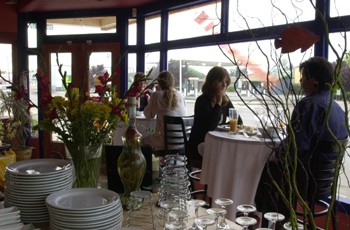
High Thai: Sea’s food is sophisticated.

By the Beautiful Sea

Thai restaurant is more bistro than Bangkok

By Heather Irwin

It wasn’t all that long ago that any Chinese restaurant worth its soy sauce prominently featured the Flaming Pu Pu Platter. As fun to say as it was to eat, this madcap appetizer was the touchstone of 1980s Midwestern Amerasian cuisine. Featuring mountains of fried egg rolls, won tons, crab puffs and sticky meats, the whole thing was artfully arranged to spotlight the most far-out feature of all–a flaming pot that smelled of Sterno and grease. Light years before searing, blackening or tableside grilling, the flame pot, of course, served no apparent purpose other than to piss off your dad when he tried to extinguish it with a napkin.

Such monstrosities of greasy goodness have all but gone out of fashion, but I still remember waiting in squirmy anticipation for the telltale click of a lighter and the little blue flame that represented something fantastic and extraordinary. When the platter arrived at our table, everyone grew hushed, awed at the sight. We knew we were about to eat something very special.

Sea, of course, doesn’t have a flaming Pu Pu Platter. As Sea is Thai rather than Chinese, and this not being the early ’80s, I’ll forgive them. They do, however, have something infinitely better and almost as fun to order: the Starters Parade.

This was the absolute must-try on my first visit to the new Petaluma restaurant. Open for about eight weeks, its bright exterior and hard-to-miss sign is a perfect match for the equally bright and funky Metro Hotel next door. Seems the neighborhood is quickly becoming a haven for the southernly hip, as evidenced by the live-work lofts going up just blocks away. Hotel? Thai restaurant? Lofts? This can only mean one thing: a wine bar isn’t far behind.

In the meantime, Sea is an exotic oasis in the mostly industrial neighborhood on the outskirts of Petaluma. After ordering a Thai iced tea, we couldn’t resist the quirkily named Starters Parade appetizer ($14). Incorporating the best of the restaurant’s modern Thai cuisine starters, it includes spring rolls, crispy prawns, chicken satay, fish cakes, mummy chicken and the “Little Basket”–crispy egg noodles tossed with a mixture of onions, cilantro, carrots and nuts.

Arriving at our table with a flourish as not a few heads turned, it was the Pu Pu Platter all over again (but without the flaming). Glasses were moved quickly aside, the platter taking up most of our small table. Little individual compartments held all sorts of condiments and sauces and–yum–lots of fried nibbles.

I waited for no man. Or Boy. A poorly timed trip to the bathroom will cost you dearly when you eat with me. And neither spring rolls nor fish cakes get better with exposure. So by the time the Boy was back from the water closet, I was halfway through the Parade.

Most fascinating were the mummy chicken (little bits of chicken wrapped in banana leaves) and fish cakes (made with red curry paste, kaffir lime leaves, fish and an array of other unknowns, deep fried and served with cucumber sauce). The texture of the latter ends up being slightly rubbery, rather than flaky, which is evidently the whole point. Dense and exotically fragrant, they are a wonder of edible consolidation.

Our other favorite was the Little Basket, a salad of fried egg noodles and finely julienned veggies. Fresh, crisp and with the Thai signature of sweet, spicy and salty all commingled, it was a refreshing foil to the oiliness of the other dishes.

The one disconcerting addition to many of the dishes was the kitchen’s use of salted mixed nuts. Now, I am no expert on the authentic use of nuts in Thai food; however, cracking open a can of Planters as garnish seems odd to me. The saltiness of the unchopped nuts really detracted from some of the dishes, and it didn’t help that I absolutely abhor Brazil nuts.

Having polished off the Parade in nearly no time, we were ready to explore the entrées, many of which tout the inclusion of wine and local produce. By simple geography, most restaurants west of, say, Idaho feel a need to tout both the use of wine in their dishes and the fact that most of their food is so spanking fresh and local that it practically came from the owner’s backyard. Sea is no exception, despite the fact that Merlot isn’t exactly native to Thailand and kaffir lime leaves are about as native to California as, well, Thais. Odd bedfellows, yes. But somehow it works.

As we prepared to order, the Boy wouldn’t be swayed from his choice of golden cashew chicken ($9), despite my heated suggestions otherwise. Determined to contribute to the review, he steadfastly insisted that, having eaten many a cashew nut chicken, this was his Thai dish of expertise.

Served piping hot, the chicken was in boneless little strips, rather than the painfully ubiquitous and rather slimy cubes one sometimes gets at other restaurants. That was a plus. A fair number of cashews and a small side salad were a plus as well. However, the sauce was somewhat bland and uninteresting, despite teasing us with promises of a honey glaze syrup. Not a honey or glaze in sight. We were both left a little disappointed, though I never have exceptionally high hopes for what seems to me to be the creamed chicken on toast of Asian cooking.

Conversely, my holy basil lamb ($16) was much more intriguing. Served in a Merlot and milk reduction sauce, it was luscious and beautifully plated with sliced red peppers. Whether the basil was holy, or even all that pious, I can’t say for certain, though it was rather divine with the zucchini dotting the plate.

The second trip, however, resulted in some of the most soul-satisfying dishes I’ve had in recent memory. As I always say to, well, anyone who pretends to listen, stick with what the chef knows best. And in a Thai restaurant, curry is almost never a bad choice. The red pumpkin curry ($10), with its creamy coconut milk base, chopped vegetables and slices of real pumpkin, didn’t disappoint. In fact, it also didn’t get shared. With anyone. The staff suggested adding shrimp, which was a perfect choice for the heat and creaminess of the curry, in addition to just looking so darned pretty in the pink sauce.

I can’t fail to mention the pad thai ($9), which I also ordered with chicken. A mainstay of American Thai restaurants, the portion was large, but lacked the hints of sweetness and pan-fried crunch that I like in my noodles. It was more overwhelmingly smoky and savory, with a little chicken and the odd mixed-nut concoction on the side. It was certainly more than passable, but paled in comparison to the pumpkin curry.

Also wonderful and worth a group nibble is the fried calamari ($7), which is served pommes frites-style in a paper-lined cup. Fresh desserts are featured on the kitchen blackboard and include banana fritters and sorbet.

With cozy benches, high bar tables, an open kitchen and large, showy displays of exotic flowers, Sea is far from the usual hole-in-the-wall restaurant, ending up more bistro than backstreet Bangkok. The smells, however, that waft from the kitchen and settle into the dining room in wave after wave may remind you a little of Bangkok–and not in a good way. Because while pleasing, mouth-watering and delightful before a heavy meal, a big sniff of fish as you’re eating dessert can be a little off-putting.

Then again, the waft of far-off lands and exotic cuisine can be a wonderful thing. Even when it isn’t a Pu Pu Platter.

Sea Restaurant, 5000 Petaluma Blvd. S., Petaluma. Open for lunch and dinner Monday-Friday from 11:30am; dinner only, Saturday-Sunday, 5pm to 9pm. 707.766.6633.

From the May 4-10, 2005 issue of the North Bay Bohemian.

© Metro Publishing Inc.

The Byrne Report

The Byrne Report

Patriot Parade

Saturday, April 23, dawned with a storm. The weather did not bode well for the Butter and Egg Day parade in Petaluma, not to mention that the entire nation was on Code Yellow alert status for “elevated risk of terrorist attack.” Nonetheless, I was looking forward to watching the quaint ritual. Every year, half of the citizenry lines main street, sitting in lawn chairs, while the rest of the populace marches, waving like movie stars from butter-yellow floats, horses, tractors, antique cars or fire engines.

After breakfast, my three-year-old son was stomping around, raring to go downtown. I was in a more somber mood, having heard a talk the night before by Lynne Stewart, the renowned criminal defense lawyer who was recently found guilty by a federal jury in New York City on five counts of defrauding the government, conspiracy and providing support for terrorism.

Stewart, 65, spent Butter and Egg Day speechifying in Marin to raise money for her defense fund. Convicted on the basis of evidence obtained by wiretaps, she faces 30 years of hard time. The Feds taped conversations between Stewart and her imprisoned client, the Egyptian sheik Omar Abdel al-Rahman, a bosom buddy of Osama bin Laden. Al-Rahman was convicted of conspiring to commit acts of terrorism in New York City, including the World Trade Center bombing. At his 1995 trial, Stewart was one of his court-appointed attorneys. She continued to represent the elderly, blind, diabetic sheik–who is a genuine terrorist–occasionally visiting him at a prison in Minnesota. The government charged that from 2000 to 2002, Stewart enabled al-Rahman’s violent agenda by releasing his political positions to the press.

Stewart says she was indicted for doing what any decent defense lawyer would do for a client. Unfortunately, she had signed a paper saying she would not facilitate the “blind sheik’s” access to the media or help him to communicate with his followers. (In 1997, al-Rahman’s followers had murdered 58 tourists at Luxor, Egypt, in protest of his imprisonment). Stewart’s defense is that the regulations she promised to obey violate the right of an accused person to have counsel, and that she was obligated by the ethics of her profession to create public opinion for the sheik and better his conditions. She argued that recording her conversations with her client shredded the principle of attorney-client privilege, a pillar of Western jurisprudence. The jury disagreed.

Although most of what Stewart did occurred before 9-11, the judge allowed her to be prosecuted under provisions of the Patriot Act and a 2002 memo written by Attorney General John Ashcroft that gives government law enforcers the authority to eavesdrop on a lawyer’s consultations with her client–without obtaining a court order or warrant–if the government decides that the client, or the lawyer, is a threat to national security.

Stewart says no harm resulted from her actions. She was convicted of “conspiring to conspire” by a jury inflamed by the prosecution’s focus on the sheik’s hatred for Israel. She notes that her co-counsel, former U.S. attorney general Ramsey Clarke, now part of Saddam Hussein’s defense team, did exactly the same things for the sheik and was not indicted. She was targeted, she says, for her history of representing black revolutionaries in court and because the Bush administration needs scapegoats to defuse its failure to find bin Laden.

But mostly, says Stewart, she was prosecuted in order to frighten lawyers who might be tempted to defend politically unpopular defendants.

With Stewart’s words echoing in my mind, we traipsed downtown to the parade. The rain held off as the extravaganza commenced. As usual, a garbage truck headed the parade. Behind the garbage strutted the Petaluma Patriots sporting American flags and “Support the Troops” signs.

A thousand feet behind them came the women of the pro-peace group Code Pink bearing an effigy of Gandhi. The Patriots had tried to ban Code Pink from the parade, complaining that the group is “political.” Of course, Code Pink does “call on women around the world to rise up and oppose the war on Iraq.” That statement could be construed by the Fox News-washed Patriots or malevolent U.S. Attorney General Alberto Gonzales as support for international terrorism. Were the Code Pinks to be detained, they might sit indefinitely in citizen-Gitmo sans competent counsel, thanks to the chilling precedent set by the Stewart case.

Pass the butter. Pass the eggs.

And pass the ammunition.

From the May 4-10, 2005 issue of the North Bay Bohemian.

© Metro Publishing Inc.

The Water Project

0

Suck It Up: In one low flow scenario, Water Agency collectors could become obsolete.

Wet Dream

Scoping Sonoma County’s ‘new’ water project

By R. V. Scheide

Earlier this year, the Sonoma County Water Agency (SCWA) came up with an elegant new moniker for its ungainly named Water Supply and Transmission System Project. Since February, when the agency notified local water users that it was preparing a new environmental impact report (EIR) for the system, it’s become known simply as the Water Project.

The agency’s mission is to expand the Water Project–the labyrinth of pumps, pipes and storage reservoirs that stretches from Potter Valley to Northern Marin County–to provide 600,000-plus people in the region with enough water through 2035. That mission may be in serious jeopardy, thanks to ongoing challenges from environmental activists and various government regulatory agencies.

To address those challenges, the agency held several “scoping sessions” this spring permitting activists, scientists and law firms involved in numerous disputes with the agency a chance to have their positions included in the Water Project’s EIR, scheduled to be completed in late 2006.

A common criticism in many of the scoping comments submitted to the agency concerns the fact that the “new” Water Project doesn’t incorporate much in the way of new knowledge and technologies learned during the past decade.

“The need for the project and project description should be updated to account for 10 years of progress in water-conservation technologies and strategies and changes in development plans throughout the county,” notes Ellison Folk, an attorney for Shute, Mihaly & Weinberger, which represents Friends of the Eel River (FOER). “Most importantly, the project description should not rely on increased diversions from the Russian River, but should evaluate methods to reduce, or at a minimum maintain, existing water-supply diversions over the lifespan of the project.”

However, the SCWA continues to insist that it needs a 35 percent increase in water taken from the Russian River in order to meet the projected growth in Sonoma County’s general plan. Geologist Jane Nielson says that’s way more water than the agency needs.

“The only possible rationale for increasing water supply by 35 percent when the population will only increase by 27 percent is not to serve the projected growth, but to stimulate it,” Neilson says in her comments.

Moreover, the only way the agency can achieve the increase is by continued dependence on the Eel River diversion at Potter Valley. Yet that formulation completely ignores the First District Court of Appeal’s landmark 2003 decision in favor of the FOER, which found that the water agency had failed to consider how the 180,000 acre feet per year diverted from the Eel River into the Russian River watershed might be affecting the Eel’s depleted salmon fishery.

“The water agency continues to focus on the Russian River watershed and accord scant attention to impacts on the Eel River,” notes attorney Stephan Volker, who represents numerous conservation groups. “It does not appear that the water agency has gotten the court of appeal’s message.”

The Eel River diversion has already been reduced by 15 percent during the crucial summer months, and most observers predict further reductions are coming. The water agency will have no choice but to turn to the water in Lake Sonoma for its planned 35 percent increase. That presents a logistical problem, since the water can’t be released directly from Warm Springs Dam into Dry Creek and then into the Russian River, because it could destroy endangered salmonid populations in those areas. A special pipeline would have to be constructed. Yet as Brenda Adelman, chair of the Russian River Watershed Protection Committee, notes in her scoping comments, the report doesn’t mention “the probable need for a pipeline to get the Lake Sonoma water supply down to the diversion facility.”

The diversion facility, the system of “collectors” near Forestville that draws Russian River water through gravel beds into the agency’s transmission system, is threatened by the National Marine Fisheries Service’s so-called low-flow proposal, which in one scenario calls for removal of the rubber dam that creates the infiltration ponds for the collectors.

With Russian River water seemingly blocked at every turn, the SCWA may have no choice but increase groundwater pumping. Yet here, too, substantial obstacles present themselves. For one, as geologist Nielson notes, the definitive United State Geological Survey (USGS) study of Santa Rosa Plain groundwater will not be completed until 2009. In the meantime, the SCWA has no groundwater management plan.

“It is irresponsible to propose additional municipal reliance on wells . . . without a groundwater management plan,” she charges. “It is unconscionable to do so before the USGS Santa Rosa Plain groundwater studies are complete. The result could be greater depletion of both surface and groundwater supplies.”

The agency’s water conservation efforts remain controversial. Although it insists it’s doing a good job, last November the State Water Resource Control Board warned the SCWA not to request any more Russian River water until conservation efforts have been demonstrably improved. Yet conservation is barely mentioned in the notice for the new EIR.

Neither are changes in climate due to global warming, an omission the Occidental Arts and Ecology Center’s Brock Dolman finds disturbing, given the region’s propensity for droughts. “With projected increases in the average annual temperature . . . it is highly likely that climate conditions will increase in variability and uncertainty,” he suggests.

Can the water agency adapt to global warming, not to mention the demands of environmentalists? Perhaps. Sonoma County Water Agency spokeswoman Emmett says that’s the essence of the scoping process. “The purpose of the comments is just like it sounds–to determine the scope of the project,” she says. “It’s a public process, and we’ll make all of the necessary modifications.”

From the May 4-10, 2005 issue of the North Bay Bohemian.

© Metro Publishing Inc.

Swirl n’ Spit

0

Swirl n’ Spit
Tasting Room of the Week

Hop Kiln Winery

By Heather Irwin

Lowdown: It’s about this time each spring that I wind my way back to Hop Kiln to get a bottle of Thousand Flowers. Green is just giving way to golden grasses, the flowers are reaching their peak of perfection and it isn’t yet sultry enough in Dry Creek that having the top down runs you the risk of heat stroke. Hop Kiln, located at a crook in the road just yonder of a few cows and chickens, is just the spot to lay out a blanket and ponder the meaning of . . . something . . . while escaping the drudgery of your everyday life and toasting to the future.

Mouth value: Every year, Hop Kiln manages to sell out of one of its most popular wines, Thousand Flowers ($12.50). A mixture of Gerwertztraminer, Sauvignon Blanc and Chardonnay, it’s the essence of summer in a bottle. Flowery and fruity without collapsing into tawdry sweetness, it’s a peach of a wine. On the flip side, the newly released Big Red ($13.50) marries Zin, Cab and Syrah in big, delicious ways. Don’t miss the ’02 Zinfandel Primitivo Vineyards ($20). With a bucking-good smack of pepper and berry, you’d be dumber than a box of hammers not to grab at least a couple of bottles before they disappear.

Don’t miss: This former brewery has some of the best grounds around, including a small garden, pond and plenty of critters for the young-uns to chase around. With plenty of snacks and goodies to sample along the way–as well as hot bread for your picnic–all you need is wine, which comes prechilled for the asking.

Spot: Hop Kiln Winery, 6050 West Side Road, Healdsburg. Open daily, 10am to 5pm. Regular tastings are free. 707.433.6491.

From the May 4-10, 2005 issue of the North Bay Bohemian.

© Metro Publishing Inc.

Brent Hartinger

Get Over It: Tacoma author Brent Hartinger wants gay teens to have the 'boring, ordinary' sweetness of life.Face TimeAuthor Brent Hartinger gives gay teens a modelBy Gretchen GilesTacoma author Brent Hartinger writes books and plays for young adults, such teen lit as The Last Chance Texaco and a popular science-fiction series. But what might set Hartinger apart from other...

Briefs

BriefsPlace Your BetsThose casinos just keep rolling along, with no less than two new Native American gaming facilities currently proposed for bucolic Cloverdale, in the far northern reaches of Sonoma County, There's one by the Cloverdale Rancheria band of Pomo Indians and the other by former Cloverdale Rancheria tribe members--and prominent Cloverdale citizens--the Santana family. Unfortunately, as those who've...

Open Mic

Dark AgesThe renewed threat to academic freedomBy Tony WhiteTwo years ago, when I returned from an educational trip to Cuba, someone gouged "communist bastard" into my office door at Sonoma State University. When I read about students accusing Santa Rosa Junior College instructors of advocating the overthrow of the government in favor of communism, it was a chilling reminder...

Cook It!

Cook It!Mom's MealBy Gretchen GilesShe endured perhaps as much as 48 hours of agony, gained an ungodly amount of weight and lost it again, subjected herself to the indignities of both the human body and the medical profession, didn't get a full night's sleep for well on years, has pretended to actually enjoy Cheerios and spinach, has relearned algebra,...

‘The Hitchhiker’s Guide to the Galaxy’

Apocalypse Now!: Comedian Geoff Bolt registers some professional disappointment that the earth didn't explode as well as it could have in 'Hitchhiker's Guide.'Big BangsOn the combustive impact of 'Guide'By David TempletonIn its ongoing quest for the ultimate postfilm conversation, Talking Pictures takes interesting people to interesting movies.Having acquired large cups of strong coffee to chase the taste of artificially...

Flea-Market Finds

Art of the DealThe haute culture of flea-market findsBy Kristy HoffmanI have a confession: I am addicted to the thrill of bargaining at the flea market. It all began while regularly attending the Cupertino flea market as a child, where I constantly went back to look for the next best toy. I have since moved on to more fashionable...

Sea Restaurant

Photograph by Pablo C. LeitesHigh Thai: Sea's food is sophisticated.By the Beautiful SeaThai restaurant is more bistro than BangkokBy Heather IrwinIt wasn't all that long ago that any Chinese restaurant worth its soy sauce prominently featured the Flaming Pu Pu Platter. As fun to say as it was to eat, this madcap appetizer was the touchstone of 1980s Midwestern...

The Byrne Report

The Byrne ReportPatriot Parade Saturday, April 23, dawned with a storm. The weather did not bode well for the Butter and Egg Day parade in Petaluma, not to mention that the entire nation was on Code Yellow alert status for "elevated risk of terrorist attack." Nonetheless, I was looking forward to watching the quaint ritual. Every year, half of...

The Water Project

Suck It Up: In one low flow scenario, Water Agency collectors could become obsolete.Wet DreamScoping Sonoma County's 'new' water projectBy R. V. Scheide Earlier this year, the Sonoma County Water Agency (SCWA) came up with an elegant new moniker for its ungainly named Water Supply and Transmission System Project. Since February, when the agency notified local water users that...

Swirl n’ Spit

Swirl n' SpitTasting Room of the WeekHop Kiln WineryBy Heather IrwinLowdown: It's about this time each spring that I wind my way back to Hop Kiln to get a bottle of Thousand Flowers. Green is just giving way to golden grasses, the flowers are reaching their peak of perfection and it isn't yet sultry enough in Dry Creek that...
11,084FansLike
4,606FollowersFollow
6,928FollowersFollow