
Forbidden Fromage

0

Forbidden Fromage

The raw and the cooked–lusting for illegal cheese

By Ella Lawrence

When I was in junior college, my friends and I had dinner parties for fun. The dining room table would inevitably be covered with chips and salsa. Bowls of chips would rest on the arms of the couch; jars of salsa would be passed hand-to-hand. Occasionally, a daring gourmand might bring a jar of bean dip.

After a couple of years, our culinary palates graduated. We were studying art and anthropology, and now we ate rubbery wedges of Brie. Around this time, I started dating a tormented French musician, and while the relationship didn’t work out, he did introduce me to my next great love: Camembert.

I’ll never forget that first morning at his mother’s breakfast table and the smelly wheel of truly French cheese she pulled from the refrigerator. Let’s just say I did not show the self-restraint that the French pride themselves on. I ate a half-wheel of Camembert on baguette for breakfast that morning and slogged around Paris with a stomachache all day. Back stateside a month later, I looked forward to impressing my friends at our next dinner party with my elegant upgrade: I would bring Camembert instead of Brie to the next party.

Alas! My selection, proudly unveiled on the dining room table, was just as rubbery and chewy as the unfortunate Brie brick had been, even at room temperature. The massive difference in texture, taste, smell and quality between French and American cheese is due to the fact that all cheese made in America must have pasteurized milk as its base, whereas the best French cheeses are typically made with unpasteurized milk. The Food and Drug Administration regulations state that the milk must be heated to 145 degrees Fahrenheit for 30 seconds or to 161 degrees for 15 seconds.

The FDA also disallows the sale of soft and semisoft cheeses that have aged less than 60 days before sale, prohibiting Americans from buying the young Epoisses, Camemberts and Bries (most of which are aged around 30 days) that many cheese lovers consider to be pinnacle of semisoft French fromage. In recently enforcing laws that have been on the books for years but generally ignored, the FDA claims that these cheeses may be unsafe because raw-milk products can harbor harmful bacteria such as E. coli and listeria at a young age.

Responding via e-mail, an FDA official explains, “The FDA is a public health agency charged with protecting American consumers by enforcing the Federal Food, Drug and Cosmetic Act and several related public-health laws. A major component of FDA’s mission is to protect the safety and wholesomeness of food. The FD&C Act gives FDA authority over products, and manufacturers of those products, not over consumers.”

What this means is that the FDA ban applies only to sellers, not buyers. If truly savvy cheese lovers knew where to look, they might be able to procure the deliciously runny, less-than-60-days-aged French cheeses they covet. While this reporter would never reveal her personal source, websites such as Fromages.com or igourmet.com might be a useful start for the intrepid hunter of raw-milk cheese.

Offerings on Fromages.com this month include delectable rounds of Bleu des Causses, Brie, Chabichou du Poitou, Comte and Tomme de Savoie. Rubbery pasteurized peddlers, eat your hearts out!

This selection, a so-called festival of the various regions of France, doesn’t come cheap ($112, including shipping from France), but to be able to savor the true representations of the finest French appellations is worth it to many a fromage fanatic.

Indeed, cheeses have appellations, just like wines. Leo Hansen, sommelier at Healdsburg’s Dry Creek Kitchen, elaborates: “In Denmark, when you first learn about appellations, you learn about French cheeses first. For example, in the Loire Valley, you have the goat cheese. In Bordeaux, there’s a famous blue cheese, and in the French Alps, there’s comte [similar to Swiss Gruyère], all of which pair well with white Burgundies.”

To get the maximum flavor from each kind of cheese, Hansen recommends taking a young, a medium-aged and an aged cheese in one sitting and sampling each category with different accompaniments. (Goat cheeses, for instance, pair well with honey.)

Maureen Cunnie, cheese maker at the Cowgirl Creamery in Pt. Reyes Station, says that because of laws in the United States that prohibit sale of raw-milk cheeses aged less than 60 days, she is obligated to pasteurize. “We pasteurize all our milk; all our cheeses age less than 60 days,” she says. Cunnie explains that both the good and the bad bacteria (E. coli and listeria, for example) in the milk are killed through pasteurization, and she then adds in several strains of bacteria to make the cheese.

“No, I’m not telling you what bacteria those are!” she exclaims. “That’s a cheese maker’s secret. We use four to five strains of lactic acid bacteria. They eat the lactose in the cheese, and turn it into lactic acid. This sours the milk, which is what preserves it and turns it into cheese.”

As far as the FDA regulation banning raw-milk cheeses aged less than 60 days is concerned, Cunnie says, “The most important factor in cheese is the milk. If you don’t have good milk, you’re not going to have a good product, raw or pasteurized. We pasteurize our milk, and people in the raw-milk movement are always disdainful of this. When they taste the cheese, though, they’re surprised!

“It’s not so much the raw-milk cheese itself that’s the problem,” she continues. “More dangerous is people handling the cheese. That’s how most people get sick from cheese consumption: post-production contamination.” But Cunnie reassures, “I think in general, a cheese maker is hygienic, because they want to cultivate good bacteria in the cheese.”

Cunnie, who comes from a culinary background (she was a chef at the Greens Restaurant in San Francisco prior to taking the helm at the creamery), likens cheese-making to alchemy. “Something is different every day,” she says. “Changes in the weather, the food the cows are eating, where they’re at in their lactation cycle–it’s always changing. So you adjust your recipe depending on how the milk is reacting. Even the temperature in the room is a factor in the final product.

“Whether the milk is raw or pasteurized is such a small thing for people to get worked up about.”

From the May 11-17, 2005 issue of the North Bay Bohemian.

© Metro Publishing Inc.

The Byrne Report

The Byrne Report

War on Vitamins

DOWN THE STREET from Santa Rosa Memorial Hospital there is a small pharmacy called Farmacopia. It is not the kind of drug store where you go to buy Sudafed or Tylenol or Trojans. No, people visit Farmacopia because they have been diagnosed with cancer or heart problems or brain disease.

Farmacopia is owned and operated by Dr. Sid Kurn, a neurologist, and herbologist Karen Mannix. They sell high-quality products that you will not find on the shelf at Whole Foods. They render expert advice on how to treat specific dietary and medical needs with vitamins and minerals. They will happily compound a special powder or tincture for your chronic disease, or your phlegm or PMS or prostrate problems, or your psychological troubles. The company’s website (www.farmacopia.net) has dozens of well-substantiated protocols for treating common ailments. Unlike some opportunist supplement venders (think: designer steroid or laetrile salesmen), these folks are knowledgeable healers, rooted in the community and medicine.

Healthy people visit Farmacopia because they plan to stay healthy. They know that even tofu is a dubious gustatory proposition these days, since so much of it’s manufactured from genetically engineered soy beans. Smart folks understand that unless you can grow and eat your own food, it’s wise to supplement a commercially obtained diet with large doses of vitamins and minerals–you know, the stuff of life that is largely siphoned out of “food.”

When I called Mannix to ask what she knows about Codex Alimentarius, she gasped. “I’d been wondering when National Public Radio was going to get on this story.” I reiterated that I was with the Bohemian, not NPR, and she calmed down a tad.

“Codex is about to destroy our business and the health-supplement industry,” she said. “And hardly anybody knows anything about it.”

Here’s the story. In 1962, the U.N. Food and Agricultural Organization (FAO) and the U.N. World Health Organization (WHO) created the Codex Alimentarius (Latin for “food code”) Commission to “harmonize” world trade in food products by setting production standards, labeling requirements and distribution restrictions on tens of thousands of food commodities, from peanuts to pineapple to cyclamates.

This summer, Codex is finally getting around to “harmonizing” world trade in vitamin and mineral food supplements. Lest anyone think that Codex is benign, allow me to note that it’s controlled by the interests of multinational food and pharmaceutical companies. Under the rubric of protecting consumers, Codex protects corporate market monopolies, now and in the future, while destroying small producers who cannot meet Codex regulations, which often require huge capital expenditures to reconfigure factories and distribution networks.

The new Codex standards will likely require that supplements be “scientifically” assessed as potential toxins, not as nutrients with proven beneficial histories going back millions of years. Codex may set very low maximum dosage limits for nonprescriptive vitamin and mineral supplements, based not upon their obviously healthy effects on those who need them, but upon potentially unhealthy effects upon population subgroups who could possibly be harmed by consuming too much of a good thing. For example, Codex technocrats will likely recommend a daily vitamin C dose of 75 mg, whereas Farmacopia suggests an RDA of 500 to 1,000 mg for a healthy person.

Many natural sources of vitamins, as opposed to synthetic sources, are probably going to be permanently banned from manufacture and distribution in Europe, along with minerals like boron, vanadium and naturally occurring selenium. Some 300 of 420 substances in 5,000 health products for sale in the United Kingdom will be banned, according to the Alliance for Natural Health, a U.K.-based trade association.

Although the United States enjoys a relatively liberal regime of supplement regulation, American suppliers will not be able to export Codex-restricted substances to Europe–and perhaps Africa, Asia and Latin America–where the draconian standards are likely to be the rule. If countries wish to remain in good standing with the World Trade Organization–thereby avoiding tariff wars or economic blockades–they will be required to “harmonize” their food industries with Codex standards written to suit the agendas of such corporations as Wyeth Pharmaceuticals, Cargill Health & Food Technologies, Bayer, Merck and Monsanto, all of which heavily influence the Codex commissioners.

The U.S. Food and Drug Administration, which plays a huge role inside the commission, is in the early stages of formulating new standards to regulate U.S. supplements as per the ultrarestrictive Codex program. The FDA admits, in its web publication on Codex, that American products might be locked out of the lucrative European market because doses and materials will violate the Codex standards. And should a European vitamin maker sue the United States under WTO rules, claiming that highly restricted European products are unfairly locked out of the U.S. market because consumers prefer large American doses over small European doses, it is conceivable that Congress and the FDA would be compelled to rewrite supplement regulations or face sanction.

Without doubt, the repercussions of this summer’s Codex ruling on nutrition standards will reverberate in the global supplement market for decades. One result could be that multinational pharmaceutical companies will suck up a newly created market for high-dose vitamins and minerals that can only be obtained with a medical prescription. Mannix says that drug-company reps are already visiting her to flog synthetic vitamin products priced several times higher than natural-based vitamins.

If Codex standards were intended to promote health, they would be based on the findings of a joint report issued by the FAO and WHO in 2003 called Diet, Nutrition and the Prevention of Chronic Diseases. The study determined that the health of Third World populations is being destroyed by importation of the First World diet which is spreading globally like an “infectious disease.”

“The population nutrient goals recommended by the Joint WHO/FAO Expert Consultation,” the study reads, are “intended to be further adapted and tailored to local or national diets and populations” and to help “reverse or reduce the impact of unfavourable dietary changes that have occurred over the past century.”

The report implicitly damns Codex’s methods suggesting that supplement regulations should not be calibrated at the level of the most at-risk subgroups–such as pregnant women–but, taking risk and benefit into account, they should be based on the needs of a whole population.

The report observes, “Seldom is there a single ‘best value'” for food standards; instead, “there is often a range of population averages that would be consistent with maintenance of health.” In other words, nationally determined regulations–not regulations invented by agribusiness and multinational drug companies–can and should be designed for specific countries and cultures. Of course, the risks of exceeding normal dosages should appear on the label.

Naturally, the WTO/Codex complex is not about to chuck its agenda and start basing international trade rules on health concerns. The likes of Monsanto are pleased that Third World markets are being saturated with fast foods, while their struggling economies are undermined by the importation of red meat, dairy, refined grains and sugar. Ironically, the bad health ensuing from eating typical American “food” is good for agribusiness firms because, you guessed it, they also sell cancer drugs and vitamin supplements.

The Journal of the American Medical Association reports that food-borne disease contributes to approximately 76 million illnesses, 323,000 hospitalizations and 5,200 deaths in the United States each year, while properly prescribed and administered prescription and over-the-counter drugs are estimated to cause annually 2.2 million serious adverse events, including some 106,000 deaths in the United States alone.

If Codex wants to serve humanity, it will kill McDonalds, Merck and Monsanto, not the neighborhood vitamin store.

From the May 11-17, 2005 issue of the North Bay Bohemian.
© Metro Publishing Inc.

‘Towelhead’


Girl Next Door: Author Alicia Erian’s debut novel travels in a dark neighborhood of the soul.

Bitter Flower

Love, sex, abuse–growing up a ‘Towelhead’

By John Dicker

Somewhere around page 75 of Alicia Erian’s first novel, Towelhead, it hits you: this book has a lot of sex. But not the good kind of sex. Erian isn’t your average peddler of Nerve.com-style erotica or the kind of intellectual smut ladled out by Nicholson Baker. She pens stark, wildly inappropriate scenes between grown men and a 13-year-old protagonist that are somehow both criminal and tender. But literary sex purists should fear not–there’s plenty of good old-fashioned fornication between consenting eighth graders.

This is a weird way to proclaim that Towelhead (Simon & Schuster; $22) is a fascinating novel that flows like butter and disrupts your stomach like the Country Kitchen Buffet. Erian, who appears May 17 at Readers’ Books, takes the line between transgressive affection, consensual sensuality and raw pedophilia, and shakes it like a damn Etch-a-Sketch.

Set during the first Gulf War, Towelhead tells the story of 13-year-old Jasira, whose curse is to be both prematurely “developed” and the offspring of two profoundly idiotic parents. The novel beings with Jasira as she moves from her Irish-American mother’s home in Syracuse to her Lebanese father’s house in Houston under less than ideal circumstances. As she explains, “My mother’s boyfriend got a crush on me so she sent me to live with Daddy.”

Living with Daddy is about as fun as any abstinence-only prison camp. That’s because, despite his good intentions, Daddy’s parenting style is one of slap first, explain later. A forty-something NASA engineer, he grows obsessed with CNN’s Desert Storm coverage, as it lets him fulminate at Saddam (whom he hates for being a tyrant) and CNN (which he hates for not understanding “the Arab perspective,” which, wouldn’t ya know, is the same as his own).

So Jasira goes to school, takes a job babysitting the boy next door and exists in a state of bored emotional starvation. When her mother calls, she’s often less interested in Jasira than in using her daughter to get back at her ex-husband. Erian has a wonderfully subtle way of crafting believable scenarios in which life just rains stones. For as her mom fluctuates between being manipulative and being absent, Daddy dearest is straight-up cruel. He says he can’t bring home his girlfriend because Jasira is always “hogging all the attention”–that’s when he’s not hitting her when she least expects it or forbidding her to date a suitor because he’s black and that will give people the wrong idea.

There’s a story here, not merely an artifice for impressive prose. Jasira’s episodes of self-reflection are frequent but not ponderous. Mostly they concern the duality imposed by her parents. Of her father she says, “I could never imagine loving him, or even liking him very much. It was something different from all of that. What I had learned about Daddy was that it was very hard for him to be nice, so when he was, it would’ve been wrong not to try to appreciate it.”

Of course, Jasira’s maturity is fleeting and combined with a frustrating passivity. She wants to be liked and often surrenders all better judgment to please the wrong people in the wrong way. I suppose this makes her a normal teenager. But it also leaves her intensely vulnerable to perverts, like the army reservist neighbor next door. She’s not ready for his advances, but she’s desperate for his attention.

In Jasira, Erian has created a character with her own perverted emotional calculus that, however flawed from our safe adult perspective, seems viable for one so vulnerable. Towelhead‘s humor is dark and subtle, almost British. Perhaps that’s why Alan Ball, creator of Six Feet Under and screenwriter of American Beauty, has optioned it for his directorial debut. It certainly stands a chance of being a great film, as its dialogue-laden pages can translate verbatim. That said, it’ll require great performances by kid actors, so who knows.

Some may confuse Arian’s feel-good, if not happy, ending with the preachiness of an after-school special, a narrative compendium of Our Bodies Ourselves. But there’s nothing preachy in the tone or the subtext, except maybe the idea that children need attention more than sex, and love above all else.

Alicia Erian reads from and discusses ‘Towelhead’ on Tuesday, May 17, at Readers’ Books. 130 E. Napa St., Sonoma. 7:30pm. Free. 707.939.1779.

From the May 11-17, 2005 issue of the North Bay Bohemian.

© Metro Publishing Inc.

‘Stones in His Pockets’

0

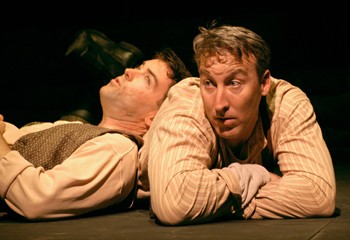
Extra, Extra: Dodds Delzell and Steven Abbott find no fit in ‘Stones in His Pockets.’

Dream Machine

‘Stones’ shows Hollywood from the extras’ side of the set

By David Templeton

‘I‘ll have the lemon meringue pie, please.”

With this conspicuously innocuous request, Belfast-born playwright Marie Jones kicks off her fast, funny and not-so-innocuous hit play Stones in His Pockets. In a smart new co-production by Actors Theatre and the Santa Rosa Players, directed by Sheri Lee Miller, every line of conversation reverberates with unspoken meaning, while desires and the pain of not having them realized, even when they dangle right before the eyes, lie in waiting behind a trailer door or sit in the sun on a lunch counter like a forbidden slice of lemon meringue pie.

A massive Hollywood production company has descended upon a tiny Irish village in County Kerry to film a lavish historical epic, allowing hundreds of local folks to take jobs as extras. To the residents, the arrival of Hollywood (to the same location where John Wayne’s The Quiet Man was filmed some fifty years before) represents several weeks’ work and decent money, but it also provides a bittersweet acceleration of the hopes and aspirations of several local dreamers, primarily the town’s resident would-be actor Jake Quinn (Dodds Delzell) and the recently bankrupt video-store owner Charlie Conlon (Steven Abbott), who meet as extras on the sprawling set of this Hollywood epic titled The Quiet Valley.

As is fitting for a play about unrealized dreams, nearly everything in Stones in His Pockets is imagined, conjured up onstage by the pantomime or shape-shifting of Abbott and Delzell, who frequently hop from playing Charlie and Jake to taking on several additional roles as the story flows along through a tangled knot of gently interweaving plots. Much of the show’s considerable entertainment value comes in watching this dynamic duo step in and out of all those characters, embodying everyone from a condescending English movie director to a pair of seasoned assistant directors to a brutish Scottish security man to a Julia Roberts-like superstar to an ancient codger whose only lingering achievement is his status as the last surviving extra from the days of The Quiet Man. With no more than a change of voice and a shift of body language, the actors bounce distinctly from character to character, unaided by costume changes.

Charlie Conlon is a hopeless schemer with even less charm than he thinks he has. Charlie has written a movie script he believes in, but, to his mounting frustration, he cannot get anyone with influence to take a look at it. He can’t even finagle that extra piece of pie, which comes to represent all the other things that have been denied him throughout his life.

The star-struck Jake Quinn, having recently returned from America where his acting ambitions were soundly thwarted, can barely believe his good fortune when the movie’s gorgeous star apparently takes an interest and invites him to her hotel room for a bit of help on her Irish accent. In the end, Jake’s already wounded dignity is further affronted, leading to a kind of consciousness-raising that spreads from one put-upon extra to the other. A concurrent plot line follows the effect a local suicide has on the strained relationship between the increasingly defiant locals and the exasperated movie people.

The set by Argo Thompson is stunningly simple: nothing more than a couple of chairs and a low, stone wall running across the otherwise bare stage. The wall is significant (and I beg Thompson and Miller’s forgiveness if I am reading too much into this), as it represents the division that seems to stand between those whose dreams are always being dashed to pieces and those whose dreams have come true with such ease they barely appreciate their own fortune.

Stones is not about Hollywood and the life of the movie-set extra any more than it is about Ireland or County Kerry; rather, it employs the Irish and Hollywood as metaphors in a probing, frequently funny examination of the way that our dreams can simultaneously help and hurt us. The ingenious script and staging are reason enough to buy a ticket, but this being a story of underappreciated actors, it is fitting to point out, that the two main reasons to see Stones in His Pockets are Delzell and Abbott, whose tour-de-force performances are sometimes hilarious, sometimes heartbreaking and never short of dazzling.

‘Stones in His Pockets’ runs through May 29 at the Sixth Street Playhouse. Friday-Saturday at 8pm; Sunday at 2pm. Special $10 matinee on Saturday, May 14, at 2pm. 52 W. Sixth St., Santa Rosa. $15-$22. 707.523.4185.

From the May 11-17, 2005 issue of the North Bay Bohemian.

© Metro Publishing Inc.

Swirl n’ Spit

0

Swirl n’ Spit
Tasting Room of the Week

Bacchus and Venus Tasting Room

By Heather Irwin

Lowdown: After a long week of driving around Italy, knowing neither the language nor how to interpret a map, we were desperate for a little bit of home. We found an “American” bar, an oddly romanticized mix of Hollywood, Levis and New York that felt as foreign to us as, well, Italy.

That’s sort of the same weird feeling I get when I visit wineries and tasting rooms that romanticize wine country as some sort of Tuscan paradise where wine flows through sunlit vineyards, all the women wear sheer sundresses and all the men are either burly farmworkers or tuxedoed waiters. Wine country is great and all, but huh?

The vibe: Located on the main tourist strip of Sausalito, Bacchus and Venus Tasting Room can hardly be blamed for trying. It’s a trendy little tasting room/art gallery that aims to bring wine country to tourists (and others) who don’t have time to make the exhausting trip north. Bacchus features wines from a pretty stellar collection of wineries, including Cakebread, Domaine Carneros, Etude, Caymus, Silver Oak and Rosenblum Cellars–these are some of the creamiest of the cream of the crop wineries.

Smartly outfitted with an undulating wood bar, big windows and a bay view to kill for, the wine shop offers various prearranged flights that currently range from the Spring Sampler ($9 for four tastes)–a sort of starter flight of several reds and whites–to more upscale reserve tastings ($25 for four), a Purely Red slate ($14 for four) and a slate of dessert wines ($25 for four). Very lovely.

The staff are very friendly and helpful, aiming to inform and educate tasters who are often more curious than savvy. It’s a nifty idea, bringing tasting rooms south to harried tourists, at least exposing folks to some very lovely pours while looking at the pervasive art shops. As I scraped mud off my shoes, I had to wonder if drinking some of the most premium wines in wine country is necessarily a good primer for what the region is really about. Then again, I’m just a local.

Spot: Bacchus and Venus Tasting Room and Art Gallery, 769 Bridgeway, Sausalito. 415.331.2001.

Huh?: Is Sauvignon Blanc disappearing? Recently I’ve started hearing rumors that Sauvignon Blanc in California is a dying trend. A few local wineries have plans to or have already stopped production on the their bottling of this wonderful varietal. Sad news, indeed. Because when Sauvignon Blanc is good, it is so very, very good. Perhaps the Froot Loops-like quality of some vintages (so tropically fruity, it hurts your teeth!) may be contributing to its mixed reviews.

From the May 11-17, 2005 issue of the North Bay Bohemian.

© Metro Publishing Inc.

‘Sculpture Sonoma’

0

Photographs by Michael Amsler

World on a String: Dr. Walter Byck and Marijke Byck-Hoenselaars beneath Cloverdale sculptor Dale Hawley’s ‘spirosphere.’

Form to Movement

Paradise Ridge’s ‘Spectrum’ exhibit launches ‘Sculpture Sonoma’

By Gretchen Giles

For the past decade, the outdoor sculpture grove at Paradise Ridge winery has presented a blank, albeit green, slate for the experimental, the conceptual, the just plain odd and the traditional. There was the year, for example, when nine fire-engine-red beds ran in a purposeful line through the treetops, swaying over the visitor’s head to represent a river bed of the firmament (“Domestic Nature,” 1997).

The pottery show curated by Guerneville artist Harley (“New Ceramic Horizons,” 2002) brought top names from the international clay world out to Paradise’s ridgetop to set biomorphic forms, towering figures and impermeable objects out to weather in a year’s worth of rain and sun. Cazadero sculptor Bruce Johnson both inaugurated the sculpture garden with its first show in 1995 and again filled the winery’s four-acre pygmy forest in 2000 with his old-growth redwood and copper structures.

In another exhibition, artists piped water in to keep moss-covered rocks on the arid hillside strangely, perpetually green, and built a conceptual triangle whose geometry could only be parsed with a keen eye while standing at an exact location and believing in the weight of the air. Such persnickety demands were rewarded when the ephemeral form was finally, breathtakingly, glimpsed (“The Secrets of Nature,” 1998). And married Santa Rosa light sculptors Michael Hayden and Kristina Lucas were among those who played with refraction and out-of-doors perception in 1999’s “Arborescence” exhibit.

What each year-long installation has had in common is that whether traditional, odd, conceptual or experimental, every object in each exhibit has been sculptural.

Walking the site on a recent foggy morning as the grounds are being readied for a new installation to open May 15, Parade Ridge co-owner Dr. Walter Byck chuckles easily. “I remember them all, of course,” he says, nodding to the leafy stand where the beds once ran through the trees and then turns to look back at where Lucas’ shimmering curtain of reflective squares once showered from limbs to the ground.

A decade-long labor of love tended to by vintner Byck and his wife Marijke Byck-Hoenselaars, the Paradise Ridge Sculpture Grove is finally extending its influence beyond the blonde hills of its Fountaingrove home. As reported before in these pages (“Byck’s Miracle,” March 2), the Bycks have done something that no one else has been able to accomplish among an often disparate and sometimes vying artistic community: they have brought it together for an ambitious summer-long project titled “Sculpture Sonoma.”

Involving some 12 Sonoma County arts organizations and 17 separate events in a sprawl of celebration–beginning with a Paradise Ridge Sculpture Grove exhibit titled “Spectrum”–“Sculpture Sonoma” was conceived to be by artists, for artists. Byck and his wife asked more than 120 local sculptors to name those North Bay artists who most influenced them and whose work they most admired. From that list came the slate of professionals gathered in the “Spectrum” show, with the others fanning out to various venues throughout the county. “Rather than let a curator decide, I let the artists decide,” Byck says.

On this misty spring morning, with only a week before “Spectrum” is to launch, Dr. Byck is characteristically calm. A tower of firewood stacked exactly from the ground straight into the snugness of a tree’s joint and handmade stone walls from previous exhibitions have been left in place as this “gallery” of acreage continues to be changed by forces both human and natural.

While some 23 pieces will be placed over the coming week, a few of the “Spectrum” pieces have already arrived, Cloverdale artist Joe Hawley is stringing what he calls a “spirosphere” from a long tree limb, where it floats freely in the air. Explaining that the sphere is made from the same light material as a surfboard, Hawley tugs the ball into place. The Bycks gamely stand beneath it, smiling upward.

In the eastern corner of the Grove, a massive steel dragon delicately twists on its pivot in the wind. A human-sized aperture hung with fluttering metal tiles made by physics master Ned Kahn was carelessly placed by a tree awaiting installation when Kahn realized that his art had found its perfect home, the tiles flirting nicely with the wind and framed by an oak. Clay sculptor Daniel Oberti’s planetary sundial moves on a whisper of a touch.

Byck is clearly in his element. He’s helping to indulge his good friend Bruce Johnson in his long-held desire to hold a sculpture “tail-gate party” (art on trucks) last this summer; he’s prodded and cajoled and charmed 12 arts organizations into cooperation under the auspices of the Cultural Arts Council; and 23 of his best friends are about to install work that he and the public can enjoy with relish for the next full year. “These are the rules,” he says. “You really have to work for the artist. That,” he shrugs, “is it.”

The ‘Spectrum’ exhibit opens on Sunday, May 15, with a reception from 1 to 4pm. Paradise Ridge Winery, 4545 Thomas Lake Harris Road, Santa Rosa. Free. 707.528.9463.

Tractor Factor: Patrick Amiot’s whimsy will of course be showcased.

Suddenly Sculpture

The lure of the three-dimensional will be almost impossible to escape this summer, not to mention the 50 images of that round-headed kid placed everywhere. Charlie Brown aside, here is a short list of what to look forward as “Sculpture Sonoma” unfolds:

June 2. “Mark Di Suvero.” Sonoma Valley Museum of Art, 551 Broadway Ave., Sonoma. 707.939.7862.
June 4. “Cloverdale Annual Juried Sculpture Exhibit.” Cloverdale Plaza, downtown. 707.894.1778.
July 8. “Reflections of an Infinite Crystal Wind: Charles Churchill” and “Rambling Modes: Monty Monty.” Finley Community Center, 2060 W. College Ave., Santa Rosa. 707.543.3737.
July 8. “Destinations: Showcase of All Venues.” Arts Council of Sonoma County, 529 Fifth St., Santa Rosa. 707.579.2787.
July 23. “Carol Setterlund,” one-person show. Sonoma County Museum, 425 Seventh St., Santa Rosa. 707.579.1500.
July 24. “Spectrum,” second section, indoor installation in champagne cellar. Paradise Ridge Winery.
Aug. 5. Outdoor exhibit. Museum of Contemporary Art, LBC, 50 Mark West Springs Road, Santa Rosa. 707.527.7006.
Aug. 6. “SMAK: Warren Arnold.” Charles M. Schulz Museum, 2301 Hardies Lane, Santa Rosa. 707.579.4452.
Aug. 15. Work by Cynthia Hipkiss and Mary Fuller McChesny. Mahoney Library, SRJC Petaluma campus. 680 Sonoma Mountain Parkway. 707.778.3974.
Aug. 18. “Concepts & Process,” Santa Rosa Junior College Gallery, 1501 Mendocino Ave., Santa Rosa. 707.527.4011.
Aug. 20. Ned Kahn’s “Digitalized Field” dedication block party and artist’s tailgate. Santa Rosa Courthouse Square.
Aug. 25. “Born of Fire Juried Exhibit.” Sebastopol Center for the Arts, 6780 Depot St., Sebastopol. 707.828.4797.
Sept. 8. “Indoor Sculpture Show.” University Art Gallery, SSU, 1801 E. Cotati Ave., Rohnert Park. 707.664.2295.
Sept. 9. Work by Aileen Cormack and 3D Edddy, Finley Community Center.Oct. 1­2. “Sculpture Jam.” Sebastopol Center for the Arts.

–G.G.

From the May 11-17, 2005 issue of the North Bay Bohemian.

© Metro Publishing Inc.

First Bite

First Bite

Dry Creek Kitchen

By R. V. Scheide

Editor’s note: First Bite is a new concept in restaurant writing. We invite you to come along with our writers as they–informed, intelligent eaters like yourselves–have a simple meal at an area restaurant, just like you do. This is not a go-three-times, try-everything-on-the-menu report; rather, this is a quick snapshot of a single experience.

To dine out alone is to become an object of suspicion: Why is he alone? Is he difficult? Has someone stood him up? The waitstaff at Dry Creek Kitchen proved no exception to this rule, and truth be told, they did seem genuinely concerned about my arrival sans date, who’d canceled on me at the last minute.

“You can join us here at the bar,” one waiter hopefully suggested. Instead, I opted for a two-seat table out in the middle of the decidedly empty restaurant’s dining area. Beautiful place, the Dry Creek Kitchen: vaulted ceilings supported by elegant arches; bare branches and boughs arranged in vases creating a rustic feel; and expansive windows overlooking the plaza park, with Fitch Mountain in the distance.

In my singular state, chef Charlie Palmer’s tasting menu fairly leapt off the page at me: six mini courses, including a choice of desert, designed to showcase Dry Creek’s emphasis on local ingredients, for the paltry sum of $69.

I say “paltry” because previous experiences here have taught me that among the area’s haute cuisine establishments, the quality and price of Dry Creek Kitchen’s fare represents a relative bargain.

The tasting menu did not dissuade me of this notion. First up were tiny Hog Island oysters, sharing their half-shells with a dollop of icy brut rosé sorbet and sprinkled with black caviar. The oysters dissolved in the mouth instantly, the sorbet melting more slowly and cleansing the palate for the next course, a langoustine cappuccino with beignets–rock lobster bisque served in an espresso cup with two battered and deep-fried lobster nuggets. Like all of the courses, this was plated in style, nuggets and cup on one side of an enormous square platter balanced by three tiny drops of condiment on the other.

Balance was also the order of the evening for duo of pork, a baby’s fist-sized cylinder of pork tenderloin wrapped with oh-my-that’s-salty! Hobbs bacon and topped with a bitterly scrumptious ramp (wild leek) dumpling, matched up with two clear, gelatinous, melt-in-your-mouth fingers of slow-cooked pork belly drizzled with tangy tomato marmalade.

The competition for best course ended in a tie. Pan-roasted Bodega halibut–fresh, flaky and tender–served with crisp-on-the-outside, eggy-on-the-inside cubes of polenta and sweet caramelized watermelon cubes, which had been a previous favorite, were rendered with even more gusto on this occasion; however, veal sweetbreads, with a tender, crumbly texture akin to calf brain, served atop a lusty fennel puree, were equally mesmerizing.

For dessert, I selected a rhubarb sampler that included a sweet, slightly tart creamed rhubarb sorbet and a strawberry rhubarb beignet that reminded me of the pies Mom made when I was a kid. I found myself pining to share this childhood memory with a companion, but, alas, still alone, had to settle for the waiter, who didn’t seem to mind in the slightest.

Dry Creek Kitchen, 317 Healdsburg Ave., Healdsburg. Open for lunch and dinner Thursday-Tuesday; closed Wednesday. 707.431.0330.

From the May 11-17, 2005 issue of the North Bay Bohemian.

© Metro Publishing Inc.

‘The NorCal Compilation 2005’

0

Agent Indie

NorCal comp thrives on organized chaos

By Jeff Latta

Listening to 22-year-old Agent Records CEO Aaron Wadler outline his daily routine might make the heads of his peers hurt worse than a night of finals cramming. A day typically “begins with responding to business e-mails,” Wadler says, “then I print out the day’s merchandise orders, go to class, work at my other job as an events programmer at Sonoma State University for a while, package the day’s orders, return some phone calls for the label, go to the post office to mail the orders and then–finally–do some homework.”

Most college students are lucky to get that much done in a month, unless drinking malt liquor is considered a productive activity. But Wadler and his intrepid crew, which includes co-owner Jeff Fasulkey, PR rep Lindsey Suda and girlfriend/day-to-day operations sidekick Annette Powell–the latter two also college students–seem to handle all this business just fine.

The history of Agent Records is as surprising as its young owner’s lifestyle. Aaron Wadler was quite the tech-savvy individual in high school. By his sophomore year, for example, he had developed a system of code allowing the then burgeoning Linux operating system to be used on Palm Pilots and other such devices. A semi-tongue-in-cheek appearance at that year’s LinuxWorld Conference and Expo led to several offers from technology bigwigs to buy the code. Sell it he did, and the resulting profits became the startup capital for Agent Records, which Wadler founded in 2002.

The label’s first release was The NorCal Compilation 2003. Featuring 15 tracks by such bands as the Muckruckers, Drowning Adam, and the Slicks, the album sold almost a thousand copies, partly through positive word of mouth alone. The next year’s comp sold around 2,500. The label has also released several EPs and full-length albums from select Bay Area artists.

One might think that all this achievement would go to Wadler’s head, but the reality couldn’t be further from the truth. He’s humble when discussing the label, gushing about the time he got to be interviewed for San Francisco’s LIVE 105 radio station and even sounding starstruck when talking about ditching a week of classes to attend Austin’s annual South by Southwest music convention (“I got to hang out with Elijah Wood!”). Wadler’s solid work ethic and decidedly noninflated ego will serve this mogul-in-training well in the coming months; with last week’s release of The NorCal Compilation 2005, his label looks poised to break through bigger than ever before.

This year’s entertaining compilation sticks to the tried-and-true formula of past releases, featuring homegrown bands, and lots of them. Busting out with a whopping 22 tracks over 71 minutes, and with a bevy of energy and catchy melodies to spare, the new CD emphasizes straight-ahead rock and punk on just over half the release. But that doesn’t mean that several truly original artists don’t manage to finagle their way onto the compilation. Highlights of the experimental variety include the space rockabilly of the Phenomenauts (“Tiny Robots”) and the frightening postpunk laptop rap of MC Lars (“Stat-60”).

Some might say the disc borders on the exhaustive; the dominating presence of pop-punk throughout the CD could fall under the dreaded description “repetitive” for those who aren’t the biggest fans of the genre that Green Day made famous. But the NorCal comp is just what it aspires to be: a spirited snapshot of the local music scene, warts and all. If those warts include an overrun of cookie-cutter (yet admittedly lively) punk-rock blasts, then so be it; sometimes the truth hurts. And sometimes the truth raps about math equations or plays rockabilly from beyond the moon.

Though only a handful of the bands featured have an official album to their name, none of the tracks come off as anything less than high quality. This shouldn’t be too surprising, considering that some of the bands sport former members of such experienced heavy hitters as Tsunami Bomb, 26 MPH and American Steel. Available at most independent record stores throughout the Bay Area, as well as online at www.agentrecords.com, this jam-packed CD is a great way to support the local music scene, not to mention help keep madman Aaron Wadler as busy as he wants to be.

But with an upcoming EP from the Wildlife to release and promote, and a sponsorship gig with the Verge Showdown battle of the bands on tap for the summer, finding something to do shouldn’t be too hard for Wadler and the little record label that could.

The Wildlife play Sonoma State University on Thursday, May 12, at noon. Stevenson Quad, SSU, 1801 E. Cotati Ave., Rohnert Park. Free. 707.664.3363.

From the May 11-17, 2005 issue of the North Bay Bohemian.

© Metro Publishing Inc.

Briefs

0

Briefs

Uno vs. Cinco

After Santa Rosa’s Cinco de Mayo celebration deteriorated into what’s become an annual debacle pitting young Latinos against local law-enforcement officials, the Bohemian received calls from several irate Roseland residents wondering what remedies city officials have proposed besides merely beefing up police department overtime budgets. Plenty, says Santa Rosa mayor Jane Bender. “There was a huge celebration at the Finley Center the previous Sunday [May 1],” Bender said. “It was quite successful.” Indeed, 4,000 people attended the Finley Center event, according to planning committee member Gail Chavez, who’s worked on the event since its inception three years ago as an alcohol-free, family-orientated alternative to the boozy, occasionally violent and totally unorganized Cinco de Mayo celebrations that have plagued the city since 2001. Chavez said this year’s event at Finley had nearly doubled the attendance of last year’s. So, if Uno de Mayo was so successful, why yet another Cinco de Mayo clash this year? Chavez points the finger at the alcohol industry, and sent the Bohemian a brochure critical of the industry’s effort to market alcohol to Latinos via the holiday. “Linking Cinco de Mayo with alcohol sends a dangerous message to children and youth who learn little about Mexican and Latino heritage in schools,” the brochure states. “Instead, advertisements teach youth that an essential part of Latino culture and identity is to consume and abuse alcohol.”

Killer Notes

The amateur cyber sleuths at ZodiacKiller.com ( Bohemian, Dec. 15, 2004) have been hot on the trail of another notorious serial killer, BTK (“bind, torture, kill”). The prime suspect, Dennis Rader, is accused of committing 10 homicides in the Wichita, Kan., area between 1974 and 1991. Webmaster Tom Voigt was already on the case at CatchBTK.com when Rader was arrested in February; since then, North Bay residents Ed Neil and Angela Avey have been assisting Voigt in the search for clues linking Rader to the crimes. To that end, Avey recently wrote Rader, currently awaiting trial in a Wichita jail cell, in order to acquire a sample of his handwriting. To her surprise, Rader wrote back a four-page letter detailing his day-to-day activities in jail and featuring some creepy poetry reminiscent of the verse the alleged murderer sent to media outlets after each crime. The letter, the first communication to the public from Rader since his arrest, made the nightly news broadcast on Wichita’s KAKE TV-10 last week. “It was freaky, that’s for sure,” says Avey. “I was shaking really bad when I opened it. I didn’t expect him to write back.”

From the May 11-17, 2005 issue of the North Bay Bohemian.

© Metro Publishing Inc.

Alternative Hip-Hop

0


Fear of a Black Plangent: Busdriver’s newest points to complex identity issues and self-doubt.

Hip to Alt-hop

The mess around sound of self-definition

By Karl Byrn

This is not another article about underground and indie hip-hop; however, it is a review of three unusual recent hip-hop releases, so I’m kind of obligated to talk about, you know, alternative hip-hop. Alt-hop? Yawn, zzzzzz. Conscious rap with a positive political message vs. gangsta mean and materialism bling? Yawn, yawn, zzzzzzzzz. Underground jazz poets and abstract DJ wizards vs. generic major-label teen hits? Yawn, yawn, yawn, zzzzzzzzzzzz.

You can get somewhere with alternative hip-hop when you just hear it as hip-hop. Hip-hop has an essence, like the essence of jazz (improvisation) or the essence of rock ‘n’ roll (a driving quest for freedom). Let’s say the essence of hip-hop is spontaneous self-definition and reinvention. It’s about opening a palette from which one depicts a new self by reassembling the past. Jazz finds its essence in pure music, and rock finds its essence in populist stance-taking. Hip-hop finds its essence in a very modern recording space, where rhythm and sonic collage collide with identity.

Three recent discs run right over any boring separation of the popular and the authentic to simply fulfill hip-hop’s essential destiny to mess around with sound while making yourself profound.

Busdriver, ‘Fear of a Black Tangent’ (Mush) Busdriver is almost close to “normal” hip-hop, but he strives to be an oddball. On his third disc, Fear of a Black Tangent, this So-Cal MC sets his rhyme-o-meter in overdrive while resurrecting Frank Zappa, rapping with the rapid precision of a bebop saxophonist to grooves that are beat-based but all over the map. Formally, it’s basic beat-and-loop pop, but amidst the wackiness, there’s no sonic center other than Busdriver’s witty hyperactivity. His flow is elastic, and he raps so fast that you can often hear him inhale between verses.

His ironic, nerdy twist on Public Enemy’s planetary album title isn’t merely the beginning; rather, it points to complex identity issues and self-doubt. Busdriver feels torn over his lack of music-business success. He’s envious, but that won’t stop him from violating hip-hop’s playbook with tricks like sampling Joan Baez. “Why did I choose to do weird shit / I steered my career off a cliff in a flaming stunt car” he laments on one track, while sarcastically noting on another cut that “most likely I’ll sell more records in France.”

Busdriver’s outsider’s stance is amusing yet also confusing. But he finally makes it clear on “Lefty’s Lament” that he’s really against narrow-mindedness, mocking the standard warm and fuzzy sensitive-rap finale and casting the terms “underground” and “fascist” as limiting epithets alongside “towel-head” and “dirty hippie.”

Dälek, ‘Absence’ (Ipecac) Sounding different doesn’t necessarily mean your identity is strong. New York political rapper Dälek gets points for fearlessness; his MC/DJ/turntablist trio push the envelope on both of their potential audiences, irritating conscious hip-hoppers with their rock excess and confusing aggro-funk rockers with their riffless squall. Their new disc, Absence, fittingly recorded for rock extremist Mike Patton’s experimental label Ipecac, aims to sound like polemicist rapper Chuck D preaching over the layered guitar distortion of the band My Bloody Valentine, with song titles like “Asylum (Permanent Underclass)” and “Culture for Dollars” that imply the righteous topicality of Rage Against the Machine.

But however seemingly radical, Dälek plays with obvious stereotypes, settling for the assumption that industrial noise and well-trodden attacks on the status quo are a challenge. And Dälek’s flow is as uneventful and droning as the squall; if Busdriver raps like a bebop saxophonist, Dälek raps like a rock drummer who can only play in 4/4 time.

Buck 65, ‘This Right Here Is Buck 65’ (V2/Warner) Buck 65 may build his tracks with twangy rawhide and pedal-steel guitar, but he’s the real hip-hop deal. He’s comfortable knowing that being white and Canadian gives him zero street cred; in fact, it’s an authenticity that he carves like a piece of wood, and a funkiness pops out of his self-acceptance. If it sounds like his all-time favorite song is Kid Rock’s “Cowboy,” he’s really more of a peer, as his second domestic release This Right Here collects new cuts with indie import tracks dating back to 1998. And unlike Kid Rock, Buck 65 is content being a regular Joe.

Buck likes to remind listeners that he’s a hick, coloring his rhymes with words like “horses,” “old yellow dogs” and “ghost town,” never rushing his gravelly voice, boasting that he’s “got a little Johnny Cash in the old tape deck.” But he’s never a redneck, as his keen sympathetic storytelling skills reveal on portraits like “Cries a Girl” and the sad-dad tale “Roses and Bluejays.”

He even covers a Woody Guthrie song, “Talking Fishing Blues,” that sounds plain and folksy even in its shuffling ambiance. Is that hip-hop? It is reinvention and self-definition, and it is an accessible alternative. Whether hick, hip or hit, Buck 65 has the genuine disregard of hipster expectations that Busdriver and Dälek crave. “We need new inventions / That reveal people’s true intentions,” he muses, knowing that hip-hop’s openness is that very device.

From the May 11-17, 2005 issue of the North Bay Bohemian.

© Metro Publishing Inc.

Forbidden Fromage

Forbidden FromageThe raw and the cooked--lusting for illegal cheeseBy Ella LawrenceWhen I was in junior college, my friends and I had dinner parties for fun. The dining room table would inevitably be covered with chips and salsa. Bowls of chips would rest on the arms of the couch; jars of salsa would be passed hand-to-hand. Occasionally, a daring gourmand...

The Byrne Report

The Byrne ReportWar on Vitamins DOWN THE STREET from Santa Rosa Memorial Hospital there is a small pharmacy called Farmacopia. It is not the kind of drug store where you go to buy Sudafed or Tylenol or Trojans. No, people visit Farmacopia because they have been diagnosed with cancer or heart problems or brain disease.Farmacopia is owned and operated...

‘Towelhead’

Girl Next Door: Author Alicia Erian's debut novel travels in a dark neighborhood of the soul. Bitter FlowerLove, sex, abuse--growing up a 'Towelhead' By John DickerSomewhere around page 75 of Alicia Erian's first novel, Towelhead, it hits you: this book has a lot of sex. But not the good kind of sex. Erian isn't your average peddler of Nerve.com-style...

‘Stones in His Pockets’

Extra, Extra: Dodds Delzell and Steven Abbott find no fit in 'Stones in His Pockets.'Dream Machine'Stones' shows Hollywood from the extras' side of the setBy David Templeton'I'll have the lemon meringue pie, please."With this conspicuously innocuous request, Belfast-born playwright Marie Jones kicks off her fast, funny and not-so-innocuous hit play Stones in His Pockets. In a smart new co-production...

Swirl n’ Spit

Swirl n' SpitTasting Room of the WeekBacchus and Venus Tasting RoomBy Heather IrwinLowdown: After a long week of driving around Italy, knowing neither the language nor how to interpret a map, we were desperate for a little bit of home. We found an "American" bar, an oddly romanticized mix of Hollywood, Levis and New York that felt as foreign...

‘Sculpture Sonoma’

Photographs by Michael AmslerWorld on a String: Dr. Walter Byck and Marijke Byck-Hoenselaars beneath Cloverdale sculptor Dale Hawley's 'spirosphere.'Form to Movement Paradise Ridge's 'Spectrum' exhibit launches 'Sculpture Sonoma'By Gretchen GilesFor the past decade, the outdoor sculpture grove at Paradise Ridge winery has presented a blank, albeit green, slate for the experimental, the conceptual, the just plain odd and the...

First Bite

First BiteDry Creek KitchenBy R. V. ScheideEditor's note: First Bite is a new concept in restaurant writing. We invite you to come along with our writers as they--informed, intelligent eaters like yourselves--have a simple meal at an area restaurant, just like you do. This is not a go-three-times, try-everything-on-the-menu report; rather, this is a quick snapshot of a single...

‘The NorCal Compilation 2005’

Agent Indie NorCal comp thrives on organized chaosBy Jeff LattaListening to 22-year-old Agent Records CEO Aaron Wadler outline his daily routine might make the heads of his peers hurt worse than a night of finals cramming. A day typically "begins with responding to business e-mails," Wadler says, "then I print out the day's merchandise orders, go to class, work...

Briefs

BriefsUno vs. CincoAfter Santa Rosa's Cinco de Mayo celebration deteriorated into what's become an annual debacle pitting young Latinos against local law-enforcement officials, the Bohemian received calls from several irate Roseland residents wondering what remedies city officials have proposed besides merely beefing up police department overtime budgets. Plenty, says Santa Rosa mayor Jane Bender. "There was a huge celebration...

Alternative Hip-Hop

Fear of a Black Plangent: Busdriver's newest points to complex identity issues and self-doubt. Hip to Alt-hopThe mess around sound of self-definitionBy Karl ByrnThis is not another article about underground and indie hip-hop; however, it is a review of three unusual recent hip-hop releases, so I'm kind of obligated to talk about, you know, alternative hip-hop. Alt-hop? Yawn, zzzzzz....
11,084FansLike
4,606FollowersFollow
6,928FollowersFollow