Before I Get Old

0

June 13-19, 2007

Rock music is full of age-based myths. First, there’s the limited notion that rock culture equals youth culture. Rock’s origins and its ongoing energy are dependent on what Neko Case calls “that teenage feeling,” but decades of creative output have shown that rock is more far-reaching and complex. The model of veterans growing old gracefully is also inaccurate. Records made by seminal figures late in their careers may or may not be centered, renewable founts of wisdom.

Rock further suffers from the cliché that “they don’t make ’em like they used to.” Every generation repeats this vile idea with disdain for what’s current. It’s certifiably true that we respond more powerfully to the music we loved in high school, but it’s never true that new eras of music are uneventful.

One recent rock event is the return of Mary Weiss, lead singer of the Shangri-Las, the iconic ’60s girl group known for teen-drama hits like “Leader of the Pack” and “Remember (Walkin’ in the Sand).” Weiss is 58 and hasn’t recorded in 40 years, and her new release Dangerous Game chops down a forest of age myths. Much of the appeal is that Weiss is a sleek, sexy older woman who time-travels back to the exact golden sound and feel of the Shangri-Las. Her backup band, the notable Memphis neo-garage act Reigning Sound, hit nuances of mid-’60s NYC rock spot-on, down to details like castanets, carnival organs and slightly out-of-tune guitars.

Gone is the teen hyperbole–there are no “vroom-vroom” motorcycle sound effects or life-and-death parental confrontations. Instead, a new song like “Stitch in Time” is a mature triumph of plainspoken innocence that’s guiltless and drama-free. The Shangri-Las’ naïveté was a thin veil for heavy layers of remorse and dread, and similarly, Weiss’ new material (largely written by Reigning Sound’s Greg Cartwright) is deceptively simple.

Weiss’ fusion of the aged and ageless seems seamless, but “Cry About the Radio” almost makes the difference seem as wide as the Grand Canyon. In a genuinely sensitive tone, Weiss bemoans that “Kids don’t know shit / They just want a hit / I don’t write hits.” When the song later notes that “music’s got no place to go,” Weiss and Cartwright–without hating the iPod generation–naively miss the fact that music is, of course, going so many more places than their beloved old-school radio.

If Weiss’ Dangerous Game finds age-based myths imploding, Ian Hunter’s Shrunken Heads leans on age clichés for steadiness. Hunter was the leader of ’70s glam-rock band Mott the Hoople, and he’s since had a hit-and-miss long-haul solo career. His new work purposefully plays the wise elder card, with reflective finger-pointing that’s buoyed by comfy post-Dylan roller-rink rock. There’s vague nostalgia on “When the World Was Round” and more detailed, carefree disregard on “I Am What I Hated When I Was Young.”

Shrunken Heads is reliable veteran blues-rock, but Hunter sometimes feigns wisdom–or edginess–to avoid his own uncertainty and resignation. “Soul of America” wraps a plea for leadership into an antiwar Everyman celebration, but also descends into cheap support-the-troops-and-party sentiments. On the driving “Fuss About Nothin’,” it isn’t clear whether the lyric “If it’s left to the left, there won’t be nothing left” is part of the mock-Bush tone or Hunter’s own doubt about the good guys.

Hunter complains about FEMA, war and designer clothes, but that’s no sign of seasoned maturity. His great talent for self-effacement seems lost between grasps at both roughness and grace. If anything, the common theme of his new material is questioning authority, an admirable trait that’s both juvenile and predictable.

Weiss and Hunter aren’t alone among this season’s re-emerging veterans; the Stooges, Graham Parker and Dinosaur Jr. have new works that can’t shake age clichés. How they face age can make rock’s age myths real. Weiss acts like age doesn’t matter, while Hunter insists that age matters most. If Hunter can neither be vigorous nor sagelike, at least Weiss is comfortable and guileless enough to still make ’em like she used to.


Arctic Adventures

0

music & nightlife |

By Gabe Meline

It’s easy to forget that there’s music even happening at this weekend’s Ice Flo event, what with all the painstaking detail to which the organizers have gone to ensure that the night is as beautifully bizarre as an evening at Burning Man. Along with an outdoor cabaret stage showcasing circus acts and a tribal fire collective, there’s the promise of wandering Burleskimos, old-fashioned cigarette girls dressed in “furkinis.” Add to the mix art displays, massage tables and the Amrita Bollywood Dancers, and you’re looking at a night to remember any way you slice it.

But wait! There’s also the seductive ukelele undulations of soul singer Rose Harting, the deconstructive consciousness-marauding of Pumps:Fire and the organizers of the event, Baby Seal Club. If Belle and Sebastian had hung out in more graveyards, they’d be writing songs like “Tethered to My Wrist,” a wryly pensive folk lamentation with shared harmonies by Baby Seal Club’s El Fudo and Choklit Chanteuse, and it’s fitting that the band close the show; last year, says BSC’s cocktail drummer Stache, Baby Seal Club were one of only a handful of live bands at Burning Man. To properly compete with the overabundance of DJs, the band had to perform on top of a pirate bus, driving around the Playa, until a sandstorm ultimately ruined their equipment.

This year, the band aim to build a large traveling blue ice stage–more securely shielded by the elements–on the back of a flatbed truck, and all funds raised by Ice Flo go toward this grand aim. Whether you care about Burning Man or not, it’s sure to be a night you can regale your dad with the next morning when you groggily take him out to Father’s Day breakfast.

Ice Flo goes down on Saturday, June 16, at the Sebastopol Brewing Company. 268 Petaluma Ave, Sebastopol. 8pm to 2am. $10; arctic attire recommended. 707.823.7837.


FIND A MUSIC REVIEW

The Byrne Report

June 13-19, 2007

Last month, dozens of white scribes employed by the white-owned media wrote thousands of paragraphs of whitewash about our white president, George Bush II, who wore white formal wear to a White House reception for the Goddess of All That Is White: Queen Elizabeth II, the wicked witch who killed the good white witch, Princess Diana, figuratively, if not literally, but probably the latter since the martyred Di was banging a black man.

Days later, we were treated to an onslaught of white noise about a White House meeting between lame duck British prime minister Tony Blair and the psychopathic Bush–the lying, hydrogen bomb-armed architects of Armageddon in the Middle East, North Africa and beyond. The Oxford English Dictionary defines “psychopathy” as “a state characterized by persistent egocentric, irresponsible and antisocial or aggressive behavior and an inability to form normal relationships with others.” Sound familiar?

There is, however, one person upon whom the presidential psychopath has bestowed personal intimacy. According to a May 18 New York Times puff piece headlined “Odd Couple Formed Bond in Response to Terror Attacks,” the two leaders of the white world were asked what they had in common: “‘Well, we both use Colgate toothpaste,’ Bush said wryly, prompting Blair to interject, ‘They’re going to wonder how you know that, George.'” While it is not surprising that the toothy duo use the same brand of sugary tooth-whitener, it takes genuine white-boy balls to pass off corporate product placement as diplomatic banter.

The Times gushed: “There were gifts in private as well. The president and the prime minister shared an intimate dinner in the White House residence . . . just the two of them, dining on she-crab soup and Wagyu beef, without spouses or aides,” after which Blair slept in the Queen’s Bedroom.

Last week, the Bohemian received a CD in the mail postmarked “Langley, Virginia.” It is a recording of the dinner with Bush and Blair. Here are some highlights:

“God, George, this she-crab is divine. But not as tasty as he-crab, if you get my drift.”

“Later for that, Tony. We have to talk about your new career in advertising.”

“OK, George, but please pass the Wagyu beef. It is so piquant and chewy, kind of like a meat cigar.”

“Ha, ha. More Parks Sausages, Mom!”

“Good to the last drop!”

“Pop, pop, fizz, fizz, oh what a relief it is!”

“Do I get the Queen’s boudoir this time, George–or the Oval Office rug?”

“Boudoir, babe. Hey, do you really use Colgate?”

“Did Saddam really have weapons of mass destruction? Ha, ha.”

“Good one, Tony.”

“Hey, George, when are you going to nuke al Jazeera?”

“After I get crowned. Check it out: the stupes actually think there is going to be another election!”

“I’m ready, George. Put me on the right hand of your throne.”

“You picked the right team, Tony. After I get through dealing with evil anti-me traitors like Hillary Clinton, John McCain, Arianna Huffington and Peter Byrne, Guantanamo Bay will seem like Club Med.”

“You know, George, your dad made my mate, former prime minister John Major, a partner in the Carlyle Group. Johnny says he finally made his bundle, and he is very grateful and he asked to be remembered to you.”

“I guess Dad made him an offer he couldn’t refuse.”

“Yes, George, just like you did with me. Uh, so what’s it gonna be? A posh pad on Park Avenue with a no-show job at Goldman Sachs? President of the World Bank? That would be cool, ripping off the wogs and calling it charity. Maybe I could be on the board of ExxonMobil, what say George? I adore oil.”

“You fucked the pooch on that one, Tony.”

“What do mean, George? I stood by ExxonMobil when we took over the Middle East and made their day.”

“The global warming thing, Tony.”

“Come on, George. You know as well as I do that the planet is heating up like a furnace, and if we do not do something about it megaquick, all life on earth is doomed.”

“Stuff it, Tony. Do you think for one second that I give a fig about ‘all life on earth’?”

“Well, now that you mention it, George, you never were a sentimentalist.”

“There is only one thing I really care about, Tony. And it is not you, not Dad, not ExxonMobil and not global warming.”

“What is it, George? Have you finally found love?”

“Yeah, but I don’t know how to break it to Laura. I suppose she will have to disappear, like the girls did.”

“Who is it, George? I won’t tell a soul!”

“Dianne Feinstein.”

“A match made in heaven, dear boy. Pass the gold toothpicks.”

or


News Briefs

June 13-19, 2007

No changes yet

Students at Redwood Middle School in Napa finished classes June 8 still following a dress code that dictates a limited range of colors–white, yellow, green, blue, brown, khaki, black and gray–and only three fabrics; cotton twill, corduroy or chino. As reported earlier in these pages ( May 2), the ACLU and a private law firm challenged the dress code this spring on behalf of six students from five families, saying they should be allowed to “opt out” of what amounts to a school uniform. With school district lawyers arguing that overturning the dress code would seriously weaken the school’s authority, a judge took into consideration a motion for a preliminary injunction to stop enforcement of the dress code, but didn’t rule before classes ended. “We’re waiting for a ruling,” says private attorney Sharon O’Grady. “School starts again in a couple of months, so the issue’s not over yet.”

Needles as carrots

Sonoma County currently only has one needle-exchange program, but more are due to be established thanks to a state contract giving the Drug Abuse Alternatives Center (DAAC) $75,000 annually for the next three years, starting Sept. 1. Under state law, the money can’t be used to pay for needles; rather, the funds will support expansion of the program and such services provided through the needle exchange program as free HIV and hepatitis C testing, infectious disease and drug use education and counseling and treatment referrals if appropriate, explains DAAC executive director Michael Spielman. He adds that for some addicts, the disease-fighting syringe exchange is their first contact on the road to recovery. “It’s the carrot approach rather than the stick approach.” DAAC was one of the top 10 agencies selected to receive the money out of 29 applicants statewide.

Cleaning tomales bay

This summer and fall, officials at Point Reyes National Seashore will be watching to see if keeping livestock away from creeks and springs, repairing ranch roads and stabilizing gullies can help clean up Tomales Bay. The goal is to evaluate the effectiveness of 10 demonstration projects along waterways flowing into Tomales Bay, according to John Dell’Osso of the Point Reyes National Seashore. Heavy winter rains often sweep muddy sediment into the waterways, along with animal waste from agricultural operations, septic tank contents and other impurities. This harms the water quality and closes shellfish operations. Tomales Bay is currently listed as impaired by the Regional Water Quality Control Board because of pathogens, sediment, nutrients and mercury. The 10 demonstration projects are part of ongoing efforts to clean the waterways.


Summer Shorts

Letters to the Editor

June 13-19, 2007

Explaining the museum

Thank you, Gretchen Giles, for pointing out the surprising lack of financial support for the visual arts in Sonoma County (Critic’s Choice, “Making Sense of the Place,” May 23 print edition). However, I don’t think George Rose deserves the lashing he received, and Kendall-Jackson did not completely underwrite the “Art of Terroir” show.

Landscape photography is a popular genre that is appreciated, admired and practiced by many. In keeping with the mission of the museum, this is just one in over 25 shows from the past five years where the museum has striven to provide the county with a range of exhibitions, mostly ambitious and challenging, and succeeding exceptionally well with nominal and fractured support from the community at large.

A large-scale exhibition on the level of James Turrell, Hassel Smith, Pond Farm, “Botany 12,” “Mapping the Pacific Coast” or Robert Hudson–to name several–as well as any history exhibition, costs the museum well over $30,000 and serves every school kid and teacher with free school bussing, free guided tours and free education materials that meet California State Content Standards for grade levels K&–12, plus monthly free family days, and bimonthly education programs, not to mention great parties, openings and outings.

Additionally, the museum expends considerable resources in the stewardship of its permanent collection of art and material culture. Unlike any other regional collection, the museum’s is incredibly diverse, from fine art to historical artifact. The museum’s programming is guided by the mission of capturing Sonoma County’s many cultural facets and its sense of place, serving a broad audience.

Local residents have had the unique privilege of claiming nationally recognized exhibitions in their charming beaux-arts former post office in downtown Santa Rosa, a treasure known to many throughout the art world and praised in prestigious publications of all ilk–art, craft, history and culture.

So how has the museum managed to perform at such professional standards? In thanks to the stalwart support of a small group of longtime and founding members, loyal patrons and major gifts that have kept the doors of the museum open for over 22 years regardless of politics, programming or personal preferences. These individuals have been the backbone of the institution and deserve radical praise! When will the other funding entities and capable patrons of our fair county join in supporting their outstanding museum, so that it may continue to grow to engage, educate and enlighten every level of interest and every local resident?

Ariege Arseguel, Executive Director, Sonoma County Museum

Construction queries

The Green Music Center is a joke ( June 6)! The project has been a nightmare ever since it was first conceived, and it should be stopped, even though it is now under construction. Why? Among other things, it is interfering with the aquifer that flows through the area underground. In the early days of the construction of the building pad, there was so much water flowing out of the ground that several shallow wells were installed to suck the water away. No permits were issued–they just did it. Unfortunately, this un-permitted move caused the casing of a 500-foot-deep well to collapse. This interfered with the water system of the organic farm across Petaluma Hill Road and caused the owner all kinds of grief when her certified organic crops were in dire need of adequate water. A complaint was filed with the North County Water Quality Control Board, but they simply issued a permit with little regard to the damages done.

Somebody from the Bohemian should look into the history of the whole sordid scheme.

Paul Stutrud, Rohnert Park

The List

I really enjoyed (“What Happened to Those Guys?” June 6). A few other “classic” Sonoma County bands of that era should be mentioned. This list is by no means comprehensive, and I am sure that I have left off a few also: the Impostors, Bristlecone, Feather, Jetstream, Skids, Pacific Coast Highway, Fargo, Spy-Dels, Rogers and Buergin, Collins and Levine, the Props, the Citizens, Mad Hatter, Starfire Express, Stark Raving Mad, Boys Nite Out, Elvis Duck, Osage, Kate Wolf, Don Coffin, the Timebenders, Bolt, Pulse, the Cunning Stunts (I kid you not) and Crossfire.

A few defunct music venues of that era: the Refectory, Valley of the Moon Saloon, Bali Station, Highland Dell, Garbo’s, Joe Frogger’s, Magnolia’s, Sundance Saloon, Studio KAFE, Frasier’s, Pasta Rock Cafe, 39 North, Steamers, the Grist Mill, Inn of the Beginning, Cotati Cabaret, Sebastiani Theater, the Keg (Asti), Marty’s Top of the Hill and Sebastian’s of Hacienda.

Sonoma County has always had, and continues to have, excellent local musicians. Please support them, and the health of the local music scene in general, by showing up at the venues that still feature live music.

Dale Beltz, Santa Rosa

Dept. of Corrections

Who, what, where and when are laughingly thought to be the stock of the journalist’s trade. Whatever. When it comes to , the restaurant we love so much (First Bite, May 30), said affection didn’t quite stretch to all da faktz. To wit: Mezzo Mezzo is proud to operate Tuesday&–Sunday, fortunately does not tuck asparagus into its cannelloni dessert and can be found via Alexander Graham Bell’s finest at 415.459.0330. We apologize for the errors yet find ourselves strangely drawn to an asparagus dessert. With a lemon cream?

The Ed., Avec Bib


Ask Sydney

June 13-19, 2007

Dear Sydney, I’m moving in with my boyfriend. Neither of us wants children. We both seek out holistic healthcare, avoid prescription drugs, etc. We’ve been relying on a cervical cap and tracking my menstrual cycle for birth control. The cap has not been ideal, and since we’ll now be living together, and able to have more regular sex, I’d like us to revisit our birth-control choices. I think it would be ideal for him to get a vasectomy, but he’s freaked out about being altered in this way. He does have a history of some difficulties with his genitalia–emergency testicular surgeries, unexplained urination difficulties and so forth–so I do empathize with his reluctance to further “mess” with his business. However, I feel frustrated that birth control seems to be up to me. What do you think I should I do?–Too Much Information

Dear TMI: It’s understandable that your boyfriend would find the idea of a vasectomy frightening, especially considering his past experiences. But even without such a history, many men find the vasectomy option, well, not to be an option at all. The colloquial assurance that “it’s just a little snip, snip,” usually accompanied by slicing movements of the fingers, does little to assuage these men’s fears. The best way to proceed is to do an extravagant amount of research. Do the research yourself, and then make it readily accessible to him. Maybe if he does enough reading and has a chance to let the idea settle, he will change his mind. This is a big deal, and he should not have to go into it in fear.

Go to your gynecologist and talk to him or her about getting an IUD as an interim measure for avoiding pregnancy. The IUD is only appropriate for people in monogamous relationships, as the little string that hangs down acts like a wick for STD’s, sending them right into your uterus. But as long as the two of you are monogamous with each other, the IUD is a miraculous device. Let your partner know that this is a temporary fix, but one that you are willing to do while you research and decide, together, if a vasectomy is the best and safest way to go for both of you.

Dear Sydney, I have a number of friends who have obsessive relationships with messed-up people. There seems to be this “I’ll save you” dynamic going on that I see repeated over and over again. I get dramatic and emotional calls from my friends at all hours, asking for my support because of their messed-up relationship. But when I try to give them honest advice, no matter what I tell them, they seem to fit it into their own vision of things. They ask for help, but they don’t want to hear it. What is my obligation as far as being a support system to friends in negative relationships? How do you help and support someone who seems to have a twisted vision of the facts?–Unplugging My Phone

Dear Unplugged: You’re under no obligation to help them at all. However, part of being a friend often means acting as a sounding board when the people you care about have something that they need to talk about. It’s up to you to draw the line, to define how late in the evening and how early in the morning you are willing to accept calls, and to decide how many of your waking hours you want to spend listening to someone, no matter how dear, wax on about the miserable nature of her relationship.

What you have noticed, and seem to be taking umbrage to, is not so much that your friends can’t find the sort of love you feel they deserve, but that they refuse to listen to reason. When other people say negative things about the person we love, we often become defensive and act as if we’re being personally criticized–and yet we reserve the right to talk about how horrible our loved one is until the sun goes down. The fact that many of us do this doesn’t make it any less irritating.

Let your friends know that if they don’t want your honest opinion, if all they want is someone to listen to them vent (as if you were their own personal diary page and they are painting you with their miseries), then fine, as long as they are up front about it. And let them know in advance that you would prefer if they didn’t ask you for advice if they don’t want to be in any way receptive to your answers.

Dear Sydney, what’s going through the mind of the guy who pulls into a local market’s parking lot driving a huge audacious truck with giant knobby tires, rips into a parking spot, taking up two, and almost running over a number of other drivers in the process? I wonder if he has a sort of global counterpart, some big burly guy who is parking his ox cart somewhere in the world, running other people off the road and sauntering into their equivalent of our local market. Is this guy just an arrogant American? Or is this personality type to be found across the world? I guess I’m wondering if this is a problem with humanity, or what.–No Parking

Dear No Parking: Though this specific brand of male may exhibit traits that exemplify machismo in our culture, there are traits across the world that men in other cultures must imitate if they want to be studs. I know that most liberal Americans feel obligated to America-bash, a habit that has only grown worse since the re-election of George W. Bush and the onslaught of this despicable war. I hear good liberals across the country echoing disgust for their own countrymen over and over and over again, and it’s hard not to get discouraged, to wonder, ‘How is life on this planet going to keep on going if this is where we place value, in our egos and the size of our trucks?’

Personally, I prefer to look at egocentrism and lack of regard for others as a global problem. Maybe this isn’t a good liberal attitude, maybe I should be more self-flagellating about it, but I can’t help but feel that ignorance and stupidity are not American conditions; they are global ones. If they weren’t, then why are people across the globe actively destroying the earth and each other with as much verve as they can muster? Though I wish that ignorance were something confined within our borders, I see no solid evidence that this is the case.

‘Ask Sydney’ is penned by a Sonoma County resident. There is no question too big, too small or too off-the-wall. Inquire at www.asksydney.com or write as*******@*on.net.

No question too big, too small or too off-the-wall.


Dispatches from Squigglyville

0

June 13-19, 2007


If it weren’t for its appointment-only policy, Napa’s new Quixote Winery would be a mob scene. The day after it opened this February, the New York Times featured it in the Sunday edition. When the winery staff came to work on Monday, 269 e-mails awaited them.

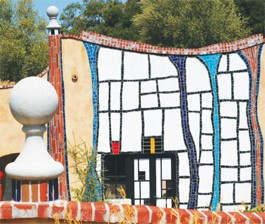
Some three months after this hubbub began, a crowd of landscape-architecture students meandered over the winery’s grounds while Lew Price, the general manager, led a smaller group of visitors on an official tour and tasting. Clustered together on an uneven brick walkway, the group listened to Price as he debriefed them about the winery, which was designed by the late Austrian artist Friedensreich Hundertwasser.

While the group absorbed their Candyland-like surroundings, Price explained that to Hundertwasser, the straight line was humanity’s worst enemy. He went on to say that in designing the whimsical mosaics covering Quixote’s surface, Hundertwasser may have looked to Catalan madman Antoni Gaudí for inspiration. Impressed–and possibly hoping to impress–one visitor suggested that perhaps French sculptor Jean Dubuffet had also been an influence. Price, who only started working at Quixote a few months prior, politely said he didn’t know about that.

A painter and a sculptor rather than an architect, Hundertwasser nevertheless designed a respectable number of wildly unique buildings during his lifetime (he died in 2000 at age 71) and developed an ardent following. Many of his buildings served rather humble purposes: public housing in Vienna and an incinerator in Osaka, for example. Price even told the group that Hundertwasser had refurbished a public toilet in New Zealand, but so many fans had flocked to see the facility that it had backup problems. For a different reason, Price seemed relieved to report that the number of “Hundertwasser people” visiting Quixote, the designer’s only U.S. building, was finally starting to abate. “They think the floor’s too flat,” said Price, looking ever so slightly scandalized.

Quixote’s owner, Carl Doumani, saw Hundertwasser’s designs for the first time on a calendar while visiting a San Francisco architectural firm during the late 1980s. One of the qualities that struck Doumani about Hundertwasser’s buildings was that they were so “human.” Some 10 years later, human was what he got with Quixote. It’s a castle on an almost kid-like scale, and because Hundertwasser abominated straight lines (he thought it was unnatural for humans to interact with them), Quixote practically giggles with squiggles.

A few days after the tour, Doumani greeted a visitor at the winery. Although it was only May, everything about Doumani was already summer-weight, from his snowy hair to his matching pants and creamsicle-colored short sleeves. He sat behind his desk in the squat rotunda under Hundertwasser’s signature dome, a golden fairy tale of an affair. This privileged position gave the impression that Doumani, for all his judiciousness, might have a bit of a despotic streak. In fact, the San Francisco Chronicle once reported on his reputation as “Ayatollah Doumani.” But for all that, Doumani is awfully approachable. He even does a lot of his own scheduling, painstakingly filling in a large desk calendar with tiny block letters.

At his visitor’s request, Doumani attempted to articulate his famously disparate aesthetic taste by pulling a few volumes on some of his favorite artists and architects from two large bookshelves in an adjacent room.

“Excuse me,” he said through the doorway. “I just remembered the best. Oh God, I just bought this damn book! I didn’t remember I had it. This guy–OK. I’m sorry,” he said, returning with a book on the late Italian designer Carlo Scarpa.

As Doumani flipped through the pages, he remarked on Scarpa’s precise shapes of shadow and light. “His detailing,” he said, “it’s kind of classic, but really imaginative.”

The visitor pointed out that this was totally different from Hundertwasser. “Well, yeah, that’s the point,” Doumani replied crisply.

Maybe it had been a mistake to try to pinpoint Doumani’s aesthetic taste with this exercise. Scarpa’s monochromatic tomb with its careful geometric shapes couldn’t have contradicted Hundertwasser’s improvisation any more. Hundertwasser had even gone so far as to smash a custom-made column one day, after it had been imported all the way from Germany and safely installed at Quixote. Apparently, the column had been too perfect.

(To complicate matters of understanding Doumani’s taste even more, he is currently working with the slick, industro-chic New York architects Tod Williams and Billie Tsien to design his private guest house.)

Still flipping through the book, Doumani revealed the key to his architectural tastes, more consistent than they had first appeared. He simply has a great capacity for appreciating wildly divergent brands of creativity–as long as they’re exciting and suit the site.

“Hundertwasser gets exuberant and organic and lyrical with [design], and [Scarpa] does this in a much more refined, much more sophisticated . . .” Here, Doumani trailed off, pausing at a modernist Scarpa mausoleum. “Too bad you have to die to go in here.”

A gust of entrepreneurial spirit tugged Doumani at the tender age of 20 while he was still an undergraduate studying business at UCLA. The owner of the barbecue joint where Doumani worked decided to sell his restaurant, and Doumani made a $200 down payment on it.

While Doumani was busy starting a career as a restaurateur and California property developer, Hundertwasser was a continent away, enjoying an ur-bohemian lifestyle and writing a treatise on why architects shouldn’t preoccupy themselves with rationalism. He changed his name from Freidrich Stowasser to Friedensreich Regentag Dunkelbunt Hundertwasser, which means something to the effect of “peaceland-rainy day-darkly multicolored-hundred-water.” The peculiar artist primarily wore wooden clogs and was often capped in a beret. But sometimes, he didn’t wear anything at all, even while lecturing.

It took Doumani a year to track Hundertwasser down, and they finally met in 1989, to discuss building Quixote next door to Stags Leap Winery, which Doumani founded in 1972 but had since sold to Beringer Wine Estates. They broke ground in 1991, and over the next several years, Hundertwasser corresponded with Doumani through petulant memos penned by his manager, Joram Harel. The flatness of the floors was indeed broached, Harel instructing, “A further crucial and vital matter is the fact that all floors which have no specific use like offices or for technical reasons, or public areas, entrances, doors, will have to be irregular, smooth, wavy floors. It is a sensational revolutionary improvement for the well being of men walking on earth. He recovers his mental equilibrium, a wavy floor is like a melody, like a symphony for the feet, extending to the soul. You may be the first in the United States to introduce and to enjoy these unique proven humanization and experience.”

Although Quixote didn’t open to the public until this year, the building was completed in 1998. Fortunately, Hundertwasser got to see it in its finished form, minus some of the landscaping, before he died. Doumani didn’t go to the funeral and still refers to Hundertwasser in the present tense.

Quixote is built into a hilltop and Hundertwasser insisted that the roof be topped with sod and planted with greenery. He didn’t care what kind, as long as it blended in with the surroundings. He just hoped that if you were looking at the winery from above, you wouldn’t notice it. He clearly wasn’t thinking about the golden dome, which sticks out like a little sun.

Mounting a dirt incline on the side of the building, one comes face to golden face with this dome. The shadows of rainwater rivulets don’t take away much of its sheen. One can walk along the modest brick parapets–wavy, of course–and peer over one side to see a cozy courtyard laid with white and blue tile. Indeed, this is a castle on a human scale, and instead of dumbfounded awe, a sympathetic “Aw” is in order.

According to Doumani, Hundertwasser once promised him that his life would change when he worked under the onion dome.

Has it?

“My answer,” Doumani joked, “to him was, ‘Friedrich, life is pretty good. Maybe you shouldn’t fool around with changing it.’ And, who knows.”

Quixote offers tours that include winetasting along with crackers and cheese scattered Hundertwasser-fashion across the plate. 6126 Silverado Trail, Napa. $25. To arrange, call 707.944.2659, or e-mail le*@***********ry.com.


Quick dining snapshots by Bohemian staffers.

Winery news and reviews.

Food-related comings and goings, openings and closings, and other essays for those who love the kitchen and what it produces.

Recipes for food that you can actually make.

Thorny Rose

June 13-19, 2007

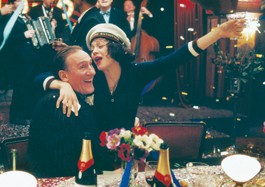
I have no idea what kind of music people are deflowering each other to these days, but it’s probably not Edith Piaf. The film La Môme (The Kid) has been retitled La Vie en Rose for the American market after Piaf’s big hit, and tries to introduce her work to a new generation using the tried and true Behind the Music approach.

Olivier Dahan, Belgian videomaker-turned-feature-director, flashes forward and backward in the short and tragedy-laden life (1915&–1963) of the singer, played by Marion Cotillard. Edith Gassion was second-generation showbiz–third, if you take into account the fact that her grandmother ran a brothel. Plagued by spectacular ill health, the performer was done in by rich living, much substance abuse and a group of internal organs that simultaneously resigned in protest. If she overimbibed, she had an excellent reason: not just heartbreak, but a severe case of rheumatoid arthritis.

Dahan alternates between the origin story and the endgame, even revealing one particularly sad event in Piaf’s life at the very last minute. By this, the film seems to be trying to re-create the effects of Piaf’s selective memory, though the actual effect, however, is more akin to taking the heroine and shaking her like a bug in a jar, between past and present.

La Vie en Rose begins with a first public performance, the child Piaf bellowing out “La Marseillaise” when passersby aren’t stopping to watch her father’s street acrobat act. After her family is swept up into the Great War, Piaf is relocated to her grandmother’s Normandy whorehouse. The young Edith is befriended by one of the ladies, Titine, played by Emmanuelle Seigner, who gives one of the few performances in the film that leaves an afterimage.

Growing up in the brothel, Edith suffers from maladies; she’s struck by temporary blindness, which is healed, as Piaf later claimed, by the grace of St. Teresa. Piaf rises fast with the help of the impresario Louis Leplée (Gérard Depardieu); he refines her act and teaches her more mainstream stage deportment than the Apache-esque cabaret she’d been performing. But he too drops out of her life–violently.

Post&–WW II success in America means little. “They don’t get me, and I don’t get them,” says this version of Piaf, who in real life played the Ed Sullivan Show eight times. Obviously, somebody got her. In New York, she meets the boxer Marcel Cerdan (Jean-Pierre Martins), with whom she formed the most serious liaison of her life, despite two marriages. Martins carries the part with as little worry as Dean Martin might have done. His scenes are some of the most appealing parts of the film, maybe because the heroine is free of pain for a short time.

Cotillard shows us the imperiousness of Piaf when she was famous, but there’s a lot to be said for the less-fraught moments of Piaf’s legend.

Dahan is at his clumsiest handling the legendary figures in Piaf’s life. During the walk-on by Marlene Dietrich (Caroline Sihol), one expects something memorable will be said. In Marlene Dietrich’s ABC, the actress’ book of received ideas and opinions, Dietrich called Piaf “the sparrow become Phoenix.” But what we have onscreen is something on the lines of “Edith, meet Marlene.” Jean Cocteau, who died on the same day as Piaf, turns up for a similarly inconsequential name drop.

Dahan is nervous about the most golden parts of Piaf’s legend–her resistance heroism in the war and the funeral that paralyzed Paris–stressing instead the symptoms of all her maladies. Dahan’s plan of attack is more than warts and all–it’s like warts and nothing but.

Oddly, the film works best when it does what it’s pretending not to do and goes straightforward into the realm of the musical bio-pic. What succeeds are the moments executed in the manner of ancient musicals–a slight figure fixed in a vivid blue-white spotlight, framed by a proscenium arch with curtains behind her. We do get what we came for in short bursts: the music, ably lip-synched and (happily) without rhyming translation in the subtitles. (Jil Aigrot does Piaf in more impromptu moments of Piaf’s singing; in the concert sequences, the voice is Piaf’s.)

If Piaf wasn’t pretty (though she was prettier than this film makes her out), neither was her voice. In the raw husk of it and the burring trilled r‘s, there was a bray, a wail. The international hit described a life seen en rose, as if viewed through rose-colored glasses, but it was sung in a voice belonging to someone who knew what it was like when the whole world was black.

‘La Vie en Rose’ opens on Friday, June 15, at the Rialto Lakeside Cinemas, 551 Summerfield Road, Santa Rosa. 707.525.4840.


New and upcoming film releases.

Browse all movie reviews.

Summer Born Great

0

June 13-19, 2007

Because Shakespeare once said “Summer’s lease hath all too short a date,” he might, were he resurrected, be just a little bit stunned to see how much theater has been planned by local companies for the few short months between now and September. This is true in spite of the fact that Shakespeare on the Green in Windsor has cancelled plans to produce two free shows again this year. Even with that sad omission, this is shaping up to be an outrageously tempestuous, and unusually challenging, summer season on local boards. With a total of five Shakespeare shows and with six impressively non-run-of-the-mill musicals planned for the same period, there will be a lot of intriguing theatrical entertainment to choose from over the next three months.

Perhaps the biggest news is that Healdsburg’s hard-working community theater company, the Raven Players, is tackling a modern Broadway behemoth: Andrew Lloyd Webber and Tim Rice’s epic musical Evita (June 22&–July 14). Under the direction of Carl Hamilton, who is known for staging stripped-down versions of American dramas and comedies, the play features a strong cast borrowed from the seasoned ranks of the Santa Rosa Players and other local companies. Featuring a full-scale orchestra and a set by former SRP technical director Doug Faxon, this might be the one to see, a make-or-break moment for this up-and-coming company.

The Mystery of Edwin Drood is Rupert Holmes’ adaptation of an unfinished Charles Dickens whodunit, conceived as a rollicking spoof that allows the audience to choose which of several alternate endings they want to see. It will open the Santa Rosa Junior College’s annual Summer Repertory Theater program on June 21 in the Burbank Auditorium on the SRJC campus and runs through Aug. 11. The other ambitious musicals planned for SRT’s season (alternating with two nonmusical dramas: Molière’s Learned Ladies and a stage adaptation of The Talented Mr. Ripley), are Working, a sprawling musical-documentary adaptation of Studs Terkel’s bestselling exploration of America’s working class, and Tick, Tick . . . Boom!, a modern rock ‘n’ roll musical by Jonathan Larsen, the guy who wrote the phenomenal Rent, in which a young composer on the brink of oblivion finds the courage to follow his dreams and sings about it to a really hot beat. For the family audiences, SRT has added Aladdin Jr., a kid-friendly adaptation of Disney’s flying-carpet extravaganza.

Meanwhile, at Santa Rosa’s Sixth Street Playhouse (recently renamed the G. K. Hardt Theater at the Sixth Street Playhouse), will take a stab at The Man of La Mancha (June 15&–July 14), with a sensational cast led by baritone Bill Neeley, usually seen on stage at Petaluma’s Cinnabar Theater. Cinnabar’s artistic director Elly Lichenstein is also lending her directorial hand to Sixth Street for this high-energy production, which gives her five times the space she usually has.

On the Shakespeare side of things, there are a number of intriguing productions planned for these parts. The Marin Shakespeare Festival at Forest Meadows is doing the marvelously manic-depressive Hank Four plays: Henry IV, Part 1 and Henry IV, Part 2, running in repertory (Aug. 25&–Sept. 29). They start their season with The Complete Works of William Shakespeare (abridged) (July 6&–Aug. 12).

A relatively new company on the scene, the nomadic Narrow Way Stage Company, plans a futuristic, post-apocalyptic Road Warrior version of Shakespeare’s Julius Caesar, running in repertory with David Rabe’s Dog Problem. It promises to be bold and bloody, and will be staged in the outdoor courtyard of Santa Rosa’s Glaser Center Aug. 2&–19.

North Bay Shakespeare (formerly Shakespeare at Stinson) stages the comedy Twelfth Night at Novato’s outdoor Hamilton Amphitheatre from Aug. 24 to Sept. 30.

And finally, all the park’s a stage as the Sonoma County Repertory Theater has some fun indoors with The Bible: The Complete Word of God (abridged) (July 6&–22) and opens its annual Shakespeare Festival with the poetic love-romp As You Like It (Aug. 10&–26), staged outdoors at Sebastopol’s Ive’s Park.


Museums and gallery notes.

Reviews of new book releases.

Reviews and previews of new plays, operas and symphony performances.

Reviews and previews of new dance performances and events.

Before I Get Old

June 13-19, 2007Rock music is full of age-based myths. First, there's the limited notion that rock culture equals youth culture. Rock's origins and its ongoing energy are dependent on what Neko Case calls "that teenage feeling," but decades of creative output have shown that rock is more far-reaching and complex. The model of veterans growing old gracefully is also...

Arctic Adventures

music & nightlife | By Gabe Meline ...

The Byrne Report

June 13-19, 2007Last month, dozens of white scribes employed by the white-owned media wrote thousands of paragraphs of whitewash about our white president, George Bush II, who wore white formal wear to a White House reception for the Goddess of All That Is White: Queen Elizabeth II, the wicked witch who killed the good white witch, Princess Diana, figuratively,...

News Briefs

June 13-19, 2007 No changes yetStudents at Redwood Middle School in Napa finished classes June 8 still following a dress code that dictates a limited range of colors--white, yellow, green, blue, brown, khaki, black and gray--and only three fabrics; cotton twill, corduroy or chino. As reported earlier in these pages ( May 2), the ACLU and a private law firm...

Summer Shorts

Letters to the Editor

June 13-19, 2007Explaining the museumThank you, Gretchen Giles, for pointing out the surprising lack of financial support for the visual arts in Sonoma County (Critic's Choice, "Making Sense of the Place," May 23 print edition). However, I don't think George Rose deserves the lashing he received, and Kendall-Jackson did not completely underwrite the "Art of Terroir" show.Landscape photography is...

Ask Sydney

June 13-19, 2007 Dear Sydney, I'm moving in with my boyfriend. Neither of us wants children. We both seek out holistic healthcare, avoid prescription drugs, etc. We've been relying on a cervical cap and tracking my menstrual cycle for birth control. The cap has not been ideal, and since we'll now be living together, and able to have more regular...

Dispatches from Squigglyville

June 13-19, 2007If it weren't for its appointment-only policy, Napa's new Quixote Winery would be a mob scene. The day after it opened this February, the New York Times featured it in the Sunday edition. When the winery staff came to work on Monday, 269 e-mails awaited them. Some three months after this hubbub began, a crowd of landscape-architecture...

Thorny Rose

June 13-19, 2007I have no idea what kind of music people are deflowering each other to these days, but it's probably not Edith Piaf. The film La Môme (The Kid) has been retitled La Vie en Rose for the American market after Piaf's big hit, and tries to introduce her work to a new generation using the tried and...

Summer Born Great

June 13-19, 2007Because Shakespeare once said "Summer's lease hath all too short a date," he might, were he resurrected, be just a little bit stunned to see how much theater has been planned by local companies for the few short months between now and September. This is true in spite of the fact that Shakespeare on the Green in...
11,084FansLike
4,446FollowersFollow
6,928FollowersFollow