News Briefs

12.22.07

God Scrapped

After standing for 13 years behind a Petaluma building, a 12-foot-high sculpture by Swedish artist Carl Milles recently became unexpectedly mobile. Purchased for $21,000 in 1984, and now possibly worth more than $100,000, the piece is an authorized replica of Milles’ The Rainbow, depicting God standing on a rainbow, hanging stars in the sky. A few weeks ago, officials at Bibbero Systems Inc. discovered the sculpture was missing and offered a $10,000 reward. That prompted a call from a local landscaper designer, who says she bought the “scrap metal” for $200 at the Sebastopol flea market. “The base is a little bent where they pried it off and one star is bent on the God-figure’s elbow,” but repairs are possible says Bibbero vice president Don Buckley. Once the sculpture is refurbished, it will be installed in either the Sonoma or Tahoe home of company president Mike Buckley.

Guns be my Wife

Repeatedly quoting lyrics from Ian Hunter’s song “The Outsider” (“Death be my mistress, guns be my wife”), Jarvis Peay opens the November episode of his Napa Public Access TV program with images of guns, followed by video of three Napa police officers’ homes, giving the exact street address for each. City officials objected, and a Napa judge granted a temporary restraining order preventing Peay from going near the officers or publicizing the addresses. Peay couldn’t be reached for comment. Napa Public Access TV station manager Dan Monez, who is also a former Napa police chief whose own home was once featured on Peay’s program (but without the street address), says he couldn’t prohibit Peay from airing the episode showing the three officers’ homes. “I’m not allowed to exercise prior restraint,” Monez explains. “We’re a First Amendment venue.”

Mission Memories

The names of 28 Coast Miwok children baptized at Mission San Rafael Archangel on Dec. 14, 1817, will be read aloud in their native tongue at a celebration of the mission’s 190th anniversary. A mass will include the Lord’s Prayer recited in the Miwok language. This will be the first time that the Miwok have been leading participants in an official program on this mission site. “It’s so magical,” says Theresa Brunner McDonald, curator of the mission museum. “It brings alive a sense of our living history.” She adds, “The Coast Miwok were here already [when the mission fathers arrived]; this is their home.” The celebration begins at 4pm, Saturday, Dec. 15, St. Raphael’s Church, 104 Fifth Ave., San Rafael. For more details, call 415.454.8141.


Shiny and New

0

12.22.07

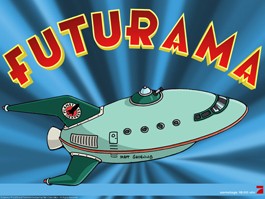
Futurama: Bender’s Big Score’ (20th Century Fox Home Entertainment; $29.99) The secret of Star Trek was a combination of sci-fi parables and a lot of dialect humor. This timely revival of the Matt Groening/David Cohen TV show doesn’t tamper with a formula that has lasted several eons across millions of light years. In this feature-length adventure, the gang is faced with an unstoppable force: the power of spam. A trio of sniggering hackers from a nudist planet foreclose on Earth, using stealth programs and pfishing. The elderly Professor Farnsworth is fooled, too, deluded by an e-mail telling him he’s the heir to the throne of Nigeria, now that the old king is dead: “I’ll inherit his kingdom, his canoe and his plump young wife.”

Meanwhile, the aliens dose the swaggering robot Bender with a virus and turn him into a “Dispatcherator” to raid humanity’s past with a ray gun. The sometimes moan-worthy jokes are bolstered with gratuitous nudity, a trip to Neptune, an appearance by Robot Santa, a nigh suicide mission by Al Gore’s head and a plausible explanation of how Bush won the ’04 election. The extras include a commentary track and a long—weeks long? I lost all track of time—appearance by the ever-compelling Hypnotoad.— RvB

‘The Two Jakes’ (1990) and ‘Chinatown’ (1974), Special Collector’s Editions (Paramount Home Video; $14.99 each) Godfather III was a bad idea. The same holds true for The Two Jakes , the 1990 sequel to Chinatown . But it’s still an entertaining movie, even if it exists only as a gloss on Roman Polanski’s 1974 masterpiece. The film picks up divorced dick J. J. Gittes (Nicholson, who also directed) in 1948, 11 years after the tragic events of Chinatown . Fatter and more respectable (“In this town, I’m the leper with the most fingers”), Gittes remains haunted by Evelyn Mulwray, the woman he couldn’t save (“You can’t forget the past any more than you can change it”).

Sure enough, the past comes back in the form of Evelyn’s daughter, Katherine (Meg Tilly), now the wife of housing developer Jake Berman (Harvey Keitel)—hence the title—and Gittes finds himself mired in a murky mystery about “old secrets, family and property and a guy doing his partner dirt.” Since the story is so steeped in memories, part of the pleasure is seeing the original characters reappear, Perry Lopez as Lou Escobar most effectively. Unfortunately, some of the new characters grate, particularly an atrocious Madeleine Stowe as an oversexed widow.

Robert Towne’s script is full of loose ends; buy this with the new reissue of Chinatown just to see the difference. Between the two discs, there are several illuminating “making of” documentaries, with long and candid interviews. Towne and Nicholson explain that Chinatown was originally designed to be a trilogy about the growth of L.A., and Polanski exposes the trick that made the famous nostril-slitting scene possible.— MSG

‘Drunken Angel’ (Criterion Collection; $39.95) Akira Kurosawa’s seventh film, Drunken Angel , was his first with Toshiro Mifune. As Matsunaga, a hot-headed yazuka in postwar Tokyo, Mifune makes a riveting antihero with his slicked-back hair and American-style zoot suit. Mifune is so vivid a bad guy that the film’s dialectic structure is thrown out of whack; in the wildest scene, Matsunaga tears up the dance floor while a Japanese Josephine Baker bellows a Cab Calloway-style “Jungle Boogie” (with lyrics by Kurosawa).

Kurosawa contrasts Matsunaga’s destructive gangster code (echoing Japanese militarism in the war) with the selflessness of Dr. Sanada (Takashi Shimura), a hard-drinking but softhearted doctor who treats the poor. When Sanada discovers that Matsunaga has TB, he makes it his duty to try to cure him, just as Matsunaga swears to save a young woman from another gangster. Unfortunately, Sanada spends too much of the film yelling impotently at Mifune’s unstoppable id.

Although subject to censorship by the Americans (as explained in a documentary on the disc), the film addresses Japanese soul-searching during the Occupation. The action takes place around a polluted open sewer that symbolizes the toxic aftermath of the war. Kurosawa returns again and again to this fetid bog bubbling with methane gas. This Criterion restoration also includes a Japanese documentary about Kurosawa and the making of the film (those bubbles were created by off-screen crew members blowing on very long straws).— MSG


New and upcoming film releases.

Browse all movie reviews.

Artful Glass

0

12.22.07


A ll four men wear wraparound sunglasses, even though they’re working indoors. Their no-nonsense look is strictly practical—the bad-ass shades protect their eyes against the intense glare. Their movements are sure and deliberate—not quick, not slow, but well-practiced. And the workshop where they labor provides plenty of room to move. That’s important when shaping a piece of glass that will be 2,190 degrees Fahrenheit when it’s pulled out of the specially designed furnace called the glory hole.

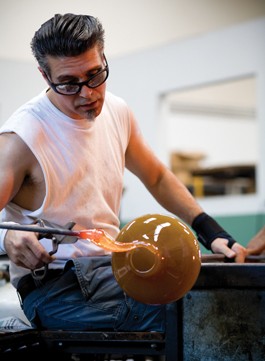
This is Bacchus Glass, which is tucked away in a warehouse-behind-a-warehouse on the east side of Sonoma. On a recent December morning, master glassblower Frank Cavaz and three assistants are handcrafting glass light fixtures. At 22 inches across, the golden glowing piece that’s gradually taking shape is an original design known as a “monarch ruffle.” It averages about two hours to make just one, and Cavaz and his team will be forming several monarchs today. Once they set up for a particular design, they usually do more than one.

“Glass definitely has its limitations,” notes Cavaz’s wife, Julie, as she watches from the sidelines. “Glass doesn’t want to be oval; it wants to be round because you’re spinning it.”

All four men gaze intently at the large, pliant shape that’s perched at the end of a long rod. One assistant carefully lays the rod across a low workbench, then twirls it, keeping the glass spinning at just the right pace so it doesn’t droop or drop. Frank sits on the bench next to the rod, inspecting the glass and preparing for the next step. Frank’s wearing a sleeveless top with protected forearms; no one wears loose clothing that could catch on fire.

The second assistant holds up wooden paddles, positioning them to protect Frank from the incredible heat of the glass. The third member of the team holds out a wooden template so Cavaz can check the size and shape of the object they are collectively nurturing.

They’re handcrafting an original Bacchus Glass design, but this piece still needs to look exactly like the monarch light shades in the company’s catalogue, and exactly like all the monarch shades they’ve already made or will craft in the future. It’s an extremely artistic production process, done one at a time and with an emphasis on reproducing quality.

“Frank’s very meticulous,” Julie says. “He has the ability to make things the same every time while still keeping that handmade quality, so it doesn’t look like it came out of a factory.”

The high-ceilinged space where the men work includes all the equipment and materials needed for all stages of crafting light fixtures, including a metal shop for creating custom chandeliers. “We want complete control of the project from start to finish,” Julie explains.

She adds, “Nothing’s very high-tech here. We love to go to Italy and look around the studios, because it’s all the same thing. It’s all about what you can make with your hands.”

After more than 20 years spent blowing glass, that’s what Frank loves about the process—the doing, the making, the problem-solving, the dynamics of it all. “When it goes really well and smoothly, it’s wonderful,” he says. “It kind of brings together all my experience and background.”

He trained as a sculptor at the Ontario College of Art and Design in Toronto, Canada, then went on to study glass at the Rhode Island School of Design. That’s where he met Julie. They started Bacchus Glass in 1995, making tableware and sculptural vessels, and evolved into lighting in 1997. All of their designs are created in-house.

“For me,” Frank says, “the best time I have in the shop is designing and figuring out new commissions and prototypes.”

Bacchus recently dropped its tableware line and is concentrating on the light fixtures, which start around $500 but can cost as much as $15,000 for a complex custom design. The company also handcrafts small Christmas ornaments ($18&–$50) for the annual holiday open-house events. It still takes teamwork to produce the small holiday globes, but they’re nowhere near as time-consuming as the light fixtures.

It’s a small family operation, and Frank loves what he does, Julie says.

“He gets up everyday and wants to blow glass. That’s what he loves to do. You have to have that passion, because it’s physically demanding.”

Frank adds with a quick laugh, “There are a lot easier ways to make a living.”

Bacchus hosts its holiday open house with glassblowing demonstrations on Saturday, Dec. 15, 10am to 4pm. The gallery is open 10:30am to 4:30pm, Tuesday&–Saturday or by appointment. Glassblowing is generally done on premises 7:30am to 2:30pm, Monday-Friday. Visitors are welcome. Bacchus Glass, 21707 Eighth St. E, Units 6 and 11, Sonoma. 707.939.9416.

Liquid Sand

Aurora Colors Fine Art Gallery & Glass Art Center in Petaluma blends a glass-art store and studio with work by local fine artists. The current exhibit of work by 30 California artists includes five glass artists. The center offers a range of glass-art classes for adults and children, as well as rental time in its studio and kiln. It also offers repairs, restoration, custom art glass, stained glass and more. 145 Kentucky St., Petaluma, 707.762.0131.

Lost Art Glassworks in Sonoma offers oversized world globes, fanciful lamps, sculptures, single and triptych windows and more, all in stained glass by Larry Brookins. 17501 Sonoma Hwy., Sonoma, 707.935-5938.

Laurence Glass Works Gallery in Occidental presents compelling sculptural fused-art glass by local artist Laurence. A French ex-pat, Laurence keeps a showroom in Occidental open on the weekends and can be found in her studio inside the A Street Gallery (312 S. A St., Santa Rosa) during the week. 74 Main St., Occidental, 707.874.3465.

M. Mitcavish Glass Artistry in Napa specializes in glass artwork, handcrafted dishware and lighting design. Its gallery also showcases jewelry, wall sculptures, home decor and more. Classes are available in a variety of glass-art techniques, including stained glass and independent study. 68 Coombs St., Building O, #1, Napa, 707.226.3613.

For other glass artisans, contact ARTrails (www.artrails.org) in Sonoma County, the Marin Arts Council (www.marinarts.org) in Marin County and the Arts Council of Napa Valley (www.artscouncilnapavalley.org) in Napa.

Letters to the Editor

12.05.07

The time is Now

Climate change is not linear; there are tipping points, such as the melting of the Greenland or Antarctic ice sheets, or the collapse of the Amazon rainforest. Once we pass those tipping points, climate becomes a runaway train, and nothing we do can prevent catastrophic impacts—massive flooding of coastal areas, widespread drought and crop failures, famine, epidemics, and the breakdown of ecosystems on a scale most of us cannot imagine.

To stop short of the point-of-no-return, we must reduce greenhouse gas emissions by 80 percent worldwide, and by 94 percent in the U.S. by 2030 at the latest; much of the reductions must come in the next five to 10 years. This cannot be achieved merely by changing light bulbs and driving hybrid cars; it requires a restructuring of our entire way of life, from agriculture and manufacturing to energy and housing. Think of the rapid U.S. shift to wartime production in 1941, and then multiply that 10-fold.

Is this even possible? Barely—but not if we wait for governments to act. This shift is far beyond the modest efforts currently debated in policy circles. We can only accomplish this with a global grassroots movement to directly change public policies and our way of life. It must include a shift in cultural values, from consumption to restoration, from endless growth to living within ecological limits, and from economic inequity to social justice.

This climate crisis coincides with the end of cheap, abundant energy from fossil fuels. Global oil production has peaked and will soon decline, with natural gas following. As demand outstrips supply, shortages will produce price spikes, supply chain disruptions, economic instability, and sooner or later, the collapse of nearly every aspect of the current oil-driven globalized economy. Peak oil may also lead to more resource wars over access to the remaining Middle East oil supplies.

Oil wealth made the United States a superpower, allowed us to build endless expanses of freeways, suburbs and malls, consume at historic rates and create a booming economy based on the illusion of endless growth. Now the boom is over, U.S. debt is at crisis levels, and our economy is largely propped up by Asian investment and the fear of a currency collapse.

The reason this matters is that the world will need all our remaining wealth and natural resources to pay for the conversion to a sustainable way of life. We have to build millions of wind turbines and solar panels, retrofit buildings and create mass transit systems before we lose the capacity to do so. And the United States, which is responsible for 25 percent of global greenhouse emissions, must take the lead.

In short, we need the biggest and most ambitious public works project in history, and the money to pay for it. Nothing short of this will prevent a climate meltdown. Yet we are wasting the needed capital on a destructive and immoral war which cannot succeed in maintaining long-term U.S. control of Middle East oil, but which will almost certainly consume enough public money and resources to bankrupt our government and preempt the possibility of shifting to a solar economy.

We have little time left to choose: either we devote all our economic resources to limiting climate change and preserving a livable planet, or we continue with business as usual. We cannot afford to do both. Military spending is not just bad foreign policy, it is economic and ecological suicide.

Daniel Solnit, director, Institute for Local Economic Democracy Sebastopol

One week too late

Re “The Liquidator” (Nov. 14): Your article about ticket terminology (scalpers vs. retailers vs. corporate scum) came one issue too late. I wanted to purchase tickets for Jersey Boys and found the Curran and Ticketmaster websites out, so I googled and did 10 minutes of looking. Many sites appeared to have two to eight tickets for that day, ranging in price from $150 to $226 a ticket. I used ClickitTicket and opted for the $150 seats. I was at the very end of the transaction when they said they needed a 15 percent service fee and a FedEx fee, which added $60 to my total. I grumbled and paid more for these than I have for a Broadway show, figuring they were the best seats at $150. When the tickets arrived five days later, they were $96 tickets, which meant ClickitTicket “retailed” me $108 plus the extra $45. Ticketmaster has long done an upcharge on their events, but nothing like this. I will never again use online retailers, even when I’m traveling to New York.

Mark Messersmith Mountain View


Nothing Compares 2 Sue

0

12.05.07

Cracking Prince jokes is like shooting fish in a barrel—even his most ardent admirers have to admit that the artist takes pains to maintain what is already an enigmatic aura. But Prince is in your corner, folks. Early last month, His Purpleness took steps to make it that much easier to make a funny at his expense when his legal team presented unofficial Prince websites with cease-and-desist letters demanding that they remove all photos, album covers, lyrics and Prince-related images.

It’s hard to run a Prince fan site without access to anything Prince-related. And because we Americans are mightily fond of our First Amendment rights, three of the sites—Housequake.com, Prince.org and PrinceFams.com—have come together to form PrinceFansUnited.com. They hope to talk sense into Paisley Park or, if necessary, to “defend their position in the proper court of law, as well as fully prosecute any claims to which they are justly entitled.”

This puts PrinceFansUnited.com in the curious position of attacking Prince in order to continue supporting him. If the devotion of Prince’s fans means so little to him, why adore Prince in the first place? It’s potentially crushing, a cruel slap of reality in a world constructed purely for escape. Will this bitter aftertaste irrevocably destroy fans’ ability to get hot and funky with the music of their faraway Purple Highness? And why would Prince do such a thing in the first place?

Such a move may seem ridiculous, but—for better and for worse—”Prince” and “ridiculous” go hand-in-hand. He established his eccentricity decades ago: the aborted symbol name-change, the abrupt conversion to Jehovah’s Witnesses, the ill-conceived and iller-executed vanity movie projects. (Purple Rain may have an immortal soundtrack, but the film itself is only watchable if you are drunk and on the precipice of passing out.) From the perspective our seats afford, the dude’s crazy, and quite possibly totally sincere about it.

Let’s try to think of this from Prince’s angle. First of all, there’s a chance that his grasp on reality is tenuous, a risk all those who dwell in glass bubbles run. It’s hard to keep it real when you are constantly surrounded by (or surround yourself with) a gaggle of sycophantic hangers-on, or when your name rarely appears in print unaccompanied by the word “genius.” Prince Fans United claims that the cease-and-desist orders may have been an attempt to stifle critical commentary. If that was a motivation, it backfired. Badly. What’s more fun to write and read about than a pint-sized megalomaniac’s unwarranted attacks on his devoted fans?

Comments on RollingStone.com have both defended and attacked Prince. “Instead of creating an innovative Internet model for his music, he is taking his frustration over his failed business model out on the very people who put him in business in the first place. . . . Prince gets no more $$$ from me and that will be what hurts him the most in all this,” wrote one disgruntled Prince follower.

But not everyone feels this way: “Prince doesn’t want us worshiping him like an idol, he wants us to respect him as a man and artist and let him do his thing,” another Prince fan countered. “There’s more to the world than just Prince and this is his point!”

If that is indeed Prince’s point, he made it in a very bratty way. An artist does have a right to control how and where his output is represented—but at the same time, once art is out there, it’s out. People grab on to it, and their passions can take a number of paths, from misinterpreting a song’s intended meaning to sharing a bootlegged concert recording.

It’s hard to empathize with the very rich and naturally cocky, which Metallica showed us in 2000 when they sued Napster after an unauthorized demo of their song “I Disappear” showed up on the file-sharing site. “We take our craft—whether it be the music, the lyrics, or the photos and artwork—very seriously, as do most artists,” Metallica drummer Lars Ulrich stated in a press release at the time. “It is therefore sickening to know that our art is being traded like a commodity rather than the art that it is.”

So even if Metallica vs. Napster did have less to do with money than asking fans to respect the band’s boundaries for control of their craft, fans didn’t sense artistic integrity rolling off Metallica in waves. In the media circus that sprang up around the trial, the band came across as a bunch of reactionary billionaire crybabies with no capacity to adapt to major shifts in the way consumers gather and listen to recorded music. Is it better to shut up and take it, or speak out and risk isolating a gigantic chunk of your fan base, the very people whose hard-earned cash bankrolls your Basquiat paintings and designer spike-heeled boots?

It must be utterly exhausting to mean so much to so many people, but there are those who manage to be gracious to their fan base. Radiohead recently released their pay-what-you-wish Internet-only album, squeezing more publicity from that action alone than anything surrounding their previous album, Hail to the Thief. What makes Prince exactly so hard to pin down are such dichotomies as his string of 21 London shows last summer with tickets uniformly priced at a mere £31.21 and his renegade giveaway of his lastest disc, Planet Earth, in the Sunday edition of London’s Mail newspaper before it was formally released to fans.

Without fans, Prince is nothing. This is indisputable; it means the fans have the upper hand, but only to the degree that their appreciation gives Prince’s oeuvre meaning outside of his own kingdom. A Nov. 17 statement on PrinceFansUnited.com speaks of negotiations with the Prince’s lawyers, reading, “Everyone involved now wishes to move on towards a more harmonious future, where the protection of artists’ rights and the freedoms of fan forums can happily co-exist.”

But despite any possible outcome, the situation has no true resolution; Prince will never have full control of his image, and fans will never have unfettered access to Prince the Artist. The tension of this balancing act is called celebrity, and it is the motor of our entertainment industry—perhaps more than it should be.


Bubble & Squeak

0

12.05

S trange Cabbage are in their own little world—the Sonoma County eclectic rock band’s fans are known as “Cabbageheads,” and each member of the band has a name involving the vegetable: the bassist is Cabbage Loco, singer-guitarist is Professor Cabbage (a respected local philosophy teacher), Fuzzy Cabbage is on drums, Uncle Cabbage on guitar and Country Cabbage on vocals. They describe their music as the “Cabbage sound,” and, of course, their north Santa Rosa rehearsal studio is the “Cabbage Patch.” They appear Dec. 8 at the Black Cat.

In the grand tradition of the joke band that simultaneously mocks and pays homage to the absurdities of rock music, the Cabbage don’t take things too seriously, while also penning evocative songs that don’t hide behind the safety of fashionable PC culture. Song titles like “Love Stain,” “Rasta Bartender,” “Old Hairy” and “Please Don’t Be Offended” are indicative of a band doing things their own way; their website carries a Parental Advisory and a button to push agreeing you are 18 or over to hear song clips.

“We’re a pretty ragtag bunch,” Professor Cabbage says, “an unlikely crew composed of teachers, safety consultants, claims adjusters and a former speed-metal thrash drummer, led by a Huck Finn rocker from Iowa.” There’s a cryptic element to the band, but also accessibility; they do some fairly faithful cover songs by the likes of Gutterball, Free, Butthole Surfers, Judas Priest and the Stones. One minute the Cabbage sound like musical hobbyists, and the next they’re busting out an original like “Porn Shop,” a lament on how Internet porn is driving the good ol’ Ma and Pa corner porn shop out of business.

Along the lines of Ween and Tenacious D (who the band agree are influences), there is a pleasant unpredictability to Strange Cabbage—one song’s goofy and sardonic, the next is serious. “We’re not out to blow anyone away, but most people seem intrigued by our satirical edge,” Professor Cabbage explains. The Cabbage sound is upbeat, funny, groovy, stylistically diverse and down-to-earth. Everyday objects are puzzling, enigmatic, bizarre—if looked at in the right light. Which is all Strange Cabbage are asking you to do.

Strange Cabbage and the Music Lovers share the bill at the Black Cat on Saturday, Dec. 8. 10056 Main St., Penngrove. 8pm. Free. 707.793.9480.


News Briefs

12.05.07

it’s a gas gas gas

Milk cows outside Petaluma are generating enough energy to run their farm’s creamery. The power comes from a methane digester. Cow poop is collected in a tarpaulin-covered “lagoon.” In this sealed, oxygen-free environment, the manure breaks down and is converted into methane gas, which is then collected, cleaned and stored. The poop from the farm’s 250 cows generates 40 kilowatts of electricity, enough to power the onsite creamery. All this occurs at St. Anthony Farm, part of a free drug and alcohol rehab program. “The idea of sustainability is very much part of what we do as an organization,” says St. Anthony spokeswoman Francis Aviani. “We approach people holistically and we look at the universe holistically. The biodigester fits nicely into that.” The poop-into-power program was created with the help of PG&E, which recently honored 19 of its employees for their efforts to make the biodigester a reality. On their behalf, PG&E donated $5,000 to Sustainable Conservation. The company also recognized the individual efforts of Marin County employee Rex Bell, who played a key role in creating free, local and convenient ways for California residents to recycle everyday household items. For Bell’s award, PG&E donated $5,000 to the Marine Science Institute.

‘shock’ at sundance

A movie filmed in Napa and Sonoma counties on a 30-day shooting schedule last August will be filling screens at the prestigious Sundance Film Festival in January. Under a cast headlined by English actor Alan Rickman (the Harry Potter films, Die Hard), Bottle Shock takes a light-hearted, fictionalized look at the 1976 blind taste testing that energized California’s emerging wine industry. The movie’s creation was profiled in these pages (“Quiet on the Set,” Aug. 15, 2007). Local producers Marc and Brenda Lhormer, who run the Sonoma Valley Film Festival, say they were notified Thanksgiving morning that Bottle Shock will be shown at Sundance. It was a welcome surprise. “We knew we had a shot, we made a good movie—but you never expect these things,” Marc Lhormer explains. After finishing filming at the end of August, it was a tight turn-around to have a rough cut ready by the Sundance Film Festival’s October deadline. “Director Randy Miller worked with an assistant editor and they did an amazing job putting together something that could be sent to Sundance,” Llhormer explains. “We heard Randy didn’t sleep for weeks.” The screening schedule hasn’t been announced yet, but Lhormer says he expects Bottle Shock will be shown three to five times during the festival, which runs Jan. 17&–27 in Park City, Utah.


First Bite

 E ditor’s note: First Bite is a new concept in restaurant writing. This is not a go-three-times, try-everything-on-the-menu report; rather, this is a quick snapshot of a single experience. We invite you to come along with our writers as they—informed, intelligent eaters like yourselves—have a simple meal at an area restaurant, just like you do . 

Sometimes, nothing in life is better than a sunny-side up egg, flecked with crunchy crystals of sea salt and freshly ground, deeply aromatic black pepper.  

The perfect specimen has been slow-fried on one side, so that the yolk is still liquid and brilliant yellow-orange under its thin-set skin, the white is meaty, and its barest edges crackle like lace. Preferably, the top was basted with butter (or even better, bacon fat) while it cooked.  

The dish is wonderful all on its own, but even better if it’s served blanketing something starchy, so the yolk has something to swim into after being pierced with a fork—crispy hash browns, perhaps, or toast. 

Such is the egg I’m savoring at Carneros Bistro & Wine Bar, the restaurant in the Lodge at Sonoma Resort & Spa. Two eggs, in fact, as the centerpiece to exquisite huevos rancheros ($11.75). 

The creation of chef Janine Falvo, the eggs crown layers of alternating soft and crisp corn tortillas, whole al dente black beans, gooey ribbons of Sonoma Jack cheese, a puddle of warm grilled tomato ragout and scoops of chunky, chilled tomato-purple onion salsa. The yolks seep through, imbuing everything with golden richness. 

It’s a surprisingly fine-dining experience for an often-overlooked meal: breakfast in a hotel. 

I already knew that Falvo was talented; I’d discovered that the night before, as soon as I tasted my first bite of a foie gras and chestnut froth parfait that was served as an amuse-bouche at a tasting dinner (price varies) in the same restaurant. Her skill was evident in a spoon of Forbidden rice capped with a glistening cube of uni; I poured a raw quail egg over the top and downed it in a single mouthful.  

Falvo’s delicate squash agnolotti stuffed with spinach and pine nuts had melted on my tongue in a buttery, nutty slick. Then she’d sent out a square of monkfish, wrapped in crisp potato paper on a nest of chanterelles tucked with black truffle confit and a dusting of heirloom tomato powder. My entrée was a luxurious CK Lamb chop, smoked in vanilla cigar and bedded on peppery arugula risotto pooled in bright white Parmesan foam.

A Cypress Grove truffle “tremor” with black olive crackers and a fig shooter was an intense intermezzo to the dessert of persimmon bread pudding capped with saffron-cardamom ice cream. Each course had been paired with wines from sommelier and storyteller Christopher Sawyer, culminating in such a long, luxurious evening that driving an hour-plus home was out of the question. The plush bed of a Lodge cottage beckoned irresistibly. Thus, this impromptu breakfast. 

So now, I’ve got a silver pitcher of fragrant black coffee all to my own, plus a side dish of three glistening Caggiano country sausage links ($6), so fresh their skin actually snaps. And I’ve got another reason to appreciate the remarkable dining experience that is Carneros Bistro.The only thing left? Lunch. 

Carneros Bistro & Wine Bar, 1325 Broadway, Sonoma. Open for breakfast, lunch and dinner, Monday-Saturday; Sunday, brunch and dinner. 707.931.2042.


View All

Quick-and-dirty dashes through North Bay restaurants. These aren’t your standard “bring five friends and order everything on the menu” dining reviews.

Aquaculture Upset

12.05.07

It’s a familiar scenario: an environmental group and a business fighting over the same piece of land. One wants to preserve the land, the other wants to use it for its resources. This time though, instead of a nameless corporation, the business is Drake’s Bay Family Farms, a local sustainable oyster producer that owns acreage that has been operating in the Point Reyes National Seashore, formerly as Johnson’s Oysters, for decades. Furthermore, Drake’s Bay claims that it wants to preserve the land while using it for resources.

Supporters of Drake’s say that if the oyster farm is closed down and the 1,050-acre ranch converted to wilderness, as mandated by a 40-year lease with the National Park Service (NPS) that comes due in 2012, Marin will not only lose one of its most ecological food producers, it will lose a piece of its history as well.

In 1976, the Point Reyes Wilderness Act created 25,000 acres of wilderness and an additional 8,000 acres of “potential” wilderness in the national seashore, land that is treated as part of the park even though something else—a road or a farm, say—is located in it. Part of that potential wilderness includes Drake’s Estero, the estuary where the oyster farm operates. If the Drake’s Bay Family Farm’s lease is not renewed by the NPS in five years, the business will shut down and the land will officially be converted to wilderness forever.

“It has become an environmental crossroads,” says Drake’s Bay Family Farms co-owner Kevin Lunny, who bought the ranch in 2005 with his two brothers. The family are third-generation West Marin ranchers who also raise cattle on the Historic G Ranch near Inverness. “Most of us in the environmental community spend a lot of time fighting for wilderness. It’s an important and valuable thing. But here the community is saying, ‘Wait a minute, we love wilderness, but slow food production is not harmful to the environment.'”

Drake’s Bay Family Farm annually produces some 300,000 pounds of oysters and a million clams, accounting for 85 percent of Marin’s shellfish industry and 50 percent of California’s mariculture. It is also home to California’s last oyster cannery. The operation’s cessation could have a significant impact on shellfish availability in Northern California.

This past year, the fight to keep that from happening turned ugly, with accusations flying in all directions, city council meetings, coalitions forming to support both sides, and even the involvement of Sen. Dianne Feinstein, who gathered park and government officials together to discuss the situation.

In the end, the law is clear about one thing: Whether or not oyster production will be allowed to continue after 2012 is up to the NPS.

“The National Park Service has told us that they don’t plan to renew the lease,” says Lunny. “There’s the issue. The law apparently tells us that this is a choice the National Park Service has. It is their choice, so they can choose.”

The NPS insists that Lunny knew from the beginning that the oyster farm would close down in 2012. Park officials claim operations were always supposed to shut down so the land could revert to wilderness.

“The intention was for the oyster farm to basically sunset in 40 years time,” says John Dell’osso, chief of interpretation for the Pt. Reyes National Seashore. “And in 2012, the area would become a wilderness area. We’ve always managed that area as wilderness, even though it’s called ‘potential.’ Wilderness is wilderness. The only differentiation here is that this impediment will be removed in 2012.”

Although the NPS calls the oyster farm an “impediment,” Dell’osso is quick to point to the many other ranches and dairies that have leases within the park. The difference between those operations and the oyster farm is that the ranches are zoned for agriculture and the oyster farm is zoned as wilderness.

Environmentalists are concerned about the impact the oyster farm is having on the estuary, citing possible effects on such wildlife as endangered eelgrass and harbor seals during pupping season. In May, the NPS blamed Drake’s Bay Family Farms for an 80 percent decrease in harbor seal pups in 2007 compared to 2005. At the time, staff scientist Sarah Allen called it a problem of “national significance.”

The claim was proven false. According to the NPS’ own numbers, while there was a significant drop in seal pups on one sandbar, there was an increase on another nearby sandbar, meaning that the seals just moved to a different place to pup that year. And it was disturbances like hikers and predators that caused them to move, not the oyster company.

“That’s something I can’t comment on until some issues are better documented,” says Dell’osso.

“It’s irrelevant whether he has disturbed the seals or not, he needs to keep [the oyster harvesting] boats away from the seals,” says Gordon Bennett, conservation chair of the Sierra Club Marin Group. “The way he runs his business, it is disturbing the seals, and we believe it is significant. So it doesn’t matter whether it has happened or not.”

Lunny would be the first to admit that it’s impossible to run a business without having some impact on nature. For him, it’s a matter of how significant that impact is, especially considering that the oyster farm also has beneficial impacts on the environment. Oysters improve water quality, and their shells are almost pure carbon.

For others, it’s not worth risking even the slightest impact when you’re talking about the only estuary on the West Coast south of Canada.

Johnson’s Oysters, the original ranch owner, first opened in 1940, but oysters have been commercially harvested in Drake’s Estero for at least 100 years. Losing the farm would be losing a piece of the park’s history.

Of course, nature was there even before that.

“It depends on how you define history,” Bennett says. “The canning operation is basically a one-truck container. It’s a high-tech situation, not some elegant Victorian factory that’s been there a hundred years. The fact of the matter is fairly clear here, which is that the Lunny family wants to make money from it. That’s what business people do. But the wilderness is not about money.”

Still, it’s hard to argue that the Lunny family hasn’t displayed devotion to the land. Drake’s Bay Family Farms has the first certified organic pastures in Marin, the only certified beef cattle and the only salmon-safe certified farm in California.

“They did a fabulous job of cleaning up a horrible mess,” says Dell’osso, who perhaps unintentionally voices the equivocation this situation has evoked. “Well, they haven’t made anything worse. So, yes, they’ve done a good job since then.”


Hopmonk Update

0

12.05.07

W hen Dean Biersch, cofounder of the Gordon Biersch brewery chain, took over the Sebastopol Brewing Co. in downtown Sebastopol last month, he hinted at a neighborhood friendly operation with his new Hopmonk Tavern.

It looks like he’s delivering.

The upscale, North Bay—friendly bar and bistro opens this spring, featuring handcrafted beers made by small, independent and traditional brewers. Sure, some of the beverages will come from Europe, but now the official word is out: We’re guaranteed “an impressive array of local” product, too.

In fact, Biersch, a Sonoma resident, will be personally selecting each and every beer found on the constantly changing lineup, and will be hands-on in the tavern’s day-to-day operations. Want to request a specific brew from a rare backyard talent? Just shout it out, and if it’s not in stock, Biersch himself may track it down for you.

Now, Biersch also tells us that the short but sexy food menu will draw from lots of local fish, produce, cheese and meat vendors. Look for seasonal, beer-friendly plates with “a California vibe.”Sonoma County musicians and music lovers can rejoice, too. The 1,400-square-foot venue adjacent to the restaurant will showcase local, regional and international performers.

Yet here’s how we can really tell we’re not going to be treated like big-city corporate customers: in a sneak peak at marketing materials, we saw this unique selling point: “In addition to ample free vehicle parking, a regional bike trail passes through the front of the property, and bike travelers are invited to stop by.”

Free parking? Bike racks? Now that’s a welcome mat only a small, neighborhood-respecting place could know to lay out.

Sebastopol. [ http://www.hopmonk.com/ ]www.hopmonk.com.

Quick dining snapshots by Bohemian staffers.

Winery news and reviews.

Food-related comings and goings, openings and closings, and other essays for those who love the kitchen and what it produces.

Recipes for food that you can actually make.

News Briefs

12.22.07 God ScrappedAfter standing for 13 years behind a Petaluma building, a 12-foot-high sculpture by Swedish artist Carl Milles recently became unexpectedly mobile. Purchased for $21,000 in 1984, and now possibly worth more than $100,000, the piece is an authorized replica of Milles' The Rainbow, depicting God standing on a rainbow, hanging stars in the sky. A few weeks ago,...

Shiny and New

12.22.07Futurama: Bender's Big Score' (20th Century Fox Home Entertainment; $29.99) The secret of Star Trek was a combination of sci-fi parables and a lot of dialect humor. This timely revival of the Matt Groening/David Cohen TV show doesn't tamper with a formula that has lasted several eons across millions of light years. In this feature-length adventure, the gang...

Artful Glass

12.22.07A ll four men wear wraparound sunglasses, even though they're working indoors. Their no-nonsense look is strictly practical—the bad-ass shades protect their eyes against the intense glare. Their movements are sure and deliberate—not quick, not slow, but well-practiced. And the workshop where they labor provides plenty of room to move. That's important when shaping a piece of glass that...

Letters to the Editor

12.05.07The time is NowClimate change is not linear; there are tipping points, such as the melting of the Greenland or Antarctic ice sheets, or the collapse of the Amazon rainforest. Once we pass those tipping points, climate becomes a runaway train, and nothing we do can prevent catastrophic impacts—massive flooding of coastal areas, widespread drought and crop failures, famine,...

Nothing Compares 2 Sue

12.05.07Cracking Prince jokes is like shooting fish in a barrel—even his most ardent admirers have to admit that the artist takes pains to maintain what is already an enigmatic aura. But Prince is in your corner, folks. Early last month, His Purpleness took steps to make it that much easier to make a funny at his expense when his...

Bubble & Squeak

12.05S trange Cabbage are in their own little world—the Sonoma County eclectic rock band's fans are known as "Cabbageheads," and each member of the band has a name involving the vegetable: the bassist is Cabbage Loco, singer-guitarist is Professor Cabbage (a respected local philosophy teacher), Fuzzy Cabbage is on drums, Uncle Cabbage on guitar and Country Cabbage on vocals....

News Briefs

12.05.07 it's a gas gas gasMilk cows outside Petaluma are generating enough energy to run their farm's creamery. The power comes from a methane digester. Cow poop is collected in a tarpaulin-covered "lagoon." In this sealed, oxygen-free environment, the manure breaks down and is converted into methane gas, which is then collected, cleaned and stored. The poop from the farm's...

First Bite

Aquaculture Upset

12.05.07It's a familiar scenario: an environmental group and a business fighting over the same piece of land. One wants to preserve the land, the other wants to use it for its resources. This time though, instead of a nameless corporation, the business is Drake's Bay Family Farms, a local sustainable oyster producer that owns acreage that has been operating...

Hopmonk Update

12.05.07W hen Dean Biersch, cofounder of the Gordon Biersch brewery chain, took over the Sebastopol Brewing Co. in downtown Sebastopol last month, he hinted at a neighborhood friendly operation with his new Hopmonk Tavern.It looks like he's delivering.The upscale, North Bay—friendly bar and bistro opens this spring, featuring handcrafted beers made by small, independent and traditional brewers. Sure, some...
11,084FansLike
4,446FollowersFollow
6,928FollowersFollow


