UA 5, 1997

0

It may not have been very glamorous, but the old UA 5 on Mendocino Avenue for many years was Santa Rosa’s premier movie theater. From the first movie I ever saw there (Three Amigos, if memory serves) to the hog-wild, anarchistic Midnight Movies of 2001 (Blazing Saddles, A Clockwork Orange, I was always too drunk to remember any others), it seemed, to those of us who grew up in a certain era, that UA 5 would never, ever die. But in 2002 it finally did just that, closing its doors and leaving a sentimental collage of moviegoing memories in the dust.

But wait—hold the violins! Once again, the past is made present through YouTube. Behold Movie Juice, a documentary about the hopelessness of movie theater life, filmed on-site in 1997 at United Artists Cinema 5 in Santa Rosa. Ezra, the director, was a film student at SRJC at the time; this was one of his class projects. It’s insightful, it’s kinda sad, and it’s funny as hell.

Most of the theater employees from this documentary are still around. Dustin does horror makeup for movies. Trevor draws and publishes comics. Gerry sells records. Josh is a pop culture professor. Joe runs an upholstery shop.

None of them still work at a movie theater.

Save Our Parks

As you bloody well should know, Gov. Schwarzenegger’s budget proposal includes closing some 48 California parks this year to help offset the $6 billion deficit in part created by his refusal to close the yacht loophole or otherwise tax the very wealthy. Monday, April 7, marks Save Our State Parks day, an action day in which all who enjoy a dusty path, a big tree, the very ocean itself or a single fern are encouraged to mass upon Sacramento to signal protest.

Among the threatened parks is the Armstrong Redwoods SRA, a preserve in which most trees are 600 years old and which over a million folks visit each year. Freelance vlogger Travis Mathews of San Francisco submits his short documentary on Armstrong to remind us of why this very important resource is more than worthy of keeping open. Take the eight minutes or so to remember why. Mathews is available to do videos by request. Reach him at 415.730.2415 or travisdmathews[at]gmail.com.

Merle Haggard at the LBC

Near the beginning of Merle Haggard’s hour-long set tonight, he turned to the crowd and inexplicably asked, “No caffeine?!”
Er. . . Huh?
“No steroids? No crank?!” What was Haggard getting at?
Then the bomb: “Maybe a little herb!”
The aroma at a Merle Haggard show is just like any other country show: a time-honored combination of stale cigars, Copenhagen, cheap perfume and Jack Daniels. But the smell of marijuana guaranteed that we weren’t at no wussy-ass Dierks Bentley concert. From the guys out in the parking lot flaming up the reef, to the random whiffs in the lobby, to Haggard’s new song, “Half of My Garden is for Willie,” weed was the order of the night. And that suits the 70 year-old, white-haired Haggard—who still acts like a goofy little kid with a big heart—very well.
Acting out the song in adolescent, animated gestures, Haggard sang about the “tobacco, mushrooms, and cannabis” in his garden, and how half of it he’d give to Willie Nelson because “a man like that shouldn’t have to grow his own.” It brought the house down.
But by far the set’s highlight was one of the greatest songs ever written: “If I Could Only Fly.” The utmost of tenderness, the prettiest of melodies, the timelessness of the lyrics—everything about the Blaze Foley song cast a hush over the normally boisterous crowd, who shouted requests and rampantly ignored the ‘No Cameras’ signs throughout the bulk of the show. In the song’s quiet smallness, it attracted the most undivided attention of the night.
Hit-song standbys included “Silver Wings,” “The Bottle Let Me Down,” “Guess I’ll Just Stay Here and Drink,” “Swinging Doors,” “Big City,” and “Workin’ Man Blues,” and much to the surprise of the crowd, Haggard actually performed “Fightin’ Side of Me” and “Okie From Muskogee,” which in recent years he’s either tried to justify as spoofs or plain disowned outright.
Haggard’s also good for whatever latest ballad Willie Nelson’s written; the last time I saw him, in 2005, he sang “It Always Will Be,” and tonight, it was “Back to Earth.” The Strangers, his 10-piece backing band, played as fantastically as they always have (that drummer’s bones know when the song ends), and Haggard still has a hell of a voice.
Haggard was warm and welcoming to the crowd—much more so than most country stars of his vintage. He started “I Wish Things Were Simple Again” in the wrong key, which distracted him so much that he accidentally sang “My dad was a lady. . .” He stopped the song, everyone laughed, he made a couple jokes about “jambalay, crawfish pie, and be gay-o,” and then got back on track. At other times he joked about pulling up his bra, and said “I might be a transvestite!” He also spent a good deal of time criticizing the city of Redding, where in his words, “talent goes to die.”
Haggard’s playing Redding tomorrow night. Something tells me his talent will survive.

We’re Screwed

04.02.08

When I received notice that the Praxis Peace Institute, a nonprofit organization dedicated to offering peace education, would be hosting a presentation titled “Facing the Heat: Global Warming, Peak Oil, Economic Collapse,” I was conflicted. I wasn’t sure if I was up to another power-point session on global warming. In fact, it’s quite possible that if I see one more slide of the predicted ocean levels in 2030, I’m going to become one of those people so cynical that the few friends I have left will begin to seriously consider dumping me for someone who isn’t such a bummer. But deadline loomed, and so I made the trek to Mill Valley on a recent gorgeous Sunday afternoon to hear Daniel Solnit give his take on climate change, the oil crisis and what he thinks must be done about it.

Solnit is the founder and director of the Institute for Local Economic Democracy, a nonprofit leading the transition to local sustainability, the campaign coordinator for GE-Free Sonoma County and the lead organizer for the Green Party of California. He is knowledgeable, equipped and ready to tell me what I don’t want to hear.

I arrive half an hour late as usual, and pick a seat in the back behind about 20 other people who are there to hear the bitter truth. Solnit’s presentation is fast-paced, gripping and absolutely devastating. As he speeds through slide after slide, covering everything from the effects of factory farming to the power of corporate globalization, I take as many notes as I can in an attempt to document, at least quasi-accurately, what it is, exactly, we are up against.

From what I can glean from Solnit’s rapid-fire presentation, we have roughly 10 years to build an alternative to our current, unsustainable system, and 20 years, should we fail to do so, before we hit the earth’s tipping point. The main tipping points are the ice sheets in Antarctica and Greenland, the Amazon rain forest and the ocean floor. When the North Atlantic Current, warmed by the melting ice sheets, begins to wreak havoc on our weather patterns, the massive amounts of carbon sequestered in the Amazon rain forest and the ocean floor will be released into the atmosphere.

Here’s the fun part. According to Solnit, unless the United States reduces its CO2 emissions by 94 percent by 2030—that’s just 22 years—we will not be able to avoid the tipping point. The entire world needs to reduce by 80 percent to 90 percent, but the United States remains the leading offender. Once the tipping point is reached, the planet will be decimated by climate change—drought, ravaging storms, etc.—and there will be no way to save us.

This is an issue, Solnit stresses, not of overpopulation, but of over-consumption. If everyone on the planet consumed as much as we do, we would need five and a half earths to sustain us. We are using things faster than they can rejuvenate, and we need to get over the mythology that this is solely an environmental issue. The reality is that we have to change our way of life, and we don’t have much time to do so.

Solnit also stresses that we would have enough on this one single planet to take care of everyone if we did not suffer from a concentration of capital. Statistics show that, after a certain point, wealth actually decreases our well-being (though the statistic alone may not be enough to convince the obnoxiously wealthy to donate their extra money to halting climate change, one can always hope).

Solnit does not seem to put too much stock in this possibility, however, and believes that our hope lies in the global grassroots popular-resistance movement. There is nothing we can do in our individual lives that will solve this problem, he emphasizes—not even with our reusable grocery bags, organic food or hybrid automobiles. According to Solnit, the only thing that will save our planet is if we become involved politically and systemically. And do it now.

On the way home, I find myself stuck between a behemoth Alhambra truck and a Hummer. Together, we roar past a small gathering of fawns munching grass on the side of Highway 101. Solnit’s presentation spoke clearly of his reverence for the earth, which he describes as a living organism, and I find myself overwhelmed by a great sadness, not for myself or my fellow animals, but for the earth herself. Though Solnit ended his presentation with a long list of solutions, I can’t help but fixate on that daunting 94 percent reduction.

In order to assuage my feelings of gloom, I hope to attend an upcoming event put on by the Praxis Peace Institute on April 8, “The Lasting Appeal of War and the Quest for a Moral and Erotic Equivalent,” presented by Sam Keen. Though the topic may not be helpful for cocktail conversation, I am encouraged by the word “erotic.”

If nothing else, at least we have that.

Sam Keen appears on Tuesday, April 8, at the Glaser Center. 547 Mendocino Ave., Santa Rosa. 7:30pm. $20. 707.939.2973.


Green Music

0

04.02.08


We have green clothing, green restaurants, green investments—why not green music? Musicians are generally an earth-lovin’ lot, as are many of their fans. But music is a business, and no business is 100 percent environmentally benign.

The bad news for record lovers is that vinyl is diabolically full of toxins. The good news is that the volume of newly released vinyl records is a mere drop in the bucket compared to how much PVC we encounter through construction, apparel, food packaging and toys. Of course, you could buy only used records—there are only a million billion out there—or bite the bullet and score some yummy newly pressed vinyl, perhaps compensating for your purchases by swearing off bondage gear or vinyl siding for life.

Compact discs are smaller, but still material-intensive, mainly polycarbonate and aluminum. In life, there are two kinds of CDs: the ones we want, and the ones we don’t. Sure, we’re encouraged to donate or reuse CDs. The reason people get rid of CDs is because they suck and no one in her right mind has any use for them outside of scattered ill-conceived art installations. It’s possible to recycle unwanted CDs, but very few facilities accept them; so, for most of us, into the landfill they go.

Digital music, as unromantic as it may be, boasts a teeny footprint. There are no transportation costs, and we utilize computers, which we already use for every other damn aspect of our lives, to perform this task. So even though that little mp3 player may be loaded with heavy metals, it’s small and built to last, or at least until the newest gadget technology makes it obsolete.

The problem that eco-savvy performers face is less about recording media than road miles. Touring the country in a marginally roadworthy van is an indie-musician rite of passage, but these days it takes a lot more CD and T-shirt sales (inorganic cotton sewn in a foreign sweatshop, natch) to fill a tank up with fossil fuel.

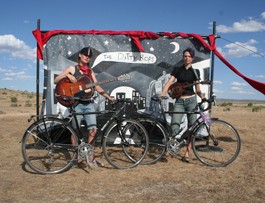
The progressive bluegrass band Hot Buttered Rum converted their diesel engine to run on vegetable oil, a transportation method with the added benefit of requiring frequent detours to greasy restaurant dumpsters; their current tour is fueled by biodiesel. In the summer of 2006, the female duo the Ditty Bops rode their bikes 4,700 miles to gigs across the country. They had a support vehicle in tow, but they also had the PR machine of a major label and their bike tour scored plenty of goodwill and press.

However, the touring method of a band—while it might be both novel and environmentally friendly—is ultimately not going to determine whether or not an audience will come. Anyway, it turns out that it’s the thousands of fans driving to a stadium concert that leave a bigger carbon footprint than Miley Cyrus’ multitrailer caravan of Hannah Montana props and lighting. Hmm. Better carpool.

Stripped of all else, music is sound, and it’s silly to think of something as ephemeral and purely organic as sound as having a carbon footprint. Will CD inserts printed on recycled paper, eco-pavilions at the Warped tour and Bonnie Raitt’s carbon-offset surcharge for front-row seats make any difference to speak of, or is it all just well-intentioned hot air? Musicians can sing until their faces turn blue, but someone’s got to listen to them for it to make any difference.

Maybe the best way to have a diminutive music-carbon footprint is to not sweat the small stuff and instead focus on the larger picture. What’s more important, the 500 cassette tapes I just took to the Goodwill, or getting people to vote for candidates who support positive changes in energy policy? Maybe buying a new record or two isn’t such a bad thing after all.


Play Dates

0

the arts | stage |

Photograph by Kim Taylor
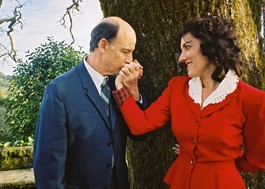
Literary love: Chuck Isen and Jennifer Reimer co-star in ‘Shadowlands,’ currently running with the Ross Valley Players.

By David Templeton

For most North Bay theater companies, springtime marks the halfway point in their season of shows, most of which began in September of last year. For those companies whose seasons begin with the first of the year, we’ve only just begun, but many companies choose spring to make their announcements, naming the plays and musicals that will make up their next season.

Such announcements, anticipated the way some anticipate Christmas morning, have already begun and will continue over the next several weeks. A few of these initial announcements are little more than hints and teases. Others are the whole enchilada, listing every play, author and date of performance. More will be announced in the near future, but here’s what we know for now.

Having only just begun its 10-month-long 2008 season, the popular Oregon Shakespeare Festival in Ashland is first out of the gate with a March 7 announcement of the 11 plays in rotation for the 2009 season, a mix of Shakespeare, classics, world premieres and a rare musical. Beginning with the Shakespeares, the lineup is Macbeth, All’s Well That Ends Well, Henry VIII and Much Ado About Nothing.

Also on the roster are Nigerian playwright Wole Soyinka’s anti-colonial Death and the King’s Horseman , Clifford Odets’ Paradise Lost , Carlo Goldoni’s The Servant of Two Masters , a new adaptation of Don Quixote by San Francisco playwright Octavio Solis, a world-premiere comedy by Bill Cain about the aging Shakespeare titled Equivocation , Sarah Ruhl’s comic-thriller Dead Man’s Cell Phone and the aforementioned musical, a stripped-down rethinking of Meredith Wilson’s The Music Man . (For reviews of the shows currently running in Ashland, check www.bohemian.com).

The Music Man will make an earlier appearance late this summer, when Santa Rosa’s Sixth Street Playhouse opens its new season with Wilson’s popular tune-a-palooza, directed by Holly Vinson, who will incorporate students from her annual summer theater camp into a cast of seasoned adults. That’s all that we’ve been told so far about the season (no one gets the full report until after the company’s donors and subscribers hear the news at next week’s gala announcement party). What we do know is that the season will comprise four musicals and three non-musicals to be staged on the 185-seat G. K. Hardt Stage, with the new Studio Theater playing host to an additional four plays, more along the “edgy” lines of last January’s Public Exposure and the currently running Oleanna by David Mamet.

In fact, three companies have announced their intention to stage old and new works by the controversial Mamet. In Marin’s sleepy little Ross, the Ross Valley Players have announced an ambitious season that includes Mamet’s macho masterpiece Glengarry Glen Ross . Also in the lineup are Ron Hutchinson’s Moonlight and Magnolias (recently staged by the Sonoma County Repertory Theater in Sebastopol); Samuel Taylor’s 1954 romantic comedy Sabrina Fair (best known for inspiring the beloved Audrey Hepburn and Humphrey Bogart film Sabrina ); Ron Severdia’s one-man-show adaptation of Dickens’ A Christmas Carol ; Alfred Uhry’s lovely Jewish-American comedy-drama The Last Night of Ballyhoo ; Arthur Miller’s A View from the Bridge ; and Alan Ayckbourn’s newish Private Fears in Public Places .

Santa Rosa’s Narrow Way Stage Company has announced its summer schedule, with recent Mamet creation Romance —a screwball courtroom comedy about duplicity, legal double-dealing and bigotry—to be performed in repertory with local playwright Dan Farley’s harrowing Darryl Come Home .

Mamet may appear again in the Sonoma County Repertory ‘s 2009 season, since, according to producing artistic director Scott Phillips, Mamet’s Glengarry Glen Ross is one of several show they are considering. Other potential choices include John Patrick Shanley’s Doubt , Lisa Loomer’s ADD fantasia Distracted , Ibsen’s Hedda Gabler , John Murray and Allen Boretz’s Room Service , Reed Martin and Austin Tichenor’s All the Great Books (abridged) , Robert Hewett’s The Blonde, the Brunette and the Vengeful Redhead and a new re-imagining/adaptation of Shakespeare’s Tempest by Sebastopol’s Conrad Bishop.

Lastly, San Rafael’s Marin Shakepeare Festival , which opens in July, will stage the Bard’s ever-popular Much Ado About Nothing (never trust your friends!), The Winter’s Tale (the queen’s not dead, she’s just been pretending to be a statue for 16 years!) and Peter Shaffer’s Amadeus (Salieri did it!).

Mark your calendars and check websites for the inevitable changes and additions.


View All


Museums and gallery notes.


Reviews of new book releases.


Reviews and previews of new plays, operas and symphony performances.


Reviews and previews of new dance performances and events.

Poor House Bistro

0

04.02.08

As happens every once in a while, I recently went broke. My car was in need of major repair (screw you, Volvo!). My dog got sick, and I was hit with a huge vet bill (rest in peace, Django). Then I went into debt to PG&E for a month of cranking a heater that turned out to be faulty and inefficient. No wonder my house was always so cold.

Add it all up and it made for a perfect storm that blew through my personal finances. My bank account was nearly empty and I was counting down until my next paycheck arrived. Meanwhile, I had to eat.

Until my next infusion of funds, a big trip to the grocery store was out. That meant it was time to survey the nonperishables in the cupboard and the dwindling food stocks in the refrigerator, and try to make a few meals until payday came around. But rather than an experience of grim gastronomic privation, I found scraping by for a few days strangely satisfying and revealing.

It was satisfying because I learned I could cobble together meals based on forgotten canned goods and packages in the cupboard and a few other ingredients. It’s usually not until I find myself moving and packing up the contents of my kitchen cabinets that I realize how much stuff I’ve amassed: half-consumed packages of spaghetti, a tin of anchovies, canned tomatoes, black beans, dried lentils, canned soup and other random foodstuffs. But rather than subsisting on the dregs of the peanut butter jar and creamed corn, I actually made a couple of good meals, dishes I cooked again when I was back in the black. It’s amazing what a little brush with penury will do for one’s creativity and appetite.

My spell of poverty was revealing because I realized I don’t make very good use of the food I have on hand and I could probably spend less at the grocery store if I paid better attention to my inventory. Before heading off to the store, I’ll take a quick look at what’s in the fridge, but I’m usually guided by what sounds appetizing rather than a thorough accounting of what I’ve already got.

Now, I’ve started to stock up on pasta, canned vegetables, chicken broth, dried beans and other nonperishable items. I’ll throw in a few extra bottles of wine for good measure, too. That way when my next economic meltdown occurs—or when the San Andreas fault splits open and nobody can go the store—I know that for at least a few days I’ll be eating well.

Quick dining snapshots by Bohemian staffers.

Winery news and reviews.

Food-related comings and goings, openings and closings, and other essays for those who love the kitchen and what it produces.

Recipes for food that you can actually make.

First Bite

0

04.02.08

Editor’s note: First Bite is a new concept in restaurant writing. This is not a go-three-times, try-everything-on-the-menu report; rather, this is a quick snapshot of a single experience. We invite you to come along with our writers as they—informed, intelligent eaters like yourselves—have a simple meal at an area restaurant, just like you do.

As a formerly hardcore 20-year vegetarian, I found Elmo’s Steakhouse almost custom-tailored for folks like me, with its promise of hormone- and antibiotic-free beef humanely raised on certified sustainable family farms. Elmo’s “green steer” logo says it all: You can have your cow and eat it, too.

If this provisional omnivore is going to have a steak, that steer had better have had a decent life before its untimely date with the grill. To help me evaluate the experience, I persuaded two confirmed carnivores to join me, the type of people who hear the words “free filet mignon” and do not flinch.

The space is furnished sparingly, appropriately for upscale comfort food, with bare wood tabletops. Some bluegrass tunes played lightly in the background, adding the down-home touch. The bread was fresh and accompanied by butter instead of a Rorschach blot in an oil slick, a good start. The wine list offers a nice variety of mainly local options at reasonable prices, and corkage is only $15. Our 2005 Balletto Syrah ($32) was just 50 percent above retail.

I expected more from a jumbo crab cake ($10), but the forkful of meaty needles was fresh and clean-tasting. Utterly innocent of the price of top-grade beef, I was shocked to find that the entrées are served solo. However, the “big sides” are cheap ($5.50 each) and can easily be shared among three. We all got second helpings of broccoli with garlic and flaked pepper, which could use even more spice. Gorgonzola potatoes au gratin were browned on top and served in a milky, delicious sauce so deep we lost the serving spoon in it. The special side that night was a sweet and sublime heap of brown sugar-glazed, gingered carrots that we talked about for several days afterwards.

A choice of house-made sauces, including traditional brown sauces like the red wine and shallot reduction, and rosemary and green peppercorn, accompanies each cut; we favored the vibrant green chimichurri, a paste of fresh minced cilantro, parsley, garlic and spices that paired zestfully with the meats.

Ah yes, the meats. The crescent-shaped, lightly roasted offering on my plate was pre-cut into cross sections, which revealed a gradation of medium-rare hues. The hangar steak ($18) was a good choice, with a whiff of char followed by lean, meltingly tender flesh. The fatter lamb T-bone chops ($27) were flavorful but not gamey. The thick cut of filet mignon ($30) was pronounced good, then darned good and as it became mere memory on the drive home, awesome.

Looking back on the meal around dinnertime, I often wish I was back at Elmo’s. The irony is that, even were I still a vegetarian, I could have eaten to satisfaction and left the dogies roaming happily in their pasture.

Elmo’s Steakhouse, 4550 Gravenstein Hwy. N., Sebastopol. Open for dinner only, Wednesday&–Sunday. Three-course prix fixe meal offered nightly, $29.95. 707. 823.6637.


Quick-and-dirty dashes through North Bay restaurants. These aren’t your standard “bring five friends and order everything on the menu” dining reviews.

Wine Tasting Room of the Week

0


Do grapes with a view taste better? Wine-label readers may be swayed by the neatly mimetic claims that are made for mountain grapes. It would seem the higher you go, the better it gets. Call it the Von Trap Family school of viticulture—plant every mountain. It’s said that quality thrives above the fog line, in the free, clear sunlight. But don’t they also say—er, isn’t it the cooling fog that gives North Coast wine its balance? Maybe it’s because the poor, gravelly soils are like the great vineyards of France where half a foot of French rainfall showers the vines during the French summer (versus an average third of an inch for Glen Ellen).

At Audelssa, we are told, part of the vineyard was potted in holes that had to be jackhammered into the rock high above Sonoma Valley. It just reminded me of a quip someone made that a top-of-the-mountain vineyard, watered by deep wells, was basically being grown hydroponically. But Audelssa’s wines are indeed as dramatic, dry and rugged as the location suggests.

And there’s no argument about those views. On a clear day, the rooftops of San Francisco are visible from Audelssa. Estate visits can be arranged, but Audelssa’s tasting room is actually down in Glen Ellen, in the remodeled former Navillus-Birney space next to the Garden Court cafe, making it a natural choice for a post-brunch tasting jaunt. It’s decorated Spanish-style with columns and heavy wooden chairs, and includes a dining area that is perfect for a restaurant or tapas bar.

In fact, a tempting little menu is printed on the back of the Audelssa business cards: prime sirloin of Midwestern beef on a potato gaufrette with arugula horseradish cream with their Summit Bordeaux blend for $12 per person? Alas, this program is on hold and due to start up again soon, if at least for groups with a reservation. Something to look forward to pairing with the high-toned, chocolatey, slightly oxidized 2004 Cabernet Sauvignon ($35), with notes of dried herb. The 2005 Audelssa Summit Estate ($50) has big and chewy plum fruit, with smooth finishing-paper tannins. Too bad we only got a drop from the bottom of the bottle of the just-released 2005 Estate Syrah ($48); it tasted like the apex of Hermitage-style Syrah.

Audelssa Estate Winery, 13647 Arnold Drive, Glen Ellen. Tasting room open Friday–Sunday 11am–5pm; Monday–Thursday and vineyard estate visits, by appointment. 707.933.8514.


View All

Flash, Dazzle and Ferocious Quiet

04.02.08

The Oregon Shakespeare Festival is once again in the spotlight, only much more so than usual. Being a major attraction for theater-lovers from the North Bay and beyond—thousands of which make the trek Northward each year to see whatever is being offered on OSF’s three world-class stages—there has been a great deal of interest in the 2008 season, which opened in late February with four new shows, and will have staged a full eleven plays by the time it closes in early November (with an anticipated 400,000 humans in attendance, a third of them from the North Bay and Bay Areas. This being Bill Rauch’s first year as the new Artistic Director, with Rauch having made it clear that he plans to shake things up a bit at the Tony Award winning institution (Best Regional Theater, 1983), expectations have been high, with fans wondering if Rauch’s get-to-know-you season will prove him to be the right person for the job. And the verdict is . . . . maybe. We’ll have to wait and bit longer to be certain, but for now, based on the first four shows out of the gate, Rauch seems to have succeeded in making this a different festival—but is it better? We won’t know until the summer, when the outdoor Elizabethan stage opens, and the rest of his vision is unleashed. Till then, the first shows are an interesting mix, with a decidedly more “hip” tone than many seasons of the past.

A Midsummer Night’s Dream, directed by Mark Rucker, is easily the hippest of the bunch, with its hippy-punk-wiseguy mortals and bi-sexual party-monster fairies, but on opening weekend, pacing issues and an uneven tone made the show less than satisfying, despite its caffeinated energy and smarty-pants, take-that-mister-Shakespeare shenanigans. Midsummer, one of the Bards most popular (and therefore most overproduced) shows, is resilient enough to survive the occasional overly-outrageous production, and one could argue that anything that makes audiences stay awake thinking “I didn’t expect this,” is fulfilling the goal of theater. Director Rucker certainly seems committed to keeping us awake, piling on towers of lights, disco-ball dance sequences, buff boy-fairies prancing about to rave music, a VW bus full of burned-out aging hippies, and a Fairy King and Queen who generate so much sexual heat they practically burst into flames.

They are Christine Albright, as Titania, and Kevin Kennerly, as Oberon, and despite the fact that the characters are at war (a skirmish over ownership of a changeling boy, changelings clearly being a big deal in the fairy world), the two battling lovers clearly just want the fighting to stop and the loving to resume. As the four hapless lovers who wander into the forest, inadvertently stepping into the middle of the fracas, Christopher Michael Rivera (Demetrius), Tasso Feldman (Lysander), Kjerstine Anderson (Helena), and Emily Sophia Knapp (Hermia) are strangely bland and interchangeable (perhaps that’s on purpose) as they pursue and escape each other and swap partners as they fall under the spell of the fairies, particularly that of Puck (John Tufts, playing Puck as a kinky, slinky bundle of bottled-up lust for his master, Oberon), who is instructed by Oberon to play Cupid with the couples, but keeps making the wrong mortals fall in love. Also in the forest are a band of lowbrow would-be thespians (the so-called “rude mechanicals”), escaping to the woods to practice a play. A motley bunch, played by a dream team of OSF’s best character actors, these goofballs give the show its biggest laughs. As Peter Quince, the would-be director of the play-within-a-play, U. Jonathan Toppo is hilarious, a strutting, intense, polyestered bundle of high-strung self-delusion; Toppo works a loaves-and-fishes miracle with this role, producing much more from his few short lines than anyone would think possible. Francis Flute, Tom Snout, Snug, and Robin Starveling, the dependably inventive Eileen DeSandre, Josiah Phillips, Jeffrey King, and Richard Elmore all give their characters individual traits and foibles that play off one another like oddball harmonies in a barbershop quartet. The biggest and boldest of these characters is always Bottom, the pompous airhead who, thanks to Puck, ends up with a donkey’s head (and this show, hooves), and even ends up sharing the leafy bower of a love-potioned Titania. He is played to hammy perfection by Ray Porter, making his return to Ashland after a two-year sojourn in Los Angeles.

Rucker certainly does brings some clever ideas to the show; whenever one of the lovers is alone in the forest, members of the boy-toy fairy ensemble keeping running past them, snatching an item of clothing until all four lovers are wandering about in their underwear, which begins changing color, going from white to blue and red as the plot, and the passion, increases. That’s pretty clever. The dazzling sets and costumes, by Walt Spangler and Katherine Roth, respectively, and the spectacular light-design by Robert Peterson, do much to keep things interesting on stage. Unfortunately, with a second act that lags as so many good actors milk every word and syllable for laughs, the show ultimately suffers from too much cleverness. Fortunately, all of the problems displayed on opening weekend are the fixable kind, and with an eight month run in the Angus Bowmer Theater, the cast has plenty of time to nail own its pacing inconsistencies, so the only question that remains is whether audiences will be drawn to a Midsummer Night’s Dream that is so outlandishly different. I suppose it’s a matter of taste. Some will like it, and some won’t. I liked it.

Another play certain to polarize audiences is The Clay Cart, one of Rauch’s much ballyhooed contributions to the current schedule, and a sing of his commitment to start introducing more classics from outside the Western canon that has ruled the OSF for years. The Clay Cart, a peppy English adaptation of a 3,000-year-old Sanskrit epic, is an Indian comedy-drama packed with crazy characters, tragic misunderstandings, hair’s-breadth escapes, and twists of fate; in other words, it’s very “Shakespearean,” and yet, coming from a very different culture in a very different time, the show can’t avoid being . . . . different, with characters that think and behave in ways that will be foreign to many most audiences. Not that it isn’t interesting, but most of the time this Clay Cart—directed with an eye toward visual and musical splendor by Rauch—reminded me of a really great parade at Disneyland, a pageant of pretty things and catchy tunes that proceeds beautifully by, but does little to captivate us dramatically or emotionally, existing almost entirely on a superficial, purely visual level.

The story, rumored to have been the basis of the “opera” at the end of the movie Moulin Rouge, is promising enough. A kind-hearted, philosphical landowner named Charudatta (Cristofer Jean, also marking a return to Ashland after a long absence) has suffered a financial setback, and yet still longs for the company of the beautiful concubine Vassantesena (Miriam A. Laube), who loves him in return. Unfortunately, she is also desired by the infantile-but-evil Samsthanaka (Brent Hinkley), the King’s idiot brother-in-law, who will stop at nothing to destroy Charudatta and possess Samsthanaka for his own. The rest is a motley mosaic of stolen money, accusations, lies, murders, twists-and-turns, ultimate sacrifices, and a spectacular storm (in which even the chandeliers over the audience sway in the make-believe wind), but with all of that activity going on, there never seems to be much happening, the result of a story-telling style that treats every event, big or small, with equal attention. It’s not bad, by any means, but it getting used to. Fortunately, The Clay Cart truly is a beautiful play to watch, with a lovely, eye-candy set by Christopher Acebo, who’s created a circular stage surrounded by pillars and dangling lamps and an enormous statue of a big green foot. The costumes, by Deborah M. Dryden, are also gorgeous, and if there seems to be little build-up of drama on stage, just pay attention to the dramatic quick-changes undergone by the concubine Vassantesena, who sometimes transforms herself entirely in less than 40 seconds of offstage time. Rauch wisely uses live musicians for the atmospheric score, composed and conducted by Andre Pluess, the live-ness of which adds a sense of spectacle and excitement to a play that, for no fault of its own beyond being three millennia old, often lacks the kind of excitement, or emotional depth, that one expects from an epic about evil kings, poor philosophers, and Christ-like concubines.

The Clay Cart runs through November 2.

Welcome Home Jenny Sutter, a world-premiere by Los Angeles playwright Julie Marie Myatt, directed by Jessica Thebus, is the flip opposite of The Clay Cart, being a small, simply staged story that packs an enormous emotional punch without a lot of visual flash or Disneyland stage magic. Sensitively crafted by Myatt, a playwright with an established fondness for outcasts and underdogs, Welcome Back, Jenny Sutter is an examination of grief, disillusionment, sacrifice, and healing, told through the experiences of a returning Marine, too hurt and too frightened to face her family after a stint in Iraq that has left her with too many bad dreams and one less leg than when she signed up. Jenny (played with ferocious quiet by Gwendolyn Mulamba) has a ticket home, but can’t bring herself to get on the bus, or to answer the phone when her family calls. She is in an emotional limbo, afraid to let her family see her with her new prosthetic leg and guilty-angry-ambivalent feelings about how she came to acquire it. Through a chance bus-station meeting with the high-strung motor-mouth Lou (Kate Milligan, an electric ball of contrary emotions)—recovering from so many addictions she is unable to do pretty much anything—Jenny ends up sharing a tent with Lou at Slab City, a rent-free community of transients and outcasts, all getting their shit together at a decommissioned military base in the California desert. There, she is received by the residents with a mix of open-hearted understanding and suspicion, as Jenny sleeps, argues, debates, flirts, seeks quiet, heals (a little)—and waits for an inner signal that it’s time to go home. She, of course, is not the only one seeking comfort and healing, and by caring for Jenny, some of the desert rats and social misfits find that they too are a bit better off than before Jenny arrived. Among the denizens of Slab City, which suddenly is hit with a crime wave as someone begins stealing personal hygiene items from all the tents, trailers, and lean-tos, are the self-appointed preacher Buddy, played by David Kelly with astonishing gentleness and wisdom, Cheryl (K.T. Voight) a hairdresser-turned-therapist-without-a-license, and Donald (Gregory Linington), a free-thinking loner who is attracted to Jenny as a person but repulsed by her as a symbol of a war he hates.

Welcome Home, Jenny Sutter runs through June 20.

The politics of the Iraq war, though touched upon here and there in Myatt’s poetry-in-motion script, are kept largely on the sidelines, as Myatt is mainly interested in exploring the boundaries of human frailty, the personal costs of living in fear, and the little kindnesses that can add up to major breakthroughs when offered by one person reaching out to another and dares to listen. It’s a beautiful play that deserves a long life in the theater, one that will hopefully last long after the real-life participants in this particular war have all come home. Fences, August Wilson’s Tony-winning play about an African American father-son conflict in the mid-1950s, has almost always been directed by men. By selecting Leah C. Gardner to helm this production of Fences, Rauch is breaking down a few fences of his own, the result of which, in this case, is a magnificent show that reaches into corners untouched in other productions of this play.

Troy Maxson (the great Charles Robinson), is a former Negro Leagues ballplayer whose disappointments and anger at not being given a shot at the majors linger years later, long after black players have been allowed to play professionally alongside whites. Now working as a trash-collector, Troy is fighting again, against just about everyone. On the job, where he works with his longtime friend Bono (Josiah Phillips again), Troy is fighting to be made the first black man to drive a trash truck in Philadelphia, despite the fact that he has no drivers license. At home, he is fighting his son, Cory (Cameron Knight), who wants to play football, and is being recruited by a major college ready to give the young-man a full scholarship, if his father will only give his consent. Still angry over his own experiences, perhaps unwilling to allow his son to succeed where he could not, Troy keeps throwing roadblocks in Cory’s path, despite the intercession of his wife Rosa (a powerhouse performance by Shona Tucker), who reveals layer upon layer of strength and resolve as she watches the two men she loves engage in a battle of power and one-ups-man-ship. Troy’s adult son Lyons (Kevin Kennerly, also featured in Midsummer), stops by from time to time to borrow money and try to lure his father to come see him play the guitar at a local club. Another occasional visitor is Gabriel (G, Valmont Thomas, never better), a mentally ill man-child who, like his namesake the angel Gabriel, carries a trumpet in the event of the end of the world. He reveres Troy, whose constant inquiries about this older brother may not be entirely brotherly.

Troy, as written by Wilson, is a remarkable creation, a man whose strengths and weaknesses are fighting within his soul as powerfully as he is fighting the world around him. It is easy to see why Rose loves him, and why she cannot abandon him, even as his betrayals—against Cory, Lyons, Bono, Gabriel, even against herself—begin stacking up.

Powerfully acted by the entire cast, the play benefits greatly from Gardner’s direction, bringing a woman’s touch to the play by allowing Rose to rise up as a character every bit as strong and memorable as Troy. Emphasizing Wilson’s themes of regret, resolve and forgiveness, Gardner stacks the deck with masterful details and perfectly-paced backyard battles. Easily the best show of this initial batch, Fences is a must-see in Ashland, and proves that Rauch, whose artistic gambles may sometimes fall short, can—and in this case definitely do—result in a theatrical triumph that sticks around in the mind and heart long after the last devastating blast of the trumpet.

Fences runs through July 6.

For information on the Oregon Shakespeare Festival, visit the website at www.osfashland.org, or call the box office at (800) 219-8161


Museums and gallery notes.

Reviews of new book releases.

Reviews and previews of new plays, operas and symphony performances.

Reviews and previews of new dance performances and events.

UA 5, 1997

It may not have been very glamorous, but the old UA 5 on Mendocino Avenue for many years was Santa Rosa's premier movie theater. From the first movie I ever saw there (Three Amigos, if memory serves) to the hog-wild, anarchistic Midnight Movies of 2001 (Blazing Saddles, A Clockwork Orange, I was always too drunk to remember any others),...

Save Our Parks

As you bloody well should know, Gov. Schwarzenegger's budget proposal includes closing some 48 California parks this year to help offset the $6 billion deficit in part created by his refusal to close the yacht loophole or otherwise tax the very wealthy. Monday, April 7, marks Save Our State Parks day, an action day in which all who enjoy...

Merle Haggard at the LBC

Near the beginning of Merle Haggard's hour-long set tonight, he turned to the crowd and inexplicably asked, "No caffeine?!" Er. . . Huh? "No steroids? No crank?!" What was Haggard getting at? Then the bomb: "Maybe a little herb!" The aroma at a Merle Haggard show is just like any other country show: a time-honored combination of stale cigars, Copenhagen, cheap perfume and...

We’re Screwed

04.02.08When I received notice that the Praxis Peace Institute, a nonprofit organization dedicated to offering peace education, would be hosting a presentation titled "Facing the Heat: Global Warming, Peak Oil, Economic Collapse," I was conflicted. I wasn't sure if I was up to another power-point session on global warming. In fact, it's quite possible that if I see one...

Green Music

04.02.08We have green clothing, green restaurants, green investments—why not green music? Musicians are generally an earth-lovin' lot, as are many of their fans. But music is a business, and no business is 100 percent environmentally benign. The bad news for record lovers is that vinyl is diabolically full of toxins. The good news is that the volume of newly...

Play Dates

the arts | stage | Photograph by Kim Taylor Literary...

Poor House Bistro

04.02.08As happens every once in a while, I recently went broke. My car was in need of major repair (screw you, Volvo!). My dog got sick, and I was hit with a huge vet bill (rest in peace, Django). Then I went into debt to PG&E for a month of cranking a heater that turned out to be faulty...

First Bite

04.02.08Editor's note: First Bite is a new concept in restaurant writing. This is not a go-three-times, try-everything-on-the-menu report; rather, this is a quick snapshot of a single experience. We invite you to come along with our writers as they—informed, intelligent eaters like yourselves—have a simple meal at an area restaurant, just like you do. As a formerly hardcore 20-year...

Flash, Dazzle and Ferocious Quiet

04.02.08 The Oregon Shakespeare Festival is once again in the spotlight, only much more so than usual. Being a major attraction for theater-lovers from the North Bay and beyond—thousands of which make the trek Northward each year to see whatever is being offered on OSF's three world-class stages—there has been a great deal of interest in the 2008 season,...
11,084FansLike
4,446FollowersFollow
6,928FollowersFollow