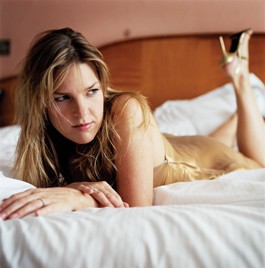
Scarlett Johansson Takes Our Advice

2

I know we all weighed in on the mostly forgettable Scarlett Johansson album in last week’s Bohemian, but I never expected she’d read the reviews, consider our rapier criticism, and tighten up her act. But lo, here it is, Johansson performing “live” (yeah right) and though it’s still kinda like, whatever, it’s way better and more passionate than the cruddy record. Gone are the excessive vocal effects and the washed-out production, and she seems like she actually cares about the song. Why didn’t she just do this in the first place?

Poco Persevere

0

05.21.08

Poco is a case study in perseverance. Formed from the remnants of Buffalo Springfield in 1968, the upbeat country-rock band recorded a series of well-liked but not terribly strong-selling albums. As the ’70s wore on, key members Jim Messina, Richie Furay and Randy Meisner sought, and mostly found, greener pastures elsewhere, eventually leaving Rusty Young as the last original member. He still is.

The 12th record Poco had released, Legend, included “Crazy Love” and “Heart of the Night,” two back-to-back Top 20 hits that dramatically revived the band’s fortunes.

“The only reason we’re talking now is ‘Crazy Love,'” Young cheerfully admits by phone from his home overlooking the Missouri forest. “That was our first hit single. It’s a classic, and it still pays the mortgage.”

Although they never reached that pinnacle again, Poco have remained active, playing 40 to 50 shows each year, a level of activity that Young laughs is “plenty for me.” The current edition of the band plays the Mystic Theatre on May 22, and it’s a given that their two signature hits will be on the set list; the long, lean years gave Young a rich appreciation for the good fortune those songs represent.

And that sets off a story, Young recounting a conversation many years earlier with one of his contemporaries. “It was 3am and I was sitting across the table from Tom Fogerty, and Tom said, ‘I’m quitting Creedence Clearwater.’ And you know, Tom didn’t write the songs, he didn’t sing, he played rhythm guitar. He was making a gazillion dollars, and I didn’t see his future as being particularly bright if he quit. And I said, ‘I can’t believe you’re going to quit, Tom. What’s up with that?’

“And he said, ‘If I have to play “Proud Mary” one more time, I think I’ll kill myself.’

“I told him, ‘If we had a song like “Proud Mary,” I’d do like Hank Williams did with “Your Cheating Heart,” I’d open with it, I’d play it in the middle of the set, I’d close with it and it would be the first two encores.’ That’s how I feel about ‘Crazy Love.’ I can’t imagine not playing it in concert.”

As the story suggests, Young is a ready raconteur. No wonder he’s putting the finishing touches on his musical memoirs.

“I’ve been in this band for 40 years,” he says. “I’ve got Elton John stories, Keith Moon stories, backstage stories that people haven’t really heard. And over the past 20 years, we’d be sitting around a dinner table or at a bar and I’d start talking about, say, the session I watched with Keith Moon. And people started telling me, ‘You ought to write these down.’ So that’s what I’m doing.”

An early chapter will likely revisit the path that brought Young from Colorado to Los Angeles to contribute some pedal-steel work to Buffalo Springfield’s Last Time Around LP and how that led to his role in Poco.

“An audition was set up with Gram Parsons,” he says, “because he was going to start a new band. But I blew off the audition because Jimmy and Richie and I just hit it off—we had a lot of things in common, goals and musical history, and the Springfield was breaking up and they were going to start a new band and it was just a perfect match, so I went that way.”

Later, however, he says, “Gram Parsons came back and auditioned to be in Poco and that didn’t work out as well. That’s all in the book.”

Young in print vows not to pull any punches. “I just read so many autobiographies that I felt were unsatisfying because they gloss over things and they don’t really tell the stories,” he explains. “They’ll say something like, ‘I had a really rough flight over to France,’ and it’ll be somebody I know, and I was on that flight, and they had more than a rough flight—they left the airplane in handcuffs!”

Poco play Thursday, May 22, at the Mystic Theatre, 23 Petaluma Blvd. N., Petaluma. 8pm. $23. 707.765.2121.


If You Build It

05.21.08

Rumor has it that new downtown Windsor, called Old Town Windsor and once touted as breathing fresh economic life into the town, isn’t working. Buildings stand empty. Stores have gone out of business. Not enough people are shopping or maybe the rents are too high or maybe small towns need to be built with locals in mind rather than a projected tourist industry. With such a nearby example of a revamped downtown gone bad, one could wonder what, exactly, is driving the green city council of the small town of Sebastopol to consider a similar endeavor.

Yet considering it they are. Though most of us do not frequent enough city council meetings to be really on top of the issue, the rustling of local dissent has grown loud enough that even those removed from city politics are beginning to ask, what is this Northeast Plan, exactly? And even more importantly, should we be worried?

According to Magick, a mono-monikered member of the Sebastopol Preservation Coalition and a willing consultant on this issue, we should be worried. Magick and I meet at Infusions tea shop to discuss the plan. As we drink our tea, Magick explains the situation, referring periodically to three massive books she has brought with her, including the general plan and the Northeast Plan’s EIR. The more she elaborates, the greater my sense of unease. I happen to like the small, eclectic shops that dot Sebastopol’s Main Street. I don’t need a new downtown, a fancier downtown, a Laguna de Santa Rosa&–smothering, water-sucking, traffic-congesting downtown.

The land in question comprises 52 acres in the lower half of the northeast area of Sebastopol. Most of it is in a flood zone, an earthquake zone and a liquefaction zone—think earth shaking and sliding away all at the same time. The Northeast Plan is not a development project, per se. What it does is change the city’s general plan in order, some would posit, to allow for a certain set of developers to have their way with what is now a fairly open area decorated with mostly defunct warehouses.

The changes would include circumventing the current 25-unit-per-year growth limit to allow for the creation of over 300 dwelling units designed in the form of four-story buildings. Changes to the general plan also include Sebastopol’s “level of service” rating, which measures the congestion of an area based on stoplight wait times. If the development goes through and 8,000-plus daily car trips are added to the already congested streets, Sebastopol’s major intersections would all be demoted to an F. Solution? Dispose of the level of service.

Though few Sebastopol residents would deny the woeful lack of living arrangements in this beautiful town, putting in living units priced at over $500,000 a piece is hardly helping the low-income strata. How 391,000 square feet of retail/commercial space, including another hotel, could add to the beauty of the community is also highly debatable. Magick assures me that the coalition is not buying the idea that the new plan is environmentally sound just because the buildings will be “green.” This is yet another example of “sustainability” being tossed around like popcorn: it’s vacuous in nature and prone to getting stuck in your teeth.

With a projected 250 new parking spaces, changes in growth management, four-story buildings built on top of 10 feet of fill, up-scale retail and the further drain on the city’s water supply, using green building supplies hardly qualifies the project as “sustainable.” The coalition believes that this land should be returned to wetlands where possible, and that permeable constructs should be erected in the flood zone. They would welcome the creation of a community garden, a year-round farmers market, parks and an amphitheater.

Any building or reuse of current buildings could be done above the flood zone with actual affordable housing, incubator businesses and the preservation of light industry. Thus far, 24 local businesses have signed a petition requesting a new economic study, because they fear the competition and undercutting of prices brought in by chain stores and tourist-oriented businesses.


There is a large monkey tree on the corner of Morris Street. On this tree, way up near the top, is a large yellow ribbon. The ribbon is an indicator. This is what four stories looks like. Go to the monkey tree, look up, then glance across the open lots, and try to imagine them filled with buildings. If this is a disconcerting image, then be sure to attend the final city council meeting addressing this issue. The planning commission has already passed the Northeast Plan.

 June 3 at 7pm at the Sebastopol Community Center, the city council will be holding its next meeting. Exact meeting times can vary slightly. Be sure to attend and have your voice heard. For details, contact Magick at 707.824.1394.


In a Quiet Way

0

05.21.08

As one of the most popular draws in popular music—not only here, but around the globe—Diana Krall makes a special return to the Sonoma Jazz + festival this weekend. The alluring jazz songstress appears on May 24.

Introduced to the jazz world with a pair of intimate trio albums, the blonde Canadian branched out in 1999 with When I Look in Your Eyes. Orchestrations by Johnny Mandel along with Krall’s sultry vocals and Grace Kelly&–like countenance took the album’s record sales into the stratosphere, and the album won Krall her first Grammy award.

Ironically, when she was discovered by jazz drummer Jeff Hamilton in her homeland, she was pounding the keys—she didn’t really sing. While doing solo piano gigs at a restaurant, jazz greats the L.A. Four, with Hamilton and legendary bassist Ray Brown, showed up one night; they were performing in a club down the street. The next evening, the entire group had dinner at Krall’s parents’ house and, as she tells me on the phone, “they talked about my future. It was exciting.”

I ask if it was true that there was hesitancy on her part to start singing, and after a very long pause, she answers. “Uh . . . yeah. I wanted to sing like Sarah Vaughan! At 20 years old, I didn’t know my style. I’d think, ‘If I don’t sound like Sarah, I’m not any good.’ I still don’t have the greatest instrument in the world. I guess it’s unique, I don’t know.”

She stops and reconsiders. “It’s not unique,” she laughs. “I sound like my grandmother!

“When you’re young, you try to sound like somebody else,” she continues. “You’re trying everything. I finally decided I was just gonna sing.” She says that she only began to relax about her vocals during the When I Look in Your Eyes sessions. “I’m never satisfied, but I started to feel more comfortable.”

Krall’s early piano influences include the barrel-house style of Fats Waller and the stride playing of Hank Jones. Teddy Wilson, Red Garland and Oscar Peterson are among her other favorites. The music of Bill Evans took her through high school.

I mention that I’ve certainly heard the Evans influence, but that Fats Waller had eluded me while listening to her music, until I heard the bass line from her recording of “I Can’t Give You Anything But Love.”

“That’s exactly where I got it,” she says.

Krall’s also listened to a lot of Elton John. “I just saw him [perform],” she says. “There’s no one like him. He’s amazing, especially doing boogie-woogie. He dedicated a song to me!”

Elton John’s estate is where Krall tied the knot, in 2003, with Elvis Costello, in a pairing that reminds some of the Julia Roberts and Lyle Lovett coupling. These not-so-strange-bedfellows, along with their young twins, have managed to carve out a family life that involves constant touring and endless recording by both parents. They’ve also influenced each other’s music. In 2004, Krall released The Girl in the Other Room, featuring, for the first time, songs she had written, one with lyrics from Costello. It also featured the single “Temptation” written by Tom Waits, a record still on the playlists of local radio stations.

But her core repertoire remains the standards. I ask how hard it is to record a song like “I’ve Got You Under My Skin,” the Cole Porter classic forever remembered as one of Frank Sinatra’s most loved records. “Every tune in some quiet way is a tribute to somebody else,” she says. “Everything I listen to is put into what I do.

“I know Sinatra’s version like the back of my hand, every bump and move, I’ve listened to it over and over again. The fun of it is to do something different, but to keep a little of its spirit. Frank’s version is very upbeat. We took it down and changed the lyric. I’ve always messed with tempos—tempos are everything. You can change the whole mood of a piece. You can go from one story to another just with a tempo change.”

Now 43, marriage and motherhood have slowed Krall’s tempo a bit, but a new album is in the works, and after her show in Sonoma, she’s off to Europe for jazz festivals throughout the summer. She’s not concerned about the busy schedule. “I never think anything to death,” Krall says easily. “I have my own quiet way of thinking about things.”

Diana Krall appears Saturday, May 24, at the Field of Dreams as part of the Sonoma Jazz + series. 151 First St. W., Sonoma. The incredible duo of Taylor Eigsti and Julian Lage open the show at 6:30pm; Krall plays at 9pm. $60&–$110. 866.527.8499.


Rockin’ This Vote

0

05.21.08

On June 3, the people of Sonoma, Marin and San Francisco counties will select the Democratic Party nominee for State Senate, which is the same thing as electing a senator, since Bay Area Republicans are as rare as rattlesnakes. Many years ago, the Burton Brothers machine carved out our weirdly shaped senatorial district to protect the Burton brand of liberalism: promoting socially conscious and pro-labor legislation while wallowing in overpriced public works projects and practicing cronyism.

Our sitting senator, Carole Migden, was nurtured by the Burton machine, as was her opponent, San Francisco assemblyman Mark Leno. But the third candidate in this race, Joe Nation, as his campaign funding reports show, is a creature of the RAND Corporation, Chevron, Dow Chemical, ExxonMobil, Coca-Cola Corp., the ultra-right-wing American Enterprise Institute and the health insurance industry. Locally, he is funded by Pflendler Ranches, Basin Street Properties and bankers with ties to Rohnert Park casino interests, such as Clem Carinalli.

Let me be clear: Migden must go. She was recently fined $350,000 for using campaign credit cards for hundreds of thousands of dollars in personal expenses, and concealing $1 million in donations. Migden’s malfeasance is not a mere technicality. Were she not a state legislator, she would stand accused of a white-collar crime.

On the other hand, I have observed Assemblyman Leno since Willie Brown appointed him to the San Francisco Board of Supervisors in 1998. Frankly, he surprised me by quickly becoming his own man. I have learned to respect his integrity and the political savvy he has shown taking the lead on such vital issues as marriage equality and fiscal responsibility. Vote for him, not the corrupted, vainglorious Migden.

And under no circumstances should one cast a vote for Joe Nation. When Nation ran for Congress in 2006, I interviewed him at length. His “signature” issue, then and now, is opposing single-payer healthcare by proposing phony “universal” healthcare plans that are ploys concocted to derail genuine healthcare plans. Nation’s current Trojan horse healthcare plan is designed to primarily benefit the clusters of insurance companies, pharmaceutical corporations and medical groups that are stuffing thousand dollar bills into his half-million dollar campaign purse.

In the Assembly, Nation has twice proposed legislation designed to kill genuine healthcare bills. His AB 1670, which failed in committee, would have ordered every person in California to buy a commercial health insurance policy with a deductible of up to $5,000. Those without coverage would have their tax refund seized—a disaster for poor people. After Nation’s bill was shot down, he resurrected it, with changes, as AB 1952.

In addition to forcing people to buy health insurance (without doing anything about the ever-inflating costs of medical care), the new bill proposed to fine people who do not obtain health insurance—at prices set by the insurance cartel—by fining them twice the cost of the average premium. The insurance industry, of course, adores compulsory premium paying, and Nation is their running dog.

Furthermore, this RAND Corporation&–employed candidate has reinvented himself as a “climate change advisor.” (RAND was responsible for designing the defoliation of Vietnam during the 1970s, and it currently profits off causing pain in Iraq.) Nation moonlights for an international consulting firm called Environ. That privately owned company counsels industrial corporations, Fortune 500 types, on how to protect corporate interests in a world increasingly hostile to degrading the environment by emitting greenhouse gases.

In a telephone interview, Allan Delorme, an owner of Environ, declined to name his client list or to say anything about Nation’s work for Environ, except that it is performed “as needed.” One of Environ’s specialties is negotiating the sale of corporate carbon pollution credits called “cap and trade.” Environ’s Nation calls for dealing with global warming by selling these carbon emissions credits.

His top legislative agenda, he says, will be enabling the sale of pollution credits from one polluting corporation to another polluting corporation. Say, for example, that ExxonMobile befouls the air in one state at 100 tons a day less than normal. It can sell a “right to pollute” to Dow Chemical so that Dow can pollute 100 tons a day more than normal—perpetuating global warming!

According to an article on carbon markets in the December 2007 Scientific American, responsible scientists and politicians (unlike Environ and Nation) are calling for an end to pollution credits. The best way to combat global warming, scientists say, is to tax corporations for emitting carbon: “[C]ap-and-trade systems hinder planning. Tax systems reduce opportunities for political favoritism and corruption.”

Enough said.


 A former ‘Bohemian’ columnist, Peter Byrne is currently at work on a book for Oxford University Press about famed physicist Hugh Everett III.

Open Mic is now a weekly feature in the Bohemian. We welcome your contribution. To have your topical essay of 700 words considered for publication, write [ mailto:op*****@******an.com” data-original-string=”7Dgo9DXpBA/XOtS103XB8w==06aGxA1AGyJIZa3YpFhqvDQBENK6eO3h9nUW9WTrk8OJqS1lKSKXvKmezFVVuJAipVHve/Ey4VZv0wg/7qvLDqq+M/3lrsUq/jcqgaKm5bnTws=” title=”This contact has been encoded by Anti-Spam by CleanTalk. Click to decode. To finish the decoding make sure that JavaScript is enabled in your browser. ]op*****@******an.com.


Taking It Slow

05.21.08

Just as European nations are protecting their Champagne and Parmesan and Port from generic designations unrelated to geography, so too are American providers beginning to understand that what is produced exactly and only here is unique and worthy. That’s where the Slow Food Nation steps in. Working outside of, say, such besmirchments as the 2008 Farm Bill, SFN works to “inspire and empower” Americans, it says, to rebuild our food network, returning it from a mass distribution system that grossly impacts the planet to the simpler days when agriculture and consumption were cleaner and fairer.

Slow Food Nation’s inaugural event is slated for Labor Day weekend in San Francisco’s Ft. Mason and the downtown Civic Center area. Featuring such reliable speakers as Marion Nestle, Michael Pollan, Wendell Berry, Slow Food’s own Carlo Petrini, Alice Waters and others, this three-day celebration of real food by and for real people will also offer a marketplace, a tasting pavilion and even an old-fashioned victory garden to be planted in the city’s center; a dinner for 500 will be held around that garden.

Speaking of that hateful real Farm Bill, the one that rewards factory farming, allows subsidies for wealthy growers and is generally a meal ticket to those who need it least, SFN will offer a ceremonial presenting of a “model” farm bill that outlines what such a government doc would resemble were it truly by and for the people. Expect to see plenty of North Bay neighbors at this event, from the Russian River Slow Food chapter to many local providers. Most events at this three-day fandango are free, but some warrant ticket purchase now. For details, go to [ http://www.slowfoodnation.org/ ]www.slowfoodnation.org.

Quick dining snapshots by Bohemian staffers.

Winery news and reviews.

Food-related comings and goings, openings and closings, and other essays for those who love the kitchen and what it produces.

Recipes for food that you can actually make.

Three for the Treble

0

05.21.08

Hip-hop is full of shoulda-beens. Currently filed in Los Angeles’ urban dead letter office is an expertly crafted recording representing the multiracial makeup of that city. Made by a black and Asian rapper with a white DJ, it’s hard to say why the 2005 album Fly School Reunion, by Giant Panda (above), never took off. Throughout, MCs Maanumental and Chikaramanga wrestle the polyrhythmic beats of Newman in pure Angeleno style: smooth, hot and confident, even interpolating A Tribe Called Quest’s “Midnight” (you know the transaction) to pay tribute to the golden era in the “’90s.”

The group releases its follow-up, Electric Laser, this week, and the title reflects Giant Panda’s new chosen sonic turf: lots of synthesizers, lots of electronics. Check ’em out when they perform with Pigeon John, the Crown City Rockers’ Raashan Ahmad, Distant Relatives and Lost Role Models on Friday, May 23, at the Raven Theater, 115 North St., Healdsburg. 8pm. $20. 707.433.6335.

Sebastopol’s own Smoov-E has occupied a similar spot of obscurity in Bay Area hip-hop, with the usual reason offered (“He’s white”) that unfairly simplifies his unique aesthetic as the Ron Jeremy of hip-hop. Not hard enough for the gangsta contingent, yet too persona-driven for the backpackers, Smoov-E may be the tightest dude ever to actually rock a player piano and a bullhorn.

Sex plays heavily in Smoov-E’s raps, but within that approach his methods are as tricky as a pick-up artist; he’s international spy Long Duck Dong one second, ’70s disco king Larry Dallas the next. His latest incarnation, Rusty Squeezebox, “the Fornicating Cowboy,” debuts on Saturday, May 24, at the Raven Theater, 115 North St., Healdsburg. 8pm. $20. 707.433.6335.

Finally, to fully spin heads into a tizzy, the affable and laid-back Devin the Dude comes to town this weekend in a rather underpromoted but no less exciting North Bay debut. The Dude pops up in the zaniest places—on Carson Daly, in Treal TV and on Dr. Dre’s Chronic 2001 album, wedged, for one brilliant verse, between Snoop and Dre—and this weekend, he’s at the Flamingo Hotel, of all places. Pool party afterwards, by chance?

With one of the most conversational styles in hip-hop, the Texas prattler eschews an aggressive flow for a more ruminative, distracted result; his awkward pauses are as much a part of his success as an MC as his humorous outlook. Devin’s the only rapper ballsy enough to name his album To the X-Treme after Vanilla Ice’s best forgotten crapolafest, and “Doobie Ashtray” is a comical, in-the-know description of herb gettin’ ganked by roommates. He appears with guest DJs and comedians on Friday, May 23, at the Flamingo Hotel, 2777 Fourth St., Santa Rosa. 7pm. $30&–$35. 707.545.8530.


Vital Vacation Vittles

0

05.21.08

Apples, milk and chicken. Yucky-fun insect stuff. Soccer. Puppies and their trainers. Stuffed birds, Hula-Hoops, gooey arts, awesome crafts, freebie books. Kids can enjoy all this and oodles more by simply showing up for lunch at one of 33 Sonoma County sites hosting Redwood Empire Food Bank’s Summer Lunch Initiative.

As our national economy continues its depthless dive, doubtless determined to sleep down there with the fishes, an ever-mounting strain is placed on public services, particularly for those most affected by program cuts. And that would be kids, little ones with mouths to feed and bodies to grow.

For the last five years, the Redwood Empire Food Bank has organized hundreds of volunteers serving tens of thousands of hot meals to hungry kids throughout Sonoma County. Their Every Child, Every Day program is designed to fill summer’s three-month respite when students who’d enjoy free or reduced-price lunches during the school year fall into a dark nutritional sinkhole.

According to REFB executive director David Goodman, summer means “nearly 20,000 kids are left without.” Goodman adds how everything worsens for low-income families in belt-tightening times like this. The food bank’s lunch program is one small remedy addressing the needs of the many. “Our summer lunch program,” Goodman says, “is increasingly important to the well-being of the children and the community.”

Jill Barron is REFB’s community programs coordinator. A Sonoma County native who returned home after completing her degree in community studies at UC Santa Cruz, Barron stresses the county’s need for the five-year-old program, noting that it’s grown from serving 40,000 meals in 2006 to over 53,000 last year. She’s enthusiastic about the work she does. “I’ve always had an interest in nonprofits,” she says. “I worked for the YMCA and really enjoyed going to work each day.” Barron leads a team of five REFB staffers coordinating the efforts of over 150 volunteers at sites in Santa Rosa, Healdsburg, Rohnert Park-Cotati, around the Russian River and in Petaluma.

The Redwood Empire Food Bank’s Summer Lunch Project runs from Monday, June 9, through mid-August at 33 different sites. For volunteer information or to learn where to go to eat, call Jill Barron at 707.523.7900, ext. 34.


Muchos Gracias

05.21.08

I congratulate Bruce Robinson and you for the column summarizing Judge Tansil’s recent ruling and the events of the past few years with regard to KBBF-FM radio station in Santa Rosa (“Clearing the Air,” Blast, May 7). This bilingual public radio station, the first in the nation, is a treasure that needs attention and nurturing from our many citizens, both English- and Spanish-speaking. There will be another election soon, and it is an opportunity that invites good reporting and citizen participation.

I sincerely hope that you will continue to have coverage so that the community can understand the issues in depth, and be fully able to take action to preserve and develop what should be a community resource, building bridges across languages and cultures, and especially providing essential information to the Latino, Chicano and all indigenous peoples of Sonoma County.

Ann Tompkins

Santa Rosa

Great story here by P. Joseph Potocki (“We Are Family?” April 30). This is the sort of story that is usually under-researched and deserves a closer look. Costco’s practice of spinning off separate companies to work in its stores allows it to have its cake and eat it, too. The demonstrators don’t eat quite as well, and the rationale is offered that the income for them is merely supplemental. Not a pretty picture, but an accurate one. Thanks for publishing work of this quality.

Jeff Fletcher

Weaverville, N.C.

How can we miss him if he won’t go away?

 Alex Easton-Brown

Lagunitas

This may be too Orwellian for some people, but it may appeal to those sharing my cynicism regarding the pandering of all the potential presidential candidates.

The only absolute truth we know about them is their body type and appearance. You want a pear-shaped, 60-year-old white woman or a tall, thin, youngish dark man or a 72-year-old, hunched-over, arthritic white guy? Wait until they match up with their vice-presidential candidates to make your final choice; opposites may attract.

Working this premise, pundits would probably find that each “type” of candidate has a subliminal appeal to his or her body-type look-alike no matter what they do—or don’t—promise.

Meaning, Tom Cruise and Pamela Anderson are not electable.

neil davis

Sebastopol

I would like to take a moment to share the positive experiences that I have had with Valerie Brown over the past 20 years. I met Valerie in 1998 when she was an active board member of the Sonoma Valley farmers market. In 1990&–1992, when Valerie moved on to the city council, she was present when we had community issues arise, including supporting the Sonoma Community Center, the Vintage House, Valley of the Moon Boys and Girls Club and Sonoma Valley High school among others. Valerie was appointed in 2002 to the Sonoma County Board of Supervisors, where she has been a strong voice and supporter of the Sonoma Valley.

I see Valerie in our community at the Glen Ellen Fire Department pancake feed, the Boys and Girls Club auction, the Sonoma Valley farmers market, town hall meetings, school fundraisers and in our town, dining at our local restaurants. Valerie is a true representation of Sonoma Valley, and I proudly take this opportunity to voice my support. I encourage you to vote for Valerie Brown.

Sheana Davis

Sonoma


Food writers, put down that fork and pick up that mouse! We need you. Please send a short, graceful note to ed****@******an.com introducing yourself and explaining why you should be able to chew not only on, but for, the Bohemian. Clips, links and other past expressions of the written word that reflect kindly upon your freelance talents are hugely welcomed. No calls, please. We’re way too cranky.


&–&–>

Who’s Minding the Kitchen?

0

05.21.08


Use your fingers. I don’t care if you burn them, you weren’t given fingers not to burn them.

—Chef Marco Pierre White, White Heat

Anyone who watches the Food Network knows that professional chefs work their magic with bare hands, citing the increased dexterity, tactile finesse, speed and even safety that skin provides over rubber or metal.

And with the proliferation of exposition kitchens in restaurants, diners may be seeing the barehanded magic up close. Yet in the eyes of national restaurant inspectors, these chefs are no artists. They’re a potential health hazard, and what they’re doing is against the law. Since the Federal Food and Drug Administration’s most recent food code was issued in 2005, bare-hand contact has been prohibited for commercial kitchen personnel. The rules are clear: gloves or utensils, such as tongs, are required when handling anything ready-to-eat.

Unless you’re a California chef.

Because in a compromise reached last summer between the State of California Food and Drug Branch and the FDA, Golden State restaurant workers have been granted special permission for bare-hand contact.

Under the new California Retail Food Code (Cal Code) that went into effect last July, how a chef handles food is now up to his or her preference. That means food can be touched with naked fingers, then sent out for immediate consumption by a diner.

California may be the first to adopt such lenient guidelines; the FDA allows variance within its codes for states, and even for the 58 counties within California. Many chefs are cheering, but some are ready to throw up their hands—bare or gloved—as they try to figure out how it all really works.

Long Hand of the Law

The FDA Food Code prohibits bare hand contact with ready-to-eat foods under section 3-301.11 Preventing Contamination from Hands.

—Lisa Whitlock, regional food specialist, FDA, email March 8, 2008

The bare-hand issue is nothing new. Extensive FDA research concludes that many viruses are spread through hands, and food is an excellent vehicle for pathogens, so workers are required to use serving utensils, tongs, single-use gloves, deli tissue or dispensing equipment when touching it.

When the new Cal Code went into effect, however, it replaced the California Uniform Retail Food Facilities Law (CURFFL) as the governing legislation for retail food facilities throughout the state. The goal was to update food vendor rules to bring them in line with national guidelines focusing on current risk factors for food-borne illness as identified by the Centers for Disease Control.

It was an enormous undertaking, spanning a full decade of discussion between numerous boards and restaurant industry professionals throughout the state. When the California Department of Public Health drafted the final language, it resulted in an exhaustively detailed 132-page manual.

Before it was unveiled, chefs and kitchen workers were encouraged to attend county food handler’s programs outlining the changes. There they learned that while the Sonoma County Environmental Health Division (SCEHD) now “discourages” using bare hands, according to division director Walter Kruse, it does in fact allow it.

Except that maybe it doesn’t. Or maybe, depending on how you interpret CURFFL, it has all along.

Gloves Are Off

A busy North Bay cafe sports a novelty sign in its front window reading, “Sorry We’re Open.” Guests sit at a counter overlooking a tiny open kitchen, watching the chef prepare a full carousel of tickets. She scoops a handful of fresh greens to a plate, and then dumps a bowl of fried calamari over it. She slices some bread, tosses frozen french fries into bubbling oil, then turns to answer the phone.

The call finished a few moments later, she slices some raw chicken and puts it on grill, takes toasted bread off a neighboring burner, picks a few slabs of bacon out of a package and wipes her chin with the heel of her hand. After dragging her hands down the front of her apron, she salts some raw burger, drops the patty on the grill, slices a chunk off an enormous piece of raw tuna, then builds a chicken sandwich, piling cooked bird, lettuce, avocado and cheese over the toast.

The chef is wearing gloves. Yet throughout an hour-long lunch service, she never stopped to change them. The number of violations that have just occurred are too numerous to count.

It’s a graphic, real-life example of why Cal Code officials rethought the FDA gloved-hand mandate for the new laws. “Gloves can offer a false sense of security,” says the SCEHD’s Walter Kruse. “People think because their skin is insulated, they can’t contaminate.”

Instead, Cal-Code has now toughened its hand washing requirements, within a new, 1,215-word description of what clean hands mean. To not properly wash hands—as when between touching raw and cooked meat—is a “major” violation in the new law.

“The issue we’re concerned about is cross-contamination,” Kruse says. “Hand hygienic practices become the area of concern, [and new] hand-washing procedures and requirements are specified.

“Bare hand is OK,” Kruse adds, “but cross-contamination is not.”

Fingering a Violator

On a busy Saturday night at the West County Grill, the seats at the counter overlooking the exposition kitchen are filled. Mere feet away from the diners, chef Darren McRonald is a dervish in a short-sleeve shirt, black pants and a long white apron. He’s manning a fiery, charcoal hardwood grill laden with perhaps a dozen orders of Fulton Valley chicken, Niman Ranch pork loins and Liberty duck breasts.

He pokes the meat with his fingers, and when a piece of chicken springs back the way he likes, he uses tongs to move it from the flames to a plate. Quickly, his hands almost a blur, he drops the tongs, positions the poultry just so with his fingers, arranges a pile of matchstick potatoes, plops down a bunch of watercress, brushes a stray bit of jus off the plate rim and moves the dish out to service. He wipes his hands on a clean cloth flung over his shoulder, then whirls back to start another set-up.

Since the restaurant opened last spring on the Sebastopol Plaza, the pace has been like this for McRonald and crew, through lunch and dinner, seven days a week. He’s used to the pressure, having worked in the business for more than 20 years, including at Chez Panisse, Napa’s Table 29 and Barbuto and Bellavitae in New York. 

For a guest perched at the dining counter overlooking the exposition kitchen, it’s like watching a frenetic ballet. Later, McRonald is asked if he was aware how much he’d used his bare hands, and if perhaps he shouldn’t have.

Maybe. “I have to admit, I’ve gotten used to doing things a certain way,” he says. “But no matter how busy it gets, we need to be ever mindful and diligent about our actions.”

Then he shrugs. The Cal Code rules can be confusing, he says, on what he’s now allowed to touch, or not to. “I’ve talked to the health department,” he says. “The response I got from them was that they’re not too sure about [all the details] either.

“I moved from New York City two years ago, where the health codes are different,” he continues. “[Last] January, I attended a seminar given by the Sonoma County Health Department where even the health inspectors admitted that there are a lot of gray areas they’ll have to iron out in time.”

No wonder chefs are confused.

The Bohemian contacted a half-dozen California health officials to track down the exact nature of the new guidelines. Inspectors and officers provided often conflicting regulations, contradicting correspondences and bureaucratic language that made deciphering one single question nearly impossible: Are chefs allowed to touch ready-to-eat food with their bare hands?

“It’s important to note that there has not been a change in California law as it relates to bare-hand contact,” wrote SCEHD environmental health program manager Jerry Meshulam in an email dated Feb. 20, 2008. Yet this was as a response to a follow-up question for Kruse’s Dec. 20, 2007, statement that “as to why California decided to allow bare-hand contact, you should contact the State of California Food and Drug Branch within the California Department of Public Health,” the party responsible for drafting the new code language. (Several emails to their communications staff went unanswered.)

Indeed, the new Cal Code section 113961(a), reads, “Food employees shall minimize bare hand and arm contact with non-prepackaged food that is in a ready-to-eat form.”

As Kruse points out, “The word ‘minimize’ is important, because it does not say ‘eliminate.’ Cal Code allows bare hand contact.”

Yet Code F03 &– §114020 of Sonoma County’s own Explanation of Critical Violations warns in very specific terms, “Employees shall use proper utensils (tongs, spoons, spatulas, plastic gloves) to eliminate unnecessary hand contact with cooked and prepared foods.”

If it’s possible for Meshulam to sound frustrated via email, when responding to another request for clarification, he does. “There is no conflict between the older CURFFL wording and the new Cal Code wording. Both allow bare hand contact. The phrase ‘eliminate unnecessary hand contact’ still allows necessary hand contact, under conditions specified in the code.”

Necessary Evil

Well, what’s necessary? Listening to the chefs, it seems that all bare-hand contact is.

As McRonald points out, “If you’re wearing gloves, that sometimes causes you to wash your hands even less, because you’re unaware of how your hands feel or what’s on them.” He adds that he does use gloves for handling raw chicken, but otherwise finds them restrictive.

“I’m sort of old-school in that I like hands for certain things I know,” he says.

Some chefs feel gloves are unsafe, noting that they can numb feeling and cause knife cuts. Rubber or latex can melt around a hot stove. And they can be impractical, says Mateo Granados, chef-owner of the eponymous catering company in Healdsburg. “It is much harder to change gloves than to wash hands. It can slow down production in a busy restaurant. Wearing gloves also limits artistry, because you lose sensitivity to feel temperature or assemble dishes,” he says.

“My feeling is that it is much better to work with your hands,” agrees Douglas Keane, executive chef and co-owner of Cyrus in Healdsburg. “Cooking is often based on feeling how something is finished, and you learn from an early age as a cook to touch and feel. Gloves take the personal feeling out of it. If you make a cook cover their hands, you may as well blindfold them, too. I am actually baffled that this law exists.

“How can you dress a salad and feel if it is coated perfectly when you have gloves on?” he continues. “You would have to put some of the salad in your mouth and taste it. You are going to use your gloved hand and put it to your mouth and then use the same gloved hand to redress the salad if any modification is necessary—it just doesn’t make sense.”

It also doesn’t necessarily go appreciated. “You get customers calling and asking if you wear gloves in the kitchen,” McRonald says. “And then they’d say, ‘Well, we can’t eat there because we have a latex allergy.'”

Tong vs. Right

Utensils aren’t the solution either, chefs and county officials agree. “Do they say you can’t use the same tongs for chicken and steak? Use different spatulas for turning fish versus turning poultry?” McRonald asks. “If a chef is using tongs for handling food, does he need to disinfect the tongs between use of raw and ready-to-eat foods?”

The SCEHD’s Kruse says, “The preferred method would be to have separate tongs for raw meat, for example, and cooked meat, rather than relying on the employee to stop and wash, rinse, sanitize the utensil between uses.”

Tongs can ruin food, says Granados, who has worked at Charlie Palmer’s Dry Creek Kitchen, San Francisco’s Masas, 42 Degrees, Alain Rondelli and Rubicon, as well as Manka’s Inverness Lodge. “In my experience with fine dining,” he says, “everyone has their own spoon, with washing in between tasks.”

Keane, too, uses spoons instead of tongs, so as not to “rape” the delicate food.

Yet even the biggest arsenal of utensils doesn’t guarantee perfection. At a Scottsdale resort recently, a Food Network Iron Chef laughed and pointed to a pile of spoons sitting on his workstation during a cooking demonstration. He’d just stuck his forefinger into a blender of pear balsamic vinaigrette, then into his mouth for a taste. “I have to stop and pause for a spoon,” he shrugged. “My hands, they’re always with me.”

Cleanliness Next To?

Food employees are required to wash their hands with cleanser and warm water by vigorously rubbing their lathered hands and arms for at least 10 to 15 seconds and rinsing with clean running water followed by drying of cleaned hands.

—Cal Code, Section 113953.3

At Go Fish in St. Helena, a trio of chefs decked in crisp whites and black caps work quickly and quietly behind the sleek marble sushi bar, rolling rice bundles in bamboo mats and slicing exquisite cuts of silky bluefin tuna belly. Their hands are bare and as softly pink as the salmon sashimi they lay out on the glistening steel countertops.

Every few minutes, they glide their hands under sinks at their station, scrubbing like surgeons with soap from a turquoise pump. They pluck a disposable towel from a pile, rub thoroughly and then drop it in the trash.

Their ritual should pass muster with the pickiest health inspectors, and is a perfect example of why bare-hand contact with ready-to-eat foods can benefit both chefs and diners. According to Kruse, “It is the scrubbing action of rubbing soapy hands together and running water that washes dirt and other contaminants away.”

Regulated or not, it’s what the best professional chefs are doing anyway.

“I worked at Le Cirque, and every shift we would have to present our hands to the chef,” McRonald remembers. “Hand checks like in the military. They’d look clean, he’d check our nails. We’d keep nail brushes by our hand sinks.”

Ultimately, whether or not California actually has introduced groundbreaking rules with its bare-hand contact regulations isn’t clear. Meshulam directed the Bohemian to the FDA’s Whitlock, who in turn directed the Bohemian to Meshulam. Yet it seems it would be a good thing for them to take credit for.

Meanwhile, the county continues to monitor kitchens by instructing inspectors to watch chefs at work, weighing their feedback and sending the kitchen staff scurrying.

“I think the inspectors are doing their best to work with us, trying not to make anyone angry,” McRonald says. “It’s a tough position.”

Quick dining snapshots by Bohemian staffers.

Winery news and reviews.

Food-related comings and goings, openings and closings, and other essays for those who love the kitchen and what it produces.

Recipes for food that you can actually make.

Scarlett Johansson Takes Our Advice

I know we all weighed in on the mostly forgettable Scarlett Johansson album in last week's Bohemian, but I never expected she'd read the reviews, consider our rapier criticism, and tighten up her act. But lo, here it is, Johansson performing "live" (yeah right) and though it's still kinda like, whatever, it's way better and more passionate than the...

Poco Persevere

05.21.08Poco is a case study in perseverance. Formed from the remnants of Buffalo Springfield in 1968, the upbeat country-rock band recorded a series of well-liked but not terribly strong-selling albums. As the '70s wore on, key members Jim Messina, Richie Furay and Randy Meisner sought, and mostly found, greener pastures elsewhere, eventually leaving Rusty Young as the last original...

If You Build It

05.21.08Rumor has it that new downtown Windsor, called Old Town Windsor and once touted as breathing fresh economic life into the town, isn't working. Buildings stand empty. Stores have gone out of business. Not enough people are shopping or maybe the rents are too high or maybe small towns need to be built with locals in mind rather than...

In a Quiet Way

05.21.08As one of the most popular draws in popular music—not only here, but around the globe—Diana Krall makes a special return to the Sonoma Jazz + festival this weekend. The alluring jazz songstress appears on May 24.Introduced to the jazz world with a pair of intimate trio albums, the blonde Canadian branched out in 1999 with When I Look...

Rockin’ This Vote

05.21.08On June 3, the people of Sonoma, Marin and San Francisco counties will select the Democratic Party nominee for State Senate, which is the same thing as electing a senator, since Bay Area Republicans are as rare as rattlesnakes. Many years ago, the Burton Brothers machine carved out our weirdly shaped senatorial district to protect the Burton brand of...

Taking It Slow

05.21.08Just as European nations are protecting their Champagne and Parmesan and Port from generic designations unrelated to geography, so too are American providers beginning to understand that what is produced exactly and only here is unique and worthy. That's where the Slow Food Nation steps in. Working outside of, say, such besmirchments as the 2008 Farm Bill, SFN works...

Three for the Treble

05.21.08Hip-hop is full of shoulda-beens. Currently filed in Los Angeles' urban dead letter office is an expertly crafted recording representing the multiracial makeup of that city. Made by a black and Asian rapper with a white DJ, it's hard to say why the 2005 album Fly School Reunion, by Giant Panda (above), never took off. Throughout, MCs Maanumental and...

Vital Vacation Vittles

05.21.08Apples, milk and chicken. Yucky-fun insect stuff. Soccer. Puppies and their trainers. Stuffed birds, Hula-Hoops, gooey arts, awesome crafts, freebie books. Kids can enjoy all this and oodles more by simply showing up for lunch at one of 33 Sonoma County sites hosting Redwood Empire Food Bank's Summer Lunch Initiative.As our national economy continues its depthless dive, doubtless determined...

Muchos Gracias

05.21.08I congratulate Bruce Robinson and you for the column summarizing Judge Tansil's recent ruling and the events of the past few years with regard to KBBF-FM radio station in Santa Rosa ("Clearing the Air," Blast, May 7). This bilingual public radio station, the first in the nation, is a treasure that needs attention and nurturing from our many citizens,...

Who’s Minding the Kitchen?

05.21.08Use your fingers. I don't care if you burn them, you weren't given fingers not to burn them.—Chef Marco Pierre White, White Heat Anyone who watches the Food Network knows that professional chefs work their magic with bare hands, citing the increased dexterity, tactile finesse, speed and even safety that skin provides over rubber or metal. And with the...
11,084FansLike
4,446FollowersFollow
6,928FollowersFollow