Flyin’ to Rio

0

05.28.08


For all the talk about marijuana expanding one’s mind, it’s amazing the quantity of stale repetition in hip-hop that is passed off as the new style by blunt-wielding beatheads. Enter a much-needed revolutionary, a sativa savant currently at the forefront of hip-hop production who calls himself Madlib. Or Quasimoto. Or DJ Rels or Malik Flavors or Monk Hughes, or one of any 31 other aliases.

Born Otis Jackson Jr., the 34-year-old Los Angeles&–based producer has single-handedly broadened the horizon of what’s possible in hip-hop production at large. When I saw him in 2004 at a sold-out record release show for Madvillainy, the sprawling masterpiece he created with the mush-mouthed Atlanta rapper MF Doom, he spent 15 minutes giving his fans a lesson in jazz. “Y’all into McCoy Tyner?” he asked to a mostly unresponsive crowd. He played a minute or so of Tyner’s “Atlantis” from the DJ stand, quickly flipping through his stack of LPs. “How ’bout Sun Ra?” Same reaction, same determined result: Madlib was out to drill jazz into hip-hop’s collective head, one minute at a time.

Madlib is always flipping the stack to find the next record, always looking toward what’s next. In his music, the result of his ADD is that he constantly ends his own tracks when he gets bored, usually after only a minute or so. This soured me to his style at first, but lately I’ve been able to hear reticence as an instrument in his productions, a variation of the Count Basie effect, where rests are just as important as notes.

But the real instrument in Madlib’s musical language is irresolution. Whereas most hip-hop emphasizes the downbeat with a kick drum and solid bass, Madlib’s production is instead syncopated and snaky, squirming around on the minor third or the fifth, and rarely does he lock into the pocket of the track’s root chord. Working in such ungrounded fashion opens his productions to a wide palette of possibility, a rarely desired goal of abstraction in hip-hop.

Madlib latest album, Sujinho, which comes out next week under the alias Jackson Conti, is the producer’s excursion into a musical genre viewed by the average hip-hop fan as anathema: Brazilian music. Originating as most Madlib productions do (by going record shopping and obsessing over the day’s finds), the album is a product of luck, tenacity and love. It’s also among his most focused and inspired projects, with the majority of songs timing in at over four minutes—downright epic by Madlib’s clock.

Madlib loves drummers, and goaded by friends while on tour in Rio de Janeiro in 2006, he resolved to track down one of his favorites, Ivan “Mamão” Conti, the trap-kit wizard from the 1970s Brazilian trio Azymuth. (Once, on an obsessed streak, Madlib recorded a series of Azymuth cover songs in his home studio, much to the confusion of his associates.) Once he got Conti on the phone, the two had an instant rapport. The Los Angeles hip-hop maven and the Brazilian jazz specialist hit the studio shortly thereafter, two worlds coming together for one rainy, humid night of inspired magic.

The resultant Sujinho is pure dope. A sonic version of Brazil’s climate, it explores the sweltering sounds of South America to conjure the most tropical translation of Madlib’s singular musical language yet. Some of this is due to famous Brazilian composers like Airto Moreira, Deodato and João Donato, but there’s something else at play as well, a relaxed atmosphere that allows Madlib to open up and exhale. Rio de Janeiro’s pleasant lassitude extends tracks like the 10-minute “Papaya” into a long, languorous groove with sun-streaked guitars and meandering, improvised bass lines, while seven-minute closer “Segura Esta Onda” is a musical morning, day and night all on its own, switching gears and pushing the mercury.

Throughout the album, Conti’s unique rhythms punctuate Madlib’s dreamy sense of chord structure, and once the record was completed, his previously stumped friends signed on as converts. “Music has a beautiful way of making you reevaluate what you may have discarded,” admits hip-hop photographer Brian Cross (B+), now a diehard Azymuth fan. “Madlib is an artist who gives one new ears every couple of years if you choose to pay close enough attention.”

Will hip-hop fans rock Sujinho? It depends on how willing they are to tag along on Madlib’s journey; they’ve already separated themselves when it comes to Madlib’s more jazzy excursions. But with summertime on the rise, Sujinho should be headed straight for the heavy rotation box of those lucky enough to discover its tropical specialties.

With a side of blunts, please.


The Minnow Would Be Lost

0

05.28.08

It’s no secret that one of my favorite concert-going experiences is the Treasure Island Music Festival, a two-day soiree out in the middle of the San Francisco Bay with an incredible lineup and a beautifully scenic setting.

Festival organizers say the choice for Treasure Island was born—even before last year’s inaugural event—purely of necessity. All the viable locations within the city of San Francisco were already spoken for. But the forgotten plot of man-made land in the bay turned out to be one of the most inspired venues in the entire overblown, countrywide festival phenomenon, with the island itself sculpting the unique feel of the two-day experience. Isolated yet metropolitan, the festival provides a paradisaical indie-rock getaway beneath the bustling loom of both the Golden Gate and Bay bridges.

With the organizers also planning the gigantic Outside Lands Festival in Golden Gate Park this year, I expected that a second year on the island might be a sinking prospect. I needn’t have worried. The event, returning Saturday&–Sunday, Sept. 20&–21, will go off as planned and acts were just announced last week.

The lineup on Saturday (the “electronica” day) includes Justice, TV on the Radio, Goldfrapp, Hot Chip, CSS, Aesop Rock, Antibalas and Amon Tobin. On Sunday’s more indie-rock-slanted lineup, it’s the Raconteurs, Vampire Weekend, Spiritualized, Okkervil River, the Kills, Tegan & Sara, Dr. Dog and John Vanderslice.

The setup is unique—there’s no parking out on the island, but the public shuttles work smoothly. Festival-goers ride from the Giants’ ballpark, over the Bay Bridge, to the island. Last year, I never waited for more than 10 minutes in line for the shuttles, and the experience engendered a spirit of community excitement on the way there and back. The grounds, limited by the island, weren’t too sprawling, the sound was great and the added attractions—like an ’80s video arcade and a Ferris wheel—are an inspired touch. You could call it the festival for people who hate festivals, and you wouldn’t be too far off the mark.

Tickets are $65 per day, $115 for a two-day pass, and go on sale Friday, May 30. [ http://www.treasureislandfestival.com ]www.treasureislandfestival.com.


Green Gold

05.28.08

As Tina Montgomery, project manager for the Sonoma Mountain Village, gives me a tour of the Rohnert Park site, which is in midconstruction, I try to keep an open mind. With development, there is always controversy, and I don’t want to be lured into believing that something is a positive action for the community only to discover later that I have been overly gullible, unable to tell the difference between real sustainability and corporate brainwashing.

This isn’t to say that I don’t want to believe. I do. I want to see something good here. We need places to live, especially in the North Bay, but I’m getting a little tired of “sustainable” housing at half a million dollars, no rentals anywhere and “green” living for those who can afford it. I want to see green buildings where I could live, not just my rich neighbors. Sorry to be so selfish, but it’s getting harder and harder to admire how green the wealthy can be. What about me and my family?

I’ve read the stats. Sonoma Mountain Village is the largest privately owned solar installation in Northern California, covering over 88,000 square feet. It will boast a village square with a daily farmers market, a movie theater and environmentally conscious businesses—no big-box stores allowed. There will be a neighborhood grocery store, dog parks, an all-weather soccer field and edible landscaping. The project is pedestrian-oriented and zero waste, with a sustainable water system, affordable-by-design housing, natural habitats and abundant wildlife. But can such a rattle of green faktz be believed?

According to BioRegional Development, an independent environmental group operating out of the United Kingdom, and the World Wildlife Foundation, who have partnered to develop the One Planet Living (OPL) model, Sonoma Mountain Village actually is what it claims to be. As such, it has been certified by OPL, making it the first community in North America, and one of only three officially endorsed developments in the entire world, to adopt the 10 conditions for sustainability outlined by the OPL.

The idea behind the OPL model is that if everyone lived like your average North American, we would need five planets to live on. If everyone lived like your average European, we would need three. If everyone lived by the One Planet model, we would need one, which, I’m sorry to break it to you, is all we actually have.

Until fairly recently, the 200-acre site in Rohnert Park that once housed Agilent Technologies had been an empty wasteland as outsourcing and eventual closure left 3,000 people unemployed and the warehouse-sized buildings empty. Now Sonoma Mountain Village is actively working toward its goal of creating a community of 1,900 homes and over a hundred businesses, all of which will meet the One Planet Living Communities guidelines by the year 2020. This means zero carbon, zero waste, sustainable transport, local and sustainable materials, local and sustainable food, sustainable water, natural habitats and wildlife, culture and heritage, equity and fair trade, and last but not least, the health and happiness of the community members.

Sound ambitious? I would say so, but Brad Baker, CEO of Codding Enterprises, which owns the development, is obviously looking to the future. If developers don’t change their ways, no one is going to buy anything, because we will all be dead.

But what about affordability? Sorry to be stuck on this, but I would love to live somewhere where I can walk everywhere, can eat the bushes, live in a LEED-ND Platinum certified house and not have to feel guilty for breathing. By the time we reach the end of our tour—which includes walking through Codding Enterprise’s on-site recycled steel plant, where eight recycled cars, as opposed to about 43 trees, will be used to make the frame for one home—I’m convinced I’ll never be able to afford it. Add to my low income the fact that everything I’ve seen so far is esthetically pleasing, and that the homes will be designed by different architects to avoid that despicable “cookie cutter” feel, and I figure my chances are about nil.

Montgomery is full of reassurances. For one thing, there will be affordable rentals and for-sale houses that go above and beyond municipal requirements. Affordable-by-design homes are smaller and aren’t as fancy as, say, the one down the street selling for $2.5 million, but they are built with the same level of commitment to efficiency of design, and they are projected to break in around $300,000. Will Sonoma Mountain Village be as irresistible as it promises to be? Only time will tell. For those interested in having a peek, model homes should be ready for viewing in the fall.

For more information on Sonoma Mountain Village go to www.sonomamountainvillage.com. For more information on One Planet Living, go to [ http://www.oneplanetliving.org ]www.oneplanetliving.org.


Planting the Seeds of Crisis

0

05.28.08


T he global agriculture market is busy cooking up a recipe for disaster. World grain production is on the rise, but this cheap oversupply has put millions of farmers in developing nations out of work. Equally problematic, policy makers are increasingly directing edible calories toward biofuels and animal feed. Meanwhile, impoverished humans starve.

At center stage in this misallocation of food is the modern practice of monocropping, or monocultures, in which one plant is sown exclusively. At first glance, selecting for the most lucrative, high-yield variety of plant and covering one’s acreage with it and nothing else seems like a very methodical and sophisticated idea; such crops are easily planted and tended, and entire fields can be harvested in one fell swoop. But monocultures facilitate two serious matters: pests and soil depletion.

The latter results when a farmer perpetually cultivates a single type of plant on a given parcel of land, which steadily drains the earth of a particular spectrum of soil minerals. Eventually, such farmland grows off-balance and may eventually be rendered completely inadequate for agriculture. In fact, experts guess that at its current rate, soil depletion will leave the planet without farmable land in three to five decades, at which point the game will be up for biodiesel engines, cows and human beings alike.

Victory Gardening

John Jeavons, an innovative farmer, lecturer and author based in Willits, says that solutions as simple as home gardening can alleviate such serious problems. Jeavons is an advocate of biointensive farming, an ancient system of agriculture that he has helped rediscover over the last 30 years and which fosters biodiversity, intersperses different crops on small and vibrant plots of land, retains groundwater in the earth and naturally replenishes soils. Jeavons’ hope is to see a return to a local, organic, regenerative farming system in which people everywhere embrace the lost art of growing food.

“With soil loss, the world is entering a new time of crisis,” he says. “But the wonderful thing is that we have the power to change it in our own backyards.”

But is home gardening enough? Can it supply the calories to feed families, not to mention the world? Devlin Kuyek is a Montreal-based researcher with GRAIN (Genetic Resources International), an organization that advocates sustainable agricultural biodiversity. Kuyek says the problems facing agriculture today are global in scale, and that most communities, especially urban ones, have lost all power over where their food comes from.

That, he says, must change.

“People need to start feeding themselves again. The government needs to give people back their lands.”

Once Upon a Time

Localized, diverse, healthy agriculture was once the way of the world, before land consolidation, global markets and the capacity for long-distance transportation changed everything. People ate strictly what they grew locally, and gardeners and farmers cultivated a wide and colorful range of edible plants. In turn, this biodiversity maintained soil health and mineral balance, as did composting, which recycled organic matter back into the earth. The soil stayed rich and a diversity of foods sustained societies.

Industrialization altered everything. Division of labor pulled people away from their land, sending them en masse to cities where they worked at specific tasks, leaving the farmland in the hands of fewer and fewer landlords. These remnant farmers discovered that they could streamline their operations by focusing on commodity crops at the largest scale possible. They sold and shipped to increasingly distant markets, and the local urban populations likewise began importing foods from farther and farther away. Enjoying a diverse diet remained possible, as it is now in most California communities, but the fruits, grains and vegetables at the grocery store today come from separate fields, often thousands of miles apart.

For the moguls of today’s ag industry, there is little incentive to do as Jeavons recommends and grow biointensively. Large-scale producers are interested in high yields, not in intermingling various crops together, farming organically and leaving much land permanently feral to promote beneficial insect habitat. Such tactics are not conducive to reaping profits. Or are they?

One study, published in 2006 and directed in part by UC Berkeley postdoctorate Lora Morandin, at the time a student at Simon Fraser University in British Columbia, found that Canadian canola farmers who allowed 30 percent of their land to grow wild and uncultivated produced higher gross yields and more than double the profits due to an increased presence of pollinating insects inhabiting the brush.

Jeavons’ biointensive farming system also produces dramatically boosted yields—nearly double that of conventional agriculture—while replenishing the soil. Jeavons cultivates one-third of an acre with a systematically diversified array of many edible plants, including a backbone of grains and high-calorie root crops. The land serves as a classroom and lab for Ecology Action, a nonprofit organization dedicated to developing high-yield farming methods by which individuals can grow all their own food on small plots of land while consuming a minimum of resources and sustaining soil balance.

Dump ‘n’ Run

But not everyone is dancing in the garden. While an advocate of genetic diversity and sustaining soil, Sonoma State University’s director of sustainable landscapes Frederique Lavoipierre says biointensive farming is not practical as a means of feeding the globe.

“We’re blinded in [the North Bay],” she says. “We have an ability to easily grow things almost all year long. In other places, they have a three-month growing season, and they need to produce intensively. There is a certain level of efficiency that we need to consider.”

Monocultures are often the best way, Lavoipierre says, and they can even be produced in sustainable situations; the crops must simply be rotated seasonally to alleviate pressures on the soil’s nutrient supply, replenishing its mineral load and maintaining balance. Trees and grapevines can obviously not be switched out season after season, but cover crops like weeds, grasses, crimson clover and edible vegetables, if allowed to thrive among the trunks, can nourish the soil and preclude the need for fertilizers.

Monocultures are devastating the security and stability of food production, says Kuyek, whose book Good Crop / Bad Crop: Seed Politics and the Future of Food in Canada hit shelves in December. The postmodernized world has seen a drop in nutritional value in staple crops, an increased reliance on pesticides and fertilizers and a severe loss of genetic diversity.

“Canada and the United States have been convinced of the vision of industrial agriculture, modernity, science and increased productivity,” he charges. “People have stopped paying attention to pest problems, soil depletion and the water supply. Western science has totally dismissed ancient seed systems, but the diversity of plants used to be amazing.”

In Mexico, thousands of varieties of corn once grew, but many of the peasant farmers who stewarded such brilliant diversity have been put out of business. Kuyek says that U.S. farmers are largely at fault for overproducing, flooding Mexico’s market with underpriced corn and undermining Mexican growers. Growers in the States have done the same thing to Haitian rice farmers, who sufficiently fed their country as recently as a few decades ago. But in 1986, the Haitian government opened its doors to U.S. rice.

“We undercut their producers with cheaper imports,” Kuyek says. “It’s called ‘dumping.’ They had to give up on their own production, and they’ve become dependent on our imports.”

The United States also destroyed Haiti’s once prolific sugar industry, infiltrating the island with American sugar and squashing the local production. Today, Haiti is the poorest nation in the Western Hemisphere.

According to the United Nations Food and Agriculture Organization (FAO), 82 “low-income, food-deficit countries” currently depend on imported food and are forecasted to purchase 82 million metric tons of grain in 2008. These countries’ traditional agrarian systems have withered, leaving many people jobless and, ironically, scarcely able to afford the overtly cheap imported foodstuffs that put their own farms out of business in the first place. Nations worldwide have come to similar economic ruin under the crushing hammer of global agriculture.


Dirt Is Gold

The United Nations FAO reported that global grain production increased during 2007, though not quite at pace with the earth’s growing population, and according to the USDA, the world’s emergency supply of grain is diminishing. In December 1999, the earth’s warehouses held 116 days of surplus food; today, we have 50 days’ worth.

Jeavons attributes this decline to population growth, global warming complications and soil deterioration. The United Nations FAO estimates that soils worldwide are being depleted between 13 and 80 times faster than they are being restored. Rising fertilizer costs due to climbing oil prices have prompted many farmers to curtail their use, in turn producing less food of decreasing nutritional value on soils of diminishing quality. Soil is lost to erosion and weathering, too. Cover crops would prevent such deterioration, yet most of the world’s farmers disdain “weeds,” preferring fields, vineyards and orchards uncluttered by alien plant life.

SSU’s Lavoipierre is perplexed.

“I just don’t understand this feeling that people have where they think they need to remove everything and clean-cultivate the ground. They remove all the biomass and the roots. They basically remove the structure of the soil. I don’t understand the reasoning behind this.”

The good news is that more and more farmers understand and appreciate the importance of soil sustainability. They see farming not as a way of growing food, but as a way of growing soil, the product of which is good food. Biodynamic agriculture, for example, promotes techniques that cultivate a living ecosystem among the crops, between the rows, overhead and, especially, underfoot. German philosopher and gardener Rudolph Steiner developed this spiritual earth science in 1924 after investigating reports from nearby communities that nutritional integrity of crops was decreasing and health of villagers failing.

“In those days, people were much more connected to their land,” says Colby Eierman, director of gardens at Benziger Winery, which utilizes biodynamic practices. “Their life stream was right off the farm, and it was not a far stretch to connect their health to what was coming from the land.”

Steiner perfected a system of growing cover crops, fertilizing with fresh manure and providing habitat for a diverse food chain of insects. Done right, biodynamic farming improves the health of the plants and of the soil, which Steiner recognized as a complex living ecosystem. Benziger is certified biodynamic, and Eierman concedes that adhering to the requirements for certification is relatively costly.

“We find it to be a significant investment,” he explains, “mainly because you’re investing a significant portion of your land in plants other than grapes.”

These cover crops promote soil nourishment and habitat for predatory insects. But the sacrifice of acreage is worth it, says Eierman, who swears the wine is as good as wine gets.

The land stays happy, too. Whereas conventional farming leaches every bit of profit that it can from the soil through what Eierman calls a “soil deficit program,” biodynamic farming is far less intensive.

Most farms, says Eierman, see soil as a base for simply upholding plants as they await harvest.

“In biodynamics, it’s the exact opposite. We want to grow rich soil, and this system deals with soil depletion at the highest level. All efforts are put toward soil health, because soil is sacred.”

But done incorrectly, warns Lavoipierre, biodynamic systems can still deplete soils. So, too, can organic farming.

“Organic farms may use organic fertilizers, but they’re coming out of the earth from somewhere else,” she says. “That is clearly not a balance.”

Back to the Backyard

Many experts agree: Poorly managed monoculture farm systems are draining the earth of its vitality, and by some estimates the earth bears as little as 36 to 52 years’ worth of farmable soil. If communities only fed themselves, says Kuyek, such uncertainty might dissipate.

“There has to be a return to local food systems. That’s the only answer. That’s the only way that people can take charge of feeding themselves again. Only local food systems provide a sense of a community’s needs.”

The idea is that when people produce their own food, they take better care to produce it right. Diversification of crops inherently follows, which keeps life on the table interesting. Plant health improves and soils thrive.

Unfortunately, few of us know anymore how to care for and cultivate the earth.

“It’s not only our water tables, genetic diversity base and soil base, but we’ve lost our skill base,” Jeavons says. “Just one person in 625 in the United States is a farmer on a tractor. Almost no one grows their own food supply anymore, and it’s very important that we rejuvenate our skills as farmers.”

Our plants are vanishing, too. Experts estimate that a mere 5 percent of plant varieties once commonly grown are still available today. Worldwide, nine-tenths of our calories come from 20 crop species, and four plants—rice, corn, wheat and potatoes—provide half of our calories. The livestock and biodiesel industries aren’t helping. Together, they devour some 50 percent of America’s grain production. To make matters worse, the captains of these industries have little interest in maintaining genetic diversity or maintaining nutritional value in the plants. Seed selection is driven by concern for caloric yield alone.

That’s how it’s been since approximately 1900, says Kuyek.

“In the last century, human nutrition has never been a concern. The focus is all on yield, hybridization, crop density and the ability to absorb fertilizers, and overall in the United States and Canada, there’s very little genetic variation anymore in corn and soybeans. This has left us extremely vulnerable.”

The threat of famine, even in the U.S., is plausible. We need only look back to 1970. That year, farmers nearly lost the nation’s corn crop when a particular gene in a widely grown hybrid variety facilitated the spread of an aggressive fungus. Eighty percent of the country’s corn crop withered. The Irish potato famine was also result of inadequate crop diversity. In the 1700s, the island nation borrowed a favorable potato variety from Peru, which had long subsisted on countless varieties. A century later, in 1845, the water mold Phytophthora infestans ravaged the nation’s potato fields on which the populace by now relied. By 1849, over a million Irish had died.

“They should have been diversifying that crop,” says Lavoipierre. “They had one variety and lost it all to Phytophthora. Diversity is like insurance, and we’re losing our diversity. What’s happened to America’s corn is truly frightening. We’ve thrown out so much genetic diversity that people should be scared.”

Seed banks exist around the world. One, established in February in the Svalbard Islands of the Norwegian Arctic, has been dug deep into the permafrost, where freezing temperatures persist all year. With the capacity for as many as 4.5 million seed samples, the facility, operated by the Global Crop Diversity Trust, has been heralded as a triumph in protecting the security of our future food security. Concern has been expressed, however, that it creates the possibility that, should a seed variety vanish in the outside world, the surviving vaulted sample could be snatched up, patented and even genetically modified by powerful seed corporations.

For now, television coverage of food riots and famine worldwide gives Western viewers a comforting distance from the severe problems of the 21st century’s global agriculture system. But Americans depend on soils and farming as much as any other nation, and it may be just a matter of time before the crisis hits home.


An Open Letter

05.28.08

Dear Corporate Broadcasters:

Remember bombs dropping while your video footage awed us half a decade ago? Public opinion had largely coalesced around the president, pumped up by broadcast media’s unrelenting pre-war, Super Bowl&–style, whiz-bang enthusiasms. One big reason a majority of the public backed the Iraq invasion was because you in the mainstream media had failed in your mission to investigate what we now know were false pre-war claims and assertions. You traded objective inquiry for cheers and talking points.

Open societies require free, wide-ranging discourse and self-examination in order to remain open and free. These practices are especially critical when violent conflict is proposed. But those who dared question or presented facts contrary to let-’em-have-it excitations were simply disappeared, à la Phil Donahue, or not allowed on “your” airwaves in the first place.

In short, you, the entire corporate broadcast news industry, stand guilty of propagandizing We, the People of the United States of America, compelling us to support a baseless, morally reprehensible and illegal war. You overwhelmed the American public with a staccato war-mongering repertoire of lies, fear, high-tech romance, giddy bravado, lapel-pin patriotism and hormonal rage spilled from the maws of an unending chorus of financially conflicted and ethically putrefied old brass and right-wing babbleheads. And then we went to war.

Your payback? A spike in viewership, listenership and profits—and no more silly congressional talk of broadcast regulation. In fact, the Republican-dominated FCC just recently handed you yet another deregulatory plum, though that ruling is now threatened by Congress.

Broadcast media’s pompon cheers encouraged the killing of hundreds of thousands of Iraqi innocents and the destruction of a sovereign nation’s infrastructure as well as many of civilization’s seminal cultural artifacts. By “misunderestimating” war’s impact, you share blame in driving the diverse religious sects and tribal groups that we Americans can still hardly discern from each other into desperate warring factions. Consequences of these actions have led to one in five Iraqi’s being forced into internal displacement, or else fleeing their country altogether.

You, America’s corporate media, failed to adequately investigate, research, question, counter, analyze or debate a dizzying array of now proven false claims presented as fact by the G. W. Bush administration. Moreover, you ignored, prevented and continue to exclude voices of truth and reason (Ritter, Chomsky, Zinn, et al.) from participating in discourse concerning our violent overseas activities, while even today you continue to provide a forum for those who have been demonstrably wrong about Iraq from the beginning.

America’s newest showroom conflict will likely be with Iran. How well have you covered this issue so far? Aside from pieces that a Joint Chiefs leadership change might have something to do with disputed Iran policy, and vague mention that certain cabinet members might favor negotiating with Iran over bombing it, no one aside from Bill Moyers seems interested in or capable of critically examining the Iran situation.

And yet this is the law: We, the People, own the airwaves. Arms manufacturer General Electric does not. Rupert Murdoch, Clear Channel and Disney do not. You, the broadcast media, lease time on our commonly held airwaves at our pleasure and discretion. We lease these public airwaves to you, and you in turn are charged with broadcasting in our public interest. For that we permit you to produce commercial revenue. But while you do make your money, you rarely program for the public good.

Congress must reform and bolster legislation dealing with licensing corporate broadcast media, that these media sources be obliged to comply with all laws concerning broadcasting in the public interest and to make certain that the Justice Department fully enforces them. Should a broadcaster fail to comply, that license should be revoked.

These are a few media reform recommendations:

• That broadcasters pay a fair sum, which you have not, for the right to commercially broadcast.

• That the American public require all broadcast license ownership return to the commons should any broadcaster leave the air.

• That broadcasters be proscribed from engendering propaganda.

• That candidates for office receive free and equal air time.

• That commercial news and opinion programming be dramatically expanded to offer the widest range of ideas and opinions in order to assure that a more vibrant democracy might flourish and prosper.

By honoring and renewing your compact with the American people, not only does the broadcast news industry stand to regain a measure of respect and legitimacy, but you may just help save our struggling democracy.

Open Mic is now a weekly feature in the Bohemian. We welcome your contribution. To have your topical essay of 700 words considered for publication, write [ mailto:op*****@******an.com” data-original-string=”x9qiLXTmpJ/7V4bITlN7Og==06akp+TbPMuHOA2wpX7mPZbxp/9F9VFcLt+IwlOYepSQ6QapCc2bFYgGFdC9QLjO4h4vCLJ7EfyFm9IxZbe1Up3px3Yu5WfFxsms8EIrN/IZpg=” title=”This contact has been encoded by Anti-Spam by CleanTalk. Click to decode. To finish the decoding make sure that JavaScript is enabled in your browser. ]op*****@******an.com.


Secrets and Lies

0

05.28.08

This is the second of a multipart series on the state of the economy and how we got here.

About a decade ago, I was cross-country skiing in Aspen with another trader from Wall Street, a guy named Vince who worked at Bear Stearns. At the time, Vince was worth perhaps a few million dollars. Today, he’s worth about 3 or 4 hundred million.

We were as happy as blue jays as we skied through the groves of pine. At the old Independence Homesite, the once thriving mining camp and stagecoach stop along the Roaring Fork River that became a ghost town once the fast-moving trains came to Aspen and the gold played out, Vince called out to me. “Hey, Johnny,” he said. “Let’s stop for a minute.”

I turned to him.

“Wanna know something?” he asked. “There’s gonna be a new gold rush. It’s called swaps and derivatives.”

“What are swaps and derivatives?” I asked. “Never heard of ’em.”

“You will, Johnny,” Vince said. “You will.”

We leaned against a log fallen from a roofless cabin. “It’s a market that’s gonna be in the trillions of dollars,” he said. “And it’s gonna be a very esoteric market. Too hard for lawmakers and regulators to understand. So lawmakers and regulators won’t even try.

“It’s gonna be an unregulated and unrestricted market. We traders are gonna have this gold rush all to ourselves. Swaps and derivatives are also gonna be hard for auditors to value. So auditors won’t bother us either.”

I blinked stupidly.

“Swaps and derivatives are gonna be hard even for the senior executives at the companies we work for to understand. So our bosses won’t bother us. How cool is that?”

He smiled. “And guess what? Swaps and derivatives are gonna be virtually hidden from the American public. No class-action investor lawsuits. No pension funds blowing up. No stories on the front page of the Wall Street Journal. No election year calls for reform. Swaps and derivatives won’t ever be a campaign issue, because no one will have ever heard of them. At least not for a while. I’ll give us 10 years.”

Vince poked my ribs. “We’re gonna make a ton of money originating and underwriting this shit, and then another ton of money trading this shit. We’re gonna be able to gamble with borrowed money and take really crazy risks. How beautiful is that, huh?”

I nodded.

“But the really beautiful thing is that, if we get into trouble, the American taxpayer is probably going to have to bail us out.”

He paused.”That isn’t true for stocks and bonds, of course.” He winked. “Stocks and bonds are fuckin’ old school.”

The late CNBC commentator Seth Tobias once told me, “Hedge funds do not lie. They have no secrets. Investment performance over time tells the whole tale.”

Two words resonate: lies; secrets. Which brings us to swaps and derivatives.

As the name would imply, derivatives are “derived from” something else. In calculus, derivatives are measurements of how a function changes when the values of its inputs change. Loosely speaking, that’s a pretty good definition for what happens on Wall Street, too.

When traders trade derivatives, they aren’t trading on the prices of stocks, bonds, treasuries, commodities or foreign currencies—the usual stuff. They’re trading on things related to, or derived from, “the usual stuff.”

Here’s an example from football: When most people bet on the Super Bowl, they’re betting on the outcome of the game. The point spread is usually figured into the bet, so that the team not favored to win is given points or equalized with the favored team. The oddsmakers in Las Vegas calculate the spread.

But other oddsmakers are also very busy. They come up with bets, or inputs, for any aspect of the game that ultimately yields the final score. You can bet on which team has the most passing yardage or rushing yardage, which team has the most tackles or sacks or interceptions, which team kicks the most field goals. You can even bet on which team wins the coin toss before the game even starts.

Same with derivatives. On Wall Street, you can bet on anything that goes into the pricing structure of anything else that is formally traded as a registered security.

Currently, some derivatives are exchange-traded, but most are not. Most trade in secret, in markets called dealer markets, and there are many more flavors of derivatives than Baskin-Robbins ever had ice cream flavors.

I’ll pick just one letter of the alphabet. How about C? Here are just a few flavors of derivatives beginning with the letter C: calendar spreads, capital guarantees, cash-flow matches, collateralized debt obligation, commodity ticks, constant maturity swaps, constant proportion portfolio insurance, contango, contracts for difference, correlation trades, credit default swaps, credit default swap indexes, credit derivatives, credit spreads on bonds, credit spreads on options, credit spread warrants, currency futures and currency swaps.

That’s just one letter of the alphabet. The total value of derivatives in the derivative markets beginning just with the letter C is in the many trillions of dollars.

Swaps are a type of derivative. In a swap, two parties agree to exchange one stream of cash flow for another stream of cash flow generated by underlying assets. Those cash flow streams are called “legs.”

These cash flows are calculated as coming from what’s called a “notional principal amount.” The notional principal amount is usually backed by a real asset, like a bond. (But lately, a lot of junk wants to be called bonds.) Other words for popular bond-type investments in today’s Wall Street parlance are CMOs (collateralized mortgage obligations), CDOs (collateralized debt obligations) and SIVs (structured investment vehicles).

But it’s not always a bond or bond wannabe that backs a swap. It could be a basket of foreign currencies. It could be a basket of commodities. Assets indexed to the price of oil are very popular right now, as oil is extremely volatile and hitting new highs almost every day.

The important thing about some of the underlying swap assets is that they can be exotic or opaque. These particularly weird assets are usually thinly traded or hard to value, and sometimes they are nearly worthless, although this is often not immediately obvious. Regardless, the underlying asset backing a swap must throw off streams of cash or cash equivalents, at least in the beginning—that’s why they’re called legs. But legs slow down. Sometimes they stop. Ideally, legs work together, like the legs of a centipede. But sometimes, the centipede goes spastic.

As the assets behind swaps are usually not exchanged between the parties, swaps can create an unfunded exposure with respect to the underlying asset or principal amount. Parties can earn profits or losses from the price movements of the assets without ever actually having to own or control them or post a penny in collateral for the notional value of the asset.

When used properly, swaps can be used to hedge against certain risks, like big fluctuations in interest rates. They can also be a sort of insurance against companies going bankrupt and their bonds going into default.

When used improperly, swaps can be used to irresponsibly speculate without ever having to put up any real cash and they can be used to manipulate markets in gross and ugly ways.

Here’s a particularly gross and ugly example pulled from a British Bankers Association report. The case study cited in the report is now used at the CFA Institute to train certified financial analysts. Here’s why I’ve come to equate swaps and derivatives with lies and secrets: “The market for credit derivatives is now so large that in many instances the dollar amount for credit derivatives outstanding for a particular bond issue is vastly greater than the actual value of the bonds outstanding. For example, Company X may have $1 billion in outstanding debt and $10 billion in credit derivatives outstanding. If such a company were to default, and the recovery to creditors was only 40 cents on the dollar, then the loss to the investors holding the bonds would be $600 million. However, the loss to the sellers of the credit derivatives would be $6 billion.

“Considering this amplification effect, unethical executives could engineer the bankruptcy of their own company, and thus, arrange for their company to needlessly default on their bonds so as to collect on their credit derivatives contracts in secret, offshore accounts. The trick to pulling this fraud off is that the bankruptcy must be sudden and unexpected, with unavoidable loss in the company’s bonds.”

Sounds a lot like Bear Stearns, doesn’t it?

Since their demise, I have heard from more than one credible source that the bankruptcy of Bear Stearns was a highly sophisticated pump-and-dump scheme. While the Bear Stearns bailout probably cost the American taxpayer something like $35 billion, Bear Stearns held credit default contracts carrying an outstanding value of $2.5 trillion.

Gulp.

Regardless of the $35 billion price tag, the rescue at Bear Stearns did nothing but buy time. The rescue did nothing to protect the broader economic system. One could even argue that the federal government’s intervention will ultimately encourage riskier, more speculative behavior on Wall Street. Maybe even corrupt, criminal behavior.

To avoid this surety, the United States must do the following, and do it quickly:

• Consolidate the regulatory powers of the Federal Reserve Bank, the U.S. Department of the Treasury and the Securities and Exchange Commission into one agency. Strengthen existing laws that are vague and ambiguous, and often lead Wall Street into what Barney Frank, chair of the House Financial Services Committee, calls “moral hazards.”

• Define, regulate and restrict swaps and derivatives. We must reconsider—and as a nation, perhaps publicly consider for the very first time—swaps and derivatives and the shadow banking system in which they trade.

• Wall Street must upgrade IT systems to reduce the backlog of “unprocessed” contracts. The notional value of these outstanding contracts must not be allowed to exceed the notional value of the deliverable bonds or other underlying asset classes which back them.

• Investment banks such as Merrill Lynch, Goldman Sachs, UBS, etc., should have to disclose off-balance-sheet risks while also making those firms subject to federal audits, much like commercial banks are required to do.

• Investment banks must set aside reserves for potential losses to provide a private-sector cushion during financial panics. The American taxpayer can no longer afford to bailout the fat cats of Wall Street.

• The originators of CMOs, CDOs, SIVs and other alternative debt must retain a portion of the loans they make, while also requiring the investment banks who securitize this debt to also retain a big portion. It is unacceptable for bad loans to be passed on to unsuspecting buyers, like many pension plans.

• Rating agencies, like Moody’s, Standard & Poor’s and Fitch must formally distance themselves from the investment banks whose products they are paid to rate.

The nice thing about George Soros, 77 years old and one of the world’s most successful investors and richest men, is that he can afford to be honest. On April 17, I flew to the Centre for European Policy Studies in Brussels to hear Soros speak. I had no other business in Brussels. Soros talked about how the proliferation of new and unregulated financial instruments, like swaps and derivatives, created the credit Godzilla that the world is now wrestling with. “Worse than wrestling,” murmured the Swiss banker sitting next to me. “More like a SmackDown vs. Raw.” I was surprised that he knew anything about the WWE.

At the podium, Soros said, “I consider this to be the biggest financial crisis of my lifetime. The superbubble that has been inflating for the last 25 years is finally bursting.” Soros warned that the hyperinflating consequences of funny money, like swaps and derivatives, may last through “our lifetime, maybe the lifetimes of our children.”

Soros saw the seizing up of credit markets at about this time last year. He bet his hedge fund on it. Seeing something that very few other people saw or intuited, he came into his office and made a few bets. By the end of the summer, the subprime mess was front-page news, and his last-minute bets paid off roughly $4 billion, a 32 percent return for his fund.

Critics generally charge that Soros has a doom-and-gloom attitude. They further maintain Soros occasionally makes statements that are variously hysterical, reckless, apocalyptic or irrational—comments that have a nasty habit of being taken seriously and spooking financial markets around the world.

But what do critics know? They aren’t multibillionaires like Soros, are they?

Money talks. Bullshit walks.

And guess what? It gets a federal bailout, too.

John Sakowicz is a Sonoma County investor who was a cofounder of a multibillion-dollar offshore hedge fund, Battle Mountain Research Group. Ryan Morris and Andy Schexnaydre assisted with research for this article. Next up: The New Master Race.



News Briefs

0

ISSUEDATE

night of the living wage

A family of four living in Sonoma County must earn $57,728 a year simply to meet their basic needs. So states the 2008 California Family Self-Sufficiency Standard. Napa County is slightly more costly than Sonoma, while living in Marin County drills that same four-member family for a mind-numbing $73,576 each year. And that’s just to squeeze by. With stats like this, it’s no wonder North Bay municipalities are scrambling for creative ways to keep working families housed and fed.

On Monday, June 16, the city of Petaluma considers one creative plan to measure the impacts of business growth upon members of its community. As reported earlier in these pages (“True Cost,” March 5), community impact reports, or CIRs, are being considered by Petaluma to be matched with already mandated EIRs to provide a more comprehensive picture of how any proposed development affects them. The CIRs are designed, according to the Living Wage Coalition of Sonoma County, to factor in “the potential impacts of proposed large retail projects on small businesses, public health and social services, job quality and affordable housing.”

Ben Boyce of the Living Wage Coalition describes how this works. “If a business pays substandard wages with low benefit ratios, then it’s going to have a measurable impact on public services in the form of things like affordable-housing subsidies, food-stamp usage and usage of public health facilities. So what we’re saying to public policy makers is that we need to look at all of the impacts of a particular business.”

To get a notion of how high the North Bay’s cost of living is, just compare our stats with those of Portland, Ore. Sperling’s Best Places rates Portland-Vancouver-Beaverton as being 27 percent cheaper to live in than Santa Rosa-Petaluma. And the $57,075 it takes to make ends meet in Sonoma County? Portland, one of the most desirable metropolitan areas in America, is $15,000 a year less expensive, a savings of $1,250 each month.”

This [CIR] process helps weight the decision-making process in favor of the more responsible businesses that pay better wages, provide better benefits and are less of a drain on the public sector,” says Boyce. “Our mission is to improve living standards for working people.”

The CIR meeting is slated for Monday, June 16, in the Petaluma City Council Chambers, 1 English St., Petaluma. 7pm. For details, call 707.478.9663.


The Thin Man

05.28.08

E ach Wednesday and Sunday at 7pm until June 22, the Smith Rafael Film Center honors Jimmy Stewart’s 100th birthday by screening some of the best of his classics. Here are two short reminders of what you don’t want to miss .

‘The Shop Around the Corner’ (June 1)

Ernst Lubitsch’s 1940 classic with Jimmy Stewart and Margaret Sullavan, The Shop Around the Corner , is a romantic comedy in the finest classic style—light, sophisticated and glowing with William Daniels’ creamy lighting. Alfred Kralik (Stewart), dyspeptic from some inferior goose-liver pâté, is the best salesclerk at Matuschek and Company, a small notions store. On this day, a woman he thought was a customer, Klara Novak (Margaret Sullavan), turns out to be just another job seeker. To Alfred’s disgust, Klara is hired on as a saleswoman.

The rivalry between the two clerks is the backbone of the story, yet the film is actually a heavenly romance. Both Klara and Alfred are conducting affairs through letters with strangers; neither ever realizes that his/her soul mate is actually the colleague he/she is spatting with all the live-long day. (Shop was remade by Nora Ephron as the Tom Hanks and Meg Ryan vehicle You’ve Got Mail .)

Lubitsch was bold to make a Christmas movie about retail work, a reminder of how love and generosity have to fight for a place amid pestering customers, sagging sales and mandatory overtime. Speaking of work, Nora Ephron certainly had her work cut out for her.

‘Rear Window’ (June 15)

When Alfred Hitchcock’s devastating classic Rear Window was released in 1954, it was greeted as the perfect trifle. As was said of Max Ophuls’ films, it’s superficially superficial. Rear Window , since re-released in a beautifully restored print, tells the story of an affable voyeur, a news photographer named L. B. Jefferies (James Stewart).

Laid up in a wheelchair in his studio apartment, recovering from a broken leg, Jefferies spies on his Manhattan neighbors across a courtyard. The action, confined entirely to that courtyard, takes place during a heat wave, when the neighbors’ windows are open and their lives are revealed to him. One day, he sees evidence in a neighboring apartment that a husband has murdered his wife.

Rear Window ‘s boundlessly clever techniques mirror the same mystery that a good film provides, and it comes to a terrifically simple point. In an instant, Jefferies is transformed from a watcher to the watched, the focus of all eyes in his courtyard. And the moral, according to Jefferies’ nurse, Stella, played by the all-wise Thelma Ritter, is “Someday, you’ll see something out the window that’ll get you into trouble.” It’s a caution every moviegoer ought to heed.

Sure, it’s all a trifle—or it would be in the hands of any director less troubling than Hitchcock. This gorgeous thriller boasts a strong subplot about a man who has had one leg in a trap for weeks and is anxious not to get the other one caught. Jefferies is under pressure to marry his affluent girlfriend, Lisa (Grace Kelly). Wordlessly, Hitchcock relates the backstory of how Jefferies broke his leg by casting his lens over a few framed photographs. We see that Jefferies is a man who has photographed wars and auto races; we see that he’s being urged into marrying Lisa and starting a new career as a society photographer.

As a sort of joke, Jefferies has framed the negative of a glamour photo of Lisa. She has white pupils and black teeth—it’s a portrait as romantic as a jack-o’-lantern. As he tries to hold the insistent Lisa back, Jefferies watches a pageant of men and women through the windows of the other apartments. (“Everything [Jefferies] sees across the way has a bearing on love and marriage,” Hitchcock once explained to his interviewer François Truffaut.)

John Michael Hayes’ screenplay, from a story by pulp genius Cornell Woolrich, never got the praise it deserves. (“I thought the rain would cool things down—all it did was make the heat wet.”)

And the older you get, the better Hitchcock’s films look. What dignity Hitchcock gives middle-aged angst here—as in Vertigo , which begins where Rear Window ends, with Stewart dangling over the abyss.

In addition to the above screenings, the Rafael tribute schedule includes ‘Winchester ’73’ (May 28), ‘Anatomy of a Murder’ (June 4), ‘Harvey’ (June 8), ‘Mr. Smith Goes to Washington’ (June 11), ‘The Man Who Shot Liberty Valance’ (June 18) and ‘Two Rode Together’ (June 22). 1118 Fourth St. San Rafael. 415.454.1222 .


New and upcoming film releases.

Browse all movie reviews.

We’re All Just “Fools”: Strummin’ and Drummin’ with Meric Long of the Dodos

0

  The Dodos: Meric Long & Logan Kroeber

A friend of mine, we’ll call him the Music Guru (he’s where I go for all the fresh insider info from the alternative music scene), feverishly texted me late one night about a month ago. He had just seen a show at a small New Haven club and told me that he had seen the sharpest set he had seen in a long time, played by a new band called the Dodos. A short time later, the name kept popping up everywhere. I would be surfing an old friend’s MySpace and the signature track “Fools” from Visiters, their debut album as the duo, began playing in the background. NPR did a feature on them, their list of tour dates keeps growing and growing and now they’ve taken off to Europe to charm more avid music fans. The Dodos. Where on earth did they come from?

Beer Mistress

0

05.28.08


T he best brewer of beer does not necessarily leave his trademark upon the product. To the contrary, he may be a humble man and a servant to cherished styles. A seamless transition as a new beer man takes over for an old at a neighborhood brewpub is among the strongest testimonies there is to a brewer’s understanding of his science and mastery of his craft.

Or hers.

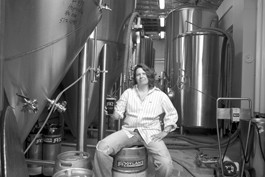
Just a handful of women in the Bay Area and a scant dozen in the United States brew beer professionally, and Moylan’s Brewing Company in Novato has one of them, though Denise Jones doesn’t dwell on the novelty of it all.

“I don’t think people look at me, taste my beer and say, ‘That’s pretty good for a woman,'” she says. “Beer is really about the beer.”

Moylan’s was founded 19 years ago, in which time customers have come to know, expect and enjoy its list of familiar ales. So when owner Brendan Moylan hired Jones in October of 2006, he was not looking for an overhaul of the beer list; on the wet end of the tap, it’s still just business as usual.

“It wasn’t my job to come walking into Moylan’s and make sweeping changes to the beer or even leave my signature on the beer,” Jones, 43, says. “My job was just to tighten up a few loose ends, increase the balance here and there, and increase the shelf life for the bottled beers.”

Moylan’s has seen a growth in its bottled-beer program as the brewery gains renown across the country. The beer is distributed to 15 states, and Jones calls the long and winding road of national distribution the “beer torture chamber.” It must travel from tank to filter to bottle to truck and, finally, to retailers across the nation, where poor staff handling and balmy stockrooms can potentially damage the product, if transport hasn’t already.

Meanwhile, Jones feels beer is best served on draft over the counter, when it’s just days or weeks old, an unusual philosophy in the midst of so much buzz over barrel-aging, vertical vintage tastings and ancient ales pulled from the cellar. But Jones grew up on fresh beer. She learned to brew in brewpubs and was never even a home brewer, which is the way that many, if not most, brewers begin.

She has almost always made beer to be served onsite, moving the majority of the product from tank to keg to glass, all within 30 feet and two weeks of its point of origin. Jones enjoys this close relationship between brewer and buyer, as she receives immediate feedback, criticism, praise and questions.

Yet she remains behind the scenes most of the time, brewing beer without end. In fact, to compare the art of winemaking, the Bay Area’s other specialty in artisan beverage making, to that of brewing paints a telling picture. Winemaking is a vintage activity that arrives each fall in a flurry of mild panic. Brewing, on the other hand, is a steady, repetitive effort that occupies a professional day in and day out, much like a chef’s.

Which isn’t so unusual. In merry olde England, beer was considered “women’s work,” something done in the kitchen to feed the men. Asked why not many women helm the kegs today, Jones considers. “I think it’s always been an engineering-type job, and more men are usually engineers than women,” she says. “It also requires physical strength—muscular strength—and that’s usually men. In the latter part of history, men have just been the brewers, but I never approached it as a man’s job. I just approached it as a function of creativity, and for that I really enjoy it.”

Good thing, because last year, over a thousand barrels of beer were served across Moylan’s bar.

Jones says that the greatest challenge of beer-making, especially for familiar locals, is meeting the demand for consistency.

“Brewers must diligently watch the beer, and it has to taste exactly the same each time you put a new batch on the shelf, whereas the winemaker will say that 1997 tasted like this and 1999 was a little more of that. Winemakers say nature gives them a different product each year, but nature gives us different products, too. It’s shifting sands with barley, and it’s shifting sands with hops.”

Drinking the stuff is easier, though caution is advised when tipping back some of Moylan’s whoppers like the Hopsickle Imperial Ale, a triple IPA. Buffed up to over 9 percent alcohol by volume, it’s a tempest of flowery aromas, caramel in the mouth and stinging alpha acids. The imperial stout goes 10 percent and bubbles with black fudge, smoky dark chocolate and peanut butter. The Old Blarney Barleywine is just as strong, a deep dark brown, and layered with caramel, butterscotch and candy flavors. And there’s the 8 percent Kilt Lifter, a sweet Scotch ale that blends the nutty flavors of wild rice, rye, wheat and corn. On the lighter side are the Dry Irish Stout, the Tipperary Pale Ale and the fruity, red Wheat Berry. A dozen or more beers are available on draft at any time.

Yet some 70 percent of the brewpub’s forecasted 4,000-odd barrels of beer will be shipped outward to 15 states this year. With national distribution comes national acclaim, and Jones is getting it. She has won nearly 20 awards since arriving at Moylan’s 18 months ago, and among the nationwide fraternity of craft brewers, Jones is becoming an increasingly recognized name and face who has taken several medals at the Great American Beer Festival.

Jones attended the American Brewers Guild in Davis, received her master of styles degree in Chicago, studied in Munich, has attended national and international beer and wine conferences and has received training in sensory analysis. Still, she’s not done.

“Constantly learning is really important to me,” she says. “I will not be complacent in my craft.”

She calls her job a “highly worthy career,” made interesting by the daily challenges, the customers, the feedback, the balancing of art and science, and her team of assistants.

“It’s a job. It’s a career. It’s something I have passion for. There’s plenty of room for women out there in brewing. I’d encourage anyone—if you’re a man or a woman, young or old—to go into brewing if that’s what you like. Maybe it’s a blinded, sexist attitude, but I belong to one of the most fraternal orders of people, and I really don’t think I encounter sexism among brewers.”

Quick dining snapshots by Bohemian staffers.

Winery news and reviews.

Food-related comings and goings, openings and closings, and other essays for those who love the kitchen and what it produces.

Recipes for food that you can actually make.

Flyin’ to Rio

05.28.08For all the talk about marijuana expanding one's mind, it's amazing the quantity of stale repetition in hip-hop that is passed off as the new style by blunt-wielding beatheads. Enter a much-needed revolutionary, a sativa savant currently at the forefront of hip-hop production who calls himself Madlib. Or Quasimoto. Or DJ Rels or Malik Flavors or Monk Hughes, or...

The Minnow Would Be Lost

05.28.08It's no secret that one of my favorite concert-going experiences is the Treasure Island Music Festival, a two-day soiree out in the middle of the San Francisco Bay with an incredible lineup and a beautifully scenic setting. Festival organizers say the choice for Treasure Island was born—even before last year's inaugural event—purely of necessity. All the viable locations within...

Green Gold

05.28.08As Tina Montgomery, project manager for the Sonoma Mountain Village, gives me a tour of the Rohnert Park site, which is in midconstruction, I try to keep an open mind. With development, there is always controversy, and I don't want to be lured into believing that something is a positive action for the community only to discover later that...

Planting the Seeds of Crisis

05.28.08T he global agriculture market is busy cooking up a recipe for disaster. World grain production is on the rise, but this cheap oversupply has put millions of farmers in developing nations out of work. Equally problematic, policy makers are increasingly directing edible calories toward biofuels and animal feed. Meanwhile, impoverished humans starve. At center stage in this misallocation...

An Open Letter

05.28.08Dear Corporate Broadcasters:Remember bombs dropping while your video footage awed us half a decade ago? Public opinion had largely coalesced around the president, pumped up by broadcast media's unrelenting pre-war, Super Bowl&–style, whiz-bang enthusiasms. One big reason a majority of the public backed the Iraq invasion was because you in the mainstream media had failed in your mission to...

Secrets and Lies

05.28.08This is the second of a multipart series on the state of the economy and how we got here. About a decade ago, I was cross-country skiing in Aspen with another trader from Wall Street, a guy named Vince who worked at Bear Stearns. At the time, Vince was worth perhaps a few million dollars. Today, he's worth about...

News Briefs

ISSUEDATE night of the living wageA family of four living in Sonoma County must earn $57,728 a year simply to meet their basic needs. So states the 2008 California Family Self-Sufficiency Standard. Napa County is slightly more costly than Sonoma, while living in Marin County drills that same four-member family for a mind-numbing $73,576 each year. And that's just to...

The Thin Man

05.28.08E ach Wednesday and Sunday at 7pm until June 22, the Smith Rafael Film Center honors Jimmy Stewart's 100th birthday by screening some of the best of his classics. Here are two short reminders of what you don't want to miss . 'The Shop Around the Corner' (June 1)Ernst Lubitsch's 1940 classic with Jimmy Stewart and Margaret Sullavan,...

We’re All Just “Fools”: Strummin’ and Drummin’ with Meric Long of the Dodos

  The Dodos: Meric Long & Logan KroeberA friend of mine, we’ll call him the Music Guru (he’s where I go for all the fresh insider info from the alternative music scene), feverishly texted me late one night about a month ago. He had just seen a show at a small New Haven club and told me that he...

Beer Mistress

05.28.08T he best brewer of beer does not necessarily leave his trademark upon the product. To the contrary, he may be a humble man and a servant to cherished styles. A seamless transition as a new beer man takes over for an old at a neighborhood brewpub is among the strongest testimonies there is to a brewer's understanding of...
11,084FansLike
4,446FollowersFollow
6,928FollowersFollow