
Know What Imeem?

0

06.04.08

In the small Midwest town where I grew up, the only access I had to current pop music that wasn’t Top 40 was the local college radio station. On a clear day, if I stood in just the right spot of my bedroom with the radio antenna pointed just so, the college station broadcast would be mostly audible, albeit ridden with static.

If a user-friendly music-sharing website had existed in those stone-age days , I’d probably have gobbled it up, and my mother, instead of repeatedly asking me to cease watching late night television and finish my homework, would have had to instead drag me away from the computer.

It sounds great, doesn’t it? A virtual land of countless songs free for the listening, pre-selected for quality by scores of celebrities, friends and strangers—or, in hopeful terms, friends-to-be. And that’s what makes websites like imeem.com so popular. Remember Napster, the ill-fated, oft-sued charter of free Internet music sharing? After that empire toppled, Napster’s Jan Jannink cofounded imeem in 2004, and, after a fairly short gestation period, the site exploded; late last month, Wired reported that imeem is now the most popular social music site in the country.

There are a couple different reasons for its popularity, but the main one is imeem’s breadth of content, focus on high-profile playlists and ease of use. Last year, College Music Journal posted a free playlist over 270 songs long, featuring acts appearing at their CMJ Music Marathon and Film Fest. And they’ve made deals with all four major record labels, allowing imeem to be a veritable Candyland of streaming music: click on the song, the whole thing plays for free, and if you like it, you can download it from iTunes or Amazon for a small fee.

Shortly into my own excursion with imeem’s ad navigation and playlist browsing, I began to think of more exciting things to do. There was too much of everything—ads, songs, videos—and I don’t even have enough time to listen to the music I already have to begin with.

All of the playlists categorized as “shoegaze” sucked. I could have created and posted my own superior shoegaze playlist, but that would have taken time and effort. Truth be known, it would have been something I did not for the greater good of shoegaze music, but because I wanted people I’d never met to know how much cooler I was than them.

While vacationing recently in a small town adjacent to a national park, I stumbled across an antique mall. One section held shelves and shelves of country music records, most of them from the 1960s, and most of them in excellent condition. They were 50 cents each, and I felt my pulse quicken. Although we’d just visited the only temperate rain forest in North America, I knew I’d come away from the trip boasting of 50 cent country music records. It took restraint, but I only bought two albums, seeing as we don’t actually have a record player.

But I love the way the records smell, and I love the photos on their covers of my favorite Nashville Sound divas with their bouffants and puffy-sleeved prairie dresses, and the men with their pompadours and Nudie suits. And that’s the difference between me and a satisfied imeem user. These music-sharing sites—save ads and videos and user profiles—are pure music, scads of it, but the context is a computer screen and a set of speakers. To me, I guess music is a bunch of musty records I can’t even listen to.

That’s too bad, maybe, because sites like imeem give music lovers more control over what they listen to than ever before. For those who care about Nicole Richie, imeem shared her own Best Of 2007 playlist (number five is Maroon 5’s “Wake Up Call”). But for those who, like me, could care less if Nicole Richie fell off the face of the earth, imeem posted dozens of other year-end playlists to choose from, compiled by artists like Spoon or Aesop Rock.

It’s almost as if Spoon made a personalized mix just for you, except they didn’t. Spoon made a playlist of stuff they like, not stuff they think you, specifically, will like. If Spoon came over and brought one of those record players you could use to upload songs to your computer, I’d make them a playlist of my new Loretta Lynn and Porter Wagoner gospel albums. No one would ever have to settle for standing on one foot just to listen to the college station ever again. Unless you wanted to.
Raised on Radio

0

06.04.08

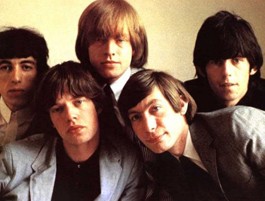
When the sun went down, our radios came on. Faintly through the twilight, then with increasing clarity as the darkness intensified, the clarion 50,000-watt signal of KOMA reached across the midwestern plains, a beacon of aural gratification for a town full of teens hungering to hear the hits.

Although our backwater enclave was hundreds of miles away from the station’s studios in Oklahoma City, we knew we were dialed in to what was happening musically. This was the mid-1960s, the era when Top 40 radio ruled the airwaves, and “playing the hits” was radio’s raison d’être from coast to coast. For a generation—the one I share with Pete Townshend—that artistically agnostic weekly tally of the records that got played, requested, sold, memorized, imprinted on a generation, was the embodiment of the democratic ideals that seemed so irrelevant in civics class.

For these were our songs, the favorites (and all the rest) that served as something important and meaningful that could help maintain and reinforce the connections that we in our class and our school and our town and our county shared with our counterparts in all the other classes and schools and towns and counties and even states across the country.

This wasn’t really anything new. Music publishers began tracking the sales of sheet music a century earlier, making Stephen Foster a temporary superstar long before the term was coined. And the nationwide radio broadcasts of The Lone Ranger and Amos ‘n’ Andy and The Shadow and Jack Benny and dozens more fulfilled a similar function until television added pictures and swept them into the new medium.

As music returned to fill the void, regional stations began to share ideas—promotions, business innovations and on-air talent, too. And when the earliest innovators figured out that they could play the same songs that were sounding from local juke boxes—over and over and over—what soon became Top 40 radio was, in short order, a nationwide presence.

Reinforced by weekly charts in the trinity of trade magazines—Cashbox, Record World and Billboard—Top 40 radio was musically ecumenical, ready to play almost anything that would generate a flurry of calls to the request line. Thus we had such incongruous juxtapositions as Elvis Presley and Perry Como jostling for position at the top of the charts in the spring of 1956; Louis Armstrong (“Hello Dolly”) bumping up against the Beatles (“Can’t Buy Me Love”) in early 1964; or Sept. 20, 1969, when the Rolling Stones’ glorious “Honky Tonk Women” had its four-week run as the nation’s No. 1 song ended by, of all perverse possibilities, “Sugar, Sugar.”

Yet this same stylistic color-blindness also allowed all kinds of strange and wondrous exotica to slip onto the national playlists, giving naive teens tastes of ska (Desmond Dekker’s “Israelites”), African pop (Miriam Makeba’s “Pata Pata”), bossa nova (Getz/Gilberto’s “The Girl from Ipanema”), skiffle (Lonnie Donnegan), pure gospel (“Oh Happy Day”) and such jazz artists as Cannonball Adderly, Dave Brubeck, Hugh Masekela, Ramsey Lewis and Mongo Santamaria.

It also left room for an endless stream of comic “novelty” records, creating careers for Stan Freberg, Alan Sherman, Ray Stevens and “Weird Al” Yankovic.

Top 40 radio was the wave that carried California surf music around the world, and gave certain cities a clear musical identity, such as New Orleans, Detroit, Memphis or later, San Francisco. It lifted local acts to (often fleeting) national prominence from such unlikely cities as Minneapolis (the Castaways, “Liar, Liar”), Seattle (the Ventures), Pittsburg (Tommy James & the Shondells) or rural Louisiana (Tony Joe White).

As FM emerged as the medium of choice for deeper musical explorations, Top 40 radio became even more eclectic, embracing the cream of serious rock (the Beatles, the Stones, etc.) scrambled with the likes of Tony Orlando, Cher, Helen Reddy, Bread, the Carpenters and other middle-of-the-road acts whose painfully unhip hits never darkened the turntables of the “underground” stations.

Whether or not they acknowledge it, many practitioners of that “freeform” approach to FM programming surely had their ears opened, at least to some degree, by the anything-goes ethic of their Top 40 antecedents. But given the timid playlists and corporate conservatism that dominate broadcast radio today, and the vast array of narrow niche formats that has blossomed on satellite and Internet radio, it’s a wonder how a new generation can find, share and learn from a world of music. For us, it was once encapsulated in an ever-shifting list of 40 favorite songs.


Keeping It Light

0

06.04.08

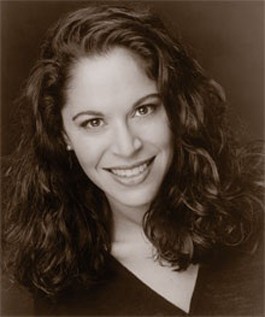
A Music Matters concert bears about as little similarity to a night at the opera as a Yo-Yo Ma concert would have to an extravaganza featuring Celine Dion,” says acclaimed soprano Rebecca Plack (above). And indeed, anyone who thinks classical music is stuffy and pretentious is in for a pleasant surprise as Santa Rosa’s Friedman Center presents the final show in its monthly “Absolute Music” series.

The season closer is a little program titled “Music Matters,” in which Plack and tenor Stephen Guggenheim are joined by pianist Blaise Bryski for a peppy, informal concert described as offering “a refreshing alternative to the staid, traditional concert-going experience.” The show features works by Haydn, Schubert, Mussorgsky and Mozart, but should not be thought of as another showcase of gems from the concert hall and opera stage.

A 90-minute recital, the performance highlights Songs from Letters by daredevil composer Libby Larsen—clever musical settings of letters written by Western legend Calamity Jane to her daughter in the early 1900’s—and The Nursery, Modest Mussorgsky’s playful song cycle about nannies, toys and cats. Each piece is accompanied by the performers’ sprightly and light-hearted remarks about the composers and their music. The artists have designed these shows to make classical music more accessible to young and unfamiliar audiences, with the intention of planting little seeds of musical appreciation that will spout and grow and turn everyone into lifelong music lovers. They do it in the most ingenious and insidious of ways—by making it fun.

“Music Matters” takes it lightly on Sunday, June 8, at the Friedman Center, 4676 Mayette Ave., Santa Rosa. 2pm. $18; students, free. 707.538.1899.


Don Byron at the Healdsburg Jazz Festival

1


Though billed as “Bug Music for Juniors,” both the seven-year-old child and the fifty-something-year-old man on either side of me at the Raven Theater smiled and bounced their heads last night as Don Byron launched into “Siberian Sleighride.”
The youngster was thrilled that the cartoons were back up on the movie projector screen in the form of Meatless Flyday, a wacky 1944 Warner Bros. cartoon, and the man was thrilled at hearing one of Raymond Scott’s bounciest compositions revived by Scott’s greatest acolytes.
Holding court on a demonstrative jazz concert, meant mostly for kids, Byron spent equal time explaining chords, syncopation, and why musicians write on piano as he did playing the part-klezmer, part-swing, part-avant-garde jazz that’s his trademark. Watching the New York clarinetist explain jazz to kids, however, was a performance in itself.
“So you can kinda hear it, right?” Byron asked the kids, after playing select passages from both Raymond Scott and John Kirby. “Raymond Scott’s all wild, but John Kirby’s more elegant. He’s like, chillin’ at the club, drinkin’ Cristal. More slick, smooth, and cool. He’s like P. Diddy—you know, the way P. Diddy would hang—draped in nice clothes, clean clothes.”
One by one, Byron introduced the instruments in his sextet, conducting the proceedings like a game show announcer and ending with a drum solo that turned into an off-the-cuff version of “Shaft.” During “Powerhouse,” Scott’s most famous tune, a toddler danced in front of the stage, and Byron played off of its vocal noises during the breaks.
Bugs Bunny and Tom & Jerry cartoons screened in the background, as did old film reels of jazz bands; Byron also spoke at length about the Cotton Club and Duke Ellington, whose “The Mooch” opened up eventually into a free-for-all blowing session—and into the Byron that fans of records like his excellent Ivey-Divey are used to.
After a few solos during “The Mooch,” and after applauding for each one, the seven-year-old next to me turned and said, “We’ve already clapped, like, four times for this song!”
“Do you know why?” I asked.
“No.”
“Because they’re not reading from music. They’re making it up as they go along.”
“You mean they don’t know what they’re playing? Why do they do that?”
I was stumped. “Because,” I told him. “It’s jazz.”

Christopher Gathercole

0

Hundreds gathered today along Mendocino Avenue to honor Christopher Gathercole, the Army Ranger from Santa Rosa who was killed during combat operations in Afghanistan last week.
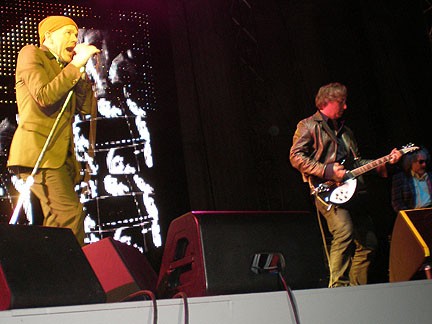
Fire cranes were hoisted from either side of the avenue above the procession of vehicles as it crept towards Eggen & Lance Mortuary.

All traffic stopped as service vehicles parked at a diagonal in the center of the street, and drivers stepped out and removed their hats while Gathercole was carried into the funeral home.

Gathercole was 21 years old.

R.E.M. Play College, Rock

0

R.E.M., Modest Mouse and The National – Greek Theatre, UC Berkeley, Saturday, May 31, 2008

One of the season’s most impressive tour lineups–R.E.M., Modest Mouse and The National–made its way through UC Berkeley’s Greek Theatre last weekend with two packed shows that could’ve been billed as “Three Generations of College Rock.”

Charles Lloyd at the Healdsburg Jazz Festival

1

When I worked at the Last Record Store, and pored through people’s record collections on a daily basis, I routinely flipped through countless copies of LPs by Santana, Jefferson Airplane, Janis Joplin, and Quicksilver Messenger Service. There’s such a glut of these albums in the Bay Area that they’re not worth much, and I’d have to break the news gently to a daily stream of baby boomers that we had little use for what to their minds was the greatest music of the century.
There’d almost always be a copy in these collections of Charles Lloyd’s Forest Flower, which seemed strange to me until I read Bill Graham’s autobiography, Bill Graham Presents. Say what you will about Bill Graham—and you’d probably be right—but Graham truly excelled at the lost art of adventurous booking; placing Neil Young and Miles Davis on the same bill, say, or booking Gabor Szabo together with Jimi Hendrix.
Charles Lloyd, who Graham loved, found himself booked at the Fillmore along such names of the day as Chuck Berry, the Butterfield Blues Band, Jeff Beck, and the Young Rascals—and eventually wound up guilty by association, in my mind, to It’s A Beautiful Day. Lloyd to me became just another face in the crowd, and in all the times I listened to Forest Flower, I had the same dismissal: it’s close, but it’s not Coltrane.
Maybe I’ve changed. Maybe Charles Lloyd has changed. One thing is certain.
I was such an idiot.
Last night at the Jackson Theater, Charles Lloyd and his quintet gave an utterly transforming performance. Aided by Jason Moran, Ruben Rogers, Eric Harland and Zakir Hussain, Lloyd led his group on a frighteningly inventive sojourn which plunged into unchartered depth and redefined the rules of collective creativity. Amidst a furious storm of talent, the centered Lloyd remarked to the crowd, “It’s better to stick with the ship—and go down with it, if necessary.”
Now 70, Lloyd still plays in the great searching vein of late-era Coltrane, although his solos aren’t an aortic torrent of bitten reeds and quickly-changing ideas but rather more subtly crafted meditations. Last night, lifting his horn and marching in place while switching between tenor sax, alto flute, and a Hungarian instrument, similar to a clarinet, called a tárogató, he brought the audience to numerous pinnacles; or, in his own words, “up there to those elixirs.”
Dazzling pianist Jason Moran was responsible for just as many highlights, with a number of propulsive and chord-driven Gershwin-esque solos that incredibly bent the rules without breaking. Zakir Hussain, sitting in on tablas, added a rich texture that never overpowered the group, and bassist Ruben Rogers held the mast of simultaneous improvisation together with a solid, steady hand.
Lloyd and the group were unbelievable—but it was really all about Eric Harland.
So open to different paths and yet so confident of his own, drummer Eric Harland stole the show as the main superprocessor of the group’s collective thought. With impeccable touch and flawless taste, Harland not only drummed—he actually deciphered the conversation on stage into the most representational and delightful stickwork this side of Jack DeJohnette.
Given the open space offered by Lloyd’s group, Harland responded keenly to every moment on the stand, playing ahead of and behind the beat; keeping time with a footpedal connected to a tambourine; switching to piano when Lloyd directed him, mid-song, and plucking the strings inside while poking hard low notes; going head-to-head with Hussain in rapid-fire rhythm duets; executing ballet-like maneuvers while utilizing every inch of the drum kit; and always, always knowing where the song was headed and when to suddenly stop.
As if to acknowledge his blessed constituents, Lloyd throughout the night placed his hands in a prayer-like position, clasped his arms across his heart, and bowed. He also gratefully thanked the attentive audience, who leapt to their feet and handed him roses at the night’s end.
“When folks come with simple living and high thinking,” Lloyd said to the people, “it always helps us out.”

The Cure at the HP Pavilion in San Jose

1


We started taking bets on what the Cure’s opening song would be. “‘The Kiss,'” I said, “it’s gotta be ‘The Kiss.’ Can you imagine how awesome that’d be?”
When the lights went down and faint chimes tinkled over the stage, I knew I’d guessed wrong. The bells, the chimes, could it. . . would they. . . oh my God, for real? Like an avalanche, the Cure laid down the opening chords of “Plainsong,” the first song off Disintegration, and I squeezed my eyelids shut, balled my fists, and let out an ecstatic cry of release. And I pretty much didn’t stop until the end of the night—37 songs later.
Until Wednesday night’s show, I was never a total superfreaky Cure fan. Over the past 20 years, I’ve loved them incrementally—album by album, song by song—but never signed up as one of the fully obsessed. That’s all in the past now. Show me where to sign. On Wednesday night, during a staggering three-hour and fifteen-minute set, the Cure was even more than a great band: they were the greatest band in the universe.
Superfreaky fans abounded, that’s for sure. Around us, there was The Reciter, who blankly spoke every lyric back to Robert Smith as if it were scripture; The Dancer, who occasionally made his way out into the aisle to do some ’80s prom dancing before being shown back to his seat; and The Hoochie, a girl who kept the ticket stub stuffed in her very-exposed cleavage and who at one point stripped down to her bra, singing wildly.
As for me, I stood in awe and sang along to an onslaught of fantastic song after fantastic song—for over three hours! Take that, Bruce Springsteen!

More photos and set list below.

Bonnie Raitt at Sonoma Jazz+

0

(Note to the Reader: For this installment of City Sound Inertia, we welcome guest reviewer Bob Meline! A finish carpenter by trade, longtime music fan, and secretly, a solid bass player, he’s also my dad—and one of the greatest guys I know.)
Acknowledging that early in her career she would “never have been able to set foot” in a tent housing a jazz festival, Bonnie Raitt very aptly closed the four day run at Sonoma Jazz+, constantly educating the audience in musical history and, in the process, giving the capacity crowd the party they were looking for.
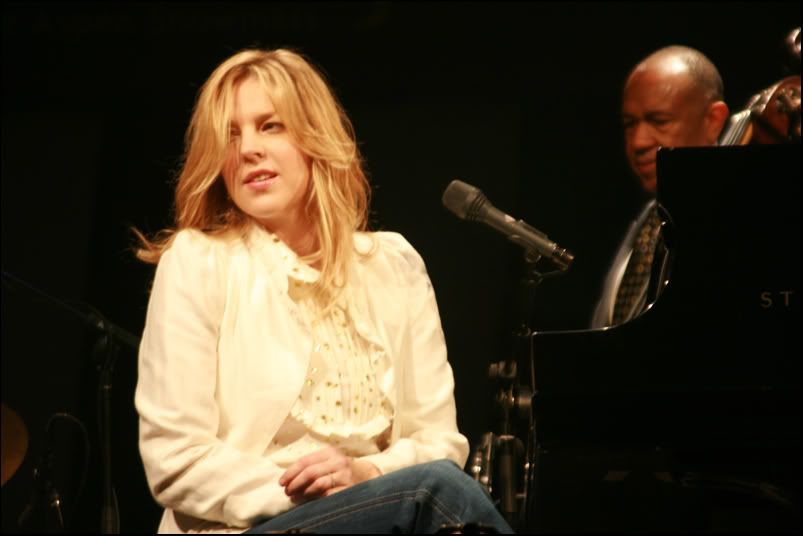
While the festival seems to be moving more and more away from traditional jazz, Raitt brought an amazing band and some well-suited musical guests in paying tribute to blues, rock, reggae, r&b and jazz—“all the tributaries and roots of not just jazz,” she said, “but what we call good music.”
Bonnie Raitt has worked through the years with drummer Ricky Fattar and bassist extraordinaire James “Hutch” Hutchinson, but the addition a few years ago of George Marinelli on guitar has become the perfect compliment to Raitt’s slide guitar and rock and rhythmic style—expertly filling the voids with single notes, short riffs and all-out leads without taking the attention away from center stage. But by far, Raitt’s band has profited the most with the addition of Jon Cleary on keyboards. His swampy New Orleans jazz/roots/funk style is the base from which he can also deliver rock, r&b and even those dark, smoky bar ballads, wrenching true human emotion out of every single note from his keyboard.
Raitt’s set list drew from all along the timeline of her lengthy career and showcased a varied cross section of musical styles. While Raitt has not written the majority of her recorded material, she has a gift for choosing other artists’ songs, no matter what the genre, and making them uniquely her own. Bonnie’s all out rockin’ version of John Hiatt’s “Thing Called Love” was early in the set, soon followed by the r&b gem from Isaac Hayes, “Your Good Thing (Is About to End).” She introduced it as a song about “how messed up love can be—and I’ve been makin’ a livin’ off it ever since.”
Working some reggae into the evening, she did “Premature,” her recent duet with Toots and the Maytals, calling Toots Hibbert “a great songwriter and friend.” She then brought out her first guest of the evening, Maia Sharp, duetting on a song from her recent Souls Alike album, “I Don’t Want Anything to Change.”
Returning to her self-titled debut album of 1971, she paid tribute to the pioneering blues singer of the 20’s, Sippie Wallace, performing an acoustic slide version of “Women Be Wise.” Cleary’s honky tonk piano solo was a perfect fit and enthralled even Raitt—who waltzed over and laid her elbow on the piano, propped her chin in her hand and seemed as amazed as the rest of the audience at Cleary’s ability.
As advertised, slide master Roy Rogers made his first appearance on stage next, doubling up with Raitt on an absolutely incendiary acoustic version of Robert Johnson’s “Walkin’ Blues.” Raitt is one of the better slide guitarists in the business, but even she was thrilled to have Rogers alongside showcasing his unique style. After the song, and the well-deserved standing ovation, she remarked to Rogers, “Your wife is a lucky woman…”
Raitt included John Prine’s “Angel from Montgomery,” bringing Sharp back on stage to join the band, the four backup vocalists soaring on the choruses. The lead track from her most recent album, “I Will Not Be Broken,” finished with a fade into some soft gospel vocal vamps, which led into “Something to Talk About, ” the first of two roadhouse rocking set closers. Exhorting drummer Fattar to “Keep it going, Ricky,” the band finished with “Love Sneakin’ up On You.” The all-ages audience, long ago tired of doing Dan Hicks’ “barstool boogie in their seats,” had filled the aisles in all manner of dance and wasn’t at all ready for the party to be over. Thunderous applause filled the huge but now-intimate tent and brought the band back for a four-song encore.
Noting that it was “not exactly a dance tune,” Raitt, absent her guitar and perched on a stool with a single spot accenting her flame red hair, rode Cleary’s sensuous keyboard work into the beautiful “I Can’t Make You Love Me.” While known for her guitar chops and rough edged vocals, Raitt took everyone on a spine-tingling soul search for love never returned, the raw passion fueled no doubt by having admitted in the past that she’d been on “both sides of this one.” And if Bonnie’s vocals didn’t break your heart, Cleary’s closing piano solo finished the job and brought the hard truth of the title into plain view.
Staying in the smoky bar-like vein, and again working with Sharp, Raitt came as close to jazz as she would get on the night through Sharp’s “The Bed I Made.” As suited as Raitt’s vocal intensity is to the song, it was again the musicians who shone, Hutchinson working a nice bass melody, Cleary wringing emotion out of every note and Sharp adding a sexy, breathy baritone sax solo to close out the tune.
Kicking it back into high gear, Raitt strapped on her guitar and pronounced, “Yes, I’m ready!” and brought back Rogers, the song’s co-writer, for their thumping and chunking “Gnawin’ on It,” going shoulder to shoulder with him so she could watch him “blow the windows out of the place.” And that he did.
Always paying tribute and giving credit to others, Raitt dedicated the last song to the late Phil Elwood, the longtime jazz/blues reviewer for the San Francisco Examiner and later the Chronicle, calling him “one of the best friends music ever had.” And in her unending praise to those who paved the way for her, she introduced a tune she’s done through the years with Charles and Ruth Brown, “Never Make Your Move Too Soon.” A rocking, rollicking shuffle blues, it was the perfect opportunity for Raitt to let each of the musicians shine one more time, including her brother, David Raitt, on the harmonica.
In welcoming the sold-out audience at the start—and make no mistake, this show was the draw of this year’s festival—Raitt, performing close to her real home, said she felt like she was with family. No doubt the crowd, as it reluctantly filed out, was feeling the kinship—“Souls Alike,” if you will—and hoping for a reunion much, much sooner than later.
Robert Meline

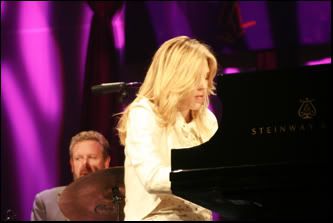
Diana Krall at Sonoma Jazz+

2


“I’m all pumped up full of steroids,” croaked a bronchitis-ridden Diana Krall to a sold-out Sonoma crowd on Saturday night, “so you’re gonna have to put up with my shitty piano playing the whole show.”
A woman in the audience yelled something about smoking.
“Oh—do you want me to stop talking?” asked Krall. “Is it like nails on a chalkboard. . . or too sexy you can’t stand it?”
It speaks volumes about Krall’s immense popularity that during an absolutely classic performance in Sonoma, her singing voice never wavered in the slightest—in spite of the fact that Krall’s speaking voice, which offered an ongoing stream of self-deprecating quips, sounded more like Edward G. Robinson. One could interpret this either as the resilience of a seasoned vocalist or one of the fringe benefits of having, in Kralls’ own words, a “smoky, sultry, cool sound.” Bronchitis would level most singers, but for Krall—who along with nighttime film-noir pianist-singers Holly Cole and Patricia Barber rarely, if ever, pushes her vocal chords—it never once hindered the show.
Though Krall acknowledged her bronchitis (announcing and then slipping into a Tom Waits impersonation during “Exactly Like You”), most of the time it worked in her favor. A fading whisper of the word “darling” during a spellbinding solo version of Joni Mitchell’s “A Case of You,” a particular husk to “The Look of Love”—these touches only added to what she does best.
With a few stride-piano intros—to “Frim Fram Sauce” and “I Don’t Know Enough About You”—that faltered greatly in tempo, Krall’s piano playing may have been lessened, but not enough to keep her from quoting Charlie Parker songs in solos which played well into her rhythm section’s impeccable backing. But it was her descriptions of motherhood and of breastfeeding her two children—she had twins a year and a half ago with Elvis Costello—which truly tickled the mostly middle-aged crowd.


“They’re both grown up now,” she joked. “They’re out in the hotel playing cards and smoking cigars. They look like their dad!” (“I’m sorry!” shouted the woman in front of me.)
At the end of the night, after a practically begged-for encore at the hands of a long standing ovation, Krall had triumphed. She even cast aside her sad, tortured persona for a split second—at the end of the bowed bass solos, sharp rim shots and dazzling guitar lines during the night’s closer “Gee Baby, Ain’t I Good to You,” the 43-year-old mother squirmed on the piano bench, opened her mouth, and squealed like a little girl.
Photos and set list below.

Know What Imeem?

06.04.08In the small Midwest town where I grew up, the only access I had to current pop music that wasn't Top 40 was the local college radio station. On a clear day, if I stood in just the right spot of my bedroom with the radio antenna pointed just so, the college station broadcast would be mostly audible, albeit...

Raised on Radio

06.04.08When the sun went down, our radios came on. Faintly through the twilight, then with increasing clarity as the darkness intensified, the clarion 50,000-watt signal of KOMA reached across the midwestern plains, a beacon of aural gratification for a town full of teens hungering to hear the hits.Although our backwater enclave was hundreds of miles away from the station's...

Keeping It Light

06.04.08 "A Music Matters concert bears about as little similarity to a night at the opera as a Yo-Yo Ma concert would have to an extravaganza featuring Celine Dion," says acclaimed soprano Rebecca Plack (above). And indeed, anyone who thinks classical music is stuffy and pretentious is in for a pleasant surprise as Santa Rosa's Friedman Center presents the final...

Don Byron at the Healdsburg Jazz Festival

Though billed as “Bug Music for Juniors,” both the seven-year-old child and the fifty-something-year-old man on either side of me at the Raven Theater smiled and bounced their heads last night as Don Byron launched into “Siberian Sleighride.” The youngster was thrilled that the cartoons were back up on the movie projector screen in the form of Meatless Flyday,...

Christopher Gathercole

Hundreds gathered today along Mendocino Avenue to honor Christopher Gathercole, the Army Ranger from Santa Rosa who was killed during combat operations in Afghanistan last week.Fire cranes were hoisted from either side of the avenue above the procession of vehicles as it crept towards Eggen & Lance Mortuary.All traffic stopped as service vehicles parked at a diagonal in the...

R.E.M. Play College, Rock

R.E.M., Modest Mouse and The National – Greek Theatre, UC Berkeley, Saturday, May 31, 2008One of the season’s most impressive tour lineups–R.E.M., Modest Mouse and The National–made its way through UC Berkeley’s Greek Theatre last weekend with two packed shows that could’ve been billed as “Three Generations of College Rock.” Brooklyn wonders The National kicked off the festivities Saturday...

Charles Lloyd at the Healdsburg Jazz Festival

When I worked at the Last Record Store, and pored through people's record collections on a daily basis, I routinely flipped through countless copies of LPs by Santana, Jefferson Airplane, Janis Joplin, and Quicksilver Messenger Service. There's such a glut of these albums in the Bay Area that they're not worth much, and I'd have to break the news...

The Cure at the HP Pavilion in San Jose

We started taking bets on what the Cure's opening song would be. "'The Kiss,'" I said, "it's gotta be 'The Kiss.' Can you imagine how awesome that'd be?" When the lights went down and faint chimes tinkled over the stage, I knew I'd guessed wrong. The bells, the chimes, could it. . . would they. . . oh my God,...

Bonnie Raitt at Sonoma Jazz+

(Note to the Reader: For this installment of City Sound Inertia, we welcome guest reviewer Bob Meline! A finish carpenter by trade, longtime music fan, and secretly, a solid bass player, he's also my dad—and one of the greatest guys I know.) Acknowledging that early in her career she would “never have been able to set foot” in a...

Diana Krall at Sonoma Jazz+

"I'm all pumped up full of steroids," croaked a bronchitis-ridden Diana Krall to a sold-out Sonoma crowd on Saturday night, "so you're gonna have to put up with my shitty piano playing the whole show." A woman in the audience yelled something about smoking. "Oh—do you want me to stop talking?" asked Krall. "Is it like nails on a chalkboard. ....
11,084FansLike
4,446FollowersFollow
6,928FollowersFollow
