Lord, Could You Please Make My ‘Ass’ Record Number One?

0

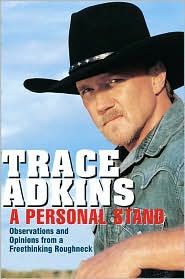
There’s a ten-gallon hatful of absurdly quotable passages in Trace Adkins’ freewheeling autobiography, A Personal Stand: Observations and Opinions from a Free-Thinking Roughneck. But I think this one is my favorite:
Even though it might be my most famous song, technically “Honky Tonk Badonkadonk” was never a number-one record, and for a pretty good reason. It was number two the same week Carrie Underwood went number one with “Jesus, Take The Wheel.” Right behind me, at number three, was Brad Paisley’s “When I Get Where I’m Going,” a song about heaven. So there I was, in a sticky position. I couldn’t exactly root against the records ahead of or behind me. I couldn’t pray to the man upstairs, asking, “Lord, could you please make my ‘ass’ record number one instead of the two ‘Jesus’ songs?” It would have been wrong. And that’s probably why it didn’t go number one. I had ass, they had Jesus, and Jesus won, which I guess is the way it ought to be.

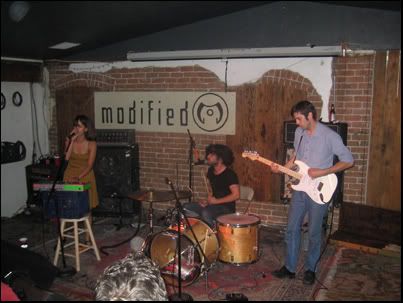
Times New Viking at Modified Arts: Phoenix, AZ

0

After the Tom Waits show, we drove to Modified Arts, a small all-ages club in Phoenix. Times New Viking were playing, who, strangely, I’d read about that morning in Spin at the ultra-modernist Phoenix Library. Even though I’d heard their album on Matador when it came out and not thought much of it, I liked ’em live. They were insanely loud, very funny, and pretty much outta control. Modified has a no-alcohol policy, but the band blatantly took celebratory glugs from a Makers Mark bottle throughout their set. I think they said things to the crowd between songs, but there was a piercing battalion of feedback emanating at all times, so I have no idea what they were trying to communicate. They were good.
Sadly, we arrived just in time to miss the set by the opening band, Psychedelic Horseshit.

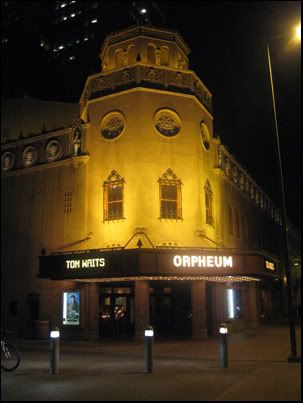
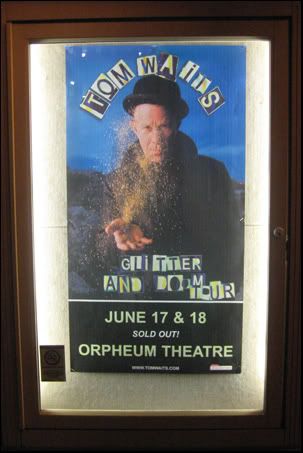
Tom Waits at the Orpheum Theatre: Phoenix, AZ

2

This is an obsessed-fan review, here, folks. When Tom Waits tours, there are no press passes. You wanna review the show, you’ve gotta buy your own tickets like the rest of ‘em. And that’s fine by me.
When Tom Waits tours, he doesn’t play in the Bay Area. You wanna see Tom Waits, you’ve gotta buy airplane tickets and fly somewhere else. And that, too, is fine by me.
So my friend Gerry and I flew 800 miles in 115-degree heat to see Tom Waits in Phoenix, AZ—his closest show—and we slept on the floor of the airport afterwards to catch a flight back home the next morning at 6am. Tickets: $100 each; airfare: $200 each; food and miscellaneous expenses: about $200.
Was it worth it? Completely.
Walking into the beautiful Orpheum Theatre on Wednesday night, we were met with marching drums, gongs, organs, and a ringside fight bell littering the stage. Hanging from the ceiling above were two huge, heavy sculptures of rusty bullhorns quietly emitting the sound of old 78s. And from the first to the last note, Waits commanded the room like a giant, slamming his feet on a dust-covered pedestal; punctuating each songscape with his stickman ballet; tumbling to the ground like an elastic wooden doll. His band was incredible—a six-ring ensemble who hauntingly conjured atmospheres more than they performed songs. I was literally on the edge of my seat, with my eyes wide open, through the entire show.
It’s gonna get interesting as the tour continues. According to people working on the inside, Waits and his band spent rehearsals at Zellerbach Hall in Berkeley running through over 65 songs in preparation for this tour.
But on Wednesday night, during a two-hour set, Waits offered a lopsided view of his majestic career. He played nothing at all from his Asylum years. Instead, he concentrated on material from Real Gone, his latest and most underwhelming album. When I came home from Phoenix and looked up the set list for the previous night, I wished I’d gone to that show instead. (But sweet Christ, at least I didn’t go to El Paso.)
The set list of an artist with zillions of songs is always a hard thing to accept. Shouldn’t we, as an audience, be happy with whatever the artist we avowedly love wants to play? I’ve seen plenty of prolific artists like Bob Dylan, Bruce Springsteen, Sonny Rollins, Guided by Voices, Frank Sinatra, A Tribe Called Quest—and because of their extensive recorded output, I’ve inevitably spent some time during the show wishing they were playing some other, and usually older, song. It might not be fair, but as a fan, I can’t help it.

Also, Tom Waits basically plays blues songs now. One-chord, stomping blues songs that just sort of chug along and don’t really go anywhere. Lots of white guys in their fifties immerse themselves in the “authenticity” of blues music, never to resurface—but if there’s anyone who can push past it, it’s Waits, and I hope that he does.
All of this I’d expected. So the show’s many highlights were a welcome surprise. “Cemetery Waltz” was unbelievable, as was a lower-register version of “Dirt in the Ground.” “November” came as a delightful rarity from The Black Rider, probably Waits’ most underrated album, and “Lost in the Harbour,” a poignant song from Alice, written around the same time, was beautifully performed on a reed organ.
Two songs gave me actual chills: “The Day After Tomorrow,” which I last saw performed (and cut short!) on The Daily Show (“my moment of zen”). Also, “A Little Rain,” which despite Waits’ new bassist Seth Ford-Young being slightly sharp throughout the entire song was still mesmerizing. Three cheers, too, for “All the World is Green” and “Hoist that Rag,” during which guitarist Omar Torrez thrilled with a dead-ringer Marc Ribot impersonation.
In other band news: Waits might be able to replace Ribot, but he sure can’t replace Ralph Carney. Saxophonist Vincent Henry proved an able accompanist, but man, his solos sounded like something from the Saturday Night Live band; just completely out of place. Casey Waits on drums was probably the biggest surprise—supremely tasteful and stylistically adaptable—and although Larry Taylor’s been Waits’ right hand man for decades on bass, Ford-Young’s tone and style is actually better suited to his material.
At times, Waits was his own best backing musician. During “16 Shells From a Thirty-Ought-Six,” he crashed his foot down in time onto a pedal, clanging the ringside boxing bell in time to the choruses. But between songs, his unfortunate accompaniment was the many rude and unintelligible shouts from the crowd. (Do hipster wannabes in vests and bowler hats annoy you? Do people shouting inane things like “You go, Tom!” in between songs annoy you? Be forewarned.)
All in all, it was a truly magical night, and one that ended too soon. It’s easy to relate facts and to dissect set lists, but it’s impossible to capture the presence that is Tom Waits on stage. Before the show, I’d started to wonder if I was crazy for flying all the way to Phoenix just to see him—especially when I’m seeing him again in Dublin next month. But afterwards, underneath the Phoenix sky and filled with a dizzying love, I was ecstatic that I made the trek, and felt like one of the luckiest people in the world to be able to witness the show.

Winged Glory

06.18.08


In our garden state of almonds, grapes, rice, walnuts, figs, olives and so much more, the bees are starving. According to entomologists, the rising tendency toward monocultures, in which single-plant crops cover many contiguous acres, is limiting bees to a nutritionally deficient diet. The result is a weakened immune system, loss of reproductive capacity and decline in overall vigor of the species.

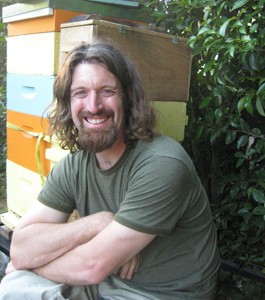
“When you come to the reasons that bees are dying, like colony collapse, loss of habitat, stress, loss of genetic diversity and the use of pesticides—all of these things can be addressed to an extent by beekeeping in urbanized areas,” says Serge Labesque, a beekeeping teacher at Santa Rosa Junior College.

But many cities, like Santa Rosa and Napa, have safety ordinances against keeping bees, and the political climate is not entirely apiarian-friendly. Rob Keller, an artist and leading figure in the local beekeeping community, lives in Napa and keeps scores of hives around the North Bay. Keller has observed his rural bee colonies deteriorate, showing particular susceptibility to the problematic Varroa mite. For most of the past year, however, he stashed over a dozen hives in his Napa backyard.

“Those colonies of mine were of great genetic material, and I had them here in the city to make it easy on them to get food and to keep their health up,” he says. “They were getting a much more varied diet here.”

Keller’s cherry tree, too, produced a bumper crop this year—strong testament to the beneficial work of bees—but following a neighbor’s complaint, Keller was forced by the city to transfer the boxes to a friend’s pear orchard south of town.

“It’s a monoculture out there,” Keller says. “They have nothing to forage on. There are grapes, but grapes are self-pollinating.”

Hybridization between the European honeybee, the bee reared in hives around the world, and the African honeybee, introduced to South America in the 1950s, is another threat faced by honeybees today.

Labesque believes that a large community of hobbyist beekeepers could serve as a barrier to hybridization between the two subspecies. Hobbyists, he explains, tend to pay closer attention to their hives than large-scale beekeepers, and when aggressive behavior in a colony is observed, beekeepers often respond by “requeening” the hive, or replacing the current female breeder with a fresh specimen and thereby resetting the genetic makeup of the colony.

Feral populations, of course, receive no such treatment and may transform completely into the dangerously aggressive Africanized hybrid, which moved into the southern United States in the late 1990s. “But urban beekeepers tend to maintain a gentle, good-natured population of bees,” Labesque assures.

Helene Marshall, co-owner of Marshall’s Farm Honey in American Canyon, says that cities can be just as unhealthy as farmland. “Gardeners use plenty of pesticides, too,” she says. “It’s not necessarily safer in the city than in the country.”

Katia Vincent, owner of the Beekind store in Sebastopol, disagrees. She points to city parks, where eucalyptus trees in particular may offer a wealth of seasonal blossoms, all high out of range of municipal pesticide application. Moreover, urban gardens are well-watered most of the year, keeping the nectar flow of the blossoms moving. In the feral rangeland, the current drought has curtailed nectar production in many wildflowers, Vincent says, and bees may be hard-pressed this summer to gather sufficient food for the winter.

The city of Napa, which has never recorded a serious bee-sting case, prohibits bees on properties of less than one acre in size and requires that legal hives be kept at least 40 feet from neighbors’ homes. In short, having legal hives in Napa is scarcely possible and most local beekeepers are no more than a phone call away from being shut down.

Sonoma, Petaluma and Sebastopol are more accommodating toward bees, says Labesque. His hometown of Glen Ellen, too, is a relatively bee-friendly place, but the monotony of the surrounding grape-grown land constitutes a nutritional desert. Biodynamic and organic vineyards often provide cover crops and bee-friendly habitat among the rows, but most vineyards are barren.

California’s largest monoculture occurs in the Central Valley, where most of the state’s 650,000 acres of almonds grow. These vast groves are simply too much for California’s resident bees alone, which occupy an estimated half-million commercial hives. To mitigate this deficiency, almond growers bring in hives from as far away Australia and place the boxes among the trees at a density of three per acre.

Such intermingling of bees from around the world has encouraged the spread of disease, says Kathy Kellison, who believes one of the answers to alleviating bees’ troubles is to foster a population of pollinators in California substantial enough to handle the bulk of the almond industry’s needs. As executive director of Partners for Sustainable Pollination (PSP), Kellison is working with state legislators to improve the habitat available for honey bees and other pollinators. The PSP has also submitted a written amendment to the 2008 Farm Bill that would create various incentives for California farmers to provide fallow habitat on their land for bees and native pollinators.

The issues facing bees must be taken seriously, Labesque says. “If we lose our pollinators, we’ll lose our ecosystems. The entire environment functions because we have pollinators. Without them, we’ll lose most of our food supply. Ground cover will decrease, erosion will increase, plants everywhere will vanish. Pollinators have made everything around us happen. Without them there would be nothing.”

For Keller, beekeeping borders on a personal responsibility. While he negotiates on cordial terms with city officials for the right to bring his bees back to town, he encourages others to take a beekeeping class, invest in the basic equipment and, he smiles, “go guerrilla.”

“Drastic times call for drastic measures,” Keller says. “This is the right thing to do. You can’t go to the city and ask, ‘Can I please keep bees within the city limit?’ They’ll say no.

“You just do it.”


Oh, Oregon!

0

06.18.08


Coriolanus—bloody and brilliant

Staged as a intimate theater-in-the-round in Ashland’s adaptable New Theater, developed under the wildly inventive direction of OSF mainstay Laird Williamson, the rarely staged Coriolanus—often dismissed as one of Shakespeare’s “problem plays”—has been transformed from a text-heavy, off-putting bore into a bloody, brilliant, tragic, and surprisingly elegant thing of beauty. OSF, which has proven itself adept at bringing the bard’s more difficult works to entertaining life, adds to its reputation with this visually rich, astonishingly well-acted triumph, among the best shows I’ve seen in Ashland this decade.

In a fractured, sleekly modernized Rome, the masses are conflicted about homecoming warrior Caius Martius (Danforth Comins, leaping to star status in his first major dramatic role after five years at OSF).

Though he’s just defeated an invading enemy, almost single-handedly conquering the strategically-placed city of Coriole (thus earning the nickname Coriolanus), his brusque manner, refusal to bow to polite custom, and his constant, war-like attitude, have landed him at the center of a battle between the leaders of Rome and the affronted representatives of the common people. Raised as an arrogant fighter by his manipulative mother Volumnia (a strong performance by Robynn Rodriguez), Martius stampedes and roller-coasters toward doom though a series of personal and political events in which he battles his country, his family, his past, and his own deepest self. Comins plays the part with a transparent, eloquent emotionality, fully illustrating Volumnia’s hasty explanation that “His heart’s his mouth.” As natural and convincing as he is raw and raging. Comins delivers a must-see performance in a season of the strong performances by OSF actors. At the end of the play, his apparent physical and emotional exhaustion is palpable, and entirely well-earned.

As Menenius, Martius’ long-time friend and surrogate father, Richard Elmore makes an equally powerful impression, especially in his final moments, as painful a portrayal of paternal heartbreak as one could ask for. In the small-but-pivotal role of Gneral Aufidius, Martius’ bitter but better self-controlled rival, and leader of the enemy Volscians, Michael Elich is mesmerizing, a watchful volcano waiting the right moment to unleash his fury. Also good are Demtra Pitman and Rex young as Sicinus and Brutus, the roman tribunes who originally set the people against Martius, then quake in fear when he joins the enemy to lead a march against Rome.

The simple set by Richard L. Hay—who designed two of the festival’s three theaters, and who does much of the set designing at OSF—is ingeniously conceived, a slab of stone with a jagged, metal fault-line splitting the performance space as clearly as Rome is split by its own political divisions, as unrepairably as Matrius is ultimately divided from his own truest nature. This Coriolanus is a production savor, to discuss, and, no doubt, to remember for a very long time.

Othello—Villainy and Jealous on the battlefield of Love

There is no jagged crack down the middle of the stage in Lisa Peterson’s grand Othello, but division and disruption are just as much at the heart of Shakespeare’s grand tragedy as they are central to Coriolanus. In Peterson’s gorgeously stripped-down staging, performed on the big Elizabethan stage, the emphasis is on the guy doing all the the dividing. As Iago, one of Shakespeare’s most indelible villains, Dan Donahoe delivers the other great performance of the season, eschewing the snarly cartoon villainy that so often comes with the Iago package, and instead presenting the character as a normal, highly-functioning soldier who’s been eaten-alive by suspicion, competition, and un-named past humiliations. Lines that are usually rushed through— including the rumored mention that his captain, Othello (Peter Macon), may have slept with Iago’s wife Emilia—are strongly emphasized here, and it makes a huge difference. Suddenly, Iago makes sense. He’s not just evil; he’s angry and powerless. What little solace he can have comes from discovering that he is something of a genius at deception. Because it makes him feel better, he sets out to destroy Othello’s brand-new marriage to the lovely Desdemona (Sarah Rutan).

Though the interracial marriage theme cannot be escaped in any production of Othello, this show, as directed, is less about race and bigotry than it is about human frailty and the ease with which love can be turned into hate. Macon, a newcomer to OSF, shows us the giddy, sensitive side hidden beneath the calculated warrior façade, not an easy task, and makes the bold choice of suggesting that beaneath of competent general lies a simmering madness that has, till now, been kept in check. A throwaway line about a conflicted Othello having fallen into “a kind of epilepsy” is staged as a frightening literal seizure, and the site of the imposing Othello thrashing helplessly on the stage is unexpected and deeply moving, a clear sign that there is weakness and vulnerability in anyone and everyone.

In the difficult small role of Roderigo, the love-struck gentleman whose fixation on Desdemona is manipulated by Iago, Christopher DuVal makes a strong impression; he’s a fool, certainly, but a harmless fool, and Iago’s corruption of his trust is as heartbreaking as his destruction of Othello’s fledgling love with Desdemona.

The simple set, with its lone black-and-white slab center stage and bright white lights illuminating the various levels of the Elizabethan theater, lends a sense of contemporary immediacy to the tragic tale. In the end, this Othello is about optimism gone bad, with Iago as its mesmerizing poster boy.

Our Town—classy but flat

Also opening on the outdoor Elizabethan Stage is Thornton Wilder’s Pulitzer-winning Our Town, here directed by Chay Yew, with stage-and-screen actor Anthony Heald (Boston Public,Silence of the Lambs) as the omniscient, all-powerful Stage Manager (making less of an impact that one might have expected, given the brilliance of his performances in the past, including last year’s magnificent turn in OSF’s Tartuffe).

In this production, Heald plays the Stage Manager as genial and kind, where a bit of ambivalence and weariness is generally more effective. Starting out as a simple narrator, describing and conducting the actors through a single day in the life of Grovers Corners, circa 1901, the Stage Manager, by the end of the play, has become God, able to grant wishes and even allow the dead a second-chance at life. It is a deceptively difficult role, and Heald, while easily commanding authority, delivers less of the Ancient Almighty than the role demands.

At the center of the play is the relationship between young Emily Webb (Mahira Kakkar) and her next-door neighbor George Gibbs (Todd Burstrom), who are Wilder’s powerfully simple metaphor for the strengths and weaknesses of everyday American life, as we see them court, connect, marry, and ultimately be separated. The cast, called on the pantomime their way through the daily activities of smalltown life, are all quite good, with special attention going to Dan Donohoe (who also plays Iago) as the alcoholic choirmaster Simon Stimson, and Catherine E. Coulson (she was the Log Lady in David Lynch’s Twin Peaks) as Mrs. Soames, whose palpable desperation and loneliness extends all the way to the grave.

In this production, Wilder’s simple, powerful script is staged as written, with little more than chairs and tables as a set, and the inter-racial, multicultural cast are fine at creating the believably lived-in Grovers Corners out of thin air. The story is as quietly forceful as ever, a loving but unsentimental demonstration of American life, love, and death, but as directed by Yew, the pace is too fast for the impact to take root, and the overall result is a disappointing flatness that undermines the play’s emotional power. Tis is a play in which nothing happens, and everything happens, and the pace is crucial. Yew’s Our Town is classy, to be sure, but not nearly as devastating and inspiring as it should and can be.

Further Adventures of Hedda Gabler—A Literary Playground

The name itself is amusing, if something of a literary inside joke. In the large indoor Bowmer Theater, OSF’s Artistic Director Bill Rauch directs Jeff Whitty’s The Further Adventures of Hedda Gabler, which Rauch staged three years ago at Southern California’s South Coast Repertory Theater. If it seems a little funny to make a sequel to a play, Henrik Ibsen’s Hedda Gabler, in which the lead character blows her brains out in the last scene, make no mistake—it’s a lot funny. In Further Adventures, poor, depressed Hedda awakes to the realization that, as a fictional character, she is doomed to repeat her terrible, unhappy life over and over until there is no one left who remembers Hedda Gabler or Henrik Ibsen.

Played with wicked relish by Robin Goodrin Nordli, Hedda chooses to change her fate. She brings along her servant, Mammie (that’s right, Mammie, from Gone With the Wind, played magnificently by Kimberly Scott, who originated the role in Southern California), herself doomed by her author to be contentedly servile. Pursued by her simpering husband Tesman (DuVal again; great again), Hedda escapes the Cul-de-sac of the Tragic Women, where her next door neighbors are Medea and Tosca, and where everyone seems eager to keep her within shooting distance of her father’s famous pistols. Heading off in search of their respective authors, Hedda and Mammie intend to demand happier endings. Along the way, they encounter a number of famous fictional characters, chiefly Patrick and Steven, a deliberately stereotypical gay couple straight out of The Boys in the Band. Like Hedda and Mammie, they’d prefer to have written differently (not less gay; just less swishy and cliché), but are more understanding of their place in literature. The most challenging, and hilarious, moment comes when the characters stumble into the Verdant Glade of the Christs, where an assortment of Jesus incarnations—from the juggling “clown Jesus” from Godspell to the bloody-drenched “suffering Jesus” of Mel Gibson’s The Passion of the Christ—all wander about (“Feel free to browse,” says one of them)

Hilarious and profound, the conclusion of the play is a fascinating meditation on the powers and responsibilites of literature, in which Mamie and Hedda are given a glimpse into why they are such enduring characters, and exactly how long they’d have been remembered had they been written differently.

Archy & Mehitabel—Bugs on the Side

With so much to see at OSF, it seems unthinkable that one could spend a weekend in Ashland and lack for something to do, but with so many shows playing to full houses )aka ‘selling out’), some enterprising theater-goers have discovered that there are other companies staging enjoyable shows in town as well. Last weekend, as OSF was celebrating its opening weekend, the Oregon Cabaret dinner theater was opening a delightful new show of its own: the rarely performed 1957 musical Archy & Mehitabel, written by Mel Brooks and Joe Darion with music by George Kleinsinger. Based on the Roaring Twenties-era poems of New York Sun columnist Don Marquis, A&M is a story of unrequited love between Archy the cockroach (a spectacular Andy Liegl), who lives in a newspaper newsroom and types poems by leaping from key to key on an enormous typewriter, and the over-sexed alley cat Mehitabel (the sexy-funny Bryn Elizan Harris), who keeps getting herself in trouble out on the Bohemian streets of Shinbone Alley. The direction by Jim Giancarlo keeps things moving along, but gives the characters the opportunity to slow down and play the identifiable emotions that are coursing through these very human “animals.” The choreography, by Harris, is fun and frisky, especially that of Archy as he dances on the typewriter keys. The rest of the fine small cast (Joe Massingill, Jessica Price, and Cat Yates) play a combination of street critters, from the various Tom Cats that dally with Mehitabel’s emotions (and occasionally knock her up) to an assortment of street cats, lightning bugs and “ladybugs of the evening.”

Though there can be no romance between a cat and a bug, Archy loves her still, and eventually convinces her to “take a job” as a domestic pet. The results satisfy no one, least of all Archy, who soon realizes he’s lost his best and only firend.

Though this is a show in which people play animals, it should be stated that it is not intended for children, though much of the sexual content is more implied than explicit, Delightfully subversive, and well-suited to the Beatnik era in which it was created, this show is really the story of what happens when a promiscuous kitty is encouraged to abandon her natural instincts, and charts her return to the streets where she is most happily herself. The jazzy, cleverly written songs are sung to a canned score (disappointing; live music is so much better) on a charming set by Norm Spencer. A sneaky surprise by Oregon Cabaret, this charming production, a few quibbles aside, does satisfying justice to this forgotten theatrical gem.

The Oregon Shakespeare Festival runs through the first weekend in November. For information on their full schedule of plays and ticket sales visit [ http://www.osfashland.org ]www.osfashland.org. Archy & Mehitabel runs through August 31 at the Oregon Cabaret Theater. Visit www.oregoncabaret.com

Museums and gallery notes.

Reviews of new book releases.

Reviews and previews of new plays, operas and symphony performances.

Reviews and previews of new dance performances and events.

Nick’s Summer Vacation: Hiking the PCT

0

Former Bohemian classified ad rep Nick Curran is currently hiking the Pacific Crest Trail. Having left in April, he plans to finish his journey in September. Periodically, when he staggers into a town, he’ll send us an update. And man, are we jealous!

Muir Pass, courtesy of the PCT

Hiking the Pacific Crest Trail has been spectacular. You wouldn’t believe how beautiful some of the passes have been. I’ve been hiking the John Muir Trail portion of the PCT since Mt. Whitney. Going over some of the passes has been very difficult. Muir Pass in particular was completely snow covered—I had to hike in snow for 12 miles to get through that particular pass earlier in the week. Muir Pass is proved to be the most difficult portion of the trail so far.

The other night, I hiked until about 10:30pm, when I reached the Middle Fork of the Kings River (about 7 miles south of Palisades Lakes on the PCT – if you happen to check out a map of the PCT). When I arrived, I was greeted by two sets of yellow-green eyes. I was completely in the middle of nowhere, surrounded on all four sides by 3,000- to 4,000-foot-high mountain cliffs.

Trouble That Never Came

06.18.08


A few weeks back, a mild stink was raised concerning the inclusion of $45 million in earmarks by two local members of Congress, Lynn Woolsey and Mike Thompson. House Representative Mike Thompson put in for the lion’s share of these North Bay monies. Thompson’s bid to funnel $3,332,000 to public institutions for “Pierce’s disease/glassy-winged sharpshooter” research got front-page coverage in a news critique aimed at earmarks benefiting private political donors. While the piece did not criticize the more than $3 million aimed in part to protect North Bay vineyards, the figure represented merely the tip of the glassy-winged sharpshooter funding iceberg.

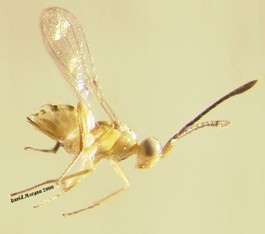
Eight years ago, a flurry of troubling stories started cropping up. Many foretold, Cassandra-like, the annihilation of our vaunted North Bay wine industry. An unwanted pathogen vector, the half-inch-long leafhopper called the glassy-winged sharpshooter (GWS), seemed poised to invade our climes and kill our vines. The GWS plays host to the deadly bacterium Pierce’s disease, an incurable condition made all the worse by this particular vector’s lengthy travel habits and hearty buffet-hog appetite.

Traps went up in vineyards, signs got posted on roads, and seemingly overnight, the GWS became a familiar yellow- and ivory-speckled poster child for tasting rooms throughout Sonoma and Napa counties, garnering jaw-time equal to discussion of tannins and terroir. Some time between then and now the GWS faded from the local radar, a fuzzy recollection for many who had kept it on high alert just a few years before.

So what’s become of the glassy-winged sharpshooter, that once feared angel of grapevine death? An informal survey conducted at more than a dozen winery tasting rooms in both Napa and Sonoma counties over the last few weeks produced near universal shrugs, smirks and stabs at funny comebacks. Few offered reasons concerning why the GWS threat hadn’t materialized, and a few even suggested that it hadn’t really posed much of a threat in the first place.

But the GWS hasn’t gone away—it’s just not here yet. Thanks to ongoing efforts by a range of public and private agencies, this pest has remained a few precious counties removed from us. Hopes are that the GWS never will establish itself in the North Bay. But the glassy-winged sharpshooter does thrive in other parts of California, and this native of the southeastern United States has been residing here in California for quite some time.

Vineyards around Anaheim down in Orange County experienced the first outbreak of Pierce’s disease, then called Anaheim disease, way back in the 1800s. More than 40,000 acres of vineyards were destroyed as the disease choked avenues of water flowing through the grape vines. But it wasn’t glassy-winged sharpshooters doing the damage in Anaheim. A feeble cousin to the hardy GWS called the blue-green sharpshooter was that century’s death-dealing varmint.

The blue-green chews a vine leaf or two, but soon tires of dining following its three-foot-long daily journey. By contrast, its big, bad cousin, the glassy-winged sharpshooter, flies a quarter mile at a time, often in numbers, is considerably larger, consumes up to 10 times its body weight in liquids per hour and injects its needle-like mouth into leaf after leaf after leaf, thus infecting far more plants than the blue-green with the Pierce’s disease it carries.

Rhonda Smith is a viticulture farm adviser with UC Davis Cooperative Extension in Sonoma County and an expert on both Pierce’s disease and the GWS. Smith assures, “The glassy-winged sharpshooter is not present in Sonoma County nor anywhere on the North Coast to anyone’s knowledge. There are traps up for it. The Agriculture Commissioner’s office in this county, in Napa County and in other North Coast counties are all quite good at looking for egg masses in incoming shipments of ornamental plants from infested counties in Southern California. Ornamental plants are also inspected and treated at the point of origin in Southern California before they’re loaded on trucks and shipped here.”

Any possibility the GWS might ever settle in the North Bay still strikes fear in the local wine industry. And for good reason. Once the GWS arrives, it’s one interloper that’s difficult to vanquish. Take Temecula, for example. Ten years ago, Pierce’s disease wiped out fully one-third of Temecula’s vineyards, causing losses totaling $20 million. It was hoped that vineyard eradication efforts had long ago paid off, but almost 40 GWS were found trapped in Temecula vineyards during the last week of this past April. In addition to its voracious appetite for grape leaves, the GWS has an equal taste for precious ag crops like citrus, almonds and stone fruit. So it’s not hard to see why this issue’s still delivering plenty of political punch along with wine-industry attention.

Approaches to the problem vary from place to place. Whereas Temecula vineyard owners tend to favor pesticides like Admire in combating the GWS, here in the North Bay, groups like the Sonoma County Winegrape Commission, a member organization representing over 1,800 grape growers, place a greater emphasis on integrated pest management. The commission champions the use of natural biological controls on pests like the glassy-winged sharpshooter. Insectories, or gardens filled with plants that attract and thus employ “good” bugs to feed on their destructive brethren, help eliminate pest species.

Providing homes for insect eating birds and hungry little bats helps, too. One recent demonstration was described in which a team of search and rescue dogs from Twin Pines Vineyards in Napa sniffed out what Winegrape Commission president Nick Frey contends is now the single most threatening insect facing grape production in the North Bay: the vine mealy bug.

The last North Bay contacts with the glassy-wing came back in 2007. In February of that year, a mature GWS was captured in Napa. The next month, a sharpshooter egg mass was discovered in a shipment of ornamentals at Lowe’s in Cotati. Neither incident led to an outbreak. Apparently, those millions of federal dollars going into Pierce’s disease research and eradication efforts matched with ongoing local vigilance have prevented what once seemed an inevitable regional infestation. While the GWS will continue to pose a threat to North Bay vineyards for the foreseeable future, don’t expect to be spending a lot of time discussing it with tasting-room folk. At least for now, they’d rather talk tannins and terroir.


News Blast

0

06.18.08

Mate or Die

If the light brown apple moth (LBAM) were on Homeland Security alert, its flashing colors would be green/blue for low, though guarded for Sonoma and Napa counties; and yellow, or elevated, for southern Marin. While Marin County faces the threat of aerial spraying aimed at eradicating the pest later this summer, such is not the case with the neighboring North Bay counties.

Stephan Parnay is a division manager for the Sonoma County Agricultural Commission. Parnay says there hasn’t been an LBAM find in Sonoma County since April 21, and that this find was just the second of the entire year. Only a few LBAMs have been discovered in Napa County over the same time frame.

But this doesn’t mean the LBAM isn’t affecting wine country. “The light brown apple moth has a huge host-list. It can affect over 2,000 plants, as well as about 250 agricultural crops,” Parnay says. “One of our main concerns is that it’s having an economic impact on our growers here. So we are having to help growers meet specific requirements so that they can continue to move their products outside the quarantine area and also out of the state.”

Absolutely no spraying is presently anticipated for Sonoma or Napa counties. “That’s not even being considered,” Parnay says. In lieu of spraying, the Ag Commission has distributed little twisties impregnated with a pheromone, which is then tied to metal hangers in trees and shrubs surrounding those areas where the most recent finds have occurred. The pheromones act to disrupt the moth’s mating habits. Since it can’t mate, it dies. The twisty ties are approved for organic use, so they pose no threat to organic or biodynamic farmers.

Parnay’s advice in keeping the LBAM away is to ask locals, particularly gardeners, to keep a vigilant eye out for the varmints. “When they’re out in their yards and they see something they don’t remember ever seeing, they can give our office a call,” he says. “They can also call the University of California Extension Master Gardener Program, and either our office or theirs can look at those insects and can determine if it is something that is nonnative, an exotic that we need to do something about.”

To keep abreast of the latest developments regarding the LBAM, go to www.cdfa.ca.gov/phpps or [ http://www.stopthespraymarin.org/ ]www.stopthespraymarin.org.


Room for Growth

0

06.18.08

In 1975, Martha Davis migrated south from Berkeley to Hollywood, landed a contract with Capitol Records and put out four reputation-making albums with the Motels, a period she now refers to casually as the band’s “heyday.” But looking up at a gold record while chatting amiably by phone from her current home outside of Portland, Ore., she muses that it was, at best, a mixed experience.

“It was amazing, because we were having success,” she says, “but I was in a relationship with a guy that was not a good relationship. The producer who produced that record was a jerk, and I was getting emotionally—and occasionally physically—beat up,” she recalls haltingly. “So at the same time we were having all this great success, it was really not that much fun.”

Touring behind a newly released album is standard practice. But this year, the Motels have three of them, an unlikely surge of fresh output from the new wave&–era band known for its pair of hits, “Only the Lonely” and “Suddenly Last Summer.” The band plays June 22 at the Sonoma-Marin Fair.

The new albums—Beautiful Life, This and Clean, Modern and Reasonable—were all recorded with her current touring band, an accomplished group of younger players she has been working with for the past several years. Beautiful Life, Davis explains, began as a simple set of songs, recorded a couple of years ago but delayed before final mixes were completed. In the interim, a new burst of inspiration found her with another batch of songs which, with the arrival on the scene of Portland producer-engineer Matthew Morgan, quickly took shape as This.

“While we were working on that,” Davis continues, “there was another album that was made in about two weeks time called Clean, Modern and Reasonable, which is remakes of old Motels songs, but they’re completely different arrangements.”

Of the three, it becomes clear that Beautiful Life is the most personal project. Davis recalls that her soon-to-be ex-husband (“We’re in the middle of a little divorce,” she says airily. “Ah, well, it happens.”) suggested having Morgan take a look at the rough mixes. “All of a sudden, it really started taking a different shape. It went from just being a collection of pop songs to an album about my mother’s life and death, which was a suicide.”

Martha was just 20 at the time. Not long afterward, she came across her mother’s diary. “She was really this brilliant woman,” a Phi Beta Kappa at Berkeley, Davis says. “She wanted to be Virginia Woolf, and she ended up selling out all her dreams. She ended up trading that in for the husband and the kids, and becoming a very, very sad housewife.”

Sketching that life in a series of songs, “I thought I was totally making [the album] about my mother,” Davis says, “but when the smoke cleared, I realized I was making it about me as well.”

With a little distance now, she acknowledges that was hardly surprising. Reading the diary “literally changed my mind,” she says. “I had been doing music, but I was scared and I wasn’t sure, and I read that book and I thought, ‘I have to.’ And I sat my little kids down and I said, ‘You know what, we’re going to do this thing and it’s going to be really hard, and it might not work at all. But if I don’t do it, I’ll probably resent you and hate myself.'”

Davis, strikingly visual with her arch, vampish persona, was perfectly positioned to catch the wave of early ’80s video-driven musical marketing, and rode it to the Top 10 twice. “There’s still a lot of resonance with the two hits,” she acknowledges, adding that other early Motels songs like “Counting” and “Total Control” from the first album “are just like dressing up, still tons of fun to play.”

But when she thinks back on the circumstances that surrounded those early recordings, Davis becomes reflective. “It was remarkable that I actually did it. Both of my parents were dead. I had two kids. I had no husband, and somehow I managed to pull this off. I still don’t know how I did it.”

 The Motels perform Sunday, June 22, at the Sonoma-Marin Fair, 175 Fairgrounds Drive, Petaluma. 6pm. Free with fair admission; $9&–$14. 707.283.3247.


The Bee’s Knees

06.18.08

It’s no secret that bees are disappearing at a startling rate. What is a secret, though, is where exactly they’ve gone. Best-case scenario? They’ve all relocated to the Melissa Garden, a 40-acre refuge for our striped and fuzzy pollinator friends tucked into the edge of the Russian River Valley in Healdsburg.

A sign that reads “Bee Crossing” welcomes visitors to the property, and the dusty road crunches underfoot amid a quiet buzzing. A fountain trickles away in the center of an explosion of color—purples, yellows and reds all clamor for the eye’s attention—and sunflowers of all shapes reach toward the early morning sun. When Barbara Schlumberger, the driving force behind the gardens, appears in a woven sun hat and a big smile, it’s easy to understand why the bees seem to love it here.

Not only do the central botanical gardens evoke a natural and protective environment for the bees, educational tours and classes are offered for any aspiring beekeeper: plants to plant, hive management, the benefits of bee products and ways to spread the buzz on sustaining the bee community at large.

After meeting at a biodynamic beekeeping workshop in 2006, Schlumberger, Priscilla Coe and Michael Thiele began to weave ideas together for a sanctuary that would allow them to take care of their bees in the most natural and green way possible.

“We decided that we needed to make a bee sanctuary that would be a paragon, so that people around the world could see that they could do it themselves,” says Schlumberger, who lives on the Melissa Garden property with her vintner husband, Jacques.

“Sort of like a bee hospital,” she adds with a laugh. She bends to replace a cover on one of the hives, which are hand-painted by Schlumberger and look like something out of an art gallery, almost hidden among the hues of the flowers.

The farmers took a cue from the gods in naming the gardens—”Melissa,” the Greek word for honeybee, is said to have been a nymph who fed Zeus honey as a child—and are now taking bee survival into their own hands.

“Last year, we lost a third of the bees in the United States. It’s pretty amazing when you think about the consequences of that,” she says. “We’ve been using the bees as our slaves for years, and they’re dying now, their immune systems are down. It’s just a total collapse.”

Schlumberger attributes a large part of the bee disappearance to the use of pesticides and fatigue. Collectively, she says, the bees have around 80 to 90 diseases running rampant in their tiny systems.

The bees currently residing at the Melissa Garden—about 60,000 per hive in peak season, with a total of six hives on the property—take no notice of onlookers, being as busy, well, as bees as they crawl in and out of the hives carrying pollen on their back legs.

This bee oasis has big dreams. In the works since 2007, the grounds currently include an iconic garden, orchard and bee yard, an herb garden and a pond, not to mention the surrounding forest full of native vegetation; a medicinal garden is slated for installation in late 2008. Each element of the landscape is planned using biodynamic gardening methods, providing the most organic and sustainable setting for humans and insects alike.

“One of the most important things is how we prepare the garden,” Schlumberger says. “We add minerals and medicinal herbs to cow manure, and we do different sprays. The main idea is that the invisible world is taken into consideration as well. The moon, the sun, all of the natural elements are incorporated.”

One of the many unique benefits of the Melissa Garden is its dedication to holistic beekeeping, a practice that originated in Germany.

“Holistic beekeeping is looking to the bees to see what they need, instead of what humans need,” Schlumberger explains. “We give them large hives that are sized in a very natural way, instead of in traditional boxes, and we let them make their own comb, instead of putting in sheets of plastic. “And we don’t take all of their honey, if any at all,” she says.

The beekeepers also place an emphasis on only planting botanicals that bees are known to love, not simply like. Each plant is selected based on its nectar and pollen quality, as well as its ability to nourish the bees’ needs. The current list of “core plants” stands at about 113 or more different species of plant life, both annual and perennial, and new varieties are constantly being added depending on the season.

Happy bees and honey aside, these gardens are downright heavenly.

The Melissa Garden is currently open for classes and by appointment only. For more information, visit [ http://www.themelissagarden.com ]www.themelissagarden.com.


Lord, Could You Please Make My ‘Ass’ Record Number One?

There's a ten-gallon hatful of absurdly quotable passages in Trace Adkins' freewheeling autobiography, A Personal Stand: Observations and Opinions from a Free-Thinking Roughneck. But I think this one is my favorite: Even though it might be my most famous song, technically "Honky Tonk Badonkadonk" was never a number-one record, and for a pretty good reason. It was number two the...
Times New Viking at Modified Arts: Phoenix, AZ

After the Tom Waits show, we drove to Modified Arts, a small all-ages club in Phoenix. Times New Viking were playing, who, strangely, I'd read about that morning in Spin at the ultra-modernist Phoenix Library. Even though I'd heard their album on Matador when it came out and not thought much of it, I liked 'em live. They were...

Tom Waits at the Orpheum Theatre: Phoenix, AZ

This is an obsessed-fan review, here, folks. When Tom Waits tours, there are no press passes. You wanna review the show, you’ve gotta buy your own tickets like the rest of ‘em. And that’s fine by me. When Tom Waits tours, he doesn’t play in the Bay Area. You wanna see Tom Waits, you’ve gotta buy airplane tickets and fly...
Winged Glory

06.18.08In our garden state of almonds, grapes, rice, walnuts, figs, olives and so much more, the bees are starving. According to entomologists, the rising tendency toward monocultures, in which single-plant crops cover many contiguous acres, is limiting bees to a nutritionally deficient diet. The result is a weakened immune system, loss of reproductive capacity and decline in overall vigor...

Oh, Oregon!

06.18.08 Coriolanus—bloody and brilliant Staged as a intimate theater-in-the-round in Ashland's adaptable New Theater, developed under the wildly inventive direction of OSF mainstay Laird Williamson, the rarely staged Coriolanus—often dismissed as one of Shakespeare's "problem plays"—has been transformed from a text-heavy, off-putting bore into a bloody, brilliant, tragic, and surprisingly elegant thing of beauty. OSF, which has proven...

Nick’s Summer Vacation: Hiking the PCT

Former Bohemian classified ad rep Nick Curran is currently hiking the Pacific Crest Trail. Having left in April, he plans to finish his journey in September. Periodically, when he staggers into a town, he'll send us an update. And man, are we jealous!Muir Pass, courtesy of the PCT Hiking the Pacific Crest Trail has been spectacular. You wouldn't believe...

Trouble That Never Came

06.18.08A few weeks back, a mild stink was raised concerning the inclusion of $45 million in earmarks by two local members of Congress, Lynn Woolsey and Mike Thompson. House Representative Mike Thompson put in for the lion's share of these North Bay monies. Thompson's bid to funnel $3,332,000 to public institutions for "Pierce's disease/glassy-winged sharpshooter" research got front-page coverage...

News Blast

06.18.08 Mate or DieIf the light brown apple moth (LBAM) were on Homeland Security alert, its flashing colors would be green/blue for low, though guarded for Sonoma and Napa counties; and yellow, or elevated, for southern Marin. While Marin County faces the threat of aerial spraying aimed at eradicating the pest later this summer, such is not the case with...

Room for Growth

06.18.08In 1975, Martha Davis migrated south from Berkeley to Hollywood, landed a contract with Capitol Records and put out four reputation-making albums with the Motels, a period she now refers to casually as the band's "heyday." But looking up at a gold record while chatting amiably by phone from her current home outside of Portland, Ore., she muses that...

The Bee’s Knees

06.18.08It's no secret that bees are disappearing at a startling rate. What is a secret, though, is where exactly they've gone. Best-case scenario? They've all relocated to the Melissa Garden, a 40-acre refuge for our striped and fuzzy pollinator friends tucked into the edge of the Russian River Valley in Healdsburg.A sign that reads "Bee Crossing" welcomes visitors to...
11,084FansLike
4,446FollowersFollow
6,928FollowersFollow