

I actually let out a loud, high-pitched scream when this arrived in the mail today.
I actually let out a loud, high-pitched scream when this arrived in the mail today.
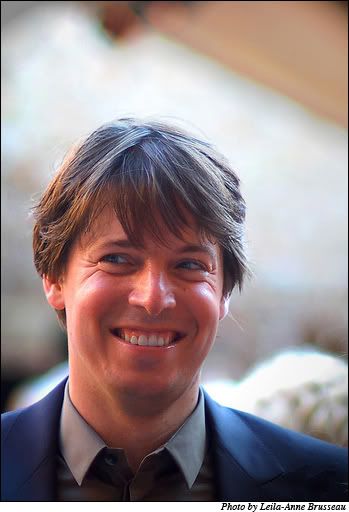 It wasn’t the castle. Nor was it the exquisite views, or the wonderful weather, or the feeling of being in a pastoral renaissance drama. It wasn’t even the awe-inspiring performances, though they ran a tight second.
No, what made Joshua Bell’s appearance at Castello di Amarosa tonight so infinitely remarkable is that during the intermission, while still bathed with perspiration from a dominating run-through of Grieg’s Sonata for Violin and Piano No. 3, Joshua Bell hopped off the stage, strolled down the aisle, and hung out.
Classical musicians do not “hang out.” Classical musicians of Bell’s caliber, especially, do not “hang out.” But there he was, doing just that, hanging out—chatting with fans, charming old ladies, signing programs for young violinists, and taking photos with visibly bowled-over members of the audience.
You don’t get this kind of close camaraderie at Avery Fisher Hall or the Kennedy Center. But in the Napa Valley, Bell thinks to himself: What the hell. I’m at a castle, it’s kinda weird, and these people seem cool. I think I’ll stand over near that cast-iron dragon head under the coat of arms unfurled on the wall and, you know, hang out.
Bell’s casual presence didn’t diminish the absolute seriousness and command he demonstrated on stage just moments before, in an utterly stunning display of precision, taste, and verve alongside the excellent pianist Jean-Yves Thibaudet.
Jogging onto the stage in an untucked white shirt, magazine-current haircut and winning smile, Bell raised his bow and dove hungrily into Grieg’s sonata. Containing numerous passages which in the hands of others might be choppy or scratchy, the piece proved a demonstrable showcase for Bell’s glassy smoothness. Flawlessly quick changes from low growls to feathery high notes abounded, and Bell’s final note of Grieg’s second movement—reaching as high as the violin can play—had the gossamer quality of untouched water at dawn.
It may be a cliché to imagine an instrument as an outgrowth of the body, but if so, the cliché begins and ends with Bell. His 1713 Stradivarius protruded from beneath his chin as an extra appendage, a thing incomplete when it is not next to him and—in ways—vice-versa; he played it as if brushing back hair, natural and thorough. His connection was just as strong with Thibaudet, who joined Bell in a telepathic understanding of the piece and of each other, handling his end with a marvelous touch at the piano.
Bell has been performing the Grieg sonata for some time now, and it’s high time he recorded it. No doubt the crowd tonight would nominate Thibaudet as his studio mate. At the end, after the intricate plucking and ferocious dance passages of the third movement, the audience was on their feet, bringing the pair back to the stage for three separate sets of bows—all of them more than deserved.
Opening the concert was soprano Lisa Delan, in a light purple dress with thin straps, singing the world premiere of Gordon Getty’s Four Dickinson Songs. A moving and often daring musical adaptation of four Emily Dickinson poems, the work nonetheless received a lukewarm reception, despite Delan’s dramatic interpretive ability. After the intermission, Thibaudet returned to the stage with the Rossetti String Quartet for a perfectly thrilling Piano Quintet in F Minor by Brahms. Like Bell’s performance, it was joined somewhat charmingly by the near-constant sound of birds chirping in the sky above the castle’s great outdoor room.
Festival del Sole co-founder Barrett Wissman was in a cream-colored suit jacket and black slacks, nursing a plastic cup of red wine; his wife, the cellist Nina Kotova, wore a chic black dress, diamond earrings and a gigantic amethyst necklace that attracted comments every ten feet or so. The Castello di Amarosa, too, was done up nicely; even the posts holding up the stage tent were covered in a faux stone to match the castle walls, as film crews from PBS were on hand, recording for a special.
But it was the close atmosphere and the proximity to greatness that defined the evening. In fact, at one point, while poking around upstairs, who should I see through a small stone window but Joshua Bell himself, in the castle’s dressing room, blowdrying his hair. It was a strange and beautiful moment, and one that I was glad I had my camera for.
All in all, it was a truly memorable night. More photos below.

Shall we give tribute to a summer’s day? What could be more lovely and temperate than the blender blades stirring the darling fruits of today, for summer’s lease hath all too short a date! So what are you waiting for? Nothing sighs “summer quenching” better than an icy blender drink. And the beauty is, you can toss just about any combination of fruits, a healthy slosh of rum (or tequila or vodka or . . . ?) and a handful of ice, and hit the button for a pitcherful of party.
I’ve included some recipes collected from sources both savory and seedy (all personally sampled—that is, inspected—by a willing and professional panel of blenderologists) to get you started. In other words, you’ve just been issued your own poetic license to go blender crazy.
• In general, four ice cubes per serving makes a slush and eight makes a frozen drink. Follow your own bliss.
• Use only fresh ice (not those old cubes with little crumbs and bits of parsley stuck to them).
• Smaller cubes are easier to blend, crushed ice being easiest, and gentler on the old Osterizer.
• You can use frozen fruit or fresh ripe seasonal fruit. If using the latter, make sure to toss it in the freezer for at least 30 minutes before starting.
• It’s a good idea to keep alcohol in the freezer. Your mantra should be: Keep it cool.
• Blend for no more than 45 to 60 seconds. Overblending will make your creations watery.
• Serve immediately. If you have any of your concoction left over, keep it cool, and reblend before serving.
• Fruit flavors can be accentuated by adding appropriate juices and/or flavored liqueurs.
• These babies are usually served in parfait glasses, but any tall glass will do.
• Now’s the time to break out those little paper umbrellas and fancy stirrers. These drinks demand to be pimped out to the max.
• Sip slowly or suffer the worse kind of brain freeze.
• Remember, just ’cause they look like smoothies, doesn’t mean they are. Go easy, pardner.
Icy Bliss
Here are both classic and more exotic recipes to prepare individual portions; multiply by the number in your party (or by the most vocal of your party) accordingly.
2 ounces light rum
1 ounce lime juice
1/2 ounce triple sec
1/2 tsp. superfine sugar
1 cup ice
5 strawberries
Garnish with a strawberry. Variations: Instead of strawberries, or in combination to taste, add chunks of mango, banana, blueberries, peach and/or pineapple.
1 cup of ice
1 1/2 ounce vodka
1/2 ounce blue Curaçao
1/2 cup fresh or canned pineapple
2 ounces grapefruit juice
Garnish with a chunk of pineapple.
3/4 cup lemonade
1/4 cup fresh lemon juice
1 cup lemon sorbet
1/2 cup vodka
1 cup ice
Garnish with mint sprigs.
1 ounce tequila
1/2 ounce triple sec
1/2 ounce sour mix
1/2 cup ice
fresh fruit and fruit liqueur of your choice; lime juice to taste
Garnish with a lime slice.
1 ounce coconut rum
1/2 ounce banana liqueur
dash of grenadine
1/2 ripe banana
dash of pineapple juice
dash of orange juice
1 cup ice
dark rum to top
—A.Y.
Quick dining snapshots by Bohemian staffers.
Winery news and reviews.
Food-related comings and goings, openings and closings, and other essays for those who love the kitchen and what it produces.
Recipes for food that you can actually make.
No, this is not a story about a comedy by Monty Python, and it is not the story of Ryan Connolly’s life. This is the story about how each and every one of us is a casualty of war.
As I sat at the end of the pew on July 7 and the flag-draped coffin of Sgt. Ryan James Connolly brushed past me, I wondered how it was I came to be there. I didn’t even know Ryan, the son of a colleague who was killed in Afghanistan on June 24. He was just 24. The St. Rose church was overflowing with people who had come to pay their last respects to this fallen soldier. Amid the wails of a distraught sister, I looked around and saw faces bearing both grief and bewilderment. There were people there like myself who did not know Ryan and probably knew no one fighting in this war on terror.
We are not allowed to see flag-draped coffins while eating our dinner and watching the 6 o’clock news, as it was when I was a child. We are not allowed to express our discontent with this war, unless we want to be labeled anti-American or unpatriotic. Yet here we all were, gathered together under the same roof, all of us with different faiths, political beliefs and reasons, to attend this funeral. And all of us were beholden to the one who gave his life.
As the service continued, we learned how Ryan had found himself in Afghanistan. He had visited the site of the World Trade Center after 9-11. He was apparently so moved that he immediately signed up to defend all those who did not stand a chance on that day. In doing so, he signed his own fate. Throughout the service, the phrase “the life of Ryan” was repeated as people told stories of him as a child, of his heroics as a soldier, his hobbies and interests and his love for his beautiful wife and infant daughter. By the time the service had concluded, we all had a personal interest vested in a man many of us never knew prior to June 24.
Under the sweltering sky again, we all gathered for the interment. I couldn’t help but notice a young girl, maybe age one, who was squirming and half-whining, half-laughing. She looked as though she was enjoying herself, as if we were all there for her amusement. I realized that this was Ryan’s daughter, naturally unaware that she was in the midst of one of the biggest losses of her life, surrounded by those who loved her most, themselves swallowed up by grief. Could it be, in fact, that she unknowingly represented all of us who don’t realize what this war is really costing us?
This is the first time I have been affected by the loss of someone from this war, even though it was only by an arm’s length. I left the cemetery serenaded by the sounds of mournful, heartbroken cries, sniffles and the shuffling of feet on the hot pavement.
During the years since the war on terrorism began, there have been over 4,000 of our young men and woman who have come home but not come back. While most of us don’t know these soldiers, the truth is that with each loss, we lose a piece of ourselves. Perhaps we don’t even realize it yet, but one day, if you too find yourself at the funeral of a friend or co-worker’s child, grandchild or nephew, you may walk away realizing that a small part of you has died with that person. We are all truly connected—our pain, our love, our hopes and our joys.
Before driving off from the cemetery, I wondered if somewhere in Iraq, Afghanistan or any of the many other war-torn corners of the world, someone like me was paying respect to those laying a loved one to rest, wondering how it was they came to be there. By the end of the day, they too might understand the connection.
You are so loved and never will be forgotten, Ryan.—Beth
Open Mic is now a weekly feature in the Bohemian. We welcome your contribution. To have your topical essay of 700 words considered for publication, write [ mailto:op*****@******an.com” data-original-string=”wEAWZaPPQqAxgRFP+1IE0g==06axiMAOza/0c9K2YtOZEH36AFceQglz7rFgkq3DwMh4YNa5dCaLl1B26pIzg+QfX2dUAr7ksjI60wEiyOxbxTO064l7l2HCvvOfWb3QGzGgCw=” title=”This contact has been encoded by Anti-Spam by CleanTalk. Click to decode. To finish the decoding make sure that JavaScript is enabled in your browser. ]op*****@******an.com.

Summer has arrived and fresh figs are back. We never doubted they’d return, of course. In early summer, the first crop of this uniquely twice-per-year fruit arrives, black, brown, yellow or green, and all as sweet as jam.
But never would we have expected that two craft breweries this year would release an oddity fig beer. Yet with the onset of the summer of 2008, we find on retail shelves Avery Brewing Company’s Fifteen and Schmaltz Brewing Company’s Rejewvenator (“the Chosen Beer”), each brewed this spring with dried California Mission figs. Commercial fig beers are about as rare as beer styles come. Adam Avery, namesake founder of the family brewery in Boulder, Colo., believes that figs are overlooked as beer recipe elements due to their profoundly subdued flavors; they are subtly complex, much less tart than berries, cherries or apricots and almost entirely void of aroma.
Yet Avery notes that dried fig nuances regularly appear in strong, dark ales. “People often say that a beer is ‘figgy’ or has a ‘fig complexity,’ and I just decided, why not throw them right in?”
Avery’s Fifteen was brewed with spices, herbs and Brettanomyces yeast, known for leaving a sour barnyard pungency. The beer comes as a celebration of the brewery’s 15th anniversary and was meant to be a particularly “weird beer,” Avery says. Brewed to 7.7 percent ABV, Fifteen appears a light pink amber, care of the hibiscus flour petals in the recipe, and smells as bright and fresh as an herb garden—with a vibrant livestock aroma and just a teasing trace of horse. The fig flavor hides very furtively beneath and invites the most attuned palates to give this ripe, tangy brew a try. Pair it with a fresh barley salad.
Schmaltz’s Rejewvenator features the fig as a quasi-serious ecclesiastical symbol of new life and spirituality, with the 22-ounce bottle riddled with Holy Book quotes and historical references to the fig. A Belgian Dubbel-Doppelbock hybrid, Rejewvenator is a robust, big-boned animal of 7.8 percent ABV, which could stand proudly on a table spread with the Old World’s richest cheeses. Brewed with 400 gallons of fig purée in the kettle, the beer is heavy, woody, dark and sticky with fudge. Its creamy, candy body is underlaid with a rich complexities of many shades, like caramel, dried apricots, prunes, vanilla, hazelnut, raisins and dates. Far back on the finish, distantly, perhaps, there may even be some fig.
Quick dining snapshots by Bohemian staffers.
Winery news and reviews.
Food-related comings and goings, openings and closings, and other essays for those who love the kitchen and what it produces.
Recipes for food that you can actually make.
Crazy, cock-eyed and extremely strange.”
Those words, attributed to the fever-brained poet Carlo Marx in Jack Kerouac’s On the Road, were written to describe the beatnik’s view of the universe in the disjointed, bomb-happy, communist-crazed postwar America of the 1950s. They are also the perfect description of the novel On the Road itself, and even more so of the play by Johnny Simons, launched last weekend in its West Coast debut at the outdoor Sebastopol Shakespeare Festival in Ives Park. Crazy, cock-eyed and extremely strange, this On the Road is also explosive, dynamic, inventive, hypnotic, ecstatic, unhinged—and exhilarating, instantly recognizable as one of the best and freshest shows of 2008, with an impressive cast that magnificently capture the lyrical cadences and outsized attitude of Kerouac’s words and world.
The very notion of anyone creating a stage play out of Jack Kerouac’s On the Road might seem, at first, to be an audacious and unfortunate folly. To many, On the Road is as sacred a text as any employed by a major world religion. Written in 1951, the thinly fictionalized autobiography was not published until 1957, but when it finally hit the bookstores, it was an immediate sensation, hailed by critics as an important example of Beat Generation literature, railed against by moralists decrying its celebration of alcohol, drug use and casual sex, and embraced like a warm and slightly sticky blanket, not only by the generation of young Americans it described, but also by the next generation of disaffected freethinkers, social anarchists and hippies who would look to On the Road as a kind of primer on living. In this new stage adaptation, creatively directed by Scott Phillips with a finely tuned eye and ear, the playwright, director and artists not only avoid the threatened doom of adapting such a work to the stage, they embrace the danger and use it in every moment, movement and line.
Sal Paradise (Kerouac’s alter ego), played by Ryan Schmidt with a graceful, easygoing sense of hunger, is a slightly nerdy writer whose life is changed when he meets wildman hedonist Dean Moriarty, played by Sonoma County Rep staple Ben Stowe with a physical commitment and emotional energy that nearly obliterates the stage every time he appears. In Puritan days, one might claim the actor was possessed, so completely does Stowe—usually given calmer, quieter roles—allow himself to embody this morally unhinged dreamer. Along with Moriarty’s new wife, Laura (Alice Grindling), the boys hit the road in search of “kicks,” driving in Moriarty’s red Hudson, which is seen only in the painting that looms over the set, along with other appropriately iconic images.
Along the way, they meet mutual friend and fellow writer-intellectual Carlo Marx, brilliantly played by Miyaka Cochrane as someone whose brain contains so many electrifying ideas and explorations that his body can barely contain the energy of it all. There are plenty of other characters on the road: Moriarty’s other lover, Camille (Laura Tennyson); goofy layabout Ed Dunkel (Samson Hood); Dunkel’s surprisingly strong-willed wife, Galatea (Karen Hanson); and the imposing Old Bull Lee (Eric Burke), a New Orleans writer and drug dispenser revered by Paradise as a kind of mentor.
Played by Burke as a contrary blend of curmudgeon and gourmet, Lee savors his seriousness as he dispenses bitter wisdom to the young beatniks whose adoration he simultaneously despises and delights in. It’s one more in a strong string of performances this year by Burke (last seen in True West), proving that whether he’s a lead or a supporting role, he is one of the North Bay’s finest actors.
If the acting and direction are the sizzle of the show, then Kerouac’s words are the steak, and the script absolutely drips with the juicy joy of his language. Kerouac, in his life as well as his writing, endeavored to embody a Zen-like devotion to being “in the moment.” Such an existence brings as many kicks in the head as it brings the sought-after “kicks,” and the play is not all Beatnik fun and games. Ultimately, the point of the play is the same principle that Kerouac learned early in his life and expressed over and over throughout his career: “Life is holy, and every moment is precious.”
‘On the Road’ runs Thursday&–Sunday through July 27 at Ives Park, Willow Street and Jewell Avenue, Sebastopol. Open for picnicking at 5:30pm; performance, 7pm. $15&–$20; Thursday, pay what you can. 707.823.0177.
Museums and gallery notes.
Reviews of new book releases.
Reviews and previews of new plays, operas and symphony performances.
Reviews and previews of new dance performances and events.
P. Joseph Potocki’s article (“Blowing Hot Air,” July 9) is very informative and, at the same time, humorous. This is journalism of the highest quality, worthy of an international audience.
Michael R. Martinez-Walsh
Rohnert Park
I was reading the North Bay Bohemian at Coffee Catz in Sebastopol when I received a call from Florida. My youngest son, Chris, had just been Tasered, maced and arrested for resisting arrest with violence. I had just read about the rash of teen and young adult shootings by Sonoma County officers in the article, “Insane Situation” by Lois Pearlman (June 25). Well, I thought to myself, at least they didn’t shoot him!
Just last month he was working in Florida as a licensed mechanic enjoying his work and being paid well. What happened?
What started out as a fun weekend with a stranger ended in a stolen wallet, a lost job and a blown engine. A bad week, a bad hangover and little sleep led to spacey behavior at the local bakery and coffee shop where the manager called the police complaining about someone (Chris) shooting a toy dart gun at one of the outdoor tables. In the meantime, the manager asked him to leave, so he walked away.
A few minutes later, an officer yelled for Chris to “Hit the ground.” He ignored the officer because he thought he had not done anything wrong, and so kept walking. The officer grabbed his hands and cuffed him from behind. My son panicked and fought back, inadvertently ripping off the officer’s badge. He ended up with a knee in his back, a Taser in his side and mace in the face. A three-to-one tag team match. He was charged with theft of the officer’s badge as well as resisting arrest with violence, which is a felony. He had just passed a drug test and had gotten a new mechanic’s job, but now needs to stay in town to defend against the felony charges.
There was no immediate danger, no reason to press the situation and no laws broken. This was at 10am. Why did a lone officer approach and force a confrontation? The manager statement reports a “plastic dart gun,” yet the officer justified the attack by reporting Chris to be “armed and dangerous with a gun.” If that were true, an officer would not risk running after him with cuffs only. The charges have been trumped-up after the fact to justify the provocation.
Just a couple days ago, the local daily reported that the Santa Rosa police chief had resigned, and that he was “unabashed about leading his troops into battle.” When did “to protect and serve” turn into “enemy combatant”?
Luckily, my son is pretty resilient and has multiple skills to develop and fall back on. But what about those who do not or cannot? Mental illness may be a misnomer, for the heart is always involved.
Daniel Osmer, Ambassador for Youth Science
Sebastopol
To object to the term “illegal immigrant” because people aren’t illegal is pettifoggery (Letters, July 2). The meaning is clear not only from convention but because “illegal person” is as devoid of meaning as “taste of yellow.”
What strikes me as really “dehumanizing” is the disregard for the individuality of personhood in the suggestion that living people are identical with their dead ancient ancestors (or even someone else’s, based on superficial resemblance). Those corpses may have “been here first,” but not today’s immigrants.
We are responsible for our own actions, including those that break the law. Breaking the law to enter the country is not noble; it is selfish. It expresses contempt for all the chumps who act properly, and for the society that upholds standards of conduct. One might as well defend reckless driving.
Phillip A. Hessel
Santa Rosa
&–&–>
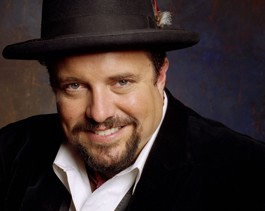
As with the Decca record company talent scout who declined to sign the Beatles and the marketing wizards who thought substituting New Coke was a good idea, we will probably never know the true identity of the vocal coach who told Raul Malo he couldn’t sing. But Malo, whose smooth, expressive delivery has since sold millions of CDs with the Mavericks, Los Super Seven and his own solo recordings, still remembers her.
“I was in a band before the Mavericks and we all went to voice lessons, and the teacher told me I wasn’t very good,” he recounts. “Luckily, I didn’t let that stop me or scar me in any way, but I remember that. She said I was doing it all wrong, and I’m, like, you know, I don’t know that there’s any right way or wrong way to do this. So I just kept at it.” He appears July 25 at the Mystic Theatre.
As their principal singer and songwriter, Malo led the Mavericks through a series of releases that moved from a strong foundation in classic country music (think Hank Williams, Patsy Cline and Johnny Cash) to incorporating a far wider array of influences, including pop hooks and lively Latin rhythms. Along the way, the Mavericks twice won the Country Music Association’s Top Vocal Group award.
As the new millennium dawned, Raul moved into solo work, releasing Today in 2001. With the bold brass and spicy dance beats of “Takes Two to Tango” and the title track, and sultry ballads like “Every Little Thing About You”—not to mention four songs sung entirely in Spanish—Today put Malo’s Cuban heritage front and center.
But Malo says neither that heritage nor the decidedly retro, hard-swinging small combo sound he featured on last year’s After Hours was any kind of career calculation. “I know that people probably think it’s deliberate and thought-out, and it’s really not,” he insists. “Growing up in a place like Miami, you not only had all the Caribbean and tropical influence, but my dad was a huge country music fan, and Mom is a big band and opera fan. So I had all this stuff always swirling around, and to me, the only criterion I had for music was whether I liked it or not.”
That helps explain why his last three discs, including a Christmas album last winter, were all collections of well-chosen songs from established writers as disparate as Buck Owens, Willie Nelson and the Bee Gees. But Malo is happy now to have recently wrapped up work on a new set of his own songs.
“It’s quite different,” he says of the still-untitled album, which is due out early next year. “The last couple of records have all been covers, so I stockpiled a nice little collection of originals. I had a lot to work with this time.”
Being off the road and home for the extended recording sessions also allowed Malo to explore a new creative outlet, an occasional topical blog on his website. “I can get on there and talk about anything, [but] sometimes I’ve got to watch it. I’ve learned not to blog when I’ve had a couple of beers, or when I’m angry,” he chuckles. “You’ve got to be careful.”
He is also careful, but firm, as he deflects any suggestion that he might work with the Mavericks again. “I’m not going to be a part of anything the Mavericks do anytime soon. That’s a part of my life that I no longer care to explore or to be a part of. We had a great run, we made what I thought were really good records, and we had a good time doing it, and I like leaving it at that.
“I thought we were real close to wearing out our welcome,” he adds.
Instead, he is now happily leading a versatile quintet that includes a two-man horn section. “The band I have now is real apt at playing different kinds of styles, which I love,” he enthuses. “They can cover it all, including all the Cuban stuff I did on the Today record and the Super Seven records. I’m really excited to get out there and play with them.”
As he prepares for the summer tour, Malo is eagerly facing a series of dates with no new record to push. “I’m covering all the bases now,” he says. “They’ll hear a little bit of everything.”
Raul Malo appears Friday, July 25, at the Mystic Theatre, 23 Petaluma Blvd. N., Petaluma. 8pm. $23. 707.765.2121.

Pity the residents of Napa County. Their burden is not so much the spas, the great wine and the world-class restaurants as it is the world-class restaurants, great wine and spas. Regular working people not directly benefiting from these luxury industries might be just as well off with a GM plant. Scratch that—a Toyota Prius plant. Up in Adventist Angwin, there’s refuge from the deluge of fermented grape—and from coffee, a deal-breaker.
With fees trending upwards of $25, winetasting is often an annual event when the folks fly in from Ohio. Now the Napa Neighbor program brings back the old days. Residents need only show their driver’s license at 103 participating Napa Valley Vintners member wineries. All offer free tasting of at least an introductory flight; some offer purchase discounts of as much as 25 percent. Napa Neighbor does not mean “neighbor of Napa,” so Sonoma citizens must still bring a loaded wallet. But Napans are encouraged to get out and explore such landmarks as Stag’s Leap Wine Cellars, a winner in the 1976 Judgment of Paris and world-famous ever since.
Stag’s Leap has a tree-shaded, campuslike layout with a scattering of tanks and cellars tucked into a knoll on Silverado Trail. Tasting in the invitingly cool cellar is a no-nonsense affair. Napa Neighbors may start with the citrusy 2006 Napa Valley Sauvignon Blanc ($26) and finish with 2005 Artemis Cabernet Sauvignon ($55). Big and grippy with dry cocoa and a deep well of cassis, very nice for a first-tier Cab. At the reserve bar, still-thirsty and spendthrift neighbors may start with the lean 2006 Arcadia Vineyard Chardonnay ($50) and enjoy a slice of Meyer lemon and golden butter on a wafer of woodsmoke; on through the warm and balanced 2004 Cask 23 Estate Cabernet Sauvignon ($175), brimming with complex dried fruits and baked berries, notes of allspice and clove, on a raft of surprisingly soft tannins. Yokel opinion: not particularly bad for a world-class Cab.
One wonders, is Napa Neighbors a preemptory welcome mat, before the mob from the village marches to the chateau gate with their pitchforks, torches and land-use-restriction ballot initiatives? Our host at Stag’s Leap says that he doubts that is a factor, and adds that the program doesn’t do much for his bottom line vs. case-hoarding tourists. It’s just a goodwill gesture. And goodwill gestures, if they are anything at all, are good.
Stag’s Leap Wine Cellars, 5766 Silverado Trail, Napa. Open daily, 10am to 4:30pm. Reserve tasting, $40; portfolio tasting, $15 (free for Napa residents). 707.261.6441. For information about the Napa Neighbor program, visit [ http://www.napavintners.com/ ]www.napavintners.com.

Driving east from Occidental to Pinole, Tim Johnson was unsure how he should break the bad news to the students at St. Joseph’s School. As a site director for the Caritas Creek environmental education program, based in western Sonoma County, it was one of his many tasks to make on-site visits to the participating Bay Area classes. As with every school he visited, the students would be excited to see him. Tall, boyishly handsome and exuding the sort of benign expression found in kindergarten teachers and Sesame Street characters, Johnson was well-liked by the students at St. Joseph’s.
Johnson’s popularity, of course, was simply a reflection of the students’ love for Caritas. As a heavily enrolled school-year environmental education program for over three decades, Caritas Creek’s unique and engaging approach to inspiring early adolescent children has proven to be an inimitable experience for tens of thousands of Bay Area children over the years.
Technically, however, Johnson was no longer employed. Just days earlier, the entire Caritas staff had been collectively terminated by the program director at Catholic Charities/Catholic Youth Organization (CCCYO) when they conflicted over proposed changes to the core tenants of the thriving program.
Against the demands of CCCYO, Johnson figured he would keep his appointments and at least offer some kind of in-person explanation. Greeting him by his nickname, Gus, the St. Joe’s eighth graders asked Johnson anxious questions about the troubling rumors they heard on MySpace concerning problems with the Caritas Creek program.
“It was all very emotional, especially for the younger kids, who were asking me why they couldn’t go to Caritas anymore,” Johnson says. “The teacher at the time told me that she might need to get grief counselors.”
As the official rationale of a “staffing problem” first leaked out, numerous parents, teachers and administrators, who have long considered the Caritas staff of college-educated teacher-naturalists one of the program’s best assets, deemed the explanation severely insufficient.
“We were very upset about the closure of Caritas at Occidental,” says Karen Francis, an eighth-grade language arts teacher at St. Patrick’s School in Rodeo, “so my students and I wrote letters to CYO and the San Francisco and Oakland [dioceses] about how we felt.”
Matters soon devolved further when CCCYO filed a multimillion dollar federal lawsuit alleging trademark infringement against a few of Johnson’s co-workers who sought to relaunch Caritas at a new location. With emotions running high, a heated tug-of-war ensued over the prevailing identity of the camp.
The origin of the 216-acre CYO site in Occidental goes back to the early 1930s, when Father John Silva purchased 12 acres on Salmon Creek and converted it into a wilderness camp for teenage boys. Shortly after World War II, he donated the camp to the Catholic Youth Organization of the Archdiocese of San Francisco, who within a few years gave more serious attention to developing facilities for a formal outdoor recreation experience.
Later, in the mid-1950s, CYO purchased an additional 74 acres in the area and began running a more complete program for the Bay Area’s schoolchildren.
As a young girl from the Epiphany School in San Francisco’s Excelsior district, Paula Pardini’s time at CYO’s summer camp would become a huge influence on her life’s direction. She volunteered as a junior counselor in high school and worked summers at the CYO camp while in college. In the coming years, her experiences with CYO would prove to be a key inspiration for her founding of Caritas Creek.
“CYO was an amazing experience for me growing up,” says Pardini. “Nothing moves kids the way the camp environment does.”
Now in her 60s, Pardini is upbeat and animated in recollecting her earlier days. With expressive eyes that are as bright as her shiny white hair, she tells of how her CYO experience landed her a job at the more affluent Cloverleaf Ranch camp in Santa Rosa during her mid-20s. There, Pardini would eventually help break the camp’s color line by raising funds to bring a group of inner city youths from Oakland to attend, an act that proved significant beyond its more obvious reasons.
“It was the best session the camp ever had, because you had eight kids who embraced everything with enthusiasm and appreciation,” Pardini explains. “The year-round director told me, ‘This was the spirit shot that this camp needed for years.'”
The unique dynamic of pairing children from vastly different socioeconomic backgrounds was an experience that Pardini kept close as she searched for a Northern California location to establish her own outdoor camp a few years later.
“The idea was to provide children with the opportunity to connect with one another on a common footing,” says Mary Gordon, a cofounder of Caritas Creek, “without the trappings of what your history is or how much money you have, and to have them understand how similar they are rather than different.”
Settling into the spectacular natural setting of the Mendocino Woodlands, Pardini’s young team launched Caritas Creek as a nonprofit organization in the summer of 1975.
“I suggested ‘Caritas,’ because it is the Latin word for ‘God’s love,'” says Pardini, “and we combined it with ‘Creek,’ feeling that it combined the spiritual with the environmental. Caritas is about these connections, with your environment, your contemporaries, your god.”
In addition to its outdoor summer recreation camp, Caritas Creek began to distinguish itself with a unique school-year environmental education program that took a distinctive spiritual approach to engaging its students. Drawing from numerous sources, including her master’s degree program at the University of San Francisco’s Institute for Catholic Educational Leadership, Pardini generated a vibrant philosophy with a focus that would be summed up as “self, others, nature and spirit.”
“In the beginning, we really had to show people what we were trying to do,” says Gordon, “but over the years we had developed a unique niche. Today, there are many choices for environmental education, but people continue to come back to us because of the history and the reputation we have built.”
Through Pardini’s earlier contacts with CYO, Caritas Creek began to rent out the Occidental facility in 1979 to conduct environmental education. By 1984, the two had joined a partnership, with Caritas running the school-year program and CYO providing financial and facility-related backing.
The program was indeed highly multifaceted. Set among the redwoods, the camp would purposefully schedule schools from sharply differing locations—such as San Francisco’s affluent Marina district with Oakland’s struggling International Boulevard—for a week of its unique curriculum. Recreational activities such as archery, canoeing and ga-ga ball (a more rambunctious though ultimately less sadistic version of dodge ball) were matched with academically oriented nature hikes and scientific study. More spiritually engaging activities proved integral to the program, such as Serendipity, which sought to engage students in matters of community, self-identity and relationship-building by inviting them to share their views and emotions in intimate group conversations led by a teacher-naturalist.
“The activities that are set up for the kids [at Caritas] are well thought-out and have a deeper meaning,” says Sonya Simril, principal of St. Leo the Great School in Oakland. “The Serendipity is one of the best aspects of the trip. The kids have the opportunity to sit down in a circle and share something, personal or not, knowing that everyone will respect them.”
Although documents prepared for their 2007 court case sketch an ever-teetering relationship between Caritas and the upper management of CYO, the program thrived over the years, garnering stellar assessments from teachers, parents and administrators.
“If school were perfect, all of school would be like Caritas,” says Ann Manchester, former superintendent for the Oakland Diocese and the exiting principal of Holy Name School in San Francisco. “The program completely engages kids on all levels and appeals to every kind of learning style. It’s a week of total learning, immersion and complete community formation.”
As teachers and parents saw their kids return from Caritas with better behavior and positive perspectives, the weeklong camping experience became a core curriculum component for numerous schools from San Jose to Lake County. Most noticeably, the students themselves regarded the trip as a special experience that delved far beyond the usual classroom monotony.
“When we were told in the eighth grade that we were going [to Caritas] again, the reaction of everyone was crazy, and we couldn’t stop talking about it until we actually got to camp,” says Hannah Kargoll, a former student of St. Joseph’s of Notre Dame in Alameda. “The lessons really carried over with us when we got back, because at Caritas, they made a really big point that everything we were doing there could be brought back with us into the world.”
Eventually, continuing management conflicts between CYO and Caritas led to Pardini’s resignation in 1999. The camp’s popularity and high evaluation marks from participating parents and teachers would continue under Pardini’s longtime assistant Paul Raia, even as tensions between the partnered organizations heightened.
After CYO completed its merger with Catholic Charities in 2003, it acknowledged the revamping of its winter and summer camps as a defined priority.
In 2005, CCCYO’s HIV director Dr. Glenn Motola’s promotion to director of programs was initially perceived as an encouraging development by members of Caritas, who were eager to see someone from the head office exhibit an on-the-ground understanding of what the program was and where it needed assistance.
“When Glenn Motola started as director of programs, he came to camp and inflated us about how he loved Caritas and how he thought it should be the flagship of CYO programs,” says current Caritas director Erik Oberg. “He really had our support when he first arrived at camp.”
The optimism proved short-lived. Caritas staff members assert that Motola’s promise of a hands-on presence never manifested, as he instead began to reveal a perspective sharply out of touch with the realities of the program.
“I remember Glen Motola promising us that he would be around a lot and watch activities, but he never did,” says Nelson Hernandez, a current teacher-naturalist at Caritas Creek, “so the people who wound up making some really big decisions simply had no real understanding of our program.”
Although CCCYO executive director Brian Cahill recognizes the popularity of the CYO-Caritas program, he asserts that it was not fiscally solvent and was falling short in other key areas. Negative feedback from teachers regarding the environmental education program, however small, typically pointed to the same two concerns: cabin supervision and a need for a higher prioritizing of the science content.
“At the time, there were serious parental concerns regarding supervision,” says Cahill via email. “[Our current] curriculum is now aligned with the California 4&–8 grade science standards, which was not the case prior to 2007.”
While everyone seemed to agree that the use of high school students for cabin supervision needed revamping, the notion of shifting the emphasis away from spiritually engaging activites toward a more explicit academic experience became a lingering point of contention.
“Glen started talking about how we need to shift to a science standards program,” says Oberg, “and if we did that, we could charge more. So everything was then leading to an inevitable goal of a science standards program as Motola started critiquing us in crazy ways.”
Moving into 2006, matters between Motola and Caritas management deteriorated so badly that a legal document prepared by Caritas for its court case one year later characterizes the time period as the point when the divide between the two organizations “became concrete.” The document provides a laundry list of conflicts between Motola and the Caritas management, which ultimately resulted in the resignation of two junior Caritas program directors in the space of about a year. (Motola, who is now the director of the Oak Hill School in Sausalito, declined to comment for this article.)
“The only thing we ever knew was that Paul Raia was struggling with the corporate office,” Johnson says, “we never had any tangible evidence that anything was really wrong, because CYO management were never around. Enrollment was doing great and most teachers were willing to book their week again as they were getting on the bus to leave.”
While some members of the staff caught wind of rumblings with upper management, such squabbling appeared to be a mainstay since the days when Pardini first formed a partnership with CYO.
“I left for Christmas break without any thoughts in my mind of things not going well,” says teacher-naturalist Camilla Guevara. “I knew that CYO was constantly second-guessing the program, but we just thought of Glenn Motola as some guy in the administration who didn’t get it. It was his job to get it—but he didn’t.”
Within a mere few days of returning from break in January, the entire program had fallen to pieces.
Little more than a week prior to hosting their first class of the 2007 spring semester, Motola called a meeting of the entire Caritas staff on Jan. 17, and presented them with a list of changes to the program that needed to be instituted immediately. Depending on whom you ask, the Caritas senior program director Paul Raia either personally chose to be absent or was prohibited from attending. (Now set to begin as the executive director of the Next Generation nonprofit in Marin, the conditions of Raia’s severance package restrict him from commenting for this article.)
Earlier in the month, Motola had received the final report of a camp evaluation he commissioned from the risk-management firm Camp and School Consulting. While the report acknowledges many positive attributes of the program, it ultimately calls for a sizable overhaul of numerous aspects of the camp and the environmental education program. The assessment echoed many of Motola’s perspectives, particularly on moving toward a more narrowly defined science-oriented curriculum. The list of changes Motola then presented to the staff heavily reflected the recommendations of the evaluation.
“Outside professional consultants had vital recommendations regarding supervision and best practices, [which] were not received in a positive manner by camp leaders,” says Cahill, “and they elected to sever ties.”
Among the list of roughly a dozen changes were issues such as the ever-worrisome dilemma of cabin supervision, disciplinary procedures and numerous facility-related matters, issues which the Caritas staff claim that they had expressed a full willingness to support. However, three points in the area of “Curriculum” proved contentious: revisions to the program’s “Serendipity” activity, a halt to the mixing of school groups and a restructuring of the week-concluding practice of “Celebration.”
It was in these three proposed revisions that the staff saw an effort by CCCYO to revamp the core tenants of Pardini’s program and skew it toward a completely new focus that removed the emphasis on connecting with the kids.
“The one change that I just couldn’t get behind was the separating of the schools,” says Johnson. “Why would you want to separate these kids when the whole point is to bring them together? It’s against what CYO says their mission is.”
When questioned on Motola’s insistence on the segregating of schoolchildren from differing socioeconomic backgrounds, Cahill asserts, “Our camp philosophy is to meet the needs of various groups of kids regardless of socioeconomic background, with specific programming and trained facilitators that meet their distinct, individual needs.”
Befuddled by how such core changes were to be implemented in the space of about nine days, the Caritas staff contends that they requested Motola’s specific plan on how to proceed.
“We said, ‘If you want us to make these changes, how should we do it?'” says current Caritas program director Emily Wood Ordway. “We were willing to hear their ideas. After two hours of discussion, they said we had to vote: ‘Yes’ you’re willing to stay, or ‘no’ you’re not.'”
What ensued is a matter of starkly different recollections. Cahill states that “the former camp leadership was not willing to consider implementing program changes. As a result, the program was temporarily suspended and staff were laid off in order to allow them to receive benefits.”
Conversely, the Caritas staff claims that they had brokered a second meeting set to convene two days later in which Motola and other CCCYO staff would return with a tangible plan for implementing the changes in such a short space of time.
“They came back on Friday and they had no proposal at all,” says Ordway. “There was no dialogue or choice on the matters. Nothing. Just eviction notices and letters of termination.”
Shocked and discouraged, many Caritas staff members simply returned to their homes around the country. Some dug in and tried to rally support against CCCYO’s decision, while others began looking forward.
“A lot of staff members were from out of state and left right away,” says Ordway. “A couple of us stuck around, and I started talking to Erik [Oberg] about doing our own camp.”
With the eager support of three schools, the duo successfully spearheaded an effort to run a pilot program for a new camp in nearby Cazadero. Amazingly, they had it up and running with a fully volunteer staff by April.
In late spring, Oberg and Ordway had paired with Gordon and Pardini to launch a new incarnation of Caritas Creek in the fall of 2007 at their new location in Cazadero. Pardini and her new partners mailed out their fall registration forms for environmental education shortly before CCCYO mailed theirs. Unsurprisingly perhaps, both parties claimed to be Caritas Creek.
“Within a week of us sending out our registration, CYO sent out their form for Caritas Creek,” Ordway explains. “That was followed by a lot of confusion and disgruntled responses from school administrators who were trying to piece the story together and decide who to trust. The phone calls just started pouring in.”
In light of the emerging conflict over who had the legitimate rights to Caritas Creek, Oberg, Ordway, Gordon and Pardini were served with papers informing them that CCCYO was suing them for trademark infringement for $9.6 million, as well as a court injunction to halt any further use of the Caritas name and logo in connection with the Cazadero camp.
“We had no resources and we didn’t know what to do,” says Ordway. “We were so passionate about the program, but felt that if we could not continue to call it Caritas Creek, it wouldn’t work.”
However, Pardini’s lawyer soon arranged a meeting with Paul Vapnek of Townsend and Townsend and Crew, one of the most renowned lawyers in the field of patent and trademark law at one of San Francisco’s oldest firms. Soon, the new upstart incarnation of Caritas Creek had a stellar legal team—pro bono.
“One of the reasons I’m still coming into the office on a regular basis is cases like Paula Pardini’s and the other Caritas Creek people,” explains Vapnek, “because these were interesting issues and these were people that desperately needed help. And the firm was willing to let me and several of our younger lawyers represent them without charge.”
When it came time for the hearing, Caritas entered the courtroom as a community. “We rallied people associated with the camp to show up for the hearing,” Ordway says. “On our side of the courtroom we had 44 supporters; on the CYO side of the courtroom they had the executive director [Brian Cahill].”
The judge quickly turned down CCCYO’s request for an injunction, and within the week, a settlement was being brokered. Among the details, CCCYO would relinquish any claim to the Caritas name or logo, while the Caritas staff would be required to state on all of the materials that they are not affiliated with CCCYO. It was a stipulation they were all too ready to accept.
Today, both CCCYO and Caritas Creek operate camp programs in close proximity to each other. The former is quick to cite its compliance with California science standards, and points to the 750 children currently enrolled in its summer camp program. Meanwhile, Caritas is presently running a summer camp in King’s Canyon near Sequoia National Park.
Yet the most telling postscript to the split is that Caritas Creek has ended up with the lion’s share of schools in its environmental education program. Whereas the final 2006 school-year program of CYO-Caritas Creek boasted 88 participating schools, nearly 50 of them had already attended the new incarnation of Caritas in Cazadero, a telling sign as to whether a spiritually oriented program has any staying power with the Bay Area’s Catholic school system.
As one teacher remarked, “It’s ironic to me that it’s a Catholic Youth Organization that wants to focus more on science.”

FOLLOW US
Copyright © Weeklys All rights reserved.
Our Publications


