Snake Oil?

07.23.08

In the olive oil market, not everything is as green as it seems. Much of the “extra virgin” oil with which Americans cook is nothing better than cheap nut oil blended with low-grade olive oil, coloring and artificial flavors. Most of this fraudulent product comes from overseas, most notably, from Italy.

But in California, where olive oil production is currently exploding like the big bang, the industry is closely watched and regulated by the California Olive Oil Council (COOC) based in Berkeley, and many producers consider the young local industry to be the most reliable source of true and untarnished extra virgin olive oil in the world.

Spain currently leads the world’s industry in production volume, generating 35 percent of all olive oil. While the United States produces less than 1 percent of the globe’s total, the California olive oil market is growing freakishly fast. This fall, the state’s 14,000 acres of trees will produce some 750,000 gallons of oil, surpassing France’s production. Within five years, it is projected that California’s production will leap to 5 million gallons. Experts predict a conservative figure of 20 million gallons by 2020. The bulk of the influx is occurring in the Central Valley, but many North Bay growers are creating artisanal products worth their weight in green gold.

The California Olive Ranch in Oroville controls approximately one-third of the state’s oil production, according to vice president of sales and marketing Alan Greene. Such consolidation of business could be a good thing in terms of wide-scale quality control; Greene himself is president of the COOC, and his olive oils are as bitter, fruity and pungent as the most discerning tasting panel could ask for.

Overseas, the European Union and the International Olive Council (IOC) share the job of governing quality control within Italy, other EU nations and other member countries of the IOC, which include nations in Africa, the Middle East and the Southern Hemisphere. However, no governing body exerts adequate control over olive oil exports, and untested products regularly go out the door dressed as “extra virgin” olive oil. Just as readily, the FDA does not test incoming olive oil as it heads to shelves across the country.

“Extra virgin” is a measure of an oil’s purity and quality. The COOC’s system of identifying and certifying extra virgin olive oil is modeled closely after the IOC’s system, in which an oil’s “defects” are definitive properties, not matters of opinion. Most defects come from mistreatment of the olives, and trained tasters can detect whether the olives were exposed to dirt, manure or grease during harvest, transport and processing.

The olives may also be bruised during harvest, which facilitates fermentation. Fermentation also results from fruit fly infestation, exposure to water or mold growth. Fermentation, in turn, produces free fatty acid, detectable both by lab analysis and by taste (the pro tasters call the flavor “winey”). The COOC limits extra virgin olive oil to an acid level of 0.5 percent or less. The IOC is slightly less stringent, enforcing a 0.8 percent limit.

On the other end of the spectrum, olive oils of more that 3.3 percent free fatty acid cannot legally be sold for human consumption in Europe, though some hustlers are known to flavor this so-called lamp oil, or lampante, with beta-carotene, color it with chlorophyll, falsely label it and market it as extra virgin.  An oil’s peroxide level, a measure of oxidation, and its ultraviolet value, which indicates light damage, must also meet standard minimums to qualify as extra virgin.

Even Italians guzzle the fake stuff, according to Maurizio Bogoni, head agronomist at Ruffino Winery in Tuscany. Ruffino and other Italian estate growers cannot sufficiently supply the nation’s oil consumption, and thus Italy relies on imports from Turkey, Morocco, Spain and elsewhere. The shipments frequently arrive as old, soggy, unprocessed olives, which in turn produce oils ranging from flavorless to rancid, though adulteration adequately hides these defects from the average consumer, who is easily convinced by TV and magazine ads that many big-business oil swindlers are honest producers, says Bogoni.

And there have been two high-profile busts of adulterated Italian olive oil just this year, with police raiding a factory in March and arresting 23 people; in April, some 40 Italians were taken in after police determined that seven olive oil plants were utilizing fraudulent practices.

In the U.S., imported oil labeled as extra virgin may run five to 10 bucks per liter, but experts contend that olive oil is too difficult and costly to produce to allow for such low prices; such “deals” are merely shams, they say. Most true extra virgin olive oils from Italy run $20 to $40 for a half- to one-liter bottle. California Olive Ranch sells its half-liters for $11.99. Stockton’s Bozzano Olive Ranch sells the same size for $16 to $22.

Sorelle Paradiso, a Mill Valley producer that crushes Central Valley fruit, sells its organic extra virgin oils at $35 to $48 per half-liter bottle. Farms like Petaluma’s McEvoy Ranch and Hollister’s Pietra Santa Winery, whose bright and pungent organic blend runs $35 for a half-liter, hand-pick their olives. But the industry is trending toward mechanization.

Nurstech, an agricultural development corporation with three bases in the Central Valley, is leading the way in developing a system called super high density, or SHD, farming. While common groves accommodate 150 to 200 trees per acre, SHD groves may bear 700 to 1,000 trees per acre. The trees are grown in shrub form to allow for harvesting with an industrial harvester. This tree-shaking machine straddles the rows as it goes and can be operated by two people at a rate of a tree every two seconds. Super high density farming eliminates 90 percent of manual human labor, say advocates. Nurstech marketing rep Jeffers Richardson says that until now, high labor costs have precluded the development of the domestic olive oil industry, but SHD technology will change that.

“The whole idea is we can use two people to harvest an entire acre in 40 minutes,” he explains. “This means we can produce more volume in less time, and ultimately it will lead to more economical prices.”

However, SHD production could lead to a homogenous industry, as only three varieties of olive—Koroneiki, Arbequina and Arbosana—can be grown in dwarf form.

In spite of the trend toward mechanization, there will always be a place for the artisans, Richardson assures. In fact, the California industry may depend on them.

“We need the romance of the small-scale producer making excellent artisan olive oil,” he says, “but to bring olive oil to more people we need to mechanize and develop the industry at a larger scale.”

Hand-harvesters deserve credit, as olive oil production is a painfully slow process. Olive trees may produce a gallon of oil per tree each season, though many produce no more than a liter, says Paul Ferrari, owner of A.G. Ferrari Foods, an importer of artisanal Italian products. To ensure A.G. Ferrari’s product quality, Ferrari visits each of his producer’s farms, ranches and orchards at least once a year.

“If they have 1,200 trees and they’re offering you x amount of oil, it’s easy to know if it’s for real or not,” says Ferrari, who has seen fraud in the orchards first-hand. In one instance, a farm that had recently lost all its trees to a severe frost was offering Ferrari “estate” olive oil which could only have been sourced elsewhere, he says.

Consumers commonly believe Italian extra virgin olive oil to be the best in the world, but Joe Bozzano, whose family comes from Liguria and Tuscany, believes that Californian oils are perfectly excellent.

“I think a lot of it is just the tradition, the romance and the history of Italy that gives it a premium over anything else when you can print it on the bottle,” he says. “It’s that whole Under the Tuscan Sun thing, but I would certainly put the high-end California oils up against the best in the world.”

Regulations in olive oil marketing are growing tighter, and the days may be numbered for olive oil hustlers. The USDA has released for public comment a proposal that would allow producers abroad and domestically to submit their bottled oils for analysis. If deemed extra virgin by international standards, the product would receive a USDA-certified extra virgin stamp. Legally, other producers could still use the term, no matter how rank their oil.

In California, though, such mislabeling could become illegal if current legislation from State Sen. Patricia Wiggins, D-Santa Rosa, becomes law. The bill, SB 634, would protect the term “extra virgin” and make the mislabeling of any olive oil being sold publicly within the state a breach of the law.

After so much talk, the question remains: Who cares if oil is extra virgin, especially if it takes a trained tasting panel and lab equipment to tell?

One reason is health. Extra virgin olive oils contain antioxidants and polyphenols, both of which increase longevity. Unique varietal variation in smell and taste is another. Some, for example, especially Arbequina oils, are buttery soft with traces of tropical fruit, while others, such as the Bozzano Tuscan blend, rake the throat with their pungency. But for some appreciators of fine things, consuming extra virgin olive oil is largely a matter of principle: There is bad coffee, bad beer and bad wine. There is also bad olive oil, and if you don’t know what you’re buying, you’re missing out.

DIY EVOO

A wine-dark flood drenches the state each year at crush time. It’s exciting, tourists love it, and it’s old news. But a lesser subsurface current that goes largely unseen is gaining speed and attention: olive oil. Though European, low-quality imports may be cheap and the color may be right, only at the Olive Press in Sonoma can one watch the making of the oil onsite and buy it one hour later—guaranteed extra virgin. The shop, founded in 1995 by olive growers Ed Stolman and Deborah Rogers, is a tasting bar and retailer, carrying some 10 olive oils alongside vinegars, tapenades, cured olives, ceramics, books and gift sets.

The Olive Press’ claim to fame, though, is its custom crush oil mill, the first such facility in Sonoma County when it opened. Since then, the Olive Press has gained a following among growers with trees but no oil-making machinery. During harvest time, in late fall and winter, the Olive Press may be busy milling fruit 24 hours a day, as growers who can manage the minimum crush-load of 800 pounds drop off their fruit by appointment and receive it again as oil within hours.

For the little people with just a few trees, “community press” day, scheduled this year for Nov. 30, offers hobbyists the chance to bottle their own estate olive oil. Participants may bring as little as a five-pound handful of olives or up to 300 pounds. The fruit is combined for a communal crush. The olives are hammered, the oatmeal-thick pulp centrifuged, the oil and particles layered out and the oil received in a large vat as a blend. Customers receive their oil at the same percentage by weight as the initial weight of their olives before processing.

The Olive Press bottles its own brand, as well. Sourcing several varieties from orchards around Northern California, the facility mills the olives into oil and stores it in barrels to maintain freshness. As inventory sells, the Olive Press staff bottles more oil as needed to keep shelves stocked with a fresh supply—all guaranteed extra virgin.  

“We’ve been saying for years, ‘Why buy olive oil from Europe when you don’t know how old it is, where it’s from or even what’s in it?'” says Rogers. “With us, you can watch us make it, taste it and buy it under one roof.”

The price may be right for Italian lamp oil, but the Olive Press offers patrons healthy, pungent and sudsy extra virgin oil from an operation as honest as the fruit that enters the press.

The Olive Press, 24724 Arnold Drive (Highway 121). Open daily. 707.939.8900. A new location for tasting and retail has also opened in Napa at the Oxbow Public Market, 610 First St., adjacent to COPIA. 707.226.2579.

Quick dining snapshots by Bohemian staffers.

Winery news and reviews.

Food-related comings and goings, openings and closings, and other essays for those who love the kitchen and what it produces.

Recipes for food that you can actually make.

Wine Tasting Room of the Week

0


Stomp some grapes, make some wine, no problem. The law allows each “head of the household” to produce the handsome quantity of 200 gallons of wine per year. That’s more than I can enjoy, and the cats don’t drink. Want to sell the surplus on the side? Out of luck. While cherries, oranges and tainted tomatoes may be sold casually on the roadside, wine is locked tightly in bond. Fiscal conservatives have jabbered for decades in favor of free enterprise, individual responsibility and hands-off government—so where the hell’s my roadside wine stand?

Fortunately for would-be winemakers with a yen for legality, there are custom facilities like Judd’s Hill MicroCrush to make their liquid dreams a cork-finished reality. Judd’s Hill offers an all-inclusive winemaking service (meaning, for one thing, customers needn’t sip contemplatively in the path of the forklift driver) for backyard vineyardists, growers with some fruit to spare and those who want to explore the possibilities of a new brand. They take care of the processing, barrel storage and, of course, the paperwork, even providing grapes if needed. It’ll cost some—but this is Napa! It’ll pay for itself.

Not ready to commit to a barrel, French, Hungarian or otherwise? There’s more. The family-owned winery offers its Barrel Blending Day Camp, after which happy campers can take home as few as three bottles that they’ve personally selected and hand-bottled from a range of Bordeaux-style blending options.

There’s so much going on up on Judd’s Hill, don’t forget they pump out 3,000 cases of their own juice. Winetasting here on a recent day is a chaotic, if friendly, affair; we’re seated around a big table with several groups under a complicated ceiling—it’s like the conference room of a hip urban company. Note the tiki ornamentation; winemaker Judd Finkelstein plays ukulele in a band called the Maikai Gents.

The light orange-pink 2007 Rosé ($18) has an appealing cantaloupe and tangy apricot base under an aroma of orange peel, while the ebullient 2005 Chardonnay ($26) uplifts the palate with the sensation of smoky roasted marshmallow. Somewhat pleasant and plummy, the lightly raisined 2006 Estate Pinot Noir ($30) seems just a mesoclimate away from ideal, while the 2005 Lodi Old Vine Zinfandel ($30) bests many producers from that locale with spot-on fresh raspberry, plum skin and soft, juicy fruit without too much spice. For this summer’s day, 2007 Sauvignon Blanc ($20) is the perfect, sweet and clean chilled melon in a glass. And with that, aloha.

Judd’s Hill Winery, 2332 Silverado Trail, Napa. Tasting daily, $10. 707.255.2332.


View All

Seeking Solutions

0

07.23.08

Leafy potato plants flourish atop a low mound of yard clippings covered with straw. There’ll be a good harvest this year.

“The fact that we can grow potatoes out of what would be considered our waste pile is fabulous,” enthuses Pam Hartwell-Herrera, executive director of Sustainable Fairfax.

She’s standing in the group’s Sustainability Center, opened last October in a former single-family home opposite the Fairfax Town Hall in the gently rolling hills of Marin County. In the center’s postage-stamp-sized front yard squats a claw-footed bathtub painted a jaunty blue and filled with water and plants. The overflow from the bathtub/pond is piped a few yards away to what Hartwell-Herrera calls a “rain garden”—a soft, luscious blend of rocks, dirt and plants.

“It’s a way to capture water and have it slowly sink into the ground rather than go into the flood drains,” Hartwell-Herrera explains. “It creates a unique space where you can grow things you otherwise couldn’t grow.”

The place is sustainability made real, giving form and substance to the nonprofit group’s desire to find ways to create a local, can-do approach to preserving natural resources and combating global climate change. The emphasis is on solutions, not problems, Hartwell-Herrera says. “We don’t believe in eco-guilt. We’re against it. We believe in eco-inspiration.”

Founded in February 1999 under the now-defunct Sustainable North Bay organization, Sustainable Fairfax is one of several independent groups in the area, such as Sustainable Mill Valley, Sustainable Novato and Sustainable San Rafael. Each has a seat on the board of the umbrella organization, Sustainable Marin.

“We consider ourselves colleagues and partners with them,” Hartwell-Herrera says, adding, “We’re working to keep all the sustainables on the same page, collaborate on policy issues and be able to make sort of broader statements on countywide issues that we all feel the same way about.”

A prime example is Marin Clean Energy, the effort to create a new power agency to collectively buy nonpolluting renewable power, with PG&E continuing to be responsible for transmission lines, billing and other duties. The new agency would eventually plan, build and own new renewable power-generation facilities such as wind, geothermal, biomass or solar.

“This was actually a project that our founder took on and brought to our town,” Hartwell-Herrera recalls. “The town took it on and became the first town for Cities for Climate Protection in Marin. And then they went to the county level, and the county took it on in a really championing way. It is now being shopped around to every town in Marin to get them to opt in and join the county in what could bring 100 percent renewable energy to Marin.”

Another ongoing project is the push for a plastic-bag ban. Last year, Sustainable Fairfax teamed with the Inconvenient Group (formed after founder Renee Goddard saw Al Gore’s movie An Inconvenient Truth) to “green”-up the Fairfax farmers market. Volunteers handed out cloth grocery bags and replaced the smaller plastic vegetable bags with “compostable” bio-bags made from nongenetically modified corn products. In one night, 1,200 bio-bags were distributed, highlighting how much plastic gets used each week.

Sustainable Fairfax continues the push to “green” not just the local farmers market, but markets and stores throughout Marin and the North Bay. The Fairfax Town Council approved a plastic-bag ban, only to be stymied by the threat of a lawsuit from the plastic manufacturing industry. Now Sustainable Fairfax is working with others to place a plastic-grocery-bag ban on November’s ballot, because although the town could be sued over a ban, the voters can’t.

Sustainable Fairfax has a core of about 30 volunteers, but more than a hundred people are involved in its various activities.

“I don’t think there’s any one particular stereotype of who Sustainable Fairfax is,” Hartwell-Herrera notes. “It’s just a lot of people who want to be working in a positive direction.”

The challenge is to maintain the group’s focus on its key issues. Unofficially, Hartwell-Herrera says, those are climate change (including energy and transportation), toxics, waste, food and water. “We try to stay focused on those and bring as much of that as we can to build a self-reliant community.”

The main emphasis is on showing what’s possible, says Sustainable Fairfax president Scott Valentino.

“People are desperate for solutions, but they don’t know where to begin. There’s so much that can be done, but people are unaware of how easy it can be at times.”

The goal is empowerment, not guilt.

“People don’t come away from Sustainable Fairfax saying, ‘This is what you guys should do.’ People come away saying, ‘This is what I can do.’ That, I think, is one of the most successful things that we do,” Valentino says.

The Sustainability Center is located at 141 Bolinas Road, Fairfax. Open Friday&–Sunday, noon to 4pm. 415.455.9114. www.sustainablefairfax.org.


Keeping It Local

07.23.08

Tucked away off of a narrow country road in Sebastopol, First Light Farm is difficult to find. One must pass through a gate, over a bridge and climb a winding uphill path before seeing the first rows of crops and hoop houses rising high above the soil. But this seclusion seems to fit the magical serenity that hangs over the three-acre property.

Owner and master farmer Nathan Boone has a calm majesty about him as he moves among the products of his careful cultivation. Boone, who shares the workload with only his daughter and the foreman, looks tired and satisfied. He describes his farming as a constant exploration, discovery and learning process. For him, farming isn’t purely about producing food. “It’s about intention,” he says, “where you are putting your heart.”

Practicing sustainable methods and inspired by biodynamic agriculture originally propounded by Rudolf Steiner, Boone says farming is his way of connecting with the earth. “You can’t just write about it or talk about it,” he says. “You have to be in it, working with it.”

This communion is exactly what participants of community supported agriculture, or CSA, are looking for. Buying produce from local farmers allows consumers to connect to the food they eat, knowing it hasn’t been sprayed with chemicals, genetically modified or shipped from thousands of miles away. Pollution from diesel fuels and unnecessary packaging is prevented.

With a set number of customers, farmers are able to grow just the right amount without wasting crops, and members agree in advance to share the losses if a farm has a bad turnout. The majority of CSAs charge for a weekly full or half share of produce, sometimes providing the option of such “add-ons” as flowers, dairy products or specialty items like honey or jam for an additional charge. Some farms ask members to volunteer a certain amount of time on the farm in addition to paying the subscription fee.

Members have the thrill of never knowing what to expect each week, when a new box filled with fresh delicacies is delivered or picked up. Most CSA farms include an informative letter with each share along with different recipe ideas for the foods in the box. Subscribers bump into each other at pickup sites and form friendships, turning shopping into a pleasant communal gathering refreshingly unlike the rushed sterility of supermarkets.

Biting into a bright yellow Taxi tomato, Boone describes the difference in taste and quality as biologically and physically unexplainable. “It’s the feeling and reality of all the love that goes into it,” he says. “People can taste it somehow.”

Pay Dirt

Experience the delights of fresh organic produce at any of these local CSAs

Canvas Ranch Season, year-round. Two hundred shares. Full share, $28 per week (four-week minimum); half-season, $320 (three months of weekly deliveries, a 5 percent discount); full season, $570 (six months of weekly deliveries, a 15 percent discount). No volunteer work required. Deborah Walton, 755 Tomales Road, Petaluma. 707.766.7171.

First Light Farm Season from June through December. Fifty shares. Full share, $20 per week; half-share, $14 per week. No volunteer work required. Nathan Boone, Bollinger Lane, Sebastopol. 707.480.5346.

Laguna Farm Season, year-round. Four hundred fifty shares. Full share, $16 per week with $75 deposit, billed monthly. Additional charge for drop-site deliveries as well as fruit, bread and extra salad options. No volunteer work required. Scott Mathieson, 1764 Cooper Road, Sebastopol. 707.823.0823.

Orchard Farm Season, year-round. Twenty-five shares. Full share, $18 per week, prepaid monthly. No volunteer work required. Kenneth Orchard, 10951 Barnett Valley Road, Sebastopol. 707.823.6528.

Shea’s Organics Season from May through November. Twenty shares. Full share, $25 per week. No volunteer work required. Erin Shea, Tre Monte Lane, Healdsburg. 707.495.0727.

Sol Food Farm Season from June through November. Forty shares. Full share, $750 per year. Volunteer work required. Brandon Pugh, 4388 Harrison Grade Road, Sebastopol. 707.874.2300.

Tierra Vegetables Season from May through December. Two hundred shares. Full share, $20 per week. No volunteer work required. Evie Truxaw, Airport Boulevard, Santa Rosa. 707.837.8366.

Valley End Farm Season from March through December. Small box, $20 per week; large box, $25 per week. No volunteer work required. Sharon Grossi, 6300 Petaluma Hill Road, Santa Rosa. 707.585.1123.

Wild Rose Ranch Season from June through November. Twenty shares. Full share, $550 per season; half-share, $300 per season. No volunteer work required. Eleanor Hilmer, 5365 Sonoma Mountain Road, Santa Rosa. 707.545.6062.

Quick dining snapshots by Bohemian staffers.

Winery news and reviews.

Food-related comings and goings, openings and closings, and other essays for those who love the kitchen and what it produces.

Recipes for food that you can actually make.
Fungal Bloom

07.23.08


We buy, hunt, cultivate, cook and eat mushrooms. They can be a gastronomic pleasure, a mind-expanding experience or a game of Russian roulette leading to illness and even death. But few ever equate mushrooms with paper, ink, crayons and rainbow-colored clothing dyes.

Forty years ago, while a youthful generation of Americans rejected consumer plasticity by emigrating “back to the land,” then-50-year-old Mendocino artist Miriam C. Rice was already there. Rice quietly worked with wood blocks and batik. She also taught youngsters at the Mendocino Art Center how to concoct and use natural dyes.

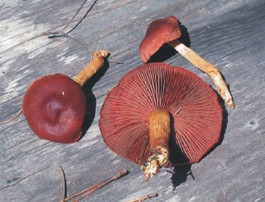
One day, friends asked Rice to join them on a mushroom hunt. Once home, she tossed a clump of gathered sulfur-yellow, gilled-cap mushrooms into a dye pot along with some wool yarn. The mushroom’s reproductive apparatus leached out its color, gifting the wool a bright, lemon yellow. To Rice’s knowledge, this had never been done before.

And so began decades of experiments, discoveries and inventions, as well as a tiny organic revolution, spreading from the cool, wet coastal woods of Mendocino and Sonoma counties to Scandinavia, Scotland and Australia. In 1973, Thresh Publications in Santa Rosa, a small press specializing in craft arts, asked Miriam Rice to write about her mushroom color discoveries vis-à-vis dye-making concoctions. The result was a little book entitled Let’s Try Mushrooms for Color. It featured pen and ink drawings by Forestville freelance scientific illustrator Dorothy Beebee, herself a longtime practitioner of natural dye applications and spinning.

“I was working with Thresh Publications,” Beebee says. “They asked me to read this manuscript, and I was entranced with it.” The publishers drove her up to Mendocino to meet Miriam Rice. So began a close collaboration lasting to this very day. “Miriam celebrated her 90th birthday just this last January. It was wonderful.” To commemorate the event, Beebee says, “we had an international symposium on mushroom dyes.”

Just as Let’s Try Mushrooms for Color was going to press, Rice discovered a “mysterious” stand of mushrooms under Bishop pines in Mendocino County. These fungi yielded brilliant purple, rose and burgundy hues, leading Rice to expand her research and document results of new experimentations in the book Mushrooms for Color, published by Eureka’s Mad River Press in 1980.

As her work progressed, Rice realized that the thorny issue of mordants had to be addressed. Mordants are metallic salts used to set dye to fiber. The mordants traditionally used for this purpose are toxic. These include tin, chrome and copper. So Rice replaced them with iron and alum. Her successful move from harmful mordants has led Rice to gently urge others to achieve bright, vibrant colors sans toxins, too.

Which is not to say all mushrooms used to dye fabric are nontoxic. In fact, one of the draws for using fungi as color dyes is that those species best suited to these purposes tend either to be unpalatable, inedible or flat-out poisonous. Consequently, there’s little or no competition with foragers seeking edible mushrooms. Furthermore, Beebee assures that these poisonous varietals pose no threat imparting mephitic payloads to one wearing said clothing, though persons with specific allergies or medical conditions might well be wary.

Back when Rice had just started down her mushroom-strewn path, she was already devoted to recycling within her realm. This led to a second field of inquiry and an entirely new mycological application.

Say your fabric gets dyed and is drying. Now, what to do with waste materials from the spent dye?

Rice’s solution was to convert fungi detritus into richly textured artisan paper. Polypores, or shelf mushrooms (like artist’s conk, turkey tails and red-belted conk), are particularly amenable to papermaking. But Rice saw yet another application spinning out of her mushroom dye-making processes—namely ink, which then led to the trademark protected crayon-like process called Myco-Stix.

Miriam C. Rice and Dorothy Beebee have recently published yet another book, titled Mushrooms for Dyes, Paper, Pigments and Myco-Stix. It’s billed by Beebee as the compendium of everything Miriam Rice has accomplished inside mushroom’s magic kingdom, which is to say a brilliant, colorful and abundant lot.

To learn more on mushroom dyes et al., go to the Sonoma County Mycological Association website, www.somamushrooms.org. To learn more about ‘Mushrooms for Dyes,’ go to www.mushroomsforcolor.com.

Quick dining snapshots by Bohemian staffers.

Winery news and reviews.

Food-related comings and goings, openings and closings, and other essays for those who love the kitchen and what it produces.

Recipes for food that you can actually make.
News Blast

0

07.23.08

Share the Road

Should a cop flag you down this weekend, here’s hoping it’s to hand out literature aimed at enhancing safety on increasingly congested and oft-contested thoroughfares used by motorized vehicles and bicycles, alike. The Marin County Bicycle Coalition (MCBC) hosts the final two in its summer-long series of Share the Road checkpoint events this coming weekend. Local law enforcement agencies are co-sponsor participants.

“We’ve been doing this for several years,” says Marin County Bicycle Coalition database and activities coordinator Jo Ann Richards. “Some years we have it on a bike path. Most of them are on road intersections.”

On Saturday, July 26, a checkpoint will be set up between 8:30am and 10:30am on Pt. San Pedro Road in San Rafael. The “1000” block of Bridgeway in Sausalito will be the site for a second checkpoint during the same two-hour time slot the following morning on Sunday, July 27.

Last year, close to 2,000 motorists and 600 cyclists made their way from these banner-identifiable checkpoints with printed safety tips ranging from California vehicle code pamphlets to info aimed specifically at either bike riders or those behind the wheel.

“Most years, we’ve had four to six checkpoints,” Richards says. “This year, we’ve had more response. We intend to have nine events [spread over the summer]. We always pick sites that are along a commonly used bike route.”

According to MCBC executive director Kim Baenisch, “With rising gas prices and concerns about traffic congestion and global warming, we are seeing a definite increase in the number of cyclists on the roads. All road users need to be aware of each other’s presence. The Marin County Bicycle Coalition provides the checkpoints, as a friendly means to communicate life-saving safety information.”

In addition to the checkpoint program, MCBC recently launched a membership drive. The goal is to double its numbers by means of the Recruit One Member campaign. Each current member is asked to sign up one new member. They’ve also set up recruitment stations along popular Marin County bike routes, accounting for 50 new members in April and May, alone.

To find out more about the MCBC checkpoints program, or for membership information visit www.marinbike.org or call 415.456.3469.


Letters to the Editor

07.23.08

Caritas Compassion

Regarding Charles Russo’s “Camp Clamp Down” (July 16): As a Junior High School teacher who brought her students to Caritas Creek for 15 wonderful years, it was with deep dismay that news of the Caritas firing was received. Thank God that people like Paula Pardini, Erik Oberg and all the others resurrected the vision of what this nourishing camp is all about. Way beyond the science standards, Caritas touches the hearts and souls of the children who experience this spiritually charged week of environmental education. Both teachers and students return to their schools enriched with an education that far exceeds the curriculum of classroom learning. “Caritas”—”God’s love”—is what the staff offers, and to live the week with these gifted people is to participate in a glimpse of heaven on earth!

Maureen Zane

San Mateo

Heart and Soul

I would like to thank you for the article about the Caritas Creek program. I have grown up with this program, went through the entire line of being a Caritas camper, a summer-camp camper, Caritas cabin leader, summer camp CIT, all the way to summer-camp counselor. I was in shock when I learned what had happened in January 2007, and it was time someone heard our side of the story. In fact, it shows how dedicated the staff members truly are to this camp.

Two days after the decision had been made to “terminate” camp, more than 25 staff members from the summer camp were in Daly City having a meeting about what we were going to do if asked back to summer camp. We made a collective decision not to, which is why I feel CYO Summer Camp was a disappointment to many of the campers in the summer of 2007. I went to visit their “new and improved” camp, and they had ridiculous rules and regulations. The staff members could not even hug the campers front to front. It had to be a “side hug” so that no genitals touched. It was tragic. It was, in fact, heartbreaking, and all I wanted to do was give these campers a real hug. So I did.

I have volunteered a couple of days a week out at the new Caritas, and I have to say that these staff members are my personal heroes. The campers I work with have never been happier to be there and have made everlasting bonds with each other.

It just goes to show what we have been telling the campers for so long: Camp is not a place; it is the connection you create with yourself, others, nature and spirit. No one can testify to that more than our staff members.

Alise Girard

Santa Rosa

Gold Standards

John Sakowicz (“Boomer Bummer,” July 16) implores baby boomers to protect their assets by buying gold or investing in gold-mining companies. What he doesn’t tell us is the dark side of gold—the environmental damage that modern gold mining causes. Gold ores these days have very low concentration of gold—gone are the days of finding pure nuggets in stream beds. This means digging, hauling, processing and disposing of perhaps tons of dirt for an ounce of gold. The processing involves toxic chemicals such as cyanide or mercury, which can sicken workers and wildlife, and which remain in the ground long after the gold is gone.

You may think, “What do I care, there are no gold mines near me—out of sight, out of mind.” Think again. It takes a lot of fossil fuel, mostly diesel, to move all that dirt around. The carbon dioxide from burning those fossil fuels affects everyone. Even worse—it’s hard to say how much worse—deep mining for gold often releases methane trapped in the ground. Methane is 21 times more potent a greenhouse gas than carbon dioxide.

But that’s just for buying gold itself. If you buy gold-mining companies, you’re basically feeding the beast that belches the greenhouse gas. I’m not an investment adviser, but I’d hope people would consider investing in clean energy to reduce greenhouse gases or something else a little more benign than gold. If we don’t begin to think of the wider impacts of our individual actions, it’s going to be a lot harder to stabilize the climate. If you don’t think individual choice can make a difference, think about how dramatically gas-guzzler SUV and truck production has dropped in the last year.

Ed Myers

Sebastopol


&–&–>

Slow Going

0

07.23.08

The Slow Food Nation is moving faster than ever, picking up steam as plans coalesce for this year’s massive gathering of convivia in San Francisco, scheduled for Labor Day weekend, Aug. 29&–Sept. 1. While a Victory Garden has been planted across from the Civic Center, the planned site of a dinner for 500 invited guests that will kick off the weekend, most of the main events take place at Fort Mason, where the largest Slow Food event yet held in the United States is gearing up to, well, take it slow.

In addition to a massive marketplace and the other “static” innovations of this enormous endeavor, Slow Food Rocks—featuring Gnarls Barkley, Phil Lesh and Friends, Ozomatli, G Love & Special Sauce and other high-end groovers—is slated to perform in the Ft. Mason Meadow Aug. 30&–31. Naturally, there are a number of special tastings and tours highlighting the North Bay, including a farm tour of Bolinas and West Marin (Aug. 29 and 30, respectively), a special dinner at Mill Valley’s Small Shed Flatbreads to benefit the Occidental Arts and Ecology Center (Aug. 28), a feast at the Foreign Cinema in honor of Marin Organic (Aug. 29) and an evening at the famed Greens restaurant to raise funds for the Marin Agricultural Land Trust (Aug. 30). Revelers can also tour Jack London’s vision of the Valley of the Moon (Aug. 29). Those who are nimble have already snapped up tickets to explore the bounty of the Russian River and tour Marin County creameries (both sold-out). Aug. 31 dawns with two free events, a Tennessee Valley hike and a trek across the wetlands abutting Infineon Raceway. The Herbst Theater hosts a series of talks each night and truly, the breadth of the event is awe-inspiring. Make plans by going to www.slowfoodnation.org.

Get a slow start on the festivities when Chez Panisse founder and cookbook author Alice Waters appears at the Sebastopol Farmer’s Market on Sunday, Aug. 3, to honor the Gravenstein apple, recently named as one of only seven U.S. food products to be placed in the Slow Food Foundation for Bio-Diversity’s “Presidium” category (“presidium” evidently means “fortress” in Latin). Slow Food Russian River convivium members are highlighting the fruit in an effort to underscore its vanishing numbers. Michele Anna Jordan will interview Waters live from 11am in the Sebastopol Plaza. Look for area merchants and restaurateurs to celebrate the pomme on their windows and in their menus during the entire month of August.

Speaking of markets, the farmers market at Marin’s Civic Center begins taking food stamp EBT cards on Thursday, July 27, allowing the nearly 5,000 Marin residents on the food stamp program to purchase fresh fruit, vegetables, seafood, meat, bread, dairy, nuts, edible plant starts and some prepackaged foods using their government benefits. The strange perception that it is somehow cheaper to eat processed commercial food than it is, say, a zucchini, can finally be debunked in this innovative program.

Quick dining snapshots by Bohemian staffers.

Winery news and reviews.

Food-related comings and goings, openings and closings, and other essays for those who love the kitchen and what it produces.

Recipes for food that you can actually make.
Barn Revival

0

In the old days, North Bay punk shows used to mean sleazy nightclubs with steroid-crazed bouncers, antagonizing pay-to-play policies, a rowdy bunch of pissed-off fans and an overpriced two-drink minimum. But on a recent Saturday evening, the punk rock underground converged at the Boogie Room and Gardens, a sprawling property tucked away deep in rural southwest Santa Rosa that’s become a lightning rod for the most exciting cultural activity the city has seen in years.

Much like the long-running house concerts at Studio E in Sebastopol, the scene at the Boogie Room is as distant from a nightclub as can be imagined. Out the side of a leaning barn, cheap drinks are sold for $1. Dogs play fetch and chickens cluck in the background. People gather around a campfire, in a makeshift tent or among the collection of furniture hauled out in the middle of a huge field, underneath the owls. Scattered around the property are an apiary, a large greenhouse and an impromptu shrine made of obsidian, jawbones, rocks, jewelry, a small Buddha statue and a French soprano saxophone.

While the sixth band of a 13-band North Bay Pyrate Punx benefit show rattles the wooden siding of the adjoining barn on a recent July night, resident Kyle Neumann attempts to explain just what in the world has been happening here since the space starting hosting shows over a year ago.

“We’re trying to go back to earlier days, when people took pride in their lives and took their livelihood into their own hands,” he says. “Back in the day, when they would have hoedowns, it’d be a local band. Those guys were farmers, they worked in the mercantile, they worked in the tannery. You could see those guys on a daily basis around the community, and then they’d just get together at night because they loved playing music for people, and people would dance to it. With the music venue, that’s what we’re trying to do: support people who love to make music and people who love to hear music.”

With the 2007 closure of Epiphany Music in Santa Rosa, the city’s all-ages underground faced an all-too-familiar quandary of having no place to play in a city that says it wants to support its youth and its nightlife, yet routinely cracks down on both. This time, however, instead of relying on an outside venue, the kids took matters into their own hands—and their own living rooms. It wasn’t long before under-the-radar spots like Boys Club, the Blue Barnacle, the Crux House, the Petaluma Church, the 600 House and numerous other residences-as-venues began cropping up to fill the void.

The Boogie Room is unique among these places in that it presents far more than just music. Monthly writing workshops with SRJC professor Richard Speakes happen here, as do gardening workshops and Food Not Bombs gatherings. A theatrical production of Ibsen’s A Doll’s House is in the works for the fall, and all of the residents are looking forward to the Second Annual Insect Carnival, a three-day festival of rampant creativity (last year’s event featured dozens of bands, fire dancers, a mud pool and a full-on, robe-clad, candlelit evangelical barn revival).

If the heart of the Boogie Room is its music barn, then its soul is surely the large garden area. Each of the four residents and six core collective members tend to the gardens, which contain everything from lettuce and tomatoes to goji berries, bananas and yerba maté. The organizers take great pains to mention the gardens on every flyer or posting about their shows, and when I ask why, almost all of them simultaneously utter the word “sustainability.”

“It feels like a really pivotal point,” says Nicko Wilde, “not just for us living here, but also for the world.” Continuing the thought, Kyle Martin adds, “People are getting the point that we need to start putting our own roots in the ground and settling in what makes ourselves feel good and what sustains us. And it’s definitely incorporating our do-it-yourself ethics—”

“—Or do-it-together!” enthuses Bryce Dow-Williamson, in the sentence-finishing style which seems to be the main form of discourse here. Dow-Williamson, who’s something of a navigator for the music events, sees a direct connection to the hands-on gardening and hands-on music at the Boogie Room. “In the time that we’re living in, more people are able to make music and spread it around,” he says. “It’s kind of like harking back to folk music, where it’s really just accessible—anybody who has some good thoughts in their head and can learn a few chords can get together.

“Music a lot of times these days is all about how many people you can possibly cram into the space,” he continues. “Just get as many as possible, no matter what, use whatever strange image that will get somebody’s attention—get them there, and ready to rock! But we want the people who’ll be here to be respectful. So we’re going through word of mouth, generally, and it’s important to do that. This would be entirely impossible over-the-radar.”

The music at the Boogie Room is by no means limited to any one genre. Whether it’s the junkyard classicism of the Highlands, the Theremin-grizzled funk of Battlehooch, the experimental one-man atmospherics of Goodriddler, the synthesizer majesty of the Iditarod or the carnival folk of the Crux, the music at the Boogie Room is consistently varied, organic and immediate.

Outside at the ever-present campfire area, in a juxtaposition to the punk band inside, the Crux’s Tim Dixon plays a beat-up acoustic guitar and sings Dylan’s “Mama, You Been on My Mind.” And in the ultimate display of what makes the Boogie Room special, I realize when I leave that out of the hundreds of people gathered here in the last few hours, I haven’t once seen anyone talking on a cell phone; everyone talks to each other face to face, the old-fashioned way.

“The whole point of what we’re doing here,” concludes Neumann, “is to teach and learn the things that it was convenient for society in general to stop teaching people. If we don’t know how to grow our own food, we’re reliant on a store to provide that food for us—which is, you know, moneymaking, and we have no say in the quality that goes into that food.

“If we have to go to the mechanic, or the carpenter, plumber, electrician or blacksmith, then we’re reliant on someone else for our survival in this world. I see this as a place for me to teach the survival skills that I know, and to learn from other people the survival skills that they know. And to share it with not just the people that live at the house, but the entire community.”


Taste3 2008

0

Having just completed its third year, Taste3 remains a dynamite event high on the list of food and wine professionals with an interest in the arts. Founded by the dynamic Margrit Mondavi, above, and underwritten by the Robert Mondavi Winery, Taste3 is a three-day conference in line with the invitation-only TED conferences that sparkle the lives of such lucky thinkers as the Google staff.

Having just returned from this two-day glut of wonder (I had to regretfully cancel the July 17 “insider” guide of three Napa artist’s studios with Margrit followed by lunch at Redd due to editorial demands for the Arcadia issue, publishing this year on July 23, and that’s a real wah), it’s difficult to know where to begin.Michael Amsler

Taste3 is designed to create a community among its 400 or so attendees, fomenting a culture about culture. As close readers of the Bohemian know, we’re not too hepped about just sticking things in your mouth. “Yum” generally sums it up. It’s sticking things in your mouth while sticking things in your brain that turns us on. Taste3, therefore, is one hell of a turn-on.

It’s also a leveling event like no other. On the first full day of sessions, the lunch break found me mildly sitting at an empty table outside on the veranda by the Napa river at COPIA, the host venue founded by the Mondavi’s, trying to eat like a lay-day and not the greedy wolf I truly am. A diminutive woman approached. “May I sit here?” she asked politely. Of course it was Margrit. “I would be honored,” I said quickly, straightening up in my seat and brushing some stray lettuce from my chin. She nodded sweetly and arranged her belongings on a chair. And then Margrit Mondavi, without whom none of this would be possible, went off to stand in line at the buffet like everyone else to collect her lunch.

Snake Oil?

07.23.08In the olive oil market, not everything is as green as it seems. Much of the "extra virgin" oil with which Americans cook is nothing better than cheap nut oil blended with low-grade olive oil, coloring and artificial flavors. Most of this fraudulent product comes from overseas, most notably, from Italy.But in California, where olive oil production is currently...

Seeking Solutions

07.23.08Leafy potato plants flourish atop a low mound of yard clippings covered with straw. There'll be a good harvest this year. "The fact that we can grow potatoes out of what would be considered our waste pile is fabulous," enthuses Pam Hartwell-Herrera, executive director of Sustainable Fairfax. She's standing in the group's Sustainability Center, opened last October in a...

Keeping It Local

07.23.08Tucked away off of a narrow country road in Sebastopol, First Light Farm is difficult to find. One must pass through a gate, over a bridge and climb a winding uphill path before seeing the first rows of crops and hoop houses rising high above the soil. But this seclusion seems to fit the magical serenity that hangs over...

Fungal Bloom

07.23.08We buy, hunt, cultivate, cook and eat mushrooms. They can be a gastronomic pleasure, a mind-expanding experience or a game of Russian roulette leading to illness and even death. But few ever equate mushrooms with paper, ink, crayons and rainbow-colored clothing dyes. Forty years ago, while a youthful generation of Americans rejected consumer plasticity by emigrating "back to the...

News Blast

07.23.08 Share the RoadShould a cop flag you down this weekend, here's hoping it's to hand out literature aimed at enhancing safety on increasingly congested and oft-contested thoroughfares used by motorized vehicles and bicycles, alike. The Marin County Bicycle Coalition (MCBC) hosts the final two in its summer-long series of Share the Road checkpoint events this coming weekend. Local law...

Letters to the Editor

07.23.08Caritas CompassionRegarding Charles Russo's "Camp Clamp Down" (July 16): As a Junior High School teacher who brought her students to Caritas Creek for 15 wonderful years, it was with deep dismay that news of the Caritas firing was received. Thank God that people like Paula Pardini, Erik Oberg and all the others resurrected the vision of what this nourishing...

Slow Going

07.23.08The Slow Food Nation is moving faster than ever, picking up steam as plans coalesce for this year's massive gathering of convivia in San Francisco, scheduled for Labor Day weekend, Aug. 29&–Sept. 1. While a Victory Garden has been planted across from the Civic Center, the planned site of a dinner for 500 invited guests that will kick off...

Barn Revival

Doing it together at the Boogie Room and Gardens

Taste3 2008

Having just completed its third year, Taste3 remains a dynamite event high on the list of food and wine professionals with an interest in the arts. Founded by the dynamic Margrit Mondavi, above, and underwritten by the Robert Mondavi Winery, Taste3 is a three-day conference in line with the invitation-only TED conferences that sparkle the lives of such...

11,084FansLike
4,446FollowersFollow
6,928FollowersFollow