Live Review: Sly and the Family Stone at the Wells Fargo Center

At the close of Friday night’s show in Santa Rosa, Sly Stone did not take a bow.
In fact, at the close of Friday night’s show in Santa Rosa, Sly Stone was nowhere to be seen. He had left the stage long ago, during “I Want to Take You Higher”—one of only four songs he actually performed—explaining to the crowd: “I gotta go take a piss. I’ll be right back.”
But throughout the rest of the 90-minute set, Stone never returned, leaving the Family Stone to awkwardly vamp songs in his absence, just like they had at the beginning of the set, until, well, the hell with it, you know, and they simply gave up and left, too. The house lights came on, and a young man sitting a few seats away from me said it all.
He stood up, angrily threw his arms in the air, and yelled, “What the fuck??!”
Yes, it was disappointing. Extremely disappointing. And by far the hardest part is that for the few songs Stone appeared on—“Sing a Simple Song,” “If You Want Me to Stay,” “Stand!” and “I Want to Take You Higher”—he was an electrifying presence which transformed the show from a schmaltzy Vegas act into a truly special occasion. That is, when Sly Stone—one of the greatest talents in soul music and an undeniable genius—wasn’t referring to Santa Rosa as “Sacramento” or telling the audience, point-blank, to shut up.
Even before the show started at 9:55pm, trouble was in the air. The opening act had played for far too long, and when Sly’s announcer finally came on stage, he felt compelled to convince the crowd of the overshadowing importance of the evening. “I know you’ve waited a long time,” he said. “But this is history! You can tell your grandkids that you waited for Sly and the Family Stone!”
The nine-piece band then took to the stage, without Sly Stone, announcing that their “master” had asked them to “warm up the stage” for a while. Apparently, “warming up” means dicking around for five minutes. They sloppily introduced the band, gave shout-outs to their friends in the crowd and joked painfully amongst themselves. Eventually, they remembered that their job was to entertain paying customers, and tore into “Dance to the Music.” The crowd went nuts.
Then came “Everyday People,” which was noticeably weaker without Sly around, and “Hot Fun in the Summertime,” which caused people to start shouting. “We want Sly!” they yelled. “Where’s Sly?” The band answered by first playing a quick funk instrumental, and then by futzing around with the monitors and complaining to the soundman.
Then, weirdly, and with no fanfare, Sly Stone appeared—coming down the aisles, walking slowly to the stage and murmuring greetings into his wireless microphone. The band kicked into “Sing a Simple Song,” and Sly opened his mouth to unleash a signature deep, rich voice that hasn’t really changed much in the last 40 years. A thrill ran through the building. The crowd jumped again to their feet and danced like crazy.
Especially moving was Stone’s version of “If You Want Me to Stay,” with its impossibly low notes and an ever-hypnotic chord progression. For as bizarre as Sly Stone is these days, he is completely and authentically in the moment during songs like “If You Want Me to Stay.” He has that kind of unpretentious honesty that draws people to him as an artist. He’s not trying to be anyone he’s not, and this keeps him from being a caricature of himself.
“Thank you, ladies and gentlemen, for your patience,” said a grateful-seeming Stone. “We’re happy to be here. We’re lucky to be here.”
Then came “Stand!,” which a large portion of the audience responded to by sitting down, and maybe Stone took the hint. Halfway through “I Want to Take You Higher,” he was off to take his piss. And to never come back.
The rest of the set dragged on in the worst possible way—with hopelessly long jams, misplaced caterwauling, obligatory drum solos, and guitars being played with teeth. People who most likely hadn’t heard Stone’s muttered promise to return and thus had figured that the show was basically over flooded out of the theater. Others, holding out hope to hear Stone come back and sing “Everybody is a Star” or “Family Affair,” stayed in their seats while the band flogged every last tiny drop out of mega-extended versions of “Don’t Call Me Nigger, Whitey,” “Thank You (Falettin’ Me Be Mice Elf Agin),” and “Somebody’s Watching You.”
The theater was already half-empty by the time the band shed their instruments and exited the stage. Scattered boos underscored the mild applause. A girl was overheard near the back, beside herself with disbelief. “Seriously?!” she exclaimed. “75 bucks to see a cover band!”
It was a rough night all around, highlighted bittersweetly with a brief flash of brilliance. Sly Stone may not retain the ability to perform much longer, whether because of mental and physical deterioration or simply because of an utterly ruined reputation. But even viewing tonight’s show through this cynical lens—that it was, at least, a historic event—it’s incredibly cold comfort in light of the disappointment he left us to remember him by.
—-
Set List:
Dance to the Music
Everyday People
Hot Fun in the Summertime
Instrumental Funk Jam
(Sly Enters)
Sing a Simple Song
If You Want Me to Stay
Stand!
I Want to Take You Higher
(Sly Leaves)
Don’t Call Me Nigger, Whitey
Thank You (Fallettin’ Me Be Mice Elf Agin)
Somebody’s Watching You
—-
UPDATE: Read all about the behind-the-scenes tumult and insanity here.

Thou Shalt Not Lie

0

Steve Einstein was angry the other day and couldn’t figure out why. While going for a run, it suddenly hit Einstein, a nurse at Memorial Hospice, what was troubling him: The McCain campaign. So Einstein did something uniquely American. He took a length of bamboo stick and an oversized piece of paper and, using yellow and green pens, fashioned a protest sign. “Thou Shalt Not Lie” is the message that Einstein has been spreading for the last three days as he walks patiently back and forth in front of Santa Rosa’s McCain/Palin campaign headquarters at the corner of South E and Fifth streets. Einstein explains that he chose the Biblical language in part to reflect the mawkish love of God and country that politicians often espouse when they want to sidestep an issue. But it was McCain’s choice of Sarah Palin as a vice presidential candidate that finally broke the proverbial straw for Einstein. “It’s such a cynical choice,” he says, pausing briefly in the hot afternoon sun. “To make the assertion that this woman is qualified to run our country. It’s absurd.”

As for how long he might keep this up, Einstein is stoic. “I plan to be here until election day,” he says, “or until they stop lying.”– Gretchen Giles

Stage Sage

10.15.08

MENTOR: Helping kids to shine is part of Holly Vinson’s success.

By David Templeton

Holly Vinson may not be a household name in Sonoma County, but to hundreds of former child thespians—many of whom have grown up into working adult thespians—Holly Vinson is known as the fondest, fiercest force in North Bay children’s theater. For 14 years, the L.A.-born director-den mother has run the summer theater camp of the Santa Rosa Players, which over the last few years has been folded into the Sixth Street Playhouse in Railroad Square, where the first show of every season is traditionally Vinson’s.

Last month, the Sixth Street Playhouse honored Vinson’s years of service by officially naming the annual program the Holly Vinson Summer Theater Workshop. At the ceremony announcing the honor—following a matinee performance of the Vinson-directed musical The Music Man—dozens of adult attendees told stories of how Vinson changed their lives with her patented blend of affectionate Mama Bear coziness and passionate, no-nonsense straight shooting. Over the years, her enduring support and belief in the power of community theater has been the palpable underscoring to all that she does.

“One of the first things I always say to a new group of kids,” Vinson explains over a cup of chai, “is that, fine, if they want to be a professional actor, more power to them, but I don’t think it’s very intelligent to go into a profession where only 5 percent of the union actors are working. But then I tell them that if they want to stay in community theater, if they want to do theater in college, then there are plenty of ways to make theater a part of their lives forever—and their lives will be richer for it.”

In 1983, when Vinson first moved to Santa Rosa after 38 years in L.A., the culture shock took some adjustment, especially with Santa Rosa’s former lack of theatrical opportunities. She found a job teaching at Brush Creek Montessori School in Santa Rosa, and begun looking for ways to continue the work she’d began in L.A., where she’d founded a popular program called Kids for Kids Theater, which had run for 10 years. It wasn’t long before she resurrected Kids for Kids, using a theater she built in her living room.

Before long, she had 40 students taking acting lessons every week on her tiny, makeshift stage, and the regular stage shows she presented there often required four or five performances to accommodate the 200-plus people who wanted to see them. Eventually, she moved into a small spot in the Lincoln Arts Center, where the Santa Rosa Players had a large theater space.

Later, after she’d been approached to direct a production of Oliver, she was asked if some sort of camp could be created for the kids who would be playing the singing orphans and pickpockets. Quick as the Artful Dodger lifting a wallet, the Summer Theater Workshop was born.

“It just came to be,” Vinson says. Oliver was followed by a string of popular shows—Peter Pan, The Wizard of Oz, Bye Bye Birdie, Joseph and the Amazing Technicolor Dreamcoat—with Vinson always casting adults in the adult roles but somehow finding ways to incorporate her growing band of theater kids.

“The important thing is finding a show that the kids can shine in,” she says. “I have insisted from the beginning that these not be shows with only kids in them, because then the only ones who come are the parents and family of those kids. My goal has been to legitimize children onstage. I want to eliminate the phrase, ‘Oh, that’s just a kid’s show.’ Kids can hold their own with the adults, and by appearing in these shows with experienced adult actors, it gives them a higher standard to rise to.

 “My students learn a lot,” she continues. “And it’s not just song-and-dance routines and stage presence and how to memorize and deliver lines; they also learn responsibility, professionalism, independence and cooperation. These are life skills they are learning, not just artistic skills.”


According to Vinson, people often tell her they are surprised at how professional the kids seem in her shows, but she insists that they never surprise her.

“I know what kids are capable of,” she says. “Kids can do anything.”


Local Gold

0

10.15.08

By Gretchen Giles

Our Boho Awards, now in their 11th year, are among our team’s annual highlights. When considering which people and institutions in the North Bay have most contributed to the rich cultural life we share, it is a regular pleasure to simply survey the vast field from which we can draw. There are so many deserving individuals and groups doing good work in the arts that this is a delicious burden. Careful to choose from all three counties, we like to mix our picks up, from the solitary teacher who has touched hundreds of lives but may not be known to a larger audience, to those professional houses that bring thousands through their doors each week. Over the past decade, we’ve built a solid roster of winners, a growing list that truly reflects a deep devotion to utilizing the arts to enrich all of our lives.

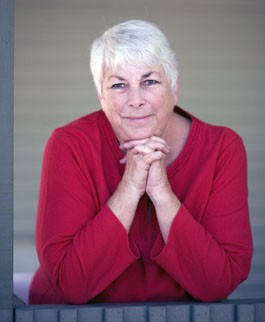
This year, we ask you to help us celebrate the achievements of five winners. The tiny volunteer-driven Sonoma Valley Jazz Society regularly hosts stellar musical performances for its small town. Acting teacher Holly Vinson has most literally changed lives. The 142 Throckmorton Theatre hosts a robust comedy program as well as supporting artists in all genres. The Jarvis Conservatory introduced Napa to the Spanish art of zarzuela, keeps live opera vigorous and screens art films not readily available elsewhere in the valley. And Mario Uribe, an artist so busy we can barely keep up with him, is the go-to guy for Santa Rosa’s civic art.

We fete our winners this year on Wednesday, Oct. 22, in a free reception that is open to the public at the Hopmonk Tavern (230 Petaluma Ave., Sebastopol), from 5:30pm to 7pm. Please consider joining us and staying on for the free, all-ages North Bay Music Awards (NORBAYs) event that follows. This is a stellar night for the arts, and we’re so honored to help reflect all of this work and wisdom to you. See you at the Hopmonk!


Secret No More

10.15.08

When I contacted the Secret Eating Society to request an interview, all I knew about them is that whatever they do involves eating and it’s secret. The cofounders, Marissa Guggiana and Sarah Domke, unaware of my naiveté, agree to meet with me to discuss . . . whatever it is that they do. As we chat over coffee, Domke and Guggiana seem slightly puzzled by my apparent lack of investigative savoir-faire, but I assure them that they came to me by good recommendation, and that, though I may not know what it is they do, my journalistic hunch is telling me that whatever it is, the Green Zone deserves to know about it.

As it turns out, Domke and Guggiana help to publish a quarterly magazine, The Secret Eating Society. The most recent issue of this adroit little glossy contains such delectable bits as a flower eater’s guide, sepia-toned prints of local beekeepers, an essay documenting one man’s quest to discover the best brain tacos in San Francisco’s Mission District and the fragrant recounting of one woman’s love affair with her restaurant in Georgia.

Domke and Guggiana are a little vague when it comes to describing the more interactive aspect of the Secret Eating Society. First of all, their gatherings or parties or whatever you want to call them come at random times, when, as Domke puts it, the “factors” come together. Their last was a cooperative event involving picking, pressing and making cider from some 600 pounds of local apples over a long weekend. Participants camped out, made cider, cooked, ate and shared ideas and enthusiasm with each other. When the hard stuff is ready—it’s currently being stored in an undisclosed location—SES members will come together once again for a lamb roast and cider drinking.

Domke and Guggiana have hosted an aphrodisiac dinner, a dinner in which participants were blindfolded and a third of July barbecue. Over the summer, they created a small 10-member CSA from the produce that Domke grew in their own backyard, with the biweekly pickup always including a liquor-drenched Slow Food–informed homemade brunch.

Domke and Guggiana are firm believers in the power of the cooperative, and their next event, they assure, is going to be extra special. Unfortunately, they can’t tell me anything about it, because it’s a secret. All they can say is that they are collaborating with Scratch and Sniff TV and SFZero, and that it will involve some type of scavenger hunt. Later, when I research Scratch and Sniff TV, I find a video of someone roasting a pig and someone else deep-frying a trout, which doesn’t do much to dispel the mystery. SFZero seems to be a fascinating interactive online game, involving real-life adventure challenges, with complex enough rules that I am both flummoxed and intrigued.

A Slow Food Russian River co-leader and a 2008 Roots of Change Fellow, Guggiana also happens to be the co-leader of the Sonoma County Meat Buying Club (in partnership with UC Davis Ag Extension), as well as the president of Sonoma Direct, which provides distribution of fresh, local meats and is also staffed by Domke. Sonoma Direct works predominantly with Sonoma County lamb ranchers. The land in this area is ideal for lamb, Guggiana says. In fact, lamb farms existed for five generations in Sonoma County before the grapes and the developers moved in. While working in her family’s local food-distribution service, Guggiana began to recognize a need. With local lamb on the decline, and meat coming from as far away as New Zealand to feed people in California, there was an opportunity.

This is what we can grow here, Guggiana tells me, so why not fashion a distribution company around it? A vital aspect of Guggiana’s job is to raise awareness and communicate with ranchers, chefs and club members regarding sustainability. Meat becomes very hard to process when everyone wants the same three cuts, she explains, and we end up killing lambs just for their racks. To this end, Guggiana—who curated the charcuterie tent at the recent Slow Food San Francisco convivial—works with local chefs to create and distribute recipes to CSA members that showcase their disparate cuts of meat.

While some blame the breakdown of the family unit for many of our culture’s ills, there are those of us who blame the TV dinner. If you exist within the latter realm, consider becoming a member of Secret Eating Society and, perhaps even more importantly, consider joining the Sonoma County Meat Buying Club. This unusual CSA offers a once a month pick-up, with seven-, 15- or 25-pound boxes of locally grown meat—including beef, pork, chicken and lamb—and a chance to eat the freshest food possible, all carefully selected from within a 25-mile radius of distribution.

Something that great shouldn’t be a secret.

 For more information on Secret Eating Society, go to www.secreteatingsociety.com. For more information on Sonoma County Meat Buyers Club, go to http:-/groups.ucanr.org-LocalMeatProd. For more information on Sonoma Direct, go to [ http:-/www.sonomadirect.com- ]www.sonomadirect.com.


Art of Solutions

0

10.15.08

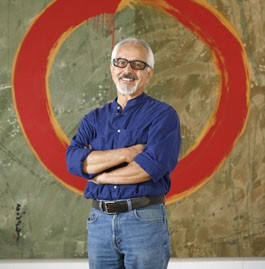
PRAYER: For Uribe, the circle represents sanctity.

By Gretchen Giles

Before the Persian Gulf War began in 1990, artist Mario Uribe and a group of colleagues rented a billboard in San Diego, where Uribe then lived. Blowing up an abstract brush image by Japanese master Kazuaki Tanahashi, they inscribed the advertisement with the question, ‘What If We Go to War?” On the day that the war started, Uribe climbed the billboard and threw blood-red paint over every word except ‘War.” For their part, the billboard’s owners swapped out the image that very same day.

Almost two decades later, Uribe, now 66, is in the seemingly curious position of having recently completed a war memorial for the city of Santa Rosa. Except that, from Uribe’s standpoint, it’s not curious at all. It’s yet another chance to publicly protest the unholy carnage that results when diplomacy is too quickly exhausted. And it’s emphatically not a memorial to war. It’s a monument to those who served.

‘Every art challenge that comes my way requires an art solution, and for me, designing a veterans memorial, I approach it from a perspective of not having any more wars,” Uribe says, seated in the industrial space that houses his studio and those he rents to other artists in Santa Rosa’s eclectic South A Street area. ‘We acknowledge that wars are terrible. We don’t want to glorify war, but we acknowledge that people have given their lives. So coming up with a design that was all circles, that was all positive . . . The main theme behind the design was that it was a prayer. To me, circles are prayers, that’s how I use them all the time.”

The subject of much initial controversy, Uribe’s veterans memorial, placed adjacent to Santa Rosa’s City Hall at Sonoma and Santa Rosa avenues, was unveiled this summer to near universal approval. Rather than the original proposal—a bronze statue of two soldiers that Uribe gently describes as ‘old-fashioned”—his vision includes a group of columns representing different 20th- and 21st-century conflicts inscribed with the names of residents who died in them. One column was purposefully left blank.

‘The circular configuration, the descending size of the column has to do with fewer names, less wars, less death,” Uribe explains. ‘We are moving to a point where we are not going to need to put more names on columns. The last column is left blank for that reason. That’s part of this whole prayer, this hope that we never put names on that column.”

Known as a painter, Uribe has, since he moved to Santa Rosa in 1995, been increasingly active in the civic art placements of his adopted town. He is involved in so many public projects that it’s almost hard to keep track. A former owner, with his wife Liz Uribe, of the American School of Japanese Arts, Uribe’s Zen-influenced circle paintings are his signature. Having just resigned as the creative director of ArtStart, the innovative program for high school artists cofounded by Liz and Eleanor Butchart in 1999 (and itself a 2006 Boho Award winner), Uribe remains deeply involved in the program.

For the past four years, he and the ArtStart kids have labored on the sculpture almost directly across the street from his veterans memorial at Gateway Park, a lead-in to the Prince Memorial Greenway, the trail alongside Santa Rosa Creek that ArtStart has adopted and hugely embellished. A massive rainbow trout encased in mosaic leaps from the Gateway Park’s cement floor, sparkling in the sun and promising a day when fish may again be plentiful in local creeks. Uribe hired sculptor Daniel Oberti to design the steel and concrete structure even though Oberti initially objected that he didn’t like working with teens. ‘Since then, he’s done two other projects with ArtStart,” Uribe reports with a chuckle, ‘because he loved working with the kids.” With this completed, Uribe next returns to work on a farmworkers mural some three years already in the making and to placing site-specific artworks at the Sonoma Mountain Village.


Having collaborated on civic art for over 30 years, Uribe is now firmly known as a problem-solver by city officials. It’s a designation he savors.

‘There should be an artist involved in every civic project,” he pronounces, ‘because art creates civilization.”


Maim That Tune

0

10.15.08

We’re gonna do the start of this song old,” intones the unknown vocalist over a slow blues vamp, “but then we’re gonna do the finish real old.”

While the introduction is a clear nod to Tina Turner, this version of “Proud Mary” downshifts the Creedence classic into a midtempo, doo-wop shuffle—the “old” opening—before kicking into a hard-bop swing treatment that turns the clock back even another decade.

Welcome to the mysterious world of Godfrey Daniel.

That was the name under which an otherwise anonymous group of musicians released a 1972 gem titled Take a Sad Song…, which reworks a fistful of enduring hits from that time into stylistic ringers for performers from the pre-Beatle ’60s all the way back to a crackup, Al Jolson&–ized “Groovin'” and a Rudy Vallee&–ish crooner fronting a Goodman-like combo for the ultimate throwback cover of Buddy Miles’ “Them Changes.”

More contemporary—in strictly relative terms—is the faux Righteous Brothers cover of “Hey Jude,” the Dick Dale&–like version of “Mercy, Mercy, Mercy” and the Del Shannon treatment of “Woodstock,” complete with slippery organ solo.

Most of the rest—”Purple Haze,” “Dance to the Music,” “Honky Tonk Women” and more—come in various shades of doo-wop, but it requires a more thorough knowledge of the genre than mine to recognize the nuances that distinguish a Coasters parody from a nod to the Clovers or the Regents. Fortunately, that’s not necessary to appreciate the way arranger Andy Solomon is able to find an earlier-era touchstone at the heart of each song.

Solomon and engineer Dave Palmer are the only people credited on the album jacket, despite what sounds like a cast of dozens, including multiple singers and a versatile horn section (cryptically credited as “The Charles Solomon Orchestra with the Syncopated Serenaders”). And they’ve kept their secrets well. There’s speculation among the album’s scattered fans that Godfrey Daniel (the name was a favorite W. C. Fields expletive) was in some way linked to the Amboy Dukes (“Journey to the Center of the Mind”), an idea based solely on the presence of an Andy Solomon in that early Detroit psych-rock band. But it hardly seems plausible that a one-time Ted Nugent sidekick could have helmed a project so vastly different in style and sensibility.

Take a Sad Song… was scarcely noticed when it first came out, and so far has not been deemed worthy of a CD reissue. But even now copies turn up occasionally in used record bins here and there. If you see one, your four bits will be well invested.

A decade later, a more identifiable group latched on to the same concept and rode it into the CD age. Big Daddy was an L.A.-based quintet whose “official” bio explains that the band members were captured during a USO tour of southeast Asia in 1959 and held in Laos as POWs. The band was allowed to practice and play, but didn’t hear any new music until their release from prison in the mid-1970s, which explained, so the story went, their need to play then-current songs in styles that were mostly two decades older.

On their 1983 debut, What Really Happened to the Band of ’59 , Big Daddy gave the doo-wop do-over to the likes of “Eye of the Tiger,” “You Don’t Bring Me Flowers” and “Just What I Needed.” More amusing, however, are the wilder contrasts, such as a stripped-down, surf-guitar adaptation of the theme from Star Wars, or applying clean, clear Everly Brothers harmonies to “Super Freak.”


But Big Daddy’s masterwork was their fourth and, so far, final release in 1992: Sgt. Pepper’s, a track-by-track remake of the Beatles’ landmark album in which each oh-so-familiar song is recast as if performed by a distinctive voice from a generation earlier, from Elvis (“Lovely Rita”) to Jerry Lee (“Lucy in the Sky with Diamonds”), Freddy Cannon (“Mr. Kite”) to Johnny Mathis (“With a Little Help from My Friends”). “Within You Without You” becomes a bongo-driven beat-poetry recitation, while the album’s epic closer is rendered à la Buddy Holly, ending not with an orchestra implosion but a newscaster’s report of a fatal plane crash.

All in all, an impossible act to follow. No wonder they haven’t tried.


Thoughts on Grief

0

10.15.08

 Santa Rosa archaeologist Mike Newland wrote the following essay as part of an exercise in hospice counseling. His work was chosen from some 50,000 other submissions to be featured on NPR’s reprise of Edward R. Murrow’s stellar ‘This I Believe’ series. Past commentators have included Gloria Steinem, Bill Gates, Colin Powell and even John McCain. Mike’s essay was aired on Oct. 12 and remains available for listening online at www.thisibelieve.org. We’re honored to reprint his wisdom.

I believe that grieving is good for you. As a culture, I feel we’ve forgotten how to grieve, and last year, I had the opportunity to remember.

My wife was seven months pregnant when her blood pressure spiked. Her liver started to shut down, so the doctors performed a cesarean and our son was delivered to save both of their lives.

The first time I saw my son, he was in an incubator with nurses clearing his airways. He looked at me, like a dolphin surfacing to look at a fisherman, and then resubmerged when the team took him away to stabilize him. He was the smallest, most fragile baby I’d ever seen.

Over the next two weeks, my wife’s health stabilized; my son’s condition, however, deteriorated. The lungs of premature babies are as delicate and tenuous as a spider web, and they shred at the slightest pressure. I wanted to put him inside my chest and give him my lungs to breathe with. We went from holding him, to putting a hand on his head, to, at the end, with all the tubes and wires, only being able to lay one finger on the back of his hand. His lungs failed, and we had to let him go.

We never heard him cry. My wife and I, first-time parents, held him as he died, and we bathed him, washed his hair, and dressed him before he was cremated. In my mind, I could see an angel close her hand around my son like he was a gold coin and slip him into her pocket.

As each day passes, you close your eyes and let your grief slide through your fingers, one rough, cold link after another, until your loss settles deep inside you. It is a give and take between you and your grief, a tension that rolls your emotions back and forth. And at first you are certain that your life is going to capsize and you will drown. Eventually, the grief will ground you and give you stability in troubled times.

I am a better husband, a better father and a better man for my loss—I’m kinder, more empathetic and have different priorities. Our marriage was reforged, the impurities burned out of the relationship by the furnace of our son’s death. To be with your child nearly every minute of his life is a gift few parents get, and my son died in the arms of people who loved him.

Ten months ago, my wife gave birth to our healthy daughter, and I am filled with a joy made greater by the loss of my son, because I know now what we have. The angel has extended her open hand to me. When my daughter turned to look at me for the first time, I picked her up and held her with everything I had.

Copyright © 2008 by Mike Newland, part of the This I Believe Essay Collection found at www.thisibelieve.org, Copyright © 2006–2008, This I Believe, Inc. Used with permission.

Open Mic is now a weekly feature in the Bohemian. We welcome your contribution. To have your topical essay of 700 words considered for publication, write [ mailto:op*****@******an.com” data-original-string=”01l2ZcchTMorLv9WsSk+cg==06aZPFzz1cDaHpBWsOSS0k0+KZqWbQucwNxPgUtHIVLkwU+ZRjCJ5Xae9Oe41gnRpAFV7STv/ByhsH6wm03a/iyXAa7BOGcogKk0PXlylzGOE8=” title=”This contact has been encoded by Anti-Spam by CleanTalk. Click to decode. To finish the decoding make sure that JavaScript is enabled in your browser. ]op*****@******an.com.


Monster

10.15.08

The 41-year-old, jogging-suit-clad body of Harvey Leroy “Lee” Atwater was buried on April 1, 1991. The date was considered significant on two counts.

One was that it was Easter weekend, and Atwater’s terrible death of brain cancer had been excruciating, as if “from the cross.” It was also fitting that this shameless liar and evil prankster was eulogized on All Fool’s Day.

First as hired gun, later as chairman of the Republican National Committee, Atwater bamboozled his country with two decades of uniquely vicious political campaigns. He died young, before he could write an autobiography celebrating his unique achievements in the art of deceit. But if he were alive today, he’d see that his craft lives on. For example, Republican strategist Tucker Eskew is an Atwater disciple. Eskew is likely the man responsible for the latest McCain/Palin strategy of smearing Obama by claiming that he goes steady with an ex-Weatherman.

In just under 90 compact and infuriating minutes, Stefan Forbes’ Boogie Man: The Lee Atwater Story gives us the man who got Bush the Elder the White House instead of a well-deserved jail cell for his part in the Iran/Contra scandal.  And, as a rueful Michael Dukakis tells Forbes, “If I’d beaten the old man, you never would have heard of the kid.” Atwater mentored his friend George W. Bush. If Karl Rove is Bush’s brain, Atwater was Rove’s teacher.

Raised in working-class South Carolina, Atwater was haunted by the untimely death of his younger brother. Aside from this tragedy, Atwater’s history is as sketchy as the man himself. (He was married, but there’s very little info here from his widow.) One of the main sources for Boogie Man are terrific interviews with Ed Rollins, Ronald Reagan’s ex-assistant. Rollins is a Vallejo-bred ex-boxer who looks and sounds like Gene Hackman. Atwater’s scandal-mongering was too much even for this hard-charger.  Rollins weaves fascinating, regret-tinged anecdotes about his rival Atwater’s rise and fall.

Forbes refreshes the public memory about the campaigns against Bob Dole in the 1988 primaries. Later that year, Atwater tried to float the idea that Dukakis was mentally unstable. An early master of the push poll, Atwater once jinxed a Jewish congressional candidate by phoning Southern voters and asking, “Would you vote for a man who didn’t believe in our lord Jesus Christ?”

Atwater’s defenders claim he wasn’t at all racist. But novelist Ishmael Reed has to compose himself for five seconds of screen time before he can be calm enough to discuss Atwater’s famous “Revolving Door” campaign, threatening America with an onslaught of negro rapists if Dukakis were elected.

Forbes includes the counterpoint of friends and advisers. Eskew himself is interviewed, saying that liberals never will understand how working-class loyalty to patriots crosses all class lines. A more germane cautionary note comes from conservative strategist Mary Matalin. She insists Atwater’s deathbed repentance for a long career of dirty tricks obscures the importance of the message Atwater was delivering.

That’s an argument. But to quote the profane Rollins, “Bullshit. Atwater had no principles.”  While doing his bit to inflame the Republican base, he privately referred to the anti-abortion single-issue voters as “extra-chromosome cases.”This was his life and his art: repositioning pink-sweatered Connecticut gentry as Texas rebels, and teaching Ronald Reagan to say “welfare queens” instead of “darkies.”

Atwater’s well-publicized hobby of playing blues—the basis for this documentary’s wickedly ambiguous title—debased even that music’s force for rebellion. One clip here shows how a 1980s TV newscaster had to explain what “a so-called negative political advertisement” is. Who needs such an explanation now? Thanks, Lee.

My problem with the current cinema is that nothing is as exciting onscreen as the political spectacle going outside the theater. This is the exception. I was expecting some amount of guilty pleasure from Oliver Stone’s upcoming farrago W, but Boogie Man will probably surpass it by serving up a villain worthy of Richard III.

  ‘Boogie Man’ opens on Friday, Oct. 17, at the Smith Rafael Film Center, 1118 Fourth St., San Rafael. 415.454.1222.


New and upcoming film releases.

Browse all movie reviews.

Wine Tasting Room of the Week

0

I  should have known better than to second-guess the Sonoma County Harvest Fair judges. Presented with some of the best wines of the land, I chose the lesser. This is how it happened:

On Friday, the fair offers unlimited tasting of Gold Medal and Best of Class vintages. It’s a winetaster’s dream ticket, but I was cautious to limit the unlimited; to swirl, sip and use dump buckets liberally; and not to get lost in the dream, lest I attract the snickers of amused gawkers as did one gentleman, who, poised in the classic stance of the contemplative aficionado (glass in hand, flehmening lightly), directed his gaze reverently upward, as if soliciting Dionysus, presumably perched on the rafters of Grace Pavilion, for an apt summary of that grape nectar’s palate profile.

After an hour, my tongue was drier than English wit. Yet I detoured in the wine shop on my way out, thirsty for a full glass of memorable Pinot. Buena Vista’s Carneros Pinot Noir ($24.99) was surprisingly rich with chewy dried cherries and allspice for moderately priced Pinots from that area—it squeaked in by a penny to win best under-$25 Pinot. But I demurred, instead thriftily choosing a $19 Pinot that had garnered a bronze. And? The judges did their job. The best I can say about the bronze winner’s neutral bouquet is that, oddly enough, it conjured a nostalgic memory of my grandmother’s old kitchen in Illinois. Which is to say, very clean—freshly laundered dish towels at most.

True devotees of the thin-skinned Burgundian can revel in all their favorite, piquant flavors at this month’s Pinot on the River. Events include winemaker dinners, a field trip, and seminars on the status of the 2007 vintage. On the river but not just of the river, Pinot on the River brings a hundred producers from the Amity Hills to the Santa Rita Hills for a grand tasting at Russian River Vineyards. The focus is nearly entirely on independent, ultra-premium makers of single vineyard small lots who are creating the new classic map of West Coast Pinot Noir. Surely in this place, our rapturous friend from the Harvest Fair might commune freely with like-minded acolytes, in their very own Olympus.

Pinot on the River at Russian River Vineyards, 5700 Gravenstein Hwy. N., Forestville. Friday–Sunday, Oct. 24–26. Sunday, Grand Artisanal Tasting, noon–4pm; $69. Full weekend, $750. For more information, go to www.pinotfestival.com or call 707.922.1096.


View All

Live Review: Sly and the Family Stone at the Wells Fargo Center

At the close of Friday night’s show in Santa Rosa, Sly Stone did not take a bow. In fact, at the close of Friday night’s show in Santa Rosa, Sly Stone was nowhere to be seen. He had left the stage long ago, during “I Want to Take You Higher”—one of only four songs he actually performed—explaining to the crowd:...

Thou Shalt Not Lie

Steve Einstein was angry the other day and couldn't figure out why. While going for a run, it suddenly hit Einstein, a nurse at Memorial Hospice, what was troubling him: The McCain campaign. So Einstein did something uniquely American. He took a length of bamboo stick and an oversized piece of paper and, using yellow and green pens, fashioned...

Stage Sage

10.15.08 MENTOR: Helping kids to shine is part of Holly Vinson's success. By David TempletonHolly Vinson may not be a household name in Sonoma County, but to hundreds of former child thespians—many of whom have grown up into working adult thespians—Holly Vinson is known as the fondest, fiercest force in North Bay children's theater. For 14 years, the L.A.-born director-den mother...

Local Gold

10.15.08By Gretchen GilesOur Boho Awards, now in their 11th year, are among our team's annual highlights. When considering which people and institutions in the North Bay have most contributed to the rich cultural life we share, it is a regular pleasure to simply survey the vast field from which we can draw. There are so many deserving individuals and...

Secret No More

10.15.08When I contacted the Secret Eating Society to request an interview, all I knew about them is that whatever they do involves eating and it's secret. The cofounders, Marissa Guggiana and Sarah Domke, unaware of my naiveté, agree to meet with me to discuss . . . whatever it is that they do. As we chat over coffee, Domke...

Art of Solutions

10.15.08 PRAYER: For Uribe, the circle represents sanctity. By Gretchen GilesBefore the Persian Gulf War began in 1990, artist Mario Uribe and a group of colleagues rented a billboard in San Diego, where Uribe then lived. Blowing up an abstract brush image by Japanese master Kazuaki Tanahashi, they inscribed the advertisement with the question, 'What If We Go to War?" On...

Maim That Tune

10.15.08We're gonna do the start of this song old," intones the unknown vocalist over a slow blues vamp, "but then we're gonna do the finish real old."While the introduction is a clear nod to Tina Turner, this version of "Proud Mary" downshifts the Creedence classic into a midtempo, doo-wop shuffle—the "old" opening—before kicking into a hard-bop swing treatment...

Thoughts on Grief

10.15.08 Santa Rosa archaeologist Mike Newland wrote the following essay as part of an exercise in hospice counseling. His work was chosen from some 50,000 other submissions to be featured on NPR's reprise of Edward R. Murrow's stellar 'This I Believe' series. Past commentators have included Gloria Steinem, Bill Gates, Colin Powell and even John McCain. Mike's essay was aired...

Monster

10.15.08The 41-year-old, jogging-suit-clad body of Harvey Leroy "Lee" Atwater was buried on April 1, 1991. The date was considered significant on two counts.One was that it was Easter weekend, and Atwater's terrible death of brain cancer had been excruciating, as if "from the cross." It was also fitting that this shameless liar and evil prankster was eulogized on All...
11,084FansLike
4,446FollowersFollow
6,928FollowersFollow