
Funny Flashback
Thank you for “Field Trippin'” by John Moss (Jan. 21). I appreciated it for two reasons. First, the candid approach Mr. Moss employs when addressing his students’ questions about drugs is a healthy departure from the too common “Do as I say, not as I do” tack, which clearly doesn’t work.
Secondly, his story was vividly reminiscent of a fine spring day in 1968 when I, then a student at Sonoma Valley High School, decided it would be a good idea to drop acid at lunch. It wasn’t. Turns out high school is not the optimal setting for that type of pursuit. Who knew?
What I did know for sure, though, was that no adult in my entire world at that time had any inkling of what I was experiencing, and it was likely that any adult attempts to “help” would be hysterical and counterproductive. Mr. Moss’ students are fortunate in that regard.
Such serious issues aside, I was right there with him, walking those same streets 40 years later! Eerily synchronistic, too, that Mr. Moss sought refuge under the very same giant eucalyptus that was the place we budding hipsters would gather and, yes, trip, way back when. Coincidence? Probably.
Jeff Falconer
AGua Caliente
Dose of Humor
I laughed so much that empathetic tears streamed down my face. John Moss’ “Field Trippin'” was terrific. His account of an acid trip unknowingly given to him by a high school student had me smiling and in stitches. Thanks.
Carla Sarvis
Forestville
Mining for Information
I landed on your website by tracking the financial articles by John Sakowicz. I enjoyed reading the coal article by Ms. Locke (Green Zone, “Powering Past Coal,” Jan. 21). I was aware of the coal-ash mess because I am involved with an alternative energy startup company. I just wish to address a couple of points raised.
I am no defender of the coal industry, but when they talk “clean coal,” they specifically mean carbon capture and sequestration (CCS) technology, which is not even a proven, viable standard. This technology involves piping CO2 emissions back into the ground. My references indicate the system requires 25 percent additional coal burning to handle the penalty of CCS inefficiencies. This definitional application was not brought out in the article. No need to set up a straw dummy.
Next, the author may be unaware to the extent the Obama campaign took lobby money from this industry. Check it out: he got more from them than Clinton or McCain. So don’t be surprised by the industry getting paybacks. Above all else, Obama is a politician.
Next, my U.S. government data indicates that we get half our electric power from coal. Perhaps the author is mixing in the transportation sector energy use of oil to arrive at her one-third figure mentioned in the article. The world figure is 40 percent of electric power derives from coal. But China and India are nearly 80 percent coal-powered and growing, which means more coal plants. Even Germany plans to add coal plants to its portfolio. I hate to bring sad news.
Finally, keep the faith. If we can get our technologies developed, the world can go 100 percent renewable. We’re hoping to obtain our proofs of concept within a few years.
Mark King
Arcadia
AutoReply to Sen. Boxer
Well, Sen. Boxer, as a member of the Foreign Relations Committee, your autoreply email regarding the recent Israel-Gaza “conflict” continues to place the onus on Gaza and the empathy on Israel. That is completely one-sided. Where is your sense of justice and fairness, Sen. Boxer? Even a look at the simple facts illustrates the numbers of Palestinian civilians who were killed and maimed in the 22 days of Israeli bombing. I am sadly disappointed in your thin analysis of that harsh reality.
T. Freedman
Santa Rosa
&–&–>
Born Again

As a half-Asian music fan, I’ve never seen much of myself in pop music. Sure, there were the guitarists from the Pixies and the Smashing Pumpkins, and the singer from Hoobastank. These days, there’s the Filipino guy from the Black Eyed Peas and the fellows in Linkin Park, but someone like Berkeley hip-hop vocalist Lyrics Born still sticks out like a sore thumb. In a recent phone interview, the half-Japanese artist, who brings his high-energy show to the Hopmonk Tavern in Sebastopol this Saturday, reiterates that he’d rather be judged on his merits than complexion.
“First and foremost, I’m an artist and that’s my job,” says the musician, whose birth name is Tom Shimura and who changed his name from his original, less-subtle moniker Asia Born. “I feel that art should benefit people in their lives somehow. I hope that what I do is inspiring to everybody.”
That’s just what Shimura has done since he attended UC Davis, where he cofounded the Solesides/Quannum Projects collective and record label, which featured such local luminaries as duo Blackalicious, singer Joyo Velarde (Shimura’s wife) and Mill Valley’s DJ Shadow (Shimura can be seen in a wig on the cover of the latter’s landmark 1996 album Endtroducing). As part of the duo Latyrx, Shimura received raves for his infectious speak-sing snarl that seamlessly blended elements of rap, funk and soul. It’s no wonder his regional smash “Callin’ Out,” from his 2003 solo debut Later That Day, was a hit on both R&B and hip-hop stations as well as local alternative rock radio.
“We’re in an ‘anything goes’ kind of time, since the iTunes/iPod generation is so diverse in their taste,” says Shimura, who relishes the diversity he sees in the Bay Area hip-hop scene. “That’s something I’ve been about my whole career and now the rest of the world is getting there. This sort of ‘mash-up’ culture is right now.”
Lyrics Born’s latest album, the aptly titled Everywhere at Once, is a beautifully jumbled affair, featuring the electro-funk of “I Like It, I Love It,” the rallying new wave of “Do U Buy It?” and even the reggaetón strut of “Top Shelf (Anything U Want).” It’s also his first album since shifting to full-band mode, something that’s accentuated his already dynamic live shows.
“For people that had seen my shows, I never want it to get stale. It has to always improve and stay exciting,” says Shimura. “This was a natural progression for me. I always imagined, even when I was sampling, that I was leading a band. My older records, even though they were sample-based, a lot of times they sounded live.”
The album’s lyrical content covers everything from romance and media overload, to the lies of the government and the sudden death of a close friend. At his most original, Shimura references the prejudices he’s dealt with in “Cakewalk,” a buoyant, inspirational tale of perseverance: “‘A Japanese rapper? That’ll be the day’ / That’s what my teacher told me back in the 12th grade / Can you believe that shit? Good thing I didn’t / Otherwise, who else is gonna sell these tickets?”
Shimura does see things improving, though. “I think what’s more important is that music in general, the entertainment business in general and public life in general are more reflective of what the true makeup is in this country and in the world,” he says. “We should be educated about all cultures and all peoples’ history in this country, whether that history is difficult to stomach or not.”
As a proud evader of pigeonholing himself, Shimura supported our new interracial president, whose stature is already a symbolic victory no matter what his administration achieves. “A lot of people who have been disenfranchised by the political system are suddenly energized and actually feel a part of it and not excluded,” says Shimura, who postponed his latest tour for the campaign. “The new American culture are people like Lyrics Born, people like Obama. There’s definitely going to be more Obamas, more Lyrics Borns, more Kimora Lee Simmons’, more Derek Jeters, more Keanu Reeves’ than just straight stock.”
Hopefully, one day soon, Tom Shimura will be known as simply “Lyrics Born, brilliant hip-hop artist.”
Lyrics Born performs Saturday, Jan. 31, at the Hopmonk Tavern, 230 Petaluma Ave., Sebastopol. 9:30pm. $25. 707.829.7300.
Live Review: Thorns of Life at the Hemlock Tavern, San Francisco
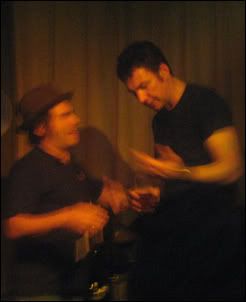 By the time the doors opened for the Thorns of Life show at the Hemlock Tavern in San Francisco tonight, the line of 300 people had completely wrapped around the venue. Only 110 people made it in—including notable attendees Billie Joe and Fat Mike—and those lucky few who got to see the San Francisco debut of the most highly anticipated band of the new year weren’t disappointed.
In short? Thorns of Life were beautiful and amazing.
I’ve written about Thorns of Life before, albeit on a purely speculative basis. I’d refused to watch the YouTube videos, as untainted by advance coverage as possible so as not to deny myself the enjoyment of in-person discovery. Patience is a virtue. The show was outstanding.
My God, the songs are good. This is the first thing that matters. The songs are good, some of them downright blissful. I take back my speculation about Aaron not being able to play ballads. I also take back my speculation that Blake might be retreating to relive a former self circa 1994. I’ve never been so glad to have been wrong. The songs are good.
Lyrics are a huge part of any Schwarzenbach band, and the ones I could make out ranged from the sentimental (“We tend to fill the void with hope and longing”) to the image-laden (“Hari-kari with a Smith-Corona. What the fuck?”) to the referential (“We listened to the Velvet Underground, ‘Heroin.’ And even though it wasn’t appropriate, it’s such a beautiful song.”) to the political (“Al-Qaeda is in Washington, why aren’t you fighting them?”) (I paraphrase). Blake mentioned at one point that all of his songs were about suicide and unrelenting misery; that he’d now had enough distance from graduate school to look at the subject of suicide objectively, and that he felt a real dialogue needed to occur in society about suicide.
Out of 13 or 14 songs, the band delivered alternating moments of elation, poignancy, humor, dejection, ennui and triumph. One, perhaps called “The First Time,” ranks among Blake’s best songwriting ever, and he closed the set with a solo song that between its lines about postcards and towers even utilized a harmonica and, after some deserved dissing of the capo, a capo.
When it was all over, I felt so completely and gloriously happy that Blake is making music again. There was a long time there where it looked as if he’d played his last show, and as clusters of exhausted people shuffled past me, smiling and reveling, I savored the annihilation of that worry.
I ran into a friend afterwards who muttered that the crowd was irritating and that too much hype had killed any possible positive experience the show could have offered. I disagree. Yes, people shouted Jawbreaker references (“Hey, look, it’s a new band,” Blake warned). Yes, there were superfans showing off their pictures taken with Blake. Yes, it was a miracle if you could get in. Yes, some people got a little too excited and drunk. Yes, Fat Mike hopped on stage afterwards to talk to Blake and Aaron, presumably about recording. Yes, there were tons of cameras out when the band hit the stage. These things happen.
 But hype that forms inorganically with no actual basis can be smelled like the shit that it is from a mile away. The atmosphere surrounding Thorns of Life is different in that it’s based on something very real. To wit: A huge subculture of people, all with a longstanding personal connection to the music and writing and art that Blake and Aaron and Daniela have created in their time. I don’t believe for a second that the majority of people at the show were there because it was the “it” thing to do. I believe that most people who were there—people like Kyle, Avi, Brian, April, Tony, Brandt, Chris, Billie Joe, Jerry, Haley, Ivy, Jason, Fat Mike, or Martina—most of these people are fans, just like me, who have followed and loved and been touched by great art, and who are compelled to check in and see what the creators of that art are up to.
As for the couple hundred people who got turned away tonight at the door, rest assured that what Thorns of Life are up to is thrilling and great, and they more than live up to the intense curiosity that so many people understandably share.
——–
UPDATE: Thorns of Life played four days later at Adam’s basement in Santa Rosa; my interview with Blake is here.
Picks of the Crop

Mushroom hunting is generally a dirty business. Those leaving from southern North Bay climes are looking at a good hour’s winding drive up Highway 1 to Salt Point State Park, one of the only state lands where it’s legal to pick wild mushrooms. Once there, several hours of wandering about, poking the ground with sticks and wondering over the possible edibility and/or poison content of what’s been found ensue. Clumps of leaves could disguise chanterelles, that black icky thing sticking up actually is a chanterelle, and banana slugs are inevitably discovered to be far less cute than some children’s songs might cast them.
Enter the Monte Rio Recreation and Park District, which hosts a Divine Mushroom Experience on Saturday, Jan. 24. “Divine” in this instance is defined as a limousine ride to Salt Point for an afternoon’s hunting foray with professional mycologist David Campbell and a return to Monte Rio to indulge in a gorgeous mushroom-driven meal prepared by professional chef Maria Vieagas paired with Mat and Barb Gustafson’s Paul Mathew wines, small-lot, hand-crafted vintages made from native yeasts. For just $125.
Those who like to keep their hiking boots clean can sign up solely for the four-course, wine-paired meal at a mere $50. Tickets for the day are almost gone, but Monte Rio parks district staffer Dawn Bell assures that a few are still left. The Divine Mushroom Experience is slated for Saturday, Jan. 24, from 8:30am to 4pm. Monte Rio Community Center, 20488 Hwy. 116, Monte Rio. $50&–$125. 707.865.9956. . . .
Speaking of small things best picked locally, the Sonoma Valley’s Olive Festival continues with the Feast of the Olive dinner, this year pairing “duets” of chefs from different valley restaurants together for a five-course meal. The only stipulation, other than it all be amazingly, gorgeously yummy, is that olives and their oil be showcased. To that end, everything from Ramekin’s chef Steve Valadez’s amuse-bouche to Harvest Moon Cafe chef Jen Demarest’s chocolate cake feature the goodly fruit. Eight wineries pair with the food and the Olive Press’ Deborah Rogers will be honored on Saturday, Jan. 24, from 6pm at the Ramekins Culinary School. 450 W. Napa St., Sonoma. $150. 707.996.1090.
Quick dining snapshots by Bohemian staffers.
Winery news and reviews.
Food-related comings and goings, openings and closings, and other essays for those who love the kitchen and what it produces.
Recipes for food that you can actually make.
Field Trippin’
01.14.09
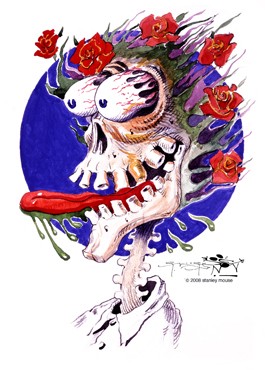
Illustration by Stanley Mouse
WE DON’T NEED NO THOUGHT CONTROL: Students! Leave those teachers alone!
We were barely past MacArthur when I felt it beginning to take hold. It was a big Friday for me, taking 40 students on a walking field trip to our local bookstore, then a tour of the Community Center and, if there was enough time, a little sit-under-a-tree-and-read time for the students in the Plaza.
I was in my tenth year of teaching in the only alternative high school in the town of Sonoma. Fall semester I was teaching English, algebra, science and art to students who usually hate each of those subjects. My primary task was engagement: get the kids understanding why knowledge is power and why they should give a shit, and then fill in the blanks as they appear.
It was the beginning of the year, and our office manager had informed the staff two weeks ago that we suddenly had $4,000 to spend. “But spend it fast,” she warned, “because you never know.” Budget distribution in the district frequently means no money for long periods of time, then a big wad to be spent within two weeks before it disappears into another pot. I quickly scheduled a Friday walking field trip to Readers’ Books, telling each student they had $15 to spend on a book of their choice. The only catch was that they would have to complete a book report. It’s an excellent way to spend $600, as most of my students have never been in a bookstore, much less bought or read a book of their own.
At first I felt lightheaded, like I hadn’t eaten anything or was out in the sun too long. Then I started noticing my legs. It felt like each step I took was propelling me up into the next. It was like I was walking on a brand-new track, only five times as springy. I noticed my whole body bouncing up and down. Something was amiss.
Drugs are a common topic in my classroom. The students have questions and I have answers, and if I can prevent one less overdose or drunken driving death, it’s worth it. My students get fucked up. We live in the wine country, and whenever you live in a booze-based economy, kids are going to grow up with issues. Acid, mushrooms, meth, coke, prescription drugs and a whole lot of weed are what the students are into. You would think it would change after 25 years, but it’s just the same as when I was in high school.
Max had left a screensaver depicting 12 tabs of Scooby-Doo windowpane acid on one of my classroom computers. I told him to do a research paper on Timothy Leary and quit being such an asshole. I think that’s why he dosed me.
By the time I reached Chase Street, I had a pretty good awareness of what was happening. Some of the treetops were dancing in the heat and wind, and my mouth was extremely dry. I went straight to Max, who was walking about 20 feet behind me.
“How you feeling, Mr. Moss?” he said with a smirk.
“Max, this is by far the dumbest thing you’ve ever done. How’d you do it?” I asked.
“Coffee” he admitted.
“How much?” I inquired.
“Small drop, one to two doses, should keep you going for a while.”
I ran through my options as best I could in my altered state, settling for what I thought was the most rational.
“Look, this is how it’s going to go. I’m going to ride this out, and you’re not going to tell anyone about it. Then you’re going to be expelled and brought up on criminal charges for dosing your teacher. Finally, you are not going to tell anyone what you did as it will seriously jeopardize your outcome. Clear?” I was getting lightheaded again, but I could tell that the point was made.
“Yes, Mr. Moss” he responded.
I had a big day that I didn’t want ruined by an LSD trip. Two years ago, a student had brought cookies made with marijuana butter to a teacher in the local middle school. After eating two, the student admitted to the prank. The student was expelled, and the teacher went to the hospital for tests and then home.
I had no time for that scenario; 10 years of following the Grateful Dead had trained me to control my experience. I used to volunteer with the Haight-Ashbury Rock-Med program, where I’d watch a guy named Doc Rock do drug talk-downs to people who were out of their minds. Besides, we were only going to the local bookstore, the community center and a park. How tough could it be? I was a professional; I could get through it.
Second Street East is one of those Sonoma streets that make tourists want to move here. Lovely restored cottages, perfect landscaping, large porches, shade trees—the American dream. I stopped at a white craftsman, similar to the home I grew up in. I was thinking how my dad, a newspaper writer, was able to pay for this house and our not-so-extravagant middle-class life (two kids, two cars, dog, tennis club membership, a cabin in the mountains) while I struggle like crazy working two jobs, hardly able to afford my mortgage in a little house on the other side of town, with no tennis club and certainly no cabin.
“Mr. Moss, are you OK?” It was Brenda, suddenly pulling me out of my thoughts. “The rest of the class is blocks ahead; you’ve been staring at this house forever.”
“Uh, fine, let’s catch up,” I answered.
We walked on at a brisk pace. My lightheadedness prevented running, but I started smiling as I was still feeling the bounce in each step.
Roll with it, John, control the craziness, but let yourself feel the drug was my internal mantra as we caught up to the other students.
At the corner of East Napa and Second Street East, we met up with the rest of the group. My teaching assistant and I had made a plan to split up the students and take 20 to the bookstore and 20 to the community center then switch so as to not overwhelm either venue. I contemplated telling the TA what was up but then thought better of it.
“All right, seniors with me to the community center, everyone else with Mr. H, switch in half an hour. Any shenanigans and we cancel the next trip.” Max was a junior, which was one of the reasons I wanted the seniors with me. The only thing worse than trying to hold it together while on drugs is having someone with you who knows you are trying to hold it together while on drugs. Also, most of the seniors had been with me for at least a year, and I knew they would be easier to control.
On the way to the community center, there’s a bed and breakfast with the most beautiful dahlias growing in the front yard.
“What kind of flowers are these?” I asked when their heads suddenly began to explode like little fireworks. I watched for a minute then turned and kept walking. Hallucinations were rare in my previous LSD experience, but I already had dancing trees, bouncy sidewalks and exploding flowers. Dangerous signs this early in the trip.
Alex was waiting in front of the community center. Blond and cute, she is the executive director and a longtime professional friend of mine. I had a huge crush on her when I first moved to Sonoma, but we were both happily married, so the flirting never went anywhere dangerous.
“Welcome, Mr. Moss. Welcome students.” She had a smile that made me turn away, as I didn’t want to seem too happy to see her and I was worried about blowing it. I fixed my eyes on a statue of a giant metal salmon some 10 feet away on the front lawn. It is a huge statue I had admired before, created by my friend Martin who had attached a bicycle gear to the bottom so that it moved in the wind. It was spinning very slowly, and the vision centered me.
“John, are you coming?” Alex walked over to me; the students were already inside. I had heard nothing of Alex’s introduction or history of the community center; I was just connecting with the salmon. “You feel all right? You look pale.”
“Sure, fine, I just really like Martin’s sculpture,” I replied, taking way too long to pronounce “really.” We walked inside where the students were looking at the artwork on the walls. I took my sunglasses off before realizing that they were acting as a shield between my drug-addled mind and the real world. I quickly put them back on.
Alex walked us around the community center, poking into classrooms and art rooms, saying little to me and focusing on the students. I told the students I had a new prescription so I needed to keep my sunglasses on. I had never worn glasses in the classroom, but nobody brought that up.
We left the community center after what seemed like hours but was probably only 20 minutes. Alex gave me a sideways glance. I thanked her for the tour and I realized that I needed to hold it together a little better. I knew I was in trouble as I bounced past the dahlias again and they were still exploding. I thought about sending the students into the bookstore alone and going to sit under my favorite tree in the Plaza, but realized that was the drug talking.
The bookstore was packed. It’s a very small place, and seeing it filled with 30 students would normally be a wonderful scene, but today it brought fear. I greeted the owner at the door, then beelined it for the children’s section in the back of the store. I spent the next half-hour completely ignoring the students and reading The Lorax by Dr. Seuss.
The walls of the bookstore were slowly closing in on me. I still had my glasses on, but they were no longer keeping me safe. I was having trouble processing the words in The Lorax, but I knew the story so well that I was able to live in the pictures in the book. I stopped on the page where the last Truffula Tree is whacked, staring at the vast ugliness of the barren landscape. My thoughts turned to clearcutting, global warming and environmental degradation, and when I looked up, the walls of the bookstore were moving in closer like the garbage-crusher scene in Star Wars.
I headed for the door. I asked Marsha the bookstore owner to tell the students to meet in the park after they finished. She flashed me a curious look, as what I really said was “Mettledeparkwhenrstudentsrdun-geddinbooks.” Somehow she understood “park,” “done” and “books,” which were the key words.
As I passed the register, Marsha asked me a question. I could not answer, as it sounded like she asked it in a foreign language. Keep going, don’t hit anyone, and don’t knock over anything, just focus and keep going. I had once tripped over a dead seal on the beach in Santa Barbara during a college acid experience; it had put me in such a bad mood that I’d spent the next two hours curled in a ball, rocking back and forth crying.
Outside was good. I could breathe easier, there were no students and I was no longer going to be killed by a wall of books. I still had The Lorax in my hand, which was not a bad thing—I assumed Marsha would just ring it up with the other books. I knew I had to get to the Plaza to sit under a giant eucalyptus tree, watch the ducks and wait out the acid.
It’s only about 500 feet to the tree, but I knew it would be tough as my bouncy-squishy walking style was now a more falling-swerving walking style. I walked along trying desperately to remain upright, one hand holding The Lorax and the other palm down, fully anticipating the concrete pushing up from the sidewalk and throwing me off balance as I walked.
The Laughing Queen, a novelty and costume shop, had a display of glasses in the window. The faces holding the glasses began to swirl and move as I reached out for them and touched the glass. I hadn’t realized it was there. I turned just as a voice said, “Hey, John.”
It was my friend Jim, a Sonoma city councilman and ex-mayor. “Whoa, you OK?” he asked. “Can I help you get somewhere?”
I had to make a snap decision to tell him the truth or try to lie and get away before he found out the truth. I was in no shape to do either.
“Uh, fine. Fine.” Not my best comeback. “Park.” I had been reduced to single syllable words, like a dog barking.
“Well, all right. You take it easy,” he replied with a curious look. I shuffled past him, restarting my falling-swerving style. Jim and I had been at a few wine-soaked fundraisers together, and I knew he had some bacchanalian tendencies. An occasional swerve in our town often goes unnoticed.
At the corner of First Street and East Napa, I had trouble crossing. I had been staring down to make sure I didn’t step on anything (the seal incident), but now I had to look up and I couldn’t gauge when it was my turn to cross. Cars were coming from every direction at a very rapid pace, and I knew crossing at the wrong time would mean instant death. Finally, an old man started across in front of me and I followed, able to reach the other side. I wanted to hug him and thank him and tell him what a savior he was, but luckily I didn’t.
I finally reached the tree and lay down with my head at the base. I closed my eyes for a few seconds, then opened them to see Jim and two police officers walking toward me.
“Not good,” I thought to myself. I propped myself up against the tree. My back immediately molded itself into the shape of the trunk.
“Mr. Moss, can you stand up, please.” One of the officers stood over me, looking about eight feet tall and three feet wide.
“Uh, no,” I replied, still unable to form much of a response.
“Well, Mr. Moss, your friend here told us that you are under the influence of LSD, and we also understand that you are leading school field trip and are responsible for 40 students, who don’t seem to be around. Now, please stand up so that we can arrest you, put you in jail, take away your credential, make you lose your job and completely ruin your reputation in this small town.” I looked over to see all of my students lined up clapping as he put the cuffs on me.
I woke up sweating. I was still alone, my head against the tree, The Lorax at my side. “Get a hold of yourself man,” I thought, breathing in and out, feeling the sweat cool on my body. After 20 minutes, I carefully crossed the street to Plaza Liquors for a giant bottle of water and returned to the tree to ride out the rest of the trip. I knew the arrest dream was the peak and now sanity would slowly return. A couple of students came by and asked me how long they had to stay. I told them they could leave whenever they wanted. I was happy not to be barking anymore. I watched the trees dance and read The Lorax about a hundred times.
I never did suspend Max. He became one of my best students, and is now studying to be a pharmacist at UC Davis. Soon, he’ll be dosing people for a living. Funny how life turns out that way.
On a Thread
For once, I am ahead of the curve. Thanks to my low-rolling, music-journalist lifestyle, I’ve been broke for ages, and this whole “cutting back” business is old hat. So if you’ve made a New Year’s resolution to spend less money but have a weakness for concert tickets and deluxe reissues, prick up your ears, for I have perfected the art of cheapskate music connoisseurship. Granted, I’ve also become more deeply cloistered in monklike seclusion from current cultural happenings, but my credit card statement is less horrendous every month. Follow these easy tips, and you’ll be well on your way to Easier Street.
First off, stop buying new music. Music used to be my number one entertainment expense, but it now ranks below artisan cheese (splurge level: rare). Fill the void with low-cost alternatives, and listen to NPR instead. If you wait long enough, your favorite musician, producer or songwriter will be a guest on Fresh Air. Plus, after a few weeks of Lutheran musical humor on A Prairie Home Companion, pretty much everything else sounds luminous in comparison.
Some songs make it easy not to spend money, which is why I boycott Auto-Tune overdrive. This negates, like, 75 percent of current singles. Though extreme utilization of robotic vocals attained via Auto-Tune is de rigueur these days, it’s also like nutmeg: a great asset when used sparingly, in the right place. I want a teensy sprinkling of nutmeg, not a blizzard.
Raid your own music collection. “You kids have so many toys. How can you possibly be bored?” my mother would appeal to my brother and me, but I now see her point. Man, do I have a lot of CDs, most of which are pretty damn good. I’m finally giving three amazing music collections— The Complete Hank Williams, Tom Waits’ Orphans and Rhino’s Girl Group Sounds— the detailed, repeated listens they deserve.
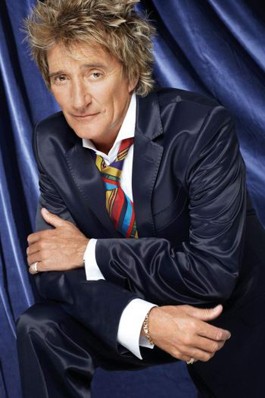
If you crave some variety, borrow it: visit the local public library. The newest CDs are always checked out; you’ll probably have to place a hold to get them. Opera, jazz and wanky baby-boomer rock are the best genres for walk-ins, which is how I grew addicted to the delightful cocktail of Le Nozze di Figaro washed down with disc two of Rod Stewart’s Storyteller box set. Sweet!
For music you can keep, cultivate friendships with musicians, who are overwhelmingly kind and generous people. They always have their own CDs lying around, and if you act interested enough, they will give them to you for free!
Don’t visit Pitchfork.com. Time is money. By ceasing to peruse all of the music-related websites I used to frequent, I’ve saved lost hours, avoided thousands of tasteless American Apparel ads and remained completely unaware of Vampire Weekend.
Fail to see your favorite performers. Neil Diamond, Holly Golightly and the Joneses, Tom and Sharon, all passed through town without my presence gracing the audience. Probably I was at home instead, listening to rebroadcasts of interviews with these very performers on NPR while I mopped the floor. I get fixes of live music when I can, though, because when you have a musician spouse, thanks to the magic words “plus one,” you’re guaranteed at least a few shows a year. And there’s not always a cover, anyway.
Go see unknown local folk singers and bar bands for free, and tip them a little so they can gas up the van on the way home. If there’s no band, have an impromptu hootenanny. Go to a bar with lots of friends and sing a bunch of songs everyone knows. (I don’t recommend doing this at a bar you would mind getting kicked out of.)
Once you’ve alienated all of your close friends with your skinflint ways, you’ll have to entertain yourself, so buy roller skates. Mine were $49.95 and are of middling quality, but they get the job done. Who needs a gym membership (and the attendant piped-in, douchebag Top 40 hits) when the church parking lot down the street and “Sara’s Bumpin’ Roller Jam” playlist on my iPod await?
After a solid year of miserly behavior, you hopefully will have squirreled away some savings. To allay my guilt over denying hard-working musicians my petty cash, I’m making a donation to a local music-related nonprofit organization. Then I’m having a hootenanny, so see you at the bar—even in hard times, there’s always skill for swill.
Powering Past Coal
01.21.09
Back in December, I downloaded a video emailed from an environmentalist friend who lives back east. It featured anthropomorphized chunks of coal. Each lump grinned and bounced while I followed instructions to “dress” them in warm clothes such as hats and scarves. When attired, the coal characters began singing “Joy to the World” under a banner reading, “Clean Coal.” I waited for sarcastic lyrics to deliver the punch line. But none came. My friend had sent me a marketing video. Exploiting the holiday spirit of love and joy, the coal industry intended I should welcome in the oxymoronic concept of “clean coal” as I would welcome holiday carolers. Not.
We don’t have a theme song for the climate-protection movement. A lot of uplifting songs come to mind. But while I’m feeling solidarity with victims south of the Mason-Dixon, I think we need a song about heartbreaking loss. Maybe the “Tennessee Waltz,” where the lyrics claim, “I know just how much I have lost.”
Tennessee is 2,500 miles from here. And because the North Bay and the rest of California enjoy some of the strongest environmental regulations in the country, and there are no coal formations atop Mt. Tamalpais, Sugarloaf or Mt. Veeder, we may not feel very connected to that coal-burning region, except to acknowledge Nashville for launching the careers of musical greats from Aretha Franklin to Elvis Presley.
Give a thought to the people of Harriman, Tenn., who just held their first farmers market last year and, in keeping with their community’s temperance roots, didn’t even have a liquor store until 1993. These people are struggling to recover from a coal-related disaster that illustrates why it is not enough to put more renewables online. We need to eliminate coal-burning power plants.
Three days before Christmas, the Harriman countryside was flooded with a billion gallons of toxic coal-ash sludge, which escaped violently from a slurry pond said to have contained a 50-year accumulation of coal ash. The grayish mixture containing arsenic, lead, chromium and other heavy metals flooded more than 300 acres of rural Tennessee. Drinking water was poisoned, animals killed, asthma attacks triggered, skin conditions exacerbated and the once-beautiful Emory River turned opaque gray.
There is no such thing as clean coal. It is the most carbon-intensive power generation on earth. Coal is mined by explosives that disfigure mountains, and tunneling that disfigures humans and groundwater courses. Toxic coal-ash is stored in 1,300 slurry ponds throughout the country, leaching poisons and threatening wildlife, human health and drinking-water supplies of nearby communities.
Even if Obama is successful in doubling the country’s renewables capacity in the next three years, renewable energy will still represent only a fraction of the power pie chart. About one-third of America’s power is generated from coal. California gets power from coal-burning plants owned by the utilities. So this is no time to sing a victory song because renewables are expanding. It’s time to eliminate coal-burning plants and stop the eco-social injustices that accompany them.
Like Katrina victims, the people of Harriman and of other towns vulnerable to coal poisoning deserve our civic action. One way is to participate in 100 Days of Action to Power Past Coal. Just launched last week, the PowerPastCoal.org website features ways you can help and a video of the sludge disaster, where even the banjo on the soundtrack sounds plaintive.
Music helps us respond to strong feeling. Singer-songwriter Kate Wolf drew her inspiration from the “golden rolling hills of California,” while Tina Turner, Dolly Parton and Aretha Franklin may have been equally inspired by landscapes in Tennessee, the state where all three were born. What about the kids born there now?
My first action to power past coal is this column, for the children of Tennessee; like all children, they deserve inspiring landscapes, unpoisoned air, clean drinking water and asthma-free lungs. And (even if they are not the next Tina Turner) they can one day join the climate-protection chorus for some victory songs.
But right now we’re in solidarity with coal-poisoned communities across the country and throughout the world—hearing a plaintive banjo and singing the beautiful “Tennessee Waltz.”
Establishing Ephermera

01.14.09
“ I f people don’t like it, that’s good ,” stresses Nicole Lee, “as long as they feel something about it.” Lee speaks in italics to emphasize the risks that the Arts Council of Sonoma County is taking on her new ArtSpace404, formerly the Arts Council Gallery. Under Lee’s direction, ArtSpace404 dispenses with the previous mandate of the Arts Council to solely show and support work by area member artists, and expands to set the bar for exhibitions in the North Bay by artists from all regions. The only rule? That it be excellent. With the exception of the innovative and national work showcased at the Sonoma Valley Museum of Art, and as the Sonoma County Museum begins to emerge from its fallow period, there hasn’t been much of a cultural barometer of excellence in Sonoma County since Gay Dawson’s Sonoma Museum of Visual Art closed.
Back when the Arts Council depended on the state to fund its activities, work had to be from area member artists; shucks, the council itself had to be a certain amount of feet away from a bus stop. Now that the money has dried up, there’s a curious freedom to the council’s endeavors. Their first foray opens on Jan. 23 with “100% Compostable,” a green art show in which all media are derived from ephemeral sources that can go back to the earth. Juried by S.F. Art Institute instructor and sculptor Philip Ross, this maiden show has a bit of a wobble, and Lee is the first to admit it. “This was a real challenge for our members,” she says. A recent visit to the jury room found several works suitable for the Thanksgiving dining table (think turkey feathers and moss) but not a fine arts gallery. Lee is certain, however, that things will right themselves once the North Bay accustoms itself to seeing excellent, cutting-edge modern work regularly on show at its very own arts council.
“100% Compostable” runs Jan. 23–Feb. 20. A free public reception is slated for Friday, Jan. 23, from 5pm to 7pm. Special events include an artist discussion on ephemeral art, Jan. 30 at 6:30pm; “Growing Gardens from Garbage,” Feb. 7 at 2pm; “Roll Your Own: Make Fine Art Pastels from Soil,” Feb. 14 at 1pm. ArtSpace404, 404 Mendocino Ave., Ste. C, Santa Rosa. 707.759.2787.
Museums and gallery notes.
Reviews of new book releases.
Reviews and previews of new plays, operas and symphony performances.
Reviews and previews of new dance performances and events.
Slaves of New York
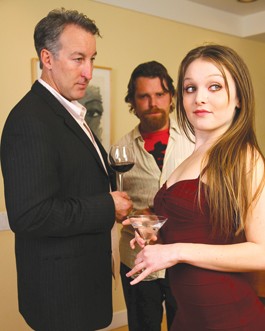
In theater, there is often an underlying tension between the written word and the performances of the actors who bring it to life. So often, the script is better than the cast, or vice versa. It is surprisingly rare to discover both at the same time: a theatrical production featuring fine actors all working at the top of their game in a play so good it seems impossible more people haven’t heard of it.
The new show at Sixth Street Playhouse is just that.
The Scene, by prolific New York writer Theresa Rebeck (how has this woman avoided winning a Pulitzer all these years?) is a superbly crafted, four-character immorality tale, so well written and edgily funny and full of nuance and shades of subtlety that it demands to be acted by a quartet of performers who are not merely top-notch, but are also confident, controlled, believable—and fearless.
Under Beth Craven’s masterfully spot-on direction, and working within a cool, rotating set by Paul Gilger, the Sixth Street Playhouse has taken Rebeck’s Scene and delivered a show that perfectly matches the brilliance of the script. Running through Feb. 8, The Scene—which, tragically, could still fail to bring in audiences for the simple reason that few people have heard of it and it’s not a musical—is the year-opening show by which all other productions, at this theater and beyond, should come to be measured.
Charlie (Keith Baker) is an angry, out-of-work television actor who has developed an attitude of unmeasured disdain for the industry that no longer has use for him. Sick of “the scene”—New Yorkers’ double-edged euphemism for the system of party-hopping and schmoozing that constitutes networking within the Big Apple entertainment community—Charlie survives emotionally only by convincing himself he’s better than everyone he encounters, and keeps a roof over his head only because his supportive wife, Stella (Michelle Maxson), maintains a steady job as a “booker” of celebrity guests on an unnamed television talk show. Stella, who hopes to mitigate the unsatisfying repetitiveness of her career by adopting a baby, gently prods her husband to take a meeting with a despised acquaintance who’s producing a television pilot so bad it might actually get made.
To Charlie, Stella’s patient encouragement has become a dagger of deprecating guilt and unworthiness, so when he and his faithful bachelor friend Lewis (Dodds Delzell) encounter the annoyingly ditsy Clea (Rose Roberts) at a party, he unleashes his self-loathing on the vacuous newcomer from Ohio, berating her for her inappropriate use of the world “surreal,” her passive-aggressive way with a vodka and her enthusiastically halting, dim-bulb exclamations: “I’m from Ohio. Isn’t that hilarious?” Charlie also delights in telling her that the “infertile Nazi priestess” (her words) who declined to hire her that morning is, in fact, his wife.
It is only after a lonely Lewis invites Clea to his apartment, and a surprised Charlie drops by to vent after a soul-scarring lunch with the TV producer, that Clea reveals herself to be as smart as she is dumb. Recognizing a way deeper into “the scene,” she seduces the vulnerable Charlie by comparing him to a lion roaming the savannah. Her cruel side appears in the second act, after an afternoon of acrobatic sex in Charlie and Stella’s living room (“I love that you brought me here. It’s so hostile!” Clea says).
When a stunned Stella walks in on them, both she and Charlie are shocked by the budding femme fatale’s boldness. Responding to Stella’s remark that Charlie is her husband and the interloper has no rights, Clea calmly replies, “I’ve been fucking him all afternoon and you haven’t. That doesn’t exactly give me no rights.”
As good as Rebeck’s writing is, the cast match her line for line. Baker and Roberts are sensational, each peeling away layer after layer of artifice to reveal the caustic, empty but thoroughly believable people at their core. Maxson, in what could have been a supporting role, is a tower of wounded strength, and Delzell, as the watchful, careful observer, turns waiting and seeing into an art form, and in this magnificent, must-see play, proves that even on the noisy New York “scene,” sometimes it’s the quiet one who wins the prize.
‘The Scene’ runs Thursday&–Sunday through Feb. 8 at the Sixth Street Playhouse. Thursday&–Saturday at 8pm; Sunday at 2pm. $15&–$26. 52 W. Sixth St., Santa Rosa. 707.523.4185.
Museums and gallery notes.
Reviews of new book releases.
Reviews and previews of new plays, operas and symphony performances.
Reviews and previews of new dance performances and events.
Wheat Wash
01.21.09
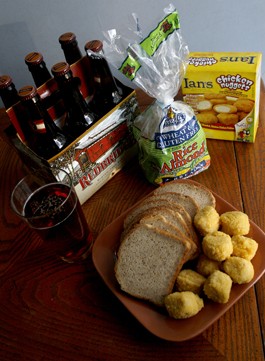
OH, YUCK: This bland assortment of the gluten-free makes one fervently wish for a stalk of broccoli.
I‘m no dieter. In the food pyramid of my life, pizza and beer each enjoy their own trapezoid. But on a dare, I enlisted the office “glutards,” Molly and Maree, to help me give up gluten, a protein found predominantly in wheat, rye and barley, for two weeks. Unfortunately, that means it’s abundant in foods like bread, pasta, desserts and, sigh, beer. Neither Molly nor Maree has had gluten in years. “It totally changed my life,” Maree assured me.
Gluten-free food is a $2 billion business, far surpassing the possible consumption of those relatively few people who have the autoimmune intolerance of gluten, called celiac disease. The anti-gluten buzz has given the diet a violent shove into “trend” status. After all, “Oprah did it,” as I was informed more than once in the course of my experiment.
Though Oprah was (again) trying to lose weight, going off gluten can supposedly fix problems ranging from gas to bloating, fluid retention, headaches and skin conditions, but Molly and Maree told me it can go further than that. While enumerating my vague health problems—lethargy, mild depression, cloudy thinking—Molly excitedly gasped, “You might totally have a food allergy.”
What the glutards described was not just a weight-loss program. It offered the possibility that things I had figured were personality traits—gloomy mood swings and general laziness—were actually treatable with a simple diet change. Like the addict I am, I first insisted on a ravioli binge, and then agreed to give it a try.
Molly had given up gluten under the guidance of a naturopath whose practice emphasizes the effect of one’s diet, and often recommends a wheat-elimination test. “I started eliminating it for weight and then I started realizing how good it made me feel,” the doctor said. “Everyone is a little different in terms of their tolerance.”
People who are “sensitive” to gluten have trouble processing the protein, which has become overly abundant in modern foodstuffs. Although no one can actually digest gluten (it passes through us), a lower tolerance can cause problems like, perhaps, my lethargy and moodiness.
The naturopath recommended that I try giving up gluten for two weeks and then “challenge” it by returning to my old habits to see how I feel. “You’ll start to develop a taste and liking for these substitute products,” she predicted. “Once you challenge the wheat, you’ll realize how crummy you feel.”
She armed me with a couple of handouts, which merely sent me into full-blown panic. Not only was I going to have to give up the things I crave most—pasta, pizza and beer—but wheat and gluten are apparently hidden in soy sauce, soup, ketchup, sandwich meat, cereal, processed cheese and sauces. It seemed endless.
I hit the natural-foods market to see what my options were. At first, I went looking for things that said “gluten-free” and found at least 50 products that make up the ranks of that $2 billion industry. There’s even an Anheuser-Busch beer called Redbridge made out of sorghum. With a shopping bag of rice-almond bread, a rice-crust pizza, a gluten-free pasta and a six-pack, I figured I really wasn’t giving up anything.
That, of course, was before I tried any of it.
My pizza was tasteless and soggy beneath the cheese. The beer was too sweet, and the gluten-free pasta, though the package actually promised that it was “not mushy,” was just that, and turned into a gluey mess at the bottom of the pot.
The night after I tried to make a meal out of the pasta, I decided to weigh myself. I found I’d shrunk to my high school weight. That was definitely not a good thing. After a week of pushing my food around the plate, I was merely starving myself.
I realized that even more after I talked to Dr. Susan Algert, a nutritionist at the Wm. K. Warren Medical Research Center for Celiac Disease in San Diego. “It’s being recommended for weight loss, and there’s absolutely no reason for that,” she said. “It’s not really a good idea to leave a whole group of foods out of your diet.”
She warned me that self-diagnosing can be a pretty bad idea, especially since so many of the wheat-replacement products are made of rice and corn. “Many of the gluten-free products are not enriched with B vitamins,” she said. “That’s needed for energy. A person’s not going to feel well without them.” She recommended I make sure I get whole grains from things like brown rice, quinoa, couscous, bulgur and teff. And, she reminded me, only about 7 or 8 percent of the population is sensitive to gluten.
After Dr. Algert’s stern warning, I figured I would eat normal foods that do not contain gluten. I took up tamales and tacos, brown rice and beans, lots of green vegetables, and my mom’s Chinese recipes with tamari instead of soy sauce. I easily gained the weight back, and then something sort of cool happened: one night after dinner, I didn’t slink off to my room to lie in bed. I worked. I chatted with my roommate. Another night I went for a bike ride.
This was probably the biggest difference; I did not become any less moody, as my long-distance boyfriend can attest. I still had my down moments. The little pouch around my belly button did not shrink, meaning it isn’t “inflammation” or “water retention,” but just plain old fat. Turns out I’m a woman.
After the two weeks, per the naturopath’s recommendation, I challenged myself with a big ol’ box of macaroni and cheese, and crashed hard at 8:30pm. But the next morning I got up easily and had much the same type of day that I had when I was off gluten. Everything felt pretty much the same.
But perhaps that’s just me. For people like Molly and Maree, the diet seems to be life-altering, so it could be worth a try with a healthy dose of skepticism and plenty of real food. The wildly varying promises in magazines sometimes fail to mention that the majority of the population can digest gluten just fine, but it does happen to occur in some of our most unhealthy foods. In a way, the proper gluten-free diet is just like any recommended health regimen—whole grains, fruits, vegetables and protein, lay off the pizza and beer. Like that’s going to happen.
Letters to the Editor
Born Again
Live Review: Thorns of Life at the Hemlock Tavern, San Francisco
Picks of the Crop
Field Trippin’
On a Thread
Powering Past Coal
Establishing Ephermera
Slaves of New York
Wheat Wash



FOLLOW US
Copyright © Weeklys All rights reserved.
Our Publications
