The scene: the recent presidential inauguration, out on the mall. The situation: 5 million people and only 5,000 Port-a-Pottys. “Suddenly,” explains Bridget Palmer, barely containing her laughter, “It was suggested that President Obama was in one of those Port-a-Pottys, and everyone was running around opening doors to see which one he was in so they could, you know, meet the new president. And then there was this Secret Service agent, but he wouldn’t tell us which potty Obama was in.”
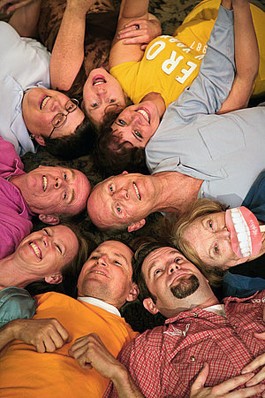
Though this anecdote sounds like either the best untold news story of the 2009 inauguration or some kind of twisted delusion, it is in fact the highlight moment of the night during a recent performance by Sixth Street Improv. Since the beginning of January under Palmer’s direction, the quick-thinking team of actors and comedians has taken over the Playhouse’s Studio theater, landing twice a month to open the dams of improvisational comedy. Sixth Street Improv employ a combination of classic improv games and live spontaneous songs, invented on the spot with the help of a live accompanist on piano. According to Palmer, the goal is higher than just earning some quick laughs.
“Well, we definitely are aiming to be funny,” she says, “but our primary emphasis is on story, so a lot of our improv bits are like little tiny plays, based on suggestions tossed out by the audience. Fortunately, most of the time the stories we get from the audience are pretty hilarious, and if they’re not obviously humorous, like the inauguration thing, our cast is pretty good at finding the humor in it and taking it as far as we can go.”
Since opening the series, the group has proven surprisingly popular, selling out their first night and threatening to turn people away ever since. As an art form, improvisation is on the rise in Sonoma County, with more and more improv acts appearing on the lists of local entertainment events. Palmer thinks it has to do with a growing need for laughter and a desire for community.
“Our purpose,” she says, “is to create a place where people know there will be improv in a theatrical setting on a regular basis. There really is a certain community that develops around these kinds of comedy series, and that’s what we’re hoping to build over at Sixth Street.”
Catering to a somewhat less refined, decidedly younger crowd is the World’s Largest Comedy Duo, a team of some eight insanely quick-on-the-uptake actors performing every Thursday night at Santa Rosa’s Black Rose Irish Pub. Formed two years ago by Adam Aragon, the group has developed a strong local following, in part through their presence on YouTube and through their website ([ http://www.biggestcomedyduo.com/ ]www.biggestcomedyduo.com).
Says Aragon, “Our goal is to just be as funny as we possibly can, to hopefully make the audiences laugh so hard they hurt. We practice that, making people laugh so hard they hurt, and we’re getting better and better at it.”
The group really does practice. Each week brings a different theme to the evening’s activities—science fiction, politics, vacations, bad literature and drunkenness—and the troupe meets weekly to plan out games and routines specific to the theme.
“We find that, in doing improv, the more you do it, the quicker you get,” Aragon says, “and timing is as important in improv as any other comedic form.”
The group took the drunkenness theme to hilariously improper levels, demanding that every member of the company have at least a couple of beers in them before they could take the stage.
“We probably weren’t as quick as we usually are, I admit that,” Aragon laughs, “but the audience understood the theme, and since all of the routines were about different aspects of drunkenness, it turned out to be one of our funniest shows. Everyone wants to know when we’re planning to do another one like that.”
Sixth Street Improv play the second and fourth Saturday of each month, with the exception of April, when the group appear the second and fourth Sunday night, through June 6. Sixth Street Playhouse, 52 W. Sixth St., Santa Rosa. 8pm. $12. 707.523.4185. The World’s Biggest Comedy Duo play every Thursday night at 8pm at the Black Rose Irish Pub, 2074 Armory Drive, Santa Rosa. $3. 707.546.7673.
Museums and gallery notes.
Reviews of new book releases.
Reviews and previews of new plays, operas and symphony performances.
Reviews and previews of new dance performances and events.
Media oftentimes has an awkward relationship with other forms of media, but when celluloid documents pulp, it’s hard to lose. Such was the case for the last week at the Noir City Film Fest at the Castro Theatre in San Francsico. All old movies about the newspaper industry in a fitting, timely program curated by Noir City founder Eddie Muller, who introduced each film with his comfortable wit and contagious appreciation. Not like the crowd needed any needling: these films were outstanding. Most of them, sadly, are unavailable on DVD.
I joined the sold-out crowd for the opening double feature. Deadline U.S.A. isn’t on DVD and it’s a crying shame; Bogart as the tough-as-nails newspaper editor who refuses to see his paper sold to the tabloid without a fight is unbelievable. Muller mentioned seeing the film when he was a kid; his dad, he said, was a reporter, and the end of Deadline U.S.A. is one of the few times he saw his dad cry. It encapsulates everything that we hope newspapers truly used to be, and everything that we lament that they’re not. Some bootlegs of it can be found for sale online.Scandal Sheet showed next, a dark, gripping tale of ink and murder. A circulation-obsessed editor accidentally kills his former girlfriend and tries to cover it up; his reporters, meanwhile, pick up some suspicious evidence from the crime scene and ask to pursue it. A harrowing, tense film, as the editor tries to evade his own writers while watching his readership climb because of the juicy story. You can guess how it ends.
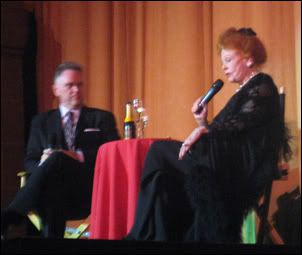
I woke up the next morning unable to do anything but hop in the car and drive back down to the city for more. Unsurprisingly, the line was around the block again. Chicago Deadline brought Alan Ladd and Donna Reed together on the only known print of the film in existence; Slightly Scarlet closed the night with two redhead bombshells, Arlene Dahl and Rhonda Fleming; but it was the film in the middle, Wicked as They Come, which shined, with Dahl as a kleptomaniacal, nymphomaniacal rung-climber. Dahl herself made a special appearance and sat down for an interview with Muller afterwards to dish the dirt on Errol Flynn, Clark Gable and John F. Kennedy, whom she dated at one point, long before his presidency. She called him “Jack.” It was sweet.
It was hard to stay away for the rest of the week, especially with titles like Ace in the Hole, The Big Clock, and The Sweet Smell of Success on the big screen, all three of them incredible movies about newspapers and publishing (they’re on DVD, at least). Muller did a fantastic enough job picking the films last year with titles like Gun Crazy, The 3rd Voice, and The Face Behind the Mask, but by this year offering a cinematic salve for the struggling print newspaper business, he’s shown acumen and heart. The Noir City Film Fest is a treasure; here’s to next year.
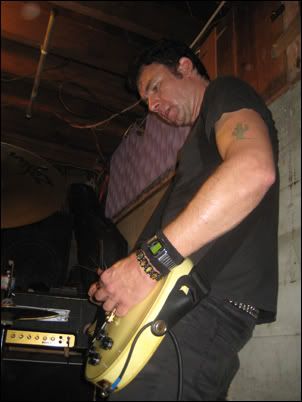
Last night, between dates at Thrillhouse Records and Gilman, Thorns of Life played a stellar show with Santiago and the Semi-Evolved Simians in the basement of Adam’s house in Santa Rosa. It’s more like an interrogation chamber than a basement down there, but in spite of our repeated warnings to the band in the last few weeks that the downstairs is a tiny, 10-foot-by-15-foot concrete cell, they kept shouting back their approval. It’s small? Sure! It’s cramped? We’re there! It’s going to be a total disaster? Great!
So the basement it was, as Thorns of Life—Blake Schwarzenbach, Aaron Cometbus, and Daniela Sea—came to Santa Rosa for another hush-hush house show last night on their West Coast tour. There were some hidden flyers around town, but unless you looked inside dumpsters, sewer tunnels and library book-return slots, you had to rely on the word-of-mouth secret show game, with all of its social awkwardness and selective dispensing. But in the end? A night, as they say, for the books.
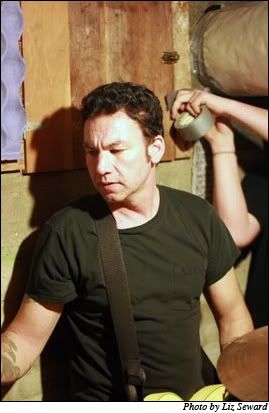
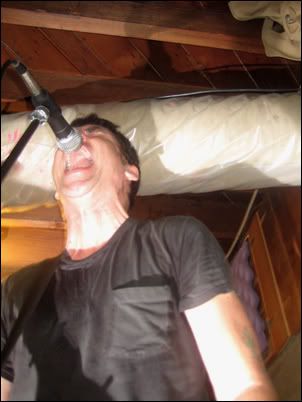
Looming over the house at the onset was a freak nervousness, aided by the cops parked a couple houses down. Then: the slow dissipation. The opening bands, the opening beers, the opening hearts. Sweat doesn’t just break through the lining of the skin; it opens up invisible barriers. By the time Thorns of Life played, there was no option but the personal. I sat essentially on top of Blake’s shoes with a sea of people at my back; Blake fit squarely beneath a heating duct; Daniela played between the water heater and exposed fiberglass insulation; and Aaron crammed more people in the basement by directing them behind the drums, atop the workbench.
The show was a brilliant blur; smeared further, a bit, with disbelief and volume. For 11 songs, everything gelled inside the ridiculously populated basement on the corner of Spencer and King, and afterwards, it was beers in the backyard, “On The Way to Frisco” in the kitchen, Nancy Ling Perry obituaries in the hallway, and for me, catching up with Blake Schwarzenbach.
At some point during the party—between discussing the house’s cats, the possibility of playing Jets to Brazil songs at acoustic shows in the future, Creature Feature host Bob Wilkins, accidentally ripping off “Ingrid Bergman,” the challenge of playing harmonica, the memory of losing one’s virginity, and sending postcards to Verona—Blake and I managed to slow down and escape to the sidewalk outside, next to the station wagon they’ve been touring in, to conduct an official interview. I first interviewed him in 1991, 18 years ago. He’s just as open now as he was then.
Do you look at the past as a hindrance or an asset?
I used to look at it as a hindrance, but I think I broke through in the last couple years. I don’t really know when it happened. I did a lot of work on myself, getting me to enjoy my past. I found out I could actually use it a little bit to help me out. What about regret? Is regret useless?
Yeah. If you can’t convert it into art, then it’s gonna destroy you. What about nostalgia? Where does nostalgia lead?
I think it’s pretty good if you don’t live in it. It’s always nice when you think of somebody fondly, or go to a place and remember something or somebody. That’s part of travel, and being alive. I’m usually grateful for it, I don’t get it that often. Really—you’re not a nostalgic person?
No, I’m sad. I’m sad. What I used to think of as nostalgia was my recognizing degraded human environments , and it was a response to poverty, I think—poverty of spirit, a lot of times, but also social poverty, aesthetic poverty in our country, the way living spaces look awful and our civilization is really ugly physically. So, yeah. There’s a big difference between sadness and nostalgia. One of the things noticeable in this band is the apparently conscious decision to play house parties and DIY places. Can you talk a little about that?
Well, it’s how we started, when Aaron came to me. We’ve had this courtship for a decade, but really in the last few years when I started having songs, he coaxed me into going to a house show. And it was really fun. And then I felt like in order to justify going to house shows I needed to have a band; after a while, I felt like I was freeloading, like the old punk guy who goes to shows. Like, ‘I’d better have a band, to go here and hang out.’ So it was a pretty natural progression, and I think I have some indie damage from the Jets where I just never want to be in a rock club with someone from the local free weekly being disinterested and asking questions. You know that I’m technically from the local free weekly, right?
Yeah, but you know what I’m talking about, that whole apparatus, like the person who goes to interview the Matador band that week, or whatever. So having survived that machine, I was kind of happy not to… it was really boring, honestly. The clubs.
Yeah. And we’ll play clubs. I mean, I’d like to. But you have to have less stages, I think. We don’t have a P.A. in our rehearsal space that’s very good—it’s just a guitar amp, it’s very sketchy. It just ended up being the sound of the band, that there should be a little bit of struggle in it. The first show of this tour we played at a club in San Diego, and I have to say it was really disorienting to have a monitor. I spent years learning how to use a monitor, but I’ve completely unlearned it, and now I don’t want too much of me. I’d rather push, and hear it out in the room. Some of your more ardent followers take issue with this whole approach, where you do shows that are word of mouth and therefore only for the in-the-know; it’s frustrating for them, and can seem kind of elitist. How would you respond to people’s concerns like that?
I can’t help them. Well, you could play larger places.
That’s true, and I’d like to. But last time, for me, in my band, it was the other thing. The punks thought that that was elitist, and that we didn’t give a shit because we played big clubs: ‘I’m not paying eight bucks to see you, fuck that.’ So I kind of feel like it’s hard to win. And if you’re gonna err, you might as well err on the side of…
Right. Free shows, or four-dollar pass-the-hat shows, where we have fun. I’d rather have fun first and then worry about other people’s fun. I’m pretty selfish that way. One of your infamous positions has been leaving the punk scene behind—and now, between playing house parties and embracing a political stance, it seems like you’re rediscovering your inner punk.
Well, I became politically articulate in New York through graduate school and through the last three wars. I used to write about it, I mean, I felt it was intrinsically in me, because my parents were radicals and I grew up suspicious—I grew up in Berkeley in the late- late-’60s, I watched the Watergate hearings with my dad. It was in me, I didn’t know how to express it, and I always found it a little corny when people would do it on the nose. I had to find a voice where I felt I could be helpful. When I can put it in a song, I really like it. I just have to earn it in a way, to take on other people’s pain. I don’t want to write any kind of sloganeering song, or jingoistic song or anything. So if I can use my own subterfuge of poetic language, and do it, that’s actually where I feel like I should be writing. I’m a little tired of me. I haven’t had a relationship in a long time, so there’s no stories there. I’ve been living the Palestinian struggle for the past five years. That’s more interesting to me right now. You have a song about Al-Qaeda in Washington.
Yeah, and it was a really quick song to write. It was just about surviving the primaries and seeing Hilary Clinton in the ascendant, which to me was a dark harbinger of more bad policy. It’s a cautionary song about not putting all your money in Obama curing the guilt of white people and saving the world. I don’t wanna say no to that, I wanna give him his shot, and I voted for him, and I would work with anyone to change anything. Would you call yourself cautiously optimistic about his presidency?
Yeah, yeah. I think it’s only responsible to wait and give him 100 days, or four years, whatever it is. The title—the idea, to me, studying Iraq for the past few years, studying Afghanistan, studying the Western attitude toward the Arab world—“We Build Al-Qaeda in Washington,” that’s the title. The core of Al-Qaeda is in Washington. Sure, it grows in Yemen, and it grows in the Saudi oligarchy and everything, but I think we’ve done so much to foster militias around the world that the idea is you should go there and fight, you don’t need to go across the world. That’s the title, that’s the idea. Has the punk scene changed, or have you changed?
I think I’ve changed. I mean, yeah. I went back. Could you imagine yourself doing a tour of house shows in, say, ’96?
No, but I longed for it many a night. I was just like, ‘This is so boring!’ Like God, these fucking places. The shows could be great, and musically it was fun to have that huge apparatus. But it’s a limited thing: you get 40 minutes of feeling powerful, and a lot of drudgery. As I said, being politically articulate helped me miss punk. I realized that those are my people. At least they’re asking those questions. Indie rock isn’t asking those questions. It’s so inward-looking and ambitious, in New York especially. It helps to be in New York, because they’re just shameless about wanting to fuck you over to get ahead. Brooklyn, in particular?
Now, yeah. I guess now Brooklyn is this kind of Seattle. I never thought of it that way, but it’s… I just found those people not very interested in the world. Interested in their own local phone code, their own space. I was heading out into the world at the time that it seemed like that music scene was heading into itself. So punk was the only place where people were going out and marching, doing actions. They just gave a shit about the world! It seemed to be about the most important thing anyone could do in the last eight years. You took part in some of that. I think you gave a speech in New York at some point.
I did, yeah. I have a great friend who’s a historian, a professor, and she insisted that I speak at a student walk out. She goosed me into awareness; I met a lot of great people there. It was terrifying, but I was embraced, which was nice. I just tried to do my own thing; I didn’t want to be presumptuous, so I wrote a poetic essay, I guess, and I was surprised that it seemed to register with a few people there. I was speaking with bona fide refugees and people I felt really outclassed by. All I had was band experience. But I think the people, they see you out there, they appreciate it. Are you worried that people may be forgetting how to live in the moment?
I worry that they are forgetting how to live in the world. I don’t mean even the big world, but just in terms of going outside, or not being online. That new technology, it’s just not… I don’t quite get it yet. I know you have to give youth a shot, and some kids have really happy, connected lives that way, but I don’t feel it. I miss the bricks-and-mortar stuff. What about the hundreds of cameras at shows? It’s reasonable to expect people to appreciate what’s happening in front of them, to experience it, but instead there’s this need to record it.
Yeah. I don’t know. I mean, we thought about… I don’t want to tell people not to do that. I just don’t have enough time in my life, I’d much rather work on making our show sound good, and playing well, and seeing the people we like. Are you happier when people don’t take pictures all the time, film you all the time?
Yeah, of course. But I have to admit, there is this strange little vain part, if the show’s really kickass, that I think it’d be fun if I could tell my dad he could watch it, or my sister, to tell them, ‘Hey, we just played in this big closet!’ Were you nervous about tonight when you saw that tiny basement?
We had questions about how we were going to fit in there, but once we set up, once we started, it was great. What do you think is more important, to be smart or to be honest?
That’s a tough one. Oh, I would say to be honest. And I think to be really honest, you have to be pretty intelligent. If it means being honest with yourself, or being really clear with your friends and loved ones, to communicate, you have to be smart. You can be clever, and that’s bad. Clever is like being surreptitious, and figuring out how not to be truthful. I think smart and intelligent means an ability to be honest. I’ve done a lot of work getting past clever to what I think is a broader kind of intelligence, which involves honesty. Are you going to record an album?
Yeah. I couldn’t help but notice Fat Mike hop on stage the other night and talk to you guys. Was that about recording at all?
I think he’d like to do something. He’s been a really supportive guy. But I don’t… we don’t have a label. We don’t have a ‘dream label’ or anything, other than one we make. It seems we’re about at that point, with technology, that you can just have your own label. You have a reference to a Smith-Corona, and you own a Smith-Corona. Do you use it to write lyrics?
No, I don’t. That’s about Mishima, that song. It’s about writers, the verse is about Mishima committing ritual suicide. So the line is: “Hari-kari with a Smith-Corona, what the fuck? The left arm of the right wing.” You mentioned the other night at the Hemlock that all of your songs are about suicide and unrelenting misery. Is that actually true?
Kind of! It’s surprising, yeah. I mean, they’re pretty joyous tunes, but they’re pretty dark lyrically. Do you feel a discussion on suicide is something that’s ignored in society?
Yeah. It’s either glamorized or it’s shunned, and it’s only the most important question that everybody asks themselves, especially in their young life. It’s something you reckon with as a youth. Our song is ‘O Deadly Death,’ it’s kind of a valentine to suicidal feelings, and how important that is in your development to go to the wall, and then step back. That’s just part of identity, is finding your way to the utmost point and then reveling in the beauty of being alive. What song do you hope you’re listening to when you die?
“Girl From the North Country,” maybe, with Johnny Cash and Bob Dylan, the duet version. That’s always a sweet, off-into-the-wilderness song.
In 2004, I walked into the Tradewinds in Cotati and felt my jaw immediately hit the floor in amazement over the two guys opening for the Rum Diary. A greasy-haired hippie-looking drummer who played just a little behind the beat and a sharp-throated, fingerpicking singer who blew the harmonica and sang songs about trying to care that the country’s at war in the midst of a ruined liver and other malaise. It felt like this band was created just for me, and after their captivating set, I found out that the band was called Two Gallants. Both Michael Houghton and I cornered the singer near the pool tables and bought everything he had.
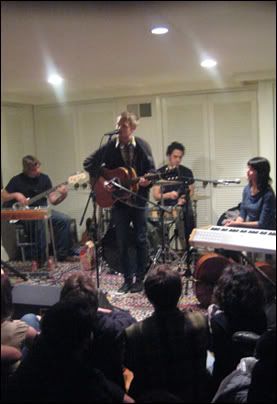
I felt a similar sort of excitement tonight when I opened the antique door to Cast Away, a precious yarn shop in Railroad Square, to check in on that same singer, Adam Stephens, and his new solo project. Clusters of people lined the stairway up to the store’s loft, where the outstanding owner Justine usually offers knitting classes but tonight had transformed into a mini-concert space. About 30 or 40 people sat crowded on the floor, quietly passing around libations and listening intently to the music, while below, older customers reclined on couches for the evening’s ‘Knit & Sit’ session, knitting needles and unfinished scarves in hand. Santa Rosa never ceases to amaze me.
Stephens explained that he’d forgotten his harmonica holder, but he had more than enough texture to make up for it; cello, piano, drums and bass filled out his sound while managing to be mostly quieter than anything Two Gallants has ever done. His songs, I noticed, were long, but as Henry Nagle whispered in my ear, they’re paced extremely well, akin to long Springsteen epics. How Stephens manages to come up with so many words to fill his songs is beyond me. I only heard one reference to someone else’s lyrics—a line about sweeping out the ashes—and for the most part, his songs were things to get happily lost in.
Two Gallants is officially “kind of on hiatus,” Stephens told me afterwards, so he’s planning on recording and touring with this new outfit—whatever it may come to be called. “I hate my own name,” he murmured on the sidewalk, “but I also hate coming up with band names. I’ve only named one band in my life, and I was sick of it after a month. So we’ll see.”
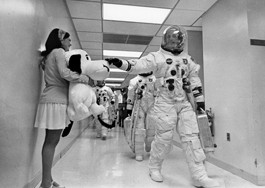
NASA Photograph-courtesy of the Charles M. Schulz Museum & Research Center BON VOYAGE: NASA secretary Jamye Flowers Coplin holds a stuffed Snoopy out for a final earthbound pat from Lt. Gen. Thomas Stafford as he prepares to embark on the Apollo 10 flight.
On May 25, 1961, President John F. Kennedy submitted his lunar-landing program to Congress for approval, spurring the nascent NASA agency skyward. On July 20, 1969, Neil Armstrong became the first man to walk on the moon. But Snoopy got there first. In fact, he did it twice.
Aiming to become the “first beagle on the moon” in March of 1969—at least in Charles M. Schulz’s wildly popular “Peanuts” comic strip—Snoopy adorned his WW I flying ace scarf and goggles with a clear, round globe protecting him from the moon’s thin atmosphere as he piloted his doghouse upward. He got there before that stupid cat next door and, with NASA’s approval, he got there before Neil Armstrong. Just two months later, he and Charlie Brown actually circled the moon, playing host to astronauts Thomas P. Stafford, Eugene A. Cernan and John W. Young. Well, at least the lunar and command-service modules bearing their names did. The Charles M. Schulz Museum pays tribute to the strip’s space adventures by hosting Cernan, Stafford and others on Jan. 31.
In 1969, “Peanuts” was at the zenith of its popularity, read by some 355 million people in 75 countries. Snoopy and the gang were perfectly poised, NASA felt, to help the American public rally around the space program after the disastrous 1967 Apollo 1 launch pad fire that killed astronauts Virgil I. “Gus” Grissom, Ed White and Roger B. Chaffee while tragically trapped in their seats. Thinking of the successful Smokey Bear campaign, NASA heads decided that they needed a way to extend the agency’s strict safety standards to its many subcontractors and award those whose work was truly outstanding. With Schulz’s enthusiastic support—he drew a new logo and service posters for the project gratis—NASA established the Silver Snoopy award, still given to space-agency service providers whose work is stellar. But Schulz’s enthusiasm and his work extended further into the program.
When Apollo 10 launched on May 18, 1969, the command module was named Charlie Brown; the lunar module, Snoopy. When the two craft successfully recoupled after moon recognizance, Mission Control showed the crew a special strip Schulz had prepared depicting Snoopy kissing Charlie Brown with the thought balloon, “Smack. You’re right on target, Charlie Brown!” And when the recovery team picked the crew up after their safe return, the underside of the helicopter read “Hello ‘der, Charlie Brown.” It was all “Peanuts,” all the time for this space flight, one that exemplified the hope and vision for NASA’s ambitions.
Capt. Cernan and Lt. Gen. Stafford are joined by Navy frogman Wesley T. Chesser, Navy helicopter pilot Chuck Smiley and secretary Jamye Flowers Coplin when they appear at the Schulz Museum on Saturday, Jan. 31, from 1pm to 3pm. 2301 Hardies Lane, Santa Rosa. Free. 707.579.4452.
Museums and gallery notes.
Reviews of new book releases.
Reviews and previews of new plays, operas and symphony performances.
Reviews and previews of new dance performances and events.
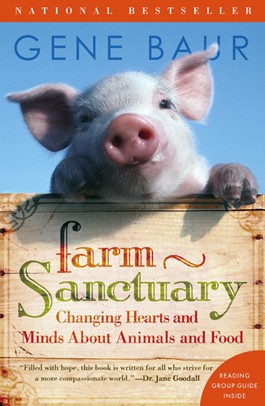
“People are buying food and supporting agricultural systems that are harmful to themselves. They are eating food that is making them sick and in some cases killing them,” says Gene Baur by phone from Southern California. As president and cofounder of Farm Sanctuary, a nonprofit farm animal rescue organization with refuges in upstate New York and California, Baur has spent some 20 years documenting abuses in the slaughterhouses and industrial farming centers across the United States. His bestselling book, Farm Sanctuary: Changing Hearts and Minds About Animals and Food, offers an extensively researched and harrowing account of the systematic abuse of the animals that end up as food on American plates. He appears at Copperfield’s Books on Jan. 31.
“Most people do not want to be cruel to animals but unwittingly support animal cruelty by their food choices,” Baur explains. He hopes to changes people’s attitudes about food by encouraging them to live in a way consistent with their values.
Information of this sort about the meat that the foodie-culture of the North Bay eats with gusto might be met with frustration. Does this mean goodbye to that nice pork belly at the bistro? Baur, a longtime vegan, does not see this as an issue. “Everything that is done currently with animal products can be done with plant products. The same is not true in the opposite direction. You cannot replicate broccoli by killing a cow. So I think the foodie world would do well to delve more into plant options as opposed to continuing to be stuck in the quagmire of eating animals,” he says.
Baur hopes that educating people about the cramming of sows into gestation crates and the injection of chickens with growth-inducing hormones that make it impossible for them to walk might make it easier to say no to poultry and pork. The environmental effects of resource-hungry industrial farming is another good reason to lay off meat, Baur says, since animal agribusiness is one of the top contributors to global warming, the shortage of fresh water and the steady depletion of fossil fuels.
“Historically, many societies, especially those that have existed for hundreds of years, were primarily plant-based,” he continues. “Meat traditionally has been an elite food and an indication of wealth and status, and that is still the case. The assumption is that we are supposed to eat meat, we’re entitled to eat meat and it’s good and appropriate and healthy to eat meat. It’s hard for people to try to get out of that narrow mindset, but that’s what our challenge is.”
Gene Baur appears at Copperfield’s Books on Saturday, Jan. 31. 140 Kentucky St., Petaluma. 1:30pm. Free. 707.762.0563.
Quick dining snapshots by Bohemian staffers.
Winery news and reviews.
Food-related comings and goings, openings and closings, and other essays for those who love the kitchen and what it produces.
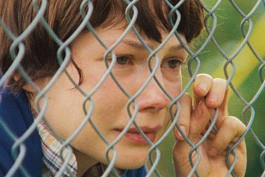
It’s not that Wendy and Lucy is mediocre; at about 80 minutes long, it doesn’t have the time to be. And it’s a simple story. Having left her family back in Muncie, Ind., Lucy (Michelle Williams) is driving her old Honda to the fisheries in Alaska. With her is her part-Labrador Lucy (played by the director’s dog). In a nowhere town in northern Oregon, Wendy’s car refuses to start. Losing her car, Wendy soon also loses Lucy. She’s stranded and broke, befriended only by an old security guard who lets her use his cell phone.
This is the kind of movie that’s usually given the small-camera treatment for budget reasons or to give it more grit. Director Kelly Reichardt (Old Joy) and her two cinematographers worked hard on the composition and color. If you’ve ever had the foolish reverie of getting a sleeping bag and heading for the rail yards to hop a freight train up north, Wendy and Lucy visually idealizes that dream. At one point, Wendy is just a little blue riding hood in a boxcar cruising among the dreamy, foggy trees. There’s further realism in the use of natural sound, with occasional unsynched noise, such as the dubbing of a blare of train horns over talk at a campfire. (The title of Jon Raymond’s source story is “Train Chorus.”)
Until the sustained closeups at the end of the film, Reichardt keeps her cameras at a distance from Wendy. The setups have the sharpness of Edward Hopper paintings, with the heroine perched in the shadows outside a lit-up Walgreens parking lot. Alone at night, she crosses the road to return to the sharp, Ed Ruscha&–like angle of a gas station, where she washes and changes her clothes.
At the beginning of the film, Wendy discovers a group of train-hoppers around a fire. The real professional among them, musician Will Oldham, looks right and grubby until he starts to act, standing up and orating a story about how he got in trouble in Alaska for driving some heavy equipment while stoned. If Reichardt wants to escape the ghetto of being a great regional filmmaker, she’s going to have to figure out a way to coordinate the acting styles in her films. She ought to rehearse the non-actors to the point where they look natural or else cut their dialogue down to a minimum.
As for the star, Williams can hit the notes; she’s slight, thin-legged, fragile enough that we’ll worry about her. The problem is that Williams is too skilled. Nothing sticks out more than poised acting in a naturalistic film.
Unlike Agnes Varda’s 1985 classic Vagabond, what happens to Wendy is never her fault. She has none of the usual problems of a wanderer: no tendency for drink or drugs, no alienating tattoos, no interest in hooking up with men or women. It’s in Wendy and Lucy‘s interest to present Wendy as an innocent version of everyone we ever ignored or refused to give spare change to. We can watch her and feel the panic of what might happen to us if we ran out of money or tried to make a break for it.
The situations in Wendy and Lucy are plausible, and it resolves on a point that’s absolutely ancient-movie effective. It would have worked as well in 1909 as 2009. That might be enough for some audiences, who won’t miss the answers to the questions about what Wendy’s running from or what she’s running to. Ask the average person what makes Wendy wander, and he’ll say, “It’s the economy, stupid.” But the truth is that unlike Sandrine Bonnaire’s Mona in Vagabond, this Wendy is a stranger to us as much as she is to herself.
‘Wendy and Lucy’ plays for one week only at the Smith Rafael film Center, opening on Friday, Jan. 30. 1118 Fourth St., San Rafael. 415.454.1222.
Iwas a Boy Scout. I stood every morning at school for the Pledge of Allegiance and at football games for the national anthem, and felt some self-righteous scorn at the ignorance of people who applauded when it ended. (You are supposed to remain standing briefly in silence, then sit without demonstration. It is not a performance.)
Some time during the Vietnam War I decided that I would not rise to show agreement with the anthem’s martial theme, that holding my hand over my heart was a sign of disrespect to the people of the nations we were oppressing and showed tacit support for leaders who were calling on us to be neither brave nor free, but craven in protection of privilege.
Over the decades, it became a deep habit to grit my teeth at the hypocrisy of that song in the face of countergraduated tax rules, foreign misadventures and wars of choice, homeland oppression, shortsighted energy and environmental practices and a widespread lack of national mission beyond self-indulgence in the private and public realms. I remained seated, distant from my nation’s anthem.
The past several months I have experienced many teary moments as I felt that we really might be embarking on what Bruce Springsteen has called the “long walk home.” Last week, I watched the inaugural with a small group of friends and friends of friends, all people of similar persuasions with a deeply patriotic skepticism about Patriotism-with-a-capital-P. I heard our new president say nearly all the right things about our history, our values, our mission and our intended behavior as a polity. At the end of the ceremonies, Old Glory waved and the military band struck up. I asked myself, “Are you going to stand up for this?” but habit remained strong. Then one woman rose to her feet and faced the TV. I still felt silly; my legs could not do what my heart yearned for. At the lyric “What so proudly we hailed,” my friend Catherine rose and turned to the first woman with a thank you. The woman gently replied, “If not now, then when?”
It felt so wonderful to come home to America. I even took off my hat (it was cool in that environmentally attuned house) and held it over my heart. All these years, I have been proud of what this country could stand for. But standing for those things has felt like a conspiratorial endeavor, outside the declared mainstream, like demonstrating against invading Iraq before we went in or nodding to the rare fellow citizen doing their errands on a bicycle.
All these years, living in the land of the free and the home of the brave has felt like a private matter—me and a few of my homeys making ice cubes while the glaciers crash into the sea. That doesn’t work for me now. Yes, it’s gonna be a long walk home. But we’re marching together, picking up steam, with a leadership that calls us forth to write the next chapter with a loving, steady hand. Old Glory’s out in front, unfurled, and it is right once more to show her my full measure of respect.
i>Ken Roberts is a financial planner, gardener, father of two adult sons and a 25-year resident of western Sonoma County.
Open Mic is now a weekly feature in the Bohemian. We welcome your contribution. To have your topical essay of 700 words considered for publication, write op*****@******an.com.
There have been several firsts lately. Here’s one. Last week in Napa I found myself in an elegant wine bar on a weekday morning, not winetasting but rather crying and hugging and cheering along with about 90 strangers, all of us watching the live broadcast of President Obama’s inauguration.
Mostly I cried. But I wasn’t embarrassed, since so many other people were crying. Even the manager shed tears. With no tissues available, my friend Beth grabbed a stack of cocktail napkins and set them within easy reach of us and five others. Given the occasion, it seemed natural for her to cheerfully assist strangers and friends alike.
The feeling in the room was electric as Obama pointed out to over a million attendees (and tens of millions of web streamers plus uncounted millions of television viewers) a number of resonating truths. Among these was the fact that we’re living on a warming planet, and for our survival we need to harness the sun and wind and earth for power.
Thank you, Mr. President. How uplifting to hear those words spoken after the Bush administration sneered at global warming along with human rights and ecological justice. For the past eight years in particular, oil interests have held us hostage. Oil contributes to less than 5 percent of our energy, but Cheney and Bush, whose families profited, made oil-market wars a national priority, sending ill-equipped soldiers into combat while cutting benefits to their families. Morale plummeted.
Soil and water quality sank, too. Under Bush-Cheney leadership, the Environmental Protection Agency was functionally dismantled, along with the EPA research library that provided documentation essential to controlling the sale and use of over 800,000 potentially dangerous pesticides. What did this accomplish besides the business-as-usual profit making and interspecies poisoning? Underhanded and underreported, it spread the toxin of discouragement, a condition that makes people feel hopeless, disconnected and powerless. This condition has been more threatening to the planet than pollution.
So far in the global crises, the obstacle preventing our country’s withdrawal from fossil fuels has not been a lack of technology but a lack of organized will. The power source within the human spirit has not been fully tapped—yet. But it just might happen after all.
When Obama acknowledged global warming and endorsed renewable energy in his first presidential speech, cheers broke out all over the room and I cheered the loudest. Another first! But underneath it was the most significant first, the key to our sustainable future.
The foundation of Obama’s campaign strategy, where social networking met grassroots organizing, was a reconstruction of our collective hope. It produced a rebirth of community involvement. Encouraged people feel connected to one another, empowered. And empowered people make changes. Our new president made it clear that this isn’t going to be a picnic, that there are difficult days and “hard choices” ahead of us. But he reminded us that we will move forward with hope and unity. We’ll function as a true democracy now.
It sure felt that way to me, looking around the crowded wine bar during the inauguration broadcast and seeing the happy, proud faces. It felt the same watching video clips of other happy, proud faces gathered in other cities to watch change come to the White House. We got Obama there. We overcame two major obstacles—discouragement and big money—and we did it together.
So together we celebrated. I remember feeling close to everyone that morning, experiencing a heightened sense of purpose and optimism. Those few who could sip wine or Champagne that early in the day raised their glasses while others raised coffee mugs. And near the end, almost everyone stood and raised their voices to sing along with “The Star-Spangled Banner.” It has been harder to sing that song in recent years. But now it seems right. Beth improvised a terrific harmony and we sang at the top of our lungs.
I went home elated, wondering how long it would take us to make the behavioral changes required to become a sustainable “land of the free and home of the brave.” I don’t know the answer, but I’m feeling very hopeful.
02.04.09The scene: the recent presidential inauguration, out on the mall. The situation: 5 million people and only 5,000 Port-a-Pottys. "Suddenly," explains Bridget Palmer, barely containing her laughter, "It was suggested that President Obama was in one of those Port-a-Pottys, and everyone was running around opening doors to see which one he was in so they could, you know, meet...
Media oftentimes has an awkward relationship with other forms of media, but when celluloid documents pulp, it’s hard to lose. Such was the case for the last week at the Noir City Film Fest at the Castro Theatre in San Francsico. All old movies about the newspaper industry in a fitting, timely program curated by Noir City founder Eddie...
Last night, between dates at Thrillhouse Records and Gilman, Thorns of Life played a stellar show with Santiago and the Semi-Evolved Simians in the basement of Adam's house in Santa Rosa. It’s more like an interrogation chamber than a basement down there, but in spite of our repeated warnings to the band in the last few weeks that...
In 2004, I walked into the Tradewinds in Cotati and felt my jaw immediately hit the floor in amazement over the two guys opening for the Rum Diary. A greasy-haired hippie-looking drummer who played just a little behind the beat and a sharp-throated, fingerpicking singer who blew the harmonica and sang songs about trying to care that the country's...
01.28.09 NASA Photograph-courtesy of the Charles M. Schulz Museum & Research Center BON VOYAGE: NASA secretary Jamye Flowers Coplin holds a stuffed Snoopy out for a final earthbound pat from Lt. Gen. Thomas Stafford as he prepares to embark on the Apollo 10 flight. On May 25, 1961, President John F. Kennedy submitted his lunar-landing program to Congress for approval, spurring...
01.28.09 "People are buying food and supporting agricultural systems that are harmful to themselves. They are eating food that is making them sick and in some cases killing them," says Gene Baur by phone from Southern California. As president and cofounder of Farm Sanctuary, a nonprofit farm animal rescue organization with refuges in upstate New York and California, Baur...
01.28.09It's not that Wendy and Lucy is mediocre; at about 80 minutes long, it doesn't have the time to be. And it's a simple story. Having left her family back in Muncie, Ind., Lucy (Michelle Williams) is driving her old Honda to the fisheries in Alaska. With her is her part-Labrador Lucy (played by the director's dog). In a...
01.28.09Iwas a Boy Scout. I stood every morning at school for the Pledge of Allegiance and at football games for the national anthem, and felt some self-righteous scorn at the ignorance of people who applauded when it ended. (You are supposed to remain standing briefly in silence, then sit without demonstration. It is not a performance.)Some time during the...
01.28.09There have been several firsts lately. Here's one. Last week in Napa I found myself in an elegant wine bar on a weekday morning, not winetasting but rather crying and hugging and cheering along with about 90 strangers, all of us watching the live broadcast of President Obama's inauguration. Mostly I cried. But I wasn't embarrassed, since so many...

 Media oftentimes has an awkward relationship with other forms of media, but when celluloid documents pulp, it’s hard to lose. Such was the case for the last week at the
  Last night, between dates at Thrillhouse Records and Gilman,
  Do you look at the past as a hindrance or an asset?
 Has the punk scene changed, or have you changed?
 In 2004, I walked into the Tradewinds in Cotati and felt my jaw immediately hit the floor in amazement over the two guys opening for the Rum Diary. A greasy-haired hippie-looking drummer who played just a little behind the beat and a sharp-throated, fingerpicking singer who blew the harmonica and sang songs about trying to care that the country’s at war in the midst of a ruined liver and other malaise. It felt like this band was created just for me, and after their captivating set, I found out that the band was called