


FOLLOW US
Pins and Needles

Bohemian Grove Logging Edging Closer
04.08.09
Courtesy bancroft library
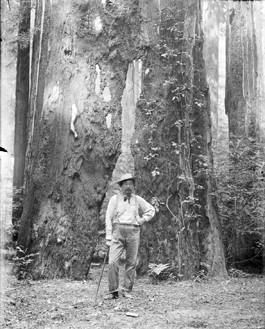
LUSH LIFE: A Bohemian Club member known only as Paul poses before a mammoth old-growth tree back at the turn of the last century.
After nearly three years of wrangling and a truly massive amount of paperwork, on March 30 the Bohemian Club received a favorable recommendation on a proposed perpetual logging plan for its Russian River forestland.
The conditional approval by the California Department of Forestry (Cal Fire) and other state agencies “was a foregone conclusion and comes as no surprise,” says John Hooper, a former Bohemian Club member who founded the nonprofit SaveBohemianGrove.com. While club representatives assert that specific contested issues have been addressed in their revised plan, Hooper vows that he and other environmentalists will continue to fight the club’s logging plans.
Before the Bohemian Club can get final approval, it must address a few remaining mitigation actions requested by state agencies and respond to any new information or issues submitted as written public comment by 5pm on Monday, May 11. That public comment deadline is the mandated 45 days from March 25, when Cal Fire officially posted the more than 450-page document that is the Bohemian Club’s revised NTMP application.
That’s a lot of pages to wade through to be able to make a cogent comment, but there’s a lot at stake. The Bohemian Club owns the 2,700-acre Bohemian Grove, prime forestland that’s home to rare old-growth redwoods, second-growth redwoods that have stood undisturbed for more than 100 years and towering Douglas firs, plus tanoaks and other less lofty flora.
The club began logging in the 1980s, cutting about 500,000 board-feet of timber each year, for a cumulative total estimated at 10 million to 11 million board-feet. As reported previously in these pages (July 4, 2007), in May 2006 the club applied for a non-industrial timber management plan (NTMP) that would let it harvest a set amount of timber each year in perpetuity. Once the NTMP is approved, the club will be able to log with minimal oversight and without additional public hearings.
Club representatives say expanded logging is needed to reduce a high fire risk and restore a forest that was deeply disturbed by clear-cutting more than a century ago; they’ll use the money from the timber harvests to pay for these efforts. Opponents argue that the amount the club wants to log each year—700,000 to 1.6 million board-feet annually in the revised plan—is excessive, and that precious natural resources will be irrevocably harmed if the NTMP is approved and carried out.
It’s a clash of individual property owners’ rights to manage their property as they choose versus the community’s interest in preserving rare and potentially fragile resources.
One controversy in the NTMP approval process centers around exactly how many forested acres the Bohemian Club owns, since NTMPs are limited to 2,500 acres or less (nonforested acres don’t count). The club recently finalized a 163-acre easement with a conservation foundation, prohibiting logging in some of the old-growth redwood stands. The only tree-cutting allowed in those areas would be for safety reasons and, except when there’s immediate danger, would have to be preapproved by the foundation.
“The idea in these areas is to allow the current activity, which is recreational,” says Nick Kent, the registered professional forester who is handling the NTMP application for the Bohemian Club.
With the donation of the easement, the amount of forested land covered by the NTMP dropped to about 2,300 acres. Ron Pape, who’s leading the NTMP approval process for Cal Fire, says what’s key is how many total acres of timber are available for harvest. The easement protects old-growth trees and makes it clear that the NTMP covers less than 2,500 acres.
“Our legal staff has researched it, and they feel the conservation easement is appropriate,” Pape explains.
Jay Holcomb, chairman of the Sierra Club Redwood Chapter, has concerns about NTMPs in general. They’re a two-edged sword, Holcomb says. They do give small landowners guidance about good forestry practices, but they have no revision or renewal process. A growing number of property owners are applying for an NTMP instead of having a timber harvest plan approved for each logging operation.
“Once [NTMPs are] set in place, there’s no mechanism or incentive for the landowner to adopt new forestry rules that come into place,” Holcomb says. He notes that what is considered good forestry practice right now might not be good 25 to 50 or even 10 years from now.
And he questions the Bohemian Club’s assertion that it needs to harvest trees to pay for fire-prevention measures.
“We would hope that the Bohemian Club of all people could afford to do more restoration work on their own dime rather than trying to fund it with the sale of wood.”
Public comments on the Bohemian Club’s revised NTMP application must be submitted in writing and should be emailed to sa********************@*****ca.gov or mailed to Attn: Forest Practice, Cal Fire Northern Regional Headquarters Santa Rosa, 135 Ridgway Ave., Santa Rosa, CA 95401.
Found Wonder

04.08.09
Photographs by Lawrence Watson
STORIED: Fiction offers an escape for the nonfiction writer.
I grew up with the sense that a clear hierarchy existed among the literary genres. Poetry, I determined, was the top dog. What could be more pure? It was also what I happened to write. Next in line came the novel. Now, as a novelist, I’ve been guilty of regarding the memoir as a second-class literary form, or believing, as one of my novelist friends claims, that instead of being called “creative nonfiction” it should be dubbed “noncreative fiction.”
But recently, after reading Noelle Oxenhandler’s The Wishing Year: An Experiment in Desire, I told myself to hush up. Here was a book that, despite its practical concerns, showcased a supple mind grounded in philosophy and introspection—the kind of thing I’m used to finding in the best literary fiction.
Oxenhandler, a Glen Ellen writer who teaches creative writing at Sonoma State University, made her reputation as a writer of nonfiction. In the mid-’90s, she published five essays in The New Yorker. Her book The Eros of Parenthood, which appeared in 2001, grew out of a New Yorker essay, and is a brave exploration of a taboo topic. Last year, she gained a wider readership with the publication The Wishing Year.
When I learned that Oxenhandler was now working on a novel, I wanted to know how she was going about it. Oxenhandler is a warm, sprightly woman, whose voice has a formal lilt to it. In a conversation with her at her Glen Ellen home, I found her responses to be so wise and articulate, I sat listening to her with my mouth open.
One of the surprises of writing fiction, she said, “is that it’s almost like having an overly permissive parent. I can invent anything. It reminds me of moving back to California after years in the gray East Coast. At first, I felt like somebody was going to arrest me for living here, and I was going to be deported. But what I experience as freedom with fiction is an illusion. Even though every morning is a wild ride, I sense that there is a necessity to what happens that I must follow.”
How, I wondered, did she deal with the challenges of plot. “I believe that there’s something about plot that’s not at all arbitrary, that is somehow ‘hard-wired’ into the human brain,” she explains. “I understand the people who say that a classic plot, with its three-part structure of rising tension, climax and falling action is a kind of ‘sex for the mind.’ But I do not experience that life itself has plot—at least not in any sort of linear, predictable way. I experience life as being much more freely flowing, circular, recursive, overlapping, full of mysterious synchronicities and marvelously random juxtapositions. For this reason, although I’ve been teaching myself to write with plot, it does feel like an imposed order, like turning a field of wild and crazy grasses into a lawn.”
And how does this differ from writing nonfiction? “In nonfiction, I love the feeling of being able to soar within the parameters,” she says. “Life is so surprising in its rhymes and unexpected juxtapositions. There is a wonder at what is that feels almost religious.”
As an example of this found wonder, Oxenhandler describes a recent stroll she took from the parking lot at Sonoma State. “I walked under trees filled with blossoms, over a memorial to genocide, past a group of students, dressed in old costumes playing croquet. Then I saw a campaign-style button on the ground that I expected to read ‘Obama,’ but instead it said, ‘I “Heart” Female Orgasm.’ As a nonfiction writer, life functions as the wild imagination. It’s just a matter of paying attention.”
Then why write fiction? “I don’t have to be careful of everybody’s feelings. And the novel permits me to explore a lot of issues I might shy away from in nonfiction. Issues about being a woman of my age, about the power and meaning of appearance and the impact of that on a woman.”
When I asked Oxenhandler if she had a particular novelist in mind as a model for her own project, she responded without hesitation. “I’ve compulsively read Iris Murdoch’s novels since I was a teenager. I’m drawn to the highly narcissistic male characters she tends to create. They wreck havoc on everything but still manage to be endearing. Iris Murdoch was a philosopher and I have that background. I’m aware that I’m using the novel to explore ideas about beauty and identity.”
Noelle Oxenhandler’s latest book, ‘The Wishing Year,’ appears in paperback this July.
Novelist Bart Schneider was the founding editor of ‘Hungry Mind Review’ and ‘Speakeasy Magazine.’ His latest novel is ‘The Man in the Blizzard.’ Lit Life is a biweekly feature. You can contact Bart at li*****@******an.com.
Museums and gallery notes.
Reviews of new book releases.
Reviews and previews of new plays, operas and symphony performances.
Reviews and previews of new dance performances and events.
Letters to the Editor
04.08.09
Changes at St. Joseph’s
The public needs to know that St. Joseph’s of Greater Sonoma County Healthcare System no longer has the patient’s ultimate safety and welfare in mind when their planned firing and elimination of ancillary staff goes into effect at Petaluma Valley Hospital on April 8.
St. Joseph’s has repeatedly refused to find financial means to insure that the staff that serves you, the patient, at the bedside—aside from the RNs who treat you—will continue to be there for you next month.
St. Joseph’s knew very well last year that Medi-Cal and insurance reimbursements were causing financial shortages at Petaluma Valley, and yet refused to go public immediately until after the proposed cuts were put into place in January 2009.
St. Joseph’s failed in their responsibility to notify the community of Petaluma and the residents of Sonoma County, as well as the Petaluma Health Care District, which is ultimately in charge of securing the best healthcare available for the city of Petaluma, about the proposed changes.
The hospital has planned to lay off Certified Nursing Assistants, housekeeping, transport personnel, and others so they don’t have to pay for their healthcare costs or their salaries. How crass can you get? The last time restructuring took place in 1998 at PVH, patient-care satisfaction plummeted while patient and worker injuries skyrocketed.
Can you imagine how long you will have to wait for someone to help you to the bathroom or to get you pain medicine or to clean you up after an accident? Not giving you the complete care you have received in the past and deserve in the future is antithetical to the ideals St. Joseph’s touts. So much for “Dignity and Stewardship”!
It is very disappointing to see St. Joseph cut these direct caregiver hours when we know that they understand the consequences and understand the direct impact those losses have on RNs and on our ability to provide safe, quality patient care.
However, PVH RNs are determined to do everything necessary to keep our patients safe, even if it kills them. But we need the public’s help!
Please call and write immediately, expressing your concerns and disappointments about the layoffs and how this will ultimately affect overall patient care, safety, wellness, cleanliness and staff morale.
Those letters and phone calls should be made not only to Petaluma Valley Hospital, but to Memorial Hospital in Santa Rosa, and to the Petaluma Health Care District. Please let them know that the layoffs are not acceptable.
Anonymous
Petaluma Valley Hospital employee for 18-plus years
Forest for the trees
With Earth Day coming up, it is a good thing that the United Nations has set a goal to plant 7 billion trees by the end of this year. That’s just over one tree per person on the planet.
But lest we not forget, over 1 million acres in the Sierra Nevada forest are scheduled to be clear-cut by Sierra Pacific Industries (SPI), California’s largest private forest landowners.
In a clear-cut, all of the vegetation is removed. Intensive amounts of herbicides are applied to wipe out whatever manages to survive. Then the area is saturated with chemical fertilizers and planted with rows of evenly spaced, same-age, same species pine trees—becoming monoculture tree farms that contain 90 percent fewer species than a natural forest.
These tree plantations are more susceptible to wildfires and outbreaks of insects and disease. Old-growth forests, which have evolved over thousands of years, are resistant to pathogens.
Clear-cutting is the second largest source of greenhouse gas emissions in the world, second only to the burning of fossil fuels.
Our taxpayer dollars are helping to fund clear-cutting. Write your representatives in Congress and demand an end to this harmful practice.
An alternative to clear-cutting and tree farms is selective harvesting, where only trees used for lumber production are removed. Selective harvesting, when properly managed, preserves forest ecosystems and protects wildlife, does not degrade our water supply (60 percent of California’s water supply comes from the Sierra Nevada) and can produce timber forever.
Justine Ashton
Glen Ellen
Natural High
04.08.09
Morning sunlight spills into Tom Killion’s studio through a large window looking out onto his home in the backwoods of Point Reyes Station. Wood blocks, saws, sketch pads, carving tools and paint rollers adorn most of the available space on his studio walls. Quail Press, the large printing press Killion purchased in 1977, sits like a trusty friend beneath one of the windows, waiting patiently for the artist to resume his work. Wood blocks fitted together to create the next print still sit inside the press, bespeaking ever-present work in progress.
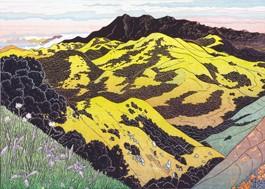
On this spring morning, Killion interrupts coffee with his wife, Katerina, and their dog, Chica, on the back deck of their home to talk about the publication of his most recent collaborative work with Beat poet Gary Snyder. Their book, Tamalpais Walking (Heyday Books; $50), includes personal accounts of the mountain from both artists. Killion, who grew up in Mill Valley, says that his history with Mt. Tam “is very deep and very personal.” The book contains 60 woodblock prints he made over the years, some dating back to the early ’70s when he was still a student at Tamalpais High School.
Killion remembers a trip to the de Young Museum with his mother to see a Japanese landscape print exhibit and the profound effect these prints had on him as a young boy. On that day, at the Japanese tea garden, he purchased Hokusai’s 36 Views of Mt. Fuji. “By the time I was in my early teens,” he says, “I was doing these outdoor pictures from all around Marin and Mt. Tam. And I started to get this idea, somewhere between the ages of 12 and 15, that I would do pictures of Mt. Tam like Hokusai’s views of Mt. Fuji. So then I carried that idea with me, and I started doing linoleum cut prints and then some wood ones with little Japanese carving tools that I got over in San Francisco.”
The old carving tools lying in the sunlight on his workbench take on new meaning. Killion continues, “I got to be a pretty good carver by the time I was in my early 20s.”
So good, in fact, that by the time he had graduated from UC Santa Cruz with a degree in history at age 21 he had printed 28 Views of Mt. Tamalpais. “I meant to get to 36,” he says, “because Hokusai did 36 views.” He looks out the window of his studio into the yellow west Marin sunlight, and continues, “Mill Valley was a lovely place to grow up. It was a different community then, it was full of bohemians and artists. Gary Snyder lived there, actually. I didn’t know that.”
Snyder occupied a small cabin he called “Marin-an” in Homestead Valley in the ’50s and ’60s. His love affair with the mountain, like Killion’s, is well-documented; Snyder was Jack Kerouac’s inspiration for Japhy Ryder, the main Zen lunatic in his 1958 novel Dharma Bums.
When asked about his history with Snyder, Killion says, “I’m of that generation of young men for whom Gary Snyder was our hero.” His working history with Snyder starts much earlier than Tamalpais Walking. Their collaborative project The High Sierra of California was published in 2005 and depicts Killion’s woodprints of the Sierra interspersed with Snyder’s poetry inspired by the area.
“But I actually started doing things with him many years ago, in the ’70s,” Killion says. “I got him to donate a poem for a broadside for a land preservation thing in Santa Cruz and then some of my illustrations went into some books that had his poetry in it, and some biographical stuff in the ’80s.”
Killion actually gave Snyder a copy of his 28 Views of Mt. Tamalpais in 1975, right after he finished it. He recalls bringing the book up to Snyder’s place, and laughs, saying, “He was more interested in my girlfriend than in me. I was going off on this big trip, and I wanted some advice because he was the great traveler.” Killion smiles, “He told me to bring a lot of Kaopectate.”
Presumably armed with stomach medicine, Killion hitchhiked across the United States and Europe, making his way to Northern Africa, the Sahara and West Africa. Spurred by what he still terms “the epic trip,” Killion obtained a Ph.D. in African studies from Stanford. He specialized in Ethiopian studies and went on to work in refugee camps there. He got a Fullbright to spend a year teaching at the University of Asmara. After teaching at Bowdoin College and San Francisco State, Killion says, “I finally managed to quit my day job and just do art, right after that High Sierra book with Gary Snyder. That got me enough notoriety that I could sell enough of my work to make a living.”
As for the historical element that is unquestionably a part of Tamalpais Walking, Killion says, “I thought I knew everything about Mt. Tam, and I realized how little I knew.” Using mostly compiled research and finding some new information along the way, Killion follows the transformation of Mt. Tamalpais from a recreational epicenter in the late 19th century to a silent backdrop when “people forgot about the mountain during the suburbanization after World War II. Gary found it and really loved it when it was least used, in the late ’50s early ’60s. Then it got rediscovered by the hippie generation as a place to go party.”
Partly due to Dharma Bums, Snyder became renowned for introducing Buddhism to Western popular culture as an alternative lifestyle. Snyder was among a crowd of “rucksack Buddhists” who started circumambulating Mt. Tam in the ’60s. Circumambulation refers to a Buddhist practice otherwise known as “walking mediation.”
When asked if Killion circumambulates, he says, “I just circumambulated on Sunday for the spring equinox. There is this early Buddhist guy who owned the frame shop in Mill Valley who started doing this solstice-equinox circumambulation with Gary in the ’60s, and he’s pretty much done it every season and he hasn’t missed it ever. He still does, and he’s in his mid-70s.” Killion’s eyes twinkle. “And he’s fast,” he whispers. When asked if he is a practicing Buddhist, Killion begins a reply, then hesitates, before saying, “I feel like Buddhism is the closest to whatever religious thing I can deal with. I’m not a good Buddhist, but that’s the way I feel. I’d like to work on the eight ways to live correctly, especially the one about talking,” he laughs.
“When I learn how to shut up, I’ll start to feel like I can be a good Buddhist.”
Museums and gallery notes.
Reviews of new book releases.
Reviews and previews of new plays, operas and symphony performances.
Reviews and previews of new dance performances and events.
Orchard Spotlight Goes Dim
 A month after the City of Santa Rosa changed the zoning code to make it harder for all-ages venues to open downtown comes the disappointing news that the Orchard Spotlight, a historic church and acoustic performance space, has been forced by the City to cancel all of their upcoming concerts.
The music has been quiet. The attendees have been well-behaved. The neighbors haven’t complained. So what’s the deal?
Last week, the Orchard Spotlight hosted Will Oldham, a.k.a. Bonnie “Prince” Billy, an underground legend who drew a large line on the sidewalk, causing a nosy tipster driving by to notify the city. “It wasn’t like they were even complaining,” says Spotlight co-owner Linda Rose-McRoy, “they just called with an inquiry, saying, ‘We saw this line outside of 515 Orchard. We wondered if that was okay.’ Like, duh!”
Rose-McRoy and co-owner Cheryl Ulrich met soon after with the Community Development department and were informed that entertainment at the Orchard Spotlight violates the area’s residential zoning. “We’ve known for a while that there were going to be some zoning questions here,” says McRoy, mentioning certain loopholes to stay loosely legal—registering on the Internet as a church, for example, and holding “mass” at 8pm on Friday and Saturday nights. “But Cheryl and I are the kind of people who don’t like feeling we have to continually look over our shoulder,” she adds. “But we’re also not giving up.”
What’s exciting is that “not giving up” involves working with the Arts District and the City Council to get a variance in zoning to allow entertainment at the venue. Vicky Kumpfer, coordinator of the Arts District, thinks it’s possible. “This is really an interesting opportunity to try to make this viable, and to work within the law,” says Kumpfer. “Yes, we have these laws, but is there a way that we can make a certain exemption?”
What the issue comes down to, then, is the neighbors, and so far, the Cherry Street neighborhood association has been supportive of the Orchard Spotlight. If that continues to be the case, and if the City is willing to honor their General Plan guideline to “consider the diverse cultural needs and talents of the community,” we may see the Orchard Spotlight rise again. “It’s just gorgeous,” Rose-McRoy says of the space. “It’s so moving, because it was built in redwood, for sound, for the human voice! I love it, it just makes me tingle all over. And so we’re not giving up.”
Interview: Joel McHale from ‘The Soup’
 Did you ever in a million years think you’d have a job making fun of TV?
No. I did not make this plan. It’s very strange, because I was always highly opinionated about pretty much about anything. I was one of those guys who was always like, “Your favorite band sucks!” So I would yell back at the TV all the time. The fact that someone would pay me for it? And that I’m not sitting around in my underwear yelling? Its just a hoot. I never would have thought it.
So many people watch TV these days—especially with the glut of reality shows—and say, “I know it’s awful, but I’m addicted to it.” Do you understand where they’re coming from?
Yeah, I think there’s a lot of Schadenfreude. It’s like, “Look at these freaks.” I see the morbid fascination; it’s the Gladiator aspect of wanting to see people fall apart. The shows are becoming so insane, I can’t imagine what it’s going to be like in twenty years.
After that girl taking a shit on the stairs on Flavor of Love, where is there really to go?
That was an incredible moment in television. And then her excuse was just tremendous! She’s like, “Well, I had to go, and then I started walking up the stairs, and then that happened.” That doesn’t happen to normal people! Normal people, that does not happen to. Something is wrong with you, ma’am. And what a surprise you got on a reality show with Flavor Flav.
Where do you think television’s gonna be twenty years from now?
I’m gonna say Live Sponsored Executions. It’ll be like Monday Night Football.
Do you think your job on The Soup, then, is important?
Well, it’s definitely important to pay my mortgage, and clothe the children and things like that. I… gosh, I have not really thought about that.
Well, culturally, do you think society needs someone to point out that what they’re addicted to is ridiculous?
I don’t know. Television is out of control, and a morally bankrupt place. To comment on that is good. I don’t know if it’s important, but it’s not stupid. There’s a lot of things on TV that suck, and they’re very popular, and kids love ‘em. When we make fun of an MTV show and go, “Hey Mom and Dad, it’s on after school!”—I feel like that’s a good comment. Or like a few weeks ago, VH1 was running promos for Black History Month. They’d run this very beautifully done promo with a lot of still photographs of African-Americans, in America, with beautiful music behind it, saying, “This is Black History Month, send in your photos and you could be a part of this campaign!” We just put Rock of Love and Charm School and Surreal Life—we just put a bunch of footage from that behind that very same music, showing how African-Americans are portrayed on VH1 shows. We felt like that was good. We love calling bullshit on things, but we don’t want it to be heavy-handed, or no one would watch. We still want it to be as funny as possible.
How do you deal with celebrities who get mad at The Soup? Is Tyra Banks still constantly pissed off at you?
We ignore it until they try to sue us, which really hasn’t happened. She’s the only one who’s tried to legally stop us, but almost without exception, there’s been very few really upset with us, from what I can tell. I know that David Hasselhoff is not a big fan, but he shouldn’t have gotten totally wasted and started shoving tacos in his mouth! It’s like, what do you expect us to do? We never go after people because we have a vendetta; we try to let their clips hang themselves. Like, we don’t make much fun of Oprah until she talks about her vajayjay. Because for the most part, Oprah’s show is great, and reasonable, and she’s a reasonable person, and she does good topics. But you know, when you have Tyra saying she’s afraid of dolphins, we’re gonna make fun of it!
Were you surprised when the Karsashians agreed to be on the show the other night?
Kind of! We’ve been relentless against them. I did learn that Bruce Jenner hates me, which. . . I don’t blame him. But you know, when someone comes on the show, I’m kind of like, “Hey, that was really cool.” So we probably won’t go after them the way we do. Of course, Kim has that sex tape, which is crazy, and which we have made relentless fun of. But they were all really cool, and I liked them. Hopefully they’ll come back.
How much of The Soup is written by writers, or written by you beforehand, or written by you on the spot, ad-libbed?
The whole script is written out, by the writers. I used to write way more than I do now—my schedule has become so crazy. But I rewrite the script on Wednesday night for how I want it to sound, and then on the floor I let it go and do a lot of improvising. You can’t just walk out and start riffing, because it’s 22 minutes of television, and it has to be very tight. So if something doesn’t work, or goes on too long, we stop and go back and get a new joke. For the most part, we try to tape it without stopping. The writers are so tremendous that there’s no need to improvise a lot of times. I’m not able to watch the amount of TV I used to watch, either. It used to be awful. I used to watch four to six hours a day and it was just killing me. It became a chore. My wife would be like, “Can’t you go do…” I was like, “I’m literally working! I’m literally working, watching this show, this Extreme Makeover: Home Edition two-hour special. Again. I have to do this, hon. Don’t disturb me!” It was really weird.
I assume the show now has people whose job it is to watch TV.
Yeah, we have twelve staff members and a few interns that are watching TV all the time. And we have to cover the things like Idol, and Dancing With the Stars, all those things. You know, the Rock of Loves and the Charm Schools are really easy lay-ups to make fun of. But it’s the shows like Dutch Oven, and I Love Toy Trains, and Korean Drama—literally called Korean Drama—it’s those shows that I really love covering, because they’re so off the regular map. I love it. Like, I Love Toy Trains is a show! I love that!
Part of your charm on The Soup is that fantastic, Conan O’Brien-ish self-deprecation.
Well, he’s a genius.
Does that style—“What am I doing here? Why am I on this show?”—does that come naturally for you? Or in real life are you actually a total egomaniac?
I was raised Catholic, so I grew up with all that guilt. That helped. I think anybody raised Catholic is self-deprecating to a point, where you think basically, if all’s going well, at some point the wheels are going to fall off and everything will be a disaster. And anything you get on top of that is a bonus, so you’re like, hey, this is working out great! But I think you can’t be a jerk, or people will not tune in to watch. I’m not putting on an air, but you just have to approach the show with a light heart, and not take it too seriously.
And not be afraid to dress up like Rainbow Brite.
Right! Anything for comedy!
My gay friends are all in love with you. As a married man, how do you react to that kind of adulation?
I love lesbians! Oh, wait, you’re talking about gay men! Well, I love gay men. Just pull that right out, pull that soundbite out. Having a gay following is great, because they seem to have all the money, they’re definitely the best dressed, and the most in shape. So that makes me very happy. And what’s great is that they’re very loyal fans. Lately we’ve been having Matt the intern come out, and he is always covered in oil, it seems now. He’s been doing interviews with a couple of gay websites, and he was addressed as a “greasy treat.” Which, I think, is really funny. But no one ever talks about my enormous straight following! Or, my enormous hermaphrodite following. That’s so sad.
You grew up in Seattle in the ’90s. How did you weather the grunge storm?
“Weather the grunge storm?!” I think grunge is the greatest music of all time!
Seriously?
Yeah! I really disliked big hair metal, I just never got into it. I spent most of my time listening to the Beatles, Talking Heads, Peter Gabriel, Bruce Springsteen, R.E.M.—a lot of alternative stuff. I just could not stand all those big hair bands. Then grunge came in when I was in college, and it was the greatest four years in Seattle. Nirvana is, I think, one of the best all-time bands ever. I actually saw their last show in Seattle, and it was tremendous, it was for the In Utero tour. I’ve seen Pearl Jam almost every time they come through here, and Soundgarden. Mother Love Bone, way back when. I loved that time, and I knew no different growing up in Seattle. Bands were just playing everywhere all the time, because Seattle was not a stop for any of the big acts; they would go up to Vancouver because it was a bigger and, at that time, more metropolitan city. Seattle had to make their own music. I mean, to think that a pair of jeans and a flannel shirt became popular is nutty. It’s ridiculous! But it did what it did—it shut down the entire hair-band industry, and Sebastian Bach was left without a job for a while. And now he’s on a reality show.
Did you ever hop in your car and drive down Broadway on Capitol Hill listening to Sir Mix-a-Lot’s “My Posse’s on Broadway”?
“My Posse’s on Broadway!” I have done it! I did it in high school, I admit it! That was the great thing—obviously Sir Mix-a-Lot’s music wasn’t grunge, but it was so Seattle. He made all these local references, so you kinda felt like, this guy! He’s ours! The same thing with Sleater-Kinney, which is an actual place outside of Seattle. “Baby Got Back” is still one of the biggest hits of all time. And going to Dick’s Drive-In on Broadway is still the best burger in the world.
So, your standup show in Santa Rosa coming up. Is it like The Soup at all?
It is. I don’t bring a monitor out and make fun of things, but I talk a lot about pop culture, I talk a lot about behind the scenes at E!, and I can go into a little more depth than I do in The Soup. That’s half the show, and the other half I’m talking about my life, and my family, which is a nutty, nutty place. So it’s half-and-half, there’s something for everyone. And then I take my pants off.
Joel McHale comes to the Wells Fargo Center in Santa Rosa on Saturday, April 11 for two shows, at 8pm and 10pm. Tickets, $39.50 each, can be bought here.
Eminem Has Ruined My Morning Yet Again
Where do you go as an artist when you don’t have anything fresh to say never had anything fresh to say in the first place? Awkwardly combine Weezer’s “Pork and Beans” with Weird Al’s “White and Nerdy” and catapult yourself into loserdom where you always belonged?
Behold, Eminem’s comeback, littered with tired-ass pop culture references and a grating fake-Middle-Eastern-by-way-of-fake-British accent. It’ll totally bum you out, whether you’re a longtime fan or even if, like some of us, you always hated his overrated guts.
‘Saving Newspapers, The Musical’
Fresh from their anger-inducing (read: excellent) exposé of Yelp’s grainier tactics, staffers at the Oakland-based alternative newsweekly the East Bay Express have somehow found the time to film and perform this bit of tomfoolery, a musical skit on the fate of the print newspaper. Their answer to saving papers from a certain demise is a lot like ours. (Pssst: Half-dressed good-lookin’ women sell free papers.)
Live Review: Classics of Love at the Last Record Store

“It’s nice to see so many health food stores in Santa Rosa,” announced Jesse Michaels partway through the set by his band, Classics of Love. “Santa Rosa used to be known for something else.”
That thing, of course, was meth, which propelled an entire generation of thrash bands to play as fast as humanly possible while growling unintelligible, moronic lyrics. Jesse, of course, was affected by the drug in other ways; by writing some of the greatest lyrics of all time with Operation Ivy, and singing them in such a controlled, rapid-fire way that evoked chemical desperation as much as unbridled joy. Who knew Jesse equated Santa Rosa with meth? I mean, except for Capitalist Casualties?
“Let’s dedicate this next one to Victims Family, what the hell,” he continued, launching into “Time Flies,” just one of many actual great songs. Folks can disagree for hours about Big Rig and Common Rider, but let the bickering end—Classics of Love is easily Jesse’s best post-OpIvy band. The singing is in tune, his guitar playing’s right on, and his backing band is great. I’d heard stories about his faltering solo shows, but after their maiden voyage tour coming up, I’d wager to say that Classics of Love will be a well-oiled force to be reckoned with.
Jesse shouted out the Cotati Cabaret, hoping that people might remember. Some did.
Bohemian Grove Logging Edging Closer
04.08.09Courtesy bancroft library LUSH LIFE: A Bohemian Club member known only as Paul poses before a mammoth old-growth tree back at the turn of the last century. After nearly three years of wrangling and a truly massive amount of paperwork, on March 30 the Bohemian Club received a favorable recommendation on a proposed perpetual logging plan for its Russian River forestland.The...
Found Wonder
04.08.09 Photographs by Lawrence Watson STORIED: Fiction offers an escape for the nonfiction writer. I grew up with the sense that a clear hierarchy existed among the literary genres. Poetry, I determined, was the top dog. What could be more pure? It was also what I happened to write. Next in line came the novel. Now, as a novelist, I've been guilty...
Letters to the Editor
04.08.09Changes at St. Joseph'sThe public needs to know that St. Joseph's of Greater Sonoma County Healthcare System no longer has the patient's ultimate safety and welfare in mind when their planned firing and elimination of ancillary staff goes into effect at Petaluma Valley Hospital on April 8. St. Joseph's has repeatedly refused to find financial means to insure that...
Natural High
04.08.09Morning sunlight spills into Tom Killion's studio through a large window looking out onto his home in the backwoods of Point Reyes Station. Wood blocks, saws, sketch pads, carving tools and paint rollers adorn most of the available space on his studio walls. Quail Press, the large printing press Killion purchased in 1977, sits like a trusty friend beneath...
Orchard Spotlight Goes Dim
A month after the City of Santa Rosa changed the zoning code to make it harder for all-ages venues to open downtown comes the disappointing news that the Orchard Spotlight, a historic church and acoustic performance space, has been forced by the City to cancel all of their upcoming concerts.
The music has been quiet. The attendees have been well-behaved....
Interview: Joel McHale from ‘The Soup’
Did you ever in a million years think you’d have a job making fun of TV?
No. I did not make this plan. It’s very strange, because I was always highly opinionated about pretty much about anything. I was one of those guys who was always like, “Your favorite band sucks!” So I would yell back at the TV all...
Eminem Has Ruined My Morning Yet Again
Where do you go as an artist when you don't have anything fresh to say never had anything fresh to say in the first place? Awkwardly combine Weezer's "Pork and Beans" with Weird Al's "White and Nerdy" and catapult yourself into loserdom where you always belonged?
Behold, Eminem's comeback, littered with tired-ass pop culture references and a grating fake-Middle-Eastern-by-way-of-fake-British accent....
‘Saving Newspapers, The Musical’
Fresh from their anger-inducing (read: excellent) exposé of Yelp's grainier tactics, staffers at the Oakland-based alternative newsweekly the East Bay Express have somehow found the time to film and perform this bit of tomfoolery, a musical skit on the fate of the print newspaper. Their answer to saving papers from a certain demise is a lot like ours. (Pssst:...
Live Review: Classics of Love at the Last Record Store
"It's nice to see so many health food stores in Santa Rosa," announced Jesse Michaels partway through the set by his band, Classics of Love. "Santa Rosa used to be known for something else."
That thing, of course, was meth, which propelled an entire generation of thrash bands to play as fast as humanly possible while growling unintelligible, moronic lyrics....

Copyright © Weeklys All rights reserved.
Our Publications
