There are few phrases more freighted in the North Bay than “air quality.” Depending on the season, it might mean wildfire smoke, pollen, woodsmoke, exhaust or some atmospheric cocktail that turns one’s plans into an indoor activity.
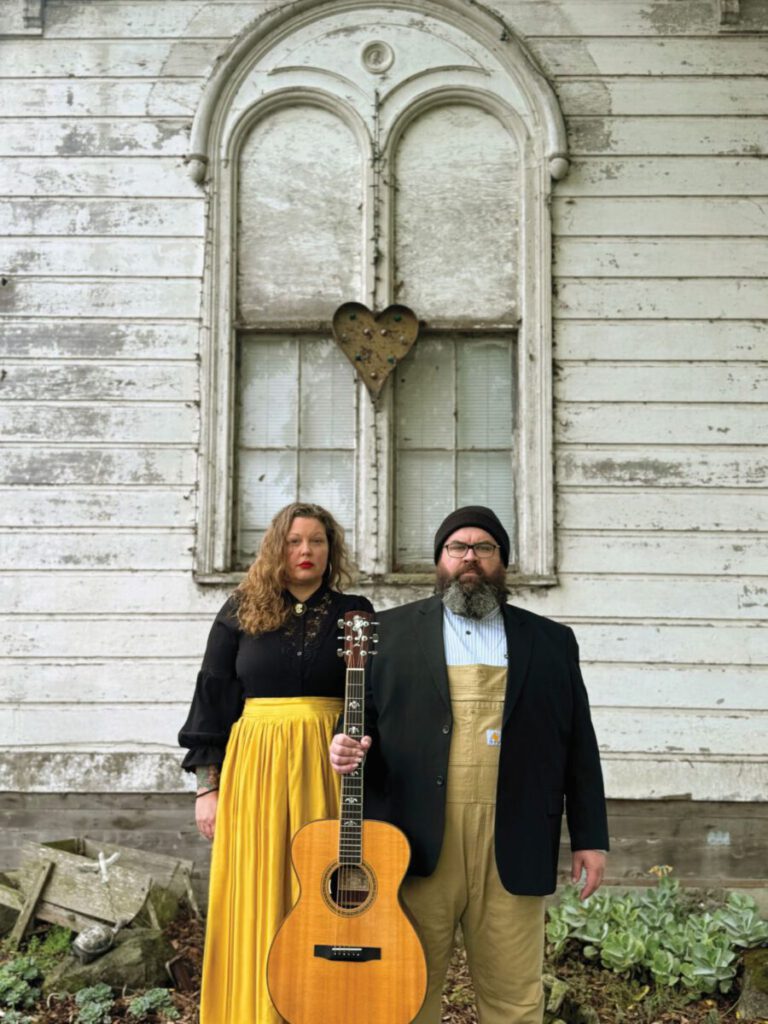
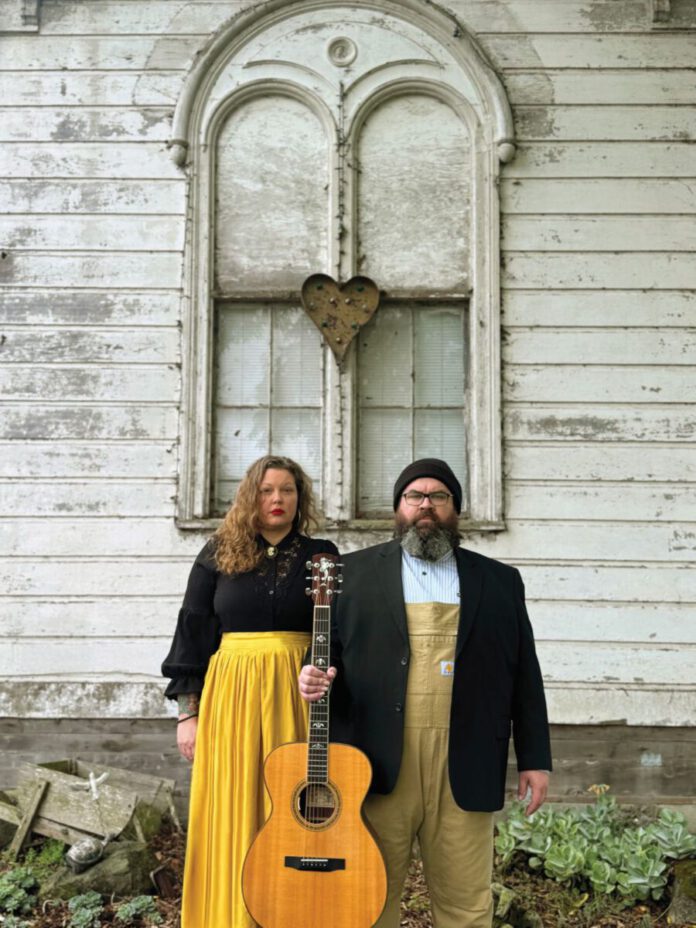
Santa Rosa couple Jason Curtis and Jennifer Nunn decided that checking the air shouldn’t become a second job.
Their solution is Canairy, a neighborhood-level air quality app built by their two-person software studio, NunnCurtis Labs. Already available for Android, Canairy arrived on the Apple App Store in late July—putting the free app on essentially every species of smartphone just as we enter that charming part of the year when North Bay residents scrutinize the horizon and ask, “Is that fog?”
The name, naturally, riffs on the proverbial canary in the coal mine—only this one spells “air” right into the middle of it.
“We wanted to make an app that helps you understand the air,” Curtis noted during a recent visit to The Drive 95.5 FM. The trick was doing so “not where you have to obsess about it.”
That impulse comes from experience. Curtis and Nunn have lived in Northern California for nearly 30 years, and asthma in the family made air quality a concern even before wildfire smoke became an unofficial fifth season. And like many in Sonoma County, they’ve also had to evacuate due to fires.
“We felt the impact,” Curtis said of the 2017 Tubbs Fire. “It was the morning of my son’s birthday, and we had to pack up and evacuate, and we opened his presents up in some hotel up in Sacramento.”
The fires eventually raised a larger question for the couple.
“The wildfires are really the first thing that made us think, ‘OK, is this the area we wanna retire in?’” Curtis explained. Beyond the flames themselves, he added, years of smoke “made it really hard … to go out and do stuff outside, to do things around what you enjoy.”
Canairy turns the region’s existing air-monitoring infrastructure into something considerably easier to live with.
The app pulls data from PurpleAir’s network of community-operated sensors, EPA AirNow monitors and Google’s pollen forecast.
“There’s PurpleAir sensors all across this county,” Curtis said. Before Canairy, “you’d go to the website, refresh it, look at it. OK, that’s what it is right now.”
Their alternative was to make the information passive.
“We wanted to build something … that can let you relax and say, ‘Hey, this is gonna alert me when the air is bad,’” he noted.
Importantly, “bad” isn’t the same for everyone. Someone with asthma or other respiratory issues may want to know when the AQI moves above 50, while others might tolerate considerably more. Users can tailor their thresholds and monitor multiple places—for example, home, school or an elderly parent’s residence.
Canairy’s free version includes one saved location, push alerts and its pollen forecast. Paid Plus and Pro tiers add more locations, faster updates, text alerts and other features.
The app is also a calling card for NunnCurtis Labs, which represents something of a second act for its founders. Curtis spent years in the wine industry—including stints at DeLoach, Rodney Strong and Coppola—before moving into winery software. Nunn is an electrical engineer with interests in solar and air quality.
Together, they wanted to build technology with a slightly different mandate than the usual attention-extraction machine.
“Instead of just creating an app that consumes your time and doesn’t really add any value to the world,” Curtis said, “we wanted to do something that really hopefully adds value, makes people’s lives a little bit better.”
Canairy is available through the Apple App Store and Google Play. Learn more at canairy-aq.com.
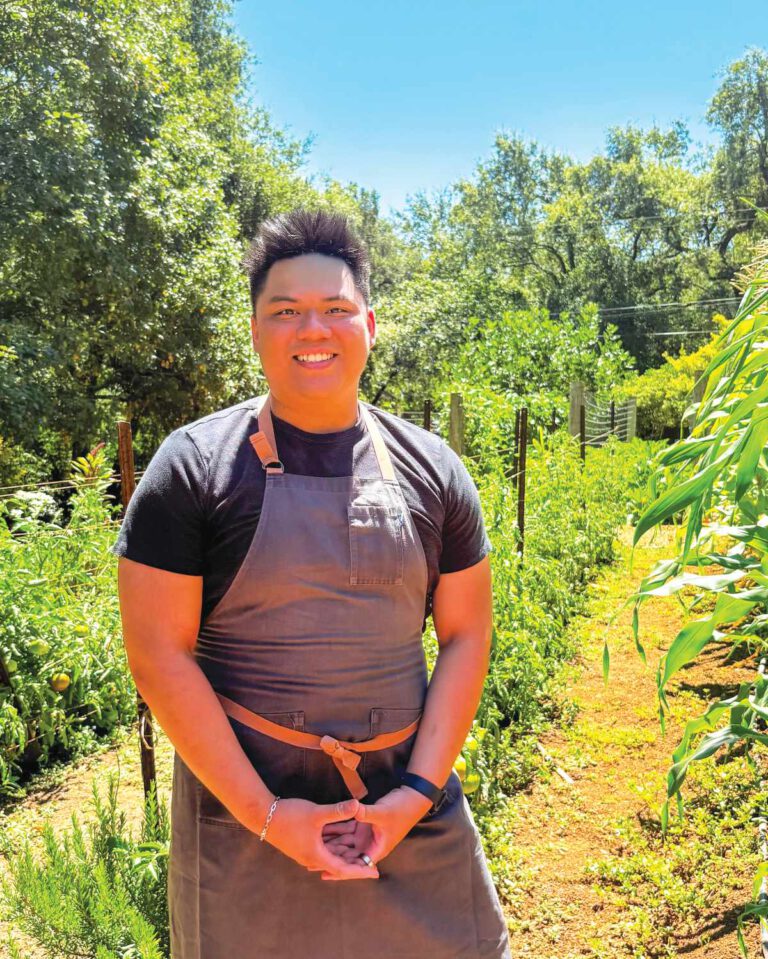
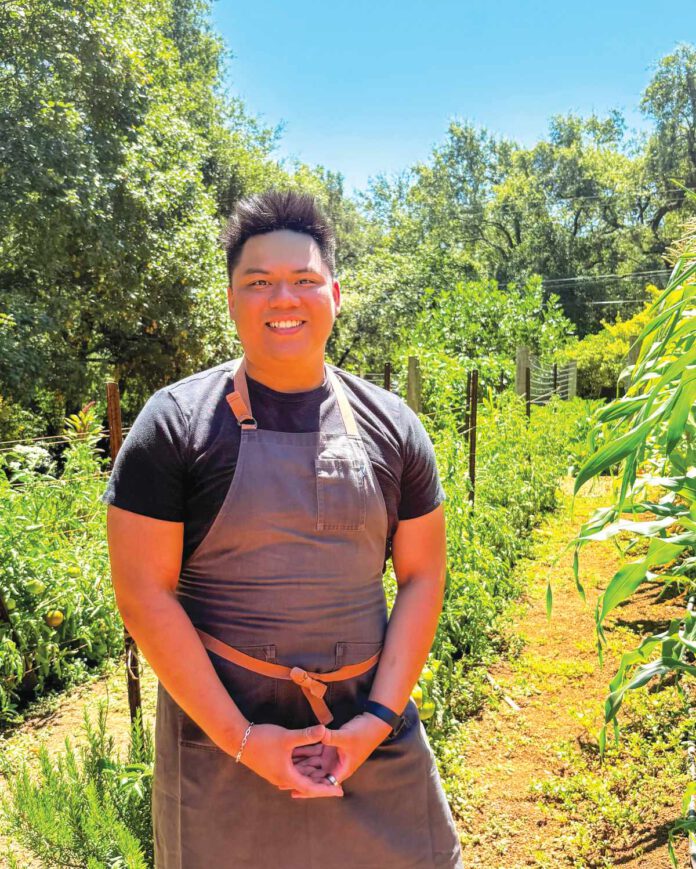
Phi Nguyen is chef de cuisine at The Madrona, marking an astoundingly speedy culinary path upwards over the 10 years since he emigrated here from Vietnam in 2016.
Rising up within the region’s dining scene, he gained experience at Flowers Vineyard & Winery, Montage Healdsburg and Farmhouse Inn before landing at The Madrona.
Amber Turpin: How did you get into this work?
Phi Nguyen: I started cooking in my senior year of high school … when I signed up for the Culinary Arts program without knowing what “culinary” even was, and I got hooked by joining the catering club … where I met my first chef mentor, Gabriel Nahas. I went on to work with him at the DoubleTree Hotel in Rohnert Park and moved my way up.
What is your favorite thing to cook (or eat) and why?
Pasta Bolognese is definitely my go-to meal and the first thing I would think of to eat or to cook. Back when I used to live in Vietnam, my mom always took me to Pizza Hut, and that was the only place I could find spaghetti and meat sauce. Later on, I got to work with the celebrity chefs Duskie Estes and John Stewart, where I got to learn how to make all the homemade pasta and all the Italian meat sauce.
What ingredients do you use or eat the most?
In every Vietnamese household, we have key main ingredients that cannot be missing in our cooking, called “Mắm, muối, đường, bột ngọt,” which is “fish sauce, salt, sugar, MSG,” and this is what I use the most at home. At work, I always love to use garlic, butter, acid (especially lemon) and green peppercorn. There is one ingredient that I always try to not use too much, but it’s so hard for me not to use it, which is shiso leaves.
What are some of your go-to places to go out for a sit-down meal? What about take-out?
My go-to places for a sit-down meal are Sorella in San Francisco; their lobster lasagna by the incredible chef Fernanda is to die for. Sushi at Sushi by Scratch or Qimura in Windsor, dessert by chef Devin at Bear at Stanly Ranch, who is so incredibly talented, and ramen from Taste of Tea by chef Shayna, who is a close friend of mine.
For take-out, Bánh mì from Kelly in Santa Rosa is my go-to quick lunch when I am on my way to work. Phở from Pho Vietnam in Santa Rosa when I don’t feel like cooking at home. Tacos from the Delicias Elenita taco truck in Santa Rosa for late-night munchies. Lastly, a Double-Double from In-N-Out: There is no need for a reason… I just love it.
Last meal on Earth?
White rice with scrambled eggs (seasoned with fish sauce and MSG). Fish sauce glazed chicken wings always makes me happy. And lastly, sparkling water, any kind, with a shot of green Chartreuse to finish the meal.
The Madrona,1001 Westside Rd., Healdsburg, 707.395.6700, themadronahotel.com.
Now that our president’s personal attorney, Todd Blanche, has become full-time attorney general, it is not the first time an unqualified, corrupt presidential crony ascended to that particular throne.
In 1969, Richard Nixon appointed John Mitchell to become attorney general by requesting that then FBI director J. Edgar Hoover not conduct the normal background checks required. Nixon knew.
Mitchell stayed in the position until 1972 when he resigned to become Nixon campaign manager, a role he had played in 1968. Like Blanche is today, Mitchell was a totally cool dude. He played a central role in attempting to covertly sabotage the 1968 Paris Peace Accords that could have ended the Vietnam War. He also believed his buddy Nixon’s “law and order” political platform justified restrictions on individual civil liberties.
He advocated the use of wiretaps without court orders and supported the efforts of police to detain criminal suspects without due process. He brought conspiracy charges against critics of the Vietnam War, likening them to Nazi “brown shirts.”
Talk about the pot calling the shirt brown. Sound familiar?
To top it all off, Mitchell was reluctant to involve his Justice Department in civil rights cases, maintaining that the Department was purely “a law enforcement agency, not the place to carry forth a program aimed at curing society’s ills.” He also said to antiwar activists, “Watch what we do, not what we say.”
Mitchell was a fun guy to be around and was eventually undone by two women—his second wife, Martha, who was prone to disagree with him and his boss in conversations with the press, and Katherine Graham, the publisher of TheWashington Post, which made public the Pentagon Papers, a top secret history of the war. The Post was Nixon’s and Mitchell’s crown of thorns throughout the Watergate scandal.
Though Trump’s cult is more stubborn than Nixon’s, they are cut from the same cloth and will come to the same demise, having taken fat chunks out of American democracy. If it survives, we will be lucky as hell, and with no thanks to Mitchell and Blanche.
ARIES (March 21-April 19): At the post office, I mischievously plucked a crumpled piece of red paper out of the trash can. I don’t usually do such things, but I sensed some horoscope material was lurking there. It turned out to be a handwritten love note addressed to “My Lush and Luminous Aries Laugh-Lover” and signed, “Your Flawed but Fiery and Funny Provocateur.” The Provocateur had written, “Let’s be rowdy investigators of wonders and miracles. Let’s hack our way through the frontiers to discover the wildest beauty and truth ever.” I was shocked that anyone would have discarded such a tempting proposal—especially an Aries. Please avoid making comparable errors in the near future, my dear.
TAURUS (April 20-May 20): The ancient Romans could be obsessive perfectionists in their approach to building stuff. They were extra thorough and scrupulous. That’s why some of the roads they constructed are still usable today, 2,000 years later. Workers dug deep foundations, then layered stones, gravel and sand before placing the final surface. In the coming weeks, Taurus, I recommend that you, too, carry out meticulous groundwork as you upgrade your foundations and optimize your stability. Don’t you dare be lazy or hurried in doing this grunt work. Your dogged and ingenious attention to detail will make your future safety zone shatterproof and shockproof.
GEMINI (May 21-June 20): I appoint you to be the chief role model in charge of showing everyone how to be a smart lover in all situations. Yes, all situations, not only those involving romance. In addition, I bestow on you the title of chief administrator of amazing grace, hoping this will inspire you to make elegant interventions in every situation where you have influence. Finally, Gemini, I exhort you to be devoted to seeing the beauty in everyone you encounter, even if you must work hard to find it. In asking you to carry out these humongous responsibilities, I’m interpreting the clues offered by the astrological omens. They have revealed to me that cultivating a generous spirit is crucial to you attracting what you want most.
CANCER (June 21-July 22): I confess I have succumbed to a very modern misdemeanor: tossing the word “sacred” around more often than it deserves. To be fair, I haven’t stooped to the tacky depths of New Age hustlers hawking “sacred e‑mail marketing” or “sacred dog-walking.” But still, I would prefer to invoke the word more sparingly, so that on the rare occasions I do, you will feel a genuine shiver of awe. Like now. I predict you will soon be stirred by marvelous encounters and realizations that flood you with reverent feelings and turn your inner life deliciously upside down.
LEO (July 23-Aug. 22): Given how extra vibrant and refreshed you have been feeling, I would understand if you had zero interest in confronting The Dilemma That Refuses to Fade. Why deliberately tangle with that stale, long‑term energy drain when your spirits are so high? Here’s why: At this moment, you possess a new and unprecedented advantage over The Dilemma That Refuses to Fade. You may not manage to completely vanquish it once and for all. But then again, you just might. At the very least, you can now sharply curtail its ability to siphon your energy and meddle with your life.
VIRGO (Aug. 23-Sept. 22): Virgo mathematician Katherine Johnson (1918–2020) was known as a “human computer” who specialized in carrying out large volumes of intricate calculations. She also had an uncanny ability to translate complex problems into elegant equations, which was why NASA called on her help to guide its early space missions. She said she simply asked the right questions until the numbers disclosed their hidden patterns. Be like her in the coming weeks, Virgo. Instead of forcing quick and simple answers, focus on dreaming up the smartest questions. Well-crafted inquiries will unlock sweet insights that brute effort can’t.
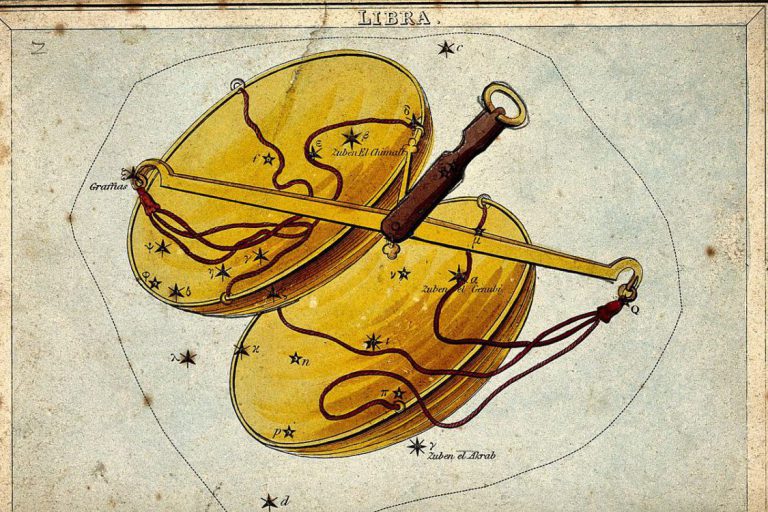
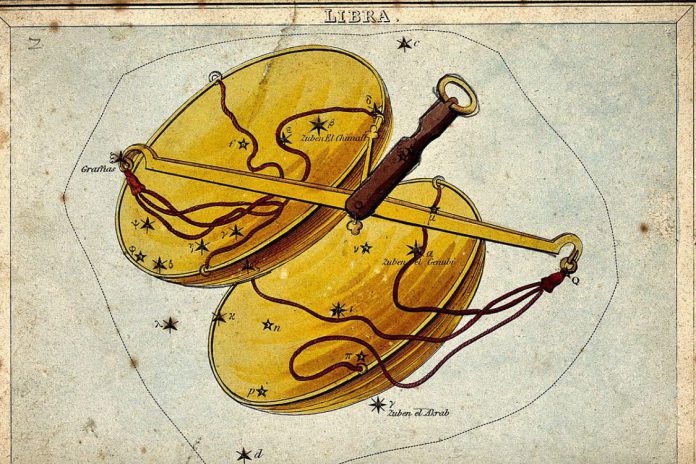
LIBRA (Sept. 23-Oct. 22): In the art of mosaic-making, tiny fragments of stone or glass are fitted together into intricate patterns. Each piece is insignificant and meaningless on its own, but together they compose luminous images. Let’s deploy the mosaic as a metaphor for your life, Libra. I invite you to consider the possibility that you are assembling minor details and small clues into a big, beautiful masterpiece. You may not even be fully aware of how exactly you’re doing it or what it will ultimately look like and do. That’s fine. Your higher self is in charge of accomplishing this minor miracle.
SCORPIO (Oct. 23-Nov. 21): Before launching spacecraft, engineers perform countless simulations of situations they hope will never happen. They repeatedly practice failures so that success becomes more likely. This is a different version of your current assignment, Scorpio. Your task is not to worry about disaster but to rehearse courage. So I encourage you to use your imagination to strengthen your resilience. Visualize yourself responding with creativity, grace and humor whenever life springs surprises and unexpected blessings. Your confidence will thrive because you will have lots of inner practice in collaborating adeptly with uncertainty.
SAGITTARIUS (Nov. 22-Dec. 21): The horizon line is always the same distance away from you, about three miles at sea level. If you walk toward it, you will never reach it because it moves with you. Now I’d like to propose that some of your personal goals work like horizons. They are orientations, not actual destinations. You’re supposed to move toward them indefinitely, never arriving. In the coming weeks, I invite you to distinguish between your horizon goals and your destination goals. Some aims are meant to be reached, while others basically guide your direction without ever needing to be attained.
CAPRICORN (Dec. 22-Jan. 19): Here’s my normally $600-per-hour advice, provided at a very low cost to you: Don’t get back to where you once belonged. Instead, go toward where you must belong in the future. Maybe the old place feels cozier because it’s familiar, even if it no longer fits the person you are now. But I recommend that you heed the subtle pull of the life that’s calling you from ahead. Who exactly is the even more beautiful self you’re on your way to becoming? Visualize in detail the situation where that sovereign majesty will thrive.
AQUARIUS (Jan. 20-Feb. 18): If you’re single, the coming weeks will be one of the most auspicious periods in ages for cultivating your own fan club of admirers. Your allure is turned up higher than usual, and the universe seems to have decided that what once might have counted as excessive is now perfectly appropriate. If, however, you’re happily ensconced in a lively monogamous bond, don’t sabotage it with daydreams of juggling multiple lovers. Instead, conspire with your partner to expand the range of flavors inside the relationship. Try stepping into different personas together: Adopt new names, experiment with strange accents and imagine you’re living in 1453 Italy, or 1506 Spain, or 1685 Japan, or 1721 France.
PISCES (Feb. 19-March 20): The speed of thought can zip along at more than 200 miles per hour. That’s the rate at which signals travel through neurons. Electrical impulses in computers, on the other hand, may travel much faster, at half the speed of light. So your thoughts are very leisurely compared to machines. But they do what computers can’t. They’re creating meaning, not just moving data. Their slowness is where the richest reality unfolds. Remember that well in the coming weeks, Pisces. It’s extra important for your mental and physical health that you not imitate machines and algorithms. You need to ruminate and meditate and muse as gently and unhurriedly as you dare.
Homework: What blessing would you most like to receive? Visualize it vividly. https://tinyurl.com/9u9u9u
The jam-band universe circles back to Sebastopol for Another Trip Around the Sun, a benefit concert bringing together musicians with deep ties to the Grateful Dead extended family. Guitarist Mark Karan of Bob Weir & RatDog, keyboardist Scott Guberman of Phil Lesh & Friends, drummer Anna Elva of Stu Allen & Mars Hotel and bassist/vocalist JP McLean of Melvin Seals & JGB join forces for an evening built on improvisation, interplay and the loose-limbed spirit of the scene. Opening the show is Slowstring, the new folk project from Sarah Ryan and Jimbo Scott. Proceeds support the Sebastopol Community Cultural Center and its arts, education and community programs. 6:30pm, Friday, Aug. 21, at Sebastopol Community Cultural Center, 390 Morris St. Doors open at 6pm. $25 advance. More information at seb.org.
Mill Valley Shop for School
Back-to-school shopping gets the boutique treatment when Hanna Andersson brings its first immersive retail pop-up to the Mill Valley Lumber Yard. The children’s apparel brand will showcase a curated fall assortment for ages 2–8, including picture-day-ready outfits, classroom staples and seasonal layers designed to make the annual wardrobe reset feel less like an errand. Families can also personalize a tote with purchase while supplies last. Set against the Lumber Yard’s relaxed outdoor setting, the event offers parents a chance to browse, kids a chance to participate and everyone an excuse to make a little occasion out of stocking the closet. Noon–5pm, Saturday, Aug. 15, at Mill Valley Lumber Yard, 129 Miller Ave. Free admission. More information at hannaandersson.com.
Rutherford ‘Home’ in the Vines
Music, memory and Napa Valley history converge at Inglenook for Home: A Toast to Napa Valley, Music in the Vineyards’ annual fundraising gala. Held during the 50th anniversary year of the Judgment of Paris, the evening celebrates the region’s legacy through chamber music, fine wine and an al fresco dinner beneath the winery’s terrace pergola. The program features works by Aaron Copland, Antonín Dvořák and Kevin Puts, performed by musicians including the Miró Quartet, with musical surprises promised throughout the night. Proceeds support Music in the Vineyards’ performances, education and community programs across Napa Valley. 5pm, Sunday, Aug. 23, at Inglenook, 1991 St. Helena Hwy., Rutherford. $500. More information at musicinthevineyards.org.
San Rafael Reach New Heights
Gravity Vault Marin celebrates five years of climbing, community and adventure with a weekend-long birthday party that’s as welcoming to first-timers as it is to seasoned crushers. Visitors are invited to tackle the walls with guided try-a-climbs, watch or join friendly climbing competitions, browse a vendor village, enter raffles, enjoy food from Sabor A Rancho and score anniversary deals on memberships and gear. Sunday’s festivities also include a free introduction to outdoor sport climbing workshop led by an AMGA-certified guide, while kids and families can meet the gym’s youth coaches and explore programs for climbers of every age. 10am–3pm, Saturday and Sunday, Aug. 15–16, at Gravity Vault Marin, 440 Smith Ranch Rd., San Rafael. $10 admission; free for members. More information at tinyurl.com/GVM-5THANNIV.
For news readers, there has been a steady drip of wine industry reportage as sour as last week’s wine.
It’s been five years of vineyard sales, declining real estate values, consolidations, the retirement of leading figures, layoffs, bankruptcies, closures and unsold grapes, rotting on the vine.
The 45 years that followed 1976’s “Judgment of Paris,” which declared Napa wine superior to French, had been a triumphal progression of growth, expansion and inebriated confidence for Sonoma County vintners. And Sonoma’s landscape changed out of all recognition. But it seems, at last, the party is over.
Sonoma’s wine industry, coming off a pandemic-era sales bump, is entering its fifth year of steady decline. The Wine Country hangover has begun.
For those tempted to grin at an over-proud industry’s humbling, this news affects everyone and everything here. With besotted civic leaders acting as cheerleaders, Sonoma County went all-in on its wine bet.
Commonly reckoned to be large, the wine industry is in fact gigantic. At its 2018 peak, 435 wineries with a combined 60,000 acres under cultivation accounted for roughly $8 billion of Sonoma County’s $30 billion GDP—the sum value of all our work and wages. Add an additional $1.2 billion for wine tourism and associated jobs, and the extended industry approached, as of 2018, a one-third share of our economy and one quarter (54,000) of our full-time jobs (according to Sonoma County Vintners, sonomawine.com).
Sonoma County is as close to a one-industry monoculture as one is likely to find outside of an economics textbook. Consider how closely local construction, real estate, restaurants, landscaping, event planning, nonprofits and, ahem, local media are allied to local wine, and it is clear how integrated the one third is to the other two. We are all second- and third-order employees of the wine industry.
Decline & Fall
Now that we know decreased wine sales mean unbooked musicians, empty salons, unpaid invoices and cancelled nonprofit sponsorships from Sonoma Valley to the coast, here are the numbers in wine.
The Grapes. 2018 was the year Sonoma County’s wine industry peaked (USDA National Agricultural Statistics Service). That year, 275,977 tons of grapes were crushed. Then the slide began. In 2025, the crush had slumped to 185,500 tons (USDA/NASS Preliminary Grape Crush Report, 2026), a decline of nearly a third from the peak.
The value of the harvest fell with it: from $777 million in 2018 (Sonoma County Crop Report, 2018) to an estimated $523 million in 2025, a decline of roughly a third in dollar terms as well.
And still we are in a state of oversupply. Karissa Kruse, president of Sonoma County Winegrowers, estimated roughly 30% of local grapes went unsold in 2025 (Press Democrat, November 2025).
The Acreage. Growers have responded by pulling out vines: Approximately 2,700 acres, or roughly 5% of the county’s planted vineyard, came out between October 2024 and August 2025 (California Association of Winegrape Growers/Land IQ, 2025 Standing Winegrape Acreage Report), a deliberate reduction in supply intended to help stabilize price per ton.
These are the only field-verified acreage figures that exist for Sonoma County; the growers association had never before commissioned mapping precise enough to measure county-level change. It is one of several gaps in the data on the county’s largest industry.
The Real Estate. Vineyard land values vary widely across the county’s 19 appellations, but it is now plainly a buyer’s market, “like catching a falling knife,” as one appraiser told the Press Democrat in May.
The Employment. The most significant statistical gap in this story is employment. No reliable current figures exist. Employment is difficult to assess because contraction rarely produces a layoff. Existing employees simply see their hours cut; seasonal workers are simply not rehired the following season.
A straight-line computation from a harvest reduced in volume and value by roughly a third would suggest a comparable reduction in hours and wages across the 2025 season. And the true number could be higher, since unharvested fruit eliminates labor entirely rather than merely reducing it.
In my own interviews with undocumented farmworkers (see “ICE and American Democracy” at bohemian.com), one contact told me that farmworkers are more frightened by sustained unemployment than by the threat of ICE seizure.
The Institutions. The downturn is visible in the industry’s own trade infrastructure. Michael Haney resigned as president of Sonoma County Vintners in July 2025, after nearly 11 years.
In November, the organization depended on voluntary contributions from the 250 wineries it represents and laid off four senior staff.
What followed was announced as a merger made from a position of strength: Sonoma County Vintners’ absorption by Sonoma County Winegrowers into a single new organization, Sonoma County Wine, will become effective January 2027. The plainer reading is lost revenue and lost function.
It promises to speak with “one unmistakable voice” for Sonoma County wine. A strong, unified voice and strong collective action will genuinely be required if the industry is to navigate this crisis. Absent that, what remains is a free-for-all: individual wineries trying things, fending for themselves, with no one speaking, or acting, for the whole. To date, the new organization has done little beyond try to put a brave face on the situation.
Causes
The person who opened my eyes to the magnitude of this industry and the severity of its losses is Dr. Damien Wilson, one of the county’s leading institutional minds on wine.
An Australian and a numbers-driven researcher with more than a hundred publications to his name, Wilson brings three very different wine markets to bear on the question: Australia, Burgundy and now California. He arrived at Sonoma State in 2015 from the Burgundy School of Business in Dijon, watched our industry peak in 2018 and has watched it decline ever since.
His position is funded in part by the industry itself and is at once semi-independent and prescriptive: to advise, statistically and experimentally, on how best to grow and now on how best to survive a violent contraction.
He is, by his own admission, an unpopular Cassandra at industry parties, the price of insisting that wine attend to numbers rather than tradition and that the industry change.
I found him dapper, affable, unmistakably academic at his leafy offices in the Wine Spectator building, and asked what lies behind the decline.
He began, characteristically, with a number: 80% of American wine is consumed domestically, so both the problem and its likely solutions are domestic, not international.
From there, a generational shift on two axes at once: how much alcohol Americans consume, and which kind. Younger generations drink less, and when they drink, they drink less wine.
Put more bluntly, in Wilson’s own arithmetic: Baby boomers who drink wine are dying. Gen Xers still drink wine, by and large. Millennials drink less, and have shifted in favor of craft beer and craft cocktail trends that developed with that generation. Gen Z is the demographic cliff.
A further factor affects each generation in rough proportion to its digital exposure. Compared with the endless, dressed-up variety of craft cocktails, or the dynamic, ever-changing brightly colored labels of craft beer, wine, he argued, is simply less photogenic. Its appearance on social media barely changes between a $10 bottle and a $100 one.
There is a second, related effect. Digital devices condition consumers to decide fast, on little information, and wine, Wilson argues, has done the opposite of adapting to that: It has overcomplicated itself, wrapping the product in a connoisseurship most young drinkers have neither the time nor the patience to learn.
A final generational factor, I will add with some bitterness, is simply wealth. Each successive generation has favored less expensive forms of alcohol because each successive American generation has been poorer than the one before it.
Desperate Times
When I asked Wilson how the industry could reach younger consumers, his answer came down to two words: affordable and simple. Basically the opposite direction wine has been moving in for 40 years.
“Affordable,” he was careful to specify, not through discounting, but through efficiencies. His clearest example is modeled on practices in other international wine regions: Within an appellation, producers would sell excess fruit through a regional cooperative that blends it into a single wine reflective of the region as a whole. Economies of scale would make it inexpensive, widely available and consistently less per bottle as well as an entry point into our region.
Second, for an individual winery: Partly or wholly dismantle the vintage system which currently forces complex inventory, shifting product and variable pricing for what could be a single blended offering, stable across years.
Third, in the tasting room itself: Acquiring the habit of wine takes repeated exposure and positive reinforcement, which means retraining how staff actually talk to people. As Wilson suggests, “Learn the language the consumer is using, be responsive to what brought them in and don’t lead the conversation.” Ask questions first. Find out why they walked in. Pedantry is the fastest way to make a newcomer feel excluded, or simply stupid.
These are radical changes, but Wilson believes there is finally an appetite for them: “People are literally walking away from their [unsalable] wineries,” he pointed out. He is dubious, notably, of government intervention as a fix, and equally dubious of repositioning Sonoma’s wine toward international export.
One of the more genuinely surprising things Wilson told me: The entire world market for wine has been in decline since the 1980s, fluctuating downward to roughly the level it was at in 1960. Sonoma and Napa’s 30-year boom, in other words, played out entirely inside a general decline in world wine consumption, even as new producing regions like Chile, Australia, Germany and others followed California’s lead after the Judgment of Paris and emerged as global export brands in their own right, entering the competition for an already shrinking market.
Wilson is a participant, not a spectator, in his own prescriptions: With his own money, he is producing a wine travelogue with himself as host, which he hopes to sell to a streamer. Its message to a younger audience: “Keep the magic. Lose the mystification.”
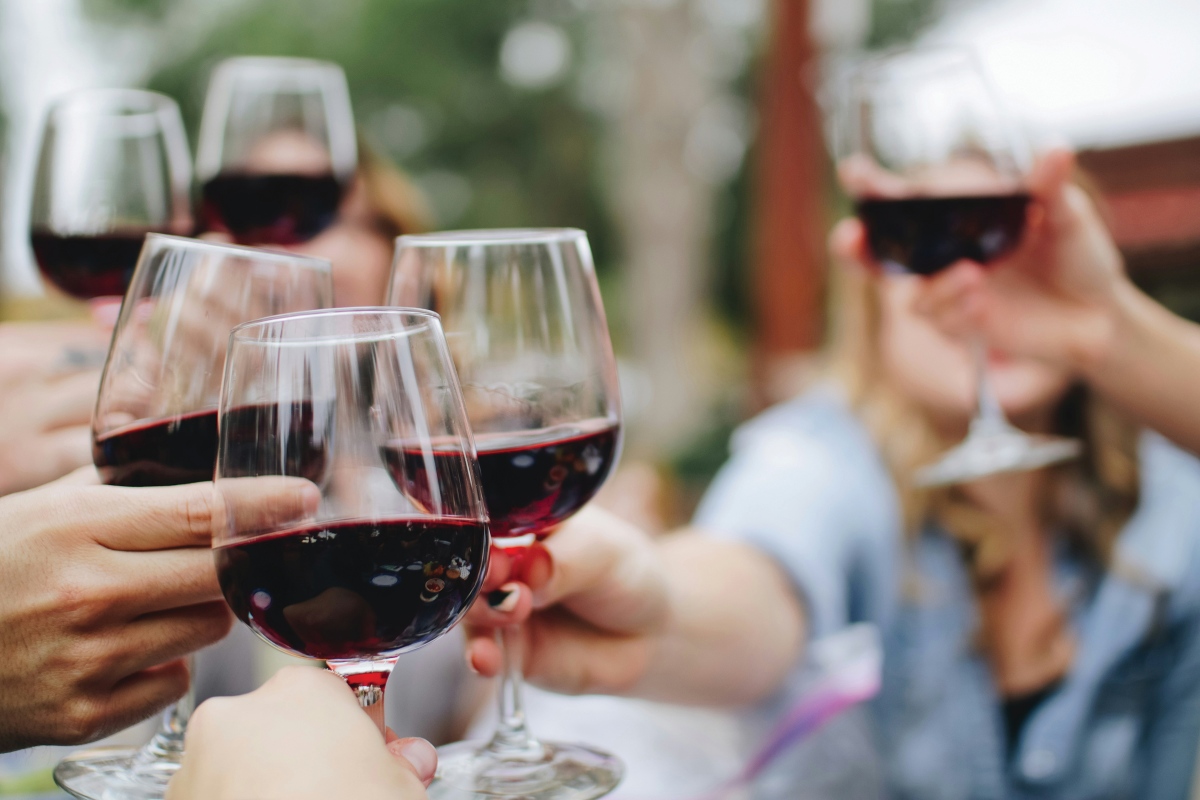
CHEERS The fact of the matter is that older wine consumers are dying off, and newer ones never arrived. Photo by Kelsey Knight.
Where’s the Bottom?
The most optimistic prediction holds that the decline will end in 2028. This is per an influential report from Rob McMillan, founder of Silicon Valley Bank’s wine division, now part of First Citizens Bank (State of the U.S. Wine Industry Report, 2026).
That is two more years of decline for the engine of Sonoma’s economy but an end to the slide, and perhaps one arriving without the radical changes Wilson argues a complacent industry needs. If the prediction is correct, Sonoma wine emerges significantly smaller in a new, permanent normal rather than a low point on the way back up.
To put figures to it: Sonoma County could emerge in 2028 with roughly 50,000 acres under vine, down from a peak above 60,000 producing a crop worth somewhere near $410 million against $777 million in 2018. The wider wine economy, retail and tourism together, would shrink by something like $2.3 billion, or nearly 8% of everything the county produces. Twelve thousand jobs’ worth of work would be gone not as firings, but as billings never sent.
These figures are my own back-of-the-envelope calculations, extrapolated from existing downward trends. No agency, university or trade group has published any projection of what Sonoma County’s defining industry will look like on the other side of its worst decade since Prohibition.
In raw numbers, the industry would sit roughly where it stood in 2005. This is not a return to the past in any meaningful sense. The 2005 industry was growing, capitalized and confident, with land values rising and buyers competing. The 2028 industry would be contracting, debt-burdened and consolidating, on land worth less than the loans against it. Same acreage, opposite trajectory, and the wine towns, the tourism infrastructure and the cost of living built during the boom don’t unwind on the same schedule.
Unfortunately, there is reason to doubt this “optimistic” prediction itself. The bottom could arrive sooner. It could also extend considerably longer and with more dire consequences. Consider this New York Times headline, which ran last week: “Sales Are So Low, California Wineries Are Burning Their Vineyards.”
The case for trusting First Citizens is that its analysts are genuine experts, and as a lender, the bank sees financial information on local wineries that no outsider does. That is also the case for doubting it: As a lender and a publicly traded company, First Citizens has a short-term incentive not to declare that the debt it holds is bad.
Every forecast, including my own, rests on assumptions. The first assumption is reasonable: that prices will stabilize as continued reductions in acreage bring supply back in line with demand, the simple law of supply and demand.
The second is more questionable: that millennials, and the generations that follow them, will acquire a taste for wine as they age, replacing the demand of a dying boomer generation. That assumption treats wine drinking as a product of aging itself, rather than of a generational culture shaped by confusion over the health effects of alcohol, and by the rise of cannabis, hard seltzer and craft cocktails alongside new, harder-edged sobriety norms. That second, shakier assumption is the one holding up the entire “optimistic” prediction.
Turning Back the Clock?
There is some indication that Sonoma County’s wine besotted political leadership is beginning to sober up. One action stands out. This past June, the Board of Supervisors approved an Agricultural Action Plan, directing county departments and partner agencies to coordinate support for growers. The plan is phased over three years, pairing short-term actions with longer-term policy changes tied to a General Plan update.
The short-term measure’s permitting reforms, an agricultural incubator and food security programs move through ordinances that don’t require the General Plan. The deeper changes, including a review of by-right agricultural uses and zoning designations, await a General Plan revision planned, not promised, for January 2029.
Together they would let grape growers experiment with diversifying revenue, minimize some costs and significantly open a door out of wine entirely, into other crops: a re-diversification of Sonoma County’s agriculture, away from near-monoculture, back toward food farming (in a county that currently imports much of its vegetables, fruit and nuts) and forward toward new housing.
At the start of this piece, I mentioned readers who might be inclined to smile at the wine industry’s misfortune, those for whom the industry meant high rents, an unbuyable home, labor exploitation, displacement, gentrification, wine politicians and a “gracious Wine Country living” identity they wanted no part of.
For those readers, wine’s contraction will indeed open space for alternative visions of Sonoma County. But getting there will likely be a painful process. I suggest opening a local wine to ease the pain.
With summer drawing to close, North Bay theater companies are prepping their houses for a robust 2026/27 season. Live theater productions in Sonoma and Napa counties will include the usual mixture of the tried and true along with a sprinkling of North Bay premieres to keep things interesting for the frequent theater-goer.
Santa Rosa’s 6th Street Playhouse kicks things off with their production of Rodgers and Hammerstein’s South Pacific. The musical tale of South Seas love and prejudice is a stark reminder that not much has changed since it premiered in 1949. It opens on Aug. 21. (6thstreetplayhouse.com)
Mercury Theater opens its second full season with Intimate Apparel. Leontyne Mbele-Mbong directs Lynn Nottage’s play about the search for love by a Black woman in early 20th-century America and all the difficulties that entails. The drama opens in Petaluma on Aug. 28. (mercurytheater.org)
Spreckels Theatre Company kicks things off with Equivocation. Bill Cain’s historical drama mixes art, politics and the corruption of both. Oh, and it involves a guy named “Shagspeare.” The “alternate history” also opens on Aug. 28 in Rohnert Park. (spreckelsonline.com)
Speaking of Shakespeare, Healdsburg’s Raven Players open their season with macbitches. The dark comedy brings a Mean Girls vibe to the Bard as high school rivalries around the casting of Lady Macbeth turn treacherous. Something wicked this way comes to the Raven Performing Arts Theater on Sept. 4. (raventheater.org)
Five, count’em, five productions open in the North Bay on Sept. 11.
Out on the Russian River, Curtain Call Theatre of Monte Rio is presenting Quartet. Ronald Harwood’s play about a group of opera singers living in a retirement home trying to put up a concert is an amusing bit of senior-centered theater. (russianriverhall.com)
Somewhat similarly, the folks at Sonoma Arts Live are presenting Follies. This time it’s aging showgirls gathered in a crumbling theater to hash out past regrets and complicated relationships. It’s an early Stephen Sondheim musical, best known for the defiant “I’m Still Here” number. (sonomaartstlive.com)
Healdsburg’s The 222 opens their season with Red. John Logan’s Tony-winning play about the tumultuous relationship between two artists plays, appropriately, at the Paul Mahder Gallery. (the222.org)
In Napa, the Napa Valley College Performing Arts Center will be presenting Barrio Hollywood. Produced by Teatro Alebrijes del Valle in partnership with Shakespeare Napa Valley, it’s a vibrant celebration of Latino culture and community. (performingartsnapavalley.org)
The Lucky Penny Community Arts Center will be hosting Freaky Friday, the Musical. If you know the book or the three Disney adaptations, you’ll know the show. Just add songs. (luckypennynapa.com)
September closes out with the Cinnabar Theater production of the ol’ Bye Bye Birdie. Cinnabar continues to produce their “adult” shows at Warren Theater on the campus of Sonoma State University in Rohnert Park, where it will open on Sep. 18. (cinnabartheater.org)
And leave it to Santa Rosa’s Left Edge Theatre to stir things up a bit with their production of Jeremy O. Harris’ controversial Slave Play. Racial trauma, power dynamics, violence and issues of intimacy between three interracial couples take center stage at The California starting Sept. 25. (leftedgetheatre.com)
From old chestnuts to modern musicals to in-your-face contemporary dramas, there seems to be something for everyone opening up the 2026/27 North Bay theater season.
It’s 1981, and Bud Tribble, a Cupertino computer engineer, is in the midst of a project that would revolutionize not only the world of computing but the world in general. Everything about this project—whether inspired or stolen—was revolutionary.
It also seemed impossible. Deadlines loomed, and seemingly insurmountable hurdles piled up. Fortunately for Tribble and his team, the person helming the project had a superpower. He wasn’t a genius engineer, nor particularly nice. In fact, by all accounts, he could be a real asshole. But he could also ensorcell his minions with a powerful, magnetic charm that left them not only defenseless but inspired to achieve the impossible.
This superpower reminded Tribble of something he had seen before—in an episode of Star Trek. Not the iconic “The Trouble with Tribbles,” which would be too cosmically cool for school, but a lesser-known season-one, two-part episode titled “The Menagerie.”
In it, the crew encounters humanoid aliens capable of conjuring their own reality through sheer mental force—what Tribble came to call a Reality Distortion Field. It’s what he attributed to Steve Jobs’ uncanny ability to make others believe, through sheer charisma, that against all odds they could, in fact, create the Apple Macintosh.
And that, kids, is why 1984 wasn’t like 1984.
When manifesting something from nothing—as creative people are wont to do—it helps to have one’s own Reality Distortion Field. First, we must convince ourselves we can do it. Then we must convince others that we are doing it. Then we need those same others to reconvince us we can actually do it when our self-belief inevitably crumbles and we drop to our knees, bellowing to the stars, What the hell am I doing?
To wit: All creative acts are a kind of insanity—a courageous, disruptive blow against the dual faces of inertia and entropy that mask the greater workings of the universe. It’s both hubristic and humbling. But belief—even self-belief—is its own contagion, and the best way to inoculate ourselves against naysayers, critics and skeptics is to lean into our own idiosyncratic madness: to believe that our specific worldview is not only valid but essential.
If we didn’t believe our own hype, who would?
Or, as another Apple copywriter famously put it: “The people who are crazy enough to think they can change the world are the ones who do.”
The trick, of course, is knowing when to turn one’s Reality Distortion Field on—and off. It’s a tactic, not a strategy—a force bubble one occasionally pops so as not to find one’s self 5150’d over what felt, at the time, like just another manic Monday. Use it to make the impossible plausible, then step back into the real world.
Because with great delusion comes great responsibility.
Daedalus Howell is editor of this paper, the writer-director of the feature film ‘Werewolf Serenade,’ author of the novel ‘Quantum Deadline,’ host of ‘The Drive,’ weekdays on 95.5 FM, and founder of the story company FMRL.
Bud Snow’s new mural brings art to local architecture
Some people look at a building and see a wall. Those like artist Bud Snow see a canvas.
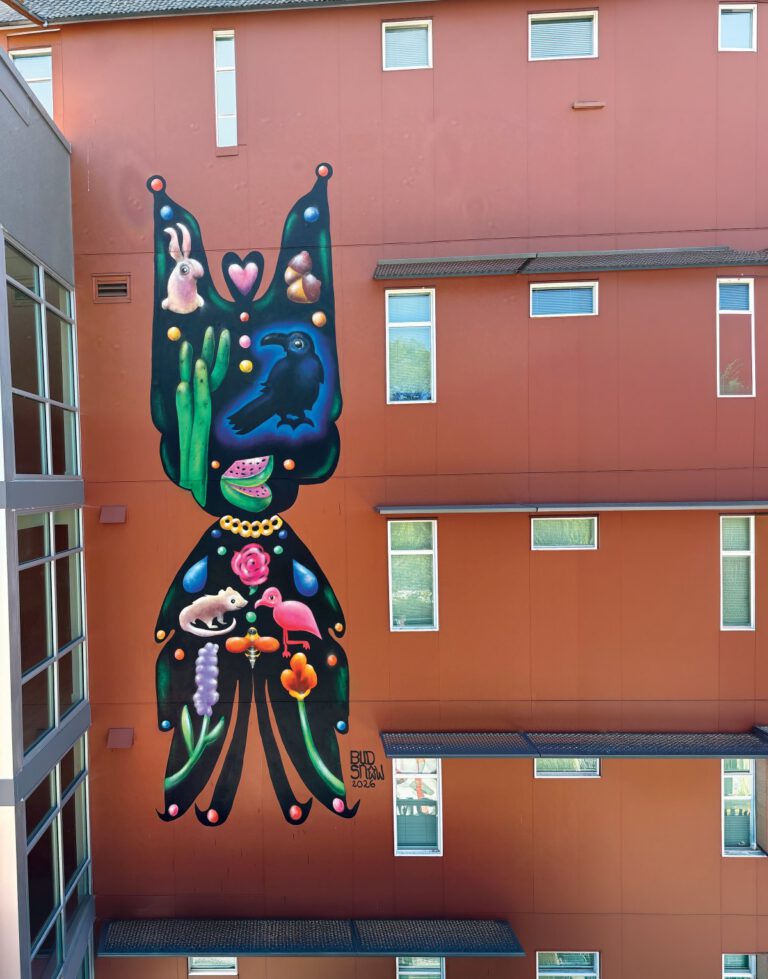
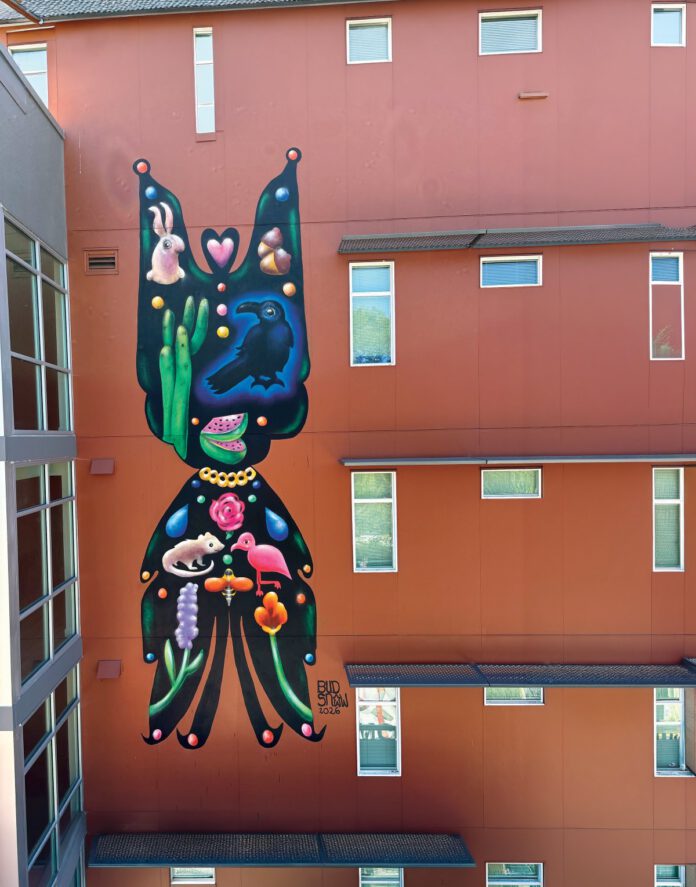
Such was the case with Snow’s latest mural, a 45-foot work overlooking Highway 12 at South Park Commons, an affordable-housing development at 702 Bennett Valley Rd. in Santa Rosa that includes supportive housing for individuals and families who have experienced homelessness.
Completed earlier this year, the mural has been doing what public art does best: becoming part of the landscape while quietly beautifying it.
This work transforms what Snow describes as a relatively standard building into a prominent visual landmark. More importantly, it emerged from eight months of conversations with residents, neighbors, community advocates and project partners. The resulting imagery incorporates symbols inspired by the surrounding neighborhood and ideas gathered during that process.
The stylized composition resolves into several images at once: two birds gathered at a fountain, the broad wings of a butterfly and the head of a dolphin. It is a suitably shape-shifting image for a place associated with transition and change.
“Art changes how we see a space. This mural is about identity and ownership,” said Snow in a statement shared with the Bohemian.
That notion carries particular weight at a supportive-housing site. Buildings intended to provide stability are often designed primarily around utility, which is understandable but can leave them visually anonymous. Snow’s mural makes the opposite argument: that a place of transition need not look temporary, institutional or unseen. It can announce the presence and humanity of the people who live there.
The mural also marks Snow’s first large-scale public artwork in Santa Rosa since 2018 and continues a relationship with the city that stretches back more than a decade.
Her first major Santa Rosa mural, completed in 2013, remains visible above Highway 12. The artist’s regional portfolio also includes a mural behind the Roxy Stadium 14 theater near City Hall, work associated with Perch and Plow and the 888 Fourth Street apartments, and previous collaborations with the Museum of Sonoma County.
Snow’s connections to the area extend beyond walls and paint. She has organized music events at the Arlene Francis Center and worked with artists and cultural organizations throughout Sonoma County.
“This region played a huge role in my career as an artist,” Snow pointed out. “Coming back years later to create a piece centered around dignity, transformation and community care feels incredibly meaningful.”
Like many ambitious public-art projects, this one required more than artistic vision and perhaps a tall ladder. Support came from the Santa Rosa Urban Arts Partnership, Montana Shop Los Angeles, the Flamingo Resort & Spa, Xies Sushi Rolls and Studio B Creative, the Santa Rosa design firm led by Belinda “B” Fernandez.
“We found ourselves with a bit of a funding gap,” noted Snow. “Studio B Creative stepped up to fill it.”
Fernandez framed the contribution as an investment in the city’s cultural and emotional life.
“We need more thought-provoking art here in Santa Rosa. Art has value,” said Fernandez. “It’s life affirming, and our community needs that right now.”
Editor’s Note: An earlier version of this article misgendered Bud Snow. We regret the error.
Positioned as it is on a large wooden porch, it’s tempting to describe Clementine as a quaint little cottage.
But that makes it sound like chef Rebecca Weitzman’s menu isn’t chock full of bold ideas. The genuinely charming orange and green color scheme connotes an idealized 1950s American kitchen.
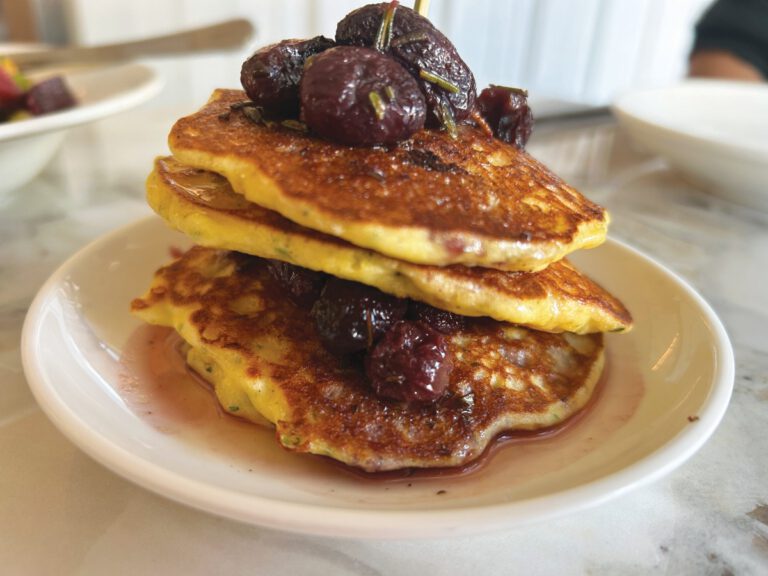
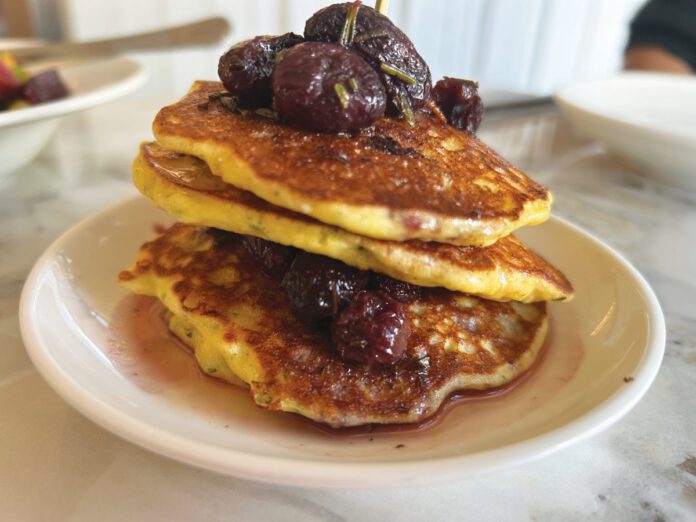
Instead of the rather ubiquitous blueberries, Weitzman’s pancakes are charged with roasted grapes, pears and parsnips, or lemon and fennel. When I spoke with Weitzman, she told me the menu is hyper-seasonal. “It’s really based on what is available and coming into season here,” she said. “We’re trying to get as much as we can from the area, so that is dictating our menu changes.”
Before Weitzman arrived in Yountville, she’d been working on a farm in Mexico. But when the opportunity came up for her to open a restaurant in California, she noted, “It was a perfect combination of an amazing job as well as just a stunning location.” She also felt that Clementine would add something new to the town’s culinary scene. “There’s a lot of very fancy, white tablecloths,” she continued. “We wanted to bring something that was more casual and laid back.”
Having said that, the chef added that the kitchen techniques and approaches are still refined. “People just come in and have an aperol spritz and a flatbread, maybe some grilled oysters or just some brunch,” Weitzman said. But the option to have a full four-course meal with a nice bottle of wine is still on the table. “We encourage people to do both,” she pointed out. “I think we’ve become, to this neighborhood, very quickly to our locals, a place for both kinds of dining experiences.”
Weitzman designed the brunch and dinner menus as shared meals with wine pairings in mind. “None of the food is polarizing,” the chef explained. “Our beverage director is really taking note of the Mediterranean and California influences on our menu, and he’s done a very good job with it.” She added that each dish is seasoned well, but none are heavily spiced or over-seasoned to the point that they would clash with wine.
“Our locals who have become regulars are definitely looking for a bit more,” Weitzman said. They’re willing to take more risks because they trust the kitchen. “They may order duck confit, or something we’ve just put on our menu, as opposed to a chicken dish.”
Tourists tend to choose more familiar dishes. That’s right in line with my first visit. I ordered that delicious stack of savory corn pancakes and lost myself in a large comforting pour of maple syrup.
Clementine, open Wed. to Mon., 10am–9pm, 6525 Washington St., Yountville. clementineyountville.com.
There are few phrases more freighted in the North Bay than “air quality.” Depending on the season, it might mean wildfire smoke, pollen, woodsmoke, exhaust or some atmospheric cocktail that turns one’s plans into an indoor activity.
Santa Rosa couple Jason Curtis and Jennifer Nunn decided that checking the air shouldn’t become a second job.
Their solution is Canairy, a neighborhood-level...
Phi Nguyen is chef de cuisine at The Madrona, marking an astoundingly speedy culinary path upwards over the 10 years since he emigrated here from Vietnam in 2016.
Rising up within the region’s dining scene, he gained experience at Flowers Vineyard & Winery, Montage Healdsburg and Farmhouse Inn before landing at The Madrona.
Amber Turpin: How did you get into this...
Same Cloth
Now that our president’s personal attorney, Todd Blanche, has become full-time attorney general, it is not the first time an unqualified, corrupt presidential crony ascended to that particular throne.
In 1969, Richard Nixon appointed John Mitchell to become attorney general by requesting that then FBI director J. Edgar Hoover not conduct the normal background checks required. Nixon knew.
Mitchell stayed...
ARIES (March 21-April 19): At the post office, I mischievously plucked a crumpled piece of red paper out of the trash can. I don’t usually do such things, but I sensed some horoscope material was lurking there. It turned out to be a handwritten love note addressed to “My Lush and Luminous Aries Laugh-Lover” and signed, “Your Flawed but...
SebastopolTrip Around the Sun
The jam-band universe circles back to Sebastopol for Another Trip Around the Sun, a benefit concert bringing together musicians with deep ties to the Grateful Dead extended family. Guitarist Mark Karan of Bob Weir & RatDog, keyboardist Scott Guberman of Phil Lesh & Friends, drummer Anna Elva of Stu Allen & Mars Hotel and bassist/vocalist JP...
For news readers, there has been a steady drip of wine industry reportage as sour as last week’s wine.
It’s been five years of vineyard sales, declining real estate values, consolidations, the retirement of leading figures, layoffs, bankruptcies, closures and unsold grapes, rotting on the vine.
The 45 years that followed 1976’s “Judgment of Paris,” which declared Napa wine superior to...
With summer drawing to close, North Bay theater companies are prepping their houses for a robust 2026/27 season. Live theater productions in Sonoma and Napa counties will include the usual mixture of the tried and true along with a sprinkling of North Bay premieres to keep things interesting for the frequent theater-goer.
Santa Rosa’s 6th Street Playhouse kicks things off...
It’s 1981, and Bud Tribble, a Cupertino computer engineer, is in the midst of a project that would revolutionize not only the world of computing but the world in general. Everything about this project—whether inspired or stolen—was revolutionary.
It also seemed impossible. Deadlines loomed, and seemingly insurmountable hurdles piled up. Fortunately for Tribble and his team, the person helming the...
Bud Snow’s new mural brings art to local architecture
Some people look at a building and see a wall. Those like artist Bud Snow see a canvas.
Such was the case with Snow’s latest mural, a 45-foot work overlooking Highway 12 at South Park Commons, an affordable-housing development at 702 Bennett Valley Rd. in Santa Rosa that includes supportive housing for individuals...
Positioned as it is on a large wooden porch, it’s tempting to describe Clementine as a quaint little cottage.
But that makes it sound like chef Rebecca Weitzman’s menu isn’t chock full of bold ideas. The genuinely charming orange and green color scheme connotes an idealized 1950s American kitchen.
Instead of the rather ubiquitous blueberries, Weitzman’s pancakes are charged with roasted...