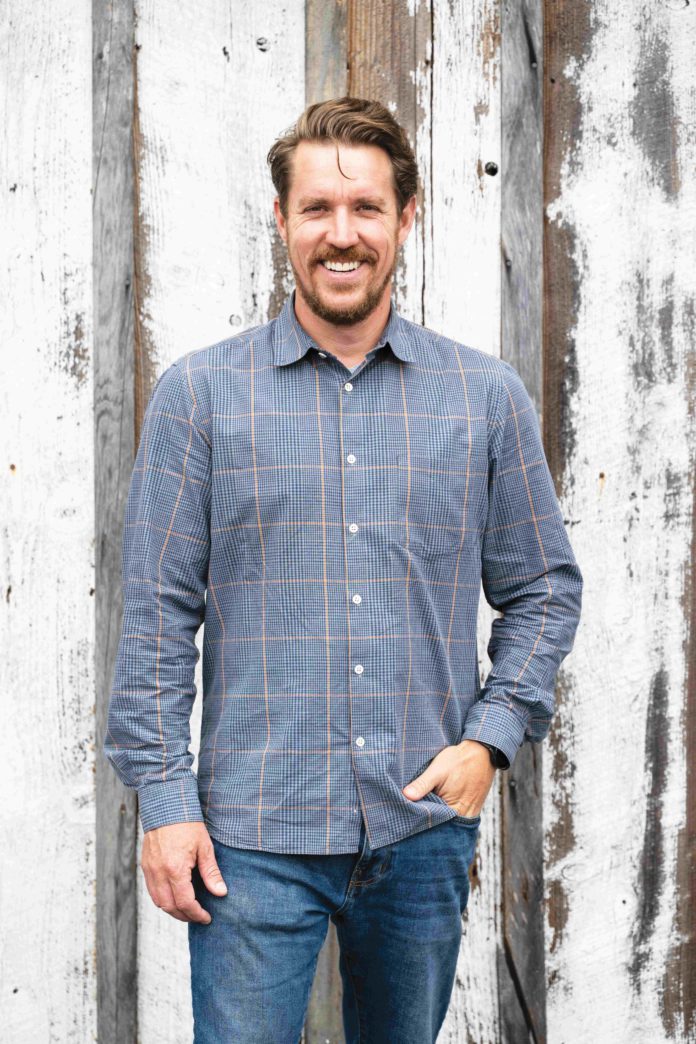
Fashion Plate Kory Vanderpool

The Opera House Collective is located on Kentucky Street in Petaluma’s historic downtown. This three-in-one vintage clothing store is the latest business to tenet the rough, pioneering “opera house,” where Mark Twain once read a short and Teddy Roosevelt once addressed a shaken Sonoma County in the aftermath of the 1906 quake.

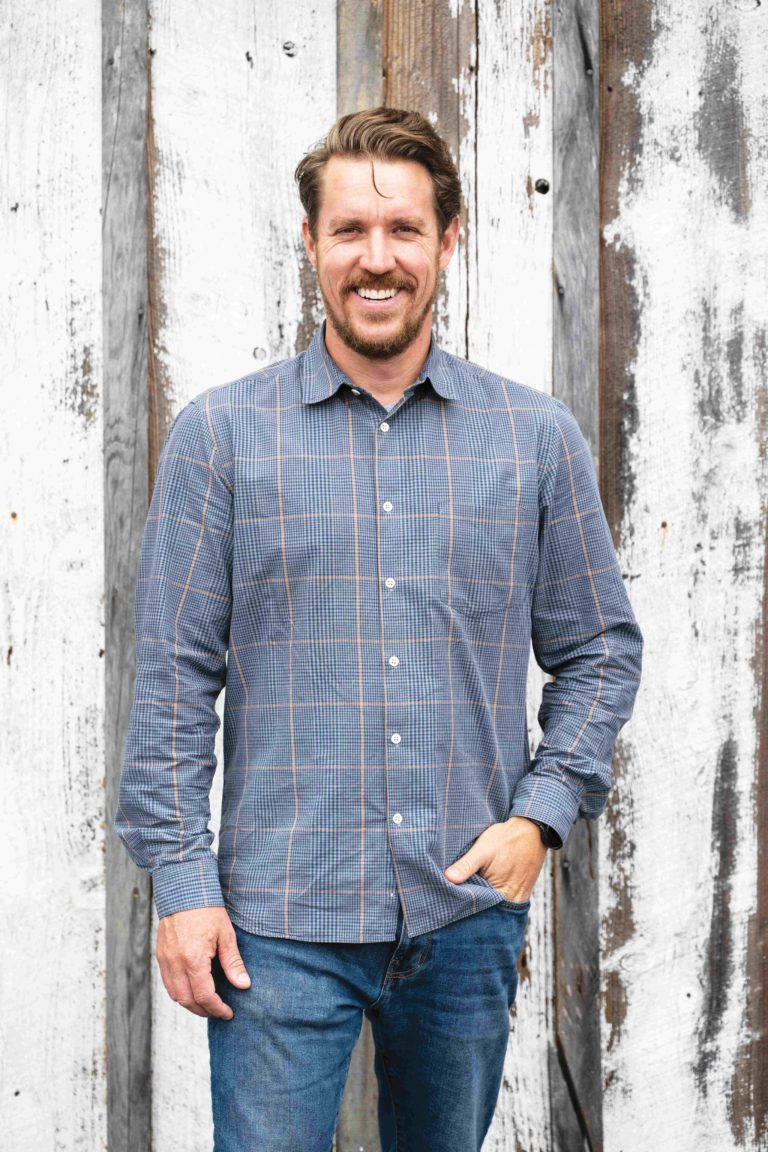
Market-wise, the store occupies a space between upmarket and down. It’s where one can always come away with a one-of-a-kind item for 10 bucks. Kory Vanderpool is the owner.

CH: Kory Vanderpool, I understand “Haight Ashbury at half the price” is the tagline of Aubergine Vintage, one of the three clothiers in your collective. Does that describe your collective aesthetic?

KV: It entirely depends on how you shop. We have a wide range of shoppers because we have a wide range of product. We have trendy teenagers coming in for Free People and floral pieces, and blue-collar ranchers are coming in for camo and work boots. And of course, because it’s Sonoma County, you can combine the two!

CH: Kory, you had sought out this soap-box because you wanted to address the stigma still attached to second-hand clothing. Namely they are second-class because they are used and uncool because they are off-trend.

KV: Yes! We believe that everyone, regardless of income, should wear second-hand and vintage clothing. It’s no trend. It’s good ecology. The new clothing industry is massively polluting. It contributes 10% of CO2 greenhouse gas. That’s more than the airline and naval shipping industries combined. I recommend the documentary, The True Cost, for people that want to learn more. Bonny, Morgan, CJ and I believe that, rather than being looked down on, people that wear second-hand clothing should be looked up to for their commitment to the birds and the trees.

CH: The other stigma you mentioned is that second-hand might be considered “uncool” because it is not up to the latest trends of cool.

KV: Yes, it’s just untrue. Thrifting offers you the opportunity to discover unique, one-of-a-kind items that speak directly to you. Compare that to the walls of uniformity you find in fast fashion. And since what you find is rarely in a matched set, and the vintage racks contain all decades of clothes, how you finish your outfit will be uniquely you.

The coolest people are always one-of-a-kind individualists. Trends follow them! And the way to achieve individuality in fashion is second-hand, repaired, customized clothing, and vintage.

linktr.ee/cincinnatushibbard.

Your Letters, 4/17

Spoken Truth

Public speaking is a politician’s stock in trade. And President Joe Biden’s impressive words are fresh air in a long vacant house. That reminds me of when I was nine years old. My friend Bill H. and I were caught and punished for throwing rocks at the windows of a vacant house. I learned my lesson, and that’s the reason I refuse to cast aspersions on Biden.

During last week’s eclipse at a Houston high school where Congressperson Sheila Jackson was speaking, I think I learned something new. We didn’t have astronomy in my high school, and so I listened with interest as Jackson described our friend Mr. Moon by saying, “It’s that complete rounded circle which is made up mostly of gasses.” The congressperson continued, “The sun is a mighty powerful heat, but it’s almost impossible to go near the sun.” 

At first blush after learning this, I concluded that I simply don’t get out enough. But I checked with Punxsutawney Phil, and even he was less the wiser concerning such advancements in astronomy. 

Politics and politicians tend to generate more emotional volatility, reactions and opinions than roadside weeds in spring. Now don’t think me ill-humored when I say lambasting Donald Trump is beginning to get stale, habitual and frankly ho-hum. There are political horses other than Trump making jackasses of themselves. And this election year is…well, let the experts explain.

Vice President Kamala Harris reminded everyone of the importance of the coming fall election when she said, ”This is the most election of our lifetime.” You betcha! And Kamala understands technology better than, say, the border, because as the VP explained, “AI is kind of a fancy thing. First of all, it’s two letters. It means ‘Artificial Intelligence.’” Wow! That’s three letters.

Leland Dennick

Sebastopol

Free Will Astrology, Week of 4/17

0

ARIES (March 21-April 19): I suspect two notable phenomena will coalesce in your sphere sometime soon. The first is a surplus supply of luck. I’m not sure why, but the fates will be sending surges of good karma your way. The second phenomenon is this: You might not be entirely alert for the potential luck flowing in your direction, and it may not leap out and grab you. That could be a problem. Fortunately, you are reading this oracle, which means you are getting a heads-up about the looming opportunity. Now that you realize you must be vigilant for the serendipitous blessings, I’m confident you will spot them and claim them.

TAURUS (April 20-May 20): You will be wise to summon extra love and rapport as you ruminate on your vivid upcoming decisions. Wouldn’t you like to bask in the helpful influences of smart allies who respect you? How nurturing would it feel to receive healing encouragement and warm appreciation? I suggest you convene a conference of trusted advisors, good listeners, sunny mentors, wisdom keepers and spirit guides. Maybe even convene a series of such gatherings. Now is an excellent time to call in all your favors and get the most inspirational support possible as you navigate your way to the next chapter of your life story.

GEMINI (May 21-June 20): If you drink alcohol, don’t operate a forklift or backhoe. If you gamble, protect yourself with safeguards and have a backup plan. If you feel called to explore altered states of consciousness, consider doing meditation, dancing or chanting holy songs instead of ingesting drugs. If you have an itch to go hang-gliding or sky-jumping, triple-check your equipment. And if you have the urge to try to walk on the water, don a lifejacket first. But please note, dear Gemini: I am not advising you to timidly huddle in your comfort zone. On the contrary. I highly recommend you stretch your limits. Just be secure and smart as you do.

CANCER (June 21-July 22): I plotted out my usual astrological reckonings for your current destiny. Then I slipped into a meditative trance and asked the spirits to show me future scenes that correspond to my assessments. In one prominent vision, I beheld you partying heartily, navigating your avid and inquisitive way through convivial gatherings. In other scenes, I saw you engaged in lively discussions with interesting people who expanded your understanding of the meaning of life in general and the meaning of your life in particular. I conclude that intelligent revelry will be a main theme for you. Productive excitement. Pleasurable intrigue. Connections that enliven and tonify your imagination.

LEO (July 23-Aug. 22): The theory of synchronicity proposes that hidden patterns are woven into our lives. Though they may ordinarily be hard to detect, they can become vividly visible under certain circumstances. But we have to adjust the way we interpret reality. Here’s a clue: Be alert for three meaningful coincidences that happen within a short time and seem related to each other. I predict the emergence of at least one set of these coincidences in the coming weeks—maybe as many as four. Synchronicities are coming! You have entered the More-Than-Mere-Coincidence Zone.

VIRGO (Aug. 23-Sept. 22): Psychologists J. Clayton Lafferty and Lorraine F. Lafferty wrote a book called Perfectionism: A Sure Cure for Happiness. It’s based on their work with clients who damaged their lives “in the illusory pursuit of the unrealistic and unattainable standard of perfection.” In my observation, many of us are susceptible to this bad habit, but you Virgos tend to be the most susceptible of all. The good news is that you now have an excellent chance to loosen the grip of perfectionism. You are more receptive than usual to intuitions about how to relax your aspirations without compromising your competence. As inspiration, consider these words from author Henry James: “Excellence does not require perfection.” Leadership expert R. R. Stutman adds: “If perfection is an obstacle course, excellence is a masterful dance.”

LIBRA (Sept. 23-Oct. 22): “Everyone is a moon and has a dark side which they never show to anybody,” wrote author Mark Twain. I agree that everyone is a moon and has a dark side. But it’s important to note that our dark sides are not inherently ugly or bad. Psychologist Carl Jung proved to me that our dark sides may contain latent, wounded or unappreciated beauty. To be healthy, in fact, we should cultivate a vigorous relationship with our dark side. In doing so, we can draw out hidden and undeveloped assets. The coming weeks will be a favorable time for you Libras to do this.

SCORPIO (Oct. 23-Nov. 21): Your current state has metaphorical resemblances to idling in your car, waiting and waiting and waiting for the red light to change. But here’s the good news: I expect the signal will turn green very soon—maybe even within minutes after you read this horoscope. Here’s more good news: Your unlucky number will stop popping up so often, and your lucky number will be a frequent visitor. I’m also happy to report that the “Please don’t touch” signs will disappear. This means you will have expanded permission to consort intimately with influences you need to consort with.

SAGITTARIUS (Nov. 22-Dec. 21): I think it’s time to graduate from your lessons in toxic kinds of enchantment and launch a new experiment with healthy kinds of enchantment. If you agree, spend the next few days checking to see if any part of you is numb, apathetic or unreceptive. Non-feelings like these suggest you may be under the enchantment of influences that are cramping your imagination. The next step is to go in quest of experiences, people and situations that excite your imagination, rouse your reverence and raise your appreciation for holy mysteries. Life will conspire benevolently on your behalf if you connect yourself with magic, marvels and miracles.

CAPRICORN (Dec. 22-Jan. 19): Luther Burbank (1849-1926) was a practical artist. Using crossbreeding, he developed over 800 novel varieties of vegetables, fruits, grains and flowers. Among his handiwork was the russet Burbank potato, a blight-resistant food designed to help Ireland recover from its Great Famine. My personal favorite was his Flaming Gold nectarine, one of the 217 fruits he devised. I propose that Burbank serve as your role model in the coming weeks. I believe you have the power to summon highly pragmatic creativity.

AQUARIUS (Jan. 20-Feb. 18): L. R. McBride wrote the book The Kahuna: Versatile Mystics of Old Hawaii. He describes the role of the kahuna, who is a blend of sorcerer, scholar and healer. At one point, a kahuna gives advice to an American tourist, saying, “You have moved too fast for too long. You have left part of yourself behind. Now you should slow down so that part of you can catch up.” I’m offering you the same advice right now, Aquarius. Here’s your homework: Dream up three fun things you can do to invite and welcome back the left-behind parts of you.

PISCES (Feb. 19-March 20): In the course of my life, I have heard the following three statements from various people: 1. “Everything would be better between us if you would just be different from who you are.” 2. “I would like you more if you were somebody else.” 3. “Why won’t you change to be more like the person I wish you would be?” I’m sure you have heard similar pronouncements yourself, Pisces. But now here’s the good news: I don’t think you will have to endure much, if any, of such phenomena in the coming months. Why? First, because you will be more purely your authentic self than you have ever been. Second, because your allies, colleagues and loved ones—the only people who matter, really—are likely to be extra welcoming to your genuine self.

High Time: A cannabis conundrum

In the lush landscapes of the North Bay, where vineyards sprawl and tech giants dream big, another industry is lighting up the economic scoreboard: cannabis. As the smoke clears post-legalization, local entrepreneurs and seasoned tokers alike are navigating a market that is as potent as a fine sativa strain but tangled in red tape that would confuse even the soberest of bureaucrats.

Let’s not mince buds here. The North Bay’s dive into the green rush could have been the next gold rush. Ideal growing conditions and a populace with a penchant for the plant should have set the stage for booming business. Instead, what we’ve witnessed is a comedy of errors and ordinances that could make a stoner sitcom look like hard-hitting drama.

Take Sonoma County, for example, with its byzantine permitting process. Entrepreneurs face a gauntlet of regulatory dragons: zoning laws, tax rates that continue to climb and a market that is as saturated.

Meanwhile, in Marin County, there’s a silent battle being waged between “not in my backyard” aficionados and green-thumbed warriors eager to cultivate their businesses. The result? Dispensaries are as rare as unicorns, leaving residents to trek across county lines, order-in (like pizza) or resort to less legitimate sources, which surely wasn’t the point of legalization.

And let’s not forget the consumers, the backbone of the biz. We are hit with prices that have them coughing up more than just smoke. Between state taxes, local taxes and regulatory fees, buying legal cannabis feels like being penalized for doing the right thing. This isn’t just a buzzkill; it’s an innovation killer, pushing potential cannabis connoisseurs back to the black market where no taxes apply.

The North Bay’s cannabis industry could be a beacon of progress, a harmonious blend of agriculture, commerce and tourism. Instead, we’re stuck in bureaucratic limbo, watching potential profits go up in smoke.

It’s time local governments streamlined these processes and laid out the welcome mat for cannabis businesses. Let’s trim the excess regulation, prune the taxes and cultivate an industry that can bloom to its full potential.

Michah D. Mercer is a self-described ‘life-long Luddite’ who ‘believes in paper mostly for rollin’ and readin’.’

The Backstory on ‘420’

In the smoky haze of counterculture and clandestine meetups, the term “420” whispers tales of rebellion, mystique and the universal language of cannabis aficionados. While the air is thick with rumors—an alleged police dispatch code or an elusive chemical compound—the truth is far more rooted in the lore of youthful daring and adventure in 1970s Marin.

First, let’s dispense with the myths of Bob Marley’s birthday celebrations (it’s Feb. 6—see One Love if you don’t believe me). The true origin of “420” is nothing short of an epic befitting the most imaginative of stoner sagas. This journey transports us back to 1971, within the verdant grounds of San Rafael High School, where a group of audacious teens, known colloquially as “The Waldos,” embarked on a quest that would unknowingly etch their code into the annals of counter-cultural history.

The narrative unfolds with The Waldos, so named for their penchant for lounging against a particular wall (see what they did there?), stumbling upon a once-in-a-lifetime opportunity.

On the podcast Criminal, hosted by Phoebe Judge, former student Steve Capper recounts his folklore-worthy tale that includes a Coast Guard brother, a hidden cannabis treasure and a map that promised untold delights—namely “free weed.” The Waldos’ adventure was set for 4:20pm, a time that would soon transcend its humble beginnings.

As Capper recounted on the podcast: “I was sitting on our hangout spot: the wall at San Rafael High School. And a friend of mine, Bill, came up to me, and he said, ‘Hey, Steve, my brother’s in the Coast Guard, and he’s been growing some weed. He’s afraid he’s going to get busted by his commanding officer. He says we can pick it. Here’s a map he drew for us.’”

Their rendezvous was set to commence at a Louis Pasteur statue on campus. However, despite their diligent searches, the crudely drawn map was bunk, and they found no magical weed garden. Yet, the ritual, camaraderie and code—“4:20 Louie,” later shortened to “420”—endured.

“We thought it was a joke then,” David Reddix, a Waldo classmate turned filmmaker and CNN cameraperson, told the New York Post in 2018. “We still do.”

What began as an inside joke burgeoned into a global emblem, celebrated far and wide, its roots traced back to a cheeky, intrepid spirit and a band of high school friends, which also included pals Larry Schwartz, Jeff Noel and Mark Gravich. And thanks to a serendipitous link between Dave Reddix’s brother and world-touring Grateful Dead bassist Phil Lesch, the coinage spread.

The Waldos’ legacy was cemented in 2017 when “420” found its rightful place in the Oxford English Dictionary, a testament to their original claim, backed by indisputable evidence from high school newspapers and postmarked notes laced with cannabis lore.

A few years ago, to commemorate the legacy and its creators, fellow Marinite and wristwatch manufacturer Barry Cohen created the 420Waldos watch, which features a marijuana leaf on its face and another leaf on the back. It also boasts two additional leaves on the straps. Likewise, Petaluma-based Lagunitas Brewing Co. once released a commemorative seasonal brew, “The Waldos Special Ale.”

Pot Reform Politics Remain Partisan

0

The politics of cannabis sometimes seem complicated because, almost uniquely in this sad political era, both support for and opposition to laws reforming cannabis laws can be found on both sides of the aisle.

This has led to some unfortunate rhetoric from reform advocates in support of ghouls like Matt Gaetz just because those ghouls favor liberalizing pot laws. For such single-issue proponents—most of them, to be fair, just individual social-media randos, though there are a lot of them—Gaetz’s overall vileness doesn’t matter a bit; he’s pro-weed, so they support him. 

From many of the same people, we get statements of opposition to Democratic politicians, and not just the ones like Joe Manchin who oppose liberalization, but even the ones like Chuck Schumer, who favor it but are perceived to be moving too slowly or getting too cozy with big, corporate weed companies—not that they are above criticism for those things, of course.

But the situation isn’t really as complicated as it might seem. It’s not really necessary to get into a moral debate over whether it’s OK to vote for people who want to deport millions or who are fine with women dying from ectopic pregnancies as long as those people are pro-cannabis.

The best course for reformers is to support Democratic politicians, period. Support for reform comes overwhelmingly from Democrats; opposition comes overwhelmingly from Republicans. If the Democrats had control of the Senate over the past several years, weed would almost certainly have been legalized at the federal level by now.

But we don’t even need to examine Congress. Look at what’s happening at the state level. In 2022, voters in five Texas cities approved ballot measures to decriminalize weed. Or, more accurately, not even to decriminalize, but simply to ratchet down enforcement by local cops of laws prohibiting the possession of small amounts of pot.

The ballot measures—in Austin, Denton, Elgin, Killeen and San Marcos—were passed overwhelmingly. In Austin, probably the most progressive of those cities, 85% of voters approved the measure. In Killeen, a military town and not exactly a hippie haven, the initiative won 69% of the vote.

In January, Texas Attorney General Ken Paxton filed a lawsuit against the five towns, seeking to block implementation of the voter initiatives. Paxton proudly issued a press release declaring that he filed the lawsuit “to protect the public from crime, drugs and violence.”

Paxton of course knows that problems stemming from “crime, drugs and violence” aren’t impacted at all by people possessing small amounts of pot, and that busting those people won’t help solve them. He’s doing this to appeal to his base, which skews toward the elderly and the malevolent. And he knows that the MAGA types who support him won’t change their votes even if they support pot reforms.

Republicans in Ohio are motivated by the same thing: sticking it to Democrats, whatever the will of the people might be. In November, a ballot measure to legalize adult-use weed passed with a whopping 57% of the vote.

Senate Republicans, who control that chamber, immediately began attacking the measure, offering a substitute bill that would ban home growing, restrict allowed THC levels, raise the excise tax rate from 10% to 15%, and direct tax proceeds away from social-equity programs and general substance-abuse programs, and toward law-enforcement and “marijuana substance abuse” programs, as well as safe-driving initiatives.

That would run directly counter to what Ohioans, including many Republicans, explicitly voted for. But screw that if you have the chance to own the libs, right? Facing widespread criticism, the Republican senators have backed down a bit since then—conceding on the home-grow provision, for example—but they’re still trying to fiddle with the law, including by insisting that tax proceeds go to cops.

If any of these efforts are successful at all, look for Republicans in red and purple states, and those in Congress, to step up their opposition. When it comes to pot reform, only one party can be counted on to do the right thing, even if its members sometimes go about it in frustrating ways.

Rohnert Park transitions 75% of encampment residents to interim or permanent housing

The city of Rohnert Park is celebrating the successful transition of nearly three-quarters of the population of a homeless encampment into interim or permanent housing after the last resident of a safe sleeping program left and the site was officially closed, city officials said last week.

Rohnert Park worked in conjunction with the Bay Area nonprofit HomeFirst, which assists unhoused individuals and families with attaining stable housing.

The safe sleeping program occupied the Roberts Lake Park and Ride area and provided safer camping for homeless residents by providing 24/7 security services while advocates worked on transitioning people to housing.

“These types of programs are important,” said Julian Elliott, director of HomeFirst’s Emergency Housing Division, in a release sent out by the city. “The ability to have a place, even in a ‘camping’ setting that is safe from theft, vandalism and violence, can provide a sense of stability and peace of mind that is so important when looking towards the future.”

On Jan. 31, the last resident of the safe sleeping site moved out, according to the city, which said that between October 2022 and January 2024, 122 individuals were served and 72% of them moved into interim or permanent housing.

Before October 2022, the encampment had been large and unregulated, according to the city. Rohnert Park had OK’d the space in February of that year, but concerns arose about its growing size and worries that it had become a magnet for more unhoused people in the area.

In fall of 2022, the city began barring any new residents from setting up camp and required anyone wishing to remain to register with the city. Quiet and visiting hours were imposed, and residents were provided with 10-by-10-foot tents.

Some park and ride residents moved to temporary housing at Labath Landing, a 60-unit interim housing structure in Rohnert Park paid for in part by state Homekey funding and Sonoma County’s Measure O, which is a quarter-cent sales tax approved by voters in 2020 that provides funding for mental health and homelessness services.

According to the city, Rohnert Park had 210 unhoused individuals in last year’s Point-In-Time Count, which takes an annual census of homelessness.

“This number reflects a 43% decline in the city’s homelessness from 2022 and highlights the successes of the city’s innovative initiatives to address homelessness,” said the city.

Just a Man: ‘The Mountaintop’ at 222

Healdsburg’s The 222 concludes its season of professional drama with The Mountaintop, co-directed by Aldo Billingsley and Rebecca Novick. Playwright Katori Hall’s imagining of Dr. Martin Luther King, Jr.’s last night on Earth runs through April 14.

It’s late in the evening of April 3, 1968, and Dr. King (Ron Chapman) has returned to room 306 of the Lorraine Motel in Memphis, Tennessee. He’s just delivered his “I’ve Been to the Mountaintop” sermon and is struggling to craft a speech in support of striking local sanitation workers.

After sending his friend, Ralph Abernathy, out for cigarettes, he calls down to the front desk in search of some coffee. A knock at the door heralds the arrival of motel maid Camae (Sam Jackson). Dr. King invites her in, and what starts as a casual conversation soon deepens into a discussion of the civil rights movement and the violence that seems to attach itself to peaceful protest.

Moments of self-reflection, doubt and even flirtation culminate in a pillow fight and physical exhaustion. A slip of the tongue brings Dr. King to the realization that Camae isn’t who she appears to be. Things then go in a very unexpected direction yet still end on the motel balcony floor.

Hall has said that she wanted to bring King off the pedestal he’s been placed upon and to view him as an ordinary man capable of extraordinary achievements as a way for other ordinary people to appreciate their own capabilities.

Playing an icon stripped of most everything that made them an icon must be doubly challenging for an actor. Chapman delivers on the playwright’s desire for “ordinariness” while delivering hints of the cadence of Dr. King’s voice.

The bombast is delivered by Jackson. But to reveal much about her character’s journey would rob the audience of their own discovery. Suffice it to say that Jackson absolutely glows in the role.

Previous productions at The 222 used minimal technical elements, but this show utilizes lighting, sound and projection designs. They will need to up their game in this department.

The Mountaintop was written in the time of the Obama presidency, when there was a sense that our country had reached a new level in dealing with the issues of race. The backsliding over the last 15 years and the coarsening of our national character casts a shadow over the play’s somewhat hopeful ending.

Hope has been replaced by fear.

‘The Mountaintop’ runs through April 14 at The 222 in The Paul Mahder Gallery, 222 Healdsburg Ave., Healdsburg. Friday & Saturday, 7:30pm; Sunday, 2pm. $45-$105. Students free with ID. 707.473.9152. the222.org.

Rising to the Moment with Debra Giusti

To speak directly to our present anxieties, we need not fear the future. Plotting national and international news stories along a narrative of decline has become commonplace, but that’s only extrapolation.

That’s why I’m so eager to share Debra Giusti’s work. She recontextualizes the same events and trends within a hopeful new narrative, that of a planetary “ascension.” And while one might disagree with her, it is an incredible relief to realize that no one really knows what the future holds. It might be cataclysmic. But it still might be utopian.

One may recognize Debra Giusti’s name. For three decades, Giusti was the organizer of The Health and Harmony Festival and The Spirit of Christmas Fair. She now leads The Global Peace Tribe.

CH: I could riff a list of bad news as long as my arm. But you believe that humanity is currently in a process of purging?

DG: Yes! If you’re getting healthy, you have to go through a detox to release all of the poisons in your body. A lot of spiritual teachers call the stage we are in “the purification.”

CH: And that is how all the bad news fits into this new narrative of ascension?

DG: Yes! If you have noticed, all the ugliness and political corruption that’s up in our face right now and not 15 years ago had been there, hidden below the surface. The pandemic was a huge catalyst in the process. Now, all that corruption and dysfunction is revealed—revealed to be healed. If you’re not aware, you can’t begin to make different choices.

CH: Your work seems to have a microcosmic analogy where humanity and history are like a single human life. One where things have been going well enough for a deeply damaged individual until a long-developing, total crisis brings all their formative trauma to the surface to be seen and healed. Their crisis becoming the catalyst for their transformation.

DG: Yes. As above, so below. The first stage of the evolutionary and healing process is called “the awakening.” But the last is called “the divine human.”

For a free download of Debra Giusti’s e-book, ‘Ascension Tips,’ as well as events and workshops related to ascension, visit debragiusti.com.

Listen to our full conversation, including a walkthrough of the 88-step process of personal and collective ascension. Search ‘Sonoma County: A Community Portrait Podcast.’

‘Bin’ There: Reseller culture thrives in Santa Rosa

0

In an unassuming warehouse off Yolanda Avenue in the Roseland neighborhood of Santa Rosa, there is a little-known, invaluable resource for thrifty shoppers: The Goodwill Outlet.

Commonly known as “The Bins,” this outlet is the last stop for Goodwill’s regionally donated items before they are sent to landfills or secondhand markets worldwide. Clothing, accessories, toys and more sit in rows of shallow blue bins and are sold by the pound.

The Bins has long been open to the public. But in recent years, as the cost of living and consumer interest in secondhand goods rises, The Bins has become a reseller’s jobsite.

According to a report from online resale store ThredUp and GlobalData, the U.S. reselling market is expected to reach $70 billion by 2027. On a rainy Friday morning, I visited The Bins to ask local resellers about their line of work.

For Cody Brown, owner of Crooks Coffee on Mendocino Avenue, reselling is a means of revitalizing Santa Rosa. In 2020, when pandemic restrictions temporarily closed his cafe, Brown began accepting donations to distribute to local unhoused people. The volume of those donations, combined with the needs of the community he serves, gave Brown the idea to expand his reselling business to offer his community “income and job training.” These days, he brings a group of 10 or so guys to The Bins to help him source.

Part-time reseller Sasha Rushmeyer comes once a week to find a new outfit for herself and to pick up a few items to sell on Facebook Marketplace under her full name. Rushmeyer, who is an operations specialist for the Sonoma County Regional Parks, explained that “sustainability is super central to who I am as a person.” As a child, she frequented The Bins with her mother and aunt.

Though Ryshmeyer is well compensated by the parks, reselling helps her offset the increasing cost of living in Sonoma County both for herself and her buyers. She keeps her prices low because she loves “helping people out by selling cheap stuff on Marketplace [in order] to prevent brand name backpacks from ending up in the landfill.”

A successful reselling business comes down to “having an eye,” as another part-time reseller who wished to remain anonymous told me. Coming to The Bins gave him something to do after a divorce, but soon turned into a lucrative side hustle. These days, he sources part time for local antique sellers and earns enough to cover the cost of his monthly car payment. During our conversation, he uncovered a mink stole underneath some dusty Easter baskets.

Full time reseller Austin Henderson credits his anonymous colleague for bringing a congenial spirit to The Bins, and seeks to create a warm atmosphere himself. When he learned I was writing about resellers and am one myself, Henderson offered me sourcing tips, like checking the pockets of an item for money. “Someone found a thousand dollars in a coat pocket once,” he whispered, as if telling me great reselling lore.

This seeming-folktale was later confirmed as truth by other resellers who recalled that wildly lucky moment (as well as the sadness many felt for the former coat owner). Later in the day, Henderson handed me a black leather Tory Burch backpack he’d found because he thought it suited my style.

Moved by his generosity, I met up with Henderson on Easter Sunday at Midgley’s Flea Market in Sebastopol, where he sells his wares. But by the time I got there at midday, Henderson was standing in front of an empty table. He’d met his sales goal for the day and was packing up to head home. Before he left, he introduced me to another friend: AJ Close, owner of an eBay store called 707 Collectables.

Close is a Sonoma County-based father of two. He left his career as a hospice operations manager to pursue reselling video games and Pokemon cards full time. Close made six figures in his first year of business, more than his former salary. Today, Close also consults with local resellers starting out. For a small fee, he will help set up an eBay store based on his own business model. Even with this new arm of his business, Close finds his work “much more manageable” than the demands of hospice management. As we chatted, he was eager to offer me advice for my own business.

Like many resellers, my interest in reselling is personal. And like Rushmeyere, I started casually back in 2019. I was living in New York City when a trip to The Bins in Long Island City forced me to physically confront overconsumption. The blue bins overflowed with Purple Label Ralph Lauren cashmere sweaters, Armani jeans and Dolce & Gabbana dresses. While it was invigorating to dig through these piles of luxury goods, I also felt sick imagining pretty things rotting in a landfill while fast fashion stores popped up all over Manhattan.

Now because of the demands of parenting and a premature menopause diagnosis, I resell seriously. At 38 years old, my rare health issue could have happened for a variety of reasons, but one stands out: environmental exposure. Microplastics commonly found in clothing and housewares are endocrine disruptors. Lifetime exposure may have contributed to my early menopause diagnosis.

Through my eBay store, HydeStreetStyle, I sell clothing made from natural fibers that I source primarily at The Bins in Santa Rosa and at local estate sales. But my personal stance alone won’t be my key to success. Close and Henderson believe people buy secondhand because the product makes them happy.

707 Collectibles customers Noah and Adrian (who preferred only using their first names) confirmed Close and Henderson’s belief when I asked about their purchases. The gamers were holding new-to-them vintage Pokemon cards that Close and Henderson told me often continue to increase in value beyond the point-of-sale. Whether for that reason or because these rare cards will add new dimensions to their Pokemon battle, Noah and Adrian were excited to have found their new creatures. With cards in hand, under the blue Easter sky, they beamed.

Jen Hyde is a writer based in Sonoma County. Read more of her work at jenhyde.substack.com.

Fashion Plate Kory Vanderpool

The Opera House Collective is located on Kentucky Street in Petaluma’s historic downtown. This three-in-one vintage clothing store is the latest business to tenet the rough, pioneering “opera house,” where Mark Twain once read a short and Teddy Roosevelt once addressed a shaken Sonoma County in the aftermath of the 1906 quake. Market-wise, the store occupies a space between upmarket...

Your Letters, 4/17

Click to read
Spoken Truth Public speaking is a politician’s stock in trade. And President Joe Biden’s impressive words are fresh air in a long vacant house. That reminds me of when I was nine years old. My friend Bill H. and I were caught and punished for throwing rocks at the windows of a vacant house. I learned my lesson, and that’s...

Free Will Astrology, Week of 4/17

Astrology, Horoscope, Stars, Zodiac Signs
ARIES (March 21-April 19): I suspect two notable phenomena will coalesce in your sphere sometime soon. The first is a surplus supply of luck. I’m not sure why, but the fates will be sending surges of good karma your way. The second phenomenon is this: You might not be entirely alert for the potential luck flowing in your direction,...

High Time: A cannabis conundrum

Click to read
In the lush landscapes of the North Bay, where vineyards sprawl and tech giants dream big, another industry is lighting up the economic scoreboard: cannabis. As the smoke clears post-legalization, local entrepreneurs and seasoned tokers alike are navigating a market that is as potent as a fine sativa strain but tangled in red tape that would confuse even the...

The Backstory on ‘420’

In the smoky haze of counterculture and clandestine meetups, the term “420” whispers tales of rebellion, mystique and the universal language of cannabis aficionados. While the air is thick with rumors—an alleged police dispatch code or an elusive chemical compound—the truth is far more rooted in the lore of youthful daring and adventure in 1970s Marin. First, let’s dispense with...

Pot Reform Politics Remain Partisan

Pot Reform Politics Remain Partisan
The politics of cannabis sometimes seem complicated because, almost uniquely in this sad political era, both support for and opposition to laws reforming cannabis laws can be found on both sides of the aisle. This has led to some unfortunate rhetoric from reform advocates in support of ghouls like Matt Gaetz just because those ghouls favor liberalizing pot laws. For...

Rohnert Park transitions 75% of encampment residents to interim or permanent housing

The city of Rohnert Park is celebrating the successful transition of nearly three-quarters of the population of a homeless encampment into interim or permanent housing after the last resident of a safe sleeping program left and the site was officially closed, city officials said last week. Rohnert Park worked in conjunction with the Bay Area nonprofit HomeFirst, which assists unhoused...

Just a Man: ‘The Mountaintop’ at 222

Healdsburg’s The 222 concludes its season of professional drama with The Mountaintop, co-directed by Aldo Billingsley and Rebecca Novick. Playwright Katori Hall’s imagining of Dr. Martin Luther King, Jr.’s last night on Earth runs through April 14. It’s late in the evening of April 3, 1968, and Dr. King (Ron Chapman) has returned to room 306 of the Lorraine Motel...

Rising to the Moment with Debra Giusti

To speak directly to our present anxieties, we need not fear the future. Plotting national and international news stories along a narrative of decline has become commonplace, but that’s only extrapolation. That’s why I’m so eager to share Debra Giusti’s work. She recontextualizes the same events and trends within a hopeful new narrative, that of a planetary “ascension.” And while...

‘Bin’ There: Reseller culture thrives in Santa Rosa

In an unassuming warehouse off Yolanda Avenue in the Roseland neighborhood of Santa Rosa, there is a little-known, invaluable resource for thrifty shoppers: The Goodwill Outlet. Commonly known as “The Bins,” this outlet is the last stop for Goodwill’s regionally donated items before they are sent to landfills or secondhand markets worldwide. Clothing, accessories, toys and more sit in rows...
11,084FansLike
4,446FollowersFollow
6,928FollowersFollow