It is, perhaps, the third most important book in human history. And yet it remains perfectly obscure. The drab cover doesn’t help. Clothed in a fatigues-esque olive green, the book resembles an army officer’s field manual. Make no mistake; that’s the point—it’s a field manual to wage a nonviolent campaign of peace. It is Gene Sharp’s Politics of Nonviolent Action, Part Two: The Methods of Non-Violent Action—sometimes referred to as “MLK’s Playbook.”
The Opposite of a Gun
The book names and describes 198 proven methods of nonviolent resistance. One hundred ninety-eight. Most Americans couldn’t name 10. Maybe that’s why most Americans feel powerless… All are necessary; each method is suited to a different tactical situation, covering every stage of a nonviolent conflict—from a one-woman stand to a general strike (in which all the people withdraw their support from an oppressive regime) and victory.
The author, Gene Sharp, was doubtless a smart man—but this book is not his genius. It contains the genius of all peoples. The 198 entries cite and reference freedom movements from around the world, across all of human history. Because violence has always been with us. It is the oldest technology of oppression.
Sharp’s 198 entries roughly describe a lineage of nonviolent resistance, with each generation contributing new methods toward a single end, the end of oppression. This tool has been finished and furnished to us now, the 10,000th generation of humanity. Surely that is a signal sign of hope in these violent and oppressive times.
It had been my hope when I partnered with Gene Sharp’s successor at the Albert Einstein Institute, Jamila Rabiq, to help bring this manual back into print. If we could arm 10,000 young leaders around the world with “MLK’s Playbook,” perhaps this generation would be the generation to turn the page on history and start humanity’s second chapter—the post-violence.
Six years on, and I see a problem with that plan. People just don’t read. This age is digital. And in it, physical books are outmoded tech. What’s more, Sharp’s 1973 field manual was written before computers, social media and artificial intelligence—“online” has become one of our most important political battlefronts.
The solution I ponder is whether we should now merge the digital content of Gene Sharp’s book with an AI. It’s a question. What is certain is that the violent forces of oppression are using AI against free peoples.
Big Tech
Donald Trump’s partnership with Big Tech is so close, the tech majors might even be considered part of the administration. This partnership has led to rapid adoption and heavy dependence by the administration on AI to do its “thinking” and strategy.
AI programs developed to identify and track “illegal immigrants” are being expanded to include AI surveillance of all political opposition to Trump (extending through social media, purchases, finances and location finding). This exceeds their legal authority and lacks transparency and independent oversight. The lodestone of this administration (and unprincipled Big Tech) is self preservation through wealth and power. And it is leading America down a path being blazed by China—the path of “techno-authoritarianism.”
China is currently implementing an AI system that integrates hundreds of millions of security cameras, sensors and patrol drones, with billions of “smart” appliances, computers and smart phones into a single integrated system of state surveillance.
This AI system is capable of conducting continuous real-time monitoring of its citizens. Activities as innocuous as getting more gas than usual or watching “the wrong type of show” are red-flagged and entered into a comprehensive assessment of that citizen’s “political risk.” That risk rating affects a loss of privileges and rights (access to loans, benefits, education, employment, travel).
At a certain threshold of “risk,” AI automatically triggers an arrest warrant. Make no mistake; the only crime for which the Communist Party is concerned is resistance to their authoritarian power. These AI systems are the future of oppression.
And the world’s authoritarian powers are following China’s lead. Weaponized AI is one of the reasons why oppressive governments around the globe are becoming more powerful and more resistant to protest movements… It’s time to level the battlefield.
Sharp Phone
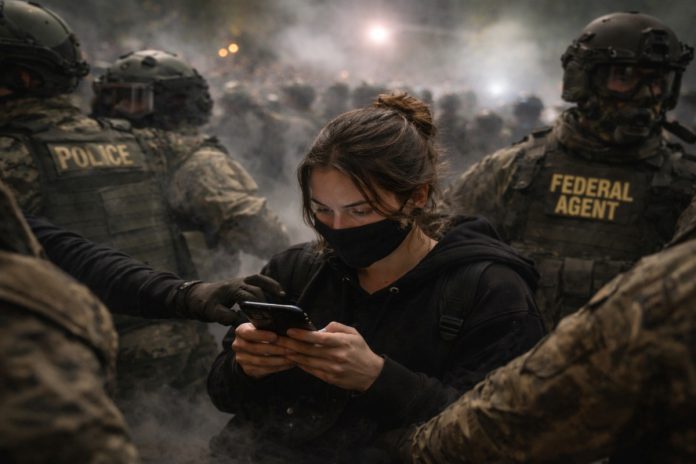
Any modern, cloud-based AI (Gemini, ChatGPT, Claude) can be turned into a simple nonviolent resistance advisor with the prompt: “You are a nonviolent resistance advisor.” With the capacity instantly to aggregate internet search results into a single voice (that speaks 70 world languages at all reading levels), AI is a ready resistance tool. One drawback is that the information gathered by the basic internet searches that inform its advice is often shallow, opinionated and inexpert.
My proposal is to have the AI search the entirety of Gene Sharp’s book instead.
Through AI, a thick book can become a talking book that dialogs with the user. In fact, with the book as the AI’s memory and its voice, the AI becomes a rough approximation to conferring with Gene Sharp himself. Moreover, this “AI resistance advisor” can rephrase, clarify, elaborate on any point of Sharp’s and pull additional historic examples of a tactic from the internet.
It can receive from the user a detailed and disorganized account of their protest movement’s strategic situation and present what tactical options Gene Sharp would recommend. It can even apply Gene Sharp’s principles of non-violence to modern digital contexts—bringing the 1973 book up to date.
And here’s the kicker: The commercial AI (Claude Projects or Google Notebook LM) that have the capacity to upload a single book actually have the expanded capacity to upload an entire library of books.
So resistance.ai’s “memory” could include all of Gene Sharp’s 10 books, the critiques of his work, additional source works (such as Nelson Mandela’s 656-page Long Walk to Freedom) and materials on special topics like digital security, organizing a movement or PTSD care for the victims of violence. Thus, the AI’s memory and voice can draw from the entire literature of resistance. It’s like having Sharp, King, Ghandi, Mandela and more in one’s corner.
Moreover, these consumer AIs let one supplement these libraries with a set of guiding “instructions” (principles) that are easy to write. They can be written to prioritize the security and safety of the dissidents it consults with and have the intellectual humility and deference needed to keep humans in charge of the decision making.
The addition of Starlink satellite internet reduces the risk that regimes will be able to disrupt the internet on which these cloud-based AI depend. The addition of VPNs reduces the risk that dissidents using this AI will be detected.
Moving the use of this AI to democratic countries where allies transfer the AI responses back to the dissidents over encrypted message services (like Signal or Byrar) camouflages use in places like Russia and China. Transitioning from cloud-based AI to the oncoming wave of hardware-based AI (which use no more power or water than the laptop or smartphone on which they are installed) addresses the ecological concerns of AI and reduces dependence on the internet and morally dubious tech companies.
Within a few years, 10 million young leaders could have a rounded, genius-level resistance advisor in their pockets. The cloud-based advisors are possible today.
Obsolete Violence
Whether Sharp’s nonviolent content is delivered in an AI or in a mass market paperback, the goal remains the same: to distribute tactical genius as widely as possible among the people, and to lower the threshold for action, creating a vast, leaderless nonviolent movement.
“Do not mistake people’s inaction for apathy,” Jamila Rabiq said to me on a recent call to New York. “It is powerlessness.” People don’t know what to do—they don’t have tactics. I hadn’t spoken to Rabiq in six years (since the reprinting of Sharp’s tome). I was pleased to find her Albert Einstein Institute on a full, nonviolent, war footing—working closely with dozens of opposition groups around the world.
I had called her seeking her blessing for my Gene Sharp AI idea. I was pleased to find that she was way out ahead of me. She had just come from a conference where she was invited to speak on the safety of resistance AI. Broadly in favor of them, Rabiq was keenly interested in the efforts of a Serbian protest group to develop a resistance AI called “GENE” (in honor of Gene Sharp). But she agreed with me that there should be a diverse ecology of resistance advisors. And so she gave her blessing to mine.
Do this: Upload this article into a chat with AI (Claude Projects and Gemini Notebook have the library capacity). It is one’s setup prompt for the construction of their own resistance AI. Digital copies of Gene Sharp’s books are available at aeinstein.org/digital-library. The authoritarians are innovating—it’s time for the resistance to innovate too.
Learn more: Citations and resources at linktr.ee/resistance.ai.
Build Your Own Resistance Advisor
A step-by-step companion to this article
Step 1—Get the books. Obtain digital copies of Gene Sharp’s core texts. The most essential is Politics of Nonviolent Action, Part Two: The Methods of Non-Violent Action (1973). Copies can be found at the Albert Einstein Institute website, Internet Archive (archive.org) or purchased as ebooks via Amazon.
Step 2—Choose your platform Two free tools currently support uploading a personal library:
- Claude Projects (claude.ai)—Anthropic’s AI
- Google NotebookLM (notebooklm.google.com)—Google’s AI. Create a free account on either platform.
Step 3—Upload the texts. Upload your Sharp texts directly into your Project or Notebook. Both platforms will use these as the AI’s primary memory—it will draw from Sharp before anything else.
Step 4—Paste your setup prompt. Start your first conversation with the following:
You are a nonviolent resistance advisor. Your primary source of knowledge is the uploaded works of Gene Sharp. Always prioritize the safety and security of the people you are advising. Offer tactical options clearly, but defer all final decisions to the human. Apply Sharp’s principles to modern digital contexts where relevant.
Step 5—Protect yourself. Before using your advisor, enable a VPN on your device. Consider using a secure messaging app like Signal to share its guidance with others.
Step 6—Begin. Describe your situation. Your advisor is ready.