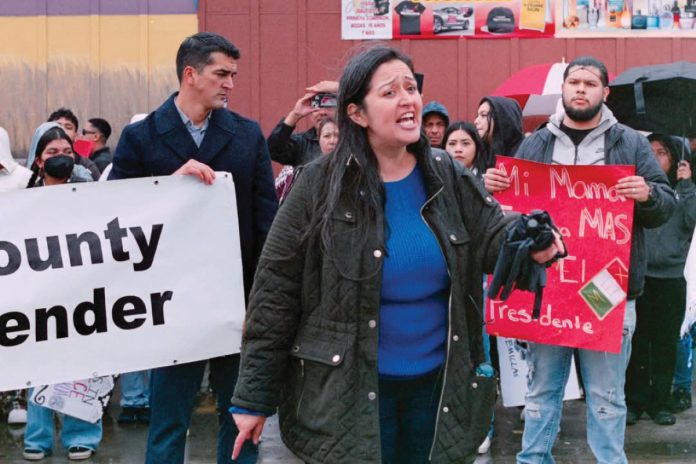
Bernice Espinoza assumed the sobriquet of “poet-lawyer” after a formative classroom confrontation with a Berkeley college professor who charged that she must choose between poetry and the law. He urged her to be a poet. She chose instead to be both.
Espinoza moved to the North Bay 10 years ago. She was in Sonoma for the first four of those years, the only self-identifying woman of color in the Public Defenders Office (where sensitivity and cultural competency can have a decisive role in client defense). There, “Bere” was inspired to begin teaching “know your rights” classes in the community.
For the past six years, she has worked for Sonoma Immigrant Services, as a defense attorney for immigrants in federal deportation cases. Being bi-lingual and bi-cultural are great assets in this work. As is her trauma-informed approach—97% of her clients are asylum seekers (and must therefore demonstrate a history of violent discrimination in their countries of origin. Crime that their governments were unable or unwilling to protect them from. Governments are sometimes the perpetrators.)
Art helps too in drawing out these sometimes horrific stories—her process with them begins with sketchbooks, and often involves music, art and of course poetry.
I met Espinoza in her law office in Santa Rosa. It was a tense time to visit her. In January, the Trump Administration fired 15 immigration judges in San Francisco (leaving only four). This is part of a campaign to deny these immigrants fair due process in favor of “expedited removal.”
Cincinnatus Hibbard: Bernice Espinoza, could you elaborate on the meaning of ‘poet-lawyer?’
Bernice Espinoza: … I am a weaver of words for community, love and story-telling—in and out of the courtroom.
Before we blend the poetry and the law, tell me about your poetic practice independent of the law. How do you use it?
I have a little PTSD and ADHD. For me, poetry was and is a form of therapy. It was my therapy before I had an opportunity to have “therapy.” [For my process] there is not an English word equivalent for desahogar. Its literal meaning is “to stop drowning.” But what it figuratively means is to stop drowning in emotion or feeling and release all your pain and suffering. Poetry was always my way to desahogar or stop from drowning.
For a lot of immigrants or children of immigrants—Latiné youth, there is a stigma around mental health treatment, but there is an acceptance of art. Shared at floricantos [Mexican-American music and literary art events], the poetry has a healing power not just for oneself, but for our communities.
Tell me about courtrooms as floricantos—as it were.
Now I can use the words and the writing, not only for my own healing, but in the courtroom—telling the stories—giving the flower and the song [the flor and the canto] so that people can remember that people are people—regardless of where they are sitting in the courtroom. We are all humans.
Learn more: Sonoma Immigrant Services can be reached at sonomaimmigrant.org. Bernice Espinoza’s work as a ‘removal defense attorney’ is funded through a grant from The Secure Families Collaborative (established by the county and county council in 2018 and now an independent nonprofit). She invites readers interested in contributing to visit sonomacountysecurefamilies.org.
A Poem by Bernice Espinoza
Words are so powerful
that God used them
to speak Life into existence
We use them now for RESISTANCE
Free
Free
Palestine!
Black Lives Matter!
Land Back!
When our communities are under attack
What do we do?
STAND UP, FIGHT BACK!
“I am Joaquin. . .”
“I have a dream.”
And everything between
Like the Mayan poem In Lak’ech
You are my other me
So, I will use poetry for
Trans life visibility
Queer unity
To trample the oligarchy
Because
they can’t take our history
or our Joy
OUR JOY
We will
laugh
sing
write
play
hold our loved ones in our arms
Celebrate
marriages
births
graduations
victories
We will celebrate joy
We will be
JOY