Under the Skies

0

‘I would rather be a superb meteor, every atom of me in magnificent glow, than a sleepy and permanent planet.”

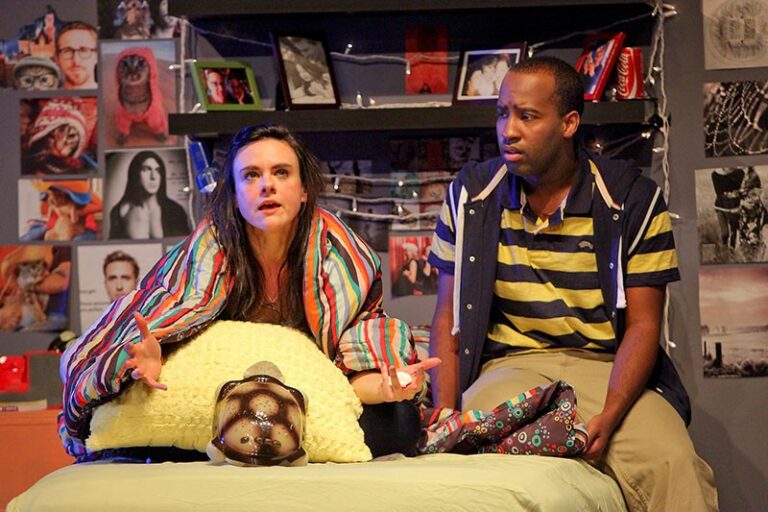
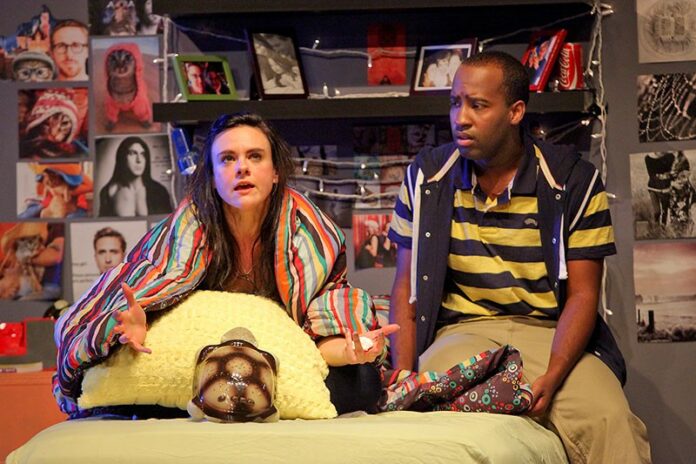
With this quote from Jack London, Transcendence Theater Company kicked off its second season of Broadway Under the Stars last week on a warm, breezy evening at Glen Ellen’s Jack London State Park. Recited by artistic director Amy Miller, those stirring words have become the traditional opening for TTC’s revues, held within the roofless ruins of London’s stone-walled winery.

Titled Fly Me to the Moon, the company’s first two-weekend-long show of the season will be followed later in the summer by Fantastical Family Night (July 19–20), the variety revue Dancing Through Life (Aug. 9–17) and the season-ending Gala Celebration (Aug. 30–31). All shows feature an assortment of singers and dancers culled from the world of professional theater.

Fly Me to the Moon—the theme partly inspired by the surrounding Valley of the Moon—mixes 30 songs (some classics, many less familiar) with dance routines and the occasional literary quote. Last year, the company established this unique blend of first-rate entertainment served up with a dash of old-time revival energy, using the music of Broadway to illustrate the life-changing power of pursuing one’s dreams and the necessity of taking chances.

It’s a powerful recipe.

Starting with a rousing opening that combines snippets from The Sound of Music with “The New World,” from Jason Robert Brown’s Songs for a New World, the otherwise sensational opening was marred a bit by some microphone issues, which persisted occasionally throughout the show.

Fortunately, nothing interfered with Stephan Stubbins (the company’s co-executive director) and his magnificent, deeply felt rendition of “As If We Never Said Goodbye” from Andrew Lloyd Webber’s Sunset Boulevard. It’s amazing how many surprises can be discovered in a well-known song when presented by a truly gifted performer.

Other highlights, in a show full of them, include Morgan Karr’s giddy, energetic performance of “In These Skies” from Taylor and Oberacker’s aeronautical adventure Ace; the brilliant Carrie Manolakis’ miraculous turns with Scott Alan’s beautiful “Never Neverland” and Leonard Cohen’s “Hallelujah”; and Nili Bassman and Kurt Domoney’s impressively flirty “Shall We Dance” (from George and Ira Gershwin’s Crazy for You), reminding us how much fun it can be falling in love.

Clearly, TTC remains committed to presenting shows that, like London’s “superb meteor,” light up the night, while setting fire to the hearts and imaginations of those lucky enough to witness it.

‘Broadway Under the Stars’ runs through Aug. 31 at Jack London State Park, 2400 London Ranch Road, Glen Ellen. All shows 7:30pm. $29-$117. For full info, see www.broadwayjacklondon.com.

Gone West

The North Coast painter Peter Onstad has a story he likes to tell. It was Nov. 22, 1963, and he and a friend were walking down a Berkeley street. A boy ran past them and shouted, “The president’s been shot!”

Most Americans tearily gathered around television sets and radios. But not Onstad and his friend.

“We had bigger fish to fry,” Onstad remembers. “We had an appointment with Richard Diebenkorn!”

That meeting Diebenkorn would be an appointment more urgent to Onstad than learning the details of President Kennedy’s assassination is but a small surprise to those who care about fine art.

Diebenkorn is set for a mini-reniassance of sorts in the North Bay and beyond, as two new exhibits open and two locally published books see release in the immediate future. To those same people who care about fine art, this is no surprise at all, a deserving recognition of the man who, before his final years in Healdsburg, left a legacy that’s still being rediscovered.

Arguably the most important painter to come from California, Diebenkorn was raised in San Francisco and fated to attend Stanford, where his father fervently hoped he would put away what he termed his son’s “fine avocation” and instead study something real, like medicine or law. But having seen a van Gogh at the de Young Museum with his grandmother in 1936, Diebenkorn was one of those rare folks who knew early on what he wanted to do with his life, and that was to paint. After Stanford, he enrolled in the California School of Fine Art, now known as the San Francisco Art Institute. His first one-man show was held at San Francisco’s Legion of Honor in 1948 when he was just 26.

Influenced by Willem de Kooning, as well as Matisse and Cezanne, Diebenkorn came of age just after WWII, when abstract expressionism held sway among young artists, mostly men well into their 20s who were just back from the corps, ready to attend college on the GI bill, and who brought with them the rage and loss of an unwanted early maturity amid gruesome war. Figures were exploded, backgrounds receded, rules were broken, everything changed.

Diebenkorn was quickly swept up into the San Francisco ab-ex movement in league with Clyfford Still, David Park, Frank Lobdell, Hassel Smith, Horst Trave and others. His daughter Gretchen remembers that as a time when, if you saw a figure in a painting, you never mentioned it. Representation was forbidden; emotion was all.

As always, the art community was divided, with New York painters claiming abstract expressionism as their own, and West Coast painters having to add the geographical descriptor “San Francisco” to the name. But in his 1997 American Visions PBS project, the great art critic Robert Hughes put the record straight.

“To me, the best abstract painter of the time wasn’t in New York at all,” Hughes intoned. “His name was Richard Diebenkorn, and he lived in California. He painted some of the most intelligent responses to Matisse that any American had done.”

[page]

By 1950, Diebenkorn moved his wife, Phyllis, and their family to New Mexico while he pursued a masters degree. By 1953, they were back in the Bay Area, settling into a comfortable house in the Berkeley hills, where they were to remain for the next 13 years. He moved again, in 1965, to Santa Monica, where he would produce his Ocean Park series of abstracts, the best-known suite of work in his oeuvre. Diebenkorn retired to Healdsburg’s Alexander Valley in 1988, and lived there until his death in 1993.

Hugely celebrated, the Ocean Park series was honored in a massive 1997 exhibit emanating from the Whitney Museum that traveled to the San Francisco Museum of Modern Art, among others. A piece from that period, Ocean Park No. 117, sold at a Christie’s auction in 2009 for $6.5 million, just shy of the $6.7 million that marks his most expensive canvas.

The work, both figurative and abstract, that Diebenkorn produced during his East Bay tenure is less well known. That oversight has been remedied with “Richard Diebenkorn: The Berkeley Years,” a lush, stunning new exhibit at the de Young Museum running through Sept. 29.

“It was during this period that Diebenkorn really became Diebenkorn,” argues Timothy Anglin Burgard, the Ednah Root curator-in-charge of American art at the de Young.

“His artistic integrity rendered him immune to external pressure to conform to either abstract or figurative styles, and set a liberating example that seems remarkably prescient given the inclusive nature of the contemporary art world.”

Not to be outdone, the College of Marin art gallery is undergoing a summer facelift in order to host a 40-piece show of Diebenkorn’s works on paper this September in conjunction with two new books on the subject introduced by painter Chester Arnold, a longtime COM faculty member, and produced by novelist Bart Schneider through his Kelly’s Cove Press.

The Bay Area could be said to be suffering from a delicious delirium of Diebenkorn fever.

Seated at the outside table of a Sonoma cafe one early morning last month, Arnold and Schneider allowed a visitor to admire the two books they have produced. One, From the Model, concentrates on Diebenkorn’s figures; the other, Abstractions on Paper, on his nonrepresentational pieces. Each is small enough to slip into a purse or read in bed, and cost just $20 apiece.

Seeing that the de Young was preparing to mount a large exhibit, Schneider thought to produce an accompanying book centering on Diebenkorn’s 4,000 or so works on paper. He approached the Richard Diebenkorn Foundation about the project and, he says, “they kind of lit up. That great work is just sitting there in their databases.”

Schneider asked Arnold to help him choose the images and write a short introduction to each book. Arnold asked the College of Marin to mount a show. Things started rolling. After Kentfield, it will travel the country.

Arnold, a highly regarded painter just returned from a one-man exhibit at the Katzen Arts Center in Washington, D.C., remembers that he first saw Diebenkorn’s work in reproduction. It caused what he calls “a spark.”

[page]

“That’s why I think that these books are so important,” Arnold says, sitting over a cappuccino. “You don’t need to see an original to get a spark. And that spark was something that really appealed to me. I was doing a lot of figure drawing at that time. Not that I patterned myself after him, though I did go through a Diebenkorn period in the late ’70s, I have to say.

“After the Ocean Park series came out, I started to rethink lots of composition and my use of diagonal. It was born from a tremendous admiration for someone who was a lot more refined than I thought I would ever be. It’s elegant, thoughtful, profound—transcendent.”

Schneider adds, “I think it’s a combination of really richly imaginative work, but it has a coherence to it, you know. Somehow, we can approach it. And,” he shakes his head, “it’s so damn handsome.”

The works on paper held by the Diebenkorn Foundation are all digitized and include pieces perhaps no one has before seen, stuff hidden in drawers, scraps from the studio floor. After choosing the work, Arnold wrote a grant to have the works framed and readied for shipping.

But choosing the art was all the fun.

“It was much easier than I had originally thought,” Arnold says. “Visually, [Schneider and I are] very much on the same page. We just sat together at the computer, and in a few hours, we had done the first cut. The difficult thing for me to get my head wrapped around was, ‘Here I am, sitting here, cutting Diebenkorn?’

“It’s an embarrassment of riches,” he laughs, “but someone had to do it. We tried to pick pieces that had some kind of unique spark to them or that were particularly good versions of all the different genres he was exploring from those early ink things to the collages with the cut-outs.”

The College of Marin show will open just before the de Young show closes.

“In some ways, for purposes of clarity and appreciation, to see a small show like that of really beautiful drawings is a really unique way of appreciating what he did,” Arnold says, “just as these books are, because they’re closer in size to the actual work, and will start to feel closer to the real feeling that’s coming off the work.”

In his recent review of the de Young exhibit, San Francisco Chronicle art critic Kenneth Baker derides the show as having “the opposite of its intended effect of boosting the artist’s stature,” arguing that by focusing on Diebenkorn’s Bay Area years, the museum gives yet another boost to the “cultural prejudice” in favor of New York and European artists.

The group at the cafe table just sighs.

“Do you call a mathematician from California a ‘California mathematician?'” Schneider quips.

Arnold, who was raised in Germany but has long resided in California, has surely felt the sting of this “cultural prejudice” before. He takes the long view.

“It’s only New Yorkers who have to do that; they build a fortress around themselves,” he says calmly.

“I always characterize California artists as being the weeds in the garden with deep tap roots, and the New York artists as being the orchids in the hothouse. They’re expensive, they take a lot of high maintenance, and, after all the dust settles, we’re still here and we’re still grounded, pulling out the foxtails.”

Housing Alert

0

A new disclosure form given to Marin homebuyers is the latest fault line in a Richter-topping controversy over regional zoning laws and affordable housing.

The Marin Association of Realtors’ form informs potential homebuyers of usual disclosures such as pesticide-spraying, potential fire hazards and wastewater regulations. But on page 13, in a new clause adopted in May, it also addresses nearby housing developments.

Fair-housing advocates worry that adding affordable housing to a list of mostly negative disclosures, including the presence of lead paint and any prior death on the property, could have NIMBY implications.

“From time to time, the county, city and towns of Marin identify areas of Marin for possible developments,” it reads. “Real estate brokers and their agents are not responsible for investigating or identifying properties which may be rezoned or affected by future developments.”

It’s hardly inflammatory language, but the environment into which it slips is very much heated.

The document was updated around the same time the Marin Association of Realtors announced its opposition to One Bay Area, an ambitious, controversial effort by regional planning hub the Association of Bay Area Governments (ABAG) to encourage smart growth. As the Bohemian has previously reported, One Bay Area was motivated by SB 375, California’s statewide senate bill that discourages commuting and sets emission reduction goals through infill and city-centered growth. According to studies funded by foundations in Napa and Marin, the idyllic, open-space-worshipping North Bay is in dire need of such a push: 60 percent of Marin workers and 30 percent Napa workers commute in daily from Sonoma, Solano, Alameda and other places where the cost of housing isn’t nearly as high.

But the plan—which would zone for 2,292 new units, including low-income housing, between 2014 and 2022—has been lividly debated in Marin. Some groups, like Citizen Marin, voice fears about high-rises and big-development interests that could radically alter the parks and oak-lined hiking trails residents now enjoy. Other groups have voiced dissent in more radical ways; Corte Madera voted to withdraw from ABAG altogether in 2012, and earlier this year another citizen group began collecting signatures to recall county supervisor Susan Adams.

Though it is the wealthiest county in California, Marin has been notoriously reluctant to zone for low-income housing in the past, spurring at least one lawsuit. Novato’s 2011 attempt to update its housing element was an almost frenzied affair, in which townspeople—most of them, like Marin’s 80 percent majority, white—packed the meeting hall, many lambasting the gang-banging, drug-using, sex-offending others that would supposedly come with their rent-controlled homes. Speakers pushed to segregate these perceived projects across the freeway, away from homeowners and their children—one going so far as to suggest that housing for “them” should be kept safely “in the desert somewhere.”

The five councilwomen eventually zoned at a lower number than they were supposed to in an effort to “push back” against ABAG, and even zoned land with existing businesses on it, one of which said publicly that it did not intend to sell.

[page]

It’s in this charged political climate—which has divided defenders of green open-space from advocates for green growth and sparked protests with signs reading “End Apartheid in Marin”—that a simple clause like the one released by the Marin Association of Realtors becomes a big deal.

“This is very much an issue that we are concerned with,” says Caroline Peattie, executive director of Fair Housing of Marin. “A disclosure means something negative is involved. You disclose that there’s lead paint. When you disclose a potential affordable housing site, you’re saying it’s bad.”

Peattie says Fair Housing of Marin is less worried with the new disclosure and more concerned with a prior legal form drafted by Bradley Real Estate, which specifically cites affordable housing and proposed zoning sites.

Robert Bradley, CEO of Bradley Real Estate, believes the company had a legal responsibility to disclose what he calls a massive rezoning of the county.

“A disclosure is anything that will have a material effect on the desirability of the property,” he says, adding that a large development in a neighborhood of single-family homes could do just that. He also voices concern about how a below-market-rate property could affect an area where schools and city resources are shared, but inhabitants aren’t paying property taxes.

His wife, Melissa, echoes his statements, citing a slogan she’s heard repeatedly in her 20-year real estate career: “When in doubt, disclose.” She says she’s surprised that the larger Marin Association of Realtors has not previously made zoning changes an issue of disclosure.

“We count on our board for updates on how things are going and what new info we need to disclose,” she writes in an email.

Edward Segal, CEO of the association, said there was no connection between the Bradley document and his association’s disclosure, which was voted on by a task force within the organization. He would not state who was on the task force.

“It was just for the sake of being current with all the talk and public discussion and debate,” he says, denying that the association is somehow taking a political stance on the explosive issue.

Michael Allen, a civil rights attorney working with Marin Fair Housing, says that no matter the intent of the disclosures, they could easily become a self-fulfilling prophecy. He explains it cyclically: perception that affordable housing will lower property values could make a neighborhood less desirable to buyers and that, in turn, could lower property values.

“Each of them has the effect of suggesting there’s something wrong with affordable housing,” he says. “The effect in the real world is going to be negative on affordable housing and negative on integration in Marin.”

Allen says he doesn’t see a precedent for this kind of notice in California real estate disclosure law. A perusal of the law reveals many examples—asbestos, flooding, radon gas—that are, in fact, negative. According to Bradley, his notice is an attempt to get information out into an atmosphere that has been politicized to the point where simple facts are lost.

“It’s like there’s a Fox News and an MSNBC, but no CNN,” he says of the cataclysmic debate.

In the meantime, most of the county’s workforce commutes in, clogged freeways spew emissions, and the state’s wealthiest county remains economically and racially segregated—with few places for its workers to live.

Spy vs. Spy

0

In the midst of the continuing conversation about Edward Snowden, the former CIA and NSA employee who leaked information about the government spying on U.S. citizens, the New York Police Department has been found using less than ethical practices with surveillance as well.

After 9-11, the NYPD, according to reports in many major papers, employed four CIA agents to track suspected terrorists. However, because one of these agents was on a leave of absence, he had, according to a story from The Atlantic, “no limitations.”

Following the news stories on data-mining and government spying has been interesting on many levels. Discovering just how closely the public is watched and realizing that many conspiracy theorists have been right after all seems to have blown our minds. But how surprised should we really be? There are complaints about private companies providing information to the government, but in an age of oversharing trackable information online, it’s no surprise the government is watching.

Of course, there’s also that pesky Patriot Act.

We put so much information out there, forgetting that our social profile impacts us in the real-world—and forgetting that once it’s out there, it’s out there for good. This is not a new concept, but the issues are getting more relevant as more interaction takes place online. The phrase “what happens in Vegas stays in Vegas” can be adapted to say “What happens on the internet stays on the internet—forever.”

The California Senate believes this to be true, particularly for youth. In May, the senate unanimously passed an online privacy bill aiming to protect children from themselves. It included provisions for giving minors an “eraser button” with the ability to permanently delete “content or information” supplied to websites and apps. Sounds great. But who knows if this is even viable?

While I believe Snowden did a huge service in revealing the NSA’s reach, that the government lied about these surveillance programs is more disturbing than their existence in the first place. If the technology is there, it’s unlikely the government will stop using it. People ask over and over, what can be done, why aren’t there protests?

If you don’t want the government watching you, the best protest is to go offline, where they can’t see.

Love Prevails

0

Bill Rousseau hadn’t married a gay couple since 2008. But in his office at the county clerk last week, sure enough, his phone started ringing again.

Following last Wednesday’s Supreme Court decision effectively overturning Proposition 8, the gates have been reopened for Rousseau to issue licenses for and to conduct legal same-sex marriages in California. It’s something the Sonoma County clerk-recorder-assessor had been eagerly awaiting, and he’s not alone.

On Monday, the hallway of the clerk’s office teemed with couples in line when the doors opened at 8am. Not long after, Katie and Amy Evans-Reber became the first couple married—by Rousseau himself. Throughout the day, more couples wed, like Wanda and Susie Johnston of Lake County, above.

Rousseau remembers being an officiant in 2008, describing it as a celebratory time. “As the officiant, I felt very honored to be able to perform some of those services. There were couples that had been together 20, 30 years, finally getting married,” he says.

For the next couple of weeks, Rousseau predicts a near-constant stream of happy spouses-to-be. “We’ve got a couple wedding rooms, and we’re going to get some more as this thing develops,” he says. “We’ve got a couple of nice arbors at the clerk’s office that we can do for outdoor ceremonies as well. And we’re going to look for more depending on the demand.”

Same-sex couples can start the marriage process by filling out a marriage license application online through the county office’s website, where fees for licenses and ceremonies are also provided. Those rushing to the clerk’s office should remember that both parties must be present to receive a license, and for ceremonies, a witness is needed, Rousseau adds. And, yes, there may be a wait.

West End Farmers Market

0

Gloomy weather didn’t keep the crowds away from opening day of the new West End Farmers Market on Sunday, June 23; in fact, according to Allen Thomas, one of the event organizers, approximately 500 people came through to check out the goods from 30 vendors>

Santa Rosa’s newest farmers market includes organic veggies and flowers from Bloomfield Farms and Tusque Farms, sustainably raised eggs from Wise Acre Farm, fresh organic strawberries from Yerena Farms in Watsonville, coffee from the Arlene Francis Center Cafe and grass-fed beef burgers prepared on the spot by Guerilla Food.

“It was absolutely successful,” said Jessica Rasmussen of Criminal Baking Co., who had sold out of nearly everything by the end of the day, praising the market’s family environment and great turnout. “I hope we can keep this momentum going,” she added.

Behind her, families lounged on the lawn aside the DeTurk Round Barn, talking, laughing and enjoying the energy of the commons on a Sunday morning—like a slice of Dolores Park brought to a little patch of Santa Rosa. And while some were skeptical that Santa Rosa has the population, or consumer base, to support four farmers markets—with successful versions already in place at the Wells Fargo Center, the Veterans Memorial Building and the Wednesday Night Market—the numbers show that there’s always room for more community in Sonoma County. The West End Farmers Market runs every Sunday through Oct. 27. Donahue Street between West Ninth and Boyce streets, Santa Rosa. 10am–2pm. 707.477.8422.

William Harrison Winery

0

Exactly when, in the course of human events, does it become necessary to ask, “What wine pairs best with barbecue?” What I’m getting at, of course, is “With what wine shall we celebrate a merchant class tax revolt with Enlightenment gloss against a kind of tyrant acting with the assent of more than 50 percent of a restive bicameral legislative body ‘cross the pond?”

Zinfandel comes to mind, not least because it’s fun to say. Norton is more on point, but for the name—no fireworks. Amidst all this, William Harrison rides to the rescue like some Paul Revere, advertising on his Silverado Trail sign, “American Owned.”

Inside the tasting room, housed in an attractive Spanish colonial California-style stonework winery, I’m told that owner Bill Harrison once had second thoughts about his sign. The people revolted, though, so he put it back up. And the sign has a point: a good portion of the Napa Valley has been bought up by British, French, Spanish, Australian, and now Chinese and Chilean and Constellation overlords. One can hardly accuse them of a long train of abuses and usurpations—mostly they are hawking high-end hooch for ready buyers—but the line at this bar is firm: “We’re just proud to be American-owned.”

No shots have been fired in this revolt, unless you ask the stuffed bear and wild boars to the left of the bar, who look as if they would like to add something to the discussion. Harrison’s grandfather Antonio Perelli-Minetti immigrated from Italy in 1902 with little but a winemaking degree in hand, then grew a 20th century wine empire. In the 1980s, Harrison believed that mobile bottling lines were the future, and, after dozens of brush-offs, founded Estate Bottling.

With a touch of antique furniture to the aroma, the 2011 Carneros Chardonnay ($32) jives with the sepia-toned vibe of the place, but the palate bursts with buttered, baked pears. A vertical tasting of Estate Cabernet Franc is the main event here. The 2008 Cabernet Franc ($45) is a warmer, more appealing version of the angular 2007—all pencil lead, pumice stone and plum. The 2008 Estate Cabernet Sauvignon ($50) tops them all with a floral interpretation of Cab aromas, and a juicy, tense palate. Yea, even this Napa patriot is in thrall to the king of grapes—but what nation’s wine drinkers anointed that tannic, tooth-staining tyrant to the throne? Avid tea importers who also ran Bordeaux for centuries . . . as . . . a . . . colony.

William Harrison Vineyards and Winery, 1443 Silverado Trail, St. Helena. Daily, 11am–5pm. Tasting fee, $15. 707.963.8310.

Love at Last

0

All the images of people getting married at the Sonoma County Clerk’s Office on July 1—a few short days after the Supreme Court’s historic ruling in favor of gay marriage—are a joy to behold. Ecstatic couples, many with decades of relationship behind them, smile through tears, kissing and holding up the rings that make it official.

The excitement brings to mind my own wedding day in 2008, when my husband and I said “I do” on a bluff in Salt Point overlooking the Pacific Ocean, surrounded by our family and friends. It stands as one of the best days of my life. At the time, because ours is a heterosexual marriage, we had no trouble heading down to the clerk’s office to get our marriage certificate. I still remember the rush of excitement as we signed the official documents, making our marriage “legit.”

A mere 50 years ago, my marriage would not have been recognized as legal in 17 states, solely because I loved someone of a different race; our five-month old daughter would have had parents that could not marry because certain people—I’m looking at you, Harry Truman—deemed marriage between races to be wrong. Seems ridiculous, right? But it wasn’t until 1967 that the U.S. Supreme Court deemed anti-miscegenation laws unconstitutional, making interracial marriage legal across the entire country. Now, people don’t even bat an eye, at least in the Bay Area, at mixed-race couples. But it wasn’t always that way.

The argument against gay marriage goes along the lines of “Marriage is between a man and a woman,” but in the not-too-distant past it was “Marriage is between a white man and a white woman” or “Marriage is between a black man and black woman,” and on and on. Fortunately, last week, we saw a moment of sanity and grace in American history with the dismantling of DOMA.

I look forward to a time, 50 years from now, when we look back and say, “Remember when same-sex marriage was illegal? How crazy was that?”

Leilani Clark is a staff writer at this paper.

Open Mic is a weekly op/ed feature in the Bohemian. We welcome your contribution. To have your topical essay of 350 words considered for publication, write op*****@******an.com.

Letters to the Editor: July 3, 2013

In Support of Libraries

I use the libraries in Sonoma County and contribute to Friends of the Library in Rohnert Park. I was very disappointed when the libraries closed on Mondays system-wide, affecting school children and people looking for work using the computers. I am in agreement that the libraries should return to the Monday availability—if not every Monday, then perhaps in some areas the first and third Mondays of the month, and in other areas the second and fourth Mondays of the month.

Thank you for running the piece, and hopefully the community and the county supervisors will work with the joint powers to restore at least some of the availability of the libraries.

Santa Rosa

If library is a place where one maybe reads some magazines and gets to take home free books and recordings, then I agree with the county officials, we have more important things to worry about. If library is a people’s meeting place, a classroom for small children, a spot to have short afternoon nap or the most convenient public restroom in town, then perhaps we should rethink the hours.

Via online

Editor’s note: Six days after our cover story on library closures and mismanagement, Sonoma County Library director Sandra Cooper announced her retirement.

Wages and Tips

In the letter titled “Tip Away” from a Ms. Scruggs in the June 19 issue, she refers to “wine stewards,” which is a term normally associated with sommeliers in restaurants. Having worked in the industry in various Michelin-starred restaurants, I can assure you that any fine dining establishment that can have a sommelier does not pay him or her $12 an hour, as Ms. Scruggs claims. They are usually in management and in charge of wine purchasing, inventory, pricing, wine list production and updates, etc., and make a considerable salary—in addition to bonuses and in many cases being in the tip pool that gets divided between waiters, bussers, bartenders and food runners.

If she is referring to tasting room associates and “wine educators” (as they are sometimes called), that is completely different, and in most cases they earn between $15 and $20 as a base salary plus commissions on wine sales. To compare this salary range to that of a typical Denny’s worker (a company often cited for employing illegal workers at below minimum wage) is misleading and disingenuous, to say the least.

If you want to leave an additional gratuity for a sommelier (wine steward) or a tasting room associate that is fine, but it is not the norm, nor is it required.

Healdsburg

It Can’t Be That Much Work

I deplore the social psychology of those who are fortunate enough to belong to the Hundred Thousand Dollar Club who feel that they have to automatically defend anyone else in that pay bracket. Is it because they are not sure of their own worthiness?

More to the point: Why does the Marin I-J feel that the Marin supervisors deserve a wage hike? Is it the $35 million they lost on the computer fiasco? Their slavish bowing to ABAG and the MTC? Their tremendous giveaways to the consultant class?

The error of basing one’s pay on the other guy’s pay is what got us on the merry-go-round of astronomical CEO compensation. Public service should be its own reward. Consider all the really talented people in Marin who would be glad to take on the supervisors’ responsibilities. After all, with two or three full-time aides, it can’t be that much work.

The problem with running for the job is the political support purchased by incumbent supervisors with all the slush-fund cash they spread around. How can you beat that kind of campaign funding?

Let’s look at the Marin County median wage before going overboard with supervisor pay hikes. Next you will want to be buying each of them a new house.

Lagunitas

Write to us at le*****@******an.com.

Partake of Plenty

‘Guess what it is!,” enthuses my server, Jessica, whose raven hair matches the wine glass she’s just placed in front of me. The black glass conceals the tell-tale violet or honey-hued color of the liquid inside. Is it dry and prickly? Buttery and floral?

No matter what I find inside this “mystery glass,” one thing is clear: I am not here to idly imbibe; I am here, as the very name suggests, to partake.

The latest creation of Kendall-Jackson, Partake is defined as much by what it isn’t as what it is. Too gastronomically ambitious to be a tasting room, more wine-driven than a mere restaurant, Partake—just off the plaza in Healdsburg—bills itself as an eatery-tasting lounge, a place where food and wine exist to complement the other.

“We start with the wine,” executive chef Justin Wangler tells me, “and then create the dishes.”

Like Wangler, who’s worked at Kendall-Jackson’s winery for nearly a decade, the mystery glass has its roots in the tasting room. There, the “wine geeks” competed to see who could guess the unknown wine they enjoyed after their shifts. “We turned it into a contest,” Wangler says, “but it’s really about opening up and using your senses.”

My mystery wine turned out to be Kendall-Jackson’s Avant Chardonnay, whose brightness paired perfectly with a tart and creamy salad of fresh mozzarella, preserved lemon, summer squash and Castelvetrano olives ($9).

The white flights complement light, dainty offerings like the challah with Dry Creek peaches, crescenza and hazelnuts ($8). Already a house favorite, and not to be missed, are the caramelized carrots with guajillo chile and coconut ($6), paired with a Vintner’s Reserve Muscat.

Moving down the seasonal menu, the flavors get bolder and richer, the wines darker and heavier. The perfectly pillowy pork buns ($7) are made with Syrah grapeskin flour, and the tempura maitake mushrooms ($8) evoke all the earthy goodness of rained-soaked soil.

Highlighting the harvest of Kendall Jackson’s eight-acre garden, the menu offers a refreshing selection of veggies and fruits. A corn pudding with pickled mushrooms ($8) has all the rich decadence of bacon-laced mac and cheese, but without the meat or the gluten (or, ahem, the stale trendiness). Another unexpected treat? The unctuous Riesling and Chardonnay grapeseed oils, proud products of the “Whole Vine” philosophy, which easily push olives out of the limelight.

Diners are advised to save room for dessert. “The nectar of the gods” is how one winemaker describes the lush Grand Reserve Late Harvest Chardonnay, a fitting antidote to pastry chef Buttercup’s heavenly bite-sized mignardises ($10).

In the location formerly occupied by Shimo Modern Steak, Partake’s two main seating areas, both amply windowed, are understated and elegant. The creamy white walls are mostly bare, save for an ancient gnarled grapevine and a blown-up photo triptych of Alexander Valley. And in a playful nod to Rodin, local tattoo artist Adam Burns of Bad Billies has used a mobile chalkboard as a canvas to paint his version of The Thinker.

Backed by the sun setting over rolling vineyards, the iconic man with the furrowed brow has one hand tucked beneath his chin, the other holding—what else?—the stem of a mysteriously dark wine glass.

Partake, 241 Healdsburg Ave., Healdsburg. 707.433.6000.

Under the Skies

'I would rather be a superb meteor, every atom of me in magnificent glow, than a sleepy and permanent planet." With this quote from Jack London, Transcendence Theater Company kicked off its second season of Broadway Under the Stars last week on a warm, breezy evening at Glen Ellen's Jack London State Park. Recited by artistic director Amy Miller, those...

Gone West

The North Coast painter Peter Onstad has a story he likes to tell. It was Nov. 22, 1963, and he and a friend were walking down a Berkeley street. A boy ran past them and shouted, "The president's been shot!" Most Americans tearily gathered around television sets and radios. But not Onstad and his friend. "We had bigger fish to fry,"...

Housing Alert

A new disclosure form given to Marin homebuyers is the latest fault line in a Richter-topping controversy over regional zoning laws and affordable housing. The Marin Association of Realtors' form informs potential homebuyers of usual disclosures such as pesticide-spraying, potential fire hazards and wastewater regulations. But on page 13, in a new clause adopted in May, it also addresses nearby...

Spy vs. Spy

In the midst of the continuing conversation about Edward Snowden, the former CIA and NSA employee who leaked information about the government spying on U.S. citizens, the New York Police Department has been found using less than ethical practices with surveillance as well. After 9-11, the NYPD, according to reports in many major papers, employed four CIA agents to track...

Love Prevails

Bill Rousseau hadn't married a gay couple since 2008. But in his office at the county clerk last week, sure enough, his phone started ringing again. Following last Wednesday's Supreme Court decision effectively overturning Proposition 8, the gates have been reopened for Rousseau to issue licenses for and to conduct legal same-sex marriages in California. It's something the Sonoma County...

West End Farmers Market

Gloomy weather didn't keep the crowds away from opening day of the new West End Farmers Market on Sunday, June 23; in fact, according to Allen Thomas, one of the event organizers, approximately 500 people came through to check out the goods from 30 vendors> Santa Rosa's newest farmers market includes organic veggies and flowers from Bloomfield Farms and Tusque...

William Harrison Winery

Exactly when, in the course of human events, does it become necessary to ask, "What wine pairs best with barbecue?" What I'm getting at, of course, is "With what wine shall we celebrate a merchant class tax revolt with Enlightenment gloss against a kind of tyrant acting with the assent of more than 50 percent of a restive bicameral...

Love at Last

All the images of people getting married at the Sonoma County Clerk's Office on July 1—a few short days after the Supreme Court's historic ruling in favor of gay marriage—are a joy to behold. Ecstatic couples, many with decades of relationship behind them, smile through tears, kissing and holding up the rings that make it official. The excitement brings to...

Letters to the Editor: July 3, 2013

In Support of Libraries I use the libraries in Sonoma County and contribute to Friends of the Library in Rohnert Park. I was very disappointed when the libraries closed on Mondays system-wide, affecting school children and people looking for work using the computers. I am in agreement that the libraries should return to the Monday availability—if not every Monday, then...

Partake of Plenty

'Guess what it is!," enthuses my server, Jessica, whose raven hair matches the wine glass she's just placed in front of me. The black glass conceals the tell-tale violet or honey-hued color of the liquid inside. Is it dry and prickly? Buttery and floral? No matter what I find inside this "mystery glass," one thing is clear: I am not...
11,084FansLike
4,606FollowersFollow
6,928FollowersFollow