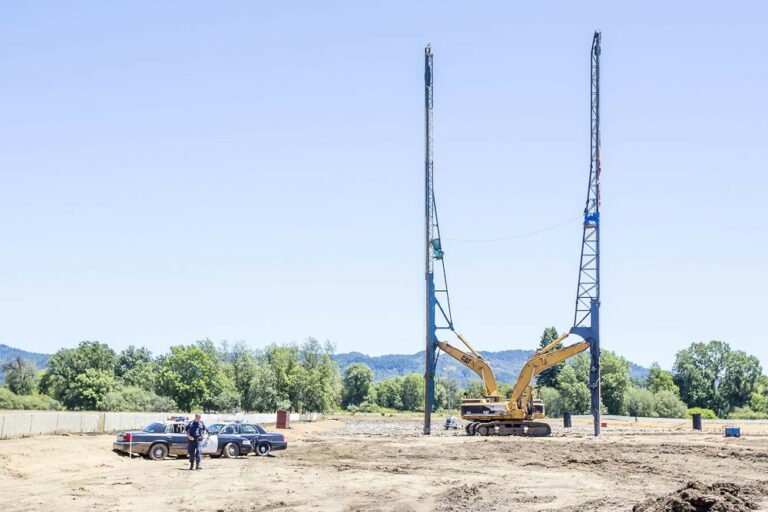
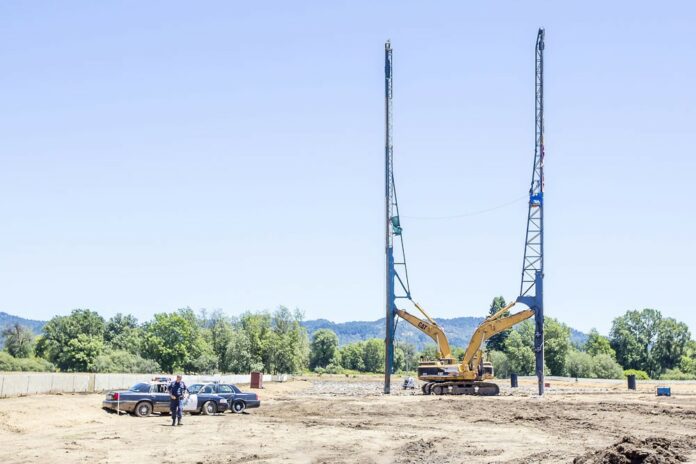
It was 5:45am, and Will Parrish sat on a thin platform 30 feet above the ground. He was exhausted. His plywood perch rested partway up a piece of drilling equipment called a stitcher, which looks like a narrow cell phone tower jutting a hundred feet into the sky. He’d wanted to climb higher—here, just above the Bobcat arm steadying the metal column, a cherry picker full of armed police could easily bring him down. But climbing even the stitcher’s base had been grueling enough to make him vomit, mostly because of what the longhaired Ukiah resident carried. Along with his platform, he’d shouldered a bucket, three gallons of water, a sleeping bag, a tarp, granola bars, an apple and a can of lentil soup. He planned to stay as long as he could.
Parrish, a reporter for Mendocino’s Anderson Valley Advertiser, was occupying the stitcher to protest a $300 million extension of Highway 101 known as the Willits Bypass. By the time he decided to climb a vertical drill in June of 2013, he’d had been covering Caltrans’ proposed diversion through Little Lake’s wetland for months, his detailed, investigative prose growing harsher and more cynical with every new piece he wrote. He’d narrated the ecological devastation it would cause—filling a wetland, clear-cutting pine groves and drying a seasonal lake.
He’d mapped out the politicians involved, traced their funding, found their regulators and uncovered multiple permit violations. He’d supported a two-month tree sit and watched as 25 squad cars full of armed riot police rolled into the valley to bring three activists down.
By June, bulldozers had arrived, pines were felled, and part of a hill had been scraped away. And Parrish rarely called the state agency by its name in his weekly installments, referring to it more often as Big Orange—each word bitterly capitalized to imply power that couldn’t be checked.
So against a growing background of high-profile journalists who have done the same, Parrish decided to become part of the story he was covering. His resolution to break into a construction site and occupy a stitcher—like Bill McKibben trespassing at Chevron or Glenn Greenwald helping Edward Snowden escape—blurs the ethics of a profession where impartiality has long been the sanctified norm. And it throws what happened eight days later—when Parrish was arrested, charged with 16 misdemeanors and slapped with a maximum of eight years in jail—into two conflicting narratives.
On the one hand, he crossed the sand-line from journalist to activist, knowingly trespassed and expected to be charged. On the other, he’d written about enough lawsuits, conflicting statistics and regulatory breaches to fill a book; he’d begun to feel that mounting a stitcher was the only option left. Like Greenwald and McKibben, he’d started to see direct action as the logical extension of his role.
It was mid-summer, so even at this early hour, the sun hung over the hills. A dense white mist was thinning in the morning brightness, and Parrish could see the arid dirt patch that surrounded him. It looked like the surface of the moon. Months before, it had been a wetland where fissure-thin creeks cut through marshy reeds. Those waterways had been the source of the valley’s name, Little Lake, because every winter they would flood and pool together in silver sheets that reflected the sky.
Now, thanks to the tower where Parrish sat, Little Lake would be just a name. Though resting at the moment, the giant blue column was drilling wick drains deep into the ground, where the synthetic channels pulled water from 80 feet of silt. Acres of them had already been installed, and their white tips poked out of the dug-up wetlands in neat rows, folded over black runners so they looked like hundreds of stitched-up wounds.
Thirty feet up, Parrish waited to see if he’d be taken down.
The Willits Bypass is a response to the bottleneck that occurs on 101 at the town’s southern end. Local cars and semis carting loads up the coast stall in a long, smoggy line at the town entrance, where 101 has historically passed under a welcome sign that glows neon green at night. From there, the freeway becomes Willits’ main street, complete with intersections and crosswalks. The snarl is a problem, a fact that few dispute. It’s dangerous, and because the highway becomes a surface street lined with restaurants and stores, it can’t be widened. Activists generally say they don’t oppose an alternate route—just the six-mile, $300 million, four-lane one that Caltrans chose.
So far, opponents to the project have filed two lawsuits and engaged in multiple direct actions that have resulted in dozens of arrests. Labeling their motivation with the blanket term “environmental” doesn’t go far enough. Certainly ecological concern has been part of it; as Parrish wrote in an AVA article in January titled “The Insanity of the Willits Bypass,” the freeway’s construction will decimate—or, at the very least, displace—a litany of species. It will devour not only wetlands, he writes, “but oak forests, meadows, native plants, native bunchgrasses, Ponderosa pines groves, Oregon ash groves, habitat for northern spotted owls, habitat for coho salmon, habitat for steelhead trout, habitat for tidewater goby, habitat for Western pond turtles, habitat for peregrine falcons, habitat for yellow warblers, habitat for Point Arena mountain beavers, habitat for red tree voles, habitat for California red-legged frogs, habitat for foothill yellow-legged frogs, habitat for Western snowy plovers, habitat for pale big-eared bats and prime farmland.” Most troubling in a region where dwindling coho are sacred, the project’s environmental impact report states that the booms and blasts of pile driving could cause the threatened species’ organs to hemorrhage and explode.
[page]
But this makes the bypass controversy sound like it’s simply about conservation, which it’s not. If it were, Caltrans’ claim that building a freeway around town could cut carbon emissions by reducing stop-and-go traffic might hold more local weight (though Parrish reported that the construction of this mammoth project would generate 380,000 tons of CO2, “about 90 years’ worth of what Caltrans claims to be saving”).
No, the bypass doesn’t threaten only those Mendocino dwellers with wings and gills; it will also massively upend the geography of the Little Lake Valley, which is only about two miles wide and four miles long, and not simply by drying out the wetlands northeast of Willits and aerating the inland region’s namesake; not just by scraping the top off of one hill and even possibly—if parts of the EIR are enacted—exploding a second to use for fill, and not just by leveling pine and oak and ash groves.
No, because the freeway will displace all the plants and animals mentioned above, Caltrans is bound to an enormous mitigation. The state agency has seized roughly 2,000 acres of valley property so it can attempt to move and replant some of the habitats listed—much of it historical cattle ranches and farms. This means that the state agency owns nearly one-third of the valley floor, and is Little Lake’s largest landowner.
In 2012, the Farm Bureau made strange bedfellows with the Sierra Club, Center for Biological Diversity, Willits Environmental Center and Environmental Protection Information Center in a lawsuit against Caltrans, protesting its monolithic seizure (it accepted a settlement in early 2013). With Willits Economic Localization, a thriving Grange—a center of the California Grange revival—and dozens of generational farms, Little Lake valley is a hub of transitional, back-to-the-land philosophy and subsistence agriculture.
For a transportation agency to not only fill the valley’s wetlands but to take away its food production land en masse for a freeway is beyond symbolic, and cuts deeply into regional identity. Amanda Senseman, the 24-year-old who first climbed a Ponderosa pine in January to protest under the title “Warbler” wasn’t a zero-sum conservationist—she was a farmer. When I interviewed her in August, she compared the bypass to another monstrosity that has as much to do with rural land rights as it does ecology.
“This is our Keystone XL,” she said.
While protesters blocked Caltrans in March, State Sen. Noreen Evans sent a letter to the state agency’s director Michael Dougherty about the bypass.
“[A]s facts about the selected project become more widely known, opposition is mounting,” she wrote. “It is disconcerting when, after all these years, many ranchers, farmers, local business, environmental groups and ordinary citizens agree that the Willits Bypass as it is presently conceived should not be built.”
Her letter went on to question why the state transportation agency seemed to be putting fourth only two options: a four-lane bypass through the wetlands or nothing? Why not a cheaper two-lane freeway? After all, building those two extra lanes would cost another $80 million. Why not convert a surface street into a separate arterial for vehicles passing through?
Dougherty’s answer was polite but firm. No other alternative was possible, he explained, due to an interlocking chain of funding and design standards. Only a six-mile, four-lane diversion would work because only it could provide uninterrupted traffic flow, not just at the project’s completion, but 20 years in the future. If the project did not accomplish this, it would be considered “functionally obsolete,” which was not permitted by Caltrans regulator, the Federal Highway Administration (FHWA).
Evans backed off, but Willits residents did not. Just as the perception of regulatory collapse was causing Parrish to move toward action, it was also driving a handful of activists toward investigation. Local engineer Richard Estabrook wondered what the vague-sounding term “functionally obsolete” meant, so he turned to Caltrans encyclopedic EIR. It referred, he found, to the highway’s “Level of Service” or “LOS,” a term measuring traffic flow. Flying down 101 near Cloverdale at 2am would be LOS A, while sitting stalled on 580 behind a collision for hours would be LOS F. The marker that had been decided for the bypass was LOS C.
In April, Estabrook sent a Freedom of Information Act Request to the FHWA to substantiate whether federal funding for the bypass did, in fact, rest on its Level of Service of designation. In May, he received the following reply:
“LOS is not determinative of the eligibility for projects for Federal-aid funding, given that local conditions may limit the ability of a particular project to achieve a given LOS.”
In other words, no.
[page]
“For years, Caltrans has claimed the reason they have to have a four-lane [bypass] is because Federal Highways said so,” Estabrook says. “It was a powerful statement, and it was completely false. There was no merit to it, nothing to support it.
“This is an agency that does whatever it wants without any regulation,” he adds. “It’s completely out of control.”
Caltrans representative Phil Frisbie Jr. says it’s not that simple. While the FHWA doesn’t bind each project to a particular Level of Service, it does bind state and local agencies to figure out the most efficient throughway for a given area, and to work with that. And though that’s a bit less direct than the answer given to Evans, a trail of planning documents does back it up. Somewhat.
The original LOS concept can be traced back to a regional transportation plan, which states that traffic flow in Mendocino County should have a baseline of LOS D, not C. The man who wrote this local plan is Phil Dow, the head of the Mendocino Council of Governments.
“It means we don’t want traffic to get any worse than that,” Dow says, contesting opponents’ point that this further exemplifies mislabeling of facts.
Dow and Frisbie Jr. both call the project’s opponents a vocal minority. Both point to the fact that Caltrans has planned a bypass for Willits since the 1950s, and an EIR—with an extensive public process—was certified in 2006. And Frisbie Jr. paints a picture of near-unanimous support for the four-lane freeway before construction began. He recalls a Caltrans open house in 2007, where, he says 210 people showed up and only two voiced any opposition at all. But public comments in the EIR show a community that’s much more deeply divided, split nearly down the middle between desire for a freeway and desire for a throughway less expensive and ruinous than the one proposed.
More recently, a board of supervisors meeting on March 26 featured hours of public comment. Fifty-nine speakers voiced opposition to the bypass. Only one, Phil Dow, spoke up to defend it.
In the pages of the rabblerousing AVA, meanwhile, Parrish was connecting a constellation of dots.
A large portion of the project’s funding—$136 million—comes from California’s Proposition 1B, which was passed by voters in 2006 to relieve congested streets. But in 2007, the $177 million that had been favored for Willits by the California Transportation Commission was pulled to use for more urban areas across the state; the reason given was that Willits, with a population of roughly 5,000, was just too small to justify that much in funding. Planners scrambled for alternatives and came up with some less expensive options, including a two-lane bypass. A county supervisor, John Pinches, was quoted in the Ukiah Daily Journal at the time saying that although it wasn’t the “Cadillac” freeway everyone wanted, it would relieve congestion.
The difference between 2007 and 2013, Parrish reported, was Congressman Mike Thompson, who until redistricting took effect in January 2013 represented the region. Thompson, backed heavily by Building Trades Union campaign money, announced in a 2011 press release: “Bringing the Willits Bypass to completion is a top priority.”
To Parrish, the bypass exemplified a system bound to endless, senseless growth—motivated at its financial core to lay concrete, create jobs and pave the last green expanses of the American West. In the IWW-stamped pages of the AVA, his writing utilizes a sharp, macroscopic lens to show regional events in their global context. This was no different. “The Insanity of the Willits Bypass” winds a snaking narrative through history and philosophy, touching on the “freeway construction craze” of the Eisenhower administration, the mass suburbanization that ensued and its terrifying consequences.
“Caltrans is a powerful bureaucracy,” he tells me when we speak. “Its bias is toward building the biggest, most expensive project it can.”
Dow, mired in planning details for the freeway for decades, says accusations like this are downright conspiratorial.
“They come up with all these bits and pieces like ‘Level of Service’ that are technical and they don’t understand,” Dow says of the project’s vocal opponents. “They can think whatever they want. It was all done out in the open.”
But a look at the bypass’ core numbers does reveal a project bound to outdated figures—figures that rely on unsubstantiated growth. In the late ’90s, Caltrans projected steady upticks for traffic in California’s northern counties, and used them to plan for the bypass. And yet, Estabrook points out, there’s little to support this. The populations of Mendocino and Humboldt counties have grown very little since this data was gathered—0.3 percent and 0.5 percent per year, respectively—and Willits’ population has actually declined. Meanwhile, traffic counts from Caltrans show that interregional traffic passing through Willits has either stayed flat or declined in the last 10 years.
According to a study recorded in 2000, roughly 70 percent of the traffic clogging 101 at Willits’ entrance is locally bound. The bypass will funnel some traffic off the street at its entrance south of this existing bottleneck, but much of it will remain. ABC’s KGO-TV did an in-depth report on this in August, viewing Caltrans traffic cams north of Willits to assess the number of cars traveling through, up the coast. The news team watched the cams for two months. Consistently, they showed cars and trucks speeding by on an almost empty road.
In a farcical twist, Redwood Valley resident Julia Frech in July started searching for similar bypass propositions around the state. She found one four-lane diversion in the planning stages for Hinkley, the tiny town west of Barstow made famous by the movie Erin Brockovich. Caltrans projects a high growth rate for the region—which includes the surrounding county—and cites safety factors and delays associated with California State Route-58 passing through town.
But the groundwater in Hinkley is contaminated with chromium-6—a plume of toxic, cancerous waste dumped by PG&E spreading two and half miles wide. As part of a settlement, PG&E is buying the homes of residents who wish to leave. KQED’s California Report visited the two-street town earlier this year. Homes were boarded up, lawns were dead, and, due to the mass exodus, the local school was about to close.
And yet a $100 million bypass is planned. Soon cars will fly down a four-lane freeway through the flat yellow desert, and Hinkley will be gone.
Parrish has a long history of advocacy journalism, but his work with the bypass blends the two more directly than ever before—covering his wick drain sit in the paper and advocating for the facts he covered weekly. He’s aware that his actions may have harmed his credibility.
“For some people, I’ve crossed a line and they have less respect for my written word,” he says. “But when regulatory, electoral politics fail and special interests control politicians and you have all these alliances that have been dramatically at play with the bypass, then the system isn’t going to do the sane or reasonable thing. Then direct action is the only sane or reasonable thing to do. In this case, writing isn’t enough.”
So he did this instead: scaled a giant blue tower, hung a banner, drank some water, ate granola bars, retreated into a sleeping bag when it rained and fasted when his supplies ran low. All menial tasks, but as he would later write in the AVA, they were satisfying. Because of him, only one drill could be used. The valley was being stitched with half as many drains.
When he was finally brought down after 11 days, he was charged with 16 misdemeanors. He requested a juried trial, to start in November. His maximum sentence is eight years.
Still, he hasn’t given up. His strategy is bombastic and radical as his prose, putting himself at the center of conflict once again.
“I want to use the trial as a way to bring more scrutiny to the project,” he says of Caltrans. “I want to be allowed to present evidence against them in court.”