Old & New Ways

‘If I don’t allow my cooks to play with all the crayons that we have in our coloring box, then what kind of a jerk am I?”

Art metaphors, I’m quickly learning, come easily to Ruben Gomez, the new executive chef
of Corks.

So does humility. “It’s not about me, it’s about us,” Gomez continues. “A kitchen is not something you do alone. My strength is giving the cooks I work with the chance to play and make mistakes. We all need the opportunity to paint what we want to paint.”

After working in some particularly hostile kitchens as a youngster (Gomez recounts the tale of a chef who stabbed cooks in the shoulder with a carving fork by way of greeting), he takes pride in creating an environment of collaboration and appreciation. “Some chefs think they’re the first person to make chocolate chip cookies,” he marvels. “I try to keep my ego out of my cooking.”

It’s fitting that Corks, the restaurant at Russian River Vineyards in Forestville, would have chosen such a down-to-earth chef. Housed in a restored 19th-century farmhouse with a redwood-shaded outdoor seating area, Corks exudes homey comfort. Eschewing contrivance, the well-loved acreage is charming and inviting. The resident pooch lurks underfoot. A few flowers are ready for deadheading. Thousands of bats have taken up residence in the old hop kiln with a crumbling staircase, where the vineyard’s wine ages. A couple of 1930s Chevy pickups (one refurbished, another awaiting its turn) lounge on the property, which slopes downward to some chicken coops and freshly watered vegetable garden.

“My cooks know that if something pops up in the ground,” Gomez enthuses of the garden, “then we need to get it on the plate as soon as possible.” A fisherman and mushroom hunter in his spare time, Gomez delights in the forage-friendly nature of Sonoma County, a far cry from his native El Paso, where he got his start breading fish during Lent at a seafood joint.

Beginning at the age of 15, Gomez spent nearly two decades working in restaurants—as waiter, dishwasher, bartender, line cook—you name it—while also pursuing his passion for teaching art. But it was Texas, it was the late ’90s, and funding for education, especially art programs, was hard to come by.

After moving to San Francisco to attend culinary school, Gomez, like so many of his ilk, was lured north of the Bay by the sheer abundance of locally produced food. “This area is super-saturated with great chefs,” Gomez confesses. “The competition is huge. So we don’t all get to play. Sometimes you have to wait on the sideline.”

Though Gomez has enjoyed stints as executive chef at both the Applewood Inn and Iron Horse Vineyards, where he worked for four years, he’s also felt the sting of being let go. “There are no beautiful parting shots when you lose a job,” Gomez laughs. And so he’s also spent years rustling up catering gigs and picking up vacation shifts and working the line, most recently at the Hyatt Vineyard Creek Hotel in Santa Rosa.

“Being able to work on the line is the most important part of being a chef,” Gomez tells me. “Maybe it was a step down, but sometimes you gotta get humble. You don’t always get a choice about how you make your money.”

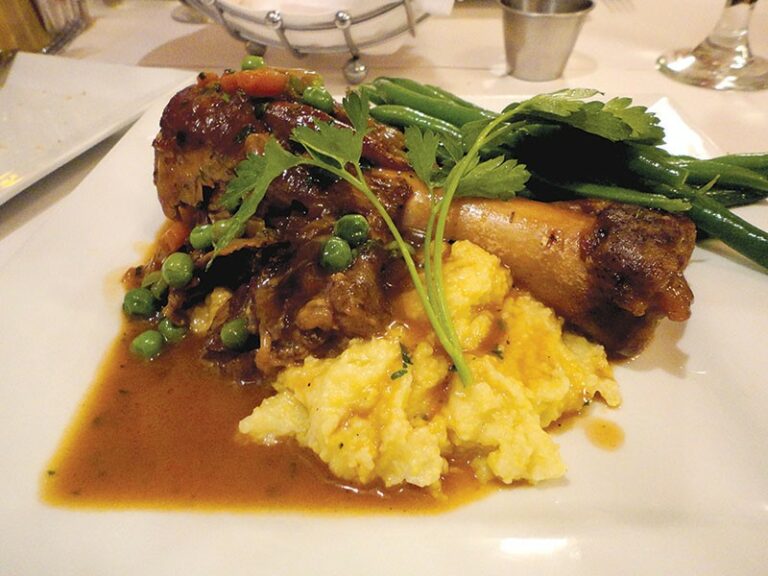
In characteristically optimistic fashion, Gomez used the experience to refine his Hollandaise sauce and master the art of cooking breakfast for a large volume of people, skills which have come in handy at Corks, where the brunch menu is classic and unpretentious. An assortment of salads balance out the meatier offerings, which include grass-fed steak and eggs ($19) and Ruben’s Reuben ($15), with house-made smoked pastrami, house-made sauerkraut and Sriracha remoulade.

The smoked salmon and asparagus Benedict ($16.75) comes with a generous helping of each, and showcases Gomez’s rich, silky Hollandaise. Another unexpected treat is the smoked chicken tinga salad tostada ($14.50). Inspired by his grandmother’s repurposed leftover Thanksgiving turkey, Gomez’s creamy chilled chicken salad blends notes of citrus and chile that pair well with a side of peach salsa. The simplicity of fresh scones (a basket of three for $5)—plumped with sweet dried cherries and slivers of almonds—cannot be beat.

Corks is especially delightful in the honeyed light of late summer. Down at the edge of the vineyards, giant sunflowers bow their regal heads. The tasting “room” (a portable table and chalkboard) is set up in the redwood grove, presided over by a giant unicorn statue whose stained glass horn catches the sunlight. At dusk, diners can watch one of Sonoma County’s largest bat colonies swoop outside in search of their own dinner.

And in the kitchen, chef Ruben Gomez garnishes his plates with fresh-picked red radishes. The artist is at work again.

Texas Turmoil

0

The Marin Shakespeare Company has a hit on its hands with the original musical adaptation
A Comedy of Errors, by playwright-directors Robert and Lesley Currier. Based on Shakespeare’s rambunctious play (Willy’s version starts with “The” instead of “A”), this adaptation is silly, sexy, fluffy and funny.

The Curriers take the basic plot of the original—along with portions of Shakespeare’s distinctive text—and blend it with wide swaths of fresh dialogue, outrageously tweaked lines and several clever new songs by Leslie Harib, which are employed to replace some of the Bard’s complexly textured exposition and labyrinthine proclamations.

Running in repertory with Shakespeare’s dark romantic comedy All’s Well That Ends Well, the musical version of Errors takes the action originally set in the ancient town of Ephesus and moves it to Texas, transforming the characters into cowboys, rodeo clowns, gun-slinging sheriffs, Wild West madams, Jewish-Indian medicine men and square-dancing town-folk, all of whom burst into song or occasionally pick up instruments to sit in with the onstage orchestra.

The story is essentially the same as Shakespeare’s, itself adapted from the works of Plautus. A road-weary stranger (Jack Powell) from the town of Amarillo arrives in Abilene, where, he discovers, people from Amarillo have been outlawed. Sentenced to die, he earns pity from the sad tale of his life.

Once married with two identical twin boys, both named Antipholus, he and his wife essentially adopted two other twin boys, both named Dromio, but a terrible sandbar accident on the Mississippi resulted in the stranger’s wife being swept away, along with one infant Antipholus and one infant Dromio. He raised the other pair, who set off years ago to find their brothers, never to return.

Given till sundown to find his sons, the stranger is set free.

In Abilene, one now-grown Antipholus (an excellent Patrick Russell) and one of the Dromios (a rubbery Jonathan Deline) are reasonably respected members of the community. When the other set of twins stumbles into town (also played by Russell and Deline), an escalating series of mistaken identities, near seductions and disastrous misunderstandings takes place.

As staged by the Curriers, the tale is rich with hilarious bits and even a few truly sexy-sweet moments, as the out-of-town twins discover their true histories, and maybe even find love in the process.

It’s not quite Shakespeare, but it’s a whole heap of fun.

Rating (out of 5): ★★★½

Slice of Sunpie

0

King of Rock and Roll. King of Pop. And now, King of Zydeco?

Recently, some have suggested crowning Bruce “Sunpie” Barnes the new king of zydeco music. Now, that would certainly be a shame, because it would restrict him to playing only one type of music—when he’s so good at many more. “His music reflects the whole New Orleans ‘gumbo’ idea of all the cultures colliding,” says Sebastopol Cajun-Zydeco Festival chairman Scott Hensey. Sunpie and the Louisiana Sunspots headline the 18th annual festival this weekend.

Sunpie’s versatility includes zydeco, blues, Creole, Caribbean, rock, gospel, jazz and more. “I call it Afro-Louisiana music,” he says over the phone. He tells stories, as music is intended to do, and “one of the best ways history is told is through the music of people,” he says. “They’re going to tell their history honestly through music.”

Barnes, a renaissance man whose life experiences infuse his New Orleans music, plays accordion, harmonica and a handful of other instruments with the group he’s been with since the early ’90s. But his full-time job is that of a park ranger at New Orleans Jazz National Historical Park. In that capacity, he’s made five CDs, including one for children with a park ranger in Colorado, and a book, due in November, designed to teach kids about New Orleans jazz. He’s a bona fide scientist, too, studying fish in parks across the country.

Barnes also works with kids as the chief of the Mardi Gras group the North Side Skull and Bone Gang. The tradition, which dates back some 200 years, involves dressing up in handmade skeleton costumes (with masks) and waking the spirits at the crack of dawn on Fat Tuesday. “We come out there and bring all those spirits back to life,” says Barnes. Three Skull and Bone songs in Creole figure on the new Louisiana Sunspots album, Island Man. “I like to keep that aspect of the real culture and music alive,” says Barnes.

With his outsized personality, Sunpie appears regularly in films and documentaries, not to mention several appearances in the HBO series Treme. His music decorates the soundtracks to about a dozen films, too. In addition, Barnes is a former All-American college football player, and also did a stint in the NFL for the Kansas City Chiefs.

“Also,” “too,” “in addition”—these words and phrases are sprinkled throughout any article about Barnes like sugar on beignets. With so many passions, how does he choose what to focus on? The short answer is, he doesn’t.

As the reluctant King of Zydeco says: “I have a passion for life. Period.”

Letters to the Editor: September 3, 2013

The Book of Right-On

The Green Center was wise to bring Rick Bartalini on board. He is a talented, innovative, true professional who will bring a whole new level of excitement to this beautiful venue!

Petaluma

Bridges & Balloons

It’s typical of Caltrans and the MTC, throwing themselves an elitist invitation-only party to celebrate the new Bay Bridge. These are the same fools who helped drive up the costs from $1.6 billion to $6.4 billion and delayed the construction all these years. Notice that the public who paid for the bridge and the rank and file workers who built it were not invited.

Lagunitas

Inflammatory Writ

President Barack Obama has threatened to bomb targets in Syria because Syria’s president Bashar al-Assad has used illegal chemical weapons on civilians. The Peace & Justice Center is taking a stand against military intervention, because we believe that violence begets violence. Others are calling for U.N. verification of the Syrian government’s role in the massacre. We are against bombing even if there is verification. Others are saying that a bombing cannot take place without congressional consent. We are against bombing even if there is congressional consent.

Of course, the Peace & Justice Center cares whether President Obama commits the “supreme international crime,” established since Nuremberg, if the United States bombs Syria without U.N. approval. Of course, we care whether President Obama violates Article 1, Section 8, Clause 11 of the U.S. Constitution. But we also believe firmly that killing always begets more killing.

We also believe that the United States has no moral grounds for this action in light of its use of the atom bomb, Agent Orange, white phosphorous, napalm, depleted uranium, landmines and cluster bombs. In fact, the Uniated States refuses to sign treaties banning some of these weapons. As for chemicals that kill? The Obama adminstration has few objections if they come from fracking, the tar sands, GMOs, chemicals in our food and so many other potentially deadly components of modern industrialized life. In fact, a number of their purveyors hold high positions in that administration. But war itself, chemical weapons or not, is “a moral obscenity.”

Though hypocrisy over decades of foreign policy makes it difficult for the United States to be considered an honest broker, we ask President Obama to work to bring all parties—particularly the nations supporting the various factions—to the table to work out a ceasefire.

It is time to stop seeing killing as the most viable option. It is time to stop putting U.S. interests over the interests of other people and countries. Say no to military intervention in Syria.

Peace & Justice Center, Santa Rosa

Have One on Me

Here we go again, another well-connected politician getting special treatment! The second delay in formal charges against Efren Carrillo has all the makings of a backroom deal. Why do you think Carrillo is allowed to run free for six more weeks? His “supporters” (i.e., Doug Bosco, owner of the Press Democrat) likely needed more time to concoct a story, or they’re gathering dirt to smear the victim. Meanwhile, Carrillo shows up to work at the board of supervisors and reads a written statement from paper, claiming that his arrest has nothing to do with his work representing the public. He was in his underwear after terrorizing a woman at 3am! Any other county employee would be handed his walking papers. Instead, Efren is handed another month to get his story straight. Shameful.

Cotati

Good Intentions Paving Company

In a listing in last week’s Fall Arts issue, we implied that musical genius Brian Wilson would be part of the band when the Beach Boys play at the Wells Fargo Center on Sept. 7. As much as we’d like to see noted Dodgers fan Mike Love patch things up with his former band mate, Brian Wilson is not, in fact, part of the touring group.

Hoist Up the John B. Sail

Write to us at le*****@******an.com.

After the Courtship

We get films of nostalgia or films that critique the past, but very few that do the same thing at the same time.

Thérèse is the late Claude Miller’s adaptation of Francois Mauriac’s Thérèse Desqueyroux, filmed some 50 years ago by Georges Franju. Then, Emmanuelle Riva (Amour) played Thérèse, “an Emma Bovary who strikes back,” as Franju said at the time. Eerily, there is a noticeable physical resemblance between Philippe Noiret in the Franju version and the very good Gilles Lellouche, here as Thérèse’s stuffy propertied husband Bernard, whose only indication of his having a heart is persistent angina.

It’s the late 1920s. After an unspeakable honeymoon, Thérèse is impregnated. Her discontent grows after the child is born, her restlessness cinematically symbolized in images of forests containing valuable timber owned by their conjoined families—trees as dry as tinder and waiting for the spark of destruction.

In the lead role, Audrey Tautou may be a bit old for the virginal early scenes, but, realistically, she’s not a star because of eternal youthfulness. Tautou made the world fall in love with her in Amélie, and then commenced more ambitious work afterward. She’s quite a not-nice female antagonist: mean, grasping, disapproving, with no interest in sex because “my head is too full of ideas.” But this isn’t a desiccated movie; it’s more of a cold-fusion version of Bette Davis in rebellion (Beyond the Forest, with its pines and its blazing kiln, comes to mind).

Some have dismissed Thérèse as Masterpiece Theater, and the framing is often televisionistic; it’s likely Thérèse Desqueyroux would never be popular cinematic material, even though it’s more tangy than dusty. But Tautou’s precision lures the viewer. With her impassive black eyes, bobbed hair and air of callousness, Tautou’s real skills show in the transformation, and in her death-warmed-over scenes close to the finale.

‘Thérèse’ opens Friday, Sept. 6, at the Rafael Film Center in San Rafael.

Mouthwatering Memories

0

For many, the most important room in the home is the kitchen. And for some, it’s also their hands-down favorite room. This week, the Sonoma Valley Museum of Art opens an exhibition that’s a gold mine for the latter group.

“Kitchen Memories: Kathleen Thompson Hill Culinary Collection” showcases over a thousand gizmos, gadgets, catalogues and cookbooks from the past century or so. Hill, a Sonoma-based culinary writer, is a collector of the estranged bits of cooking ephemera, and this impressive display represents merely a fraction of her collection. No less then 20 different egg beaters—hand-cranked, of course—are on display, and potato mashers of every style imaginable, including wooden mortar and pestle. Several species of graters, mandolin slicers, weird, unsafe-looking toasters and specialized tools are included. Don’t get me started on rolling pins—who would have thought there are better ways of flattening dough than a floured-up wine bottle? But apparently there are dozens of better ways. Go figure.

“Kitchen Memories” is on display
Sept. 7–Dec. 1 at the Sonoma Valley Museum of Art. Hill speaks in conversation with
food reporter Elaine Corn Sept. 7 at 2pm.
551 Broadway, Sonoma. 707.939.7862.

The History of Thinking

0

Entering Mark Perlman’s West County home is like entering a small art gallery. His own large, luscious abstract canvases—clothed in the signature encaustic wax that both forbids and beckons examination—hang everywhere. Complemented by delicate sculpture encased in plastic vitrines and serene flower arrangements, there is plenty of work on the walls by former students.

Ready to retire this year from full-time duties as an art professor at Sonoma State University, Perlman characteristically celebrates his students rather than his quarter century of service as he dials down his academic life. The result is an exhibit, “25 Years, 25 Artists: The Painting Students of Mark Perlman,” opening at the SSU Art Gallery on Thursday, Sept. 5. A one-man homage to his own career follows on Nov. 7. Perlman grimaces briefly when a visitor suggests that this autumn is All Mark All the Time.

He’d rather focus on the careers he’s helped to foster during his tenure. Thinking over his 25 years at SSU, Perlman tidily chose 25 former students whose dedication and learning arc remain fresh in his memory.

“It’s a pretty diverse group,” Perlman says, settling down in his backyard studio, a barnlike structure bristling with works in progress that bears no resemblance to the tranquility of his home. “It wasn’t like I was looking for anything specific. So the work is all over the place: it’s realist, it’s abstract, it’s naïve—and I don’t think it’s an accident that every one of the 25 were probably the hardest working people who were there. They were there when I got there in the morning, they were there when I left at night. Their commitment pushed that.”

Not all of them became working artists; Perlman isn’t concerned. Rather, he looked for alumni who impressed him with the changes they underwent as they learned.

“I remember when some of them first came in and they were among the worst people in the class,” he laughs. “They were late for everything and not engaged. And then gradually seeing them grown into adults and become committed was so satisfying.”

While an undergraduate himself, Perlman was asked by a professor to fill in for two weeks, teaching the class while the teacher mounted an exhibit overseas. Perlman found that what he calls the “translation of ideas” appealed to him enormously.

“As I continued in school, I started to really respect my teachers and to see how they
were really serious painters and
it wasn’t just like a day job,” he says. “They had these two careers going. The idea of just painting, all day, by myself . . . The social interaction is just really a key element for me. I think I’d go nuts if I had tried to do this and, I don’t know, wait tables.”

It’s a safe bet that Perlman would never have to wait tables. His work is collected by a group ranging from the actress Halle Berry to the Hirshhorn Museum in Washington, D.C., to the Gap’s corporate offices to those at IBM.

Rigorously abstract, Perlman’s canvases have an irresistible dynamism to them that encourages the viewer to look and rest and look again. He speaks of the “history of thinking,” one he graphs afresh each time.

“While I’m painting,” he says, “I’m painting the moment, I’m trying to stay in the moment, and whatever is occurring to me is what I want in there. I also don’t trust my reaction to the initial marks. Sometimes they look clever or kind of fresh, but I know that I have to have those things historically underneath, and maybe the history will evolve and you’ll see the different layers of time as the painting evolves. That’s the hope.”

In fact, Perlman scrapes off almost as much paint as he puts on.

“I try to create systems that break down,” he says. “Everything seems to work within a system or code, and once I’m in there, I become very bored with the predictability of the system, and so like breaking that system down to see what evolves out of that.”

Within each frame, Perlman says he weighs beauty against awkwardness against destruction, all within the limits of line, form, composition and hue—the traditional constructs of a painting.

“I really like destruction,” he smiles. “I like those opposing forces, and I want to seduce myself into loving the painting somehow. Something that’s going to draw me or the viewer to it, but once there, I also want enough disturbance or things that aren’t working quite right to be presented as a challenge to offset the expectations, the predictability.”

Encaustic wax, a form of sealing the skin of a work that’s been used since the ancient Egyptians, was popularized in the last century by artists Jasper Johns and Brice Marden, but Perlman didn’t know what it was. He just liked it.

“I started using wax because I really wanted a contradiction between space and surface to be working,” he says. “I love surface, I love texture; I also love atmosphere and space, and I thought that I could only have one or another. And then I realized that this wax was transparent but also had a materiality to it, and so I thought I’d start working it into the paint.”

And while Perlman admired Johns’ and Marden’s work, he would never emulate it. He encourages his students to do the same.

“I’ve worked really hard to help them to find out who they really are,” he says. “What their voice is. It would be such a weird coincidence if their voice were the same as mine.

“I understand about apprenticeship, but I really think that since the dawn of the 20th century, it really is about the individual road that you have to travel.”

Hold It, There

The American-Arab Anti-Discrimination Committee calls on the Obama administration to exercise restraint and not take military action against Syria. As a civil and human rights organization, the ADC condemns the use of chemical weapons by any entity and agrees that such acts must not be tolerated.

The ADC recognizes the authority and the responsibility of the United Nations Security Council to deal with this violation of international law, and calls on all nations, including the United States, to encourage the Security Council to address this illegal and immoral act. Yet pulling the United States into another needless, purposeless and costly war is not in the best interest of the country or the region.

As the conflict in Syria continues, and the death toll rises, we continue our call for a peaceful negotiated resolution, which will allow for a transition to a unified, secular and democratic Syria. This transition must be achieved by respecting the principle of self-determination, and must be free of foreign intervention.

The ADC supports those working for a peaceful transition of the Arab world to a secular and democratic system, respecting the human rights, freedom of religion and dignity of all.

The popular uprisings in a number of Arab countries signify a historic quest for peoples living in these countries to secure protections for their civil rights and civil liberties, and to establish true democracy and the rule of law in their political and legal infrastructures. We believe in the futility of resorting to violence to achieve these objectives and condemn all efforts leading to sectarian or ethnic incitement and civil strife in any Arab country. This shift in Arab domestic politics will inevitably impact U.S. foreign policy in the relationship between these countries and the U.S.

We understand that the current conflict in Syria has given rise to a serious humanitarian crisis which has led to hundreds of thousands of refugees, and call on all peoples to ensure that those in immediate need are provided with adequate resources and aid.

Again, we ask the Obama administration to refrain from military action against Syria.

The American-Arab Anti-Discrimination Committee is a grassroots civil rights organization based in Washington, D.C.

Open Mic is a weekly op/ed feature in the Bohemian. We welcome your contribution. To have your topical essay of 350 words considered for publication, write op*****@******an.com.

Coursey Runs

0

Longtime Press Democrat writer Chris Coursey has announced a run for Santa Rosa City Council. The columnist and public-relations consultant, who was also a reporter for many years, has taken strong stances on transportation and environmental issues, and his columns have generally supported the SMART Train and annexation of Roseland. As a political candidate, he has ceased blogging and writing for the Press Democrat. “After a lot of thought,” he says, “I decided I can contribute more to this city as a council member than I have as a journalist.”

A resident of Santa Rosa for three decades, Coursey says his campaign will focus on infrastructure, particularly on the west side of 101, and city budget transparency, especially with public pensions.

Coursey has been dating county supervisor Shirlee Zane for two years.

ANOTHER DELAY FOR CARRILLO

Seven weeks after he was arrested outside a woman’s bedroom window wearing only underwear and socks, county supervisor Efren Carrillo remains uncharged. On Aug. 30, prosecutors delayed for a second time slapping the local politico with an offense, claiming several unnamed documents were still needed. Carrillo has been ordered to return on Oct. 11.

After responding to two 911 calls, police stated their belief that the supervisor was attempting sexual assault at 3am on July 13, noting that the woman’s window screen was freshly ripped and that Carrillo seemed drunk at the time. Soon afterward, Carrillo checked himself into rehab, admitting he struggled with binge drinking.

Carrillo’s latest blunder comes less than a year after he was arrested for fighting outside a San Diego nightclub. He was never charged.

Trader Joe’s

0

Everybody knows that Trader Joe’s has the best price on drinkable, cheap wine—the inimitable “Two Buck Chuck.” If you are in the fortunate position of being able to spend $10 or $12, however, the discount retailer’s house-branded “Reserve” wines offer value on a different level. Many are locally made by mid-sized Sonoma and Napa County wineries that sell similar wines for $30 and up. Which wineries? It’s not always easy to tell, but often there’s a wine manager on hand who’s actually tasted the product and can offer shoppers helpful suggestions—unlike almost every other chain supermarket or discounter that you can think of. Not to toot TJ’s horn too much. A recent sampling:

VINTJS Napa Valley Chenin Blanc ($5.99) Like those kitchen-sink white blends with Gewürztraminer and Sauvignon Blanc and what-all, but drier, this smells floral, sulfurous, with fresh banana, pear and nasturtium. Mixed review? It’s the one I saved to drink after tasting. Chill it, and nuke the frozen vegetable Pad Thai.

TJ’s Reserve 2011 Napa Valley Chardonnay ($9.99) Like lemon-scented furniture polish, i.e., expensive oak barrels, with a hint of roasted cashew nut bar snack and apple syrup—but not cloying. One might imagine that it was unloaded on “Joe” because it lacked mid-palate weight, but for $9.99 that’s splitting hairs. Bake a plate of mushroom appetizers and put on a rom-com.

TJ’s Grand Reserve 2012 Russian River Valley Pinot Noir, Lot #22 ($12.99) There’s a lot more to this than many a “cheap” Pinot. It benefited after being open a day. Toasted oak, allspice, dried raspberry, strawberry conserve and a light finish reminiscent of a Côte de Beaune-Villages. Is the vanilla in front of the weeds, or behind? Is that sarsaparilla or ginseng extract? It has me thinking, anyway, and that’s a job well done. Sip it in reverie and forget to make dinner.

TJ’s Reserve 2011 Dry Creek Valley Zinfandel, Lot #71 ($9.99) Plum and boysenberry syrup drizzled over cheesecake with graham cracker crust? Yes, please. With flavors and tannin knit together like a Merino sweater, and a sticky, lingering finish, this is a standup wine for sitting down and yakking with a friend long into the night. Doctor up a frozen pizza with extra sausage, Romano and broccoli florets, and you’re in business.

TJ’s Reserve 2009 Dry Creek Valley Cabernet Sauvignon, Lot #72 ($9.99) Leather bomber jacket and gothic fruits meet plain vanilla oak. It’s enduringly tannic, but how many shoppers are going to cellar this wine? Crème de cassis, cocoa powder, blueberry—drink the second day after opening, and it’s juicy enough.

Old & New Ways

'If I don't allow my cooks to play with all the crayons that we have in our coloring box, then what kind of a jerk am I?" Art metaphors, I'm quickly learning, come easily to Ruben Gomez, the new executive chef of Corks. So does humility. "It's not about me, it's about us," Gomez continues. "A kitchen is not something you...

Texas Turmoil

The Marin Shakespeare Company has a hit on its hands with the original musical adaptation A Comedy of Errors, by playwright-directors Robert and Lesley Currier. Based on Shakespeare's rambunctious play (Willy's version starts with "The" instead of "A"), this adaptation is silly, sexy, fluffy and funny. The Curriers take the basic plot of the original—along with portions of Shakespeare's distinctive...

Slice of Sunpie

King of Rock and Roll. King of Pop. And now, King of Zydeco? Recently, some have suggested crowning Bruce "Sunpie" Barnes the new king of zydeco music. Now, that would certainly be a shame, because it would restrict him to playing only one type of music—when he's so good at many more. "His music reflects the whole New Orleans 'gumbo'...

Letters to the Editor: September 3, 2013

The Book of Right-On The Green Center was wise to bring Rick Bartalini on board. He is a talented, innovative, true professional who will bring a whole new level of excitement to this beautiful venue! —Sheila Groves-Tracey Petaluma Bridges & Balloons It's typical of Caltrans and the MTC, throwing themselves an elitist invitation-only party to celebrate the new Bay Bridge. These are the same...

After the Courtship

We get films of nostalgia or films that critique the past, but very few that do the same thing at the same time. Thérèse is the late Claude Miller's adaptation of Francois Mauriac's Thérèse Desqueyroux, filmed some 50 years ago by Georges Franju. Then, Emmanuelle Riva (Amour) played Thérèse, "an Emma Bovary who strikes back," as Franju said at the...

Mouthwatering Memories

For many, the most important room in the home is the kitchen. And for some, it's also their hands-down favorite room. This week, the Sonoma Valley Museum of Art opens an exhibition that's a gold mine for the latter group. "Kitchen Memories: Kathleen Thompson Hill Culinary Collection" showcases over a thousand gizmos, gadgets, catalogues and cookbooks from the past century...

The History of Thinking

Entering Mark Perlman's West County home is like entering a small art gallery. His own large, luscious abstract canvases—clothed in the signature encaustic wax that both forbids and beckons examination—hang everywhere. Complemented by delicate sculpture encased in plastic vitrines and serene flower arrangements, there is plenty of work on the walls by former students. Ready to retire this year from...

Hold It, There

The American-Arab Anti-Discrimination Committee calls on the Obama administration to exercise restraint and not take military action against Syria. As a civil and human rights organization, the ADC condemns the use of chemical weapons by any entity and agrees that such acts must not be tolerated. The ADC recognizes the authority and the responsibility of the United Nations Security Council...

Coursey Runs

Longtime Press Democrat writer Chris Coursey has announced a run for Santa Rosa City Council. The columnist and public-relations consultant, who was also a reporter for many years, has taken strong stances on transportation and environmental issues, and his columns have generally supported the SMART Train and annexation of Roseland. As a political candidate, he has ceased blogging and...

Trader Joe’s

Everybody knows that Trader Joe's has the best price on drinkable, cheap wine—the inimitable "Two Buck Chuck." If you are in the fortunate position of being able to spend $10 or $12, however, the discount retailer's house-branded "Reserve" wines offer value on a different level. Many are locally made by mid-sized Sonoma and Napa County wineries that sell similar...
11,084FansLike
4,606FollowersFollow
6,928FollowersFollow