On the Heitz of Delicious

0

Among the words that may be used to describe makers of Napa Valley luxury wine, “moral” is not the first to pop up in the mind. But that’s how Eric Asimov, wine writer for the New York Times, characterized Heitz Cellar during a presentation of lesser-
known Napa Valley wines.

Heitz’s moral fortitude, as it were, is supplied by a little-known grape called Grignolino. Like most Napa Valley producers, Heitz is known best for Cabernet Sauvignon, particularly its Martha’s Vineyard. The fruit of a handshake deal between Joe and Alice Heitz and the May family, Martha’s was first made as a single-vineyard wine in 1966, and has been acclaimed as one of the top wines of the 20th century.

When Heitz Cellar was founded, in 1961, in what was basically a garage on Highway 29, the property came with eight acres of Grignolino that had been planted by one Leon Brendel. Called “the little strawberry” in Piedmont, Grignolino is enjoyed as an early-to-bottle table wine while the Nebbiolo ages.

Brendel’s 1949 wine label includes a logo with an index finger pointing upward above the motto “Only One” —it’s either curiously reminiscent of Dr. Bronner’s “All-One,” or a forerunner of the zany label trend of recent years. Throughout Napa Valley, oddballs like Brendel’s Grignolino, no matter how delightful, have been replaced with popular varietals like Cabernet Sauvignon.

The Heitz 2012 Grignolino is exotically aromatic, expressing the sweetness of flowering vines, the foxiness of wild grapes, and bright berry flavors. It’s both different and easy to like.

But is it moral?

“We don’t really see it that way,” says Harrison Heitz, a third-generation member of the family business. “It’s something we enjoy drinking.”

The rosé of Grignolino, Harrison says, was inspired by a particular demand: “My grandmother’s edict was, ‘It has to be ready by Easter!'”

The winery was relocated to the hills above the Silverado Trail in 1964. Opening the door to a pre-Prohibition stone cellar, Harrison shows off the hallowed place where Martha’s sleeps—and does it with an unstudied lack of flourish, like someone pointing out his grandfather’s tool shed.

The élevage program is unusual in this press-to-barrel era; Heitz stores new wine in old, upright wooden tanks for a year before transferring it to Limousin oak barrels. The current release is the 2009. Heitz keeps more than a decade of vintages in reserve, allowing buyers to enjoy an older wine like the 2005 Martha’s, with its warming, soft and integrated palate and hint of dried mint tea, without worrying about how it will age in their own possibly suboptimal cellaring conditions—the back of a kitchen cabinet, for instance.

A vineyard occupies a gently sloping bowl behind the winery. The yellow-green leaves budding out on this first day of spring belong to Grignolino. Because conditions are better for Grignolino up here, says Heitz, cuttings were brought to the home ranch for replanting. They have treated it with great care indeed—even if Heitz won’t admit to an obligation to preserve this varietal in California.

Cabernet is now planted beside Heitz’s public tasting room, where there is still no fee charged. “Like in the golden age of Napa,” says the tasting room host. “Walk up and taste it, buy if you like it.”

Perhaps Heitz has taken a moral stand, after all.

Splendor in the Jam-Grass

0

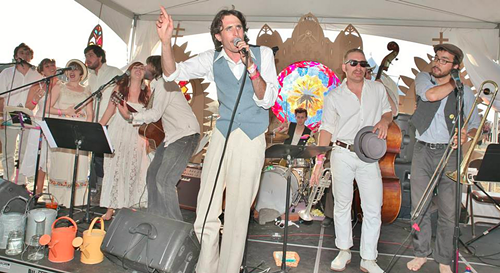
Leftover Salmon didn’t set out to be an influential trendsetter when they formed in Boulder, Colo., nearly a quarter century ago.

“It’s not like we positioned ourselves to be a jam band over a bluegrass band,” says guitarist and band cofounder Vince Herman via telephone. “We were just guys from ski towns trying to make a living. We managed to come out with something; I’m not sure what the title is. We call it ‘poly-ethnic Cajun slam-grass.'”

Nor was the Leftover Salmon sound calculated to appeal to fans who followed the members’ previous groups.

“When we first started doing this people were like, ‘Really, you guys play bluegrass with drums and electric instruments? Really? Who’s going to like that?”‘ says fiddle and mandolin player Drew Emmitt, the band’s other cofounder, in a separate phone interview.

It turns out a whole lot of people like it.

Formed in 1989, Leftover Salmon began expanding outside Colorado a few years later, developing an ever-growing legion of devoted followers who would turn up each time the band hit a town. They released their big-lable debut Euphoria in 1997.

By 2005, when the band went on a five-year hiatus, they had a national following and inspired dozens of bands to follow in their footsteps. Last year, Leftover Salmon (which currently includes bassist Greg Garrison, drummer Jose Martinez and banjo player Andy Thorn) worried some fans when they announced their plans to cut back on bus tours, months-long sojourns across the country, in favor of shorter, more focused runs.

“Our plan is definitely to cut back,” Emmitt says. But he adds fans shouldn’t be concerned about never seeing them; it just may be less often than in the past.

So how did the band come up with its unforgettable, perhaps regrettable, name? As 1989 turned into 1990, Left Hand String Band, a bluegrass outfit led by Emmitt, joined forces with jug band the Salmon Heads, led by Herman, to play a Boulder-area New Year’s Eve show. They needed a name quick, took parts from each band and— voilà—Leftover Salmon was born.

They didn’t expect the band or the name to last and had no clue that 24 years later they’d be hailed as the architects of jam-grass. “If we’d had any idea, we could have come up with a much better name,” Herman says. “We thought it was going to be one gig when we started. Now we’re stuck with it.”

He’s Somm-Body Special

0

As seen in the 2012 documentary Somm, within a minute of tasting, Ian Cauble could tell this much about a particular wine: “Aromas coming out are like this lime candy, lime zest, crushed apples, underripe green mango, underripe melon, melon skin, green pineapple. And the palate: wine is bone dry, really this, like, crushed slate, and crushed chalky note, like crushed hillside. There are white florals, almost like a fresh-cut flower, white flowers, white lilies, no evidence of oak. There’s a kind of a fresh—like a freshly opened can of tennis balls, and a fresh new rubber hose.”

He was spot-on with his description, and then correctly identified the wine: a 2009 Clare Valley Riesling. And this was before he became the 197th master sommelier in the world, and before he won the “world championship,” as he calls it, earning the title Top Young Sommelier in the World.

When Cauble began his education at Sonoma State University, he surely couldn’t have known he would become one of the youngest master sommeliers in history. He might not have known even when he graduated in 2003, with degrees in business administration and Spanish. But after working that summer at a vineyard in Chile, “he decided that drinking great wine and eating great food was what he wanted to do with his life,” says Shalyn Eyer of SSU’s School of Business and Economics.

Cauble speaks at a screening of Somm, with hors d’oeuvres paired with wine he has selected, on Friday, March 28, at the Student Center Ballroom at SSU. 1801 E. Cotati Ave., Rohnert Park. 6pm. $25. 707.664.2260.

Letters to the Editor, March 26, 2014

Smash Mouth Speaks

If I had to guess, I’d say [L38] are trying to be versatile for the sake of getting a whole big range of generations (“Bodacious Bottlerock,” March 19). A little something for everyone, know what I mean?

Have you ever seen us play? It’s a fun show, and we have fun with the crowd—well these days, anyway. Keep it real.

Via online

Thank You, Readers

Thanks a ton to the Bohemian for the recognition (“Best Of,” March 19). And congrats to the others noted here doing great work in the community in the area of food and drink.

The CropMobster team and our entire community appreciates this a great deal. The award sparks the next level of momentum for us, and we’ll keep working our tails off to do you proud.

Petaluma

Thank you, everyone, for giving us our fifth win for best bookstore in Marin! We are honored and thrilled to serve our community.

San Rafael

Textual Transgressions

Kudos to the Bohemian for the excellent article exposing the texts between Mr. Bosco and Mr. Carrillo, and for finally providing justification for what many of us have suspected all along—that there is, indeed, a cozy political relationship between the two (“The Telltale Text,” March 19). Personally, I found the text messages between them very disturbing, as they seem to call into question the very reason why the PD provided so much coverage on several aspects of the Andy Lopez story, and that is, in and of itself, quite sad.

There is no question that the Andy Lopez story overshadowed the sordid tale of Captain Underpants’ nocturnal transgressions and subsequent arrest emanating therefrom, if only for a relatively short time. But the text message that really turned my stomach was when Mr. Bosco congratulated Effie on his appointment to the board of Sonoma Clean Power. No one—and I mean no one—with whom I have spoken has voiced anything but criticism and derision for this terribly misguided appointment, which was made by chairman of the Sonoma County Board of Supervisors David Rabbitt, and now Mr. Bosco is congratulating Effie for this? Puh-lease!

I suppose we must look on the bright side, for if we have learned anything from this text-message thread it is that we now have been provided with unmistakable proof as to just exactly where the allegiances of some of our county’s movers and shakers lie. That is food for thought that I am having a hard time swallowing.

Via online

Support Medical Marijuana

When a loved one is in pain, wasting away unable to eat, and needs this marvelous herb in order to increase their appetite, reduce the overwhelming pain and live as healthy and happily as they can with the time they have left, let’s have the compassion to allow them to have it (“Pass the Dutchie,” March 19). Stop treating medical-marijuana patients like second-rate citizens and common criminals by forcing them to the dangerous black market for their medicine. Risking incarceration to obtain the medicine you need is no way to be forced to live. Support medical marijuana now!

Via online

Best Dept. of Corrections

Napa County’s winner for “Best Nonprofit,” Feast It Forward, listed in last week’s Best Of issue, is an organization connecting food lovers with charitable causes, though is not itself a nonprofit. Also, Sonoma County Honorable Mention winner for “Best Birthday Party Place,” Scandia Family Fun Center, contained an error in the contact information. Scandia’s phone number is 707.584.1398. We apologize for the errors.

Putting at the windmill

Write to us at le*****@******an.com.

Shadow of a Drought

0

Effects of the ongoing drought in California extend beyond shortening our showers and leaving rose bushes thirsty.

“We’re already doing price increases,” says Albert Straus, president of Straus Family Creamery. “I can’t see it coming down yet.” The company, which comprises eight dairies, has already experienced milk and cream shortages this year because of the drought. And Straus’ creamery is not alone.

Rex Williams, owner of Williams Ranch, says he had to sell 100 ewes to ensure there would be enough grass and water for the rest to live through the season. “This is huge,” Williams says. “I’ve heard the old timers tell stories [about the 1976–77 drought], but now I’m experiencing it.”

His flock, which totaled 389 ewes, is down to less than half that number.

California just experienced its third driest winter on record—and its hottest winter on record. Northwest California received just 12.6 inches of rain—3.3 inches less than the 1977 benchmark for the driest year on record.

Gov. Jerry Brown declared the drought an emergency, and the federal government has allowed a variance on grazing requirements for organic beef and dairy products. “Pasture is stunted, growing slower than normal,” says Straus, who started the first organic dairy in the western United States, in 1994. The variance, which loosens a 120-day pasture-grazing requirement, has helped, says Straus, but “it all depends on what happens with the rains going forward.”

The fact that cows aren’t grazing outdoors doesn’t affect the product in a noticeable way, says Straus, but it does increase demand for other feed sources. There is a lack of certified organic hay, which is used to supplement organic cows’ diet. “If you haven’t gotten a contract for hay [already], there’s nothing out there,” says Straus. The lack of hay has resulted in a price increase of about 50 percent, and if current conditions continue, Straus says the shortage could last another two or three years.

Jennifer Bice, owner of Redwood Hill Farm and Creamery, says she hasn’t been too worried about a lack of water; her company makes products with goat’s milk, and goats don’t drink as much as cows. But she is watching the Weather Channel these days for another reason. “Most hay is grown in the Central Valley,” she says. “If they’re even going to get the water to grow the hay, at the very least it’s going to be very expensive.”

Like most farmers, Bice feeds her animals hay to supplement the grasses and other plants consumed on the pasture. She has enough to last a few more months, but “this summer will be the telling tale,” she says. There aren’t many local sources, says Bice, because “when you can grow wine grapes and get $50 a bottle, you don’t want to grow hay.”

Ranches in wetter regions aren’t hit as hard by the drought, but are still feeling the effects. “Because of our location on the coast, we get a lot more precipitation than other places inland,” says Jocelyn Brabyn of Bodega Bay’s Salmon Creek Ranch. Their land is certified organic, but the animals aren’t, owing to technicalities in the certification process, says Brabyn. “The cows have not gone hungry thus far,” says Brabyn, “but we’ve had to get water trucked in for the ducks.” The cost of trucking-in water, she says, has been as high as $700 per month.

One major difference between meat and dairy cows is the amount of water they drink. A dairy cow, which needs more hydration to make more milk, can drink up to 50 gallons of water on a hot day. That means even if there is enough food, without more rain, dairies could face even more strain.

“It’s a lot worse than the ’76–’77 drought,” says Straus, whose farm was started by his father in 1941. Though the eight dairies in the Straus Family Creamery “have reported having enough water, filling ponds and reservoirs for the season to come,” Straus says he’d like to see more conservation statewide. “When I travel to Southern California, I don’t see any conservation there.”

State Assemblyman Marc Levine, D-San Rafael, has introduced a bill that would allow treated human wastewater for use with livestock. But farmers, including Williams and Straus, are skeptical. “The use of tertiary treated human wastewater for livestock is not tested and not approved,” says Straus. Even if it’s passed in the Legislature, he says, “I will not subject my cows and my customers to this potentially harmful method.”

Unmitigated Galway

0

At one end of the murder-prone Irish town of Leenane, in County Galway, 30-ish Maureen (Jessica Short Headington) lives with her insufferable mother, Mag (Lennie Dean), trapped in a mutually destructive cycle of abuse.

Meanwhile, elsewhere in the town, brutish brothers Coleman and Valene (real-life brothers Nick and Jon Christenson) alternate between battling each other for control of their deteriorating cottage and needling the local priest, Father Welsh (Clint Campbell), whose faith is in shambles, due to the generally poor spiritual life of his parishioners.

In The Beauty Queen of Leenane and The Lonesome West, two interconnected works by Martin McDonagh (now running in repertory at the 6th Street Playhouse), the underlying bleakness of the material is countered by a complex sense of dark comedy.

In Beauty Queen, gracefully directed by Bronwen Shears, Maureen’s sense of obligation has turned to bitterness. Mag openly baits her daughter with criticisms and petty demands, while secretly sabotaging Maureen’s every chance at having her own life.

Maureen’s big chance comes when snarky local youth Ray (Jay Maudlin) delivers news that his Uncle Patto (Chris Ginesi) is visiting from London, and when Patto shows up later, clearly smitten with Maureen, everyone recognizes that Maureen’s future happiness hangs in the balance.

Lonesome West, entertainingly directed by Ginesi, who takes a second stab at the play (following his production last year in Sonoma by Narrow Way Stage Company), has similarities to its companion play: dark humor, a sense of impending violence and a tendency among the characters to argue about which snack foods are better than others. The argumentative streak extends to flirtatious Girleen (Nora Summers), who even argues with poor Father Welsh, who she clearly has a thing for.

Though the accents are sometimes a bit muddy, and a key scene in Beauty Queen is staged in such low light its hard to tell what’s happening, there is much to engage in McDonagh’s beautifully crafted studies of familial love and anger. Strongly acted by two tightly knit casts, the stories are not always pretty, but will be as hard to dismiss as a whack on the head with a heavy object.

Rating (out of 5): ★★★★

Manoogian Rhapsody

0

I’d been told there’s a new winery somewhere on Occidental Road, and to look for the sandwich board. That’s all I know about Fog Crest Vineyard when I walk in, just in time to see a group of folks— “My first group!” tasting room manager Paula Minnis says—gathered under patio umbrellas, raising their glasses in a picture-perfect toast with a view of the Laguna de Santa Rosa and Sonoma Mountain completing the scene.

Staying largely behind the scenes, Fog Crest owners James and Rosalind Manoogian grant the spotlight to their new winemaker, Jérôme Chéry, who was schooled in the grape-juice way at the University of Burgundy in Dijon. Previous vintages were made by Daniel Moore and consultant David Ramey, whom Manoogian contacted specifically for his reputation for crafting a luxurious style of restaurant-wine-list-friendly Chardonnay.

Instead of pushing a silly origin story about how their tradition of winemaking began with some grandfather from the old country stomping grapes in his basement—it’s likely that said grandfather had more gainful business to attend to—the Manoogians simply explain that after James Manoogian ran a South of Market restaurant called Limbo around 1989, they headed up here and planted grapes in 1998. Both are involved in the day-to-day business. The smartly outfitted little crushpad and winery was built in 2008, while the Mediterranean-style tasting room was put on hold for better times, and completed in time for the 2014 opening.

A flick of a switch warms the room with a gas-fired hearth, designed by Bohemian Stoneworks. For now, the place smells like brand-new furnishings, but even that doesn’t overpower the 2011 Estate Chardonnay’s ($39) heady buttered-popcorn aroma. But there’s more going on with this wine: a hint of greens wrapped in caramel-apple cotton candy, with gentle acidity at the center and a savor of olive pit on the finish. Showy, but not shallow.

The 2010 Elevage Chardonnay ($39) and 2011 Laguna West Chardonnay ($29) are dialed down a bit, bringing to mind linens, pear fruit and, again, olive pit. The 2011 Laguna West Pinot Noir ($39) falls in the camp of pretty and agreeable Pinot, with bright red cherry, vanilla and crisp, dry cranberry-cherry flavors. The 2011 Estate Pinot Noir ($49) shows a little more flair: bourbon vanilla bean and cherry syrup, bright and dry.

“First Friday” wine and cheese evenings start April 4. The site is blink-and-you-miss-it on Occidental Road; look for the sandwich board.

Fog Crest Vineyard, 7606 Occidental Road, Sebastopol. Daily, 11am–5pm, June–November; Thursday–Monday, 11am–5pm, December–May. Tasting fee, $10 (waived with purchase). 707.829.2006.

Jimmy Carter’s Calling

0

For a president often accused of weakness during his four years in office, Jimmy Carter rarely shies away from conflict these days.

Working in a diplomatic capacity through his nonprofit Carter Center, the peanut farmer from Georgia has undertaken peacekeeping missions to troubled global hotspots like North Korea, Haiti and Africa, helped negotiate the 2003 Geneva Accord between Israelis and Palestinians, and built houses in Vietnam in 2009 (he’s also built houses throughout the United States through Habitat for Humanity). And he has taken U.S. policy and policymakers to task, condemning federal surveillance programs and drone strikes undertaken by the Obama administration.

Carter devoted his life to enhancing human rights and working toward world peace after his single term as president ended in 1981. In that time, he’s written almost two dozen books. His latest, A Call to Action: Women, Religion, Violence, and Power, covers women’s rights worldwide. Carter bluntly addresses religious and social constructs that stand in the way of equality for many women and encourages leaders and citizens alike to join together and end these abuses of power. And he encourages you to come to his book signing. He’ll sign copies of A Call to Action on March 29,
at Book Passage, 51 Tamal Vista Blvd.,
Corte Madera. 4pm. $30 (includes book). 415.927.0960.

North by North Bay

0

Spring has sprung in the North Bay, bringing the promise of sunny skies and blooming flowers. That’s all well and good, but some of us would still rather get out of the allergy swarm and spend the day in a dark theater watching movies.

Fortunately, spring also ushers
in film-festival season, with everything from classic Hitchcock heart-stoppers to revealing documentaries. Here are some must-see hits at four separate festivals.

Bringing independent films and filmmakers to independently minded west Sonoma County since 2007, the Sebastopol Documentary Film Festival (www.sebastopolfilmfestival.org) runs March 27–30 throughout town, and boasts over 70 films covering a wide range of topics. Highlights include the spirited Man Behind the Throne, following behind-the-scenes superstar choreographer Vincent Paterson, and Expedition to the End of the World, which follows a band of Danish sailors traveling above the Arctic Circle in three-mast schooner. Many screenings will have the filmmaker on hand, and the most interesting of these might be Mirage Men, with an appearance by director John Lundberg, which explores the government’s role in the UFO phenomenon.

Recently, news of a remake of director Alfred Hitchcock‘s classic thriller The Birds surfaced on the web with the mindless Michael Bay attached to produce. While that shudder travels down the spine, take heart that what film critic David Thomson called Hitchcock’s “last unflawed film” can still be seen on the big screen.

This year, Bodega Bay’s Hitchcock Film Festival (www.visitbodegabayca.com) shows The Birds March 29, opening a trio of Hitchcock’s best alongside Shadow of a Doubt, filmed in Santa Rosa, and the director’s most well-known masterpiece, Psycho. See all three if possible, but make sure to get there early to catch The Birds in all its suspenseful goodness before modern Hollywood mucks up another classic.

Now in it’s 17th year,
the Sonoma International
Film Festival (www.sonomafilmfest. org), happening April 2–6 in and around Sonoma Plaza, is always good for celebrity sightings along with its array of soon-to-be-hit films. Opening-night’s Dom Hemingway, starring Jude Law as a tough–as-nails safecracker, is already receiving attention for Law’s performance. Also featured is Half of a Yellow Sun, a dramatic telling of the Nigerian Civil War of the late 1960s, starring Thandie Newton (Crash) and Chiwetel Ejiofor (12 Years a Slave), that’s earning praise for its evocative exploration of class and cultural struggle.

Known as the “United Nations of film festivals,” the Tiburon International Film Festival
(www.tiburonfilmfestival.com), runs April 10–18 at the Tiburon Playhouse Theater. Two films this year in particular contrast the rural world with the modern urban one. From Kazakhstan, Little Brother is the story of a young boy in a remote village left to live on his own after his older sibling leaves for the city. And from South Korea, Sweet Corn is about an old-fashioned farmer whose son leaves to work for the newly built hotel just as the crops come under threat.

On the Heitz of Delicious

Among the words that may be used to describe makers of Napa Valley luxury wine, "moral" is not the first to pop up in the mind. But that's how Eric Asimov, wine writer for the New York Times, characterized Heitz Cellar during a presentation of lesser- known Napa Valley wines. Heitz's moral fortitude, as it were, is supplied by a little-known...

Splendor in the Jam-Grass

Leftover Salmon didn't set out to be an influential trendsetter when they formed in Boulder, Colo., nearly a quarter century ago. "It's not like we positioned ourselves to be a jam band over a bluegrass band," says guitarist and band cofounder Vince Herman via telephone. "We were just guys from ski towns trying to make a living. We managed to...

He’s Somm-Body Special

As seen in the 2012 documentary Somm, within a minute of tasting, Ian Cauble could tell this much about a particular wine: "Aromas coming out are like this lime candy, lime zest, crushed apples, underripe green mango, underripe melon, melon skin, green pineapple. And the palate: wine is bone dry, really this, like, crushed slate, and crushed chalky note,...

Letters to the Editor, March 26, 2014

Smash Mouth Speaks If I had to guess, I'd say are trying to be versatile for the sake of getting a whole big range of generations ("Bodacious Bottlerock," March 19). A little something for everyone, know what I mean? Have you ever seen us play? It's a fun show, and we have fun with the crowd—well these days, anyway. Keep...

Shadow of a Drought

Effects of the ongoing drought in California extend beyond shortening our showers and leaving rose bushes thirsty. "We're already doing price increases," says Albert Straus, president of Straus Family Creamery. "I can't see it coming down yet." The company, which comprises eight dairies, has already experienced milk and cream shortages this year because of the drought. And Straus' creamery is...

Unmitigated Galway

At one end of the murder-prone Irish town of Leenane, in County Galway, 30-ish Maureen (Jessica Short Headington) lives with her insufferable mother, Mag (Lennie Dean), trapped in a mutually destructive cycle of abuse. Meanwhile, elsewhere in the town, brutish brothers Coleman and Valene (real-life brothers Nick and Jon Christenson) alternate between battling each other for control of their deteriorating...

Best of 2014: Back to the Future Video

Bohemian "Best Of Winners 2014" from jon lohne on Vimeo.

Manoogian Rhapsody

I'd been told there's a new winery somewhere on Occidental Road, and to look for the sandwich board. That's all I know about Fog Crest Vineyard when I walk in, just in time to see a group of folks— "My first group!" tasting room manager Paula Minnis says—gathered under patio umbrellas, raising their glasses in a picture-perfect toast with...

Jimmy Carter’s Calling

For a president often accused of weakness during his four years in office, Jimmy Carter rarely shies away from conflict these days. Working in a diplomatic capacity through his nonprofit Carter Center, the peanut farmer from Georgia has undertaken peacekeeping missions to troubled global hotspots like North Korea, Haiti and Africa, helped negotiate the 2003 Geneva Accord between Israelis and...

North by North Bay

Spring has sprung in the North Bay, bringing the promise of sunny skies and blooming flowers. That's all well and good, but some of us would still rather get out of the allergy swarm and spend the day in a dark theater watching movies. Fortunately, spring also ushers in film-festival season, with everything from classic Hitchcock heart-stoppers to revealing documentaries....
11,084FansLike
4,606FollowersFollow
6,928FollowersFollow