Lexicographer

The most insightful part of Douglas Gayeton’s new book, Local: The New Face of Food and Farming in America (Harper; $34.95), might be the afterword, where he discusses the unfortunate fate of the term “climate change”: “What we can’t comprehend, we avoid. We tune out. Call it climate fatigue.”

That sort of fatigue encompasses many hot-button issues, including our food supply, the production of which is inextricably linked with climate change. It takes time, energy and discipline to stay on top of this stuff, especially when the rhetoric is all about fear.

And I’m tired of people telling me to be afraid of food. Even when fear is grounded, there’s only so much we can get out of it. It inflames our passions quickly, but exhausts them just as fast. Enter Local, part of a multi-platform project called the Lexicon of Sustainability.

The project is about hope, locality, and ordinary people taking action on large and small scales. The idea is that words come before actions. As Gayeton writes, “words illuminate.” Creating a shared language of terms—”a real food dictionary”—educates consumers so they know what they’re eating and who ultimately benefits from the money they spend.

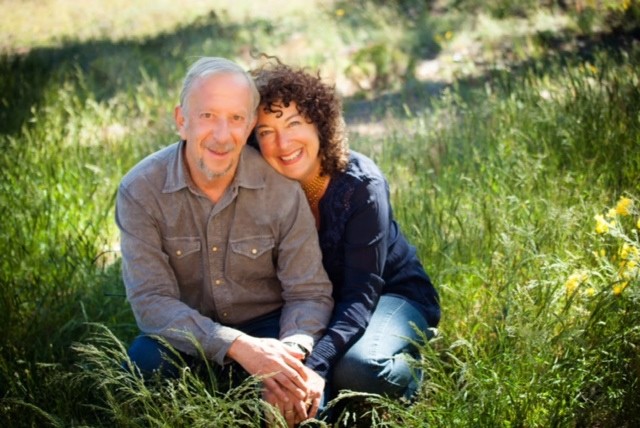
Gayeton, a Petaluma resident and multimedia artist, cofounded the Lexicon with his wife, Laura-Howard Gayeton (North Bay residents may have some familiarity with Laloo’s, her goat’s milk ice cream company). He traveled across America, interviewing and photographing farmers, scientists and entrepreneurs in both urban and rural environments to learn more about how they generate abundance using sustainability. The result, documented in Local, is a growing bank of over 200 terms, each illustrated with a colorful photo collage overlaid with Gayeton’s folksy handwriting.

These “information artworks” are dense with color and words, as saturated as a modern-day Book of Kells, but the general idea comes across pretty quickly. For instance, “cage-free” only means the poultry was not raised in a cage; it says nothing about how it was raised (most likely crowded and indoors, as it turns out).

You can also see the information artwork on the Lexicon of Sustainability website, and watch the series of short “Know Your Food” videos. The book is advantageous because it’s a bit stickier; you can read it in bed, peruse over it at breakfast and leave it out for friends to flip through. It’s interesting to see how different bits and pieces shine in each medium, even though they essentially use the same content.

The Lexicon collects the terminology of both boutique food producers (“heritage breed”) and social justice (“food security”), allowing them to coexist on the pages of Local without the antagonistic attitudes that flourish around the difference between the haves and have-nots.

This is something I struggle with, especially with the food-rescue nonprofit I work with in my own community. Is it better to focus the organization’s resources on delivering our clients the finite fresh produce grown in our community gardens, or recovering massive amounts of sugary day-old pastries? The pastries feed more people, but the homegrown tomatoes and sweet corn generate more positive comments than anything else we deliver. There’s value in both actions.

This kind of small-scale, daily activism isn’t for a cultural elite. It’s not just for people who have time to garden or know the difference between a turnip and a daikon. And it’s not just for rich, middle-aged white people. (It’s nice to see different shades of brown skin, as well as teenagers and seniors, in the book.)

Gayeton’s emphasis isn’t on what we’re against, but what we’re all for. Pleasure, not guilt, is the point. There are no ominous synthesizer chords scowling in the background of the “Know Your Food” films. In Local, Gayeton playfully refers to what I assume is Monsanto and their agribusiness cohort as “the companies that must not be named.” It’s not only OK to receive pleasure from cultivating food on small urban plots or spending what may seem to be an unreasonable amount on sustainably caught wild fish, it’s essential. As the saying goes, you attract more bees with honey than you do with vinegar—even if it’s unfiltered vinegar made from the cider of pesticide-free Gravenstein apples. If you’ve been paying attention to the news, you know we all need more bees.

We can end with the beginning of Local: “After reading this book, please give it away. You’ll know who it’s for,” writes Gayeton in the introduction. I want to give it to my crunchy hippy friends, and my arty design friends. But also my friends who sneer at the farmers market but are happy to spend $12 on breakfast at Denny’s. Or people just like me, who buy those damnable pizzas at Trader Joe’s even though they come in frozen all the way from Italy. As it turns out, we can all use illumination. Even people who are already enlightened.

Live Review: Huichica Music Festival (with Photos)

Kelley Stoltz at Huichica 2014

Nestled in the Sonoma Valley’s beautiful Gundlach Bundschu Winery, the 2014 Huichica Music Festival was highlighted by fine wine, warm weather and excellent music. Friday nights kick-off was a nice concert headlined by Vetiver, though Saturday was the real spectacle, with two stages hosting a dozen artists from the Bay Area and beyond. There were young up-and-comers, established favorites and even a few veteran folk artists for good measure. Click to read on and check out the photos below:

June 13: Greg King presents ‘The Ghost Forest’ at Jenner Community Center

0

redwoods.jpg

Writer and photographer Greg King first came to the old-growth redwood forests of Humboldt County in 1987, and soon after took up the fight against the clear-cutting that was quickly destroying the ancient trees. King’s family once owned the King-Starrett Mill in Monte Rio, one of the largest redwood mills in Sonoma County. He was instrumental in founding and preserving the Headwaters Forest, just south of Eureka, Calif., and has dedicated himself to protecting the redwoods and promoting their preservation. This week, King presents “The Ghost Forest,” a lecture on his life’s work and the issue of timber industry practices, on Friday, June 13, at the Jenner Community Center, 10398 Hwy. 1, Jenner. 7pm. $5. 707.865.2771.

June 14: Blue Rose Ball at Sebastiani Theatre

0

bluerose.jpg

The last time the Blue Rose, artist Stanley Mouse’s iconic image, made its appearance was on the poster for the farewell concert of the famed San Francisco ice-rink-turned-venue Winterland Ballroom at a show headlined by the Grateful Dead. This week, the Blue Rose image, and a host of talented musicians, many with Dead connections, appears for the first annual Blue Rose Ball, benefiting the Joseph Capone Scholarship Fund at the Old Adobe School. The Blue Rose Ball boasts a stellar lineup of performers, including Steve Forbert, Mark Karan, Josh Joplin, Jason Crosby and many others, and takes place on Saturday, June 14, at Sebastiani Theatre, 476 First St. E., Sonoma. 8pm. $100. 707.996.9756.

June 14-15: Novato Festival of Art, Wine and Music

0

Arfolicious

  • Afrolicious

This weekend, Novato goes all out in a free festival that hosts a wide range of artists and exhibitors. Multiple concert stages will see the likes of Afrolicious, Eric Martin, Crystal Bowersox and more throughout the day. Also on hand will be local and handcrafted art and jewelry from hundreds of artists, premium wine gardens, beer booths and good things to eat. The Novato Festival of Art, Wine and Music happens on Saturday and Sunday, June 14—15, along Grant Avenue, Novato. 10am both days. 415.897.1164.

June 15: Erik Jekabson and John Santos at Silo’s

0

erik_jekabson5.jpg

Trumpeter Erik Jekabson and drummer John Santos are North Bay institutions, each of whom has a loyal following and a career of exciting collaborations and experimental projects. This week, the two team up for a special afternoon concert that will explore diverse and engaging jazz. Jekabson’s quartet makes smart, post-bop jazz that’s both melodic and avant-garde. Santos is known for his Afro-Latin-jazz fusions and sharp drumming. Together, the two will push the boundaries of their talents for a day of music presented by the Napa Valley Jazz Society. The Erik Jekabson Quartet and John Santos perform on Sunday, June 15, at Silo’s, 530 Main St., Napa. 4pm. $20—$40. 707.251.5833.

Return of the NorBays!

The NorBays, the Bohemian‘s annual celebration of local music and all-around good time, is coming to Sebastopol’s HopMonk on Aug. 16.

We’ll be handing out gold record awards for the best bands in nine different categories of music, honoring the top talents in Sonoma, Marin and Napa counties. We’re also returning with another 24-Hour Band Contest.

Here’s how it works. Preliminary write-in voting for the NorBays is live now on bohemian.com. Tell us your favorite bands in genres ranging from folk to world to rock-and-roll. If you’re a band, tell your fans. If you’re a fan, tell your friends. The bands with the most write-ins go on to the final voting round on July 2. Voting ends July 23. The winners will be announced and awarded at the show.

As before, the 24-Hour Band Contest is taking sign-ups from all skill levels. Tell us who you are and what you play. On Aug. 15, we’ll pick names at random to form bands made up of complete strangers. You then have one earthly rotation to come up with two original tunes and perform them at the show the next night at the NorBays. Sign up now at bohemian.com and keep rockin’ in the free world.

Click here to vote for your favorite band and here sign up for the 24-Hour Band contest.

The 2014 North Bay Music Awards and 24-Hour Band Show happens Saturday, Aug. 16, at HopMonk Sebastopol, 230 Petaluma Ave., Sebastopol. $10 (all ages).

Who Is Levine?

0

Assemblyman Marc Levine sailed to an easy primary victory last week, earning what will almost certainly be a second term in the Sacramento statehouse. He’ll square off in November against Republican challenger Gregory Allen.

But Levine, who represents Marin and parts of Sonoma County, has peeved area progressives since he was first elected in 2012 after serving as a San Rafael city councilman.

In almost any other part of the country than hyper-liberal Marin and Sonoma, Levine’s positions on many issues would make him the most progressive pol on the block.

Yet detractors say he’s a prime example of a politician with excessive fealty to anti-environmental interests, a charge that stems in part from a vote he abstained from that would have granted the California Coastal Commission the right to levy fines on eco-violators without a court order. He had originally supported the bill.

Pulitzer Prize–winning journalist Gary Cohn argued in a well-traveled piece on capitalandmain.com that Levine embodies the California “corporate Democrat.”

Veteran progressive activist and media critic Norman Solomon, an occasional contributor to these pages who ran for Congress in 2012, says Levine is cut from the same cloth that elevated Jerry Brown to the governorship.

Solomon, who lives in Inverness and supported Diana Conti over Levine this year, says that “the Jerry Brown situation is part of a pattern that is replicated by Marc Levine. It’s seen as a winning approach—talk progressive and govern corporate centrist.”

Leo Wallach, a political consultant for Levine, roundly disagrees with the “corporate Democrat” tag and says the report was a “cooked-up hit piece on Marc.”

“I don’t think Marc likes labels,” he says, “but the accurate label would be ‘progressive independent Democrat.'”

Wallach says that label inspires some voters while making others nervous about Levine’s principles. “He didn’t take the interest-group path to Sacramento,” Wallach says. “He has progressive values and an independent approach.”

You might say the same of Brown, who also cruised to a primary victory last week and will face moderate Republican Neel Kashkari in November.

But in one critical way it is difficult to equate Levine as a sort of Mini Moonbeam beholden to corporate interests: Big Oil is the state’s largest and most powerful special-interest lobby. A recent California Common Cause study of the lobby’s influence found the oil and gas lobby, led by the Western States Petroleum Association, had spent nearly $15 million in 2013–14.

Levine has accepted zero dollars from the gas and oil lobby. By contrast, Brown has taken more than $2 million from the industry in recent years.

The “corporate Democrat” tag represents a curious evolution of descriptors, when you consider that a similar “new Democrat” designation was applied to Bill Clinton in 1992, when none other than Jerry Brown was seen as the great progressive antidote to Clinton-style centrism. Brown’s campaign that year was a model of pre-big money politics; he vowed to accept individual donations of no more than $100, and roared into the Democratic convention with hundreds of delegates in his camp.

Now the local media has taken to calling Levine a “new-style Democrat,” who has accepted contributions from various real estate interests, the California Chamber of Commerce and a hedge-funder or two.

But he has offered legislation that flies in the face of the “corporate Democrat” charge, says Wallach. The first bill Levine offered this session would have banned plastic shopping bags in big retailers. Opposed by the chamber, it petered out in the Assembly and Levine sent it to the “inactive file.”

Levine also played into the hands of the tax-and-spend-liberal crowd when he pushed a bill that would double fees on automobile registration to support fingerprint identification programs. It passed.

Critics of Levine point to his vote last year on a bill that set the stage for an expansion of fracking in the state. Levine had previously offered a bill of his own that would have put a moratorium on the practice, and says he still supports a moratorium. This year, the Press Democrat reported that a pro-fracking supporter paid for anti-fracking materials on his behalf, raising the ire of local progressives.

To opponents, the Coastal Commission non-vote was faux-progressivism of the worst sort. Yet Wallach says it signaled Levine’s deep-dive into the details of the bill, which, Wallach says, would have “created some bad incentives and unintended consequences” had it passed.

Wallach insists that Levine supported the principle driving the bill. “Some of these things are very technical, and it’s very important to have a legislator who is willing to look past the title of a bill.”

But the anti-Levine forces are not assuaged. U.S. Congressman Jared Huffman was one of numerous statewide Democrats to endorse him this year, a move Solomon calls “unconscionable.”

“Progressive independent Democrat” or company man? If reelected, Levine’s next term will be revealing.

San Francisco Quirk

0

‘This is a very busy time for me, shows opening all over,” enthuses Bay Area playwright Peter Sinn Nachtrieb, speaking from Wooly Mammoth Theater in Washington, D.C., where his newest show,
The Totalitarians, opened recently. “It’s a dark comedy,” Nachtrieb says of the sharp-witted political satire.

Of course, the phrase “dark comedy” pretty much describes everything Nachtrieb writes, including the offbeat T.I.C. (Trenchcoat in Common), opening this weekend at Main Stage West in Sebastopol.

Directed by Sheri Lee Miller, the play features Ivy Rose Miller as a teenage girl who starts a blog about the strange people who live in her San Francisco apartment building.

“It’s got every archetype of a Bay Area inhabitant you can think of,” says Nachtrieb. “I wanted to populate the play with lots of different types, people we don’t really know very much about, but who we see every day.”

Asked if his characters spring from his imagination or are suggested by real folks he’s actually encountered, Nachtrieb laughs.

“Well, I don’t know that many flasher-exhibitionists,” he allows, referring to one colorful character played by Gary Grossman. “That character did emerge out of my own head, but most of the other characters are suggested by people I’ve observed, people who just seem very serious, very single-minded and driven by different causes, though I don’t always know what those causes are.”

In the case of T.I.C., those “causes” take the story in some pretty unexpected directions, plunging our young protagonist into a weirdly funny, but potentially dangerous, world. As a playwright specializing in dark comedies, Nachtrieb knows he must maintain a very a careful balance between what is funny and what is “dark.”

“It’s that tension between the lighter moments and the darker ones that I really like exploring,” says Nachtrieb, who honed his skills writing for the beloved Bay Area comedy troupe Killing My Lobster. “My background is in writing sketch comedy, so the funny stuff is kind of my ‘sweet spot.’ With my plays, I always want to tackle serious issues, serious ideas, but it’s always through the lens of comedy, because that’s just how I see things.”

It has been pointed out that many of Nachtrieb’s characters are, for lack of a better terms, a little “inappropriate,” like the flasher in T.I.C.

“Yes,” he laughs. “And one thing I’ve found is that the characters who are the most fun to write, are the ones who are the most inappropriate.”

‘T.I.C. (Trenchcoat in Common)’ runs Thursday–Sunday, June 13–June 29 at Main Stage West. 104 N. Main St., Sebastopol. Thursday–Saturday, 8pm; 5pm matinees on Saturday and Sunday. $15–$25. 707.823.0177

Emphasize Eco

0

In the small town of Fairfax, community comes first.

This weekend’s Fairfax Festival presents a special focus on environmental issues, with the 10th annual Ecofest taking place both days, June 14–15. Fairfax has long set the standards for leading GMO-free campaigns and limiting large chain stores from sterilizing the economic and social landscape. Exhibitors from around Marin will be offering organic wine and beer, innovative environmental practices and interactive family fun that highlights the significant ways the community is moving toward sustainability.

Throughout the weekend, the festival offers food, wine, art and live music on multiple stages, featuring favorite local acts like Danny Click and Beso Negro; the live acts continue through the night in Fairfax’s vibrant downtown clubs. Saturday features the annual parade that draws out the entire town. This year’s grand marshal is Phyllis Gould, a veteran of the Sausalito shipyards during WWII à la “Rosie the Riveter.” The Friday before the festival also boasts Fairfax history night, held at the Women’s Club, that explores 100 years of colorful characters and iconic memories as well as fun film showings at Central Field.

The Fairfax Festival and Ecofest take place Saturday–Sunday, June 14–15, throughout downtown Fairfax. 10am–6pm. Free.
www.fairfaxfestival.com.

Lexicographer

The most insightful part of Douglas Gayeton's new book, Local: The New Face of Food and Farming in America (Harper; $34.95), might be the afterword, where he discusses the unfortunate fate of the term "climate change": "What we can't comprehend, we avoid. We tune out. Call it climate fatigue." That sort of fatigue encompasses many hot-button issues, including our food...

Live Review: Huichica Music Festival (with Photos)

Nestled in the Sonoma Valley's beautiful Gundlach Bundschu Winery, the 2014 Huichica Music Festival was highlighted by fine wine, warm weather and excellent music. Friday nights kick-off was a nice concert headlined by Vetiver, though Saturday was the real spectacle, with two stages hosting a dozen artists from the Bay Area and beyond. There were young up-and-comers, established favorites...

June 13: Greg King presents ‘The Ghost Forest’ at Jenner Community Center

Writer and photographer Greg King first came to the old-growth redwood forests of Humboldt County in 1987, and soon after took up the fight against the clear-cutting that was quickly destroying the ancient trees. King’s family once owned the King-Starrett Mill in Monte Rio, one of the largest redwood mills in Sonoma County. He was instrumental in founding and...

June 14: Blue Rose Ball at Sebastiani Theatre

The last time the Blue Rose, artist Stanley Mouse’s iconic image, made its appearance was on the poster for the farewell concert of the famed San Francisco ice-rink-turned-venue Winterland Ballroom at a show headlined by the Grateful Dead. This week, the Blue Rose image, and a host of talented musicians, many with Dead connections, appears for the first annual...

June 14-15: Novato Festival of Art, Wine and Music

AfroliciousThis weekend, Novato goes all out in a free festival that hosts a wide range of artists and exhibitors. Multiple concert stages will see the likes of Afrolicious, Eric Martin, Crystal Bowersox and more throughout the day. Also on hand will be local and handcrafted art and jewelry from hundreds of artists, premium wine gardens, beer booths and good...

June 15: Erik Jekabson and John Santos at Silo’s

Trumpeter Erik Jekabson and drummer John Santos are North Bay institutions, each of whom has a loyal following and a career of exciting collaborations and experimental projects. This week, the two team up for a special afternoon concert that will explore diverse and engaging jazz. Jekabson’s quartet makes smart, post-bop jazz that’s both melodic and avant-garde. Santos is known...

Return of the NorBays!

The NorBays, the Bohemian's annual celebration of local music and all-around good time, is coming to Sebastopol's HopMonk on Aug. 16. We'll be handing out gold record awards for the best bands in nine different categories of music, honoring the top talents in Sonoma, Marin and Napa counties. We're also returning with another 24-Hour Band Contest. Here's how it works. Preliminary...

Who Is Levine?

Assemblyman Marc Levine sailed to an easy primary victory last week, earning what will almost certainly be a second term in the Sacramento statehouse. He'll square off in November against Republican challenger Gregory Allen. But Levine, who represents Marin and parts of Sonoma County, has peeved area progressives since he was first elected in 2012 after serving as a San...

San Francisco Quirk

'This is a very busy time for me, shows opening all over," enthuses Bay Area playwright Peter Sinn Nachtrieb, speaking from Wooly Mammoth Theater in Washington, D.C., where his newest show, The Totalitarians, opened recently. "It's a dark comedy," Nachtrieb says of the sharp-witted political satire. Of course, the phrase "dark comedy" pretty much describes everything Nachtrieb writes, including the...

Emphasize Eco

In the small town of Fairfax, community comes first. This weekend's Fairfax Festival presents a special focus on environmental issues, with the 10th annual Ecofest taking place both days, June 14–15. Fairfax has long set the standards for leading GMO-free campaigns and limiting large chain stores from sterilizing the economic and social landscape. Exhibitors from around Marin will be offering...
11,084FansLike
4,606FollowersFollow
6,928FollowersFollow